

Badges to Acknowledge Open Practices: A Simple, Low-Cost, Effective Method for Increasing Transparency
Open accessPublished version of a preprint
The DOI matches its Crossref record; 19 of the 19 references it cites were found in a registry or an index.
Abstract
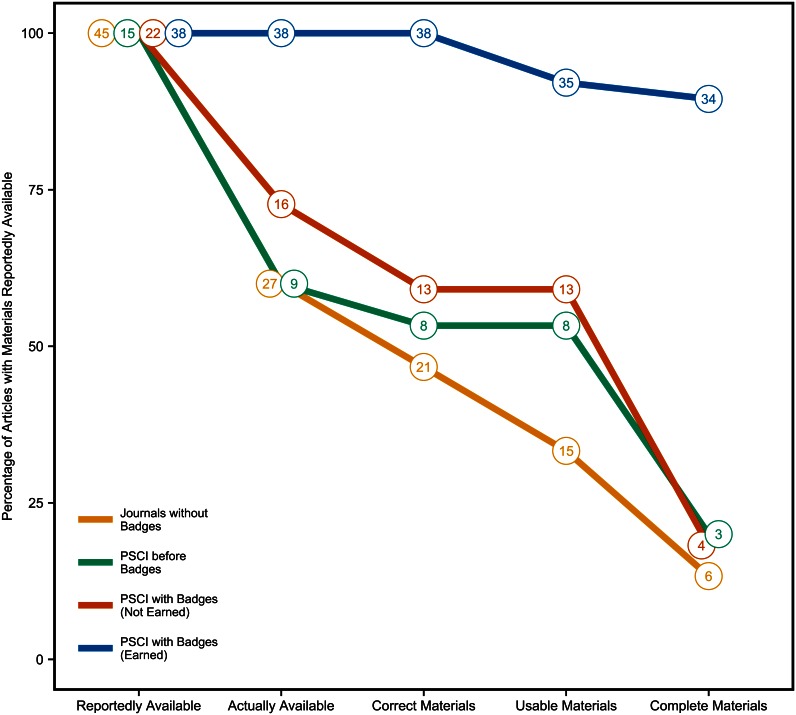
Beginning January 2014, Psychological Science gave authors the opportunity to signal open data and materials if they qualified for badges that accompanied published articles. Before badges, less than 3% of Psychological Science articles reported open data. After badges, 23% reported open data, with an accelerating trend; 39% reported open data in the first half of 2015, an increase of more than an order of magnitude from baseline. There was no change over time in the low rates of data sharing among comparison journals. Moreover, reporting openness does not guarantee openness. When badges were earned, reportedly available data were more likely to be actually available, correct, usable, and complete than when badges were not earned. Open materials also increased to a weaker degree, and there was more variability among comparison journals. Badges are simple, effective signals to promote open practices and improve preservation of data and materials by using independent repositories.
Overview
The claims and statistics of this paper haven’t been checked yet.
Free: it reads the open-access text and checks the first 5 claims that cite a source we can check. Create a free account to check every claim.
Integrity signals
Registry
Cites
Statistics
Figures


Verification
Claims the paper makes
The claims and statistics of this paper haven’t been checked yet.
Free: it reads the open-access text and checks the first 5 claims that cite a source we can check. Create a free account to check every claim.
Claims other papers make about this one
Each is checked against this paper’s own text: does it say what the citing paper says it does?
The source backs part of the claim, not all of it — or backs it for a different population, condition or comparison.
In the citing paper
“Poor distribution of labor and lack of task specialization may be part of the reason data and code sharing remain rare [48,54]”
From Open Science 2.0: Towards a truly collaborative research ecosystem (2023) · cites this paper as [54]
Experimental — accuracy not yet measuredThe source backs part of the claim, not all of it — or backs it for a different population, condition or comparison.
In the citing paper
“However, simply making data available does not guarantee that the data have utility: Kidwell et al. also observed that a substantial proportion (50/111, 45%) of reportedly available data was in fact not available or was incomplete, incorrect, or had insufficient documentation.”
From Data availability, reusability, and analytic reproducibility: evaluating the impact of a mandatory open data policy at the journal Cognition (2018) · cites this paper as [10]
Experimental — accuracy not yet measuredThe source backs part of the claim, not all of it — or backs it for a different population, condition or comparison.
In the citing paper
“For example, in an observational study examining the impact of a voluntary ‘open badges’ scheme at the journal Psychological Science, Kidwell et al. [10] found that the proportion of articles reporting available data increased from around 2.5% during the pre-policy period to 39.5% by the end of the post-policy period.”
From Data availability, reusability, and analytic reproducibility: evaluating the impact of a mandatory open data policy at the journal Cognition (2018) · cites this paper as [10]
Experimental — accuracy not yet measuredThe source backs part of the claim, not all of it — or backs it for a different population, condition or comparison.
In the citing paper
“Reproducibility badges adopted by several journals45 recognize stronger forms of reproducibility without penalizing authors who cannot yet reach them.”
From Designing reproducible large-language-model-assisted scientific analyses (2026) · cites this paper as [45]
Experimental — accuracy not yet measuredThe cited source says what the claim attributes to it.
In the citing paper
“They then studied what happened when the journal Psychological Science introduced the open data badge and found a substantial increase in the percentage of publications reporting open data [54].”
From Open Science 2.0: Towards a truly collaborative research ecosystem (2023) · cites this paper as [54]
5 more claims about this paper
Create a free account to see every claim other papers make about this one.
Self-check
Percentages, sums and reported differences re-computed from the paper’s own numbers.
The self-check needs the paper’s full text.
Citations
Cites
Spence, M. (1973) · The Quarterly Journal of Economics · doi:10.2307/1882010 · Cited by 19,518
Estimating the reproducibility of psychological science
Open Science Collaboration (2015) · Science · doi:10.1126/science.aac4716 · Cited by 8,515
Signaling Theory: A Review and Assessment
Connelly, B. L., Certo, S. T., Ireland, R. D., & Reutzel, C. R. (2011) · Journal of Management · doi:10.1177/0149206310388419 · Cited by 6,735
The Sociology of Science: Theoretical and Empirical Investigations
Kaplan, N., Merton, R. K., & Storer, N. W. (1974) · Technology and Culture · doi:10.2307/3102264 · Cited by 4,005
Promoting an open research culture
Nosek, B. A., Alter, G., Banks, G. C., Borsboom, D., Bowman, S. D., Breckler, S. J., Buck, S., Chambers, C. D., Chin, G., Christensen, G., et al. (2015) · Science · doi:10.1126/science.aab2374 · Cited by 2,708
Self-citationTHE SOCIOLOGY OF SCIENCE:: Theoretical and Empirical Investigations
Merton, R. Κ., & Storer, N. W. (2017) · Cited by 1,462
Nosek (2012) · doi:10.1177/1745691612459058 · Cited by 1,301
Recommendations for Increasing Replicability in Psychology
Asendorpf, J. B., Conner, M., De Fruyt, F., De Houwer, J., Denissen, J. J. A., Fiedler, K., Fiedler, S., Funder, D. C., Kliegl, R., Nosek, B. A., et al. (2013) · European Journal of Personality · doi:10.1002/per.1919 · Cited by 823
Self-citationThe poor availability of psychological research data for reanalysis.
Wicherts, J. M., Borsboom, D., Kats, J., & Molenaar, D. (2006) · American Psychologist · doi:10.1037/0003-066x.61.7.726 · Cited by 543 · cited 1×
“The key problem with “upon request” policies is that requests come after the researcher has completed the research, published the article, and lost or forgot detailed materials and data [9,11,16].”
BackgroundPromoting Transparency in Social Science Research
Miguel, E., Camerer, C., Casey, K., Cohen, J., Esterling, K. M., Gerber, A., Glennerster, R., Green, D. P., Humphreys, M., Imbens, G., et al. (2014) · Science · doi:10.1126/science.1245317 · Cited by 540
Self-citation
Research works printed but not linked: 1
- RK Merton, 1942, Science and technology in a democratic order, J of Legal and Pol Soc, 1, 115
Cited by
Items 301–400 of 736
Changing institutional incentives to foster sound scientific practices: One department.
Lundwall, R. A. (2019) · Infant Behavior and Development · doi:10.1016/j.infbeh.2019.03.006 · Cited by 15
An assessment of transparency and reproducibility‐related research practices in otolaryngology
Johnson, A., Torgerson, T., Skinner, M., Hamilton, T., Tritz, D., & Vassar, M. B. (2019) · The Laryngoscope · doi:10.1002/lary.28322 · Cited by 14
“This evidence-based incentive program is free to use for journals and organizations and has dramatically increased the rate of data sharing from 3% to 39% within psychological sciences.(55,56) In our view, implementing these recommendations will support physicians in establishing credible and reliable research that ul…”
BackgroundOlsen, J., Mosen, J., Voracek, M., & Kirchler, E. M. (2019) · Royal Society Open Science · doi:10.1098/rsos.190738 · Cited by 20
“Open Science Framework), and an increase in practices has been documented among researchers [23,24], as well as in scientific journals [18,25,26].”
BackgroundBottesini, J. G., Rhemtulla, M., & Vazire, S. (2022) · Royal Society Open Science · doi:10.1098/rsos.200048 · Cited by 17
Ehlers, M. R., & Lonsdorf, T. B. (2022) · Neuroscience & Biobehavioral Reviews · doi:10.1016/j.neubiorev.2022.104958 · Cited by 14
Marwick, B., & Birch, S. E. P. (2018) · Advances in Archaeological Practice · doi:10.1017/aap.2018.25 · Cited by 13
“PLOS ONE 2(3): e308.”
BackgroundInfluentialKrypotos, A., Mertens, G., Klugkist, I. G., & Engelhard, I. M. (2022) · Springer eBooks · doi:10.1007/978-3-031-04968-2_15 · Cited by 13
Giofrè, D., Boedker, I., Cumming, G., Rivella, C., & Tressoldi, P. E. (2022) · Behavior Research Methods · doi:10.3758/s13428-022-01993-3 · Cited by 13
“The list of practices reported below was adapted from Cumming (2013), the Open Science Framework badges scheme (Kidwell et al., 2016; Blohowiak et al., 2018), and the TOP Guidelines (Open Science Foundation, https:// osf. io/).”
MethodNorris, E., Prescott, A., Noone, C., Green, J., Reynolds, J. P., Grant, S., & Toomey, E. C. (2022) · Psychology and Health · doi:10.1080/08870446.2022.2139830 · Cited by 13
“…collection, making datasets (Tenopir et al., 2020), materials such as questionnaires and other experimental measures, intervention resources, interview transcripts or schedules (Kidwell et al., 2016) and software (Fortunato & Galassi, 2021) publicly available are also key elements of Open Science.”
Ugochukwu, A. I., & Phillips, P. W. B. (2022) · The Plant Phenome Journal · doi:10.1002/ppj2.20056 · Cited by 14
“The use of badges as practiced in psychological sciences could be an incentive for data sharing in phenomic research (Kidwell et al., 2016).”
BackgroundInfluentialParent attitudes towards data sharing in developmental science
Ali, J. B., Holman, R., Goodwin, A. L., Heraty, S., & Jones, E. J. H. (2023) · Open Research Europe · doi:10.12688/openreseurope.16516.1 · Cited by 16
Lyon, L., Jeng, W., & Mattern, E. (2020) · Library & Information Science Research · doi:10.1016/j.lisr.2019.100999 · Cited by 15
Bruton, S. V., Brown, M., & Sacco, D. F. (2019) · Journal of Empirical Research on Human Research Ethics · doi:10.1177/1556264619894435 · Cited by 13
“These suggestions range from ways of changing researcher behavior, such as improved training (Casadevall & Fang, 2018; Munafò et al., 2017) and motivational badges (Kidwell et al., 2016), to macro-level reforms.”
BackgroundChambers, C. (2018) · Cortex · doi:10.1016/j.cortex.2018.08.001 · Cited by 13
Lindsay, D. S. (2019) · Psychological Science · doi:10.1177/0956797619893653 · Cited by 13
Keener, S. K., Kepes, S., & Torka, A. (2023) · Acta Psychologica · doi:10.1016/j.actpsy.2023.104005 · Cited by 14
Elmer, T. (2023) · EPJ Data Science · doi:10.1140/epjds/s13688-023-00434-1 · Cited by 14
Assessing the Transparency of Methods in Scientific Reporting
Zogmaister, C., Vezzoli, M., Facchin, A., Conte, F. P., Rizzi, E., Giaquinto, F., Cavicchiolo, E., Fusco, G., Pegoraro, S., & Simioni, M. (2024) · Collabra Psychology · doi:10.1525/collabra.121243 · Cited by 18
Norris, E., He, Y., Loh, R., West, R., Michie, S., & Ward, K. D. (2021) · The Journal of Smoking Cessation · doi:10.1155/2021/6694386 · Cited by 12
“Open Science badges recognising open data, materials, and pre-registration have been adopted by journals as a simple, low-cost scheme to increase researcher motivation to engage in these reproducibility behaviours [43].”
BackgroundFish, L. A., & Jones, E. J. H. (2021) · PLoS ONE · doi:10.1371/journal.pone.0245793 · Cited by 13
“Having participants unwilling to allow their data, particularly raw non-anonymous data, to be used outside of the recruiting research group may limit transparency and reproducibility (thus potentially the credibility) of findings, and impede research collaborations [39,40].”
BackgroundInfluentialNguyen, P., McKenzie, J. E., Hamilton, D. G., Moher, D., Tugwell, P., Fidler, F. M., Haddaway, N., Higgins, J. P. T., Kanukula, R., Karunananthan, S., et al. (2023) · Cochrane Evidence Synthesis and Methods · doi:10.1002/cesm.12008 · Cited by 12
“Existing models which acknowledge sharing of data can be adopted, such as open practice badges, data citation statistics, or public attribution to data owners [60 – 62]; valuable lessons can be learned from the successes of publicly available data registries [63 – 65].”
Neoh, M. J. Y., Carollo, A., Lee, A., & Esposito, G. (2023) · Royal Society Open Science · doi:10.1098/rsos.230677 · Cited by 17
“…for initiatives targeting the use of QRPs in the scientific community such as interventions described in the citing articles (e.g. [89,96] and the cited reference by Kidwell et al. [97]) and promote greater transparency and adoption of the open science practises outlined in cluster no. 1.”
MethodNow is the time to assess the effects of open science practiceswith randomized control trials.
Suls, J. M., Rothman, A. J., & Davidson, K. W. (2021) · American Psychologist · doi:10.1037/amp0000871 · Cited by 15
Open Science in Developmental Science
Gennetian, L. A., Frank, M. C., & Tamis‐LeMonda, C. S. (2022) · Annual Review of Developmental Psychology · doi:10.1146/annurev-devpsych-120920-042335 · Cited by 13
Nuijten, M. B., Bakker, M., Maassen, E., & Wicherts, J. M. (2018) · PsyArXiv (OSF Preprints) · doi:10.31234/osf.io/fuzkh · Cited by 12
Questionable Research Practices and Open Science in Quantitative CriminologyPreprint
Chin, J. M., Pickett, J. T., Vazire, S., & Holcombe, A. O. (2021) · SocArXiv (OSF Preprints) · doi:10.31235/osf.io/bwm7s · Cited by 12
Huff, M., & Bongartz, E. C. (2023) · Advances in Methods and Practices in Psychological Science · doi:10.1177/25152459231156419 · Cited by 11
Lavelle-Hill, R. E., Smith, G., & Murayama, K. (2025) · Advances in Methods and Practices in Psychological Science · doi:10.1177/25152459251345696 · Cited by 15
“The cross-field exchange of ideas and tools for reproducibility (e.g., Bell et al., 2022; Kidwell et al., 2016; Peikert et al., 2021; Rocca & Yarkoni, 2021; Van Lissa et al., 2021) could further help research at the intersection of the two fields to establish itself as a rigorous and reputable…”
Ho, R. C. Y., Wong, S. N., Chia, P., Tang, C., & Ng, M. T. T. (2025) · Journal of the Association for Information Science and Technology · doi:10.1002/asi.70008 · Cited by 14
“Although there is some evidence of incentives provided to researchers for good RDM practices, such as recognition through badges (Feger et al., 2021; Kidwell et al., 2016) or credit, recognition, citations, or co-authorship (Devriendt et al., 2022; Gomes et al., 2022; Tenopir et al., 2020), reviews…”
Chuan-Peng, H., Xu, Z., Lazić, A., Bhattacharya, P., Seda, L., Hossain, S., Jeftić, A., Özdoğru, A. A., Amaral, O. B., Miljković, N., et al. (2025) · Advances in Methods and Practices in Psychological Science · doi:10.1177/25152459251357565 · Cited by 14
“…so Open materials Author’s public sharing of materials that were used in a study, “such as survey items, stimulus materials, and experiment programs” (Kidwell et al., 2016) Open peer review A scholarly review mechanism providing disclosure of any combination of author and referee identities and…”
InfluentialSelf-citationThe SORTEE guidelines for data and code quality control in ecology and evolutionary biology
Pick, J. L., Allen, B. J., Bachelot, B., Bairos‐Novak, K. R., Brand, J. A., Class, B., Dallas, T., D'Amelio, P. B., Fenollosa, E., Fernández‐Juricic, E., et al. (2026) · Peer Community Journal · doi:10.24072/pcjournal.687 · Cited by 11
“…in increasing data and code sharing is mixed, with early observational studies reporting increases in data sharing after badge implementation (Kidwell et al. 2016), but a subsequent randomized controlled trial finding no such effect in a biomedical journal context (Rowhani-Farid et al. 2020).”
Open Science als Beitrag zur Qualität in der Bildungsforschung
Krammer, G., & Svecnik, E. (2020) · Zeitschrift für Bildungsforschung · doi:10.1007/s35834-020-00286-z · Cited by 14
Preregistration of Randomized Controlled Trials
Cook, B. G., Wong, V. C., Fleming, J. I., & Solari, E. J. (2022) · Research on Social Work Practice · doi:10.1177/10497315221121117 · Cited by 11
“…funders requiring funded RCTs to be preregistered; institutions of higher education explicitly valuing preregistered research in hiring, promotion, and tenure decisions; journals recognizing preregistered publications with electronic badges [see Kidwell et al., 2016]) may increase its application.”
Open Up – the Mission Statement of the Control of Impulsive Action (Ctrl-ImpAct) Lab on Open Science
Reimer, C. B., Chen, Z., Bundt, C., Eben, C., London, R. E., & Vardanian, S. (2019) · Psychologica Belgica · doi:10.5334/pb.494 · Cited by 11
Kavanagh, C. M., & Kapitány, R. (2020) · Journal for the Cognitive Science of Religion · doi:10.1558/jcsr.38713 · Cited by 11
Open Science in Data-Intensive Psychology and Cognitive Science
Paxton, A., & Tullett, A. M. (2019) · Policy Insights from the Behavioral and Brain Sciences · doi:10.1177/2372732218790283 · Cited by 12
Crüwell, S., Apthorp, D., Baker, B. J., Colling, L. J., Elson, M., Geiger, S. J., Lobentanzer, S., Monéger, J., Patterson, A., Schwarzkopf, D. S., et al. (2022) · PsyArXiv (OSF Preprints) · doi:10.31234/osf.io/729qt · Cited by 11
The SORTEE Guidelines for Data and Code Quality Control in Ecology and Evolutionary BiologyPreprint
Pick, J. L., Allen, B. J., Bachelot, B., Bairos‐Novak, K. R., Brand, J. A., Class, B., Dallas, T., D'Amelio, P. B., Fenollosa, E., Fernández‐Juricic, E., et al. (2025) · doi:10.32942/x24p8s · Cited by 8
Liu, D. M., & Salganik, M. (2019) · Sage Journals Data · doi:10.25384/sage.c.4663025 · Cited by 11
Glöckner, A., Gollwitzer, M., Hahn, L., Lange, J., Sassenberg, K., & Unkelbach, C. (2024) · Social Psychology · doi:10.1027/1864-9335/a000548 · Cited by 11
Good modelling software practices
Lemmen, C., & Sommer, P. S. (2024) · Ecological Modelling · doi:10.1016/j.ecolmodel.2024.110890 · Cited by 12
“Particularly devoted to an entire array of Good Practices is the Open Source Security Foundation’s OpenSSF badge program 27 .”
BackgroundCosta, C., Pezzetta, R., Toffalini, E., Grassi, M., Cona, G., Miniussi, C., Bauer, P. J., Borgomaneri, S., Brysbaert, M., Chambers, C., et al. (2025) · Behavior Research Methods · doi:10.3758/s13428-025-02705-3 · Cited by 15
“Altogether, these key sources of information contribute to the trustworthiness of the study (e.g., Kidwell et al., 2016).”
Tier-based standards for FAIR sequence data and metadata sharing in microbiome research
Kim, L., Lavrinienko, A., Sebechlebská, Z., Stoltenberg, S., & Bokulich, N. A. (2025) · Nucleic Acids Research · doi:10.1093/nar/gkaf777 · Cited by 14
“The ISME Journal already incorporates open data badges [ 54 , 55 ] to acknowledge and incentivize open science practices, demonstrating how a badge sys-tem could be implemented.”
Gaidimas, M. A., Bai, J., Kang, Y., Kirlikovali, K. O., Bernales, V., Aspuru‐Guzik, A., & Farha, O. K. (2026) · Chem · doi:10.1016/j.chempr.2025.102921 · Cited by 11
Guilloteau, Q., Ciorba, F. M., Poquet, M., Goepp, D., & Richard, O. (2024) · ACM Conference on Reproducibility and Replicability (ACM REP) · doi:10.1145/3641525.3663631 · Cited by 10
“Studies on the artifact process focus mainly on high-level characteristics, as well as on the availability and citations of artifacts [33, 48, 51, 70, 84].”
Opening a Conversation on Open Communication Research
Shaw, A., Scharkow, M., & Wang, Z. J. (2021) · Journal of Communication · doi:10.1093/joc/jqab033 · Cited by 10
Good clinical practice improves rigor and transparency: Lessons from the ACTIVE trial.
Taylor, B., Rebok, G. W., & Marsiske, M. (2022) · Psychology and Aging · doi:10.1037/pag0000653 · Cited by 10
Preregistration: Practical Considerations for Speech, Language, and Hearing Research
Brown, V. A., & Strand, J. F. (2022) · Journal of Speech Language and Hearing Research · doi:10.1044/2022_jslhr-22-00317 · Cited by 11
Shedding light on functional near-infrared spectroscopy and open science practices
Kelsey, C. M., Taylor, J., Pirazzoli, L., Lorenzo, R. D., Sullivan, E., & Nelson, C. A. (2023) · Neurophotonics · doi:10.1117/1.nph.10.2.023520 · Cited by 14
Health Psychology Bulletin: Improving Publication Practices to Accelerate Scientific Progress
Peters, G.-J., Kok, G., Crutzen, R., & Sanderman, R. (2017) · Health Psychology Bulletin · doi:10.5334/hpb.2 · Cited by 10
“Similarly, most journals have not changed their policy regarding encouraging or demanding full disclosure of their authors (though some have implemented incentives that appear effective; Kidwell et al., 2016).”
BackgroundThe Sharing of Research Data in the Cell & Tissue Engineering Area: Is It a Common Practice?
Aleixandre‐Benavent, R., Lucas-Domínguez, R., Sixto-Costoya, A., & Vidal‐Infer, A. (2018) · Stem Cells and Development · doi:10.1089/scd.2018.0036 · Cited by 10
“…and execution of the study but use another group’s data for their own ends) [23]; the lack of incentives and rewards for depositing the data [16,24]; the The advantages and inconveniences of data sharing have been described widely in the literature, as well as questionnaires to evaluate the…”
Publication Bias in the Social Sciences: A Threat to Scientific Integrity
Malhotra, N. A., & Zigerell, L. J. (2022) · Oxford University Press eBooks · doi:10.1093/oso/9780190938550.003.0013 · Cited by 11
Data Management and Sharing: Practices and Perceptions of Psychology ResearchersPreprint
Borghi, J., & Gulick, A. E. V. (2020) · PsyArXiv (OSF Preprints) · doi:10.31234/osf.io/7g3ae · Cited by 10
Transparency of CHI Research Artifacts: Results of a Self-Reported SurveyPreprint
Wacharamanotham, C., Eisenring, L., Haroz, S., & Echtler, F. (2019) · OSF Preprints (OSF Preprints) · doi:10.31219/osf.io/3bu6t · Cited by 11
Reeves, J., Treharne, G. J., Theodore, R. F., Iwi, N. W. E. T., Ratima, M. M., & Poulton, R. (2021) · Kōtuitui New Zealand Journal of Social Sciences Online · doi:10.1080/1177083x.2021.1922465 · Cited by 12
“Journal initiatives that seek to acknowledge researchers who share data have significantly increased the rates of publicly available datasets, compared to similar journals without such initiatives (Giofrè et al. 2017; Kidwell et al. 2016).”
ResultBeer, J. S., Eastwick, P. W., & Goh, J. X. (2023) · Social Psychological Bulletin · doi:10.32872/spb.9681 · Cited by 9
“As a consequence of this combination of forces, datasets in psychological science were becoming more widely available by the middle of the last decade ( Kidwell et al., 2016).”
BackgroundMake like a glass frog: In support of increased transparency in herpetology
Marshall, B. M. (2021) · Herpetological Journal · doi:10.33256/31.1.3545 · Cited by 10
A study of the determinants of psychologists' data sharing and open data badge adoption
Kim, Y. (2021) · Learned Publishing · doi:10.1002/leap.1388 · Cited by 9
“However, the adoption rate of open science badges in psychology still remains very low, even since five leading journals in APA initially adopted the badges in 2015 (Grahe, 2018; Kidwell et al., 2016).”
BackgroundTailored Science Badges: Enabling New Forms of Research Interaction
Feger, S. S., Woźniak, P. W., Niess, J., & Schmidt, A. (2021) · Designing Interactive Systems Conference · doi:10.1145/3461778.3462067 · Cited by 10
“Open Science Badges (OSB) have been shown to significantly increase sharing of data and materials in a psychological science journal [27].”
BackgroundTowards best practices in research: Role of academic core facilities
Restivo, L., Gerlach, B., Tsoory, M., Bikovski, L., Badurek, S., Pitzer, C., Kos‐Braun, I. C., Mausset-Bonnefont, A.-L., Ward, J., Schunn, M., et al. (2021) · EMBO Reports · doi:10.15252/embr.202153824 · Cited by 10
Lindsay, D. S. (2023) · Meta-Psychology · doi:10.15626/mp.2023.4020 · Cited by 9
Sri, S., Greenstein, A. S., Granata, A., Collcutt, A. W., Jochems, A. C. C., McColl, B. W., Castro, B. D., Webber, C., Arteaga, C., Hall, C. N., et al. (2023) · Cerebral Circulation - Cognition and Behavior · doi:10.1016/j.cccb.2023.100189 · Cited by 9
“…and reporting preclinical research, a number of initiatives from the wider biosciences community including clinical research may serve to promote reproducibility, including open access practices [107], study preregistration [108] and resources to improve experimental design and analysis [109].”
BackgroundCook, B. G. (2016) · Behavioral Disorders · doi:10.17988/0198-7429-41.3.161 · Cited by 9
“Open data appears to be gaining momentum, with some funders and journals requiring open access to data and others encouraging and rewarding the provision of open data (Gewin, 2016)—for example, through awarding “badges” to authors who provide open access to data (Kidwell et al., 2016).”
BackgroundResultInfluentialLyon, L., Jeng, W., & Mattern, E. (2017) · International Journal of Digital Curation · doi:10.2218/ijdc.v12i1.530 · Cited by 9
Grahe, J. E., & Cuccolo, K. (2024) · Cambridge University Press eBooks · doi:10.1017/9781009000796.014 · Cited by 9
Guerrilla Badges for Reproducible Geospatial Data Science (AGILE 2019 Short Paper)Preprint
Nüst, D., Lohoff, L., Einfeldt, L., Gavish, N., Götza, M., Jaswal, S., Khalid, S., Meierkort, L., Mohr, M., & Rendel, C. (2019) · doi:10.31223/osf.io/xtsqh · Cited by 9
Improving Expert Evidence: The Role of Open Science and TransparencyPreprint
Chin, J. M., Growns, B., & Mellor, D. T. (2019) · SSRN Electronic Journal · doi:10.2139/ssrn.3345225 · Cited by 11
Charting the Constellation of Science Reform
Field, S. M. (2022) · Liberate Science GmbH eBooks · doi:10.53962/meeb-2ktd · Cited by 11
A Tale of Open Science: Emergence of a New Normal
Soliman, M., Sarstedt, M., Adler, S. J., Siegfried, D., Genschow, O., & Imschloß, M. (2025) · Schmalenbach Journal of Business Research · doi:10.1007/s41471-025-00218-5 · Cited by 8
“…research demonstrates that implementing open science badges is associated with increasing social media attention (Zong et al. 2023) and a higher rate of data sharing, mainly because seeing colleagues practice open science signals that new community norms have arrived (Kidwell et al. 2016).”
Four Requirements for an Acceptable Research Program
Marsman, M., Ly, A., & Wagenmakers, E. (2016) · Basic and Applied Social Psychology · doi:10.1080/01973533.2016.1221349 · Cited by 9
“…and Openness Promotion; Nosek et al., 2015), PRO (The Peer Reviewers’ Openness Initiative; Morey et al., 2016), and the Center for Open Science badges for good academic behavior (Kidwell et al., 2016) aim to change the dominant culture so that openness becomes the norm instead of the exception.”
BackgroundHow open is communication science? Open-science principles in the field
Haim, M., & Jungblut, M. (2023) · Annals of the International Communication Association · doi:10.1080/23808985.2023.2201601 · Cited by 9
“What is more is that sharing data and materials is applicable to some methods more than to others and sharing has been considered good practice not only since the debate around open-science principles took off but also before that (Blohowiak et al., 2013; Kidwell et al., 2016).”
BackgroundRequirements quality research artifacts: Recovery, analysis, and management guideline
Frattini, J., Montgomery, L., Fucci, D., Unterkalmsteiner, M., Méndez, D., & Fischbach, J. (2024) · Journal of Systems and Software · doi:10.1016/j.jss.2024.112120 · Cited by 8
“include open science badges [16, 15, 17] and registered reports [18].”
BackgroundProvide proactive reproducible analysis transparency with every publication
Meijer, P., Howard, N., Liang, J., Kelsey, A., Subramanian, S., Johnson, E., Mariz, P., Harvey, J. F., Ambrose, M., Tereshchenko, V., et al. (2025) · Royal Society Open Science · doi:10.1098/rsos.241936 · Cited by 11
“This lack of complete information can limit the ability to verify the research and potentially hinders scientific progress [10,11,22].”
Larson, M. J. (2020) · Biofeedback · doi:10.5298/1081-5937-48.1.2 · Cited by 10
Ad hominem rhetoric in scientific psychology
Holcombe, A. O. (2021) · British Journal of Psychology · doi:10.1111/bjop.12541 · Cited by 10
How can we optimise learning from trials in child and adolescent mental health?
Axford, N., Berry, V., Lloyd, J., & Wyatt, K. M. (2022) · Evidence-Based Mental Health · doi:10.1136/ebmental-2022-300500 · Cited by 8
Supporting accessibility and reproducibility in language research in the Alveo virtual laboratory
Cassidy, S., & Estival, D. (2017) · Computer Speech & Language · doi:10.1016/j.csl.2017.01.003 · Cited by 8
Navarro‐Molina, C., & Melero, R. (2019) · El Profesional de la Informacion · doi:10.3145/epi.2019.sep.16 · Cited by 8
Sakaluk, J. K. (2020) · Archives of Sexual Behavior · doi:10.1007/s10508-020-01795-8 · Cited by 8
Olalla-Soler, C. (2021) · The International Journal of Translation and Interpreting Research · doi:10.12807/ti.113202.2021.a01 · Cited by 12
Zeiler, K., Mellor, D., Pickett, J., Steltenpohl, C., Chin, J. M., DeHaven, A. C., Heycke, T., Vazire, S., & Holcombe, A. O. (2020) · Law Technology and Humans · doi:10.5204/lthj.1875 · Cited by 9
Igumbor, J. O., Bosire, E. N., Vicente-Crespo, M., Igumbor, E. U., Olalekan, U. A., Chirwa, T. F., Kinyanjui, S., Kyobutungi, C. K., & Fonn, S. (2021) · Wellcome Open Research · doi:10.12688/wellcomeopenres.17000.1 · Cited by 9
Torka, A., Mazei, J., & Hüffmeier, J. (2023) · Social Psychological Bulletin · doi:10.32872/spb.9695 · Cited by 9
“It assesses the degree to which a journal adopts each of the eight standards, and two other initiatives, Registered Reports (Chambers & Tzavella, 2022) and open science badges (Kidwell et al., 2016), on four increasing levels (i.e., Level 0 to Level III).”
BackgroundOpen Science Is Robust Science
McAbee, S. T., Grubbs, J. B., & Zickar, M. J. (2018) · Industrial and Organizational Psychology · doi:10.1017/iop.2017.85 · Cited by 8
“…the 3 Practitioners might also benefit from publishing data archives independent of research papers, thus contributing to the science of I-O psychology and reducing the scientist– practitioner gap in invaluable ways. authors have made study materials and/or data open access (Kidwell et al., 2016).”
BackgroundNudging transparent behavioural science and policy
Maynard, O., & Munafo, M. R. (2018) · Behavioural Public Policy · doi:10.1017/bpp.2018.10 · Cited by 9
Setchell, J. M., Fernández‐Duque, E., Higham, J. P., Rothman, J. M., & Schülke, O. (2016) · International Journal of Primatology · doi:10.1007/s10764-016-9925-x · Cited by 8
“Badges are effective in promoting data archiving (Kidwell et al. 2016).”
BackgroundThree Changes Public Health Scientists Can Make to Help Build a Culture of Reproducible Research
Harris, J. K., Combs, T., Johnson, K. J., Carothers, B. J., Luke, D. A., & Wang, X. (2019) · Public Health Reports · doi:10.1177/0033354918821076 · Cited by 11
Generating Codebooks to Ensure the Independent Use of Research Data
Horstmann, K. T., Arslan, R. C., & Greiff, S. (2020) · European Journal of Psychological Assessment · doi:10.1027/1015-5759/a000620 · Cited by 8
Dougherty, M. R. P., Slevc, L. R., & Grand, J. A. (2018) · PsyArXiv (OSF Preprints) · doi:10.31234/osf.io/48qux · Cited by 8
Make like a glass frog: In support of increased transparency in herpetologyPreprint
Marshall, B. M., & Strine, C. T. (2020) · OSF Preprints (OSF Preprints) · doi:10.31219/osf.io/74frd · Cited by 8
Binney, R. J., Smith, L., Rossit, S., Demeyere, N., Learmonth, G., Olgiati, E., Halai, A. D., Rounis, E., Evans, J. J., Edelstyn, N. M. J., et al. (2025) · Brain Communications · doi:10.1093/braincomms/fcaf162 · Cited by 10
“13 There is no guarantee that a published study with a linked preregistration has been reviewed for adherence to the preregistered study plan, nor that the rationales for any deviations have been evaluated.”
The future of research dissemination: Innovation in publishing formats
Trial, H., & Einsiedler, J. (2024) · MIT Science Policy Review · doi:10.38105/spr.ex3016cqt0 · Cited by 6
A systematic review of pre-registration in autism research journals
Poole, D., Linden, A. H., Sedgewick, F., Allchin, O., & Hobson, H. (2024) · Autism · doi:10.1177/13623613241308312 · Cited by 8
“Open research badges have been shown to increase the publication of studies using open research practices (Kidwell et al., 2016).”
The rise of open data practices among bioscientists at the University of Edinburgh
Deeb, H., Creasey, S., de Ugarte, D. L., Strevens, G., Usman, T., Wong, H. Y., Kutzer, M. A. M., Wilson, E., Zieliński, T., & Millar, A. J. (2025) · PLoS ONE · doi:10.1371/journal.pone.0328065 · Cited by 8
Rigor and reproducibility for data analysis and design in the study of eating disorders
Susanin, A., Boyar, A., Costello, K., Fraiman, A., Misrok, A. L., Sears, M., & Hildebrandt, T. (2022) · International Journal of Eating Disorders · doi:10.1002/eat.23774 · Cited by 10
Are we all on the same page? Subfield differences in open science practices in psychology
Rochios, C., & Richmond, J. L. (2022) · Infant and Child Development · doi:10.1002/icd.2361 · Cited by 9
Open science practices in IWO psychology: Urban legends, misconceptions, and a false dichotomy
Hüffmeier, J., Torka, A., Jäckel, E., & Schäpers, P. (2022) · Industrial and Organizational Psychology · doi:10.1017/iop.2022.69 · Cited by 7
“With Open Science Badges, the shared data were also more likely available and correct, as well as usable and complete (as compared to when authors only indicated data availability; Kidwell et al., 2016).”
BackgroundGötz, M., & O’Boyle, E. H. (2023) · Emerald Group Publishing Limited eBooks · doi:10.1108/s0742-730120230000041004 · Cited by 10
The Limitations of Social Science as the Arbiter of Blame: An Argument for Abandoning Retribution
Tullett, A. M. (2022) · Perspectives on Psychological Science · doi:10.1177/17456916211033284 · Cited by 8
“Data and materials are being made open to the public with much higher frequency than 10 years ago, allowing the research community to test the statistical robustness of reported findings (Kidwell et al., 2016).”
BackgroundThe Importance of Reproducibility in Plastic Surgery Research
Ascha, M., Ascha, M. S., & Gatherwright, J. R. (2019) · Plastic & Reconstructive Surgery · doi:10.1097/prs.0000000000005784 · Cited by 7
Metadata
- Authors
- Kidwell, M. C., Lazarević, L. B., Baranski, E., Hardwicke, T. E., Piechowski, S., Falkenberg, L.-S., Kennett, C., Slowik, A., Sonnleitner, C., Hess-Holden, C., Errington, T. M., Fiedler, S., & Nosek, B. A.
- Affiliations
- Center for Open Science (US)
- University of Belgrade (RS)
- University of California, Riverside (US)
- University College London (GB)
- Max Planck Institute for Behavioral Economics (DE)
- Mississippi State University (US)
- University of Vienna (AT)
- Corresponding author
- Kidwell, Mallory C.
- ORCID
- Venue
- PLOS Biology
- Publisher
- Public Library of Science (PLoS)
- Published
- 2016-05-12
- Volume
- 14
- Issue
- 5
- Pages
- e1002456
- ISSN
- 1544-9173 (ISSN-L)
- 1545-7885
- PMC
- PMC4865119
- OpenAlex
- W2390706404
- Cited by
- 700
- References
- 19
- Citations by year
- 2026: 31 · 2025: 35 · 2024: 39 · 2023: 71 · 2022: 110 · 2021: 87 · 2020: 98 · 2019: 80 · 2018: 70 · 2017: 54 · 2016: 25
- FWCI
- 170.82
- Type
- journal article
- Language
- en
- Open access
- gold
- doi.org
- Licence
- Locations
- PLoS Biology (publishedVersion, cc-by)
- Europe PMC (PubMed Central) (publishedVersion, cc-by)
- PubMed Central (publishedVersion, cc-by)
- PubMed (publishedVersion)
- WU Research (publishedVersion)
- Phaidra (Universität Wien) (submittedVersion, cc-by-nc-nd)
- RePEc: Research Papers in Economics (submittedVersion)
- DOAJ (DOAJ: Directory of Open Access Journals) (submittedVersion)
- MPG.PuRe (Max Planck Society) (submittedVersion)
- Faculty of Philosophy (University of Belgrade) (submittedVersion, cc-by)
- Zenodo (CERN European Organization for Nuclear Research) (submittedVersion, cc-by)
- Funders
- The Laura and John Arnold Foundation
- The John Templeton Foundation
- National Institute on Aging
- Topics
- Physical Sciences › Computer Science › Information Systems › Research Data Management Practices
- Social Sciences › Library and Information Sciences › Academic Publishing and Open Access
- Social Sciences › Library and Information Sciences › Publishing and Scholarly Communication
- Keywords
- open badges, open data, open practices, research transparency, data sharing, open materials, data preservation, scholarly publishing, author incentives
- MeSH terms
- Cost-Benefit Analysis, Psychology, Publishing, Serial Publications, Internet, Information Dissemination
About these checks
Registry, retraction, Cites and statistics results are computed, not judged, with one exception: a printed reference that no index lists is read once by a model before it counts as a citation error. Claims are extracted by a model and kept only when their quote appears verbatim in the text; each cited source is then checked, with a model’s help, for whether it says what the claim relies on. Those verdicts can be wrong — read the claim’s quote and the cited source before relying on one.
Statistics and arithmetic are recomputed, not judged.
Confidence bands are shown only for fields calibrated on our annotated test set. None is calibrated yet, so no band is shown.
What counts as a claim ›How we measure confidence ›How we check this ›
Are you an author, or do you see a problem with this page? Request a review
Data sources
Bibliographic data: Semantic Scholar, OpenAlex, Crossref.
Contains information from the Semantic Scholar Academic Graph Datasets, made available under the ODC Attribution License (ODC-BY 1.0).
Semantic Scholar’s data is described in: Kinney, R., et al. (2023). The Semantic Scholar Open Data Platform. arXiv:2301.10140.
