

Badges to Acknowledge Open Practices: A Simple, Low-Cost, Effective Method for Increasing Transparency
Open accessPublished version of a preprint
The DOI matches its Crossref record; 19 of the 19 references it cites were found in a registry or an index.
Abstract
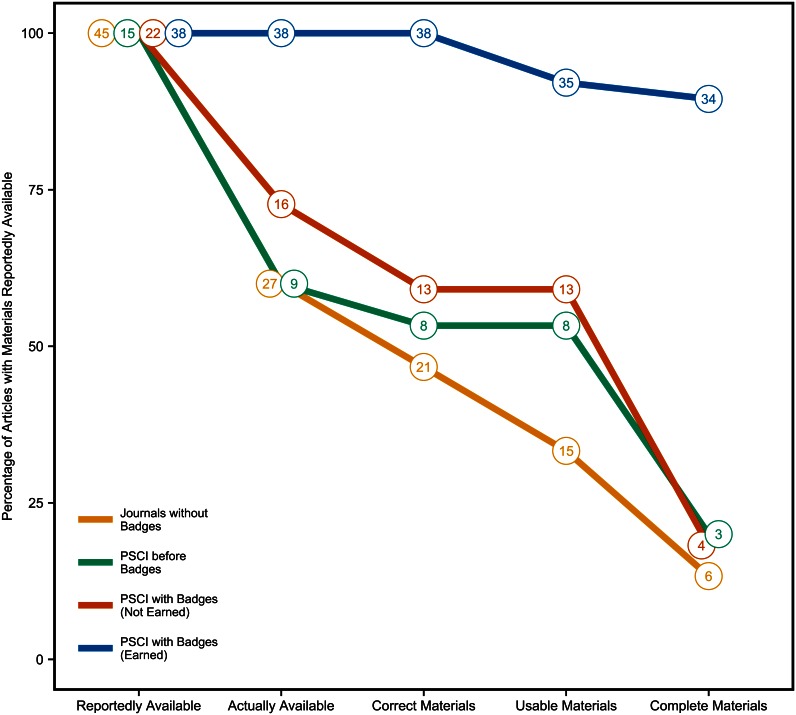
Beginning January 2014, Psychological Science gave authors the opportunity to signal open data and materials if they qualified for badges that accompanied published articles. Before badges, less than 3% of Psychological Science articles reported open data. After badges, 23% reported open data, with an accelerating trend; 39% reported open data in the first half of 2015, an increase of more than an order of magnitude from baseline. There was no change over time in the low rates of data sharing among comparison journals. Moreover, reporting openness does not guarantee openness. When badges were earned, reportedly available data were more likely to be actually available, correct, usable, and complete than when badges were not earned. Open materials also increased to a weaker degree, and there was more variability among comparison journals. Badges are simple, effective signals to promote open practices and improve preservation of data and materials by using independent repositories.
Overview
The claims and statistics of this paper haven’t been checked yet.
Free: it reads the open-access text and checks the first 5 claims that cite a source we can check. Create a free account to check every claim.
Integrity signals
Registry
Cites
Statistics
Figures


Verification
Claims the paper makes
The claims and statistics of this paper haven’t been checked yet.
Free: it reads the open-access text and checks the first 5 claims that cite a source we can check. Create a free account to check every claim.
Claims other papers make about this one
Each is checked against this paper’s own text: does it say what the citing paper says it does?
The source backs part of the claim, not all of it — or backs it for a different population, condition or comparison.
In the citing paper
“Poor distribution of labor and lack of task specialization may be part of the reason data and code sharing remain rare [48,54]”
From Open Science 2.0: Towards a truly collaborative research ecosystem (2023) · cites this paper as [54]
Experimental — accuracy not yet measuredThe source backs part of the claim, not all of it — or backs it for a different population, condition or comparison.
In the citing paper
“However, simply making data available does not guarantee that the data have utility: Kidwell et al. also observed that a substantial proportion (50/111, 45%) of reportedly available data was in fact not available or was incomplete, incorrect, or had insufficient documentation.”
From Data availability, reusability, and analytic reproducibility: evaluating the impact of a mandatory open data policy at the journal Cognition (2018) · cites this paper as [10]
Experimental — accuracy not yet measuredThe source backs part of the claim, not all of it — or backs it for a different population, condition or comparison.
In the citing paper
“For example, in an observational study examining the impact of a voluntary ‘open badges’ scheme at the journal Psychological Science, Kidwell et al. [10] found that the proportion of articles reporting available data increased from around 2.5% during the pre-policy period to 39.5% by the end of the post-policy period.”
From Data availability, reusability, and analytic reproducibility: evaluating the impact of a mandatory open data policy at the journal Cognition (2018) · cites this paper as [10]
Experimental — accuracy not yet measuredThe source backs part of the claim, not all of it — or backs it for a different population, condition or comparison.
In the citing paper
“Reproducibility badges adopted by several journals45 recognize stronger forms of reproducibility without penalizing authors who cannot yet reach them.”
From Designing reproducible large-language-model-assisted scientific analyses (2026) · cites this paper as [45]
Experimental — accuracy not yet measuredThe cited source says what the claim attributes to it.
In the citing paper
“They then studied what happened when the journal Psychological Science introduced the open data badge and found a substantial increase in the percentage of publications reporting open data [54].”
From Open Science 2.0: Towards a truly collaborative research ecosystem (2023) · cites this paper as [54]
5 more claims about this paper
Create a free account to see every claim other papers make about this one.
Self-check
Percentages, sums and reported differences re-computed from the paper’s own numbers.
The self-check needs the paper’s full text.
Citations
Cites
Spence, M. (1973) · The Quarterly Journal of Economics · doi:10.2307/1882010 · Cited by 19,518
Estimating the reproducibility of psychological science
Open Science Collaboration (2015) · Science · doi:10.1126/science.aac4716 · Cited by 8,515
Signaling Theory: A Review and Assessment
Connelly, B. L., Certo, S. T., Ireland, R. D., & Reutzel, C. R. (2011) · Journal of Management · doi:10.1177/0149206310388419 · Cited by 6,735
The Sociology of Science: Theoretical and Empirical Investigations
Kaplan, N., Merton, R. K., & Storer, N. W. (1974) · Technology and Culture · doi:10.2307/3102264 · Cited by 4,005
Promoting an open research culture
Nosek, B. A., Alter, G., Banks, G. C., Borsboom, D., Bowman, S. D., Breckler, S. J., Buck, S., Chambers, C. D., Chin, G., Christensen, G., et al. (2015) · Science · doi:10.1126/science.aab2374 · Cited by 2,708
Self-citationTHE SOCIOLOGY OF SCIENCE:: Theoretical and Empirical Investigations
Merton, R. Κ., & Storer, N. W. (2017) · Cited by 1,462
Nosek (2012) · doi:10.1177/1745691612459058 · Cited by 1,301
Recommendations for Increasing Replicability in Psychology
Asendorpf, J. B., Conner, M., De Fruyt, F., De Houwer, J., Denissen, J. J. A., Fiedler, K., Fiedler, S., Funder, D. C., Kliegl, R., Nosek, B. A., et al. (2013) · European Journal of Personality · doi:10.1002/per.1919 · Cited by 823
Self-citationThe poor availability of psychological research data for reanalysis.
Wicherts, J. M., Borsboom, D., Kats, J., & Molenaar, D. (2006) · American Psychologist · doi:10.1037/0003-066x.61.7.726 · Cited by 543 · cited 1×
“The key problem with “upon request” policies is that requests come after the researcher has completed the research, published the article, and lost or forgot detailed materials and data [9,11,16].”
BackgroundPromoting Transparency in Social Science Research
Miguel, E., Camerer, C., Casey, K., Cohen, J., Esterling, K. M., Gerber, A., Glennerster, R., Green, D. P., Humphreys, M., Imbens, G., et al. (2014) · Science · doi:10.1126/science.1245317 · Cited by 540
Self-citation
Research works printed but not linked: 1
- RK Merton, 1942, Science and technology in a democratic order, J of Legal and Pol Soc, 1, 115
Cited by
Items 501–600 of 736
Addressing Reproducibility Challenges in HPC with Continuous Integration
Hayot‐Sasson, V., Hudson, N., Bauer, A., Gonthier, M., Foster, I. T., & Chard, K. (2025) · International Conference for High Performance Computing, Networking, Storage and Analysis (SC) · doi:10.1145/3712285.3759874 · Cited by 2
“To promote reproducibility in science, initiatives such as Findable, Accessible, Interoperable, and Resuable (FAIR) principles [67], reproducibility badges [41], and open science [52, 68] have emerged.”
Mukminin, A., Marzulina, L., Abdrazakova, A., Harto, K., Fridiyanto, F., Erlina, D., & Amir, R. Z. (2026) · IGI Global eBooks · doi:10.4018/979-8-3373-6831-3.ch012 · Cited by 2
On the Computational Reproducibility of Human-Computer Interaction
Iarygina, O., Hornbæk, K. A. S., & Mottelson, A. (2026) · CHI Conference on Human Factors in Computing Systems · doi:10.1145/3772318.3791129 · Cited by 3
How to Get There From Here? Barriers and Enablers on the Road Towards Reproducibility in Research
Horbach, S. P. J. M., Cole, N. L., Kopeinik, S., Leitner, B., Ross‐Hellauer, T., & Tijdink, J. K. (2026) · Journal of Trial and Error · doi:10.36850/f4c4-4a38 · Cited by 2
“Indeed, some studies found positive effects on data sharing (45), but others found null effects on data sharing (46) and on code sharing (47).”
Professional development for open science adoption among Ukrainian educators
Marienko, M., Shyshkina, M. P., & Semerikov, S. O. (2026) · Social Sciences & Humanities Open · doi:10.1016/j.ssaho.2026.103394 · Cited by 2
Data Science as a New Foundation for Insightful, Reproducible, and Trustworthy Social Science
Landers, R. N., Auer, E. M., Collmus, A. B., & Marin, S. (2019) · Cambridge University Press eBooks · doi:10.1017/9781108649636.028 · Cited by 2
Transparency and Reproducibility: Potential Solutions
Christensen, G., & Miguel, E. A. (2020) · Cambridge University Press eBooks · doi:10.1017/9781108762519.007 · Cited by 3
Open Science and Clinical Psychology
Linthicum, K. P., Southward, M. W., & Schleider, J. L. (2021) · Elsevier eBooks · doi:10.1016/b978-0-12-818697-8.00165-5 · Cited by 2
Les revues SIC et les données de recherche: Une étude empirique
Schöpfel, J., & Kergosien, É. (2021) · Balisages · doi:10.35562/balisages.641 · Cited by 2
Setting up a Checkpoint for Research on the Prevalence of Journal Data Policies: A Systematic Review
Lee, J. (2022) · Lecture notes in computer science · doi:10.1007/978-3-030-96957-8_11 · Cited by 2
Best Practices and Navigating the Effects of Open Access Journals in Scholastic Publication
Mallika Sankar, M., Nagarathinam, A., Paramasivan, S., & Chellasamy, A. (2022) · Advances in knowledge acquisition, transfer, and management book series/Advances in knowledge acquisition, transfer and management book series · doi:10.4018/978-1-7998-9805-4.ch013 · Cited by 2
Actes des Journées européennes de la science ouverte
Conference, O. S. E. (2022) · doi:10.4000/books.oep.15822 · Cited by 2
Preregistration in Animal Research
Heinl, C., Schönfelder, G., & Bert, B. (2022) · Springer eBooks · doi:10.1007/978-3-030-99680-2_37 · Cited by 2
Linde, M., Pittelkow, M.-M., Schwarzback, N., & van Ravenzwaaij, D. (2024) · Journal of Trial and Error · doi:10.36850/mr10 · Cited by 2
Roettger, T. B., Askelund, A. D., Birkenæs, V., Bjørndal, L. D., Bochyńska, A., Glaser, B. D., Kalandadze, T., Korbmacher, M., Malovic, I., Mayor, J., et al. (2025) · BMC Medical Research Methodology · doi:10.1186/s12874-025-02601-6 · Cited by 2
Meijer, P., Aggoune, Y., Ambrose, M., Beaubien, A., Harvey, J. F., Howard, N., Inala, N., Johnson, E., Kelsey, A., Kinsey, M., et al. (2025) · Harvard Data Science Review · doi:10.1162/99608f92.08da1513 · Cited by 2
Open Data Infrastructure for Research and Development
Verma, N., Gupta, M. P., & Biswas, S. (2018) · Studies in big data · doi:10.1007/978-981-10-7515-5_2 · Cited by 2
Promoting Transparency in Evolutionary Biology and Ecology
Smith, J. F., Parker, T. H., Nakagawa, S., Gurevitch, J., & Group5, T. (. F. T. I. E. A. E. W. (2016) · Systematic Botany · doi:10.1600/036364416x692262 · Cited by 2
Promoting transparency in evolutionary biology, ecology, and ornithology
Parker, T. H., Nakagawa, S., Gurevitch, J., & IIEE (2016) · The Auk · doi:10.1642/auk-16-122.1 · Cited by 2
“Because It Is the Right Thing to Do”: Taking Stock of the Peer Reviewers’ Openness Initiative
Dahrendorf, M., Hoffmann, T., Mittenbühler, M., Wiechert, S., Sarafoglou, A., Matzke, D., & Wagenmakers, E. (2020) · Journal of European Psychology Students · doi:10.5334/jeps.506 · Cited by 2
“One of these practices is the public sharing of data, materials, and analysis scripts (e.g., Chambers, 2017; Houtkoop, Chambers, Macleod, Bishop, Nichols, & Wagenmakers, 2018; Kidwell et al., 2016).”
BackgroundDocumentation Requirements in Political Science Journals: Moving Towards Open Access Practices
Curvale, C., & Pérez-Arrobo, G. (2021) · Revista de ciencia política · doi:10.4067/s0718-090x2021005000108 · Cited by 2
Optimizing Rare Disease Registries and Natural History Studies
Hesterlee, S. E. (2021) · Springer eBooks · doi:10.1007/978-3-030-78605-2_8 · Cited by 2
Gerring, J. (2020) · Cambridge University Press eBooks · doi:10.1017/9781108762519.013 · Cited by 2
Lieberman, E. S. (2020) · Cambridge University Press eBooks · doi:10.1017/9781108762519.003 · Cited by 3
Science ouverte et évaluation académique dans un monde pluriel
Beigel, F. (2022) · doi:10.4000/books.oep.15986 · Cited by 2
Interdisciplinary Open Science: What are the implications for educational technology research?
Alhadad, S. S. J., Searston, R. A., & Lodge, J. M. (2018) · ASCILITE Publications · doi:10.14742/apubs.2018.1977 · Cited by 2
The Solution to Science's Replication CrisisPreprint
Knuteson, B. (2016) · SSRN Electronic Journal · doi:10.2139/ssrn.2835131 · Cited by 2
Journal of Traumatic Stress Ethics Policy
Kerig, P. K. (2019) · Journal of Traumatic Stress · doi:10.1002/jts.22364 · Cited by 2
Preregistration: the good, the bad, and the confusingPreprint
de Cheveigné, A. (2022) · PsyArXiv (OSF Preprints) · doi:10.31234/osf.io/bcd9t · Cited by 2
The Science of Technology and Human Behavior: Standards, Old and NewPreprint
Elson, M., & Przybylski, A. K. (2017) · PsyArXiv (OSF Preprints) · doi:10.31234/osf.io/u58mq · Cited by 2
Westwood, S. J. (2020) · PsyArXiv (OSF Preprints) · doi:10.31234/osf.io/8qms2 · Cited by 2
The Poor Availability of Syntaxes of Structural Equation ModelingPreprint
Wicherts, J. M., & Crompvoets, E. A. V. (2017) · OSF Preprints (OSF Preprints) · doi:10.31219/osf.io/qns25 · Cited by 2
Tool-driven Revolutions in Archaeological SciencePreprint
Schmidt, S. C., & Marwick, B. (2019) · SocArXiv (OSF Preprints) · doi:10.31235/osf.io/4nkxv · Cited by 3
Proposal to NSF 19-565 to Create a STEM Education Research HubPreprint
Nosek, B. A., Ofiesh, L., Grasty, F. L., Pfeiffer, N., Mellor, D. T., Brooks, R. E., Benjamin, M., Booth, A., Bowman, S. D., Davis, J. C., et al. (2019) · MetArXiv (OSF Preprints) · doi:10.31222/osf.io/4mpuc · Cited by 3
Self-citationAarts, A. A. (2022) · SSRN Electronic Journal · doi:10.2139/ssrn.4176917 · Cited by 2
Reproducible research practices and transparency across linguisticsPreprint
Bochyńska, A., Keeble, L., Halfacre, C. A. E., Casillas, J. V., Champagne, I.-A., Chen, K., Röthlisberger, M., Buchanan, E. M., & Roettger, T. B. (2023) · MetArXiv (OSF Preprints) · doi:10.31222/osf.io/rcews · Cited by 4
How the Credibility Revolution Created a Paradigm ShiftPreprint
Forozish, A. O. (2024) · SSRN Electronic Journal · doi:10.2139/ssrn.4744474 · Cited by 2
A checklist for incentivizing and facilitating good theory buildingPreprint
Lange, J., Freyer, N., Musfeld, P., Schönbrodt, F. D., & Leising, D. (2025) · OSF Preprints (OSF Preprints) · doi:10.31219/osf.io/7qvfz · Cited by 2
“For instance, when the journal Psychological Science introduced a badge for sharing data, data sharing skyrocketed (Kidwell et al., 2016).”
Brauer, K. (2024) · International Journal of Applied Positive Psychology · doi:10.1007/s41042-024-00204-y · Cited by 2
“The benefits of open science practices have been studied and positively evaluated across fields, showing higher replicability rates and trust in findings from studies that provide open research files needed to reproduce the study and analyses (e.g., Kidwell et al., 2016; Schneider et al., 2022 ).”
Li, W., Liu, X., Zhang, Q., Shi, L., Zhang, J.-X., Zhang, X., Luan, J., Li, Y., Xu, T., Zhang, R., et al. (2026) · Accountability in Research · doi:10.1080/08989621.2025.2481943 · Cited by 1
“As outlined in the TOP guideline, “open data” badges, scientific integrity credits, or other awards should be implemented to acknowledge authors’ responsibility in DAC sharing (Kidwell et al. 2016).”
Hew, K. F., & Ki, L. C. (2019) · Educational communications and technology yearbook · doi:10.1007/978-981-13-6681-9_6 · Cited by 1
Open Science badges editorial for Consulting Psychology Journal: Practice and Research.
Nowack, K. M. (2020) · Consulting psychology journal · doi:10.1037/cpb0000160 · Cited by 1
Psychology and Law, Meet Open Science
McAuliff, B. D., Fessinger, M. B., Perillo, A. D., & Perillo, J. T. (2023) · Oxford University Press eBooks · doi:10.1093/oxfordhb/9780197649138.013.5 · Cited by 1
Evaluation of Transparency and Openness Guidelines in Physical Therapist Journals
Plante, J., Langerwerf, L., Klopper, M., Rhon, D. I., & Young, J. L. (2023) · Physical Therapy · doi:10.1093/ptj/pzad133 · Cited by 1
Catalyzing communities of research rigour champions
Brumback, A. C., Ngiam, W. X. Q., Lapato, D. M., Allison, D. B., Daniels, C. L., Dougherty, M. R. P., Hazlett, H. F., Kerr, K. L., Pusek, S. N., Rethlefsen, M. L., et al. (2024) · Brain Communications · doi:10.1093/braincomms/fcae120 · Cited by 1
“Other tools at the journal level included support for registered reports 16 and for Open Science Badges, 22 which bring attention to and reward these research practices.”
BackgroundSelf-citationA survey of experimental stimulus presentation code sharing in major areas of psychology
Rawal, A., Truong, V., Lo, Y., Tseng, L.-Y., & Duncan, N. W. (2024) · Behavior Research Methods · doi:10.3758/s13428-024-02390-8 · Cited by 1
“These active policies are preferable to more passive ones, such as the awarding of “badges”, as evidence for the effectiveness of such measures is mixed (Kidwell et al., 2016; Rowhani-Farid & Barnett, 2018; Rowhani-Farid et al., 2020).”
The Evolution of Data Sharing Practices in the Psychological Literature
Neve, J., & Rousselet, G. A. (2025) · Meta-Psychology · doi:10.15626/mp.2021.2908 · Cited by 1
Kutyabami, P., Muyinda, H., Mukuru, M., Mwaka, E., Pakoyo, K., Kalyango, J. N., & Sewankambo, N. K. (2025) · BMC Medical Ethics · doi:10.1186/s12910-025-01346-7 · Cited by 1
“For instance, offering researchers options like data-sharing badges or financial compensation alongside robust data-sharing plans and clear control mechanisms empowers them to exercise their autonomy in sharing data [76–78].”
Huff, M., & Bongartz, E. C. (2026) · Zeitschrift für Erziehungswissenschaft · doi:10.1007/s11618-026-01371-1 · Cited by 1
Zhang, P., Plonsky, L., & Li, X. (2026) · Modern Language Journal · doi:10.1111/modl.70075 · Cited by 1
“These badges serve as visual indicators that a published article includes open materials, open data, or preregistration (Kidwell et al. 2016 ).”
“It makes sense to me”: Examining data file column names in the visual cognitive literature
Sordo, G. C. D., Dewis, H., Darch, P. T., Hout, M. C., & Godwin, H. J. (2026) · Behavior Research Methods · doi:10.3758/s13428-026-03104-y · Cited by 1
“Journals and funders have played a central role in advancing open science by introducing requirements for data availability and transparency (Kidwell et al., 2016; Stod-den et al., 2013).”
Feneberg, A. C., Fink‐Lamotte, J., & Niemeyer, H. (2026) · Zeitschrift für Klinische Psychologie und Psychotherapie · doi:10.1026/1616-3443/a000876 · Cited by 1
Mellenbergh, G. J. (2019) · Springer eBooks · doi:10.1007/978-3-030-12272-0_20 · Cited by 1
Tran, U. S., Berger, N., Arendasy, M. E., Greitemeyer, T., Himmelbauer, M., Hutzler, F., Kraft, H.-G., Oettl, K., Papousek, I., Vitouch, O., et al. (2017) · BMC Medical Education · doi:10.1186/s12909-017-0921-4 · Cited by 1
“Thus formally this study earns one of the three Open Practices Badges (Open Materials Badge, but not the Preregistration and Open Data Badges; see [33, 34]).”
BackgroundKreibig, S. D. (2017) · International Journal of Psychophysiology · doi:10.1016/j.ijpsycho.2017.06.001 · Cited by 1
Tackett, S., Torres, K. M., Arrastia-Chisholm, M. C., & Bradt, S. W. (2021) · Advances in educational technologies and instructional design book series · doi:10.4018/978-1-7998-6480-6.ch013 · Cited by 1
Buchanan, E. M., Valentine, K. D., & Pavlacic, J. M. (2021) · Academia Letters · doi:10.20935/al1274 · Cited by 1
Can Open Science Offer Solutions to Science Education in Africa?
Ferreira‐Meyers, K., & Dhakulkar, A. (2021) · Lecture notes in educational technology · doi:10.1007/978-981-16-4099-5_8 · Cited by 1
Gerring, J., Mahoney, J., & Elman, C. (2020) · Cambridge University Press eBooks · doi:10.1017/9781108762519.018 · Cited by 2
Gerring, J., & Cojocaru, L. (2020) · Cambridge University Press eBooks · doi:10.1017/9781108762519.005 · Cited by 1
Gerring, J. (2020) · Cambridge University Press eBooks · doi:10.1017/9781108762519.014 · Cited by 2
Gross, N., & Robertson, C. T. (2020) · Cambridge University Press eBooks · doi:10.1017/9781108762519.017 · Cited by 2
Un plan d’action pour l’édition Diamant
Borrell-Damián, L., & Rooryck, J. (2022) · doi:10.4000/books.oep.15942 · Cited by 1
Nair, S. (2022) · doi:10.4000/books.oep.15859 · Cited by 1
Open Science, Publications and Code
Harrison, M. (2022) · doi:10.4000/books.oep.16187 · Cited by 1
The role of Infrastructure for Software in Open Science
Lucke, U. (2022) · doi:10.4000/books.oep.16184 · Cited by 1
Gabriel, M. (2022) · doi:10.4000/books.oep.16089 · Cited by 1
Accelerating Your Research Career with Open Science
Norris, E. (2022) · Springer eBooks · doi:10.1007/978-3-031-10754-2_9 · Cited by 1
Promoting Open Science Principles and Primenjena psihologija (Applied Psychology)
Mellor, D. T., & Pajić, D. (2023) · Primenjena psihologija · doi:10.19090/pp.v16i4.2512 · Cited by 1
“Such visibility is associated with increased adoption of new behaviors (Kidwell et al., 2016), but importantly this process takes time-simply offering a badge is not sufficient to incentivize new behaviors (Rowhani-Farid, 2019), they have to be visible for a period of time in order to normalize the…”
BackgroundMazarakis, A., Bräuer, P., & Dorsch, I. (2025) · Scientometrics · doi:10.1007/s11192-024-05226-6 · Cited by 1
A primer on open science for cognitive psychologists
Pennington, C. R. (2025) · The Cognitive Psychology Bulletin · doi:10.53841/bpscog.2025.1.10.36 · Cited by 1
Beliefs about social dynamics and open science
Thomas, A. J., Bourg, C., & Saxe, R. R. (2025) · Royal Society Open Science · doi:10.1098/rsos.230061 · Cited by 1
Vinatier, C., Fahed, E., Chollet, Y., Caquelin, L., Jaillard, S., den Eynden, V. V., Kozula, M., & Naudet, F. (2025) · Research Integrity and Peer Review · doi:10.1186/s41073-025-00167-x · Cited by 1
“While observational data supports these policies [41], a randomised controlled trial at BMJ Open failed to demonstrate that open data badges had the intended effect [42].”
Do Open Data Badges Influence Author Behaviour? a Case Study at Springer Nature
Pearce, R., & Grant, R. A. (2020) · International Journal of Digital Curation · doi:10.2218/ijdc.v15i1.694 · Cited by 1
Research on Research: A Meta-Scientific Study of Problems and Solutions in Psychological SciencePreprint
Nuijten, M. B. (2018) · PsyArXiv (OSF Preprints) · doi:10.31234/osf.io/qtk7e · Cited by 1
Reproducible data citations for computational researchPreprint
Schulz, C. (2018) · arXiv (Cornell University) · doi:10.48550/arxiv.1808.07541 · Cited by 1
“A badge system that rewards authors for being completely transparent [14] could be used to incentivize the practice.”
BackgroundIbelli-Bianco, C. (2020) · Digital Library of Theses and Dissertations (Universidade de São Paulo) · doi:10.11606/t.18.2020.tde-05052020-164051 · Cited by 1
The Evolution of Data Sharing Practices in the Psychological LiteraturePreprint
Neve, J., & Rousselet, G. A. (2021) · PsyArXiv (OSF Preprints) · doi:10.31234/osf.io/3xdja · Cited by 1
Open Science in Kenya: Where are we?Preprint
Mwangi, K. W., Mainye, N., Ouso, D. O., Esoh, K. K., Muraya, A. W., Kamonde, C., Naitore, C., Karega, P., Gilbert, K., Musundi, S., et al. (2021) · AfricArXiv (OSF Preprints) · doi:10.31730/osf.io/mgkw3 · Cited by 1
Publishing Reproducible Geoscientific Papers: Status quo, benefits, and opportunitiesPreprint
Konkol, M. (2019) · Thesis Commons (OSF Preprints) · doi:10.31237/osf.io/mcdrn · Cited by 1
Jafari, A., & Jenner, B. (2017) · OSF Preprints (OSF Preprints) · doi:10.31219/osf.io/vgbw2 · Cited by 1
Reproducibility in small-N treatment research: a tutorial using examples from aphasiologyPreprint
Cavanaugh, R., Quique, Y. M., Swiderski, A. M., Kallhoff, L., Terhorst, L. A., Wambaugh, J. L., Hula, W. D., & Evans, W. S. (2022) · OSF Preprints (OSF Preprints) · doi:10.31219/osf.io/exyqp · Cited by 1
Otgaar, H., & Howe, M. L. (2023) · Memory · doi:10.1080/09658211.2023.2172538 · Cited by 1
How Researchers Use Open SciencePreprint
Permut, S., Saccardo, S., & Chapman, G. B. (2024) · SSRN Electronic Journal · doi:10.2139/ssrn.4838469 · Cited by 1
The Replication Crisis: A Persistent Challenge in Biomedical Research
Dagli, N., Haque, M., & Kumar, S. (2024) · Bangladesh Journal of Medical Science · doi:10.3329/bjms.v23i4.76503 · Cited by 1
“Kidwell et al ., 16 found that open data badges increased data sharing rates significantly in Psychological Science.”
BackgroundBinney, R. J., Smith, L. E., Rossit, S., Demeyere, N., Learmonth, G., Olgiati, E., Halai, A. D., Rounis, E., Evans, J. J., Edelstyn, N. M. J., et al. (2025) · PsyArXiv (OSF Preprints) · doi:10.31234/osf.io/p267j · Cited by 1
What defines big team science?Preprint
Buchanan, E. M., & Lewis, S. C. (2025) · OSF Preprints (OSF Preprints) · doi:10.31219/osf.io/hqta4_v2 · Cited by 1
Chuan-Peng, H., Xu, Z., Lazić, A., Bhattacharya, P., Seda, L., Hossain, S., Jeftić, A., Özdoğru, A. A., Amaral, O. B., Miljković, N., et al. (2025) · PsyArXiv (OSF Preprints) · doi:10.31234/osf.io/7ubk2_v2 · Cited by 2
Self-citationAn Open Toolkit for Tracking Open Science Partnership Implementation and Impact
Gold, E. R., Ali‐Khan, S. E., Allen, L., Ballell, L., Barral‐Netto, M., Carr, D. L., Chalaud, D., Chaplin, S., Clancy, M., Clarke, P., et al. (2018) · doi:10.21955/gatesopenres.1114899.1 · Cited by 1
Self-citationDesigning reproducible large-language-model-assisted scientific analyses
Dunn, C. W., Schultz, D. T., & Musser, J. M. (2026) · Patterns · doi:10.1016/j.patter.2026.101644 · Cited by 1
“Reproducibility badges adopted by several journals 45 recognize stronger forms of reproducibility without penalizing authors who cannot yet reach them.”
Transparent and credible practices under the microscope: a response to comments on Ihle et al.
Winney, I. S., & Ihle, M. (2017) · Behavioral Ecology · doi:10.1093/beheco/arx026
Research Integrity in Public Health
Gorman, D. M. (2018) · Oxford University Press eBooks · doi:10.1093/obo/9780199756797-0189
Open Science Initiatives at Emerging Adulthood
Syed, M. (2018) · Emerging Adulthood · doi:10.1177/2167696818810103
“There is some evidence that implementation of badges may be associated with increased quality of articles (Kidwell et al., 2016), but clearly badges are a very low-level change to research practice (Bastian, 2017).”
BackgroundOpen Badges for demonstrating Open Access compliance: A pilot project
Hurrell, C., Pival, P., & Ruddock, K. (2018) · doi:10.11575/prism/33202
Replication and open science: Tools for progress in psychotherapy research.Preprint
Christopherson, C. D. (2016) · PsyArXiv (OSF Preprints) · doi:10.31234/osf.io/at3rj
Publication bias and statistical power in gerontological psychologyPreprint
Brydges, C. R. (2018) · PsyArXiv (OSF Preprints) · doi:10.31234/osf.io/ruwxt
Metadata
- Authors
- Kidwell, M. C., Lazarević, L. B., Baranski, E., Hardwicke, T. E., Piechowski, S., Falkenberg, L.-S., Kennett, C., Slowik, A., Sonnleitner, C., Hess-Holden, C., Errington, T. M., Fiedler, S., & Nosek, B. A.
- Affiliations
- Center for Open Science (US)
- University of Belgrade (RS)
- University of California, Riverside (US)
- University College London (GB)
- Max Planck Institute for Behavioral Economics (DE)
- Mississippi State University (US)
- University of Vienna (AT)
- Corresponding author
- Kidwell, Mallory C.
- ORCID
- Venue
- PLOS Biology
- Publisher
- Public Library of Science (PLoS)
- Published
- 2016-05-12
- Volume
- 14
- Issue
- 5
- Pages
- e1002456
- ISSN
- 1544-9173 (ISSN-L)
- 1545-7885
- PMC
- PMC4865119
- OpenAlex
- W2390706404
- Cited by
- 700
- References
- 19
- Citations by year
- 2026: 31 · 2025: 35 · 2024: 39 · 2023: 71 · 2022: 110 · 2021: 87 · 2020: 98 · 2019: 80 · 2018: 70 · 2017: 54 · 2016: 25
- FWCI
- 170.82
- Type
- journal article
- Language
- en
- Open access
- gold
- doi.org
- Licence
- Locations
- PLoS Biology (publishedVersion, cc-by)
- Europe PMC (PubMed Central) (publishedVersion, cc-by)
- PubMed Central (publishedVersion, cc-by)
- PubMed (publishedVersion)
- WU Research (publishedVersion)
- Phaidra (Universität Wien) (submittedVersion, cc-by-nc-nd)
- RePEc: Research Papers in Economics (submittedVersion)
- DOAJ (DOAJ: Directory of Open Access Journals) (submittedVersion)
- MPG.PuRe (Max Planck Society) (submittedVersion)
- Faculty of Philosophy (University of Belgrade) (submittedVersion, cc-by)
- Zenodo (CERN European Organization for Nuclear Research) (submittedVersion, cc-by)
- Funders
- The Laura and John Arnold Foundation
- The John Templeton Foundation
- National Institute on Aging
- Topics
- Physical Sciences › Computer Science › Information Systems › Research Data Management Practices
- Social Sciences › Library and Information Sciences › Academic Publishing and Open Access
- Social Sciences › Library and Information Sciences › Publishing and Scholarly Communication
- Keywords
- open badges, open data, open practices, research transparency, data sharing, open materials, data preservation, scholarly publishing, author incentives
- MeSH terms
- Cost-Benefit Analysis, Psychology, Publishing, Serial Publications, Internet, Information Dissemination
About these checks
Registry, retraction, Cites and statistics results are computed, not judged, with one exception: a printed reference that no index lists is read once by a model before it counts as a citation error. Claims are extracted by a model and kept only when their quote appears verbatim in the text; each cited source is then checked, with a model’s help, for whether it says what the claim relies on. Those verdicts can be wrong — read the claim’s quote and the cited source before relying on one.
Statistics and arithmetic are recomputed, not judged.
Confidence bands are shown only for fields calibrated on our annotated test set. None is calibrated yet, so no band is shown.
What counts as a claim ›How we measure confidence ›How we check this ›
Are you an author, or do you see a problem with this page? Request a review
Data sources
Bibliographic data: Semantic Scholar, OpenAlex, Crossref.
Contains information from the Semantic Scholar Academic Graph Datasets, made available under the ODC Attribution License (ODC-BY 1.0).
Semantic Scholar’s data is described in: Kinney, R., et al. (2023). The Semantic Scholar Open Data Platform. arXiv:2301.10140.
