

Badges to Acknowledge Open Practices: A Simple, Low-Cost, Effective Method for Increasing Transparency
Open accessPublished version of a preprint
The DOI matches its Crossref record; 19 of the 19 references it cites were found in a registry or an index.
Abstract
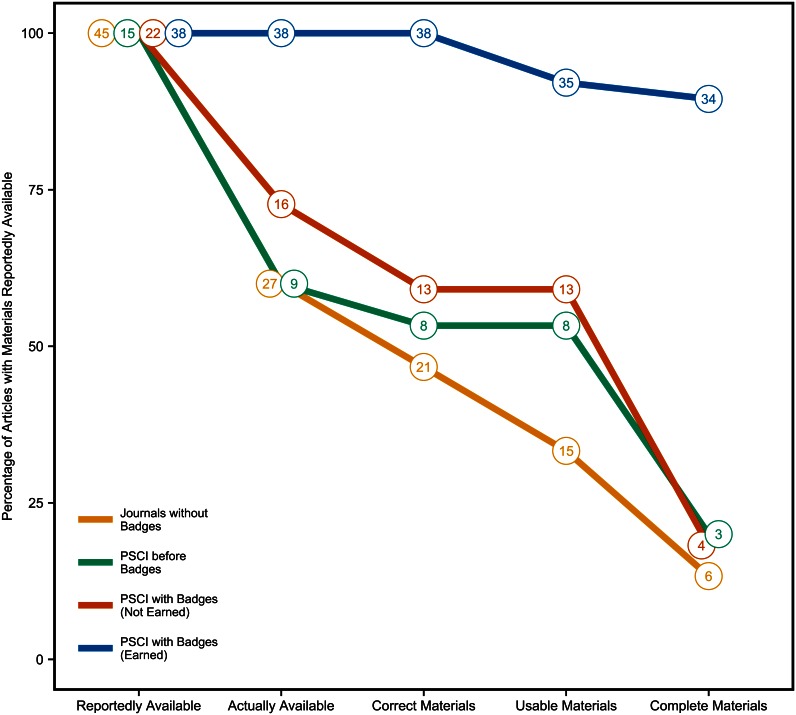
Beginning January 2014, Psychological Science gave authors the opportunity to signal open data and materials if they qualified for badges that accompanied published articles. Before badges, less than 3% of Psychological Science articles reported open data. After badges, 23% reported open data, with an accelerating trend; 39% reported open data in the first half of 2015, an increase of more than an order of magnitude from baseline. There was no change over time in the low rates of data sharing among comparison journals. Moreover, reporting openness does not guarantee openness. When badges were earned, reportedly available data were more likely to be actually available, correct, usable, and complete than when badges were not earned. Open materials also increased to a weaker degree, and there was more variability among comparison journals. Badges are simple, effective signals to promote open practices and improve preservation of data and materials by using independent repositories.
Overview
The claims and statistics of this paper haven’t been checked yet.
Free: it reads the open-access text and checks the first 5 claims that cite a source we can check. Create a free account to check every claim.
Integrity signals
Registry
Cites
Statistics
Figures


Verification
Claims the paper makes
The claims and statistics of this paper haven’t been checked yet.
Free: it reads the open-access text and checks the first 5 claims that cite a source we can check. Create a free account to check every claim.
Claims other papers make about this one
Each is checked against this paper’s own text: does it say what the citing paper says it does?
The source backs part of the claim, not all of it — or backs it for a different population, condition or comparison.
In the citing paper
“Poor distribution of labor and lack of task specialization may be part of the reason data and code sharing remain rare [48,54]”
From Open Science 2.0: Towards a truly collaborative research ecosystem (2023) · cites this paper as [54]
Experimental — accuracy not yet measuredThe source backs part of the claim, not all of it — or backs it for a different population, condition or comparison.
In the citing paper
“However, simply making data available does not guarantee that the data have utility: Kidwell et al. also observed that a substantial proportion (50/111, 45%) of reportedly available data was in fact not available or was incomplete, incorrect, or had insufficient documentation.”
From Data availability, reusability, and analytic reproducibility: evaluating the impact of a mandatory open data policy at the journal Cognition (2018) · cites this paper as [10]
Experimental — accuracy not yet measuredThe source backs part of the claim, not all of it — or backs it for a different population, condition or comparison.
In the citing paper
“For example, in an observational study examining the impact of a voluntary ‘open badges’ scheme at the journal Psychological Science, Kidwell et al. [10] found that the proportion of articles reporting available data increased from around 2.5% during the pre-policy period to 39.5% by the end of the post-policy period.”
From Data availability, reusability, and analytic reproducibility: evaluating the impact of a mandatory open data policy at the journal Cognition (2018) · cites this paper as [10]
Experimental — accuracy not yet measuredThe source backs part of the claim, not all of it — or backs it for a different population, condition or comparison.
In the citing paper
“Reproducibility badges adopted by several journals45 recognize stronger forms of reproducibility without penalizing authors who cannot yet reach them.”
From Designing reproducible large-language-model-assisted scientific analyses (2026) · cites this paper as [45]
Experimental — accuracy not yet measuredThe cited source says what the claim attributes to it.
In the citing paper
“They then studied what happened when the journal Psychological Science introduced the open data badge and found a substantial increase in the percentage of publications reporting open data [54].”
From Open Science 2.0: Towards a truly collaborative research ecosystem (2023) · cites this paper as [54]
5 more claims about this paper
Create a free account to see every claim other papers make about this one.
Self-check
Percentages, sums and reported differences re-computed from the paper’s own numbers.
The self-check needs the paper’s full text.
Citations
Cites
Spence, M. (1973) · The Quarterly Journal of Economics · doi:10.2307/1882010 · Cited by 19,518
Estimating the reproducibility of psychological science
Open Science Collaboration (2015) · Science · doi:10.1126/science.aac4716 · Cited by 8,515
Signaling Theory: A Review and Assessment
Connelly, B. L., Certo, S. T., Ireland, R. D., & Reutzel, C. R. (2011) · Journal of Management · doi:10.1177/0149206310388419 · Cited by 6,735
The Sociology of Science: Theoretical and Empirical Investigations
Kaplan, N., Merton, R. K., & Storer, N. W. (1974) · Technology and Culture · doi:10.2307/3102264 · Cited by 4,005
Promoting an open research culture
Nosek, B. A., Alter, G., Banks, G. C., Borsboom, D., Bowman, S. D., Breckler, S. J., Buck, S., Chambers, C. D., Chin, G., Christensen, G., et al. (2015) · Science · doi:10.1126/science.aab2374 · Cited by 2,708
Self-citationTHE SOCIOLOGY OF SCIENCE:: Theoretical and Empirical Investigations
Merton, R. Κ., & Storer, N. W. (2017) · Cited by 1,462
Nosek (2012) · doi:10.1177/1745691612459058 · Cited by 1,301
Recommendations for Increasing Replicability in Psychology
Asendorpf, J. B., Conner, M., De Fruyt, F., De Houwer, J., Denissen, J. J. A., Fiedler, K., Fiedler, S., Funder, D. C., Kliegl, R., Nosek, B. A., et al. (2013) · European Journal of Personality · doi:10.1002/per.1919 · Cited by 823
Self-citationThe poor availability of psychological research data for reanalysis.
Wicherts, J. M., Borsboom, D., Kats, J., & Molenaar, D. (2006) · American Psychologist · doi:10.1037/0003-066x.61.7.726 · Cited by 543 · cited 1×
“The key problem with “upon request” policies is that requests come after the researcher has completed the research, published the article, and lost or forgot detailed materials and data [9,11,16].”
BackgroundPromoting Transparency in Social Science Research
Miguel, E., Camerer, C., Casey, K., Cohen, J., Esterling, K. M., Gerber, A., Glennerster, R., Green, D. P., Humphreys, M., Imbens, G., et al. (2014) · Science · doi:10.1126/science.1245317 · Cited by 540
Self-citation
Research works printed but not linked: 1
- RK Merton, 1942, Science and technology in a democratic order, J of Legal and Pol Soc, 1, 115
Cited by
Items 601–700 of 736
Digital Equity: Not just an 'add on' but business as usual
Willems, J., Farley, H., Freund, K., Britten, D., Tickler, S., Tucker, S., Garner, J., Campbell, C., Stejar, L., Hinze, M., et al. (2018) · Murdoch University Research Portal · doi:10.13140/rg.2.2.36111.29607
Reproducibilidad en AGILE: Experiencias, logros y recomendaciones
Granell, C., Hofer, B., Nüst, D., Ostermann, F., & Šileryté, R. (2020) · Revista Cartográfica · doi:10.35424/rcarto.i100.668
Experimental Psychology in the Year 2020
Eder, A. B., & Frings, C. (2020) · Experimental Psychology (formerly Zeitschrift für Experimentelle Psychologie) · doi:10.1027/1618-3169/a000471
Open Badges for Promoting Open Practices in the Institutional Repository: A Pilot Project
Hurrell, C., Ruddock, K., & Pival, P. (2020) · Journal of Librarianship and Scholarly Communication · doi:10.7710/2162-3309.2325
“Recent research suggests that “badges are simple, effective signals to promote open practices and improve preservation of data and materials by using independent repositories” (Kidwell et al., 2016).”
BackgroundResultSubmission to the Australian Research Council for the Public Consultation into ERA & EI
Kingsley, D. A. (2020) · ANU Open Research (Australian National University) · doi:10.25911/5f8422de5713f
Interactive tools for reproducible science
Feger, S. S. (2020) · Electronic Theses of LMU Munich (Ludwig-Maximilians-Universität München) · doi:10.5282/edoc.26940 · Cited by 1
Reeves, J. L. D. (2020) · Otago University Research Archive (University of Otago)
The Solution to Science's Replication CrisisPreprint
Knuteson, B. (2016) · RePEc: Research Papers in Economics · doi:10.48550/arxiv.1609.03223 · Cited by 1
Almgren, H. (2020) · Ghent University Academic Bibliography (Ghent University)
Preregistration, Data Sharing, and Other Salutary Behaviors
Bausell, R. B. (2021) · Oxford University Press eBooks · doi:10.1093/oso/9780197536537.003.0011
A (Very) Few Concluding Thoughts
Bausell, R. B. (2021) · Oxford University Press eBooks · doi:10.1093/oso/9780197536537.003.0012
Boedker, I., Giofrè, D., Cumming, G., & Tressoldi, P. E. (2021) · MetArXiv (OSF Preprints) · doi:10.31222/osf.io/e6whp
Liao, T. F. (2020) · Cambridge University Press eBooks · doi:10.1017/9781108762519.004
Elman, C., Gerring, J., & Mahoney, J. (2020) · Cambridge University Press eBooks · doi:10.1017/9781108762519.019
NSF 19-609 Proposal: Evaluating Rigor and Transparency Culture Change InitiativesPreprint
Nosek, B. A., Errington, T. M., Mellor, D. T., Soderberg, C. K., Krall, T., Grasty, F. L., Brooks, R. E., Greene, A., Buck, S., Rosa, S. L., et al. (2020) · MetArXiv (OSF Preprints) · doi:10.31222/osf.io/ecgb5
Self-citationCenter for Open Science: Proposal for NSF 19-537 Mid-Scale Research InfrastructurePreprint
Nosek, B. A., Ofiesh, L., Pfeiffer, N., Bowman, S. D., Litherland, D. M., Booth, A., Elliott, F., Davis, J., Frazier, M., Pattison, D., et al. (2019) · MetArXiv (OSF Preprints) · doi:10.31222/osf.io/mn4t2
Self-citationAlmgren, H., Parsons, N., Bossche, S. V. D., & Marinazzo, D. (2020) · MetArXiv (OSF Preprints) · doi:10.31222/osf.io/9hg3j
(2016) · Attention Perception & Psychophysics · doi:10.3758/s13414-016-1180-x
Psychological Science Replicates Just Fine, ThanksPreprint
Aarts, A. A. (2021) · SSRN Electronic Journal · doi:10.2139/ssrn.4176922
Mellenbergh, G. J. (2019) · Springer eBooks · doi:10.1007/978-3-030-12272-0_19
Reproducibility Policies in Cardiology Journals: The REPLICA Cross-Sectional StudyPreprint
Helal, L. C. A. S., Ferrari, F., Rice, D. B., Ahmadzai, N., Skidmore, B., Umpierre, D., & Moher, D. (2022) · medRxiv · doi:10.1101/2022.08.04.22278423
Kim, I. K. (2022) · Open Access Victoria University of Wellington | Te Herenga Waka (Figshare) · doi:10.26686/wgtn.21220838 · Cited by 1
Blickhan, S., Dawson, S., Mehmani, B., Pfeiffer, N., & Schneider, J. (2022) · Information Services & Use · doi:10.3233/isu-220169
“This increased transparency of methods and data can increase the reproducibility and trust in scientific evidence and has shown to increase the rate of data sharing in publications [12].”
Preregistration of Studies with Existing Data
Mertens, G., & Krypotos, A.-M. (2022) · Integrity of Scientific Research · doi:10.1007/978-3-030-99680-2_36
Making Room for Everyone’s Talent
Huijpen, K. (2022) · doi:10.4000/books.oep.16171 · Cited by 1
Academic Publishing and Open Science – Where do we stand?
Mounier, P. (2022) · doi:10.4000/books.oep.16136
Policies to support Open Source and Open science
Choudhury, S. (2022) · doi:10.4000/books.oep.16192
Nair, S. (2022) · doi:10.4000/books.oep.16091
Construire le pilier logiciel de la science ouverte
Cosmo, R. D. (2022) · doi:10.4000/books.oep.16034 · Cited by 1
Science ouverte, édition et code
Harrison, M. (2022) · doi:10.4000/books.oep.16052
Conference, O. S. E. (2022) · doi:10.4000/books.oep.16237
To What extend are Early Career Researchers the Harbingers of Change?
Boukacem‐Zeghmouri, C. (2022) · doi:10.4000/books.oep.16159
How Psychology deals with Open Science. Principles and practices
Cristea, I. A. (2022) · doi:10.4000/books.oep.16112
New forms of publication. Why? How? How far?
Polka, J. (2022) · doi:10.4000/books.oep.16139
Gabriel, M. (2022) · doi:10.4000/books.oep.15852
Open Science Awards Ceremony and Conclusions: Opening interventions
Giry, C., & Berre, D. L. (2022) · doi:10.4000/books.oep.16194
Science ouverte, évaluation de la recherche et SHS (sciences humaines et sociales)
Kulczycki, E. (2022) · doi:10.4000/books.oep.16012 · Cited by 1
Conference, O. S. E. (2022) · doi:10.4000/books.oep.16236
Faire de la place pour les talents de chacun
Huijpen, K. (2022) · doi:10.4000/books.oep.16006
Transparency of Health Research
Boutron, I. (2022) · doi:10.4000/books.oep.16107
Academic Publishing and Latin America
Becerril-García, A. (2022) · doi:10.4000/books.oep.16142
Reproducible research practices and transparency across linguisticsPreprint
Bochyńska, A., Keeble, L., Halfacre, C. A. E., Casillas, J. V., Champagne, I.-A., Chen, K., Röthlisberger, M., Buchanan, E. M., & Roettger, T. B. (2023) · OSF Preprints (OSF Preprints) · doi:10.31219/osf.io/naf8t
Growing an Inclusive Community of K-12 CS Education Researchers
Davis, S., & McGill, M. M. (2023) · ACM Technical Symposium on Computer Science Education (SIGCSE) · doi:10.1145/3545945.3569725
“Less than two years after the badges were introduced, the number of articles reporting open data increased from 3% to 39% [33].”
BackgroundAddressing the Reproducibility Crisis
Bennett, M. (2023) · Springer eBooks · doi:10.1007/978-981-19-9240-7_3
Open science interventions proposed or implemented to assess researcher impact: a scoping review
Ghannad, M., Armond, A. C. V., Ng, J. Y., Ayala, A. P., Khan, H., Grossman, M. R., Cormack, G. V., Pham, B., Leeflang, M., Bossuyt, P. M., et al. (2023) · F1000Research · doi:10.12688/f1000research.140556.1
Konaszewski, K., Muszyńska, J., Skalski‐Bednarz, S. B., & Surżykiewicz, J. (2023) · Polska Myśl Pedagogiczna · doi:10.4467/24504564pmp.23.016.18245
Open when, why, to whom? Changing challenges, perspectives and practices in a new research culture
Mugnaini, R., Urs, S. R., & Fradkin, C. (2023) · Frontiers research topics · doi:10.3389/978-2-8325-3873-9
A recipe for extremely reproducible enrichment analysis (and why we need it)Preprint
Bora, A., & Ziemann, M. (2023) · OSF Preprints (OSF Preprints) · doi:10.31219/osf.io/r6kxg
Li, S., Sangsawang, T., Thepnuan, N., Pigultong, M., Punyayodhin, S., & Darboth, K. (2024) · Journal of Applied Data Sciences · doi:10.47738/jads.v5i1.173 · Cited by 2
A new page for the Hong Kong Journal of Emergency Medicine
Hung, K. K. C., Lam, R. P. K., & Lui, C. T. (2024) · Hong Kong Journal of Emergency Medicine · doi:10.1002/hkj2.12012
Researchers’ Perceptions of the State of Social and Personality PsychologyPreprint
Schiavone, S. R., Vazire, S., & Rhemtulla, M. (2024) · PsyArXiv (OSF Preprints) · doi:10.31234/osf.io/ja4u2
Ngô, H. H., Lê, T. H. T., Hoàng, T. M. T., Cù, T. T. H., & Mai, T. L. A. (2024) · Tạp chí Khoa học Điều dưỡng · doi:10.54436/jns.2024.04.835
The replication crisis in science and its overlap with kinanthropology: an introduction (Part 2)
Mališ, J., & Baloun, L. (2024) · Tělesná kultura · doi:10.5507/tk.2024.003
“Toto hodnocení v přípa - dě časopisu Psychological Science vedlo ke zvýšení sdílení dat autory ze 3 % na 39 % publikovaných studií za necelé dva roky (Kidwell et al., 2016).”
Preregistration in psychology: The need to consider auxiliary assumptionsPreprint
Quinton, T. S. (2024) · PsyArXiv (OSF Preprints) · doi:10.31234/osf.io/keza8
Questionable practices in data and code sharing policy in high-profile medical journal and researchPreprint
Li, W., Liu, X., Zhang, Q., Shi, L., Zhang, J., Zhang, X., Luan, J., Li, Y., Xu, T., Zhang, R., et al. (2024) · medRxiv · doi:10.1101/2024.08.29.24312818 · Cited by 1
Editorial for Attention, Perception, & Psychophysics
Ngiam, W. X. Q., Geng, J. J., & Shomstein, S. (2024) · Attention Perception & Psychophysics · doi:10.3758/s13414-024-02973-9
Ethical Issues in Psychological Science: Studying Humans, Analyzing Data, Publishing Findings
Crandall, C., Giner‐Sorolla, R., & Biernat, M. (2024) · Cambridge University Press eBooks · doi:10.1017/9781009170123.003
Transparency and Open Science Practices in Research on Emerging Adulthood
Nguyen, P., & Syed, M. (2024) · Oxford University Press eBooks · doi:10.1093/oso/9780197677797.003.0002
Tonini, F. (2024) · Revista de Psicología · doi:10.24215/2422572xe180
“Y hacerlo de manera tal que al compartirlos sean libres y accesibles al público para su uso, en lo posible, sin restricciones (Martins, 2020; Kidwell et al., 2016).”
McIntosh, R. D., & Schwarzkopf, D. S. (2025) · Cortex · doi:10.1016/j.cortex.2025.01.007
Preregistration in psychology: The need to consider auxiliary assumptionsPreprint
Quinton, T. S. (2024) · PsyArXiv (OSF Preprints) · doi:10.31234/osf.io/keza8_v1
Replication and open science: Tools for progress in psychotherapy research.Preprint
Christopherson, C. D. (2016) · PsyArXiv (OSF Preprints) · doi:10.31234/osf.io/at3rj_v1
Open Science is Robust SciencePreprint
McAbee, S. T., Grubbs, J. B., & Zickar, M. J. (2017) · PsyArXiv (OSF Preprints) · doi:10.31234/osf.io/md7hq_v1
Lavelle-Hill, R. E., Smith, G., & Murayama, K. (2023) · OSF Preprints (OSF Preprints) · doi:10.31219/osf.io/6xt82_v1
Editor's evaluation: Transparency of research practices in cardiovascular literature
Mangoni, A. A. (2022) · eLife · doi:10.7554/elife.81051.sa0
Changing Practices and Priorities in Social Psychological Research Methods and Reporting
Giner‐Sorolla, R. (2025) · doi:10.70400/zutf8520 · Cited by 2
Examining the availability/findability of stimuli employed in social media and body image research
Smailes, D., Aleksandra, A., Coakley, M., Mair, S., & Ventress, J. (2025) · PLoS ONE · doi:10.1371/journal.pone.0324514
“The awarding of badges by journals for articles that have adopted ‘open research’ practices, such as the pre-registration of analysis plans and the sharing of analysis code, has also been associated with an increase in the adoption of these practices [30].”
Sánchez‐Tarragó, N., & Oliveira, T. D. A. (2025) · doi:10.1590/scielopreprints.12798
Pinto, L. R. S. (2024) · Digital Library of Theses and Dissertations (Universidade de São Paulo) · doi:10.11606/d.5.2024.tde-01082025-155126
Zhang, S. (2025) · International Journal of Social Science and Human Research · doi:10.47191/ijsshr/v8-i9-12
Lazarević, L. B., Wagge, J., Balci, B. B., Buchanan, E. M., Greene, N. R., Folwarczny, M., Lazić, A., Want, S. C., Lee, S., Raddatz, M., et al. (2025) · Collabra Psychology · doi:10.1525/collabra.143773
Self-citationAn Open Toolkit for Tracking Open Science Partnership Implementation and Impact
Gold, E. R., Ali‐Khan, S. E., Allen, L., Ballell, L., Barral‐Netto, M., Carr, D. L., Chalaud, D., Chaplin, S., Clancy, M., Clarke, P., et al. (2018) · doi:10.21955/gatesopenres.1114891.1
Self-citationChristensen, G. (2020) · Gates Open Research · doi:10.21956/gatesopenres.14274.r28542
Christensen, G. (2020) · Gates Open Research · doi:10.21956/gatesopenres.14341.r28939
Null Hypothesis Statistical Testing (NHST)
Graham, M. E., & Slaney, K. L. (2025) · Springer eBooks · doi:10.1007/978-3-031-70581-6_9-1
JEP:HPP Is TOP: Editorial policies for transparency and openness in publishing.
Souza, A. S. (2025) · Journal of Experimental Psychology Human Perception & Performance · doi:10.1037/xhp0001299
Open Scholarship and Transparency in Applied Linguistics Research
Al‐Hoorie, A. H., & Marsden, E. J. (2025) · Wiley eBooks · doi:10.1002/9781405198431.wbeal1493.pub2
Sánchez‐Tarragó, N., & Oliveira, T. D. A. (2025) · Biblios Journal of Librarianship and Information Science · doi:10.5195/biblios.2025.1277
A Constructive Scientific Methodology to Improve Climate Figures from IPCCPreprint
Lu, Y., Tang, J., He, T., & Fekete, J. (2025) · arXiv (Cornell University) · doi:10.48550/arxiv.2512.15514
“The Open Materials Badge 2 , introduced by the Open Science Collaboration, adds another layer to peer review by recognizing researchers who make their materials openly available, enabling reviewers to assess the completeness and usability of these materials for replication [27].”
Supporting Open Science Data Curation, Preservation, and Access by LibrariesPreprint
Olson, E. L., Pfeiffer, N., Riss, C., Bailey, J., & Donovan, L. (2020) · doi:10.17605/osf.io/5yt2x
Additional file 1 of The ARRIVE guidelines 2.0: Updated guidelines for reporting animal research
Percie du Sert, N., Hurst, V., Ahluwalia, A., Alam, S., Avey, M. T., Baker, M., Browne, W. J., Clark, A., Cuthill, I. C., Dirnagl, U., et al. (2020) · Figshare · doi:10.6084/m9.figshare.12650470
Piechowski, S. (2023) · elib (German Aerospace Center) · doi:10.13154/294-10495
Self-citationData journals: Where data sharing policy meets practice
Dilles, Z. Y. G. (2023) · Carolina Digital Repository (University of North Carolina at Chapel Hill) · doi:10.17615/nqtz-b568
Additional file 4 of The ARRIVE guidelines 2.0: Updated guidelines for reporting animal research
Percie du Sert, N., Hurst, V., Ahluwalia, A., Alam, S., Avey, M. T., Baker, M., Browne, W. J., Clark, A., Cuthill, I. C., Dirnagl, U., et al. (2020) · Figshare · doi:10.6084/m9.figshare.12650479
Advancing theory and research on Open Science Practices in psychology
Torka, A. (2024) · Technische Universität Dortmund Eldorado (Technische Universität Dortmund) · doi:10.17877/de290r-24553
Open Science practices and incentives – a meta-research investigation
Crüwell, S. (2023) · Refubium (Universitätsbibliothek der Freien Universität Berlin) · doi:10.17169/refubium-38666
Opening Reproducible Research: A Research Project Website And Blog
Nüst, D., Schutzeichel, M., Konkol, M., & Koukouraki, E. (2018) · Zenodo (CERN European Organization for Nuclear Research) · doi:10.5281/zenodo.1485437
Additional file 2 of The ARRIVE guidelines 2.0: Updated guidelines for reporting animal research
Percie du Sert, N., Hurst, V., Ahluwalia, A., Alam, S., Avey, M. T., Baker, M., Browne, W. J., Clark, A., Cuthill, I. C., Dirnagl, U., et al. (2020) · Figshare · doi:10.6084/m9.figshare.12650473
Researcher Degrees of Freedom in the Psychology of ReligionPreprint
Bartlett, J. E., Uzdavines, A., Coleman, T. J., III, Messick, K. J., & Charles, S. J. (2018) · OSF Preprints (OSF Preprints)
Psihološki činioci zdravstvenog ponašanja mladih
Bogdanovic, S. (2019) · National Repository of Dissertations in Serbia · Cited by 1
Mosen, J., Voracek, M., Kirchler, E., & Olsen, J. (2019) · OSF Preprints (OSF Preprints)
Metadata
- Authors
- Kidwell, M. C., Lazarević, L. B., Baranski, E., Hardwicke, T. E., Piechowski, S., Falkenberg, L.-S., Kennett, C., Slowik, A., Sonnleitner, C., Hess-Holden, C., Errington, T. M., Fiedler, S., & Nosek, B. A.
- Affiliations
- Center for Open Science (US)
- University of Belgrade (RS)
- University of California, Riverside (US)
- University College London (GB)
- Max Planck Institute for Behavioral Economics (DE)
- Mississippi State University (US)
- University of Vienna (AT)
- Corresponding author
- Kidwell, Mallory C.
- ORCID
- Venue
- PLOS Biology
- Publisher
- Public Library of Science (PLoS)
- Published
- 2016-05-12
- Volume
- 14
- Issue
- 5
- Pages
- e1002456
- ISSN
- 1544-9173 (ISSN-L)
- 1545-7885
- PMC
- PMC4865119
- OpenAlex
- W2390706404
- Cited by
- 700
- References
- 19
- Citations by year
- 2026: 31 · 2025: 35 · 2024: 39 · 2023: 71 · 2022: 110 · 2021: 87 · 2020: 98 · 2019: 80 · 2018: 70 · 2017: 54 · 2016: 25
- FWCI
- 170.82
- Type
- journal article
- Language
- en
- Open access
- gold
- doi.org
- Licence
- Locations
- PLoS Biology (publishedVersion, cc-by)
- Europe PMC (PubMed Central) (publishedVersion, cc-by)
- PubMed Central (publishedVersion, cc-by)
- PubMed (publishedVersion)
- WU Research (publishedVersion)
- Phaidra (Universität Wien) (submittedVersion, cc-by-nc-nd)
- RePEc: Research Papers in Economics (submittedVersion)
- DOAJ (DOAJ: Directory of Open Access Journals) (submittedVersion)
- MPG.PuRe (Max Planck Society) (submittedVersion)
- Faculty of Philosophy (University of Belgrade) (submittedVersion, cc-by)
- Zenodo (CERN European Organization for Nuclear Research) (submittedVersion, cc-by)
- Funders
- The Laura and John Arnold Foundation
- The John Templeton Foundation
- National Institute on Aging
- Topics
- Physical Sciences › Computer Science › Information Systems › Research Data Management Practices
- Social Sciences › Library and Information Sciences › Academic Publishing and Open Access
- Social Sciences › Library and Information Sciences › Publishing and Scholarly Communication
- Keywords
- open badges, open data, open practices, research transparency, data sharing, open materials, data preservation, scholarly publishing, author incentives
- MeSH terms
- Cost-Benefit Analysis, Psychology, Publishing, Serial Publications, Internet, Information Dissemination
About these checks
Registry, retraction, Cites and statistics results are computed, not judged, with one exception: a printed reference that no index lists is read once by a model before it counts as a citation error. Claims are extracted by a model and kept only when their quote appears verbatim in the text; each cited source is then checked, with a model’s help, for whether it says what the claim relies on. Those verdicts can be wrong — read the claim’s quote and the cited source before relying on one.
Statistics and arithmetic are recomputed, not judged.
Confidence bands are shown only for fields calibrated on our annotated test set. None is calibrated yet, so no band is shown.
What counts as a claim ›How we measure confidence ›How we check this ›
Are you an author, or do you see a problem with this page? Request a review
Data sources
Bibliographic data: Semantic Scholar, OpenAlex, Crossref.
Contains information from the Semantic Scholar Academic Graph Datasets, made available under the ODC Attribution License (ODC-BY 1.0).
Semantic Scholar’s data is described in: Kinney, R., et al. (2023). The Semantic Scholar Open Data Platform. arXiv:2301.10140.
