

Badges to Acknowledge Open Practices: A Simple, Low-Cost, Effective Method for Increasing Transparency
Open accessPublished version of a preprint
The DOI matches its Crossref record; 19 of the 19 references it cites were found in a registry or an index.
Abstract
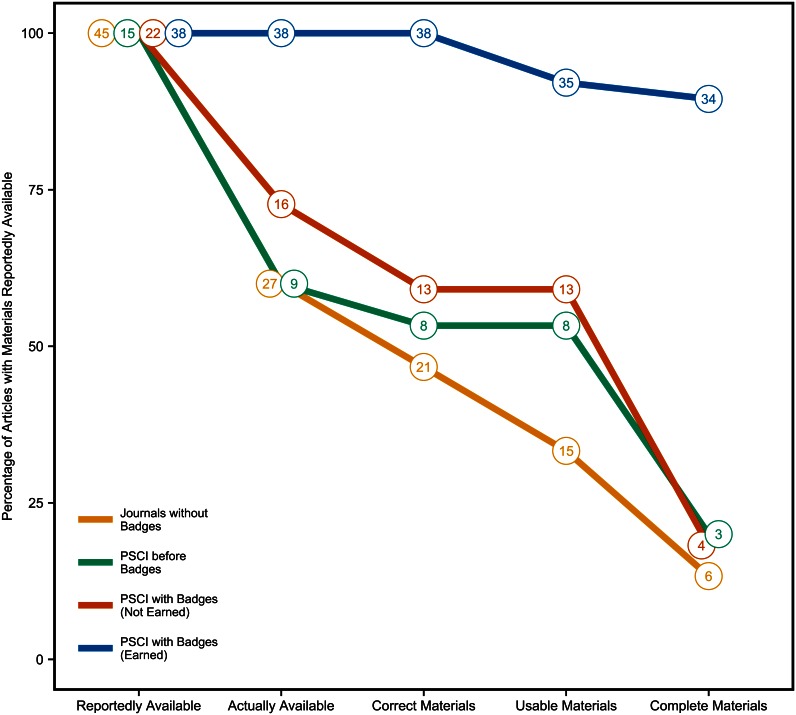
Beginning January 2014, Psychological Science gave authors the opportunity to signal open data and materials if they qualified for badges that accompanied published articles. Before badges, less than 3% of Psychological Science articles reported open data. After badges, 23% reported open data, with an accelerating trend; 39% reported open data in the first half of 2015, an increase of more than an order of magnitude from baseline. There was no change over time in the low rates of data sharing among comparison journals. Moreover, reporting openness does not guarantee openness. When badges were earned, reportedly available data were more likely to be actually available, correct, usable, and complete than when badges were not earned. Open materials also increased to a weaker degree, and there was more variability among comparison journals. Badges are simple, effective signals to promote open practices and improve preservation of data and materials by using independent repositories.
Overview
The claims and statistics of this paper haven’t been checked yet.
Free: it reads the open-access text and checks the first 5 claims that cite a source we can check. Create a free account to check every claim.
Integrity signals
Registry
Cites
Statistics
Figures


Verification
Claims the paper makes
The claims and statistics of this paper haven’t been checked yet.
Free: it reads the open-access text and checks the first 5 claims that cite a source we can check. Create a free account to check every claim.
Claims other papers make about this one
Each is checked against this paper’s own text: does it say what the citing paper says it does?
The source backs part of the claim, not all of it — or backs it for a different population, condition or comparison.
In the citing paper
“Poor distribution of labor and lack of task specialization may be part of the reason data and code sharing remain rare [48,54]”
From Open Science 2.0: Towards a truly collaborative research ecosystem (2023) · cites this paper as [54]
Experimental — accuracy not yet measuredThe source backs part of the claim, not all of it — or backs it for a different population, condition or comparison.
In the citing paper
“However, simply making data available does not guarantee that the data have utility: Kidwell et al. also observed that a substantial proportion (50/111, 45%) of reportedly available data was in fact not available or was incomplete, incorrect, or had insufficient documentation.”
From Data availability, reusability, and analytic reproducibility: evaluating the impact of a mandatory open data policy at the journal Cognition (2018) · cites this paper as [10]
Experimental — accuracy not yet measuredThe source backs part of the claim, not all of it — or backs it for a different population, condition or comparison.
In the citing paper
“For example, in an observational study examining the impact of a voluntary ‘open badges’ scheme at the journal Psychological Science, Kidwell et al. [10] found that the proportion of articles reporting available data increased from around 2.5% during the pre-policy period to 39.5% by the end of the post-policy period.”
From Data availability, reusability, and analytic reproducibility: evaluating the impact of a mandatory open data policy at the journal Cognition (2018) · cites this paper as [10]
Experimental — accuracy not yet measuredThe source backs part of the claim, not all of it — or backs it for a different population, condition or comparison.
In the citing paper
“Reproducibility badges adopted by several journals45 recognize stronger forms of reproducibility without penalizing authors who cannot yet reach them.”
From Designing reproducible large-language-model-assisted scientific analyses (2026) · cites this paper as [45]
Experimental — accuracy not yet measuredThe cited source says what the claim attributes to it.
In the citing paper
“They then studied what happened when the journal Psychological Science introduced the open data badge and found a substantial increase in the percentage of publications reporting open data [54].”
From Open Science 2.0: Towards a truly collaborative research ecosystem (2023) · cites this paper as [54]
5 more claims about this paper
Create a free account to see every claim other papers make about this one.
Self-check
Percentages, sums and reported differences re-computed from the paper’s own numbers.
The self-check needs the paper’s full text.
Citations
Cites
Spence, M. (1973) · The Quarterly Journal of Economics · doi:10.2307/1882010 · Cited by 19,518
Estimating the reproducibility of psychological science
Open Science Collaboration (2015) · Science · doi:10.1126/science.aac4716 · Cited by 8,515
Signaling Theory: A Review and Assessment
Connelly, B. L., Certo, S. T., Ireland, R. D., & Reutzel, C. R. (2011) · Journal of Management · doi:10.1177/0149206310388419 · Cited by 6,735
The Sociology of Science: Theoretical and Empirical Investigations
Kaplan, N., Merton, R. K., & Storer, N. W. (1974) · Technology and Culture · doi:10.2307/3102264 · Cited by 4,005
Promoting an open research culture
Nosek, B. A., Alter, G., Banks, G. C., Borsboom, D., Bowman, S. D., Breckler, S. J., Buck, S., Chambers, C. D., Chin, G., Christensen, G., et al. (2015) · Science · doi:10.1126/science.aab2374 · Cited by 2,708
Self-citationTHE SOCIOLOGY OF SCIENCE:: Theoretical and Empirical Investigations
Merton, R. Κ., & Storer, N. W. (2017) · Cited by 1,462
Nosek (2012) · doi:10.1177/1745691612459058 · Cited by 1,301
Recommendations for Increasing Replicability in Psychology
Asendorpf, J. B., Conner, M., De Fruyt, F., De Houwer, J., Denissen, J. J. A., Fiedler, K., Fiedler, S., Funder, D. C., Kliegl, R., Nosek, B. A., et al. (2013) · European Journal of Personality · doi:10.1002/per.1919 · Cited by 823
Self-citationThe poor availability of psychological research data for reanalysis.
Wicherts, J. M., Borsboom, D., Kats, J., & Molenaar, D. (2006) · American Psychologist · doi:10.1037/0003-066x.61.7.726 · Cited by 543 · cited 1×
“The key problem with “upon request” policies is that requests come after the researcher has completed the research, published the article, and lost or forgot detailed materials and data [9,11,16].”
BackgroundPromoting Transparency in Social Science Research
Miguel, E., Camerer, C., Casey, K., Cohen, J., Esterling, K. M., Gerber, A., Glennerster, R., Green, D. P., Humphreys, M., Imbens, G., et al. (2014) · Science · doi:10.1126/science.1245317 · Cited by 540
Self-citation
Research works printed but not linked: 1
- RK Merton, 1942, Science and technology in a democratic order, J of Legal and Pol Soc, 1, 115
Cited by
Items 401–500 of 736
Brewer, G. A., Robey, A., & Nash Unsworth, A. (2020) · Journal of Memory and Language · doi:10.1016/j.jml.2020.104185 · Cited by 7
Developments in Open Data Norms
Evans, T. R. (2022) · Journal of Open Psychology Data · doi:10.5334/jopd.60 · Cited by 7
“For example, a number of works have evidenced a citation advantage for open data over closed data [25, 5] and some journals now offer ‘badges’ alongside articles to highlight how data has been made openly available [18].”
BackgroundLeveraging Containers for Reproducible Psychological ResearchPreprint
Wiebels, K., & Moreau, D. (2021) · PsyArXiv (OSF Preprints) · doi:10.31234/osf.io/h7tkg · Cited by 7
Who does big team science?Preprint
Buchanan, E. M., & Lewis, S. C. (2023) · OSF Preprints (OSF Preprints) · doi:10.31219/osf.io/hqta4 · Cited by 8
Open Science and Transparency in Applied Linguistics Research
Marsden, E. (2019) · The Encyclopedia of Applied Linguistics · doi:10.1002/9781405198431.wbeal1493 · Cited by 6
Fitzpatrick, R., & Stefan, M. I. (2022) · Neuroinformatics · doi:10.1007/s12021-022-09584-5 · Cited by 8
“Journals could highlight this by introducing a “reproducibility audited” badge, similar to existing open science badges (Kidwell et al., 2016).”
BackgroundMatthews, A. A., & Rantanen, J. (2024) · The Journal of Law Economics and Organization · doi:10.1093/jleo/ewae001 · Cited by 6
A Checklist for Incentivizing and Facilitating Good Theory Building
Lange, J., Freyer, N., Musfeld, P., Schönbrodt, F. D., & Leising, D. (2025) · Zeitschrift für Psychologie · doi:10.1027/2151-2604/a000604 · Cited by 7
Reliability of Inference: Analogs of Replication in Qualitative Research
Fairfield, T., & Charman, A. E. (2020) · Cambridge University Press eBooks · doi:10.1017/9781108762519.012 · Cited by 6
Profile of Data Sharing in the Clinical Neurosciences
Hanson, K. A., Almeida, N. C., Traylor, J. I., Rajagopalan, D., & Johnson, J. N. (2020) · Cureus · doi:10.7759/cureus.9927 · Cited by 7
“The introduction of such badge use by Psychological Science resulted in a 10-fold increase in the sharing of data from articles published within the journal following introduction of the badges in 2014 [30].”
The poor availability of syntaxes of structural equation modeling
Wicherts, J. M., & Crompvoets, E. A. V. (2017) · Accountability in Research · doi:10.1080/08989621.2017.1396214 · Cited by 6
Les pratiques de recherche ouvertes en psychologie
Lantian, A. (2020) · Psychologie Française · doi:10.1016/j.psfr.2020.09.001 · Cited by 6
Multiverse analyses in the classroom
Heyman, T., & Vanpaemel, W. (2022) · Meta-Psychology · doi:10.15626/mp.2020.2718 · Cited by 8
Factors affecting psychologists' adoption of an open data badge
Harper, L. M., & Kim, Y. (2017) · Proceedings of the Association for Information Science and Technology · doi:10.1002/pra2.2017.14505401120 · Cited by 6
“%) after January 1, 2014 (Kidwell et al., 2016).”
Current developments and challenges for the British Journal of Psychology
Schweinberger, S. R., Franz, V. H., & Palermo, R. (2018) · British Journal of Psychology · doi:10.1111/bjop.12281 · Cited by 6
“…io/our-services/open-science-badges) as simple optional measures to acknowledge when author makes their data and methods transparent (Kidwell et al., 2016), pre-registered reports (Chambers, 2013), or, as a complementary approach, exploratory reports (McIntosh, 2017).”
Open Science Badges in the Journal of Neurochemistry
Schweitzer, B., & Schulz, J. B. (2018) · Journal of Neurochemistry · doi:10.1111/jnc.14536 · Cited by 6
First Directions for Using Gamification to Motivate for Open AccessPreprint
Mazarakis, A., & Bräuer, P. (2020) · arXiv (Cornell University) · doi:10.48550/arxiv.2002.03681 · Cited by 6
“The authors showed that the award of open science badges motivates researchers to make their research data freely available [22].”
BackgroundA Methodological Framework for Stimuli Control: Insights From Numerical Cognition
Shilat, Y., Henik, A., Galili, H., Wasserman, S., Salzmann, A., & Salti, M. (2024) · Advances in Methods and Practices in Psychological Science · doi:10.1177/25152459241249185 · Cited by 6
“…hypothesis is more suitable because many studies showed that the tendency for data sharing in cognition research and other disciplines is increasing and has mainly done so after 2010 (Federer et al., 2018; Kidwell et al., 2016; Martone et al., 2018; Prosser et al., 2023; Tenopir et al., 2015).”
Shero, J. A., Swanz, A., Hanson, A. L., Hart, S. A., & Logan, J. A. R. (2025) · AERA Open · doi:10.1177/23328584251352814 · Cited by 6
“This culture of secrecy in many cases has hampered data sharing, with reported rates of data sharing in the education and psychology fields being as low 3% (Kidwell et al., 2016).”
How to Identify and How to Conduct Research that Is Informative and Reproducible
Zickfeld, J., & Schubert, T. W. (2019) · Theory and history in the human and social sciences · doi:10.1007/978-3-030-33099-6_9 · Cited by 5
Open science practices in the false memory literature
Wiechert, S., Leistra, P., Ben‐Shakhar, G., Pertzov, Y., & Verschuère, B. (2024) · Memory · doi:10.1080/09658211.2024.2387108 · Cited by 5
“Initiatives such as the Transparency and Openness Promotion (Nosek et al., 2015), badge systems for material and data sharing or pre-registration (e.g., Kidwell et al., 2016), and the Reviewers Openness Initiative (Morey et al., 2016) exemplify such e ff orts.”
Franzen, D., Salholz‐Hillel, M., Müller-Ohlraun, S., & Strech, D. (2025) · BMC Medical Research Methodology · doi:10.1186/s12874-025-02482-9 · Cited by 6
“Clinical trials are well suited to evaluate the feasibility and usefulness of such a tool for both normative and technical reasons.”
Pot la psicologia rescatar-se a si mateixa?. Incentius, biaix i replicabilitat
Fernando, B., César, P. L. J., & Vadillo, M. A. (2018) · Anuari de Psicologia de la Societat Valenciana de Psicologia · doi:10.7203/anuari.psicologia.18.2.231 · Cited by 5
Anglin, S. M., & Edlund, J. E. (2019) · Psychology Learning & Teaching · doi:10.1177/1475725719859453 · Cited by 5
An Open Data Framework for the San Francisco Estuary
Baerwald, M. R., Davis, B. E., Lesmeister, S. A., Mahardja, B., Pisor, R., Rinde, J., Schreier, B. M., & Tobias, V. D. (2020) · San Francisco Estuary and Watershed Science · doi:10.15447/sfews.2020v18iss2art1 · Cited by 5
“Transparency and reproducibility are cornerstones of the scientific method (Nosek et al. 2015), yet, in practice, scientific journal articles with readily accessible data and fully reproducible methods are uncommon (Hampton et al. 2013; Kidwell et al. 2016).”
BackgroundTsui, A. S. M., Marchman, V. A., & Frank, M. C. (2021) · Advances in child development and behavior · doi:10.1016/bs.acdb.2021.04.003 · Cited by 6
“Many journals have imposed “open data” policies that recommend or mandate data sharing, resulting in an increase in the number of articles sharing data publicly upon publication (Kidwell et al., 2016; Nuijten et al., 2017).”
BackgroundGerring, J., Mahoney, J., & Elman, C. (2020) · Cambridge University Press eBooks · doi:10.1017/9781108762519.001 · Cited by 6
Fanelli, D. (2022) · Oxford University Press eBooks · doi:10.1093/oso/9780190938550.003.0004 · Cited by 7
Considerations towards the better integration of epidemiology into quantitative risk assessment
Déglin, S. E., Burstyn, I., Chen, C. L., Miller, D. J., Gribble, M. O., Hamade, A. K., Chang, E. T., Avanasi, R., Boon, D., & Reed, J. (2022) · Global Epidemiology · doi:10.1016/j.gloepi.2022.100084 · Cited by 5
“The badges were awarded based on criteria defined by the Center for Open Science (www.cos.io) which promotes open research and offers various platforms to share data, software, and other materials, as well as preregister research and share publications and pre-prints [41].”
Assessing Scientific Contributions in Data Sharing Spaces
Adams, K., Spadea, F., Flynn, C., & Seneviratne, O. W. (2023) · International World Wide Web Conference (WWW) · doi:10.1145/3543873.3587608 · Cited by 5
“One incentive, the use of open data badges1, has been tested in health and medical research [17], yet studies are unsure of their efectiveness [28].”
BackgroundContinuity and Change in Emerging Adulthood
Syed, M. (2016) · Emerging Adulthood · doi:10.1177/2167696816661096 · Cited by 5
Unlocking the benefits of transparent and reusable science for climate risk management
Pollack, A. B., Auermuller, L., Burleyson, C., Campbell, J., Condon, M., Cooper, C. M., Coronese, M., Dangendorf, S., Doss‐Gollin, J., Hegde, P., et al. (2026) · Proceedings of the National Academy of Sciences · doi:10.1073/pnas.2422157123 · Cited by 4
Changing the Landscape of Archaeological Publishing
Beck, J., Flad, R. K., Alex, B., Caramanica, A., Costopoulos, A., Kawa, N. C., Marwick, B., Warinner, C., Bardolph, D. N., Borck, L., et al. (2026) · Current Anthropology · doi:10.1086/739789 · Cited by 4
Pennington, C. R., Norris, E., Skubera, M., Ba, Y., Moffat, R., Amaral, O. B., Adamkovic, M., Adıgüzel, A., Almeida, R. A., Baldwin, J. R., et al. (2026) · Royal Society Open Science · doi:10.1098/rsos.260462 · Cited by 6
“Indeed, there have been positive steps to incorporate open research training for both researchers and students [16 ,36 ], incentives such as badges for open research adoption [43 ], changes to research assessment and funding for meta-research (see [37 ]).”
Self-citationLee, T.-H., Jung, M.-A., & Kim, Y. (2023) · The Electronic Library · doi:10.1108/el-10-2022-0232 · Cited by 4
Tactics of just, equitable, diverse, and inclusive scientific research
Kyonka, E. G. E., & Subramaniam, S. (2024) · Journal of the Experimental Analysis of Behavior · doi:10.1002/jeab.4201 · Cited by 4
Replication for Quantitative Research
Freese, J., & Peterson, D. (2020) · Cambridge University Press eBooks · doi:10.1017/9781108762519.010 · Cited by 4
Buckley, J., Araujo, J. A., Aribilola, I., Arshad, I., Azeem, M., Buckley, C., Fagan, A., Fitzpatrick, D. P., Herrera, D. A. G., Hyland, T., et al. (2023) · International Journal of Technology and Design Education · doi:10.1007/s10798-023-09827-9 · Cited by 4
“Outside of professional associations, journals across several fields have introduced open science badges to indicate, for example, open data, open materials, and whether the reported research was preregistered or not (Kidwell et al., 2016).”
Transparency of research practices in cardiovascular literature
Heckerman, G. O., Tzng, E., Campos-Melendez, A., Ekwueme, C., & Mueller, A. L. (2025) · eLife · doi:10.7554/elife.81051 · Cited by 4
“…have implemented practices to incentivize researchers to share their materials, methods, data, and analysis scripts, such as open science badges (Kidwell et. al., 2016)), reporting checklists (Han et al., 2017), and checking articles for reproducibility (Organic Syntheses ) or replicability…”
How Will Open Science Impact on University/Industry Collaborations?
Chataway, J., Parks, S., & Smith, E. (2018) · Springer eBooks · doi:10.1007/978-3-319-62649-9_12 · Cited by 4
FAQ zu Open Data und Open Science in der Sportpsychologie
Schönbrodt, F. D., & Scheel, A. M. (2017) · Zeitschrift für Sportpsychologie · doi:10.1026/1612-5010/a000217 · Cited by 5
Collaborative Ethnography at Scale: Reflections on 20 years of data integration
Borgman, C. L., Wofford, M. F., Golshan, M. S., Darch, P. T., & Scroggins, M. (2020) · eScholarship (California Digital Library) · Cited by 4
Internal replication of computational workflows in scientific research
Benjamin‐Chung, J., Colford, J. M., Mertens, A., Hubbard, A., & Arnold, B. F. (2020) · Gates Open Research · doi:10.12688/gatesopenres.13108.2 · Cited by 5
Transparency and Reproducibility: Conceptualizing the Problem
Christensen, G., & Miguel, E. A. (2020) · Cambridge University Press eBooks · doi:10.1017/9781108762519.006 · Cited by 4
Measurement Replication in Qualitative and Quantitative Studies
Reiter, D. (2020) · Cambridge University Press eBooks · doi:10.1017/9781108762519.011 · Cited by 4
Bustos, C., Canihuante, N. Z., Salcedo, P., & Mújica, A. D. (2020) · Psykhe (Santiago) · doi:10.7764/psykhe.29.2.1498 · Cited by 4
Sarafoglou, A., van der Heijden, A. C., Draws, T., Cornelisse, J., Wagenmakers, E., & Marsman, M. (2022) · Psychology Learning & Teaching · doi:10.1177/14757257221077307 · Cited by 5
“…relies on numerous open scienti fi c practices, such as preregistration and Registered Reports, large-scale collaborations, and sharing of data, materials, and code (e.g., Chambers, 2013; Chambers & Tzavella, 2021; Kidwell et al., 2016; Morey et al., 2016; Moshontz et al., 2018; Nosek et al., 2015).”
Johnson, A., Bouvette, M. J., Rangu, N., Morley, T., Schultz, A., Torgerson, T., & Vassar, M. B. (2023) · Annals of Otology Rhinology & Laryngology · doi:10.1177/00034894231185642 · Cited by 4
“34 These strategies can specifically increase data accessibility and reproducibility, supporting the maturation of research standards within otolaryngology and beyond.”
BackgroundHüffmeier, J., & Mertes, M. (2023) · Meta-Psychology · doi:10.15626/mp.2022.3271 · Cited by 5
“In fact, when researchers earned an Open Data Badge rather than merely indicating data availability, the data “were more likely to be actually available, correct, usable, and complete” (Kidwell et al., 2016).”
BackgroundKatz, I. R. (2019) · JAMA Network Open · doi:10.1001/jamanetworkopen.2019.13284 · Cited by 4
IMPACT OF USERS' MOTIVATION ON GAMIFIED CROWDSOURCING SYSTEMS: A CASE OF STACKOVERFLOW
(2018) · Issues in Information Systems · doi:10.48009/2_iis_2018_33-40 · Cited by 4
Hardwicke, T. E. (2017) · Thesis Commons (OSF Preprints) · doi:10.31237/osf.io/r4c32 · Cited by 5
“2.3.2.2 Open data Published studies rarely upload their raw data to a third-party repository so that it is publicly available for other scientists to access (e.g., Kidwell et al., 2016).”
BackgroundInfluentialSelf-citationPreview and Introduction of Open-Science Guidelines
Lloyd, J. W., & Therrien, W. J. (2018) · Exceptional Children · doi:10.1177/0014402918795348 · Cited by 4
“…Science made badges available to authors, the number of papers successfully showing a badge for open data jumped from 3% to 39% (Giofrè, Cumming, Fresc, Boedker, & Tressoldi; 2017; Kidwell et al., 2016) and those showing a badge for open materials jumped from 7% to 31% (Giofrè et al., 2017).”
BackgroundEditorial: Open science in consciousness research
Seth, A. K., & Hohwy, J. (2019) · Neuroscience of Consciousness · doi:10.1093/nc/niz018 · Cited by 4
Open Science Practices at the Journal of Traumatic Stress
Kerig, P. K. (2020) · Journal of Traumatic Stress · doi:10.1002/jts.22489 · Cited by 4
Correction notices in psychology: impactful or inconsequential?
Heyman, T., & Maerten, A.-S. (2020) · Royal Society Open Science · doi:10.1098/rsos.200834 · Cited by 4
``Because it is the Right Thing to Do'': Taking Stock of the Peer Reviewers’ Openness InitiativePreprint
Dahrendorf, M., Hoffmann, T., Mittenbühler, M., Wiechert, S., Sarafoglou, A., Matzke, D., & Wagenmakers, E. (2019) · PsyArXiv (OSF Preprints) · doi:10.31234/osf.io/h39jt · Cited by 4
Report of the G7 Open Science - Research on Research Sub-Working Group
Canada, E. E. A. C. C., Cloutier, M., Dacos, M., & de la recherche, M. D. L. S. E. (2023) · doi:10.52949/32 · Cited by 8
Samuel, S., & Mietchen, D. (2024) · arXiv (Cornell University) · doi:10.4230/tgdk.2.2.4 · Cited by 5
“We are working on establishing a pipeline that would regularly feed new articles and their notebooks into our knowledge graph and on highlighting the successful reproductions, e.g. by badges [25] displayed next to them or through nanopublications [10] sharing reproducibility information about them.”
BackgroundScholarly Communication and Open Access in Psychology: Current Considerations for ResearchersPreprint
Mullen, L. B. (2019) · PsyArXiv (OSF Preprints) · doi:10.31234/osf.io/2d7um · Cited by 4
“(Kidwell et al., 2016) As of the July 2018 issue of Psychological Science, “13 of the 15 ‘regular’ articles received the data badge (nine also received the materials badge and we had three of the once-rare triple-badgers).”
BackgroundGuilloteau, Q., Waehren, A., & Ciorba, F. M. (2025) · ACM Conference on Reproducibility and Replicability (ACM REP) · doi:10.1145/3736731.3746146 · Cited by 3
“In order to improve the reproducibility of articles in Computer Science, the community set up, in conferences and journals, Artifact Description/Artifact Evaluation processes [23] where authors would voluntary submit the artifact required to reproduce the main results from their article.”
The Names We Know: The Complexities of Coauthorship and Gender in Archaeology Peer-Reviewed Journals
Oas, S. E., Hoppes, K., Fladd, S. G., & Kurnick, S. (2026) · Advances in Archaeological Practice · doi:10.1017/aap.2025.10141 · Cited by 5
“Vasilevsky and colleagues (2021) suggest the adoption of “badges” as are used by the Open Science Foundation (Kidwell et al. 2016) to signify specific contributions to a paper.”
Digging deeper into data citations: recognizing and rewarding data work
Gregory, K., Haustein, S., Poitras, C., Roblin, E., Ninkov, A., Ripp, C., & Peters, I. (2026) · Research Evaluation · doi:10.1093/reseval/rvag008 · Cited by 4
How to Practice Open Science: A Cookbook for Clinical Psychology and Psychotherapy Research
Salazar Kämpf, M., Riehle, M., Ehrenthal, J. C., Blackwell, S. E., Möllmann, A., Cwik, J. C., Feneberg, A. C., Kräplin, A., Bentz, D., Burghardt, J., et al. (2026) · Journal of Clinical Psychology · doi:10.1002/jclp.70218
Enhanced independence: De-biasing processes in psychedelic research and beyond
Cheung, K., Ehrenkranz, R. C., & Yaden, D. B. (2025) · Research Ethics · doi:10.1177/17470161251326588 · Cited by 3
“One approach to encourage the use of such practices may be to create Badges (akin to Open Science Badges) (Figure 1—Open Science badges) that acknowledge and incentivize the use of these methods (Kidwell et al., 2016).”
Eleftheriou, C., Giachetti, S., Hickson, R. D. L., Kaminioti-Dumont, L., Templaar, R., Aaltonen, A., Tsoukala, E., Kim, N., Fryer-Petridis, L., Henley, C., et al. (2025) · Molecular Autism · doi:10.1186/s13229-025-00663-3 · Cited by 3
A Short Introduction to the Reproducibility Debate in Psychology
Galetzka, C. (2019) · Journal of European Psychology Students · doi:10.5334/jeps.469 · Cited by 3
Want to see more behavior? Consider institutional-level positive reinforcement
Kurz, A. S. (2019) · Journal of Contextual Behavioral Science · doi:10.1016/j.jcbs.2019.08.006 · Cited by 3
Evaluating Reproducibility and Transparency in Emergency Medicine Publications
Johnson, B. S., Rauh, S. L., Tritz, D., Schiesel, M., & Vassar, M. B. (2021) · Western Journal of Emergency Medicine · doi:10.5811/westjem.2021.3.50078 · Cited by 3
Gerring, J., Karcher, S., & Apfeld, B. (2020) · Cambridge University Press eBooks · doi:10.1017/9781108762519.015 · Cited by 3
Chan, E. W., Wong, J., Chan, C. S., & Cheung, F. (2022) · Springer eBooks · doi:10.1007/978-3-031-04968-2_18 · Cited by 4
Feger, S. S., Pertiwi, C., & Bonaiuti, E. (2022) · Proceedings of the ACM on Human-Computer Interaction · doi:10.1145/3555213 · Cited by 5
“[49] confirmed, through their quantitative analysis, that data sharing significantly increased for submissions to the Psychological Science journal after adopting those badges.”
BackgroundProceedings of the Paris Open Science European Conference: OSEC 2022
Conference, O. S. E. (2022) · doi:10.4000/books.oep.15829 · Cited by 5
Building the Software Pillar of Open Science
Cosmo, R. D. (2022) · doi:10.4000/books.oep.16182 · Cited by 3
Open Science Practices in The Journal Human Factors : 2017–2022
McCarley, J. S., Rose, L. E., Fischer, S., Haney, M. S., Hyk, A., Kuhn, K., Meredith, B., Moussaoui, J. R., Andrade, F. M. G., Pietrok, E. M., et al. (2023) · Proceedings of the Human Factors and Ergonomics Society Annual Meeting · doi:10.1177/21695067231192276 · Cited by 4
“materials or report preregistered studies (Kidwell, et al., 2016), though evidence as to the effectiveness of the practice is conflicted (Baker, 2016; Rowan-Farid et al., 2020).”
BackgroundFischer‐Hübner, S., & Karegar, F. (2024) · Synthesis lectures on information security, privacy, and trust · doi:10.1007/978-3-031-54158-2_4 · Cited by 5
Giving Away the Science of School Psychology
Ash, T. L. (2024) · School Psychology Review · doi:10.1080/2372966x.2024.2417234 · Cited by 3
“Specifically, researchers reported over a 30% increase in the number of studies who reported open data in Psychological Sciences following their first year of offering open science badges (Baker, 2016; Kidwell et al., 2016).”
Seigel, R. A. (2016) · Journal of Herpetology · doi:10.1670/16-120 · Cited by 3
“Authors could receive a badge for either providing open data (meaning that relevant data have to be made available in a digital repository) or an open materials badge, which means survey and experimental materials also have to be deposited in an open digital archive (Kidwell et al., 2016).”
BackgroundInfluentialCultural Problems Cannot Be Solved with Technical Solutions Alone
Lilburn, S. D., Little, D. R., Osth, A. F., & Smith, P. L. (2019) · Computational Brain & Behavior · doi:10.1007/s42113-019-00036-z · Cited by 3
Transparency in empirical economic research
Pérez, C. B., & Brodeur, A. (2019) · IZA World of Labor · doi:10.15185/izawol.467 · Cited by 6
Don’t let the perfect be the enemy of the good
Munafo, M. R. (2021) · PLoS Biology · doi:10.1371/journal.pbio.3001327 · Cited by 3
“Indeed, an initial observational study provided grounds to be optimistic that this was the case [4], although a subsequent experimental study did not reach a similar conclusion [5].”
ResultPreregistration and increased transparency will benefit science
Mellor, D. T. (2017) · European Science Editing · doi:10.31219/osf.io/xsfam · Cited by 3
Enhancing transparency and openness at the Journal of Research in Personality
Lucas, R. E., & Donnellan, M. B. (2017) · Journal of Research in Personality · doi:10.1016/j.jrp.2017.03.002 · Cited by 3
Replication data collection highlights value in diversity of replication attempts
DeSoto, K. A., & Schweinsberg, M. (2017) · Scientific Data · doi:10.1038/sdata.2017.28 · Cited by 3
Towards a Culture of Open Science and Data Sharing in Health and Medical Research
Rowhani-Farid, A. (2018) · Queensland University of Technology · doi:10.5204/thesis.eprints.119697 · Cited by 6
Truth and transparency in expertise researchPreprint
Searston, R. A., Thompson, M. B., Robson, S. G., Corbett, B. J., Ribeiro, G., Edmond, G., & Tangen, J. M. (2019) · PsyArXiv (OSF Preprints) · doi:10.31234/osf.io/bn85g · Cited by 4
“…that have awarded badges for open science practices have seen an increase in data and materials sharing, and the incentive of earning a badge as a signal to openness has also seemingly increased the completeness and usability of the datasets and materials that are made public (Kidwell et al. 2016).”
BackgroundFeger, S. S. (2020) · arXiv (Cornell University) · doi:10.48550/arxiv.2012.02570 · Cited by 4
“[108] found a significant increase in data sharing of submissions to the Psychological Science journal that adopted those badges.”
BackgroundInfluentialIncreasing transparency through open science badges
Jarrad, F., Main, E., & Burgman, M. A. (2021) · Conservation Biology · doi:10.1111/cobi.13735 · Cited by 3
Number of participants required for common designs in psychology: A power analysisPreprint
Brysbaert, M. (2018) · PsyArXiv (OSF Preprints) · doi:10.31234/osf.io/2v4yx · Cited by 4
Pownall, M., Pennington, C. R., Norris, E., Juanchich, M., Smailes, D., Russell, P. S., Gooch, D., Evans, T. R., Persson, S., Mak, M. H., et al. (2023) · PsyArXiv (OSF Preprints) · doi:10.31234/osf.io/xg2ah · Cited by 3
Expert Witness Codes of Conduct for Forensic Practitioners: A Review and Proposal for ReformPreprint
Chin, J. M., & McFadden, R. (2019) · SSRN Electronic Journal · doi:10.2139/ssrn.3505769 · Cited by 3
Ramsey_open_sciencePreprint
Ramsey, R. (2019) · PsyArXiv (OSF Preprints) · doi:10.31234/osf.io/3kwnu · Cited by 3
Designing for Preregistration in Practice: Multiple Norms and PurposesPreprint
Pu, X., Zhu, L., Kay, M., & Conrad, F. G. (2019) · OSF Preprints (OSF Preprints) · doi:10.31219/osf.io/w5ked · Cited by 3
Investigating Issues with Reproducibility in Journal Articles Published in Psychological SciencePreprint
Homewood, C. (2023) · PsyArXiv (OSF Preprints) · doi:10.31234/osf.io/6d5nq · Cited by 3
Investing in open and FAIR practices for more usable and equitable climate-risk researchPreprint
Pollack, A. B., Auermuller, L., Burleyson, C., Campbell, J., Condon, M., Cooper, C. M., Coronese, M., Dangendorf, S., Doss‐Gollin, J., Hegde, P., et al. (2023) · OSF Preprints (OSF Preprints) · doi:10.31219/osf.io/29nhv · Cited by 2
Questionable Research Practices and Open Science in Quantitative CriminologyPreprint
Chin, J. M., Pickett, J. T., Vazire, S., & Holcombe, A. O. (2024) · CrimRxiv · doi:10.21428/cb6ab371.0d3ec44f · Cited by 3
What’s Wrong with Replicating the Old Boys’ Networks?
Teele, D. L. (2020) · Cambridge University Press eBooks · doi:10.1017/9781108762519.016 · Cited by 2
Open Science Indicators as Metadata Fields?
Fradkin, C., & Mugnaini, R. (2021) · Frontiers in Research Metrics and Analytics · doi:10.3389/frma.2021.768428 · Cited by 2
Open science practices in demographic research: An appraisal
Basellini, U. (2024) · Demographic Research · doi:10.4054/demres.2024.50.43 · Cited by 2
“Indeed, the effectiveness of open science badges for increasing data and code sharing has already been documented in the literature (Kidwell et al. 2016), although these badges do not necessarily guarantee full reproducibility or replicability of a paper’s findings (Cr¨uwell et al. 2023; Hardwicke…”
Wood, J., & van Schalkwyk, I. (2025) · Journal of Transportation Technologies · doi:10.4236/jtts.2025.151010 · Cited by 4
Metadata
- Authors
- Kidwell, M. C., Lazarević, L. B., Baranski, E., Hardwicke, T. E., Piechowski, S., Falkenberg, L.-S., Kennett, C., Slowik, A., Sonnleitner, C., Hess-Holden, C., Errington, T. M., Fiedler, S., & Nosek, B. A.
- Affiliations
- Center for Open Science (US)
- University of Belgrade (RS)
- University of California, Riverside (US)
- University College London (GB)
- Max Planck Institute for Behavioral Economics (DE)
- Mississippi State University (US)
- University of Vienna (AT)
- Corresponding author
- Kidwell, Mallory C.
- ORCID
- Venue
- PLOS Biology
- Publisher
- Public Library of Science (PLoS)
- Published
- 2016-05-12
- Volume
- 14
- Issue
- 5
- Pages
- e1002456
- ISSN
- 1544-9173 (ISSN-L)
- 1545-7885
- PMC
- PMC4865119
- OpenAlex
- W2390706404
- Cited by
- 700
- References
- 19
- Citations by year
- 2026: 31 · 2025: 35 · 2024: 39 · 2023: 71 · 2022: 110 · 2021: 87 · 2020: 98 · 2019: 80 · 2018: 70 · 2017: 54 · 2016: 25
- FWCI
- 170.82
- Type
- journal article
- Language
- en
- Open access
- gold
- doi.org
- Licence
- Locations
- PLoS Biology (publishedVersion, cc-by)
- Europe PMC (PubMed Central) (publishedVersion, cc-by)
- PubMed Central (publishedVersion, cc-by)
- PubMed (publishedVersion)
- WU Research (publishedVersion)
- Phaidra (Universität Wien) (submittedVersion, cc-by-nc-nd)
- RePEc: Research Papers in Economics (submittedVersion)
- DOAJ (DOAJ: Directory of Open Access Journals) (submittedVersion)
- MPG.PuRe (Max Planck Society) (submittedVersion)
- Faculty of Philosophy (University of Belgrade) (submittedVersion, cc-by)
- Zenodo (CERN European Organization for Nuclear Research) (submittedVersion, cc-by)
- Funders
- The Laura and John Arnold Foundation
- The John Templeton Foundation
- National Institute on Aging
- Topics
- Physical Sciences › Computer Science › Information Systems › Research Data Management Practices
- Social Sciences › Library and Information Sciences › Academic Publishing and Open Access
- Social Sciences › Library and Information Sciences › Publishing and Scholarly Communication
- Keywords
- open badges, open data, open practices, research transparency, data sharing, open materials, data preservation, scholarly publishing, author incentives
- MeSH terms
- Cost-Benefit Analysis, Psychology, Publishing, Serial Publications, Internet, Information Dissemination
About these checks
Registry, retraction, Cites and statistics results are computed, not judged, with one exception: a printed reference that no index lists is read once by a model before it counts as a citation error. Claims are extracted by a model and kept only when their quote appears verbatim in the text; each cited source is then checked, with a model’s help, for whether it says what the claim relies on. Those verdicts can be wrong — read the claim’s quote and the cited source before relying on one.
Statistics and arithmetic are recomputed, not judged.
Confidence bands are shown only for fields calibrated on our annotated test set. None is calibrated yet, so no band is shown.
What counts as a claim ›How we measure confidence ›How we check this ›
Are you an author, or do you see a problem with this page? Request a review
Data sources
Bibliographic data: Semantic Scholar, OpenAlex, Crossref.
Contains information from the Semantic Scholar Academic Graph Datasets, made available under the ODC Attribution License (ODC-BY 1.0).
Semantic Scholar’s data is described in: Kinney, R., et al. (2023). The Semantic Scholar Open Data Platform. arXiv:2301.10140.
