

The DOI matches its Crossref record; 45 of the 45 references it cites were found in a registry or an index.
Dimensionality and Dynamics in the Behavior of C. elegans
Open accessAbstract
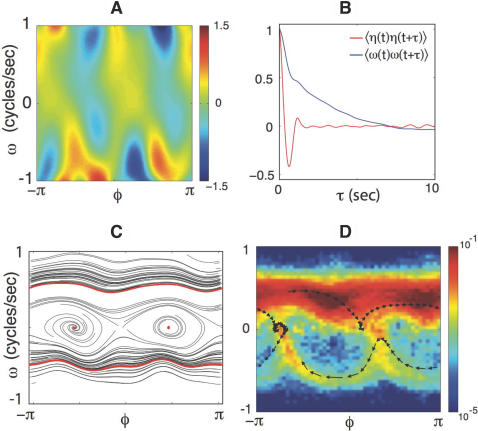
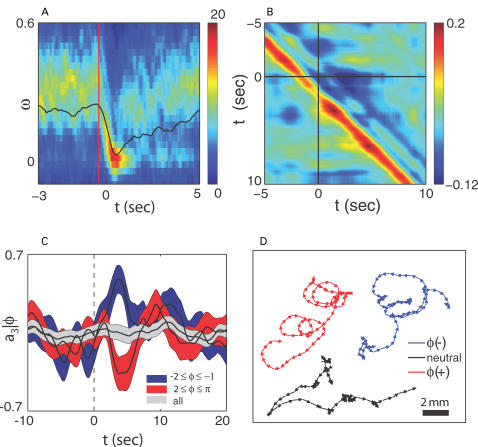
A major challenge in analyzing animal behavior is to discover some underlying simplicity in complex motor actions. Here, we show that the space of shapes adopted by the nematode Caenorhabditis elegans is low dimensional, with just four dimensions accounting for 95% of the shape variance. These dimensions provide a quantitative description of worm behavior, and we partially reconstruct "equations of motion" for the dynamics in this space. These dynamics have multiple attractors, and we find that the worm visits these in a rapid and almost completely deterministic response to weak thermal stimuli. Stimulus-dependent correlations among the different modes suggest that one can generate more reliable behaviors by synchronizing stimuli to the state of the worm in shape space. We confirm this prediction, effectively "steering" the worm in real time.
Overview
The claims and statistics of this paper haven’t been checked yet.
Run the check — free, no account needed. It reads the open-access text and checks the sources it cites.
Integrity signals
Registry
Cites
Statistics
Figures
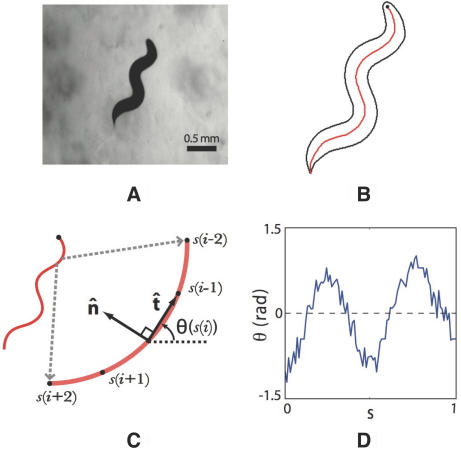
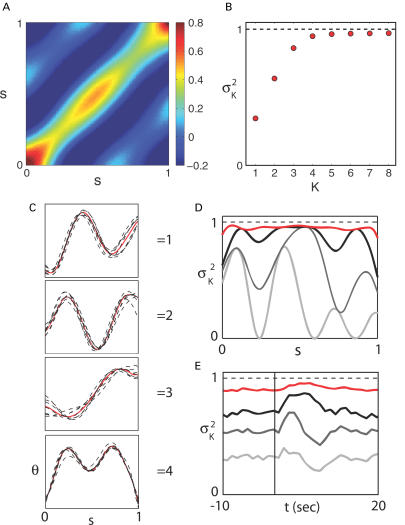
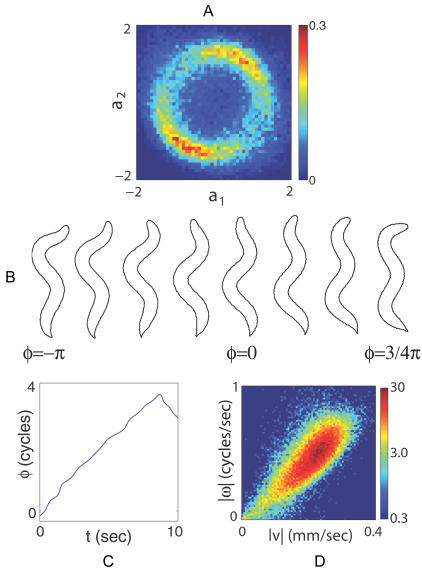
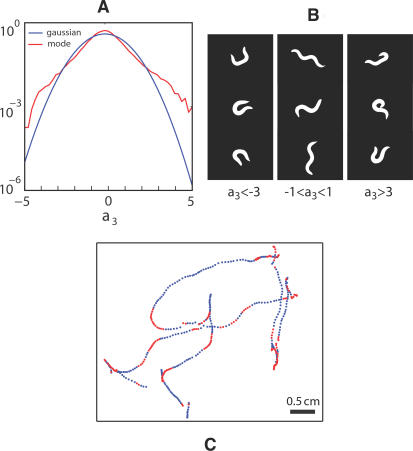
Verification
Claims the paper makes
The claims and statistics of this paper haven’t been checked yet.
Run the check — free, no account needed. It reads the open-access text and checks the sources it cites.
Claims other papers make about this one
Each is checked against this paper’s own text: does it say what the citing paper says it does?
The cited source says what the claim attributes to it.
In the citing paper
“fish larvae require only three basis functions to describe their backbone shapes, whereas worms analyzed in [18] required four.”
From The Behavioral Space of Zebrafish Locomotion and Its Neural Network Analog (2015) · cites this paper as [18]
The cited source says what the claim attributes to it.
In the citing paper
“A study of the invertebrate C. elegans by Stephens et al. [18] provided a powerful method to quantify worm locomotion in terms of the worm’s shapes.”
From The Behavioral Space of Zebrafish Locomotion and Its Neural Network Analog (2015) · cites this paper as [18]
The check wasn’t confident either way, so it gives no verdict — never disputed.
In the citing paper
“However, fish exhibit larger behavioral complexity.”
From The Behavioral Space of Zebrafish Locomotion and Its Neural Network Analog (2015) · cites this paper as [18]
Experimental — accuracy not yet measuredThe check wasn’t confident either way, so it gives no verdict — never disputed.
In the citing paper
“fish are stiffer than worms thanks to their backbone (see Fig 6D), leading to a smaller repertoire of accessible shapes of the fish backbone.”
From The Behavioral Space of Zebrafish Locomotion and Its Neural Network Analog (2015) · cites this paper as [18]
Experimental — accuracy not yet measured
Self-check
Percentages, sums and reported differences re-computed from the paper’s own numbers.
The self-check needs the paper’s full text.
Citations
Cites
THE GENETICS OF CAENORHABDITIS ELEGANS
Brenner, S. (1974) · Genetics · doi:10.1093/genetics/77.1.71 · Cited by 15,161
(1966) · Medical Entomology and Zoology · Cited by 10,293
Signal detection theory and psychophysics
Ingleby, D. (1967) · Journal of Sound and Vibration · doi:10.1016/0022-460x(67)90197-6 · Cited by 8,616
The structure of the nervous system of the nematode Caenorhabditis elegans
White, J. G., Southgate, E., Thomson, J. N., & Brenner, S. (1986) · Philosophical Transactions of the Royal Society of London. B, Biological Sciences · doi:10.1098/rstb.1986.0056 · Cited by 5,589
Genome Sequence of the Nematode C. elegans : A Platform for Investigating Biology
Berg, J. (1998) · Science · doi:10.1126/science.282.5396.2012 · Cited by 4,458
Stochastic Processes in Physics and Chemistry
Cercignani, C. (2005) · Elsevier eBooks · doi:10.1016/b0-12-369401-9/00623-9 · Cited by 2,143
Berg, H. C., & Purcell, E. M. (1977) · Biophysical Journal · doi:10.1016/s0006-3495(77)85544-6 · Cited by 1,758
Lectures on Classical Differential Geometry.
Springer, C. E., & Struik, D. J. (1952) · American Mathematical Monthly · doi:10.2307/2307130 · Cited by 1,370
Postural Hand Synergies for Tool Use
Santello, M., Flanders, M., & Soechting, J. F. (1998) · The Journal of Neuroscience · doi:10.1523/jneurosci.18-23-10105.1998 · Cited by 1,215
The neural and behavioural organization of goal-directed movements
Jeannerod, M. (1988) · Medical Entomology and Zoology · Cited by 1,164
The neural circuit for touch sensitivity in Caenorhabditis elegans
Chalfie, M., Sulston, J., White, J., Southgate, E., Thomson, J., & Brenner, S. (1985) · The Journal of Neuroscience · doi:10.1523/jneurosci.05-04-00956.1985 · Cited by 1,093
[Genetics of Caenorhabditis elegans].
Munakata, N. (1989) · PubMed · Cited by 886
A circuit for navigation in Caenorhabditis elegans
Gray, J. M., Hill, J. J., & Bargmann, C. I. (2005) · Proceedings of the National Academy of Sciences · doi:10.1073/pnas.0409009101 · Cited by 811
An excitable gene regulatory circuit induces transient cellular differentiation
Süel, G. M., García‐Ojalvo, J., Liberman, L. M., & Elowitz, M. B. (2006) · Nature · doi:10.1038/nature04588 · Cited by 714
THE DNA OF CAENORHABDITIS ELEGANS
Sulston, J., & Brenner, S. (1974) · Genetics · doi:10.1093/genetics/77.1.95 · Cited by 584
Ward, S. (1973) · Proceedings of the National Academy of Sciences · doi:10.1073/pnas.70.3.817 · Cited by 572
Normal and mutant thermotaxis in the nematode Caenorhabditis elegans.
Hedgecock, E. M., & Russell, R. L. (1975) · Proceedings of the National Academy of Sciences · doi:10.1073/pnas.72.10.4061 · Cited by 568
The Fundamental Role of Pirouettes in Caenorhabditis elegans Chemotaxis
Pierce-Shimomura, J. T., Morse, T. M., & Lockery, S. R. (1999) · Journal of Neuroscience · doi:10.1523/jneurosci.19-21-09557.1999 · Cited by 536
Berg, H. C. (2013) · Cited by 439
NEURONAL SUBSTRATES OF COMPLEX BEHAVIORS IN C. ELEGANS
de Bono, M., & Maricq, A. V. (2005) · Annual Review of Neuroscience · doi:10.1146/annurev.neuro.27.070203.144259 · Cited by 401
A sensory source for motor variation
Osborne, L. C., Lisberger, S. G., & Bialek, W. (2005) · Nature · doi:10.1038/nature03961 · Cited by 305
Self-citationCell Motility as Persistent Random Motion: Theories from Experiments
Selmeczi, D., Mosler, S., Hagedorn, P., Larsen, N. B., & Flyvbjerg, H. (2005) · Biophysical Journal · doi:10.1529/biophysj.105.061150 · Cited by 299
PHYSICAL LIMITS TO SENSATION AND PERCEPTION
Bialek, W. (1987) · Annual Review of Biophysics and Biophysical Chemistry · doi:10.1146/annurev.bb.16.060187.002323 · Cited by 237
Self-citationThermal avoidance in Caenorhabditis elegans : An approach to the study of nociception
Wittenburg, N., & Baumeister, R. (1999) · Proceedings of the National Academy of Sciences · doi:10.1073/pnas.96.18.10477 · Cited by 205
How to Quantify Deterministic and Random Influences on the Statistics of the Foreign Exchange Market
Friedrich, R., Peinke, J., & Renner, C. (2000) · Physical Review Letters · doi:10.1103/physrevlett.84.5224 · Cited by 205
Thermotaxis inCaenorhabditis elegansAnalyzed by Measuring Responses to Defined Thermal Stimuli
Ryu, W. S., & Samuel, A. D. T. (2002) · Journal of Neuroscience · doi:10.1523/jneurosci.22-13-05727.2002 · Cited by 197
Self-citationComponents and patterns in the behaviour of the nematode Caenorhabditis elegans
Croll, N. A. (1975) · Journal of Zoology · doi:10.1111/j.1469-7998.1975.tb03191.x · Cited by 184
An automated system for measuring parameters of nematode sinusoidal movement
Cronin, C. J., Mendel, J., Mukhtar, S., Kim, Y.-M., Stirbl, R. C., Bruck, J., & Sternberg, P. W. (2005) · BMC Genetics · doi:10.1186/1471-2156-6-5 · Cited by 180
Genetic and Cellular Analysis of Behavior in C. Elegans
Bargmann, C. I. (1993) · Annual Review of Neuroscience · doi:10.1146/annurev.ne.16.030193.000403 · Cited by 152
Human Arm Movements Described by a Low-Dimensional Superposition of Principal Components
Sanger, T. D. (2000) · Journal of Neuroscience · doi:10.1523/jneurosci.20-03-01066.2000 · Cited by 109
Step-Response Analysis of Chemotaxis inCaenorhabditis elegans
Miller, A. C., Thiele, T. R., Faumont, S., Moravec, M. L., & Lockery, S. R. (2005) · Journal of Neuroscience · doi:10.1523/jneurosci.5133-04.2005 · Cited by 105
Conservation rules, their breakdown, and optimality in Caenorhabditis sinusoidal locomotion
Karbowski, J., Cronin, C. J., Seah, A., Mendel, J. E., Cleary, D., & Sternberg, P. W. (2006) · Journal of Theoretical Biology · doi:10.1016/j.jtbi.2006.04.012 · Cited by 97
Sensorimotor control during isothermal tracking in Caenorhabditis elegans
Luo, L., Clark, D. A., Biron, D., Mahadevan, L., & Samuel, A. D. T. (2006) · Journal of Experimental Biology · doi:10.1242/jeb.02590 · Cited by 75
Machine vision based detection of omega bends and reversals in C. elegans
Huang, K.-M., Cosman, P. C., & Schafer, W. R. (2006) · Journal of Neuroscience Methods · doi:10.1016/j.jneumeth.2006.06.007 · Cited by 75
Quantitative Classification and Natural Clustering of Caenorhabditis elegans Behavioral Phenotypes
Geng, W., Cosman, P. C., Baek, J.-H., Berry, C. C., & Schafer, W. R. (2003) · Genetics · doi:10.1093/genetics/165.3.1117 · Cited by 71
Kernel Principal Component Analysis and the construction of non-linear Active Shape Models
Twining, C., & Taylor, C. (2001) · British Machine Vision Conference (BMVC) · doi:10.5244/c.15.4 · Cited by 69
Low dimensionality of supraspinally induced force fields
d’Avella, A., & Bizzi, E. (1998) · Proceedings of the National Academy of Sciences · doi:10.1073/pnas.95.13.7711 · Cited by 65
A Computational Model forC. elegansLocomotory Behavior: Application to Multiworm Tracking
Roussel, N., Morton, C. A., Finger, F. P., & Roysam, B. (2007) · IEEE Transactions on Biomedical Engineering · doi:10.1109/tbme.2007.894981 · Cited by 63
Faumont, S., & Lockery, S. R. (2005) · Journal of Neurophysiology · doi:10.1152/jn.01050.2005 · Cited by 61
Step Response Analysis of Thermotaxis inCaenorhabditis elegans
Zariwala, H. A., Miller, A. C., Faumont, S., & Lockery, S. R. (2003) · Journal of Neuroscience · doi:10.1523/jneurosci.23-10-04369.2003 · Cited by 61
Influence of odorant receptor repertoire on odor perception in humans and fruit flies
Keller, A., & Vosshall, L. B. (2007) · Proceedings of the National Academy of Sciences · doi:10.1073/pnas.0605321104 · Cited by 60
Lectures on classical differential geometry
Struik, D. J. (1988) · CERN Document Server (European Organization for Nuclear Research) · Cited by 50
Computer-driven automatic identification of locomotion states in Caenorhabditis elegans
Hoshi, K., & Shingai, R. (2006) · Journal of Neuroscience Methods · doi:10.1016/j.jneumeth.2006.05.002 · Cited by 40
Effects of aging on habituation in the nematode Caenorhabditis elegans
Beck, C., & Rankin, C. H. (1993) · Behavioural Processes · doi:10.1016/0376-6357(93)90088-9 · Cited by 34
Langevin equations from time series
Racca, E., & Porporato, A. M. (2005) · Physical Review E · doi:10.1103/physreve.71.027101 · Cited by 8
Research works printed but not linked: 1
- J Frenet, 1985, Sur quelque properietès des courbes á double courbure. Thèse, Toulouse, 1847., Abstract in Jour de Math, 17, 437
Cited by
Sorted by citations
Whole-animal connectomes of both Caenorhabditis elegans sexes
Cook, S. J., Jarrell, T. A., Brittin, C. A., Wang, Y., Bloniarz, A. E., Yakovlev, M. A., Nguyen, K. C. Q., Tang, L. T.-H., Bayer, E. A., Duerr, J. S., et al. (2019) · Nature · doi:10.1038/s41586-019-1352-7 · Cited by 921
Mapping Sub-Second Structure in Mouse Behavior
Wiltschko, A. B., Johnson, M. J., Iurilli, G., Peterson, R. E., Katon, J. M., Pashkovski, S. L., Abraira, V. E., Adams, R. P., & Datta, S. R. (2015) · Neuron · doi:10.1016/j.neuron.2015.11.031 · Cited by 760
Mapping the stereotyped behaviour of freely moving fruit flies
Berman, G. J., Choi, D. M., Bialek, W., & Shaevitz, J. W. (2014) · Journal of The Royal Society Interface · doi:10.1098/rsif.2014.0672 · Cited by 565
Self-citationGlobal Brain Dynamics Embed the Motor Command Sequence of Caenorhabditis elegans
Kato, S., Kaplan, H. S., Schrödel, T., Skora, S., Lindsay, T. H., Yemini, E., Lockery, S. R., & Zimmer, M. (2015) · Cell · doi:10.1016/j.cell.2015.09.034 · Cited by 536
High-throughput behavioral analysis in C. elegans
Swierczek, N. A., Giles, A. C., Rankin, C. H., & Kerr, R. A. (2011) · Nature Methods · doi:10.1038/nmeth.1625 · Cited by 460
Metadata
- Authors
- Stephens, G. J., Johnson-Kerner, B., Bialek, W., & Ryu, W. S.
- Affiliations
- Princeton University (US)
- Corresponding author
- Stephens, Greg J.
- Ryu, William S.
- Venue
- PLoS Computational Biology
- Publisher
- Public Library of Science (PLoS)
- Published
- 2008-04-25
- Volume
- 4
- Issue
- 4
- Pages
- e1000028
- ISSN
- 1553-734X (ISSN-L)
- 1553-7358
- PMC
- PMC2276863
- OpenAlex
- W2142254043
- Cited by
- 509
- References
- 45
- Citations by year
- 2026: 28 · 2025: 28 · 2024: 41 · 2023: 31 · 2022: 38 · 2021: 47 · 2020: 45 · 2019: 48 · 2018: 29 · 2017: 26 · 2016: 22 · 2015: 23 · 2014: 19 · 2013: 19 · 2012: 24
- FWCI
- 5.91
- Type
- journal article
- Language
- en
- Open access
- gold
- doi.org
- Locations
- PLoS Computational Biology (publishedVersion, cc-by)
- PubMed Central (publishedVersion, cc-by)
- PubMed (publishedVersion)
- VU Research Portal (publishedVersion, other-oa)
- arXiv (Cornell University) (submittedVersion)
- RePEc: Research Papers in Economics (submittedVersion)
- DOAJ (DOAJ: Directory of Open Access Journals) (submittedVersion, cc-by-sa)
- Data Archiving and Networked Services (DANS) (submittedVersion, other-oa)
- arXiv (Cornell University)
- Topics
- Life Sciences › Neuroscience › Cellular and Molecular Neuroscience › Neurobiology and Insect Physiology Research
- Physical Sciences › Engineering › Mechanical Engineering › Advanced Materials and Mechanics
- Life Sciences › Neuroscience › Cognitive Neuroscience › Motor Control and Adaptation
- Keywords
- Caenorhabditis elegans, worm locomotion, body shape, equations of motion, attractors, thermal stimuli, behavioral synchronization
- MeSH terms
- Animals, Behavior, Animal, Computer Simulation, Gait, Locomotion, Models, Biological, Caenorhabditis elegans
About these checks
Registry, retraction, Cites and statistics results are computed, not judged, with one exception: a printed reference that no index lists is read once by a model before it counts as a citation error. Claims are extracted by a model and kept only when their quote appears verbatim in the text; each cited source is then checked, with a model’s help, for whether it says what the claim relies on. Those verdicts can be wrong — read the claim’s quote and the cited source before relying on one.
Statistics and arithmetic are recomputed, not judged.
Confidence bands are shown only for fields calibrated on our annotated test set. None is calibrated yet, so no band is shown.
What counts as a claim ›How we measure confidence ›How we check this ›
Are you an author, or do you see a problem with this page? Request a review
