

The DOI matches its Crossref record; 45 of the 45 references it cites were found in a registry or an index.
Dimensionality and Dynamics in the Behavior of C. elegans
Open accessAbstract
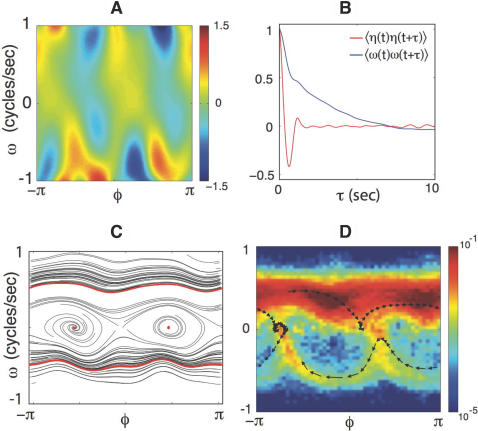
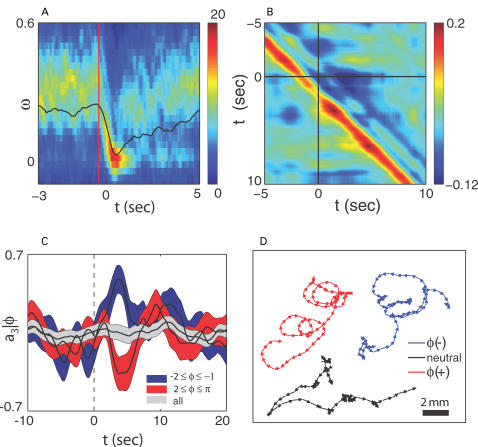
A major challenge in analyzing animal behavior is to discover some underlying simplicity in complex motor actions. Here, we show that the space of shapes adopted by the nematode Caenorhabditis elegans is low dimensional, with just four dimensions accounting for 95% of the shape variance. These dimensions provide a quantitative description of worm behavior, and we partially reconstruct "equations of motion" for the dynamics in this space. These dynamics have multiple attractors, and we find that the worm visits these in a rapid and almost completely deterministic response to weak thermal stimuli. Stimulus-dependent correlations among the different modes suggest that one can generate more reliable behaviors by synchronizing stimuli to the state of the worm in shape space. We confirm this prediction, effectively "steering" the worm in real time.
Overview
The claims and statistics of this paper haven’t been checked yet.
Run the check — free, no account needed. It reads the open-access text and checks the sources it cites.
Integrity signals
Registry
Cites
Statistics
Figures
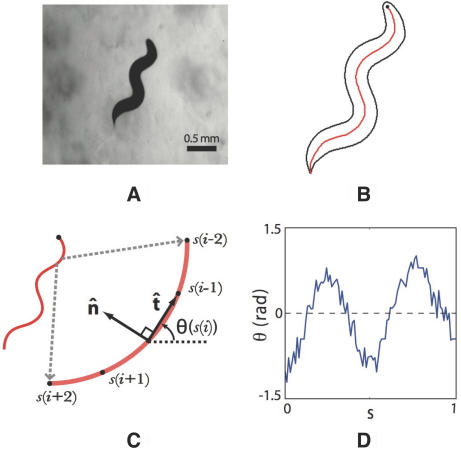
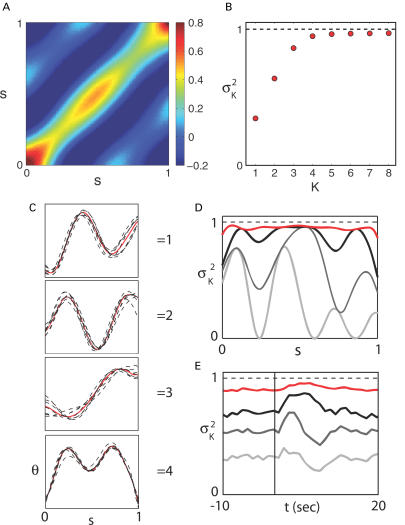
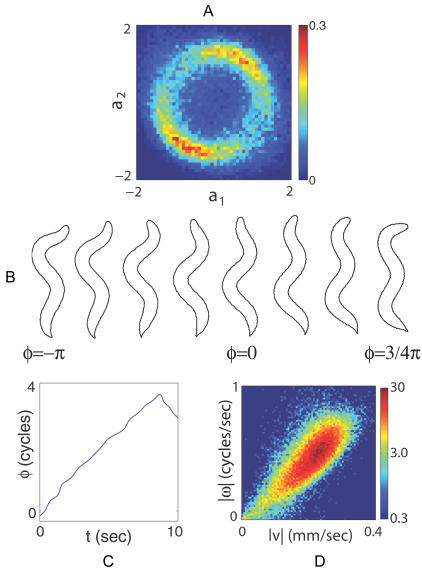
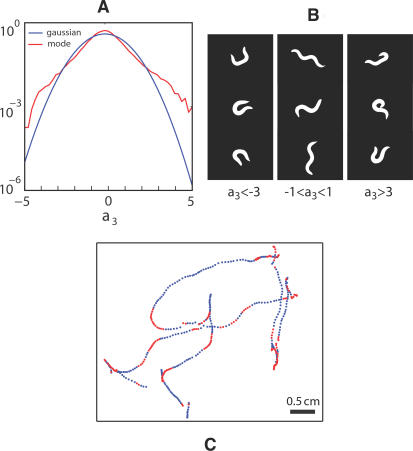
Verification
Claims the paper makes
The claims and statistics of this paper haven’t been checked yet.
Run the check — free, no account needed. It reads the open-access text and checks the sources it cites.
Claims other papers make about this one
Each is checked against this paper’s own text: does it say what the citing paper says it does?
The cited source says what the claim attributes to it.
In the citing paper
“fish larvae require only three basis functions to describe their backbone shapes, whereas worms analyzed in [18] required four.”
From The Behavioral Space of Zebrafish Locomotion and Its Neural Network Analog (2015) · cites this paper as [18]
The cited source says what the claim attributes to it.
In the citing paper
“A study of the invertebrate C. elegans by Stephens et al. [18] provided a powerful method to quantify worm locomotion in terms of the worm’s shapes.”
From The Behavioral Space of Zebrafish Locomotion and Its Neural Network Analog (2015) · cites this paper as [18]
The check wasn’t confident either way, so it gives no verdict — never disputed.
In the citing paper
“However, fish exhibit larger behavioral complexity.”
From The Behavioral Space of Zebrafish Locomotion and Its Neural Network Analog (2015) · cites this paper as [18]
Experimental — accuracy not yet measuredThe check wasn’t confident either way, so it gives no verdict — never disputed.
In the citing paper
“fish are stiffer than worms thanks to their backbone (see Fig 6D), leading to a smaller repertoire of accessible shapes of the fish backbone.”
From The Behavioral Space of Zebrafish Locomotion and Its Neural Network Analog (2015) · cites this paper as [18]
Experimental — accuracy not yet measured
Self-check
Percentages, sums and reported differences re-computed from the paper’s own numbers.
The self-check needs the paper’s full text.
Citations
Cites
THE GENETICS OF CAENORHABDITIS ELEGANS
Brenner, S. (1974) · Genetics · doi:10.1093/genetics/77.1.71 · Cited by 15,161
(1966) · Medical Entomology and Zoology · Cited by 10,293
Signal detection theory and psychophysics
Ingleby, D. (1967) · Journal of Sound and Vibration · doi:10.1016/0022-460x(67)90197-6 · Cited by 8,616
The structure of the nervous system of the nematode Caenorhabditis elegans
White, J. G., Southgate, E., Thomson, J. N., & Brenner, S. (1986) · Philosophical Transactions of the Royal Society of London. B, Biological Sciences · doi:10.1098/rstb.1986.0056 · Cited by 5,589
Genome Sequence of the Nematode C. elegans : A Platform for Investigating Biology
Berg, J. (1998) · Science · doi:10.1126/science.282.5396.2012 · Cited by 4,458
Stochastic Processes in Physics and Chemistry
Cercignani, C. (2005) · Elsevier eBooks · doi:10.1016/b0-12-369401-9/00623-9 · Cited by 2,143
Berg, H. C., & Purcell, E. M. (1977) · Biophysical Journal · doi:10.1016/s0006-3495(77)85544-6 · Cited by 1,758
Lectures on Classical Differential Geometry.
Springer, C. E., & Struik, D. J. (1952) · American Mathematical Monthly · doi:10.2307/2307130 · Cited by 1,370
Postural Hand Synergies for Tool Use
Santello, M., Flanders, M., & Soechting, J. F. (1998) · The Journal of Neuroscience · doi:10.1523/jneurosci.18-23-10105.1998 · Cited by 1,215
The neural and behavioural organization of goal-directed movements
Jeannerod, M. (1988) · Medical Entomology and Zoology · Cited by 1,164
Research works printed but not linked: 1
- J Frenet, 1985, Sur quelque properietès des courbes á double courbure. Thèse, Toulouse, 1847., Abstract in Jour de Math, 17, 437
Cited by
Sorted by citations
Whole-animal connectomes of both Caenorhabditis elegans sexes
Cook, S. J., Jarrell, T. A., Brittin, C. A., Wang, Y., Bloniarz, A. E., Yakovlev, M. A., Nguyen, K. C. Q., Tang, L. T.-H., Bayer, E. A., Duerr, J. S., et al. (2019) · Nature · doi:10.1038/s41586-019-1352-7 · Cited by 921
Mapping Sub-Second Structure in Mouse Behavior
Wiltschko, A. B., Johnson, M. J., Iurilli, G., Peterson, R. E., Katon, J. M., Pashkovski, S. L., Abraira, V. E., Adams, R. P., & Datta, S. R. (2015) · Neuron · doi:10.1016/j.neuron.2015.11.031 · Cited by 760
Mapping the stereotyped behaviour of freely moving fruit flies
Berman, G. J., Choi, D. M., Bialek, W., & Shaevitz, J. W. (2014) · Journal of The Royal Society Interface · doi:10.1098/rsif.2014.0672 · Cited by 565
Self-citationGlobal Brain Dynamics Embed the Motor Command Sequence of Caenorhabditis elegans
Kato, S., Kaplan, H. S., Schrödel, T., Skora, S., Lindsay, T. H., Yemini, E., Lockery, S. R., & Zimmer, M. (2015) · Cell · doi:10.1016/j.cell.2015.09.034 · Cited by 536
High-throughput behavioral analysis in C. elegans
Swierczek, N. A., Giles, A. C., Rankin, C. H., & Kerr, R. A. (2011) · Nature Methods · doi:10.1038/nmeth.1625 · Cited by 460
Computational Neuroethology: A Call to Action
Datta, S. R., Anderson, D. J., Branson, K., Perona, P., & Leifer, A. (2019) · Neuron · doi:10.1016/j.neuron.2019.09.038 · Cited by 453
Whole-brain calcium imaging with cellular resolution in freely behaving Caenorhabditis elegans
Nguyen, J. P., Shipley, F. B., Linder, A. N., Plummer, G. S., Liu, M., Setru, S. U., Shaevitz, J. W., & Leifer, A. M. (2015) · Proceedings of the National Academy of Sciences · doi:10.1073/pnas.1507110112 · Cited by 398
Brain-wide mapping of neural activity controlling zebrafish exploratory locomotion
Dunn, T. W., Mu, Y., Narayan, S., Randlett, O., Naumann, E. A., Yang, C.-T., Schier, A. F., Freeman, J., Engert, F., & Ahrens, M. B. (2016) · eLife · doi:10.7554/elife.12741 · Cited by 312
Network control principles predict neuron function in the Caenorhabditis elegans connectome
Yan, G. F., Vértes, P. E., Towlson, E. K., Chew, Y. L., Walker, D. S., Schafer, W. R., & Barabási, A.-Ĺ. (2017) · Nature · doi:10.1038/nature24056 · Cited by 331
Quantifying behavior to understand the brain
Pereira, T., Shaevitz, J. W., & Murthy, M. (2020) · Nature Neuroscience · doi:10.1038/s41593-020-00734-z · Cited by 323
Neural circuit policies enabling auditable autonomy
Lechner, M., Hasani, R., Amini, A., Henzinger, T. A., Rus, D. L., & Grosu, R. (2020) · Nature Machine Intelligence · doi:10.1038/s42256-020-00237-3 · Cited by 330
A database of Caenorhabditis elegans behavioral phenotypes
Yemini, E., Jucikas, T., Grundy, L. J., Brown, A. E., & Schafer, W. R. (2013) · Nature Methods · doi:10.1038/nmeth.2560 · Cited by 309
Big behavioral data: psychology, ethology and the foundations of neuroscience
Gómez-Marín, À., Paton, J. J., Kampff, A. R., Costa, R. M., & Mainen, Z. F. (2014) · Nature Neuroscience · doi:10.1038/nn.3812 · Cited by 296
B-SOiD, an open-source unsupervised algorithm for identification and fast prediction of behaviors
Hsu, A. I., & Yttri, E. A. (2021) · Nature Communications · doi:10.1038/s41467-021-25420-x · Cited by 312
Structure of the Zebrafish Locomotor Repertoire Revealed with Unsupervised Behavioral Clustering
Marques, J. C., Lackner, S., Félix, R., & Orger, M. B. (2018) · Current Biology · doi:10.1016/j.cub.2017.12.002 · Cited by 245
Aguilar, J., Zhang, T., Qian, F., Kingsbury, M., McInroe, B. W., Mazouchova, N., Li, C., Maladen, R. D., Gong, C., Travers, M. J., et al. (2016) · Reports on Progress in Physics · doi:10.1088/0034-4885/79/11/110001 · Cited by 295
Parameter Space Compression Underlies Emergent Theories and Predictive Models
Machta, B. B., Chachra, R., Transtrum, M. K., & Sethna, J. P. (2013) · Science · doi:10.1126/science.1238723 · Cited by 288
Active sampling and decision making in Drosophila chemotaxis
Gómez-Marín, À., Stephens, G. J., & Louis, M. (2011) · Nature Communications · doi:10.1038/ncomms1455 · Cited by 255
Self-citationPan-neuronal imaging in roaming Caenorhabditis elegans
Venkatachalam, V., Ji, N., Wang, X., Clark, C., Mitchell, J. K., Klein, M., Tabone, C. J., Florman, J., Ji, H., Greenwood, J. S. F., et al. (2015) · Proceedings of the National Academy of Sciences · doi:10.1073/pnas.1507109113 · Cited by 247
Pan-neuronal calcium imaging with cellular resolution in freely swimming zebrafish
Kim, D. H., Kim, J., Marques, J. C., Grama, A., Hildebrand, D. G. C., Gu, W., Li, J. M., & Robson, D. N. (2017) · Nature Methods · doi:10.1038/nmeth.4429 · Cited by 228
Challenges and solutions for studying collective animal behaviour in the wild
Hughey, L. F., Hein, A. M., Strandburg‐Peshkin, A., & Jensen, F. H. (2018) · Philosophical Transactions of the Royal Society B Biological Sciences · doi:10.1098/rstb.2017.0005 · Cited by 229
Stirman, J. N., Crane, M. M., Husson, S. J., Wabnig, S., Schultheis, C., GOTTSCHALK, A. R., & Lu, H. (2011) · Nature Methods · doi:10.1038/nmeth.1555 · Cited by 219
Geometric deep learning enables 3D kinematic profiling across species and environments
Dunn, T., Marshall, J. D., Severson, K. S., Aldarondo, D. E., Hildebrand, D. G. C., Chettih, S. N., Wang, W. L., Gellis, A., Carlson, D., Aronov, D., et al. (2021) · Nature Methods · doi:10.1038/s41592-021-01106-6 · Cited by 206
Optogenetic analysis of synaptic function
Liewald, J. F., Brauner, M., Stephens, G. J., Bouhours, M., Schultheis, C., Zhen, M., & GOTTSCHALK, A. R. (2008) · Nature Methods · doi:10.1038/nmeth.1252 · Cited by 201
Self-citationComputational Analysis of Behavior
Egnor, S. E. R., & Branson, K. M. (2016) · Annual Review of Neuroscience · doi:10.1146/annurev-neuro-070815-013845 · Cited by 200
Biomechanical analysis of gait adaptation in the nematode Caenorhabditis elegans
Fang-Yen, C., Wyart, M., Xie, J., Kawai, R., Kodger, T., Chen, S., Wen, Q., & Samuel, A. D. T. (2010) · Proceedings of the National Academy of Sciences · doi:10.1073/pnas.1003016107 · Cited by 200
Garrity, P. A., Goodman, M. B., Samuel, A. D., & Sengupta, P. (2010) · Genes & Development · doi:10.1101/gad.1953710 · Cited by 197
Physical manipulation of the Escherichia coli chromosome reveals its soft nature
Pelletier, J. F., Halvorsen, K., Ha, B., Paparcone, R., Sandler, S. J., Woldringh, C., Wong, W. P., & Jun, S. (2012) · Proceedings of the National Academy of Sciences of the United States of America · doi:10.1073/pnas.1208689109 · Cited by 200
Brown, A. E., Yemini, E., Grundy, L. J., Jucikas, T., & Schafer, W. R. (2012) · Proceedings of the National Academy of Sciences · doi:10.1073/pnas.1211447110 · Cited by 186
Measuring behavior across scales
Berman, G. J. (2018) · BMC Biology · doi:10.1186/s12915-018-0494-7 · Cited by 194
Ethology as a physical science
Brown, A. E., & de Bivort, B. L. (2018) · Nature Physics · doi:10.1038/s41567-018-0093-0 · Cited by 171
Probabilistic Models of Larval Zebrafish Behavior Reveal Structure on Many Scales
Johnson, R. E., Linderman, S. W., Panier, T., Wee, C. L., Song, E. Y., Herrera, K. J., Miller, A. T., & Engert, F. (2019) · Current Biology · doi:10.1016/j.cub.2019.11.026 · Cited by 166
Restif, C., Ibáñez‐Ventoso, C., Vora, M., Guo, S., Metaxas, D., & Driscoll, M. (2014) · PLoS Computational Biology · doi:10.1371/journal.pcbi.1003702 · Cited by 155
Big behavior: challenges and opportunities in a new era of deep behavior profiling
von Ziegler, L., Sturman, O., & Bohacek, J. (2020) · Neuropsychopharmacology · doi:10.1038/s41386-020-0751-7 · Cited by 162
Continuous Whole-Body 3D Kinematic Recordings across the Rodent Behavioral Repertoire
Marshall, J. D., Aldarondo, D. E., Dunn, T., Wang, W. L., Berman, G. J., & Ölveczky, B. P. (2020) · Neuron · doi:10.1016/j.neuron.2020.11.016 · Cited by 142
Deconstructing Hunting Behavior Reveals a Tightly Coupled Stimulus-Response Loop
Mearns, D. S., Donovan, J. C., Fernandes, A. M., Semmelhack, J. L., & Baier, H. (2019) · Current Biology · doi:10.1016/j.cub.2019.11.022 · Cited by 156
An open-source platform for analyzing and sharing worm-behavior data
Javer, A., Currie, M., Lee, C. W., Hokanson, J., Li, K., Martineau, C. N., Yemini, E., Grundy, L. J., Li, C., Ch'ng, Q.-L., et al. (2018) · Nature Methods · doi:10.1038/s41592-018-0112-1 · Cited by 151
ZebraZoom: an automated program for high-throughput behavioral analysis and categorization
Mirat, O., Sternberg, J. R., Severi, K. E., & Wyart, C. (2013) · Frontiers in Neural Circuits · doi:10.3389/fncir.2013.00107 · Cited by 143
BiPOLES is an optogenetic tool developed for bidirectional dual-color control of neurons
Vierock, J., Rodriguez-Rozada, S., Dieter, A., Pieper, F., Sims, R. R., Tenedini, F. M., Bergs, A. C. F., Bendifallah, I., Zhou, F., Zeitzschel, N., et al. (2021) · Nature Communications · doi:10.1038/s41467-021-24759-5 · Cited by 152
Cellular Contact Guidance through Dynamic Sensing of Nanotopography
Driscoll, M., Sun, X., Güven, C., Fourkas, J. T., & Losert, W. (2014) · ACS Nano · doi:10.1021/nn406637c · Cited by 141
Navigational Decision Making in Drosophila Thermotaxis
Luo, L., Gershow, M. H., Rosenzweig, M. R., Kang, K., Fang-Yen, C. M., Garrity, P., & Samuel, A. D. T. (2010) · Journal of Neuroscience · doi:10.1523/jneurosci.4090-09.2010 · Cited by 143
Glauser, D. A., Chen, W. C., Agin, R., MacInnis, B. L., Hellman, A. B., Garrity, P., Tan, M., & Goodman, M. B. (2011) · Genetics · doi:10.1534/genetics.111.127100 · Cited by 131
Keeping track of worm trackers
Husson, S. J. (2012) · WormBook · doi:10.1895/wormbook.1.156.1 · Cited by 132
Reverse engineering the euglenoid movement
Arroyo, M., Heltai, L., Millán, D., & DeSimone, A. (2012) · Proceedings of the National Academy of Sciences · doi:10.1073/pnas.1213977109 · Cited by 114
Stochastic nonlinear dynamics of confined cell migration in two-state systems
Brückner, D. B., Fink, A., Schreiber, C., Röttgermann, P. J. F., Rädler, J. O., & Broedersz, C. P. (2019) · Nature Physics · doi:10.1038/s41567-019-0445-4 · Cited by 122
Systems Neuroscience of Natural Behaviors in Rodents
Dennis, E. J., Hady, A. E., Michaiel, A. M., Clemens, A. M., Tervo, D. G. R., Voigts, J., & Datta, S. R. (2020) · Journal of Neuroscience · doi:10.1523/jneurosci.1877-20.2020 · Cited by 116
Paveley, R. A., Mansour, N. R., Hallyburton, I., Bleicher, L. S., Benn, A. E., Mikic, I., Guidi, A., Gilbert, I. H., Hopkins, A. L., & Bickle, Q. D. (2012) · PLoS neglected tropical diseases · doi:10.1371/journal.pntd.0001762 · Cited by 113
The zebrafish subcortical social brain as a model for studying social behavior disorders
Geng, Y., & Peterson, R. T. (2019) · Disease Models & Mechanisms · doi:10.1242/dmm.039446 · Cited by 117
Roberts, W. M., Augustine, S. B., Lawton, K. J., Lindsay, T. H., Thiele, T. R., Izquierdo, E. J., Faumont, S., Lindsay, R. A., Britton, M. C., Pokala, N., et al. (2016) · eLife · doi:10.7554/elife.12572 · Cited by 108
Caenorhabditis elegans: a model system for systems neuroscience
Sengupta, P., & Samuel, A. D. T. (2009) · Current Opinion in Neurobiology · doi:10.1016/j.conb.2009.09.009 · Cited by 109
Ristroph, L., Berman, G. J., Bergou, A. J., Wang, Z. J., & Cohen, I. (2009) · Journal of Experimental Biology · doi:10.1242/jeb.025502 · Cited by 108
Human sperm steer with second harmonics of the flagellar beat
Saggiorato, G., Alvarez, L., Jikeli, J. F., Kaupp, U. B., Gompper, G., & Elgeti, J. (2017) · Nature Communications · doi:10.1038/s41467-017-01462-y · Cited by 106
Modulation of orthogonal body waves enables high maneuverability in sidewinding locomotion
Astley, H. C., Gong, C., Dai, J. Y., Travers, M. J., Serrano, M. M., Vela, P. A., Choset, H., MENDELSON, J. R. I., Hu, D. L., & Goldman, D. I. (2015) · Proceedings of the National Academy of Sciences · doi:10.1073/pnas.1418965112 · Cited by 105
Luo, L., Cook, N., Venkatachalam, V., Martinez-Velazquez, L., Zhang, X., Calvo, A. C., Hawk, J. D., MacInnis, B. L., Frank, M. M., Ng, J. H. R., et al. (2014) · Proceedings of the National Academy of Sciences · doi:10.1073/pnas.1315205111 · Cited by 102
Learning Force Fields from Stochastic Trajectories
Frishman, A., & Ronceray, P. (2020) · Physical Review X · doi:10.1103/physrevx.10.021009 · Cited by 104
Deep attention networks reveal the rules of collective motion in zebrafish
Heras, F. J. H., Romero-Ferrero, F., Hinz, R. C., & de Polavieja, G. G. (2019) · PLoS Computational Biology · doi:10.1371/journal.pcbi.1007354 · Cited by 103
Automatically tracking neurons in a moving and deforming brain
Nguyen, J. P., Linder, A. N., Plummer, G. S., Shaevitz, J. W., & Leifer, A. M. (2017) · PLoS Computational Biology · doi:10.1371/journal.pcbi.1005517 · Cited by 96
Vortex arrays and ciliary tangles underlie the feeding–swimming trade-off in starfish larvae
Gilpin, W., Prakash, V. N., & Prakash, M. (2016) · Nature Physics · doi:10.1038/nphys3981 · Cited by 102
Xian, B., Shen, J., Chen, W., Sun, N., Qiao, N., Jiang, D., Yu, T., Men, Y., Han, Z., Pang, Y., et al. (2013) · Aging Cell · doi:10.1111/acel.12063 · Cited by 106
Intermittent Motion in Desert Locusts: Behavioural Complexity in Simple Environments
Bazazi, S., Bartumeus, F., Hale, J. J., & Couzin, I. D. (2012) · PLoS Computational Biology · doi:10.1371/journal.pcbi.1002498 · Cited by 101
Active sensation during orientation behavior in the Drosophila larva: more sense than luck
Gómez-Marín, À., & Louis, M. (2011) · Current Opinion in Neurobiology · doi:10.1016/j.conb.2011.11.008 · Cited by 101
Wang, W., Douglas, D. L., Zhang, J., Kumari, S., Enuameh, M. S., Dai, Y., Wallace, C. T., Watkins, S. C., Shu, W., & Xing, J. (2020) · Science Advances · doi:10.1126/sciadv.aba9319 · Cited by 91
Viscoelastic properties of the nematode Caenorhabditis elegans , a self-similar, shear-thinning worm
Backholm, M., Ryu, W. S., & Dalnoki-Veress, K. (2013) · Proceedings of the National Academy of Sciences · doi:10.1073/pnas.1219965110 · Cited by 94
Self-citationEmergence of long timescales and stereotyped behaviors in Caenorhabditis elegans
Stephens, G. J., de Mesquita, M. B., Ryu, W. S., & Bialek, W. (2011) · Proceedings of the National Academy of Sciences · doi:10.1073/pnas.1007868108 · Cited by 89
Self-citationC. elegans Positive Butanone Learning, Short-term, and Long-term Associative Memory Assays
Kauffman, A., Parsons, L. R., Stein, G. M., Wills, A. A., Kaletsky, R. L., & Murphy, C. T. (2011) · Journal of Visualized Experiments · doi:10.3791/2490 · Cited by 92
Anticipation of temporally structured events in the brain
Lee, C. S., Aly, M., & Baldassano, C. A. (2021) · eLife · doi:10.7554/elife.64972 · Cited by 91
The surveillance state of behavioral automation
Schaefer, A. T., & Claridge‐Chang, A. (2011) · Current Opinion in Neurobiology · doi:10.1016/j.conb.2011.11.004 · Cited by 90
Javer, A., Ripoll-Sánchez, L., & Brown, A. E. (2018) · Philosophical Transactions of the Royal Society B Biological Sciences · doi:10.1098/rstb.2017.0375 · Cited by 95
Biderman, D., Whiteway, M. R., Hurwitz, C., Greenspan, N., Lee, R. S., Vishnubhotla, A., Warren, R., Pedraja, F., Noone, D., Schartner, M. M., et al. (2024) · Nature Methods · doi:10.1038/s41592-024-02319-1 · Cited by 100
Resolving coiled shapes reveals new reorientation behaviors in C. elegans
Broekmans, O. D., Rodgers, J. B., Ryu, W. S., & Stephens, G. J. (2016) · eLife · doi:10.7554/elife.17227 · Cited by 81
Self-citationInferring the Dynamics of Underdamped Stochastic Systems
Brückner, D. B., Ronceray, P., & Broedersz, C. P. (2020) · Physical Review Letters · doi:10.1103/physrevlett.125.058103 · Cited by 85
Capturing the continuous complexity of behaviour in Caenorhabditis elegans
Ahamed, T., Costa, A. C., & Stephens, G. J. (2020) · Nature Physics · doi:10.1038/s41567-020-01036-8 · Cited by 80
Self-citationThe Geometry of Locomotive Behavioral States in C. elegans
Gallagher, T., Bjorness, T., Greene, R., You, Y.-J., & Avery, L. (2013) · PLoS ONE · doi:10.1371/journal.pone.0059865 · Cited by 85
Cermak, N., Yu, S. K., Clark, R., Huang, Y.-C., Baskoylu, S., & Flavell, S. W. (2020) · eLife · doi:10.7554/elife.57093 · Cited by 80
Decision-making behaviors: weighing ethology, complexity, and sensorimotor compatibility
Juavinett, A. L., Erlich, J. C., & Churchland, A. K. (2018) · Current Opinion in Neurobiology · doi:10.1016/j.conb.2017.11.001 · Cited by 82
Learning the dynamics of cell–cell interactions in confined cell migration
Brückner, D. B., Arlt, N., Fink, A., Ronceray, P., Rädler, J. O., & Broedersz, C. P. (2021) · Proceedings of the National Academy of Sciences · doi:10.1073/pnas.2016602118 · Cited by 82
Gómez-Marín, À., Partoune, N., Stephens, G. J., & Louis, M. (2012) · PLoS ONE · doi:10.1371/journal.pone.0041642 · Cited by 88
Self-citationIwanir, S., Tramm, N., Nagy, S., Wright, C. W., Ish, D., & Biron, D. (2013) · SLEEP · doi:10.5665/sleep.2456 · Cited by 78
Han, S., Taralova, E. H., Dupré, C., & Yuste, R. (2018) · eLife · doi:10.7554/elife.32605 · Cited by 79
Mechanisms of odor-tracking: multiple sensors for enhanced perception and behavior
Gómez-Marín, À. (2010) · Frontiers in Cellular Neuroscience · doi:10.3389/fncel.2010.00006 · Cited by 74
Adaptive, locally linear models of complex dynamics
Costa, A. C., Ahamed, T., & Stephens, G. J. (2019) · Proceedings of the National Academy of Sciences · doi:10.1073/pnas.1813476116 · Cited by 72
Self-citationMechanical intelligence simplifies control in terrestrial limbless locomotion
Wang, T., Pierce, C., Kojouharov, V., Chong, B., Diaz, K., Lu, H., & Goldman, D. I. (2023) · Science Robotics · doi:10.1126/scirobotics.adi2243 · Cited by 77
Kaplan, H. S., Nichols, A. L. A., & Zimmer, M. (2018) · Philosophical Transactions of the Royal Society B Biological Sciences · doi:10.1098/rstb.2017.0371 · Cited by 73
The Behavioral Space of Zebrafish Locomotion and Its Neural Network Analog
Girdhar, K., Gruebele, M., & Chemla, Y. R. (2015) · PLoS ONE · doi:10.1371/journal.pone.0128668 · Cited by 60
“It may be surprising at a first glance that fish larvae require only three basis functions to describe their backbone shapes, whereas worms analyzed in [18] required four.”
BackgroundMethodInfluentialStirman, J. N., Brauner, M., GOTTSCHALK, A. R., & Lu, H. (2010) · Journal of Neuroscience Methods · doi:10.1016/j.jneumeth.2010.05.019 · Cited by 69
Systematic exploration of unsupervised methods for mapping behavior
Todd, J. G., Kain, J. S., & de Bivort, B. L. (2017) · Physical Biology · doi:10.1088/1478-3975/14/1/015002 · Cited by 63
Nearest neighbours reveal fast and slow components of motor learning
Kollmorgen, S., Hahnloser, R. H. R., & Mante, V. (2020) · Nature · doi:10.1038/s41586-019-1892-x · Cited by 66
Wang, S. J., & Wang, Z. (2013) · PLoS ONE · doi:10.1371/journal.pone.0069653 · Cited by 68
Flow-Based Network Analysis of the Caenorhabditis elegans Connectome
Bacik, K. A., Schaub, M. T., Beguerisse-Díaz, M., Billeh, Y. N., & Barahona, M. (2016) · PLoS Computational Biology · doi:10.1371/journal.pcbi.1005055 · Cited by 65
WormPose: Image synthesis and convolutional networks for pose estimation in C. elegans
Hebert, L., Ahamed, T., Costa, A. C., O’Shaughnessy, L., & Stephens, G. J. (2021) · PLoS Computational Biology · doi:10.1371/journal.pcbi.1008914 · Cited by 68
Self-citationFrom Modes to Movement in the Behavior of Caenorhabditis elegans
Stephens, G. J., Johnson-Kerner, B., Bialek, W., & Ryu, W. S. (2010) · PLoS ONE · doi:10.1371/journal.pone.0013914 · Cited by 65
Self-citationTemporal processing and context dependency in Caenorhabditis elegans response to mechanosensation
Liu, M., Sharma, A. K., Shaevitz, J. W., & Leifer, A. M. (2018) · eLife · doi:10.7554/elife.36419 · Cited by 58
Schwarz, R. F., Branicky, R. S., Grundy, L. J., Schafer, W. R., & Brown, A. E. (2015) · PLoS Computational Biology · doi:10.1371/journal.pcbi.1004322 · Cited by 60
Stirman, J. N., Crane, M. M., Husson, S. J., GOTTSCHALK, A. R., & Lu, H. (2012) · Nature Protocols · doi:10.1038/nprot.2011.433 · Cited by 61
Kinematic gait synthesis for snake robots
Gong, C., Travers, M. J., Astley, H. C., Lu, L., MENDELSON, J. R. I., Goldman, D. I., & Choset, H. (2015) · The International Journal of Robotics Research · doi:10.1177/0278364915593793 · Cited by 61
Hums, I., Riedl, J., Mende, F., Kato, S., Kaplan, H. S., Latham, R., Sonntag, M., Traunmüller, L., & Zimmer, M. (2016) · eLife · doi:10.7554/elife.14116 · Cited by 62
The role of hydrodynamics in collective motions of fish schools and bioinspired underwater robots
Ko, H., LAUDER, G. V., & Nagpal, R. (2023) · Journal of The Royal Society Interface · doi:10.1098/rsif.2023.0357 · Cited by 58
Identifying Prototypical Components in Behaviour Using Clustering Algorithms
Braun, E., Geurten, B. R. H., & Egelhaaf, M. (2010) · PLoS ONE · doi:10.1371/journal.pone.0009361 · Cited by 60
Serotonin promotes exploitation in complex environments by accelerating decision-making
Iwanir, S., Brown, A. S., Nagy, S., Najjar, D., Kazakov, A., Lee, K. S., Zaslaver, A., Levine, E., & Biron, D. (2016) · BMC Biology · doi:10.1186/s12915-016-0232-y · Cited by 63
Mechanistic analysis of the search behaviour of Caenorhabditis elegans
Salvador, L. C. M., Bartumeus, F., Levin, S. A., & Ryu, W. S. (2014) · Journal of The Royal Society Interface · doi:10.1098/rsif.2013.1092 · Cited by 58
Self-citation
Metadata
- Authors
- Stephens, G. J., Johnson-Kerner, B., Bialek, W., & Ryu, W. S.
- Affiliations
- Princeton University (US)
- Corresponding author
- Stephens, Greg J.
- Ryu, William S.
- Venue
- PLoS Computational Biology
- Publisher
- Public Library of Science (PLoS)
- Published
- 2008-04-25
- Volume
- 4
- Issue
- 4
- Pages
- e1000028
- ISSN
- 1553-734X (ISSN-L)
- 1553-7358
- PMC
- PMC2276863
- OpenAlex
- W2142254043
- Cited by
- 509
- References
- 45
- Citations by year
- 2026: 28 · 2025: 28 · 2024: 41 · 2023: 31 · 2022: 38 · 2021: 47 · 2020: 45 · 2019: 48 · 2018: 29 · 2017: 26 · 2016: 22 · 2015: 23 · 2014: 19 · 2013: 19 · 2012: 24
- FWCI
- 5.91
- Type
- journal article
- Language
- en
- Open access
- gold
- doi.org
- Locations
- PLoS Computational Biology (publishedVersion, cc-by)
- PubMed Central (publishedVersion, cc-by)
- PubMed (publishedVersion)
- VU Research Portal (publishedVersion, other-oa)
- arXiv (Cornell University) (submittedVersion)
- RePEc: Research Papers in Economics (submittedVersion)
- DOAJ (DOAJ: Directory of Open Access Journals) (submittedVersion, cc-by-sa)
- Data Archiving and Networked Services (DANS) (submittedVersion, other-oa)
- arXiv (Cornell University)
- Topics
- Life Sciences › Neuroscience › Cellular and Molecular Neuroscience › Neurobiology and Insect Physiology Research
- Physical Sciences › Engineering › Mechanical Engineering › Advanced Materials and Mechanics
- Life Sciences › Neuroscience › Cognitive Neuroscience › Motor Control and Adaptation
- Keywords
- Caenorhabditis elegans, worm locomotion, body shape, equations of motion, attractors, thermal stimuli, behavioral synchronization
- MeSH terms
- Animals, Behavior, Animal, Computer Simulation, Gait, Locomotion, Models, Biological, Caenorhabditis elegans
About these checks
Registry, retraction, Cites and statistics results are computed, not judged, with one exception: a printed reference that no index lists is read once by a model before it counts as a citation error. Claims are extracted by a model and kept only when their quote appears verbatim in the text; each cited source is then checked, with a model’s help, for whether it says what the claim relies on. Those verdicts can be wrong — read the claim’s quote and the cited source before relying on one.
Statistics and arithmetic are recomputed, not judged.
Confidence bands are shown only for fields calibrated on our annotated test set. None is calibrated yet, so no band is shown.
What counts as a claim ›How we measure confidence ›How we check this ›
Are you an author, or do you see a problem with this page? Request a review
