

Functional brain networks develop from a local to distributed organization
Open accessThe DOI matches its Crossref record; 103 of the 104 references it cites were found in a registry or an index.
Abstract
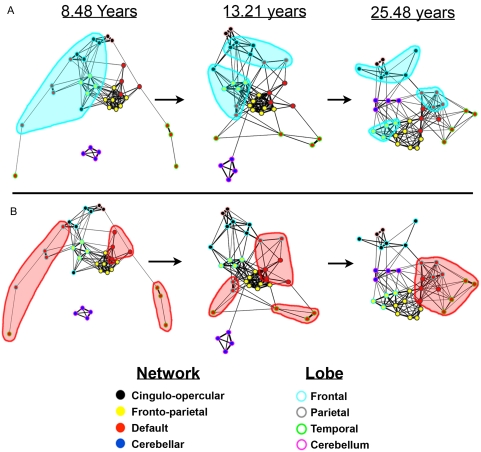
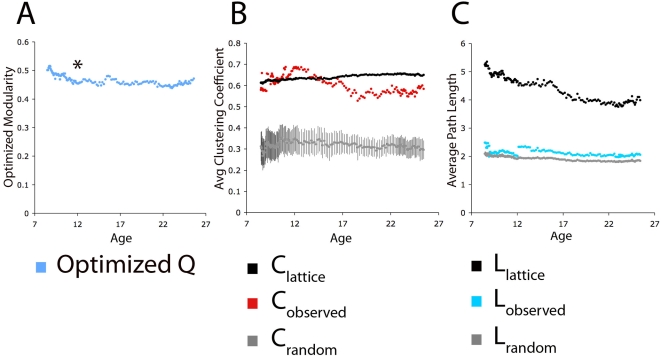
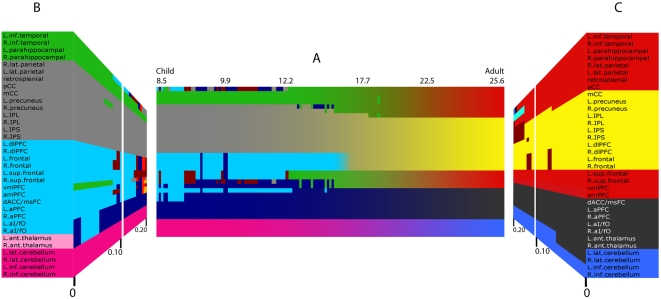
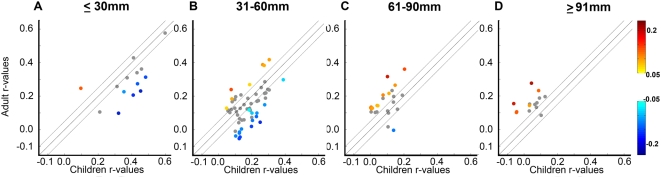
The mature human brain is organized into a collection of specialized functional networks that flexibly interact to support various cognitive functions. Studies of development often attempt to identify the organizing principles that guide the maturation of these functional networks. In this report, we combine resting state functional connectivity MRI (rs-fcMRI), graph analysis, community detection, and spring-embedding visualization techniques to analyze four separate networks defined in earlier studies. As we have previously reported, we find, across development, a trend toward 'segregation' (a general decrease in correlation strength) between regions close in anatomical space and 'integration' (an increased correlation strength) between selected regions distant in space. The generalization of these earlier trends across multiple networks suggests that this is a general developmental principle for changes in functional connectivity that would extend to large-scale graph theoretic analyses of large-scale brain networks. Communities in children are predominantly arranged by anatomical proximity, while communities in adults predominantly reflect functional relationships, as defined from adult fMRI studies. In sum, over development, the organization of multiple functional networks shifts from a local anatomical emphasis in children to a more "distributed" architecture in young adults. We argue that this "local to distributed" developmental characterization has important implications for understanding the development of neural systems underlying cognition. Further, graph metrics (e.g., clustering coefficients and average path lengths) are similar in child and adult graphs, with both showing "small-world"-like properties, while community detection by modularity optimization reveals stable communities within the graphs that are clearly different between young children and young adults. These observations suggest that early school age children and adults both have relatively efficient systems that may solve similar information processing problems in divergent ways.
Overview
The claims and statistics of this paper haven’t been checked yet.
Free: it reads the open-access text and checks the first 5 claims that cite a source we can check. Create a free account to check every claim.
Integrity signals
Registry
Cites
Statistics
Figures

Verification
Claims the paper makes
The claims and statistics of this paper haven’t been checked yet.
Free: it reads the open-access text and checks the first 5 claims that cite a source we can check. Create a free account to check every claim.
Claims other papers make about this one
Each is checked against this paper’s own text: does it say what the citing paper says it does?
The source backs part of the claim, not all of it — or backs it for a different population, condition or comparison.
In the citing paper
“Human neuroimaging studies have shown corresponding patterns of regional brain changes across development [12] with functional connectivity studies [13,14] suggesting refinement of local subcortical circuits precedes refinement of distal cortical ones.”
From Development of the emotional brain (2019) · cites this paper as [13]
Experimental — accuracy not yet measuredThe source backs part of the claim, not all of it — or backs it for a different population, condition or comparison.
In the citing paper
“A plausible temporal mechanism for the shifts in cognitive capacity from childhood to adulthood is a fine-tuning of circuits from subcortico-subcortical to cortico-subcortical to cortico-cortical consistent with postmortem animal studies of regional synaptic changes (Rakic et al., 1994) and functional connectivity studies (Fair et al., 2009) of refinement of local circuits preceding refinement of”
From Beyond simple models of adolescence to an integrated circuit-based account: A commentary (2016) · cites this paper as Fair et al., 2009
Experimental — accuracy not yet measuredThe source backs part of the claim, not all of it — or backs it for a different population, condition or comparison.
In the citing paper
“Evidence has converged on an executive attention network, with the anterior cingulate being the central structure, as the major network responsible for resolving cognitive conflicts (21, 22).”
From Multimodal imaging of the self-regulating developing brain (2012) · cites this paper as [21]
Experimental — accuracy not yet measuredThe source backs part of the claim, not all of it — or backs it for a different population, condition or comparison.
In the citing paper
“Prior work in fMRI using this modularity algorithm required that the researcher set an arbitrary threshold, or cutoff point, for what constitutes similarity between any two given individuals. Researchers would then arrive at thresholds by looking for consistency in community detection results at multiple thresholds (e.g., [2], [21], [22]).”
From Organizing Heterogeneous Samples Using Community Detection of GIMME-Derived Resting State Functional Networks (2014) · cites this paper as [22]
Experimental — accuracy not yet measuredThe source backs part of the claim, not all of it — or backs it for a different population, condition or comparison.
In the citing paper
“The functional network studies have consistently shown no statistical difference in global topological properties between children and adults”
From Developmental Changes in Organization of Structural Brain Networks (2013) · cites this paper as Fair et al. 2009
Experimental — accuracy not yet measured
5 more claims about this paper
Create a free account to see every claim other papers make about this one.
Self-check
Percentages, sums and reported differences re-computed from the paper’s own numbers.
The self-check needs the paper’s full text.
Citations
Cites
Controlling the False Discovery Rate: A Practical and Powerful Approach to Multiple Testing
Benjamini, Y., & Hochberg, Y. (1995) · Journal of the Royal Statistical Society Series B: Statistical Methodology · doi:10.1111/j.2517-6161.1995.tb02031.x · Cited by 109,482 · cited 1×
“To account for multiple comparisons the Benjamini and Hochberg False Discovery Rate [97] was applied.”
MethodCollective dynamics of ‘small-world’ networks
Watts, D. J., & Strogatz, S. H. (1998) · Nature · doi:10.1038/30918 · Cited by 43,060 · cited 1×
“long-range processes. It is this hybrid graph topology (i.e., high clustering coefficients and short path lengths) that matches the observed “small world” networks in many complex systems”
BackgroundModularity and community structure in networks
Newman, M. E. J. (2006) · Proceedings of the National Academy of Sciences · doi:10.1073/pnas.0601602103 · Cited by 12,256 · cited 5×
“As stated by Newman: ‘‘A good division of a graph into communities is not merely one in which there are few edges between communities; it is one in which there are fewer than expected edges between communities.”
BackgroundMethodInfluentialA default mode of brain function
Raichle, M. E., MacLeod, A. M., Snyder, A. Z., Powers, W. J., Gusnard, D. A., & Shulman, G. L. (2001) · Proceedings of the National Academy of Sciences · doi:10.1073/pnas.98.2.676 · Cited by 12,190 · cited 2×
“While the distinct function of the default mode network is often linked to internally directed mental activity [39], this notion continues to be debated [25,32,41–44].”
Functional connectivity in the motor cortex of resting human brain using echo‐planar mri
Biswal, B., Zerrin Yetkin, F., Haughton, V. M., & Hyde, J. S. (1995) · Magnetic Resonance in Medicine · doi:10.1002/mrm.1910340409 · Cited by 9,812
The human brain is intrinsically organized into dynamic, anticorrelated functional networks
Fox, M. D., Snyder, A. Z., Vincent, J. L., Corbetta, M., Van Essen, D. C., & Raichle, M. E. (2005) · Proceedings of the National Academy of Sciences · doi:10.1073/pnas.0504136102 · Cited by 8,553 · cited 3×
“Resting-state fcMRI analyses have repeatedly shown that these regions, along with associated medial temporal regions, are correlated at rest in adults [15,16,32,40].”
Distributed hierarchical processing in the primate cerebral cortex
Felleman, D. J., & Van Essen, D. C. (1991) · Cerebral Cortex · doi:10.1093/cercor/1.1.1 · Cited by 7,783 · cited 1×
“Increased myelination is thought to proceed from primary sensory and motor regions to association areas [68– 71], roughly following the hierarchical organization introduced by Felleman and Van Essen [72] (Note that while the most frequently referenced neuroanatomical changes that occur throughout development have been…”
BackgroundDissociable intrinsic connectivity networks for salience processing and executive control
Seeley, W. W., Menon, V., Schatzberg, A. F., Keller, J., Glover, G. H., Kenna, H., Reiss, A. L., & Greicius, M. D. (2007) · The Journal of Neuroscience · doi:10.1523/jneurosci.5587-06.2007 · Cited by 7,426 · cited 3×
“In addition, several previous findings using this technique [21,22,32] have now been replicated using continuous resting blocks [27,33,34] and other continuous resting data [89].”
BackgroundMethodFunctional connectivity in the resting brain: a network analysis of the default mode hypothesis
Greicius, M. D., Krasnow, B., Reiss, A. L., & Menon, V. (2003) · Proceedings of the National Academy of Sciences · doi:10.1073/pnas.0135058100 · Cited by 6,358 · cited 1×
“Resting-state fcMRI analyses have repeatedly shown that these regions, along with associated medial temporal regions, are correlated at rest in adults [15,16,32,40].”
BackgroundThe brainweb: phase synchronization and large-scale integration
Varela, F., Lachaux, J.-P., Rodriguez, E., & Martinerie, J. (2001) · Nature Reviews Neuroscience · doi:10.1038/35067550 · Cited by 4,761 · cited 1×
“In adults, spontaneous correlated activity has been suggested to be important for gating information flow [54], building internal representations [43,44,54], and maintaining mature network relationships [43,44,54].”
Background
Cited by
BrainNet Viewer: A Network Visualization Tool for Human Brain Connectomics
Xia, M., Wang, J., & He, Y. (2013) · PLoS ONE · doi:10.1371/journal.pone.0068910 · Cited by 4,106
The economy of brain network organization
Bullmore, E., & Sporns, O. (2012) · Nature Reviews Neuroscience · doi:10.1038/nrn3214 · Cited by 3,284
Toward discovery science of human brain function
Biswal, B. B., Mennes, M., Zuo, X.-N., Gohel, S., Kelly, C., Smith, S. M., Beckmann, C. F., Adelstein, J. S., Buckner, R. L., Colcombe, S., et al. (2010) · Proceedings of the National Academy of Sciences · doi:10.1073/pnas.0911855107 · Cited by 2,970
Self-citationNetwork-based statistic: identifying differences in brain networks
Zalesky, A., Fornito, A., & Bullmore, E. T. (2010) · NeuroImage · doi:10.1016/j.neuroimage.2010.06.041 · Cited by 2,750
“In the caseof functionalMRI, electroencephalography or magnetoencephalography, temporal correlations (Achard et al., 2006; Deuker et al., 2009; Fair et al., 2009; Hayasaka & Laurienti, 2010; Honey et al., 2009; Li et al., 2009) or mutual information (Bassett et al.”
BackgroundExperimental and theoretical approaches to conscious processing
Dehaene, S., & Changeux, J.-P. (2011) · Neuron · doi:10.1016/j.neuron.2011.03.018 · Cited by 2,573
Metadata
- Authors
- Fair, D. A., Cohen, A. L., Power, J. D., Dosenbach, N. U. F., Church, J. A., Miezin, F. M., Schlaggar, B. L., & Petersen, S. E.
- Affiliations
- Oregon Health & Science University (US)
- Washington University in St. Louis (US)
- Corresponding author
- Fair, Damien A.
- Petersen, Steven E.
- ORCID
- Venue
- PLoS Computational Biology
- Publisher
- Public Library of Science (PLoS)
- Published
- 2009-05-01
- Volume
- 5
- Issue
- 5
- Pages
- e1000381
- ISSN
- 1553-734X (ISSN-L)
- 1553-7358
- PMC
- PMC2671306
- OpenAlex
- W2159549823
- Cited by
- 1,530
- References
- 104
- Citations by year
- 2026: 69 · 2025: 78 · 2024: 89 · 2023: 66 · 2022: 87 · 2021: 78 · 2020: 86 · 2019: 103 · 2018: 109 · 2017: 95 · 2016: 102 · 2015: 107 · 2014: 106 · 2013: 113 · 2012: 84
- FWCI
- 39.01
- Type
- journal article
- Language
- en
- Open access
- gold
- doi.org
- Locations
- PLoS Computational Biology (publishedVersion, cc-by)
- PubMed Central (publishedVersion, cc-by)
- PubMed (publishedVersion)
- Digital Commons@Becker (Washington University School of Medicine) (submittedVersion)
- RePEc: Research Papers in Economics (submittedVersion)
- DOAJ (DOAJ: Directory of Open Access Journals) (submittedVersion, cc-by-sa)
- Figshare (submittedVersion, cc-by)
- Funders
- National Science Foundation (0548890)
- Dana Foundation
- Wellcome Trust
- National Institutes of Health
- National Institute of Neurological Disorders and Stroke (R01NS046424, K02NS053425, F30NS062489, NS46424, NS 41255, NS062489, R21NS041255, NS053425)
- Topics
- Life Sciences › Neuroscience › Cognitive Neuroscience › Functional Brain Connectivity Studies
- Health Sciences › Medicine › Radiology, Nuclear Medicine and Imaging › Advanced Neuroimaging Techniques and Applications
- Physical Sciences › Physics and Astronomy › Statistical and Nonlinear Physics › Complex Network Analysis Techniques
- Keywords
- functional brain networks, brain development, resting-state functional connectivity, integration and segregation, community detection, small-world networks, graph theory, children and young adults, modularity optimization, cognitive development
- MeSH terms
- Adolescent, Adult, Brain, Child, Humans, Magnetic Resonance Imaging, Models, Neurological, Nerve Net, Neural Pathways
About these checks
Registry, retraction, Cites and statistics results are computed, not judged, with one exception: a printed reference that no index lists is read once by a model before it counts as a citation error. Claims are extracted by a model and kept only when their quote appears verbatim in the text; each cited source is then checked, with a model’s help, for whether it says what the claim relies on. Those verdicts can be wrong — read the claim’s quote and the cited source before relying on one.
Statistics and arithmetic are recomputed, not judged.
Confidence bands are shown only for fields calibrated on our annotated test set. None is calibrated yet, so no band is shown.
What counts as a claim ›How we measure confidence ›How we check this ›
Are you an author, or do you see a problem with this page? Request a review
How to cite
Cite CoChat for the checks on this page, and the paper for its own findings.
- This page
- CoChat. (2026). Citation check: Functional brain networks develop from a local to distributed organization. https://app.cochat.ai/papers/10.1371/journal.pcbi.1000381
- The paper
- Fair, D. A., Cohen, A. L., Power, J. D., Dosenbach, N. U. F., Church, J. A., Miezin, F. M., Schlaggar, B. L., & Petersen, S. E. (2009). Functional brain networks develop from a local to distributed organization. PLoS Computational Biology. https://doi.org/10.1371/journal.pcbi.1000381
Data sources
Bibliographic data: Semantic Scholar, OpenAlex, Crossref.
Contains information from the Semantic Scholar Academic Graph Datasets, made available under the ODC Attribution License (ODC-BY 1.0).
Semantic Scholar’s data is described in: Kinney, R., et al. (2023). The Semantic Scholar Open Data Platform. arXiv:2301.10140.
