

Functional brain networks develop from a local to distributed organization
Open accessThe DOI matches its Crossref record; 103 of the 104 references it cites were found in a registry or an index.
Abstract
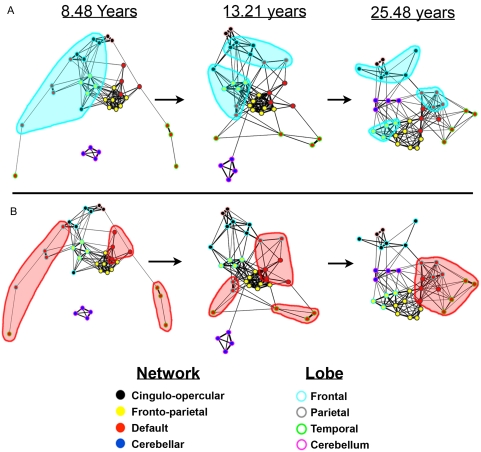
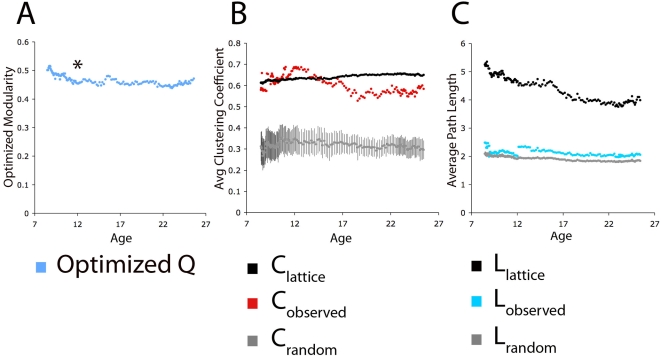
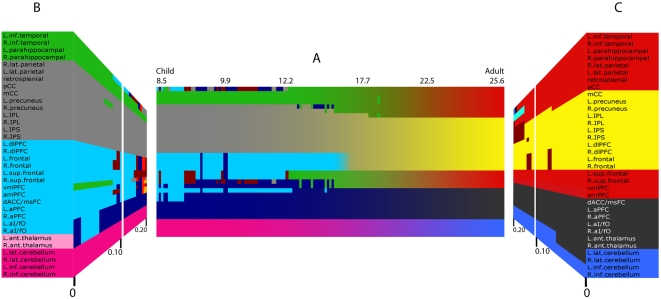
The mature human brain is organized into a collection of specialized functional networks that flexibly interact to support various cognitive functions. Studies of development often attempt to identify the organizing principles that guide the maturation of these functional networks. In this report, we combine resting state functional connectivity MRI (rs-fcMRI), graph analysis, community detection, and spring-embedding visualization techniques to analyze four separate networks defined in earlier studies. As we have previously reported, we find, across development, a trend toward 'segregation' (a general decrease in correlation strength) between regions close in anatomical space and 'integration' (an increased correlation strength) between selected regions distant in space. The generalization of these earlier trends across multiple networks suggests that this is a general developmental principle for changes in functional connectivity that would extend to large-scale graph theoretic analyses of large-scale brain networks. Communities in children are predominantly arranged by anatomical proximity, while communities in adults predominantly reflect functional relationships, as defined from adult fMRI studies. In sum, over development, the organization of multiple functional networks shifts from a local anatomical emphasis in children to a more "distributed" architecture in young adults. We argue that this "local to distributed" developmental characterization has important implications for understanding the development of neural systems underlying cognition. Further, graph metrics (e.g., clustering coefficients and average path lengths) are similar in child and adult graphs, with both showing "small-world"-like properties, while community detection by modularity optimization reveals stable communities within the graphs that are clearly different between young children and young adults. These observations suggest that early school age children and adults both have relatively efficient systems that may solve similar information processing problems in divergent ways.
Overview
The claims and statistics of this paper haven’t been checked yet.
Free: it reads the open-access text and checks the first 5 claims that cite a source we can check. Create a free account to check every claim.
Integrity signals
Registry
Cites
Statistics
Figures

Verification
Claims the paper makes
The claims and statistics of this paper haven’t been checked yet.
Free: it reads the open-access text and checks the first 5 claims that cite a source we can check. Create a free account to check every claim.
Claims other papers make about this one
Each is checked against this paper’s own text: does it say what the citing paper says it does?
The source backs part of the claim, not all of it — or backs it for a different population, condition or comparison.
In the citing paper
“Human neuroimaging studies have shown corresponding patterns of regional brain changes across development [12] with functional connectivity studies [13,14] suggesting refinement of local subcortical circuits precedes refinement of distal cortical ones.”
From Development of the emotional brain (2019) · cites this paper as [13]
Experimental — accuracy not yet measuredThe source backs part of the claim, not all of it — or backs it for a different population, condition or comparison.
In the citing paper
“A plausible temporal mechanism for the shifts in cognitive capacity from childhood to adulthood is a fine-tuning of circuits from subcortico-subcortical to cortico-subcortical to cortico-cortical consistent with postmortem animal studies of regional synaptic changes (Rakic et al., 1994) and functional connectivity studies (Fair et al., 2009) of refinement of local circuits preceding refinement of”
From Beyond simple models of adolescence to an integrated circuit-based account: A commentary (2016) · cites this paper as Fair et al., 2009
Experimental — accuracy not yet measuredThe source backs part of the claim, not all of it — or backs it for a different population, condition or comparison.
In the citing paper
“Evidence has converged on an executive attention network, with the anterior cingulate being the central structure, as the major network responsible for resolving cognitive conflicts (21, 22).”
From Multimodal imaging of the self-regulating developing brain (2012) · cites this paper as [21]
Experimental — accuracy not yet measuredThe source backs part of the claim, not all of it — or backs it for a different population, condition or comparison.
In the citing paper
“Prior work in fMRI using this modularity algorithm required that the researcher set an arbitrary threshold, or cutoff point, for what constitutes similarity between any two given individuals. Researchers would then arrive at thresholds by looking for consistency in community detection results at multiple thresholds (e.g., [2], [21], [22]).”
From Organizing Heterogeneous Samples Using Community Detection of GIMME-Derived Resting State Functional Networks (2014) · cites this paper as [22]
Experimental — accuracy not yet measuredThe source backs part of the claim, not all of it — or backs it for a different population, condition or comparison.
In the citing paper
“The functional network studies have consistently shown no statistical difference in global topological properties between children and adults”
From Developmental Changes in Organization of Structural Brain Networks (2013) · cites this paper as Fair et al. 2009
Experimental — accuracy not yet measured
5 more claims about this paper
Create a free account to see every claim other papers make about this one.
Self-check
Percentages, sums and reported differences re-computed from the paper’s own numbers.
The self-check needs the paper’s full text.
Citations
Cites
Controlling the False Discovery Rate: A Practical and Powerful Approach to Multiple Testing
Benjamini, Y., & Hochberg, Y. (1995) · Journal of the Royal Statistical Society Series B: Statistical Methodology · doi:10.1111/j.2517-6161.1995.tb02031.x · Cited by 109,482 · cited 1×
“To account for multiple comparisons the Benjamini and Hochberg False Discovery Rate [97] was applied.”
MethodCollective dynamics of ‘small-world’ networks
Watts, D. J., & Strogatz, S. H. (1998) · Nature · doi:10.1038/30918 · Cited by 43,060 · cited 1×
“long-range processes. It is this hybrid graph topology (i.e., high clustering coefficients and short path lengths) that matches the observed “small world” networks in many complex systems”
BackgroundModularity and community structure in networks
Newman, M. E. J. (2006) · Proceedings of the National Academy of Sciences · doi:10.1073/pnas.0601602103 · Cited by 12,256 · cited 5×
“As stated by Newman: ‘‘A good division of a graph into communities is not merely one in which there are few edges between communities; it is one in which there are fewer than expected edges between communities.”
BackgroundMethodInfluentialA default mode of brain function
Raichle, M. E., MacLeod, A. M., Snyder, A. Z., Powers, W. J., Gusnard, D. A., & Shulman, G. L. (2001) · Proceedings of the National Academy of Sciences · doi:10.1073/pnas.98.2.676 · Cited by 12,190 · cited 2×
“While the distinct function of the default mode network is often linked to internally directed mental activity [39], this notion continues to be debated [25,32,41–44].”
Functional connectivity in the motor cortex of resting human brain using echo‐planar mri
Biswal, B., Zerrin Yetkin, F., Haughton, V. M., & Hyde, J. S. (1995) · Magnetic Resonance in Medicine · doi:10.1002/mrm.1910340409 · Cited by 9,812
The human brain is intrinsically organized into dynamic, anticorrelated functional networks
Fox, M. D., Snyder, A. Z., Vincent, J. L., Corbetta, M., Van Essen, D. C., & Raichle, M. E. (2005) · Proceedings of the National Academy of Sciences · doi:10.1073/pnas.0504136102 · Cited by 8,553 · cited 3×
“Resting-state fcMRI analyses have repeatedly shown that these regions, along with associated medial temporal regions, are correlated at rest in adults [15,16,32,40].”
Distributed hierarchical processing in the primate cerebral cortex
Felleman, D. J., & Van Essen, D. C. (1991) · Cerebral Cortex · doi:10.1093/cercor/1.1.1 · Cited by 7,783 · cited 1×
“Increased myelination is thought to proceed from primary sensory and motor regions to association areas [68– 71], roughly following the hierarchical organization introduced by Felleman and Van Essen [72] (Note that while the most frequently referenced neuroanatomical changes that occur throughout development have been…”
BackgroundDissociable intrinsic connectivity networks for salience processing and executive control
Seeley, W. W., Menon, V., Schatzberg, A. F., Keller, J., Glover, G. H., Kenna, H., Reiss, A. L., & Greicius, M. D. (2007) · The Journal of Neuroscience · doi:10.1523/jneurosci.5587-06.2007 · Cited by 7,426 · cited 3×
“In addition, several previous findings using this technique [21,22,32] have now been replicated using continuous resting blocks [27,33,34] and other continuous resting data [89].”
BackgroundMethodFunctional connectivity in the resting brain: a network analysis of the default mode hypothesis
Greicius, M. D., Krasnow, B., Reiss, A. L., & Menon, V. (2003) · Proceedings of the National Academy of Sciences · doi:10.1073/pnas.0135058100 · Cited by 6,358 · cited 1×
“Resting-state fcMRI analyses have repeatedly shown that these regions, along with associated medial temporal regions, are correlated at rest in adults [15,16,32,40].”
BackgroundThe brainweb: phase synchronization and large-scale integration
Varela, F., Lachaux, J.-P., Rodriguez, E., & Martinerie, J. (2001) · Nature Reviews Neuroscience · doi:10.1038/35067550 · Cited by 4,761 · cited 1×
“In adults, spontaneous correlated activity has been suggested to be important for gating information flow [54], building internal representations [43,44,54], and maintaining mature network relationships [43,44,54].”
BackgroundConsistent resting-state networks across healthy subjects
Damoiseaux, J. S., Rombouts, S. A. R. B., Barkhof, F., Scheltens, P., Stam, C. J., Smith, S. M., & Beckmann, C. F. (2006) · Proceedings of the National Academy of Sciences · doi:10.1073/pnas.0601417103 · Cited by 4,326 · cited 1×
“, subjects are ‘‘at rest’’) [11,12,14–23].”
Über das Elektrenkephalogramm des Menschen
Berger, H. (1929) · Archiv für Psychiatrie und Nervenkrankheiten · doi:10.1007/bf01797193 · Cited by 4,235
Greicius, M. D., Srivastava, G., Reiss, A. L., & Menon, V. (2004) · Proceedings of the National Academy of Sciences · doi:10.1073/pnas.0308627101 · Cited by 3,684 · cited 1×
“Thus, rs-fcMRI is becoming a frequently used tool for examining changes in network structure in disease [28–31], in aging [24,29], and across development [22,32–35].”
MethodInvestigations into resting-state connectivity using independent component analysis
Beckmann, C. F., DeLuca, M., Devlin, J. T., & Smith, S. M. (2005) · Philosophical Transactions of the Royal Society B: Biological Sciences · doi:10.1098/rstb.2005.1634 · Cited by 3,398
Preface: Cerebral Cortex Has Come of Age
Goldman-Rakic, P. S., & Rakic, P. (1991) · Cerebral Cortex · doi:10.1093/cercor/1.1.1-a · Cited by 3,393
Wandering minds: the default network and stimulus-independent thought
Mason, M. F., Norton, M. I., Van Horn, J. D., Wegner, D. M., Grafton, S. T., & Macrae, C. N. (2007) · Science · doi:10.1126/science.1131295 · Cited by 2,792 · cited 1×
“While the distinct function of the default mode network is often linked to internally directed mental activity [39], this notion continues to be debated [25,32,41–44].”
BackgroundAn algorithm for drawing general undirected graphs
Kamada, T., & Kawai, S. (1989) · Information Processing Letters · doi:10.1016/0020-0190(89)90102-6 · Cited by 2,698 · cited 12×
“Found at: doi:10.1371/journal.pcbi.1000381.s007 (0.43 MB TIF) Video S1 Over age, the graph architecture matures from a ‘‘local’’ organization to a ‘‘distributed’’ organization.”
MethodInfluentialSynaptic density in human frontal cortex —Developmental changes and effects of aging
Peter R., H. (1979) · Brain Research · doi:10.1016/0006-8993(79)90349-4 · Cited by 2,645 · cited 1×
“This growth is followed by a protracted period of synaptic pruning that reaches adult levels in the late second decade of life [63–65].”
BackgroundDistinct brain networks for adaptive and stable task control in humans
Dosenbach, N. U. F., Fair, D. A., Miezin, F. M., Cohen, A. L., Wenger, K. K., Dosenbach, R. A. T., Fox, M. D., Snyder, A. Z., Vincent, J. L., Raichle, M. E., et al. (2007) · Proceedings of the National Academy of Sciences · doi:10.1073/pnas.0704320104 · Cited by 2,632 · cited 10×
“Along with these two task control networks [21,36], a set of cerebellar regions showing error-related activity across tasks [36] formed a separate cerebellar network (Figure 1).”
BackgroundMethodResultInfluentialSelf-citationAchard, S., Salvador, R., Whitcher, B., Suckling, J., & Bullmore, E. (2006) · The Journal of Neuroscience · doi:10.1523/jneurosci.3874-05.2006 · Cited by 2,393 · cited 1×
“, subjects are ‘‘at rest’’) [11,12,14–23].”
A default mode of brain function: a brief history of an evolving idea
Raichle, M. E., & Snyder, A. Z. (2007) · NeuroImage · doi:10.1016/j.neuroimage.2007.02.041 · Cited by 2,173 · cited 1×
“In adults, spontaneous correlated activity has been suggested to be important for gating information flow [54], building internal representations [43,44,54], and maintaining mature network relationships [43,44,54].”
BackgroundSpontaneous neuronal activity distinguishes human dorsal and ventral attention systems
Fox, M. D., Corbetta, M., Snyder, A. Z., Vincent, J. L., & Raichle, M. E. (2006) · Proceedings of the National Academy of Sciences · doi:10.1073/pnas.0604187103 · Cited by 2,101 · cited 1×
“To date, rs-fcMRI has been used in several domains to examine systems-level organization of motor [11], memory [24,25], attention [26], and task control systems [21,22,27].”
MethodA dual-networks architecture of top-down control
Dosenbach, N. U. F., Fair, D. A., Cohen, A. L., Schlaggar, B. L., & Petersen, S. E. (2008) · Trends in Cognitive Sciences · doi:10.1016/j.tics.2008.01.001 · Cited by 1,931 · cited 1×
“). Based on functional activation profiles of these regions characterized in the previous fMRI study, the fronto-parietal network appears to act on a shorter timescale, initiating and adjusting top-down control. In contrast, the cingulo-opercular network operates on a longer timescale providing “set-initiation” and st…”
BackgroundSelf-citationCommon blood flow changes across visual tasks: II. Decreases in cerebral cortex
Shulman, G. L., Fiez, J. A., Corbetta, M., Buckner, R. L., Miezin, F. M., Raichle, M. E., & Petersen, S. E. (1997) · Journal of Cognitive Neuroscience · doi:10.1162/jocn.1997.9.5.648 · Cited by 1,890 · cited 1×
“The default mode network (frequently described as being composed of the bilateral posterior cingulate/precuneus, inferior parietal cortex, and ventromedial prefrontal cortex) was first characterized by a consistent decrease in activity during goaldirected tasks compared to baseline [38,39].”
ResultSelf-citationA Core System for the Implementation of Task Sets
Dosenbach, N. U. F., Visscher, K. M., Palmer, E. D., Miezin, F. M., Wenger, K. K., Kang, H. C., Burgund, E. D., Grimes, A. L., Schlaggar, B. L., & Petersen, S. E. (2006) · Neuron · doi:10.1016/j.neuron.2006.04.031 · Cited by 1,772 · cited 3×
“This analysis revealed that brain regions exhibiting different combinations of control signals across many tasks are grouped into distinct ‘‘frontoparietal’’ and ‘‘cingulo-opercular’’ functional networks [21,36] (see Table 1 and Figure 1).”
BackgroundSelf-citationDisruption of Large-Scale Brain Systems in Advanced Aging
Andrews-Hanna, J. R., Snyder, A. Z., Vincent, J. L., Lustig, C., Head, D., Raichle, M. E., & Buckner, R. L. (2007) · Neuron · doi:10.1016/j.neuron.2007.10.038 · Cited by 1,592 · cited 3×
“We note that recent results in the aging literature suggest that many of the trajectories observed in the current manuscript continue inversely with advancing age [24,78].”
MethodResultComparing clusterings—an information based distance
Meilă, M. (2007) · Journal of Multivariate Analysis · doi:10.1016/j.jmva.2006.11.013 · Cited by 1,546 · cited 3×
“The robustness of the community assignments was also tested using a different information theoretic procedure implemented by Meila, [95], which utilizes the measure ‘variation of information (VOI)’ (see Figure S7 and also [96]).”
BackgroundMethodExperience and brain development
Greenough, W. T., Black, J. E., & Wallace, C. S. (1987) · Child Development · doi:10.2307/1130197 · Cited by 1,398 · cited 1×
“Pruning is also largely activity dependent, and is considered critical in the differentiation of distinct functional areas [56,66,67].”
BackgroundFunctional connectivity in single and multislice echoplanar imaging using resting-state fluctuations
Lowe, M. J., Mock, B. J., & Sorenson, J. A. (1998) · NeuroImage · doi:10.1006/nimg.1997.0315 · Cited by 1,394
Fransson, P. (2005) · Human Brain Mapping · doi:10.1002/hbm.20113 · Cited by 1,388 · cited 1×
“Resting-state fcMRI analyses have repeatedly shown that these regions, along with associated medial temporal regions, are correlated at rest in adults [15,16,32,40].”
BackgroundThe Small World of the Cerebral Cortex
Sporns, O., & Zwi, J. D. (2004) · Neuroinformatics · doi:10.1385/ni:2:2:145 · Cited by 1,356 · cited 1×
“As previously reported [21,48,49], relative to comparable lattice and completely random graphs, the adult graph architecture showed high clustering coefficients and short path lengths, consistent with the ‘small world’ architecture (Figure 3B and 3C).”
ResultNeurophysiological Architecture of Functional Magnetic Resonance Images of Human Brain
Salvador, R., Suckling, J., Coleman, M. R., Pickard, J. D., Menon, D., & Bullmore, E. (2005) · Cerebral Cortex · doi:10.1093/cercor/bhi016 · Cited by 1,344 · cited 3×
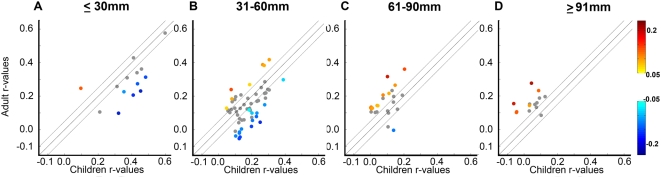
“The relationship of correlation as a function of distance is described by the inverse square law, r,1/D(2), as reported in [85] for all possible connections in children (blue) and adults (red).”
BackgroundMethodRegressive Events in Neurogenesis
Cowan, W. M., Fawcett, J. W., O'Leary, D. D. M., & Stanfield, B. B. (1984) · Science · doi:10.1126/science.6474175 · Cited by 1,316
The maturing architecture of the brain's default network
Fair, D. A., Cohen, A. L., Dosenbach, N. U. F., Church, J. A., Miezin, F. M., Barch, D. M., Raichle, M. E., Petersen, S. E., & Schlaggar, B. L. (2008) · Proceedings of the National Academy of Sciences · doi:10.1073/pnas.0800376105 · Cited by 1,314 · cited 9×
“7 cm), had a substantial increase in correlation strength over development [32].”
BackgroundMethodInfluentialSelf-citationDevelopment of distinct control networks through segregation and integration
Fair, D. A., Dosenbach, N. U. F., Church, J. A., Cohen, A. L., Brahmbhatt, S., Miezin, F. M., Barch, D. M., Raichle, M. E., Petersen, S. E., & Schlaggar, B. L. (2007) · Proceedings of the National Academy of Sciences · doi:10.1073/pnas.0705843104 · Cited by 1,244 · cited 9×
“We suggested that these global developmental processes support the maturation of a dual-control system and its functional connections with the cerebellar network [22].”
BackgroundMethodInfluentialSelf-citationJust, M. A., Cherkassky, V. L., Keller, T. A., Kana, R. K., & Minshew, N. J. (2007) · Cerebral Cortex · doi:10.1093/cercor/bhl006 · Cited by 1,081
Functional brain development in humans
Johnson, M. H. (2001) · Nature Reviews Neuroscience · doi:10.1038/35081509 · Cited by 980 · cited 1×
“The ‘‘local to distributed’’ organizing principle resonates with recent suggestions that perceptual and cognitive development involve the simultaneous segregation and integration of information processing streams [1,22,76,79,80].”
BackgroundMiezin, F. M., Maccotta, L., Ollinger, J. M., Petersen, S. E., & Buckner, R. L. (2000) · NeuroImage · doi:10.1006/nimg.2000.0568 · Cited by 944 · cited 1×
“Functional images were first processed to reduce artifacts [23,90].”
MethodSelf-citationKinney, H. C., Ann brody, B., Kloman, A. S., & Gilles, F. H. (1988) · Journal of Neuropathology and Experimental Neurology · doi:10.1097/00005072-198805000-00003 · Cited by 888
Alterations in the BOLD fMRI signal with ageing and disease: a challenge for neuroimaging
D'Esposito, M., Deouell, L. Y., & Gazzaley, A. (2003) · Nature Reviews Neuroscience · doi:10.1038/nrn1246 · Cited by 866
Maturation of white matter in the human brain: A review of magnetic resonance studies.
Paus, T., Collins, D. L., Evans, A. C., Leonard, G., Pike, B., & Zijdenbos, A. (2001) · Brain Research Bulletin · doi:10.1016/s0361-9230(00)00434-2 · Cited by 863
Castellanos, F. X., Margulies, D. S., Kelly, C., Uddin, L. Q., Ghaffari, M., Kirsch, A., Shaw, D., Shehzad, Z., Di Martino, A., Biswal, B., et al. (2008) · Biological Psychiatry · doi:10.1016/j.biopsych.2007.06.025 · Cited by 854
Brain connectivity related to working memory performance
Hampson, M., Driesen, N. R., Skudlarski, P., Gore, J. C., & Constable, R. T. (2006) · The Journal of Neuroscience · doi:10.1523/jneurosci.3408-06.2006 · Cited by 853 · cited 1×
“To date, rs-fcMRI has been used in several domains to examine systems-level organization of motor [11], memory [24,25], attention [26], and task control systems [21,22,27].”
MethodAXON RETRACTION AND DEGENERATION IN DEVELOPMENT AND DISEASE
Luo, L., & O'Leary, D. D. M. (2005) · Annual Review of Neuroscience · doi:10.1146/annurev.neuro.28.061604.135632 · Cited by 844 · cited 1×
“Pruning is also largely activity dependent, and is considered critical in the differentiation of distinct functional areas [56,66,67].”
BackgroundCoherence of gamma-band EEG activity as a basis for associative learning
Miltner, W. H. R., Braun, C., Arnold, M., Witte, H., & Taub, E. (1999) · Nature · doi:10.1038/17126 · Cited by 802 · cited 1×
“, ocular dominance columns) [55–58] and may over time represent (in a Hebbian sense) a history of repeated co-activation between regions [21,22,27,32,34,59,60].”
BackgroundMaturation of widely distributed brain function subserves cognitive development.
Luna, B., Thulborn, K. R., Munoz, D. P., Merriam, E. P., Garver, K. E., Minshew, N. J., Keshavan, M. S., Genovese, C. R., Eddy, W. F., & Sweeney, J. A. (2001) · NeuroImage · doi:10.1006/nimg.2000.0743 · Cited by 757 · cited 2×
“By examining the differences in the fMRI activation profile of a particular brain region between children, adolescents, and adults, the developmental trajectory of that region’s involvement in a cognitive task can be outlined [3,5,7–10].”
BackgroundAge-related changes in modular organization of human brain functional networks
Meunier, D., Achard, S., Morcom, A., & Bullmore, E. (2009) · NeuroImage · doi:10.1016/j.neuroimage.2008.09.062 · Cited by 756
Synaptogenesis in human visual cortex—evidence for synapse elimination during normal development
Huttenlocher, P. R., de Courten, C., Garey, L. J., & Van der Loos, H. (1982) · Neuroscience Letters · doi:10.1016/0304-3940(82)90379-2 · Cited by 745
Field, A. P. (2001) · Psychological Methods · doi:10.1037/1082-989x.6.2.161 · Cited by 725
Sowell, E. R., Trauner, D. A., Gamst, A., & Jernigan, T. L. (2002) · Developmental Medicine and Child Neurology · doi:10.1017/s0012162201001591 · Cited by 701 · cited 1×
“Increased myelination is thought to proceed from primary sensory and motor regions to association areas [68– 71], roughly following the hierarchical organization introduced by Felleman and Van Essen [72] (Note that while the most frequently referenced neuroanatomical changes that occur throughout development have been…”
BackgroundResting-state networks in the infant brain
Fransson, P., Skiöld, B., Horsch, S., Nordell, A., Blennow, M., Lagercrantz, H., & Åden, U. (2007) · Proceedings of the National Academy of Sciences · doi:10.1073/pnas.0704380104 · Cited by 696
A shift from diffuse to focal cortical activity with development
Durston, S., Davidson, M. C., Tottenham, N., Galvan, A., Spicer, J., Fossella, J. A., & Casey, B. J. (2006) · Developmental Science · doi:10.1111/j.1467-7687.2005.00454.x · Cited by 692 · cited 1×
“By examining the differences in the fMRI activation profile of a particular brain region between children, adolescents, and adults, the developmental trajectory of that region’s involvement in a cognitive task can be outlined [3,5,7–10].”
BackgroundSequence of Central Nervous System Myelination in Human Infancy. I. An Autopsy Study of Myelination
BRODY, B. A., KINNEY, H. C., KLOMAN, A. S., & GILLES, F. H. (1987) · Journal of Neuropathology and Experimental Neurology · doi:10.1097/00005072-198705000-00005 · Cited by 682 · cited 1×
“Another commonly referenced postnatal event is myelination. As with synaptic pruning, myelination continues to occur through young adulthood. Increased myelination is thought to proceed from primary sensory and motor regions to association areas”
BackgroundVery Slow Activity Fluctuations in Monkey Visual Cortex: Implications for Functional Brain Imaging
Leopold, D. A. (2003) · Cerebral Cortex · doi:10.1093/cercor/13.4.422 · Cited by 675
Fair, D. A., Schlaggar, B. L., Cohen, A. L., Miezin, F. M., Dosenbach, N. U. F., Wenger, K. K., Fox, M. D., Snyder, A. Z., Raichle, M. E., & Petersen, S. E. (2007) · NeuroImage · doi:10.1016/j.neuroimage.2006.11.051 · Cited by 587 · cited 3×
“These concatenated-extracted rest periods were shown to be equivalent to continuous resting data in a recent study describing this method [23].”
MethodResultSelf-citationDefining functional areas in individual human brains using resting functional connectivity MRI
Cohen, A. L., Fair, D. A., Dosenbach, N. U. F., Miezin, F. M., Dierker, D., Van Essen, D. C., Schlaggar, B. L., & Petersen, S. E. (2008) · NeuroImage · doi:10.1016/j.neuroimage.2008.01.066 · Cited by 582 · cited 1×
“Future work that includes regions derived from studies using a child population and obtaining the functional connections within subjects from individually defined functional areas may refine the networks and developmental timecourses presented here [84].”
MethodSelf-citationDevelopment of Anterior Cingulate Functional Connectivity from Late Childhood to Early Adulthood
Kelly, A. M. C., Di Martino, A., Uddin, L. Q., Shehzad, Z., Gee, D. G., Reiss, P. T., Margulies, D. S., Castellanos, F. X., & Milham, M. P. (2009) · Cerebral Cortex · doi:10.1093/cercor/bhn117 · Cited by 572 · cited 5×
“These results have now been replicated in a developmental resting connectivity study targeting sub-regions of the anterior cingulate [34].”
BackgroundMethodResultInfluentialUnrest at rest: Default activity and spontaneous network correlations
Buckner, R. L., & Vincent, J. L. (2007) · NeuroImage · doi:10.1016/j.neuroimage.2007.01.010 · Cited by 523 · cited 1×
“In adults, spontaneous correlated activity has been suggested to be important for gating information flow [54], building internal representations [43,44,54], and maintaining mature network relationships [43,44,54].”
BackgroundCortex and Mind. Unifying Cognition
Jellinger, K. A. (2003) · European Journal of Neurology · doi:10.1046/j.1468-1331.2003.00567.x · Cited by 486 · cited 2×
“PLoS Computational Biology | www.ploscompbiol.org 8 May 2009 | Volume 5 | Issue 5 | e1000381 Along the same lines, as Fuster [77] has pointed out, we note that myelination is not an indispensable property of utilized axons.”
Background(2003) · Cited by 476
Changes in cerebral functional organization during cognitive development
Casey, B., Galvan, A., & Hare, T. A. (2005) · Current Opinion in Neurobiology · doi:10.1016/j.conb.2005.03.012 · Cited by 471 · cited 1×
“[1–6].”
LUNA, B., & SWEENEY, J. A. (2004) · Annals of the New York Academy of Sciences · doi:10.1196/annals.1308.035 · Cited by 467 · cited 2×
“The ‘‘local to distributed’’ organizing principle resonates with recent suggestions that perceptual and cognitive development involve the simultaneous segregation and integration of information processing streams [1,22,76,79,80].”
BackgroundThe Postnatal Development of the Human Cerebral Cortex
Conel, J. L. (1960) · The American Journal of the Medical Sciences · doi:10.1097/00000441-196001000-00020 · Cited by 466
Neurocognitive development of the ability to manipulate information in working memory
Crone, E. A., Wendelken, C., Donohue, S., van Leijenhorst, L., & Bunge, S. A. (2006) · Proceedings of the National Academy of Sciences · doi:10.1073/pnas.0510088103 · Cited by 464 · cited 1×
“By examining the differences in the fMRI activation profile of a particular brain region between children, adolescents, and adults, the developmental trajectory of that region’s involvement in a cognitive task can be outlined [3,5,7–10].”
BackgroundSchlaggar, B. L., Brown, T. T., Lugar, H. M., Visscher, K. M., Miezin, F. M., & Petersen, S. E. (2002) · Science · doi:10.1126/science.1069464 · Cited by 451
Self-citationUndirected graphs of frequency-dependent functional connectivity in whole brain networks
Salvador, R., Suckling, J., Schwarzbauer, C., & Bullmore, E. (2005) · Philosophical Transactions of the Royal Society B: Biological Sciences · doi:10.1098/rstb.2005.1645 · Cited by 437 · cited 1×
“, subjects are ‘‘at rest’’) [11,12,14–23].”
Functional anatomy of cognitive development: fMRI of verbal fluency in children and adults
Gaillard, W. D., Hertz–Pannier, L., Mott, S. H., Barnett, A. S., LeBihan, D., & Theodore, W. H. (2000) · Neurology · doi:10.1212/wnl.54.1.180 · Cited by 423
Structural and functional maturation of the developing primate brain
Levitt, P. (2003) · The Journal of Pediatrics · doi:10.1067/s0022-3476(03)00400-1 · Cited by 407 · cited 1×
“For instance, from approximately 30 weeks gestation through the first two postnatal years there is substantial growth in the number of synaptic contacts throughout the cortex [62].”
BackgroundDevelopmental Changes in Human Cerebral Functional Organization for Word Generation
Brown, T. T., Lugar, H. M., Coalson, R. S., Miezin, F. M., Petersen, S. E., & Schlaggar, B. L. (2005) · Cerebral Cortex · doi:10.1093/cercor/bhh129 · Cited by 393 · cited 1×
“[3], where identical task performance on lexical processing tests strongly activates a large set of visual regions in children, but strong visual activation is much more restricted in adults.”
BackgroundSelf-citationThe Electric Currents of the Brain
Caton, R. (1970) · American Journal of EEG Technology · doi:10.1080/00029238.1970.11080764 · Cited by 384
Neurodevelopmental changes in working memory and cognitive control
Bunge, S. A., & Wright, S. B. (2007) · Current Opinion in Neurobiology · doi:10.1016/j.conb.2007.02.005 · Cited by 381 · cited 1×
“The ‘‘local to distributed’’ organizing principle resonates with recent suggestions that perceptual and cognitive development involve the simultaneous segregation and integration of information processing streams [1,22,76,79,80].”
BackgroundDevelopment and plasticity of cortical areas and networks
Sur, M., & Leamey, C. A. (2001) · Nature Reviews Neuroscience · doi:10.1038/35067562 · Cited by 372 · cited 1×
“, ocular dominance columns) [55–58] and may over time represent (in a Hebbian sense) a history of repeated co-activation between regions [21,22,27,32,34,59,60].”
BackgroundRobustness of community structure in networks
Karrer, B., Levina, E., & Newman, M. E. J. (2008) · Physical Review E · doi:10.1103/physreve.77.046119 · Cited by 350 · cited 2×
“VOI is a measure of how much information is not shared between two sets of community assignments and allows for the quantification of network robustness (see [95] and [96]).”
BackgroundMethodAnatomie des menschlichen Gehirns und Rückenmarks : auf myelogenetischer Grundlage
Flechsig, P. (1920) · Medical Entomology and Zoology · Cited by 338
Processes of change in brain and cognitive development
JOHNSON, M., & MUNAKATA, Y. (2005) · Trends in Cognitive Sciences · doi:10.1016/j.tics.2005.01.009 · Cited by 336 · cited 1×
“For instance, the ‘‘interactive specialization’’ hypothesis advanced by Johnson and colleagues, is consistent with these findings [1,81–83].”
ResultQuantification of Brain Function Using PET
(1996) · Elsevier eBooks · doi:10.1016/b978-0-12-389760-2.x5000-2 · Cited by 321
Small worlds inside big brains
Sporns, O., & Honey, C. J. (2006) · Proceedings of the National Academy of Sciences · doi:10.1073/pnas.0609523103 · Cited by 307 · cited 1×
“As previously reported [21,48,49], relative to comparable lattice and completely random graphs, the adult graph architecture showed high clustering coefficients and short path lengths, consistent with the ‘small world’ architecture (Figure 3B and 3C).”
ResultEbbesson, S. E. (1980) · Cell and Tissue Research · doi:10.1007/bf00234781 · Cited by 304 · cited 1×
“Pruning is also largely activity dependent, and is considered critical in the differentiation of distinct functional areas [56,66,67].”
BackgroundComparison of functional activation foci in children and adults using a common stereotactic space
Kang, H. C., Burgund, E. D., Lugar, H. M., Petersen, S. E., & Schlaggar, B. L. (2003) · NeuroImage · doi:10.1016/s1053-8119(03)00038-7 · Cited by 300 · cited 1×
“In addition, while there are now reports suggesting that changes observed over development with blood oxygen level dependent (BOLD) fMRI are not the product of changes in hemodynamic response mechanisms over age [86,87], differences in the hemodynamic response function between children and adults could conceivably aff…”
BackgroundSelf-citationChurch, J. A., Fair, D. A., Dosenbach, N. U. F., Cohen, A. L., Miezin, F. M., Petersen, S. E., & Schlaggar, B. L. (2009) · Brain · doi:10.1093/brain/awn223 · Cited by 278 · cited 1×
“In addition, because rs-fcMRI does not require active engagement in a behavioral task, it unburdens experimental design, subject compliance, and training demands. Thus, rs-fcMRI is becoming a frequently used tool for examining changes in network structure in disease”
MethodSelf-citationDevelopment of cortical circuits: Lessons from ocular dominance columns
Katz, L. C., & Crowley, J. C. (2002) · Nature Reviews Neuroscience · doi:10.1038/nrn703 · Cited by 275 · cited 1×
“. Much less work has been done in regards to development, but there are suggestions that spontaneous activity is important for the establishment of early cortical patterns (e.g., ocular dominance columns)”
BackgroundFunctional Brain Development in Infants: Elements of an Interactive Specialization Framework
Johnson, M. H. (2000) · Child Development · doi:10.1111/1467-8624.00120 · Cited by 257 · cited 1×
“For instance, the ‘‘interactive specialization’’ hypothesis advanced by Johnson and colleagues, is consistent with these findings [1,81–83].”
ResultA modality‐independent approach to spatial normalization of tomographic images of the human brain
Lancaster, J. L., Glass, T. G., Lankipalli, B. R., Downs, H., Mayberg, H., & Fox, P. T. (1995) · Human Brain Mapping · doi:10.1002/hbm.460030305 · Cited by 256 · cited 1×
“Each run then was resampled in atlas space (Talairach and Tournoux, 1988) on an isotropic 3 mm grid combining movement correction and atlas transformation in one interpolation [91,92].”
MethodDistributed synaptic modification in neural networks induced by patterned stimulation
Bi, G.-Q., & Poo, M.-M. (1999) · Nature · doi:10.1038/44573 · Cited by 247 · cited 1×
“, ocular dominance columns) [55–58] and may over time represent (in a Hebbian sense) a history of repeated co-activation between regions [21,22,27,32,34,59,60].”
BackgroundThe Postnatal Development of the Human Cerebral Cortex
(1939) · Journal of the American Medical Association · doi:10.1001/jama.1939.02800370072038 · Cited by 247
Lidow, M. S., Goldman-Rakic, P. S., & Rakic, P. (1991) · Proceedings of the National Academy of Sciences · doi:10.1073/pnas.88.22.10218 · Cited by 232 · cited 1×
“Increased myelination is thought to proceed from primary sensory and motor regions to association areas [68– 71], roughly following the hierarchical organization introduced by Felleman and Van Essen [72] (Note that while the most frequently referenced neuroanatomical changes that occur throughout development have been…”
BackgroundFunctional connectivity MR imaging reveals cortical functional connectivity in the developing brain
Lin, W., Zhu, Q., Gao, W., Chen, Y., Toh, C.-H., Styner, M., Gerig, G., Smith, J. K., Biswal, B., & Gilmore, J. H. (2008) · American Journal of Neuroradiology · doi:10.3174/ajnr.a1256 · Cited by 222 · cited 1×
“Thus, rs-fcMRI is becoming a frequently used tool for examining changes in network structure in disease [28–31], in aging [24,29], and across development [22,32–35].”
MethodThe development of cortical connections
Price, D. J., Kennedy, H., Dehay, C., Zhou, L., Mercier, M., Jossin, Y., Goffinet, A. M., Tissir, F., Blakey, D., & Molnár, Z. (2006) · European Journal of Neuroscience · doi:10.1111/j.1460-9568.2006.04620.x · Cited by 216 · cited 1×
“, ocular dominance columns) [55–58] and may over time represent (in a Hebbian sense) a history of repeated co-activation between regions [21,22,27,32,34,59,60].”
BackgroundComment on "Wandering Minds: The Default Network and Stimulus-Independent Thought"
Gilbert, S. J., Dumontheil, I., Simons, J. S., Frith, C. D., & Burgess, P. W. (2007) · Science · doi:10.1126/science.1140801 · Cited by 207 · cited 1×
“While the distinct function of the default mode network is often linked to internally directed mental activity [39], this notion continues to be debated [25,32,41–44].”
BackgroundNir, Y., Hasson, U., Levy, I., Yeshurun, Y., & Malach, R. (2006) · NeuroImage · doi:10.1016/j.neuroimage.2005.11.018 · Cited by 202 · cited 2×
“, subjects are ‘‘at rest’’) [11,12,14–23].”
BackgroundThe Art and Science of Dynamic Network Visualization.
Bender‐deMoll, S., & McFarland, D. A. (2006) · Journal of Social Structure · Cited by 162
Timeline of the history of EEG and associated fields.
Swartz, B. E., & Goldensohn, E. S. (1998) · PubMed · Cited by 147
Case of Intrauterine Death Due to α-Thalassaemia
Diamond, M., Cotgrove, I., & Parker, A. (1965) · BMJ · doi:10.1136/bmj.2.5456.278 · Cited by 139
Difference Image vs Ratio Image Error Function Forms in PET—PET Realignment
Snyder, A. Z. (1996) · Elsevier eBooks · doi:10.1016/b978-012389760-2/50028-1 · Cited by 130
Srinivasan, R. (1999) · Clinical Neurophysiology · doi:10.1016/s1388-2457(99)00080-2 · Cited by 125 · cited 2×
“Dynamic changes in correlations in other frequency distributions could exist (for example see [89]).”
BackgroundMethodFunctional MRI of Global and Local Processing in Children
Moses, P., Roe, K. V., Buxton, R. B., Wong, E. C., Frank, L. R., & Stiles, J. (2002) · NeuroImage · doi:10.1006/nimg.2002.1064 · Cited by 104 · cited 1×
“[1–6].”
Über das Elektrenkephalogramm des Menschen
Berger, H. (1933) · European Archives of Psychiatry and Clinical Neuroscience · doi:10.1007/bf01814740 · Cited by 92
Wenger, K. K., Visscher, K., Miezin, F. M., Petersen, S. E., & Schlaggar, B. L. (2004) · NeuroImage · doi:10.1016/j.neuroimage.2004.02.028 · Cited by 46 · cited 1×
“In addition, while there are now reports suggesting that changes observed over development with blood oxygen level dependent (BOLD) fMRI are not the product of changes in hemodynamic response mechanisms over age [86,87], differences in the hemodynamic response function between children and adults could conceivably aff…”
BackgroundSelf-citationfMRI reveals novel functional neuroanatomy in a child with perinatal stroke
Fair, D. A., Brown, T. T., Petersen, S. E., & Schlaggar, B. L. (2006) · Neurology · doi:10.1212/01.wnl.0000249348.84045.0e · Cited by 32
Self-citationFair, D. A., Brown, T. T., Petersen, S. E., & Schlaggar, B. L. (2006) · Developmental Neuropsychology · doi:10.1207/s15326942dn3001_2 · Cited by 24
Self-citationCortical Specialization for Higher Cognitive Functions: Beyond the Maturational Model
Johnson, M. H. (2000) · Brain and Cognition · doi:10.1006/brcg.1999.1180 · Cited by 16 · cited 1×
“For instance, the ‘‘interactive specialization’’ hypothesis advanced by Johnson and colleagues, is consistent with these findings [1,81–83].”
ResultFair, D. A., & Schlaggar, B. L. (2008) · Elsevier eBooks · doi:10.1016/b978-012370877-9.00027-x · Cited by 13
Self-citationHuttenlocher (1997) · doi:10.1002/(sici)1096-9861(19971020)387:2<167::aid-cne1>3.0.co;2-z · cited 1×
“This growth is followed by a protracted period of synaptic pruning that reaches adult levels in the late second decade of life [63–65].”
Background
Cited by
BrainNet Viewer: A Network Visualization Tool for Human Brain Connectomics
Xia, M., Wang, J., & He, Y. (2013) · PLoS ONE · doi:10.1371/journal.pone.0068910 · Cited by 4,106
The economy of brain network organization
Bullmore, E., & Sporns, O. (2012) · Nature Reviews Neuroscience · doi:10.1038/nrn3214 · Cited by 3,284
Toward discovery science of human brain function
Biswal, B. B., Mennes, M., Zuo, X.-N., Gohel, S., Kelly, C., Smith, S. M., Beckmann, C. F., Adelstein, J. S., Buckner, R. L., Colcombe, S., et al. (2010) · Proceedings of the National Academy of Sciences · doi:10.1073/pnas.0911855107 · Cited by 2,970
Self-citationNetwork-based statistic: identifying differences in brain networks
Zalesky, A., Fornito, A., & Bullmore, E. T. (2010) · NeuroImage · doi:10.1016/j.neuroimage.2010.06.041 · Cited by 2,750
“In the caseof functionalMRI, electroencephalography or magnetoencephalography, temporal correlations (Achard et al., 2006; Deuker et al., 2009; Fair et al., 2009; Hayasaka & Laurienti, 2010; Honey et al., 2009; Li et al., 2009) or mutual information (Bassett et al.”
BackgroundExperimental and theoretical approaches to conscious processing
Dehaene, S., & Changeux, J.-P. (2011) · Neuron · doi:10.1016/j.neuron.2011.03.018 · Cited by 2,573
Metadata
- Authors
- Fair, D. A., Cohen, A. L., Power, J. D., Dosenbach, N. U. F., Church, J. A., Miezin, F. M., Schlaggar, B. L., & Petersen, S. E.
- Affiliations
- Oregon Health & Science University (US)
- Washington University in St. Louis (US)
- Corresponding author
- Fair, Damien A.
- Petersen, Steven E.
- ORCID
- Venue
- PLoS Computational Biology
- Publisher
- Public Library of Science (PLoS)
- Published
- 2009-05-01
- Volume
- 5
- Issue
- 5
- Pages
- e1000381
- ISSN
- 1553-734X (ISSN-L)
- 1553-7358
- PMC
- PMC2671306
- OpenAlex
- W2159549823
- Cited by
- 1,530
- References
- 104
- Citations by year
- 2026: 69 · 2025: 78 · 2024: 89 · 2023: 66 · 2022: 87 · 2021: 78 · 2020: 86 · 2019: 103 · 2018: 109 · 2017: 95 · 2016: 102 · 2015: 107 · 2014: 106 · 2013: 113 · 2012: 84
- FWCI
- 39.01
- Type
- journal article
- Language
- en
- Open access
- gold
- doi.org
- Locations
- PLoS Computational Biology (publishedVersion, cc-by)
- PubMed Central (publishedVersion, cc-by)
- PubMed (publishedVersion)
- Digital Commons@Becker (Washington University School of Medicine) (submittedVersion)
- RePEc: Research Papers in Economics (submittedVersion)
- DOAJ (DOAJ: Directory of Open Access Journals) (submittedVersion, cc-by-sa)
- Figshare (submittedVersion, cc-by)
- Funders
- National Science Foundation (0548890)
- Dana Foundation
- Wellcome Trust
- National Institutes of Health
- National Institute of Neurological Disorders and Stroke (R01NS046424, K02NS053425, F30NS062489, NS46424, NS 41255, NS062489, R21NS041255, NS053425)
- Topics
- Life Sciences › Neuroscience › Cognitive Neuroscience › Functional Brain Connectivity Studies
- Health Sciences › Medicine › Radiology, Nuclear Medicine and Imaging › Advanced Neuroimaging Techniques and Applications
- Physical Sciences › Physics and Astronomy › Statistical and Nonlinear Physics › Complex Network Analysis Techniques
- Keywords
- functional brain networks, brain development, resting-state functional connectivity, integration and segregation, community detection, small-world networks, graph theory, children and young adults, modularity optimization, cognitive development
- MeSH terms
- Adolescent, Adult, Brain, Child, Humans, Magnetic Resonance Imaging, Models, Neurological, Nerve Net, Neural Pathways
About these checks
Registry, retraction, Cites and statistics results are computed, not judged, with one exception: a printed reference that no index lists is read once by a model before it counts as a citation error. Claims are extracted by a model and kept only when their quote appears verbatim in the text; each cited source is then checked, with a model’s help, for whether it says what the claim relies on. Those verdicts can be wrong — read the claim’s quote and the cited source before relying on one.
Statistics and arithmetic are recomputed, not judged.
Confidence bands are shown only for fields calibrated on our annotated test set. None is calibrated yet, so no band is shown.
What counts as a claim ›How we measure confidence ›How we check this ›
Are you an author, or do you see a problem with this page? Request a review
Data sources
Bibliographic data: Semantic Scholar, OpenAlex, Crossref.
Contains information from the Semantic Scholar Academic Graph Datasets, made available under the ODC Attribution License (ODC-BY 1.0).
Semantic Scholar’s data is described in: Kinney, R., et al. (2023). The Semantic Scholar Open Data Platform. arXiv:2301.10140.
