

The DOI matches its Crossref record; 61 of the 61 references it cites were found in a registry or an index.
Evolution of Integrated Causal Structures in Animats Exposed to Environments of Increasing Complexity
Open accessAbstract
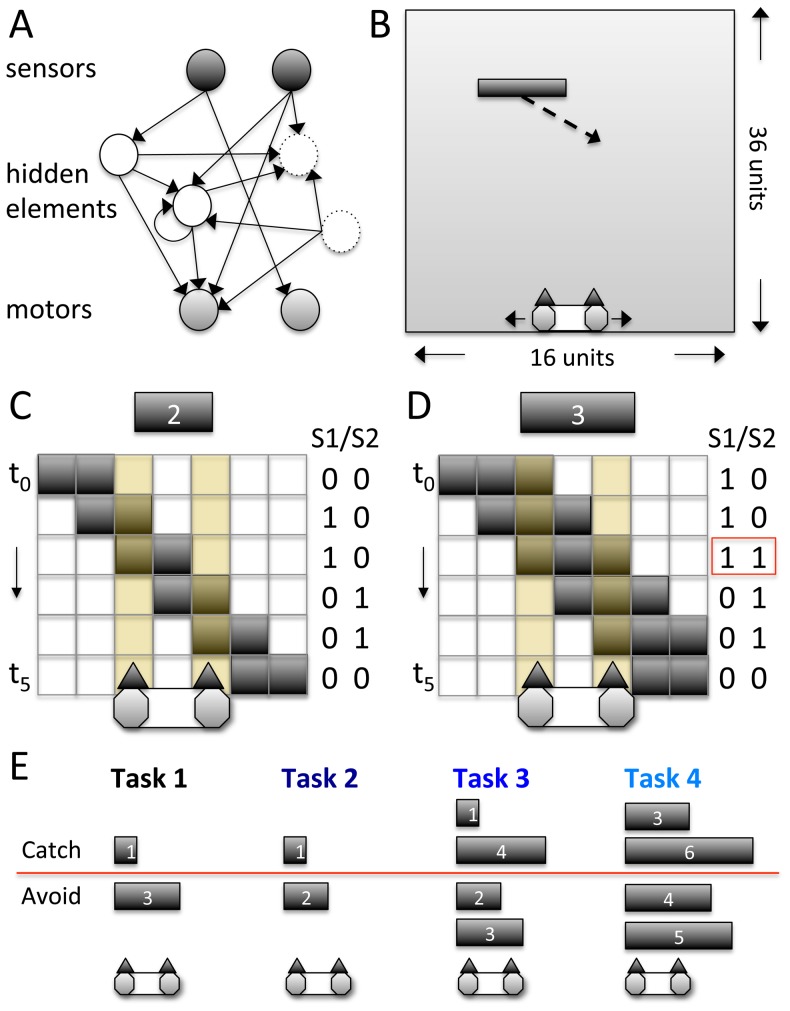
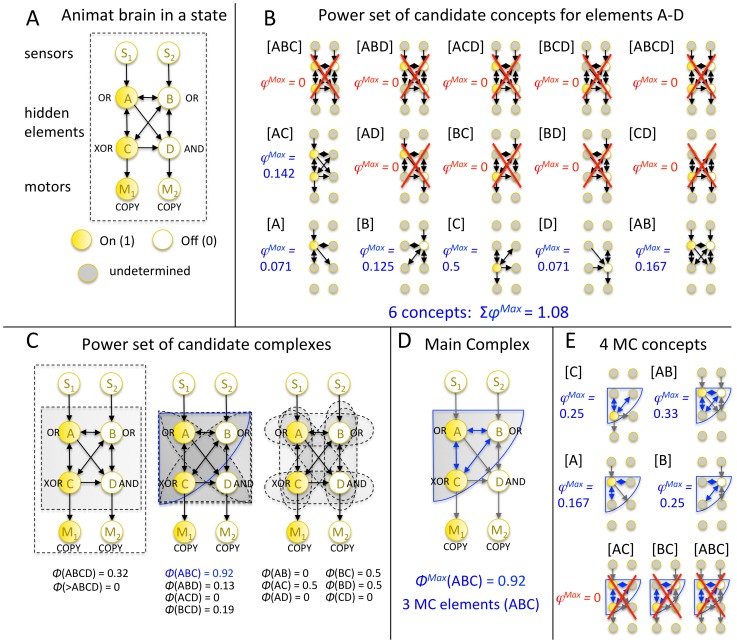
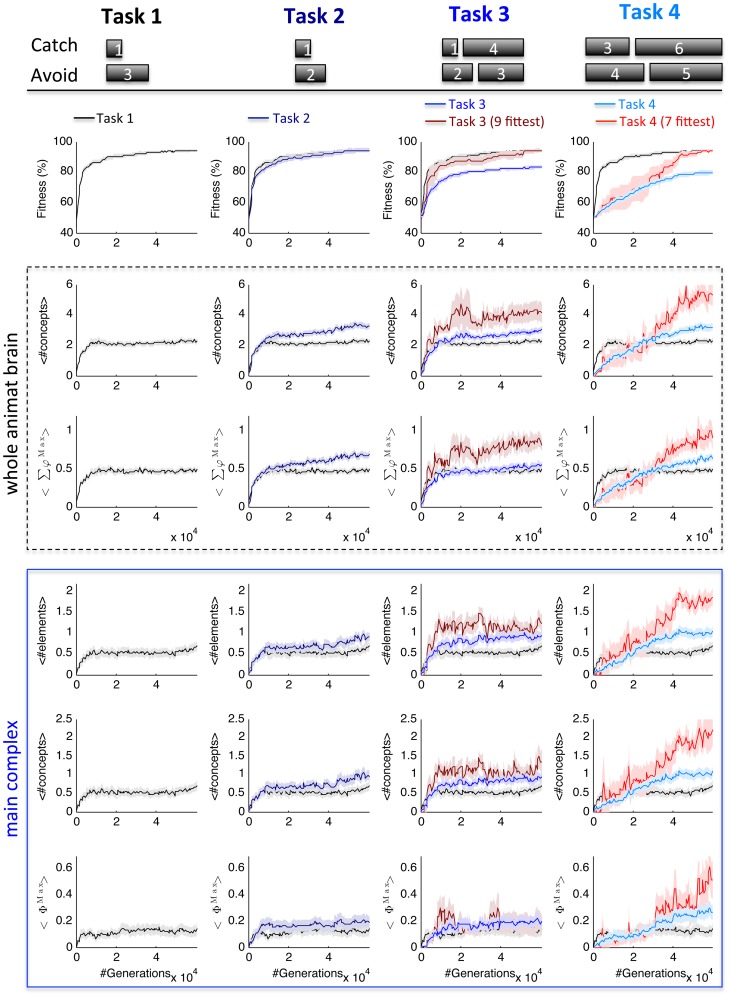
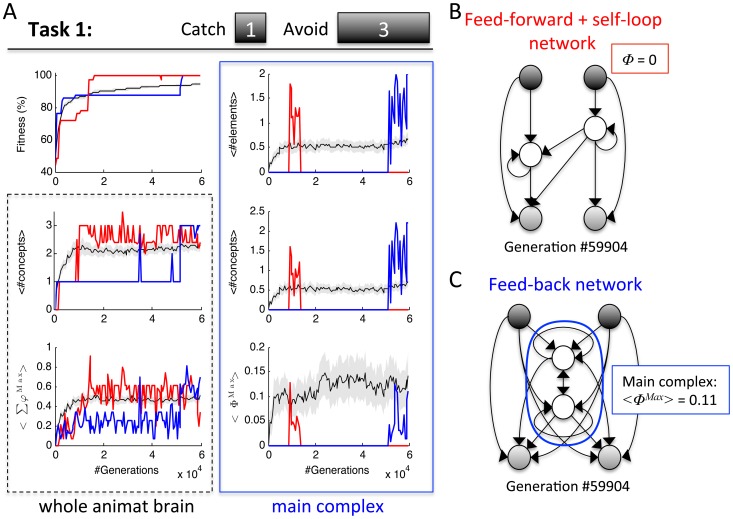
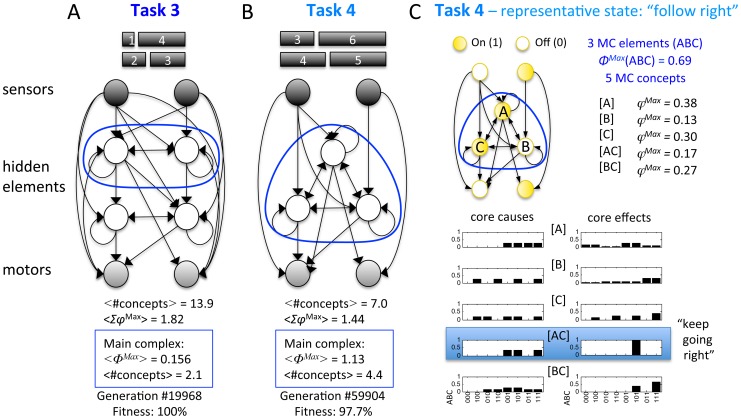
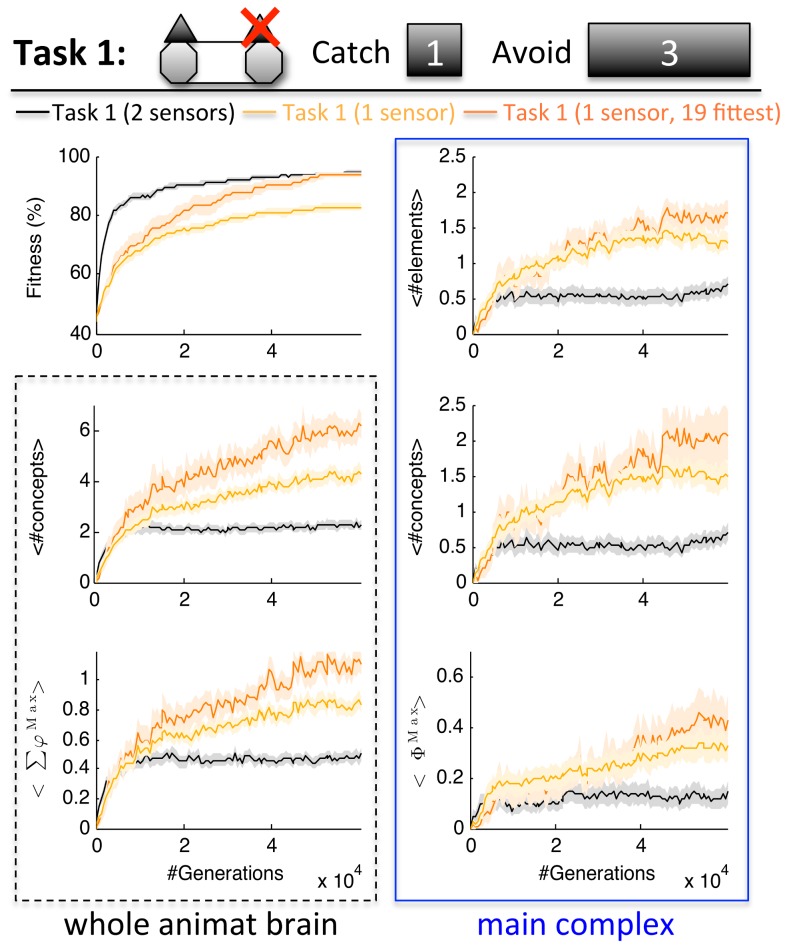
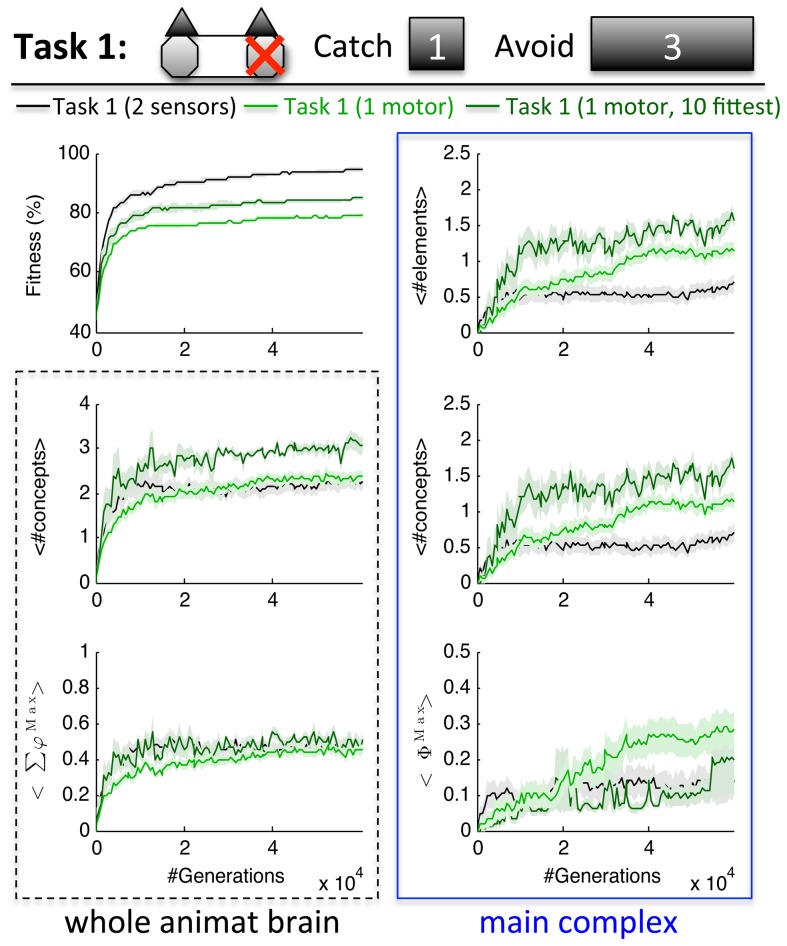
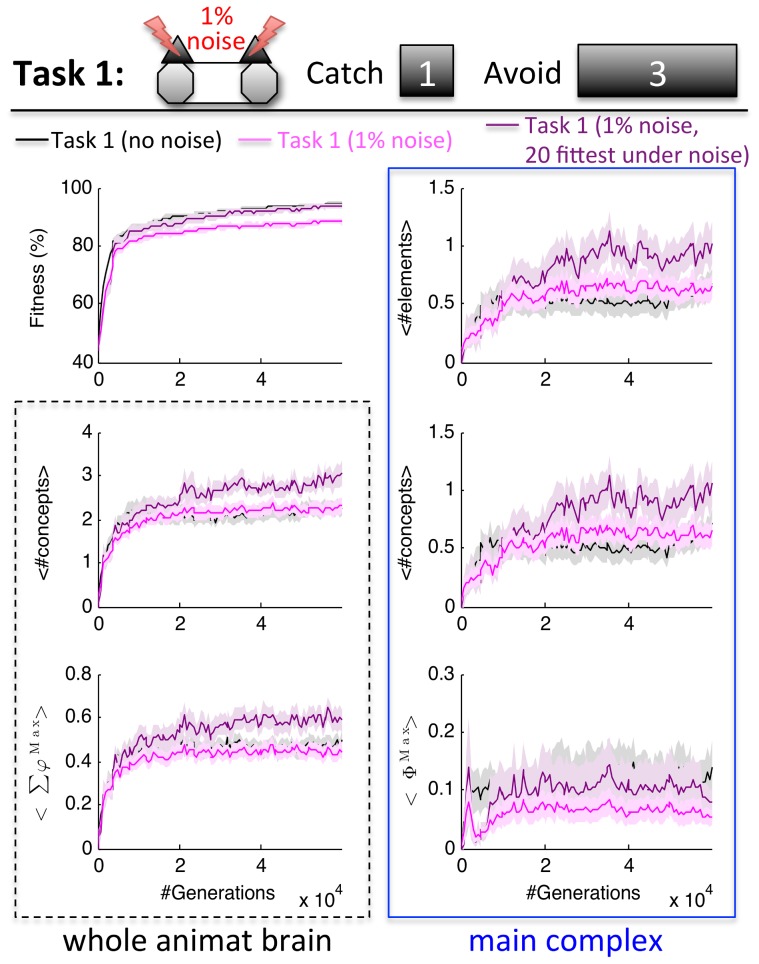
Natural selection favors the evolution of brains that can capture fitness-relevant features of the environment's causal structure. We investigated the evolution of small, adaptive logic-gate networks ("animats") in task environments where falling blocks of different sizes have to be caught or avoided in a 'Tetris-like' game. Solving these tasks requires the integration of sensor inputs and memory. Evolved networks were evaluated using measures of information integration, including the number of evolved concepts and the total amount of integrated conceptual information. The results show that, over the course of the animats' adaptation, i) the number of concepts grows; ii) integrated conceptual information increases; iii) this increase depends on the complexity of the environment, especially on the requirement for sequential memory. These results suggest that the need to capture the causal structure of a rich environment, given limited sensors and internal mechanisms, is an important driving force for organisms to develop highly integrated networks ("brains") with many concepts, leading to an increase in their internal complexity.
Overview
The claims and statistics of this paper haven’t been checked yet.
Run the check — free, no account needed. It reads the open-access text and checks the sources it cites.
Integrity signals
Registry
Cites
Statistics
Figures
Verification
Claims the paper makes
The claims and statistics of this paper haven’t been checked yet.
Run the check — free, no account needed. It reads the open-access text and checks the sources it cites.
Claims other papers make about this one
Each is checked against this paper’s own text: does it say what the citing paper says it does?
The cited source doesn’t support the claim as written.
In the citing paper
“Albantakis et al. (2014) analyzed networks with 3-6 nodes.”
From Can "consciousness" be observed from large language model (LLM) internal states? Dissecting LLM representations obtained from Theory of Mind test with Integrated Information Theory and Span Representation analysis (2025) · cites this paper as Albantakis et al., 2014
Checked by a reasoning model — may be wrong.
Experimental — accuracy not yet measured
Self-check
Percentages, sums and reported differences re-computed from the paper’s own numbers.
The self-check needs the paper’s full text.
Citations
Cites
Elements of Information Theory
Cover, T. M., & Thomas, J. A. (2001) · Wiley eBooks · doi:10.1002/0471200611 · Cited by 37,139
Multilayer feedforward networks are universal approximators
Hornik, K., Stinchcombe, M., & White, H. (1989) · Neural Networks · doi:10.1016/0893-6080(89)90020-8 · Cited by 21,728
Elements of Information Theory
Cover, T. M., & Thomas, J. A. (2005) · doi:10.1002/047174882x · Cited by 13,791
Causality: Models, Reasoning, and Inference
Pearl, J. (2009) · doi:10.1017/cbo9780511803161 · Cited by 11,653
Multilayer feedforward networks are universal approximators
HornikK., StinchcombeM., & WhiteH. (1989) · Neural Networks · doi:10.5555/70405.70408 · Cited by 9,266
Foxman, D., & Bateson, G. (1973) · The Western Political Quarterly · doi:10.2307/446833 · Cited by 7,263
The Earth Mover's Distance as a Metric for Image Retrieval
Rubner, Y., Tomasi, C., & Guibas, L. (2000) · International Journal of Computer Vision · doi:10.1023/a:1026543900054 · Cited by 5,547
CAUSALITY: MODELS, REASONING AND INFERENCE
Hitchcock, C., & Pearl, J. (2001) · The Philosophical Review · doi:10.2307/3182612 · Cited by 4,827
(1987) · Medical Entomology and Zoology · Cited by 2,512
Rich-club organization of the human connectome
van den Heuvel, M. P., & Sporns, O. (2011) · The Journal of Neuroscience · doi:10.1523/jneurosci.3539-11.2011 · Cited by 2,354
Research works printed but not linked: 1
- Bateson G (1972) Steps to an Ecology of Mind. University of Chicago Press.
Cited by
Sorted by citations
Integrated information theory: from consciousness to its physical substrate
Tononi, G., Boly, M., Massimini, M., & Koch, C. (2016) · Nature Reviews Neuroscience · doi:10.1038/nrn.2016.44 · Cited by 1,727
Seth, A. K., & Bayne, T. (2022) · Nature Reviews Neuroscience · doi:10.1038/s41583-022-00587-4 · Cited by 880
Consciousness: here, there and everywhere?
Tononi, G., & Koch, C. (2015) · Philosophical Transactions of the Royal Society B: Biological Sciences · doi:10.1098/rstb.2014.0167 · Cited by 811
Albantakis, L., Barbosa, L., Findlay, G., Grasso, M., Haun, A. M., Marshall, W., Mayner, W. G. P., Zaeemzadeh, A., Boly, M., Juel, B. E., et al. (2023) · PLoS Computational Biology · doi:10.1371/journal.pcbi.1011465 · Cited by 292
“Yet another is the study of the evolution of a substrate’s causal powers as conditional probabilities that update themselves [74].”
Can the macro beat the micro? Integrated information across spatiotemporal scales
Hoel, E. P., Albantakis, L., Marshall, W., & Tononi, G. (2016) · Neuroscience of Consciousness · doi:10.1093/nc/niw012 · Cited by 140
Self-citation
Metadata
- Authors
- Albantakis, L., Hintze, A., Koch, C., Adami, C., & Tononi, G.
- Affiliations
- University of Wisconsin–Madison (US)
- Michigan State University (US)
- Corresponding author
- Albantakis, Larissa
- Tononi, Giulio
- Venue
- PLoS Computational Biology
- Publisher
- Public Library of Science (PLoS)
- Published
- 2014-12-18
- Volume
- 10
- Issue
- 12
- Pages
- e1003966
- ISSN
- 1553-734X (ISSN-L)
- 1553-7358
- PMC
- PMC4270440
- OpenAlex
- W2070484080
- Cited by
- 101
- References
- 61
- Citations by year
- 2026: 8 · 2025: 7 · 2024: 10 · 2023: 5 · 2022: 8 · 2021: 12 · 2020: 10 · 2019: 12 · 2018: 10 · 2017: 8 · 2016: 6 · 2015: 5
- FWCI
- 6.31
- Type
- journal article
- Language
- en
- Open access
- gold
- doi.org
- Locations
- PLoS Computational Biology (publishedVersion, cc-by)
- Europe PMC (PubMed Central) (publishedVersion, cc-by)
- PubMed Central (publishedVersion, cc-by)
- PubMed (publishedVersion)
- Diva portal (Dalarna University Library) (submittedVersion, other-oa)
- DOAJ (DOAJ: Directory of Open Access Journals) (submittedVersion, cc-by-sa)
- Figshare (submittedVersion, cc-by)
- Funders
- Paul G. Allen Family Foundation
- Templeton World Charity Foundation
- Defense Advanced Research Projects Agency
- Topics
- Physical Sciences › Computer Science › Artificial Intelligence › Evolutionary Algorithms and Applications
- Life Sciences › Neuroscience › Cognitive Neuroscience › Embodied and Extended Cognition
- Physical Sciences › Computer Science › Artificial Intelligence › Psychiatry, Mental Health, Neuroscience
- Keywords
- animats, causal structure, information integration, conceptual information, environmental complexity, sequential memory, sensor integration, cognitive evolution, internal complexity
- MeSH terms
- Adaptation, Physiological, Algorithms, Computer Simulation, Biological Evolution, Models, Neurological, Selection, Genetic, Statistics, Nonparametric, Computational Biology, Feedback, Physiological, Genetic Fitness
About these checks
Registry, retraction, Cites and statistics results are computed, not judged, with one exception: a printed reference that no index lists is read once by a model before it counts as a citation error. Claims are extracted by a model and kept only when their quote appears verbatim in the text; each cited source is then checked, with a model’s help, for whether it says what the claim relies on. Those verdicts can be wrong — read the claim’s quote and the cited source before relying on one.
Statistics and arithmetic are recomputed, not judged.
Confidence bands are shown only for fields calibrated on our annotated test set. None is calibrated yet, so no band is shown.
What counts as a claim ›How we measure confidence ›How we check this ›
Are you an author, or do you see a problem with this page? Request a review
