

The DOI matches its Crossref record; 61 of the 61 references it cites were found in a registry or an index.
Evolution of Integrated Causal Structures in Animats Exposed to Environments of Increasing Complexity
Open accessAbstract
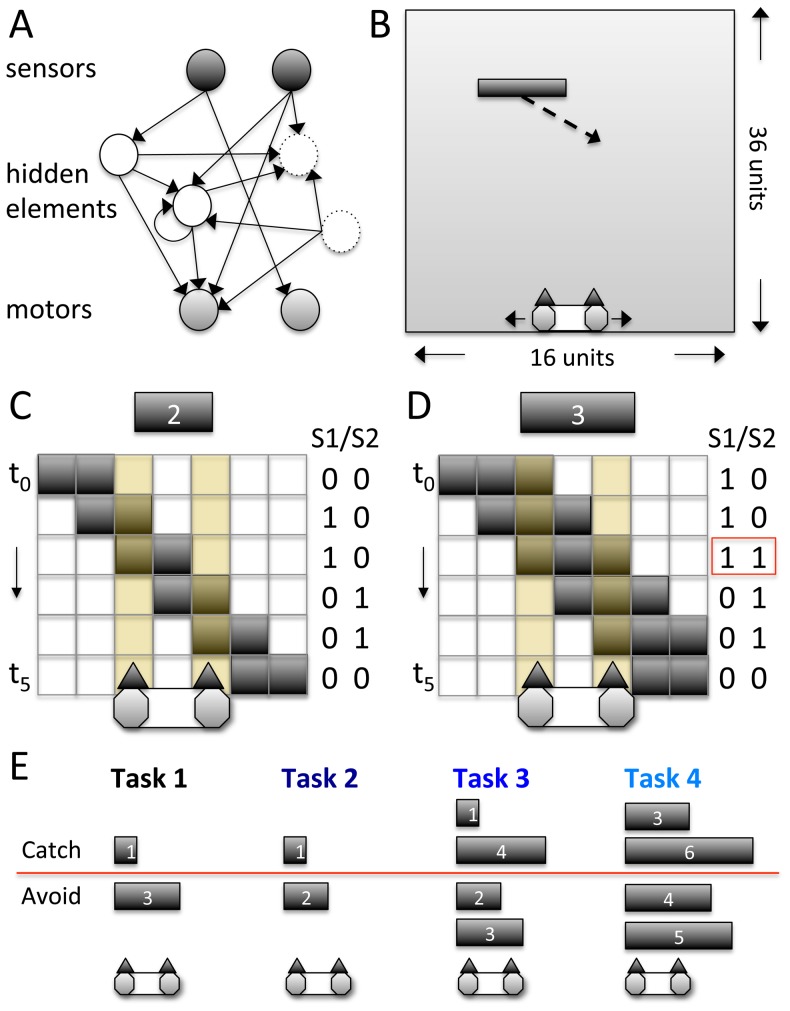
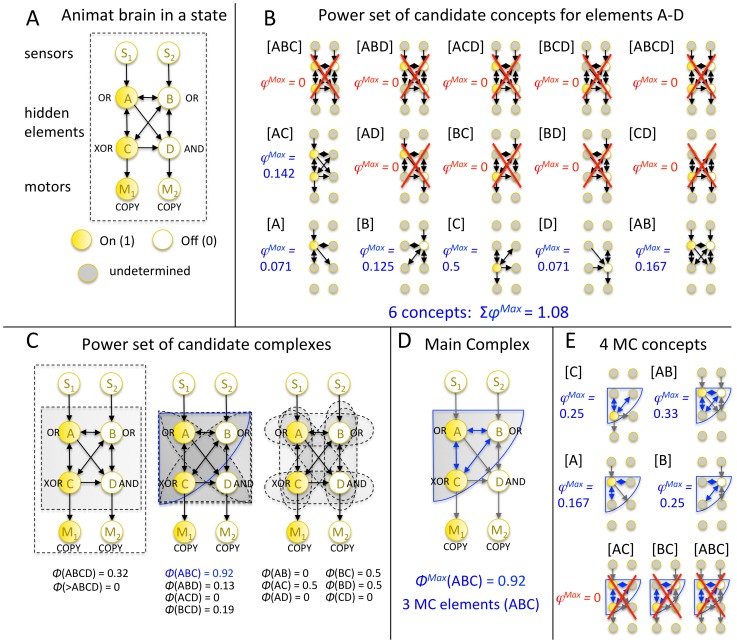
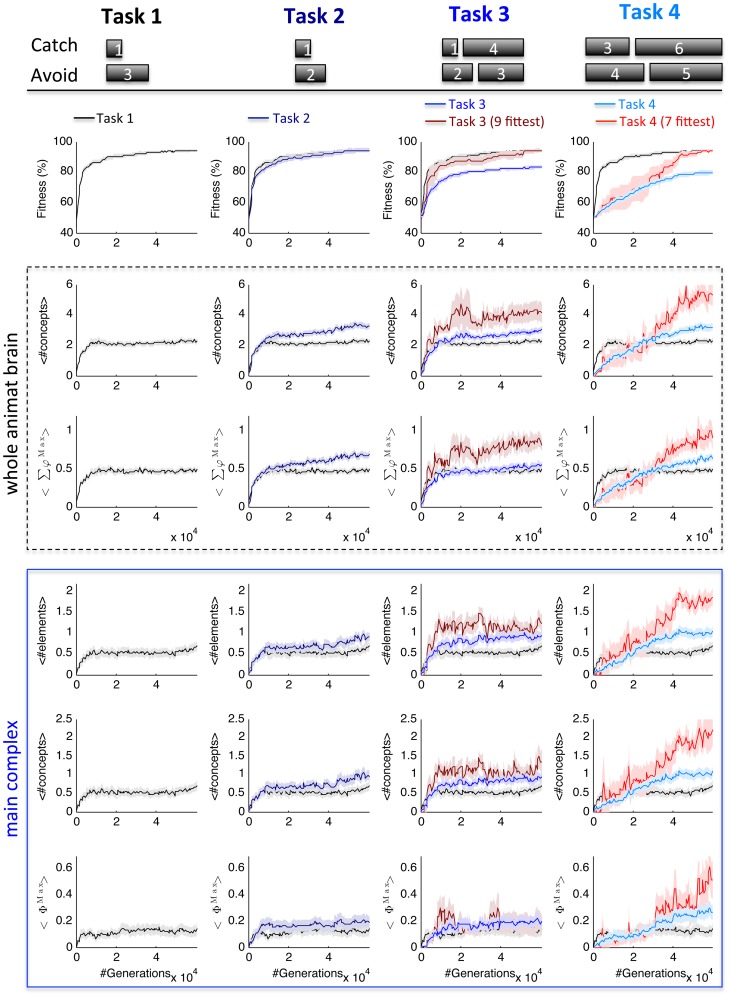
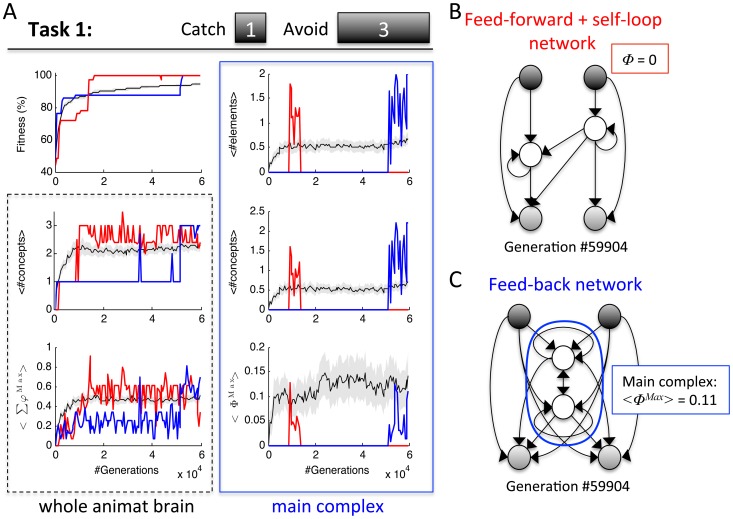
Natural selection favors the evolution of brains that can capture fitness-relevant features of the environment's causal structure. We investigated the evolution of small, adaptive logic-gate networks ("animats") in task environments where falling blocks of different sizes have to be caught or avoided in a 'Tetris-like' game. Solving these tasks requires the integration of sensor inputs and memory. Evolved networks were evaluated using measures of information integration, including the number of evolved concepts and the total amount of integrated conceptual information. The results show that, over the course of the animats' adaptation, i) the number of concepts grows; ii) integrated conceptual information increases; iii) this increase depends on the complexity of the environment, especially on the requirement for sequential memory. These results suggest that the need to capture the causal structure of a rich environment, given limited sensors and internal mechanisms, is an important driving force for organisms to develop highly integrated networks ("brains") with many concepts, leading to an increase in their internal complexity.
Overview
The claims and statistics of this paper haven’t been checked yet.
Run the check — free, no account needed. It reads the open-access text and checks the sources it cites.
Integrity signals
Registry
Cites
Statistics
Figures
Verification
Claims the paper makes
The claims and statistics of this paper haven’t been checked yet.
Run the check — free, no account needed. It reads the open-access text and checks the sources it cites.
Claims other papers make about this one
Each is checked against this paper’s own text: does it say what the citing paper says it does?
The cited source doesn’t support the claim as written.
In the citing paper
“Albantakis et al. (2014) analyzed networks with 3-6 nodes.”
From Can "consciousness" be observed from large language model (LLM) internal states? Dissecting LLM representations obtained from Theory of Mind test with Integrated Information Theory and Span Representation analysis (2025) · cites this paper as Albantakis et al., 2014
Checked by a reasoning model — may be wrong.
Experimental — accuracy not yet measured
Self-check
Percentages, sums and reported differences re-computed from the paper’s own numbers.
The self-check needs the paper’s full text.
Citations
Cites
Elements of Information Theory
Cover, T. M., & Thomas, J. A. (2001) · Wiley eBooks · doi:10.1002/0471200611 · Cited by 37,139
Multilayer feedforward networks are universal approximators
Hornik, K., Stinchcombe, M., & White, H. (1989) · Neural Networks · doi:10.1016/0893-6080(89)90020-8 · Cited by 21,728
Elements of Information Theory
Cover, T. M., & Thomas, J. A. (2005) · doi:10.1002/047174882x · Cited by 13,791
Causality: Models, Reasoning, and Inference
Pearl, J. (2009) · doi:10.1017/cbo9780511803161 · Cited by 11,653
Multilayer feedforward networks are universal approximators
HornikK., StinchcombeM., & WhiteH. (1989) · Neural Networks · doi:10.5555/70405.70408 · Cited by 9,266
Foxman, D., & Bateson, G. (1973) · The Western Political Quarterly · doi:10.2307/446833 · Cited by 7,263
The Earth Mover's Distance as a Metric for Image Retrieval
Rubner, Y., Tomasi, C., & Guibas, L. (2000) · International Journal of Computer Vision · doi:10.1023/a:1026543900054 · Cited by 5,547
CAUSALITY: MODELS, REASONING AND INFERENCE
Hitchcock, C., & Pearl, J. (2001) · The Philosophical Review · doi:10.2307/3182612 · Cited by 4,827
(1987) · Medical Entomology and Zoology · Cited by 2,512
Rich-club organization of the human connectome
van den Heuvel, M. P., & Sporns, O. (2011) · The Journal of Neuroscience · doi:10.1523/jneurosci.3539-11.2011 · Cited by 2,354
Research works printed but not linked: 1
- Bateson G (1972) Steps to an Ecology of Mind. University of Chicago Press.
Cited by
Sorted by citations
Integrated information theory: from consciousness to its physical substrate
Tononi, G., Boly, M., Massimini, M., & Koch, C. (2016) · Nature Reviews Neuroscience · doi:10.1038/nrn.2016.44 · Cited by 1,727
Seth, A. K., & Bayne, T. (2022) · Nature Reviews Neuroscience · doi:10.1038/s41583-022-00587-4 · Cited by 880
Consciousness: here, there and everywhere?
Tononi, G., & Koch, C. (2015) · Philosophical Transactions of the Royal Society B: Biological Sciences · doi:10.1098/rstb.2014.0167 · Cited by 811
Albantakis, L., Barbosa, L., Findlay, G., Grasso, M., Haun, A. M., Marshall, W., Mayner, W. G. P., Zaeemzadeh, A., Boly, M., Juel, B. E., et al. (2023) · PLoS Computational Biology · doi:10.1371/journal.pcbi.1011465 · Cited by 292
“Yet another is the study of the evolution of a substrate’s causal powers as conditional probabilities that update themselves [74].”
Can the macro beat the micro? Integrated information across spatiotemporal scales
Hoel, E. P., Albantakis, L., Marshall, W., & Tononi, G. (2016) · Neuroscience of Consciousness · doi:10.1093/nc/niw012 · Cited by 140
Self-citationAn integrative, multiscale view on neural theories of consciousness
Storm, J. F., Klink, P. C., Aru, J., Senn, W., Goebel, R., Pigorini, A., Avanzini, P., Vanduffel, W., Roelfsema, P. R., Massimini, M., et al. (2024) · Neuron · doi:10.1016/j.neuron.2024.02.004 · Cited by 114
PyPhi: A toolbox for integrated information theory
Mayner, W. G. P., Marshall, W., Albantakis, L., Findlay, G., Marchman, R., & Tononi, G. (2018) · PLOS Computational Biology · doi:10.1371/journal.pcbi.1006343 · Cited by 118
Self-citationUnpacking the complexities of consciousness: Theories and reflections
Mudrik, L., Boly, M., Dehaene, S., Fleming, S. M., Lamme, V., Seth, A., & Melloni, L. (2025) · Neuroscience & Biobehavioral Reviews · doi:10.1016/j.neubiorev.2025.106053 · Cited by 81
Black-boxing and cause-effect power
Marshall, W., Albantakis, L., & Tononi, G. (2018) · PLOS Computational Biology · doi:10.1371/journal.pcbi.1006114 · Cited by 73
Self-citationDegeneracy in hippocampal physiology and plasticity
Rathour, R. K., & Narayanan, R. (2019) · Hippocampus · doi:10.1002/hipo.23139 · Cited by 78
Informative and misinformative interactions in a school of fish
Crosato, E., Jiāng, L., Lecheval, V., Lizier, J. T., Wang, X. R., Tichit, P., Théraulaz, G., & Prokopenko, M. (2018) · Swarm Intelligence · doi:10.1007/s11721-018-0157-x · Cited by 71
Albantakis, L., & Tononi, G. (2015) · Entropy · doi:10.3390/e17085472 · Cited by 58
Self-citationWahbeh, H., Radin, D. I., Cannard, C., & Arnaud Delorme, A. (2022) · Frontiers in Psychology · doi:10.3389/fpsyg.2022.955594 · Cited by 76
The Emergence of Integrated Information, Complexity, and ‘Consciousness’ at Criticality
Popiel, N. J. M., Khajehabdollahi, S., Abeyasinghe, P. M., Riganello, F., Nichols, E. S., Owen, A. M., & Soddu, A. (2020) · Entropy · doi:10.3390/e22030339 · Cited by 47
The Relationship Between Consciousness and Top-Down Attention
Tsuchiya, N., & Koch, C. (2015) · Elsevier eBooks · doi:10.1016/b978-0-12-800948-2.00005-4 · Cited by 43
Synthetic transitions: towards a new synthesis
Solé, R. V. (2016) · Philosophical Transactions of the Royal Society B Biological Sciences · doi:10.1098/rstb.2015.0438 · Cited by 45
Causal reductionism and causal structures
Grasso, M., Albantakis, L., Lang, J. P., & Tononi, G. (2021) · Nature Neuroscience · doi:10.1038/s41593-021-00911-8 · Cited by 42
Self-citationIntegrated information and state differentiation
Marshall, W., Gomez-Ramirez, J., & Tononi, G. (2016) · Frontiers in Psychology · doi:10.3389/fpsyg.2016.00926 · Cited by 36
Integrated information as a metric for group interaction
Engel, D., & Malone, T. W. (2018) · PLoS ONE · doi:10.1371/journal.pone.0205335 · Cited by 44
Leung, A., Cohen, D., van Swinderen, B., & Tsuchiya, N. (2021) · PLoS Computational Biology · doi:10.1371/journal.pcbi.1008722 · Cited by 42
The brain's best kept secret is its degenerate structure
Albantakis, L., Bernard, C., Brenner, N., Marder, E., & Narayanan, R. (2024) · The Journal of Neuroscience · doi:10.1523/jneurosci.1339-24.2024 · Cited by 34
Self-citationCausal composition: Structural differences among dynamically equivalent systems
Albantakis, L., & Tononi, G. (2019) · Entropy · doi:10.3390/e21100989 · Cited by 30
“This is demonstrated particularly well by recent computational studies involving simulated artificial agents with minimal cognitive architectures [15,23,68,69], whose behavior can easily be predicted.”
BackgroundSelf-citationWhat Might Interoceptive Inference Reveal about Consciousness?
Nikolova, N. E., Waade, P. T., Friston, K. J., & Allen, M. (2021) · Review of Philosophy and Psychology · doi:10.1007/s13164-021-00580-3 · Cited by 30
Markov Brains: A Technical IntroductionPreprint
Hintze, A., Edlund, J. A., Olson, R. S., Knoester, D. B., Schossau, J., Albantakis, L., Tehrani-Saleh, A., Kvam, P. D., Sheneman, L., Goldsby, H. J., et al. (2017) · arXiv (Cornell University) · doi:10.48550/arxiv.1709.05601 · Cited by 35
Negro, N. (2020) · Phenomenology and the Cognitive Sciences · doi:10.1007/s11097-020-09681-3 · Cited by 25
Sleep and Dreaming in the Predictive Processing Framework
Bucci, A., & Grasso, M. (2017) · Iris (Roma Tre University) · doi:10.15502/9783958573079 · Cited by 27
Degeneracy in the nervous system: From neuronal excitability to neural coding
Kamaleddin, M. A. (2022) · BioEssays · doi:10.1002/bies.202100148 · Cited by 24
Integrated information in the thermodynamic limit
Aguilera, M., & Paolo, E. A. D. (2019) · Neural Networks · doi:10.1016/j.neunet.2019.03.001 · Cited by 22
A measure centrality index for systematic empirical comparison of consciousness theories
Chis-Ciure, R., Melloni, L., & Northoff, G. (2024) · Neuroscience & Biobehavioral Reviews · doi:10.1016/j.neubiorev.2024.105670 · Cited by 22
Information-Theoretic Neuro-Correlates Boost Evolution of Cognitive Systems
Schossau, J., Adami, C., & Hintze, A. (2015) · Entropy · doi:10.3390/e18010006 · Cited by 22
Evaluating Approximations and Heuristic Measures of Integrated Information
Nilsen, A. S., Juel, B. E., Marshall, W., & Storm, J. F. (2019) · Entropy · doi:10.3390/e21050525 · Cited by 20
Marshall, W., Grasso, M., Mayner, W. G. P., Zaeemzadeh, A., Barbosa, L. S., Chastain, E., Findlay, G., Sasai, S., Albantakis, L., & Tononi, G. (2023) · Entropy · doi:10.3390/e25020334 · Cited by 20
Self-citationEvers, K., Farisco, M., & Pennartz, C. M. A. (2024) · Consciousness and Cognition · doi:10.1016/j.concog.2024.103668 · Cited by 22
Albantakis, L. (2020) · Routledge eBooks · doi:10.4324/9781315205267-6 · Cited by 19
AHA: A general cognitive architecture for Darwinian agents
Budaev, S. V., Giske, J., & Eliassen, S. (2018) · Biologically Inspired Cognitive Architectures · doi:10.1016/j.bica.2018.07.009 · Cited by 18
Efficient search for informational cores in complex systems: Application to brain networks
Kitazono, J., Kanai, R., & Oizumi, M. (2020) · Neural Networks · doi:10.1016/j.neunet.2020.08.020 · Cited by 17
The Cognitome: Seeking the Fundamental Neuroscience of a Theory of Consciousness
Анохин, К. В. (2021) · Neuroscience and Behavioral Physiology · doi:10.1007/s11055-021-01149-4 · Cited by 17
Consciousness and complexity: Neurobiological naturalism and integrated information theory
Ellia, F., & Chis-Ciure, R. (2022) · Consciousness and Cognition · doi:10.1016/j.concog.2022.103281 · Cited by 21
Scaling Behaviour and Critical Phase Transitions in Integrated Information Theory
Aguilera, M. (2019) · Entropy · doi:10.3390/e21121198 · Cited by 16
Evolving autonomous learning in cognitive networks
Sheneman, L., & Hintze, A. (2017) · Scientific Reports · doi:10.1038/s41598-017-16548-2 · Cited by 17
Computing Integrated Information (Φ) in Discrete Dynamical Systems with Multi-Valued Elements
Gomez, J. D., Mayner, W. G. P., Beheler-Amass, M., Tononi, G., & Albantakis, L. (2020) · Entropy · doi:10.3390/e23010006 · Cited by 16
The Evolutionary Buffet Method
Hintze, A., Schossau, J., & Bohm, C. (2019) · Genetic and evolutionary computation · doi:10.1007/978-3-030-04735-1_2 · Cited by 14
A Traditional Scientific Perspective on the Integrated Information Theory of Consciousness
Mallatt, J. M. (2021) · Entropy · doi:10.3390/e23060650 · Cited by 16
A Tale of Two Animats: What Does It Take to Have Goals?
Albantakis, L. (2018) · The frontiers collection · doi:10.1007/978-3-319-75726-1_2 · Cited by 13
The structure of evolved representations across different substrates for artificial intelligence
Hintze, A., Kirkpatrick, D., & Adami, C. (2018) · Conference on Artificial Life (ALIFE) · doi:10.1162/isal_a_00076 · Cited by 16
An organisational systems-biology view of viruses explains why they are not alive
Farnsworth, K. D. (2020) · Biosystems · doi:10.1016/j.biosystems.2020.104324 · Cited by 15
The meaningful-based cognitive architecture model of schizophrenia
Schneider, H. (2019) · Cognitive Systems Research · doi:10.1016/j.cogsys.2019.09.019 · Cited by 12
How biological codes break causal chains to enable autonomy for organisms
Farnsworth, K. D. (2023) · Biosystems · doi:10.1016/j.biosystems.2023.105013 · Cited by 11
Fischer, D., Mostaghim, S., & Albantakis, L. (2018) · Genetic and Evolutionary Computation Conference (GECCO) · doi:10.1145/3205455.3205646 · Cited by 10
Can Transfer Entropy Infer Information Flow in Neuronal Circuits for Cognitive Processing?
Tehrani-Saleh, A., & Adami, C. (2020) · Entropy · doi:10.3390/e22040385 · Cited by 13
Integrated Information Theory and Isomorphic Feed-Forward Philosophical Zombies
Hanson, J. R., & Walker, S. I. (2019) · Entropy · doi:10.3390/e21111073 · Cited by 13
Augmenting Human Selves Through Artificial Agents – Lessons From the Brain
Northoff, G., Fraser, M., Griffiths, J. D., Pinotsis, D. A., Panangaden, P., Moran, R., & Friston, K. J. (2022) · Frontiers in Computational Neuroscience · doi:10.3389/fncom.2022.892354 · Cited by 9
Juel, B. E., Comolatti, R., Tononi, G., & Albantakis, L. (2019) · Conference on Artificial Life (ALIFE) · doi:10.1162/isal_a_00207.xml · Cited by 16
Skokowski, P. G. (2022) · Frontiers in Systems Neuroscience · doi:10.3389/fnsys.2022.795405 · Cited by 13
Information Fragmentation, Encryption and Information Flow in Complex Biological Networks
Bohm, C., Kirkpatrick, D., Cao, V., & Adami, C. (2022) · Entropy · doi:10.3390/e24050735 · Cited by 8
Entropy balance and information processing in bipartite and nonbipartite composite systems
Spinney, R. E., Lizier, J. T., & Prokopenko, M. (2018) · Physical review. E · doi:10.1103/physreve.98.032141 · Cited by 9
Of Evolution, Systems and Complexity
Beslon, G., Liard, V., Parsons, D. P., & Rouzaud-Cornabas, J. (2021) · Springer eBooks · doi:10.1007/978-3-030-71737-7_1 · Cited by 9
Kvam, P. D., & Hintze, A. (2018) · Evolutionary Behavioral Sciences · doi:10.1037/ebs0000115 · Cited by 7
Artificial intelligence, consciousness and psychiatry
Tononi, G., & Raison, C. L. (2024) · World Psychiatry · doi:10.1002/wps.21222 · Cited by 10
Dissociating Artificial Intelligence from Artificial Consciousness
Findlay, G., Marshall, W., Albantakis, L., David, I., Mayner, W. G., Koch, C., & Tononi, G. (2024) · arXiv · doi:10.48550/arxiv.2412.04571 · Cited by 41
“…consciousness may split under some concurrent tasks [29], why specific contents of consciousness such as the visual field, temporal flow or mental objects may feel the way they do [40, 41, 91–93], and why consciousness may have evolved due to selective pressure for information integration [94–96].”
Self-citationIntrinsic units: identifying a system’s causal grain
Marshall, W., Findlay, G., Albantakis, L., & Tononi, G. (2026) · Neuroscience of Consciousness · doi:10.1093/nc/niag013 · Cited by 12
Albantakis, L., Massari, F., Beheler-Amass, M., & Tononi, G. (2021) · Synthese Library/Synthese library · doi:10.1007/978-3-030-71899-2_7 · Cited by 9
Non-Separability of Physical Systems as a Foundation of Consciousness
Arkhipov, A. S. (2022) · Entropy · doi:10.3390/e24111539 · Cited by 8
Is the maximum entropy production just a heuristic principle? Metaphysics on natural determination
Cañizares, J. S. (2023) · Synthese · doi:10.1007/s11229-023-04129-y · Cited by 7
How cognitive and environmental constraints influence the reliability of simulated animats in groups
Fischer, D., Mostaghim, S., & Albantakis, L. (2020) · PLoS ONE · doi:10.1371/journal.pone.0228879 · Cited by 7
We need to explain subjective experience, but its explanation may not be mechanistic
Signorelli, C. M., Cea, I., & Prentner, R. (2025) · Neuroscience of Consciousness · doi:10.1093/nc/niaf034 · Cited by 9
Olesen, C., Waade, P. T., Albantakis, L., & Mathys, C. D. (2023) · PLoS Computational Biology · doi:10.1371/journal.pcbi.1011346 · Cited by 12
Tehrani-Saleh, A., Adami, C., & Olson, R. S. (2016) · Conference on Artificial Life (ALIFE) · doi:10.1162/978-0-262-33936-0-ch089 · Cited by 6
Building and Understanding the Minimal Self
Forch, V., & Hamker, F. H. (2021) · Frontiers in Psychology · doi:10.3389/fpsyg.2021.716982 · Cited by 6
How Morphological Computation Shapes Integrated Information in Embodied Agents
Langer, C., & Ay, N. (2021) · Frontiers in Psychology · doi:10.3389/fpsyg.2021.716433 · Cited by 6
Upper bounds for integrated information
Zaeemzadeh, A., & Tononi, G. (2024) · PLoS Computational Biology · doi:10.1371/journal.pcbi.1012323 · Cited by 8
The role of conditional independence in the evolution of intelligent systems
Schossau, J., Albantakis, L., & Hintze, A. (2017) · Genetic and Evolutionary Computation Conference Companion (GECCO Companion) · doi:10.1145/3067695.3076033 · Cited by 4
Quantifying the Autonomy of Structurally Diverse Automata: A Comparison of Candidate Measures
Albantakis, L. (2021) · Entropy · doi:10.3390/e23111415 · Cited by 5
Fitness and neural complexity of animats exposed to environmental change
Albantakis, L., & Tononi, G. (2015) · BMC Neuroscience · doi:10.1186/1471-2202-16-s1-p262 · Cited by 4
The Evolution of Neuroplasticity and the Effect on Integrated Information
Sheneman, L., Schossau, J., & Hintze, A. (2019) · Entropy · doi:10.3390/e21050524 · Cited by 4
Formal Approaches to a Definition of AgentsPreprint
Biehl, M. (2017) · arXiv (Cornell University) · doi:10.18745/th.17955 · Cited by 7
MKER: multi-modal knowledge extraction and reasoning for future event prediction
Lai, C., & Qiu, S. (2025) · Complex & Intelligent Systems · doi:10.1007/s40747-024-01741-4 · Cited by 3
To be or to know? Information in the pristine present
Albantakis, L. (2022) · Behavioral and Brain Sciences · doi:10.1017/s0140525x21001977 · Cited by 3
Li, J. (2025) · Natural Language Processing Journal · doi:10.1016/j.nlp.2025.100163 · Cited by 3
“To determine the specific dimensionality to which the RN should be reduced using PCA, we referred to existing implementations and/or applications of IIT, such as: • Albantakis et al. (2014) analyzed networks with 3-6 nodes.”
Tolle, H. M., Luppi, A. I., Seth, A. K., & Mediano, P. A. M. (2026) · Patterns · doi:10.1016/j.patter.2025.101457 · Cited by 9
Ellia, F., & Tsuchiya, N. (2025) · Neuroscience of Consciousness · doi:10.1093/nc/niaf014 · Cited by 4
Of integrated information theory: a philosophical evaluation
Liu, H. (2019) · Philosophical Psychology · doi:10.1080/09515089.2019.1695044 · Cited by 2
Account of consciousness by Christof Koch: Review and questions
Bachmann, T. (2020) · Consciousness and Cognition · doi:10.1016/j.concog.2020.102937 · Cited by 2
Outsourcing Control Requires Control Complexity
Langer, C., & Ay, N. (2024) · Artificial Life · doi:10.1162/artl_a_00443 · Cited by 5
Sheculski, M., & D’Angiulli, A. (2025) · Machine Learning and Knowledge Extraction · doi:10.3390/make7030082 · Cited by 1
Human consciousness and cognition go hand in hand, but require different types of explanations
Boly, M. (2026) · Aperture Neuro · doi:10.52294/001c.158354 · Cited by 2
Biological Complexity and Cognitive Evolution
Jedlička, P., Varchola, J., & Betinsky, J. (2026) · Biological Theory · doi:10.1007/s13752-026-00532-z · Cited by 1
Explanation, scope, and perspective: sources of schismogenesis in consciousness science
Ellia, F., & Tsuchiya, N. (2026) · Trends in Cognitive Sciences · doi:10.1016/j.tics.2026.03.005 · Cited by 3
Loops all the way up: Recurrency as an implementation-first primitive for consciousness
Zheng, Z., Chis-Ciure, R., Waade, P. T., Eiserbeck, A., Aru, J., Andrillon, T., Jarraya, B., Melloni, L., Northoff, G., Rosas, F. E., et al. (2026) · Physics of Life Reviews · doi:10.1016/j.plrev.2026.07.006 · Cited by 2
Optimality of Social Choice Systems: Complexity, Wisdom, and Wellbeing CentralityPreprint
Boik, J. C. (2016) · OSF Preprints (OSF Preprints) · doi:10.31219/osf.io/75jh7 · Cited by 2
An integrative, multiscale view on consciousness theories_Eary version of paper in press in NEURONPreprint
Storm, J. F., Klink, P. C., Aru, J., Senn, W., Goebel, R., Pigorini, A., Avanzini, P., Vanduffel, W., Roelfsema, P. R., Massimini, M., et al. (2024) · doi:10.31234/osf.io/9byzu · Cited by 1
Evolution of Decision-Making Systems
Schossau, J. D. (2017) · Michigan State University Libraries · doi:10.25335/m5wf78
Niizato, T., Nishiyama, Y., Sakamoto, K., Kazama, T., Okabayashi, T., & Yamaguchi, T. (2021) · bioRxiv (Cold Spring Harbor Laboratory) · doi:10.1101/2021.11.29.470324
Integrated Information in Genetically Evolved Braitenberg Vehicles
Pae, H., & Krichmar, J. L. (2024) · Lecture notes in computer science · doi:10.1007/978-3-031-71533-4_18
An Information-Theoretic Perspective on Acting Agents
Langer, C., & Ay, N. (2024) · IOP Conference Series Materials Science and Engineering · doi:10.1088/1757-899x/1321/1/012008 · Cited by 1
From Function to Implementation: Exploring Degeneracy in Evolved Artificial Agents
Hu, Z., Cingiler, O., Bohm, C., & Albantakis, L. (2025) · Neural Computation · doi:10.1162/neco.a.19 · Cited by 1
Qualia from quantum magic: a quantum resource approach to phenomenal consciousness
Viswanathan, G. M. (2026) · Frontiers in Physics · doi:10.3389/fphy.2025.1715825
Mechanisms and roles of information processing in collective motion
Jiāng, L. (2017) · theses.fr (ABES) · doi:10.70675/fe9d11ecz6accz4d36zbeefzdb3b1feeea5c
Metadata
- Authors
- Albantakis, L., Hintze, A., Koch, C., Adami, C., & Tononi, G.
- Affiliations
- University of Wisconsin–Madison (US)
- Michigan State University (US)
- Corresponding author
- Albantakis, Larissa
- Tononi, Giulio
- Venue
- PLoS Computational Biology
- Publisher
- Public Library of Science (PLoS)
- Published
- 2014-12-18
- Volume
- 10
- Issue
- 12
- Pages
- e1003966
- ISSN
- 1553-734X (ISSN-L)
- 1553-7358
- PMC
- PMC4270440
- OpenAlex
- W2070484080
- Cited by
- 101
- References
- 61
- Citations by year
- 2026: 8 · 2025: 7 · 2024: 10 · 2023: 5 · 2022: 8 · 2021: 12 · 2020: 10 · 2019: 12 · 2018: 10 · 2017: 8 · 2016: 6 · 2015: 5
- FWCI
- 6.31
- Type
- journal article
- Language
- en
- Open access
- gold
- doi.org
- Locations
- PLoS Computational Biology (publishedVersion, cc-by)
- Europe PMC (PubMed Central) (publishedVersion, cc-by)
- PubMed Central (publishedVersion, cc-by)
- PubMed (publishedVersion)
- Diva portal (Dalarna University Library) (submittedVersion, other-oa)
- DOAJ (DOAJ: Directory of Open Access Journals) (submittedVersion, cc-by-sa)
- Figshare (submittedVersion, cc-by)
- Funders
- Paul G. Allen Family Foundation
- Templeton World Charity Foundation
- Defense Advanced Research Projects Agency
- Topics
- Physical Sciences › Computer Science › Artificial Intelligence › Evolutionary Algorithms and Applications
- Life Sciences › Neuroscience › Cognitive Neuroscience › Embodied and Extended Cognition
- Physical Sciences › Computer Science › Artificial Intelligence › Psychiatry, Mental Health, Neuroscience
- Keywords
- animats, causal structure, information integration, conceptual information, environmental complexity, sequential memory, sensor integration, cognitive evolution, internal complexity
- MeSH terms
- Adaptation, Physiological, Algorithms, Computer Simulation, Biological Evolution, Models, Neurological, Selection, Genetic, Statistics, Nonparametric, Computational Biology, Feedback, Physiological, Genetic Fitness
About these checks
Registry, retraction, Cites and statistics results are computed, not judged, with one exception: a printed reference that no index lists is read once by a model before it counts as a citation error. Claims are extracted by a model and kept only when their quote appears verbatim in the text; each cited source is then checked, with a model’s help, for whether it says what the claim relies on. Those verdicts can be wrong — read the claim’s quote and the cited source before relying on one.
Statistics and arithmetic are recomputed, not judged.
Confidence bands are shown only for fields calibrated on our annotated test set. None is calibrated yet, so no band is shown.
What counts as a claim ›How we measure confidence ›How we check this ›
Are you an author, or do you see a problem with this page? Request a review
