

The Multilayer Connectome of Caenorhabditis elegans
Open accessThe DOI matches its Crossref record; 137 of the 137 references it cites were found in a registry or an index.
Abstract
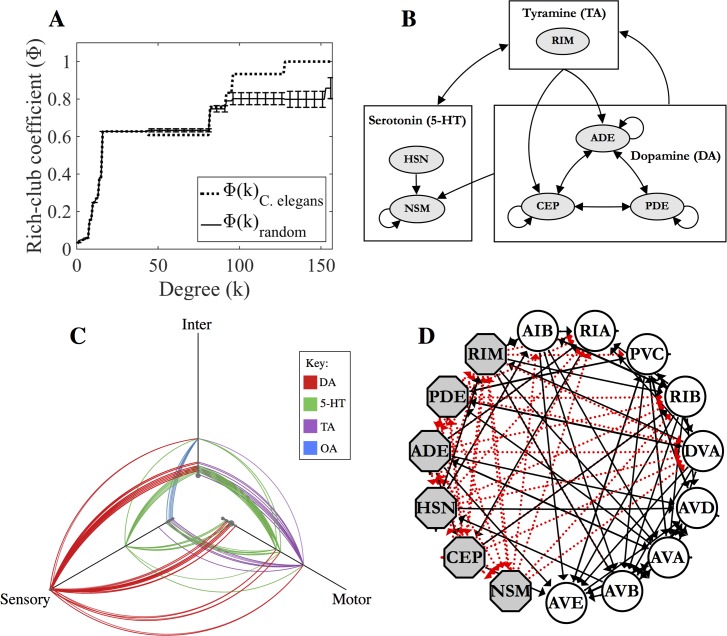
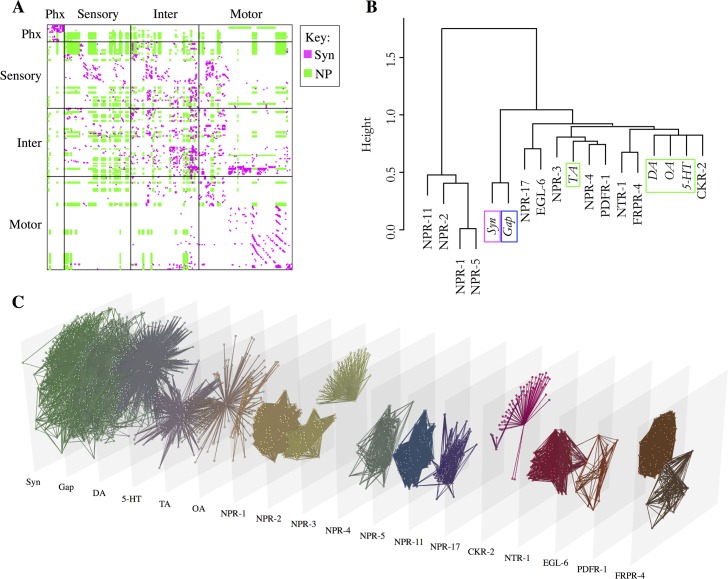
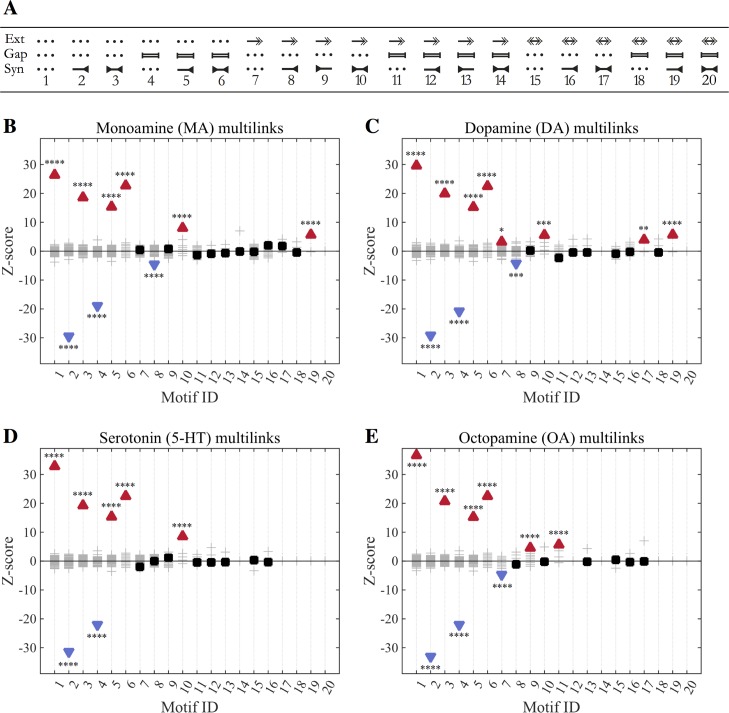
Connectomics has focused primarily on the mapping of synaptic links in the brain; yet it is well established that extrasynaptic volume transmission, especially via monoamines and neuropeptides, is also critical to brain function and occurs primarily outside the synaptic connectome. We have mapped the putative monoamine connections, as well as a subset of neuropeptide connections, in C. elegans based on new and published gene expression data. The monoamine and neuropeptide networks exhibit distinct topological properties, with the monoamine network displaying a highly disassortative star-like structure with a rich-club of interconnected broadcasting hubs, and the neuropeptide network showing a more recurrent, highly clustered topology. Despite the low degree of overlap between the extrasynaptic (or wireless) and synaptic (or wired) connectomes, we find highly significant multilink motifs of interaction, pinpointing locations in the network where aminergic and neuropeptide signalling modulate synaptic activity. Thus, the C. elegans connectome can be mapped as a multiplex network with synaptic, gap junction, and neuromodulator layers representing alternative modes of interaction between neurons. This provides a new topological plan for understanding how aminergic and peptidergic modulation of behaviour is achieved by specific motifs and loci of integration between hard-wired synaptic or junctional circuits and extrasynaptic signals wirelessly broadcast from a small number of modulatory neurons.
Overview
The claims and statistics of this paper haven’t been checked yet.
Free: it reads the open-access text and checks the first 5 claims that cite a source we can check. Create a free account to check every claim.
Integrity signals
Registry
Cites
Statistics
Figures
Verification
Claims the paper makes
The claims and statistics of this paper haven’t been checked yet.
Free: it reads the open-access text and checks the first 5 claims that cite a source we can check. Create a free account to check every claim.
Claims other papers make about this one
Each is checked against this paper’s own text: does it say what the citing paper says it does?
The cited source says what the claim attributes to it.
In the citing paper
“Here, the analysis of reducibility revealed that the monoamine networks have a unique structure, with information complementary to that provided by neuropeptide networks 90 .”
From Complex networks from classical to quantum (2019) · cites this paper as [90]
The cited source says what the claim attributes to it.
In the citing paper
“the connectome of the nematode Caenorhabditis elegans -one of the most studied in the fi eld because of its small size, with ~300 neuronal cells -has been mapped to a multiplex network where layers encode synaptic, gap junction, and neuromodulator interactions.”
From Complex networks from classical to quantum (2019) · cites this paper as [90]
Self-check
Percentages, sums and reported differences re-computed from the paper’s own numbers.
The self-check needs the paper’s full text.
Citations
Cites
Cytoscape: A software Environment for integrated models of biomolecular interaction networks
Shannon, P., Markiel, A., Ozier, O., Baliga, N. S., Wang, J. T., Ramage, D., Amin, N., Schwikowski, B., & Ideker, T. (2003) · Genome Research · doi:10.1101/gr.1239303 · Cited by 51,888
Collective dynamics of ‘small-world’ networks
Watts, D. J., & Strogatz, S. H. (1998) · Nature · doi:10.1038/30918 · Cited by 43,060 · cited 2×
“Here we present a draft monoamine connectome, along with a partial neuropeptide connectome, for the nematode C. elegans, based on new and published expression PLOS Computational Biology | DOI:10.1371/journal.pcbi.1005283 December 16, 2016 1 / 31 OPENACCESS Citation: Bentley B, Branicky R, Barnes…”
BackgroundMethodInfluentialEmergence of Scaling in Random Networks
Barabási, A.-L., & Albert, R. (1999) · Science · doi:10.1126/science.286.5439.509 · Cited by 36,135
Hierarchical Grouping to Optimize an Objective Function
Ward, J. H. (1963) · Journal of the American Statistical Association · doi:10.1080/01621459.1963.10500845 · Cited by 20,598
The Structure and Function of Complex Networks
Newman, M. E. J. (2003) · SIAM Review · doi:10.1137/s003614450342480 · Cited by 18,719
Social Network Analysis: Methods and Applications
Wasserman, S. S., & Faust, K. (1994) · Cited by 17,989
Modularity and community structure in networks
Newman, M. E. J. (2006) · Proceedings of the National Academy of Sciences · doi:10.1073/pnas.0601602103 · Cited by 12,256 · cited 1×
“(DOCX)”
Complex brain networks: graph theoretical analysis of structural and functional systems
Bullmore, E., & Sporns, O. (2009) · Nature Reviews Neuroscience · doi:10.1038/nrn2575 · Cited by 11,820
Self-citationComplex network measures of brain connectivity: Uses and interpretations
Rubinov, M., & Sporns, O. (2010) · NeuroImage · doi:10.1016/j.neuroimage.2009.10.003 · Cited by 11,522
The structure of the nervous system of the nematode Caenorhabditis elegans
White, J. G., Southgate, E., Thomson, J. N., & Brenner, S. (1986) · Philosophical Transactions of the Royal Society of London. B, Biological Sciences · doi:10.1098/rstb.1986.0056 · Cited by 5,589 · cited 1×
“The monoamine and neuropeptide networks exhibit distinct topological properties, with the monoamine network displaying a highly disassortative star-like structure with a rich- club of interconnected broadcasting hubs, and the neuropeptide network showing a more recurrent, highly clustered topology.”
Background
Cited by
Items 201–300 of 317
Structural underpinnings of control in multiplex networksPreprint
Srivastava, P., Mucha, P. J., Falk, E. B., Pasqualetti, F., & Bassett, D. S. (2021) · arXiv (Cornell University) · doi:10.48550/arxiv.2103.08757 · Cited by 2
Stochastic Optimization and Subgraph Search
Moorman, J. D. (2021) · eScholarship (California Digital Library) · Cited by 2
Subgraph Matching on Attributed Multiplex Networks with Applications to Knowledge Graphs
Tu, T. K. (2021) · eScholarship (California Digital Library) · Cited by 2
Multiscale modeling of brain network organizationPreprint
Presigny, C., & Fallani, F. D. V. (2021) · arXiv (Cornell University) · doi:10.48550/arxiv.2111.13473 · Cited by 2
“At the level of single neuron, Bentley et al. (2016) proposed a multiplex approach to represent synaptic connections (structural) as well as extrasynaptic signaling interactions (functional) inferred from gene expression data of the C. Elegans worm.”
BackgroundCharacterization of multilayer networks : theory and applications to the brain
Presigny, C. (2023) · theses.fr (ABES) · doi:10.70675/941d1c7cza07fz4a4dz9458zfc76c6d8bdd1 · Cited by 2
Rodríguez‐Ramos, Á. (2021) · Universidad de Córdoba Insitutional Repository (Universidad de Córdoba) · Cited by 2
Neuropeptidomics in C. elegans
Van Bael, S. (2018) · Lirias · Cited by 2
Nonlinear dynamics of random neural networks with second-order synaptic motifsPreprint
Yang, J., & Choi, H. (2026) · arXiv (Cornell University) · doi:10.48550/arxiv.2609.14251 · Cited by 2
Neural substrates of cold nociception in Drosophila larva
Patel, A. A., Cardona, A., & Cox, D. N. (2025) · eLife · doi:10.1101/2023.07.31.551339 · Cited by 1
Zalesky, A., Sotiropoulos, S. N., Jbabdi, S., & Fornito, A. (2025) · Elsevier eBooks · doi:10.1016/b978-0-12-818894-1.00007-0 · Cited by 1
The role of structural connectivity on brain function through a Markov model of signal transmission
Razban, R. M., Banerjee, A., Mujica-Parodi, L. R., & Bahar, İ. (2025) · PLoS ONE · doi:10.1371/journal.pone.0331085 · Cited by 1
“The importance of extrasynaptic neurotransmission, and in particular the modulatory effects of monoaminergic and neuropeptidergic signaling on the synaptic connectome, has been highlighted in multilayered mappings of the C. elegans connectome [81,82].”
Thresholds and fluctuations of submultiplexes in random multiplex networks
Bhattacharya, B. B., Bhowal, S., Das, K., Eslava, L., & Karmakar, S. (2026) · Canadian Mathematical Bulletin · doi:10.4153/s0008439526102446 · Cited by 1
Moon, S. S., Ripoll-Sánchez, L., Vértes, P. E., Schafer, W. R., & Ahnert, S. E. (2026) · Network Neuroscience · doi:10.1162/netn.a.533 · Cited by 1
“Topological network metrics have been used in combination with metadata in some contexts, such as assortative mixing (Bazinet, Hansen, & Misic, 2023), but previous studies on network motifs in single-neuron resolution data in C. elegans (Bentley et al., 2016; Milo et al., 2002; Varshney et al.,…”
InfluentialSelf-citationNikiforou, K., Mediano, P. A. M., & Shanahan, M. (2017) · Cognitive Computation · doi:10.1007/s12559-017-9464-6 · Cited by 2
Chew, Y. L., & Schafer, W. R. (2017) · eLife · doi:10.7554/elife.28780 · Cited by 1
“…of the junctions between the neurons in C. elegans has been available for decades (White et al., 1986) and the pathways of dopamine, noradrenaline and serotonin activity are largely mapped (Bentley et al., 2016), its neuropeptide systems are extremely complicated and thus mostly uncharacterized.”
BackgroundSelf-citationThe final frontier in connectomics: Forward engineering brain networks
Towlson, E. K. (2019) · Physics of Life Reviews · doi:10.1016/j.plrev.2019.11.004 · Cited by 1
Dimensionality reduction method of dynamic networks for evolutionary mechanism of neuronal systems
Duan, D., Wu, X., Bai, X., Yan, Q., Lv, C., & Bian, G. (2022) · Physica A Statistical Mechanics and its Applications · doi:10.1016/j.physa.2022.127415 · Cited by 1
Multilayer Networks in Nature, Society and Infrastructures
Bianconi, G. (2018) · Oxford University Press eBooks · doi:10.1093/oso/9780198753919.003.0004 · Cited by 1
The Structure of Single Networks
Bianconi, G. (2018) · Oxford University Press eBooks · doi:10.1093/oso/9780198753919.003.0002 · Cited by 1
Bianconi, G. (2018) · Oxford University Press eBooks · doi:10.1093/oso/9780198753919.003.0009 · Cited by 1
Codes for the paper 'Structural underpinnings of control in multiplex networks'
Srivastava, P. (2025) · Zenodo (CERN European Organization for Nuclear Research) · doi:10.5281/zenodo.15670067 · Cited by 1
Eating disorders studied over online social networks
Wang, T. (2019) · ePrints Soton (University of Southampton) · Cited by 1
Kopchock, R. J., Ravi, B., Bode, A., & Collins, K. M. (2020) · bioRxiv (Cold Spring Harbor Laboratory) · doi:10.1101/2020.08.11.246942 · Cited by 1
Neuroendocrine Modulation of Complex Behavior and Physiology in C. elegans
Florman, J. (2020) · eScholarship@UMassChan · doi:10.13028/ghnv-5048 · Cited by 1
Gross, E., Petrović, S., & Stasi, D. (2021) · arXiv (Cornell University) · Cited by 1
The exploration-exploitation paradigm : a biophysical approach
Dichio, V. (2023) · theses.fr (ABES) · doi:10.70675/fe11d432z1392z46b5z8adbz760401294210 · Cited by 1
Kim, J., Florman, J., Santos, J. A., Alkema, M. J., & Shlizerman, E. (2025) · arXiv (Cornell University) · doi:10.48550/arxiv.2504.18073 · Cited by 1
Rethinking scale in network neuroscience: Contributions and opportunities at the nanoscalePreprint
Betzel, R. F., Seguin, C., & Puxeddu, M. G. (2025) · arXiv (Cornell University) · doi:10.48550/arxiv.2508.16760 · Cited by 1
“For example, recent work has mapped the neuropeptidergic signaling architecture of the C. elegans nervous system, revealing a layered, multi-channel form of communication that complements the structural synaptic graph [38, 39].”
Ising dynamics on multilayer networks with heterogeneous layersPreprint
Kulkarni, S. S., Lynn, C. W., Porter, M. A., & Bassett, D. S. (2025) · arXiv (Cornell University) · doi:10.48550/arxiv.2509.20216 · Cited by 1
“Moreover, in addition to synaptic transmission, recent studies of C. elegans have highlighted the role of extrasynaptic signaling that arises via the diffusion of neuropeptides and monoamines [18, 19, 67].”
Dafreville, M., Canteloup, C., Beurrier, F., van de Waal, E., & George, E. A. (2025) · bioRxiv (Cold Spring Harbor Laboratory) · doi:10.64898/2025.12.24.696368 · Cited by 1
Weinreb, A. (2018) · theses.fr (ABES) · doi:10.70675/e26f5cccz86d4z4e95z840fzb20ba9a01f13 · Cited by 1
Strong connectivity and its applicationsPreprint
Daugulis, P. (2016) · arXiv (Cornell University) · doi:10.48550/arxiv.1609.07355
“The list of SC of large components starting from C is [1, 2, 3, 3, 3, 3, 2].”
BackgroundWong, J. Y. H., Wan, B. A., Bland, T., Montagnese, M., McLachlan, A. D., O’Kane, C. J., Zhang, S. W., & Masuda-Nakagawa, L. M. (2018) · bioRxiv (Cold Spring Harbor Laboratory) · doi:10.1101/295659
“Much aminergic neurotransmission acts via extrasynaptic receptors (Bentley et al. 2016), and this may be the case for Oamb in PN terminals.”
Structural Correlations of Multiplex Networks
Bianconi, G. (2018) · Oxford University Press eBooks · doi:10.1093/oso/9780198753919.003.0007
Opinion Dynamics and Game Theory
Bianconi, G. (2018) · Oxford University Press eBooks · doi:10.1093/oso/9780198753919.003.0016
The Dynamics on Single Networks
Bianconi, G. (2018) · Oxford University Press eBooks · doi:10.1093/oso/9780198753919.003.0003
Bianconi, G. (2018) · Oxford University Press eBooks · doi:10.1093/oso/9780198753919.003.0006
Synchronization, Non-linear Dynamics and Control
Bianconi, G. (2018) · Oxford University Press eBooks · doi:10.1093/oso/9780198753919.003.0015
Classical Percolation, Generalized Percolation and Cascades
Bianconi, G. (2018) · Oxford University Press eBooks · doi:10.1093/oso/9780198753919.003.0012
The Octopaminergic Modulatory Circuitry of the Drosophila Larval Mushroom Body Calyx
Wong, J. Y. H. (2018) · Apollo (University of Cambridge) · doi:10.17863/cam.32475
“While extrasynaptic OA transmission in Drosophila has not yet been studied, extrasynaptic OA receptors in C.elegans (Bentley et al., 2016) and extrasynaptic NA varicosities in the mammalian cortices (Descarries et al., 1977) have been well-documented.”
BackgroundInfluentialFeeding state sculpts a circuit for sensory valence
Rengarajan, S. (2017) · eScholarship (California Digital Library)
STRAIN: an R package for multi-locus sequence typing from whole genome sequencing data
Dalsass, M., Bodini, M., Lambert, C., Mortier, M.-C., Romanelli, M., Medini, D., Muzzi, A., & Brozzi, A. (2019) · BMC Bioinformatics · doi:10.1186/s12859-019-2887-1
Lawler, D. E. (2019) · Digital WPI
Magnetoencephalographic dynamics and adaptive brain networks across multiple timescales
Mandke, K. N. (2020) · Nottingham ePrints (University of Nottingham)
Organization of Information-Processing Biological Networks
How, J. J. (2020) · eScholarship (California Digital Library)
Control Theory for C. elegans Calcium Imaging Dynamics
Fieseler, C. (2020) · ResearchWorks at the University of Washington (University of Washington)
OpenWorm: design and evaluation of neural circuits on the virtual worm, caenorhabditis elegans
Lung, D. (2018) · reposiTUm (TU Wien) · doi:10.34726/hss.2018.53821
Neurobiology: From genome and connectome to understanding behavior
Yu, A. J., & Rankin, C. H. (2021) · Current Biology · doi:10.1016/j.cub.2021.08.055
Bianconi, G. (2018) · Oxford University Press eBooks · doi:10.1093/oso/9780198753919.003.0014
Bianconi, G. (2018) · Oxford University Press eBooks · doi:10.1093/oso/9780198753919.003.0008
Berner, R. (2021) · Springer theses · doi:10.1007/978-3-030-74938-5_1
Identification of co-existing embeddings of a motif in multilayer networks
Ren, Y., Sarkar, A., Bumin, A., Huang, K., Veltri, P., Dobra, A., & Kahveci, T. (2022) · ACM International Conference on Bioinformatics, Computational Biology, and Health Informatics (ACM-BCB) · doi:10.1145/3535508.3545528
“In the literature [2, 3, 27], the closest problem to multilayered network motifs arises in”
Background(2018) · Oxford University Press eBooks · doi:10.1093/oso/9780198753919.002.0003
(2018) · Oxford University Press eBooks · doi:10.1093/oso/9780198753919.002.0005
Directed Percolation of Interdependent Networks
Bianconi, G. (2018) · Oxford University Press eBooks · doi:10.1093/oso/9780198753919.005.0005
Growing Multiplex Networks: the Master Equation
Bianconi, G. (2018) · Oxford University Press eBooks · doi:10.1093/oso/9780198753919.005.0003
Percolation of interdependent networks
Bianconi, G. (2018) · Oxford University Press eBooks · doi:10.1093/oso/9780198753919.005.0004
Immunization Strategies on Multiplex Networks
Bianconi, G. (2018) · Oxford University Press eBooks · doi:10.1093/oso/9780198753919.005.0006
The Barabási–Albert model: the Master Equation
Bianconi, G. (2018) · Oxford University Press eBooks · doi:10.1093/oso/9780198753919.005.0001
Spectrum of the Supra-Laplacian
Bianconi, G. (2018) · Oxford University Press eBooks · doi:10.1093/oso/9780198753919.005.0007
Entropy and Null Models of Single Networks
Bianconi, G. (2018) · Oxford University Press eBooks · doi:10.1093/oso/9780198753919.005.0002
Neuropeptidergic regulation of locomotion inhibition in C. elegans
der Auwera, P. V. (2023) · Publication Server of Goethe University Frankfurt am Main (Goethe University Frankfurt) · doi:10.21248/gups.73497
Systems neuroscience: Foraging through serotonin's tangled web
Yemini, E. (2023) · Current Biology · doi:10.1016/j.cub.2023.06.030
Self-citationNeural substrates of cold nociception in Drosophila larvaPreprint
Patel, A. A., Cardona, A., & Cox, D. N. (2023) · eLife · doi:10.7554/elife.91582.1
Learning dynamic representations of the functional connectome in neurobiological networks
Dyballa, L., Lang, S., Haslund-Gourley, A., Yemini, E., & Zucker, S. W. (2024) · International Conference on Learning Representations · doi:10.48550/arxiv.2402.14102
“…to chemical synapses or electrical ones (gap junctions) (White et al., 1986; Jarrell et al., 2012; Cook et al., 2019; Witvliet et al., 2021), and others induced by, e.g., extrasynaptic signaling of monoamines or neuropeptides (Bentley et al., 2016; Ripoll-S´anchez et al., 2022; Beets et al., 2023).”
BackgroundSelf-citationZarei, M., Xie, D., Jiang, F., Bagirov, A., Huang, B., Raj, A., Nagarajan, S. S., & Guo, S. (2022) · Figshare · doi:10.6084/m9.figshare.19582444
Analysis of Molecular Circuitry Integrated to Lethargus State of Caenorhabditis elegans: A Review
Hanjabam, J. S., Devi, O. S., Collins, A., Moirangthem, L., Brahmacharimayum, N., Devi, M. A., & Devi, K. M. (2024) · Proceedings of the Zoological Society · doi:10.1007/s12595-024-00524-6
“The neurological system has a high dopamine receptor expression, which leads to numerous interaction nodes between dopamine and motor circuits (Bentley et al. 2016; Chase et al. 2004; Sugiura et al. 2005; Suo et al. 2002; Tsalik et al. 2003).”
Reviewer #1 (Public Review): Whole-body connectome of a segmented annelid larva
Verasztó, C., Jasek, S., Gühmann, M., et al. (2024) · eLife · doi:10.7554/elife.97964.1.sa1
Reviewer #2 (Public Review): Whole-body connectome of a segmented annelid larva
Verasztó, C., Jasek, S., Gühmann, M., et al. (2024) · eLife · doi:10.7554/elife.97964.1.sa0
eLife Assessment: Whole-body connectome of a segmented annelid larva
Tessmar‐Raible, K. (2024) · eLife · doi:10.7554/elife.97964.1.sa2
(2024) · Elsevier eBooks · doi:10.1016/b978-0-443-33050-6.09988-2
Bickhard, M. H. (2024) · Elsevier eBooks · doi:10.1016/b978-0-443-33050-6.00009-4
Szilágyi, G. S., Gulyás, A. I., Vassy, Z., Csermely, P., & Fenyves, B. G. (2026) · BMC Biology · doi:10.1186/s12915-026-02641-4
Shafieq, S., Ali, S. S., Sharma, N., & Sethi, V. A. (2025) · International Journal of Newgen Research in Pharmacy & Healthcare · doi:10.61554/ijnrph.v3i1.2025.148
A Lightweight Detection Network inspired by the Olfactory Learning Circuit of Caenorhabditis elegans
Zhao, M. Y. (2025) · International Conference on Intelligent Computing (ICIC) · doi:10.65286/icic.v21i2.29520
Goto, D., Rios, H. M. L., Scholz, M., & Vaikuntanathan, S. (2026) · Proceedings of the National Academy of Sciences · doi:10.1073/pnas.2607559123
“For example, a recently completed identification of the neuropeptidergic connectome of the nematode Caenorhabditis elegans [14– 16], revealed that the “hard-wired” synaptic network is overlaid by a complex “wireless” neuropeptidergic network.”
Zarei, M., Xie, D., Jiang, F., Bagirov, A., Huang, B., Raj, A., Nagarajan, S. S., & Guo, S. (2022) · Figshare · doi:10.6084/m9.figshare.19582447
Zarei, M., Xie, D., Jiang, F., Bagirov, A., Huang, B., Raj, A., Nagarajan, S. S., & Guo, S. (2022) · Figshare · doi:10.6084/m9.figshare.19582474
Zarei, M., Xie, D., Jiang, F., Bagirov, A., Huang, B., Raj, A., Nagarajan, S. S., & Guo, S. (2022) · Figshare · doi:10.6084/m9.figshare.19582450
Zarei, M., Xie, D., Jiang, F., Bagirov, A., Huang, B., Raj, A., Nagarajan, S. S., & Guo, S. (2022) · Figshare · doi:10.6084/m9.figshare.19582441
Zarei, M., Xie, D., Jiang, F., Bagirov, A., Huang, B., Raj, A., Nagarajan, S. S., & Guo, S. (2022) · Figshare · doi:10.6084/m9.figshare.19582456
Zarei, M., Xie, D., Jiang, F., Bagirov, A., Huang, B., Raj, A., Nagarajan, S. S., & Guo, S. (2022) · Figshare · doi:10.6084/m9.figshare.19582465
Zarei, M., Xie, D., Jiang, F., Bagirov, A., Huang, B., Raj, A., Nagarajan, S. S., & Guo, S. (2022) · Figshare · doi:10.6084/m9.figshare.19582462
Zarei, M., Xie, D., Jiang, F., Bagirov, A., Huang, B., Raj, A., Nagarajan, S. S., & Guo, S. (2022) · Figshare · doi:10.6084/m9.figshare.19582432
Zarei, M., Xie, D., Jiang, F., Bagirov, A., Huang, B., Raj, A., Nagarajan, S. S., & Guo, S. (2022) · Figshare · doi:10.6084/m9.figshare.19582435
Zarei, M., Xie, D., Jiang, F., Bagirov, A., Huang, B., Raj, A., Nagarajan, S. S., & Guo, S. (2022) · Figshare · doi:10.6084/m9.figshare.19582438
How neuronal SKN-1B acts to control appetite in C. elegans
Evans, J. (2022) · Kent Academic Repository (University of Kent) · doi:10.22024/unikent/01.02.95921
Zarei, M., Xie, D., Jiang, F., Bagirov, A., Huang, B., Raj, A., Nagarajan, S. S., & Guo, S. (2022) · Figshare · doi:10.6084/m9.figshare.19582459
Zarei, M., Xie, D., Jiang, F., Bagirov, A., Huang, B., Raj, A., Nagarajan, S. S., & Guo, S. (2022) · Figshare · doi:10.6084/m9.figshare.19582477
Zarei, M., Xie, D., Jiang, F., Bagirov, A., Huang, B., Raj, A., Nagarajan, S. S., & Guo, S. (2022) · Figshare · doi:10.6084/m9.figshare.19582453
Кийкова, Т. Ю. (2020) · SibFU Digital Repository (Siberian Federal University)
Monitasoverkostot: ilmiöt, teoria ja käytäntö
Nurmi, T. (2025) · Aaltodoc (Aalto University)
A Hobbit's Guide to Neurodevelopment; An Unexpected Journey into the Innate
Barabasi, D. (2023) · Digital Access to Scholarship at Harvard (DASH) (Harvard University)
Metadata
- Authors
- Bentley, B., Branicky, R., Barnes, C. L., Chew, Y. L., Yemini, E., Bullmore, E. T., Vértes, P. E., & Schafer, W. R.
- Affiliations
- MRC Laboratory of Molecular Biology (GB)
- Howard Hughes Medical Institute (US)
- Columbia University (US)
- GlaxoSmithKline (United Kingdom) (GB)
- University of Cambridge (GB)
- Corresponding author
- Schafer, William R.
- ORCID
- Venue
- PLOS Computational Biology
- Publisher
- Public Library of Science (PLoS)
- Published
- 2016-12-16
- Volume
- 12
- Issue
- 12
- Pages
- e1005283
- ISSN
- 1553-734X (ISSN-L)
- 1553-7358
- PMC
- PMC5215746
- OpenAlex
- W2514803758
- Cited by
- 269
- References
- 136
- Citations by year
- 2026: 6 · 2025: 21 · 2024: 22 · 2023: 24 · 2022: 33 · 2021: 34 · 2020: 27 · 2019: 27 · 2018: 53 · 2017: 21 · 2016: 1
- FWCI
- 19.07
- Type
- journal article
- Language
- en
- Update notices
- new_version (2017-01-04)
- Open access
- gold
- doi.org
- Licence
- Locations
- PLoS Computational Biology (publishedVersion, cc-by)
- Europe PMC (PubMed Central) (publishedVersion, cc-by)
- PubMed Central (publishedVersion, cc-by)
- PubMed (publishedVersion)
- arXiv (Cornell University) (submittedVersion)
- Apollo (University of Cambridge) (submittedVersion, cc-by)
- DOAJ (DOAJ: Directory of Open Access Journals) (submittedVersion, cc-by-sa)
- Figshare (submittedVersion, cc-by)
- Queen Mary Research Online (Queen Mary University of London) (submittedVersion, cc-by)
- arXiv (Cornell University)
- Apollo (cc-by)
- Columbia Academic Commons (Columbia University)
- Funders
- Wellcome Trust (WT103784MA)
- Medical Research Council (MC-A022-5PB91, MR/K020706/1)
- National Institutes of Health (5T32DK007328-37)
- Topics
- Life Sciences › Neuroscience › Cellular and Molecular Neuroscience › Neurobiology and Insect Physiology Research
- Life Sciences › Neuroscience › Cellular and Molecular Neuroscience › Neuroscience and Neuropharmacology Research
- Life Sciences › Neuroscience › Cognitive Neuroscience › Neural dynamics and brain function
- Keywords
- Caenorhabditis elegans, connectome, monoamine signaling, neuropeptide signaling, gap junctions, neuromodulation, multiplex networks, network motifs, network topology, synaptic connectivity, modulatory neurons, gene expression
- MeSH terms
- Animals, Biogenic Monoamines, Signal Transduction, Caenorhabditis elegans, Computational Biology, Connectome
About these checks
Registry, retraction, Cites and statistics results are computed, not judged, with one exception: a printed reference that no index lists is read once by a model before it counts as a citation error. Claims are extracted by a model and kept only when their quote appears verbatim in the text; each cited source is then checked, with a model’s help, for whether it says what the claim relies on. Those verdicts can be wrong — read the claim’s quote and the cited source before relying on one.
Statistics and arithmetic are recomputed, not judged.
Confidence bands are shown only for fields calibrated on our annotated test set. None is calibrated yet, so no band is shown.
What counts as a claim ›How we measure confidence ›How we check this ›
Are you an author, or do you see a problem with this page? Request a review
Data sources
Bibliographic data: Semantic Scholar, OpenAlex, Crossref.
Contains information from the Semantic Scholar Academic Graph Datasets, made available under the ODC Attribution License (ODC-BY 1.0).
Semantic Scholar’s data is described in: Kinney, R., et al. (2023). The Semantic Scholar Open Data Platform. arXiv:2301.10140.
