

Initial-state-dependent, robust, transient neural dynamics encode conscious visual perception
Open accessPublished version of a preprint
The DOI matches its Crossref record; 71 of the 71 references it cites were found in a registry or an index.
Abstract
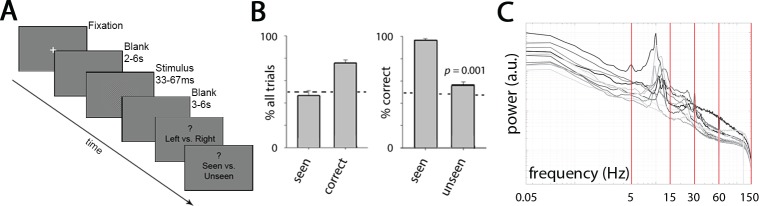
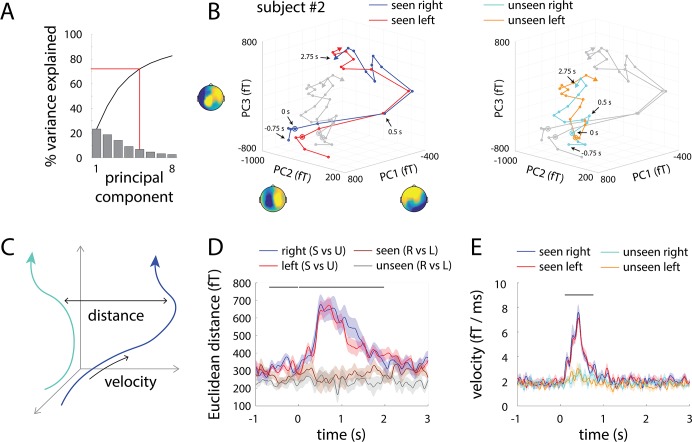
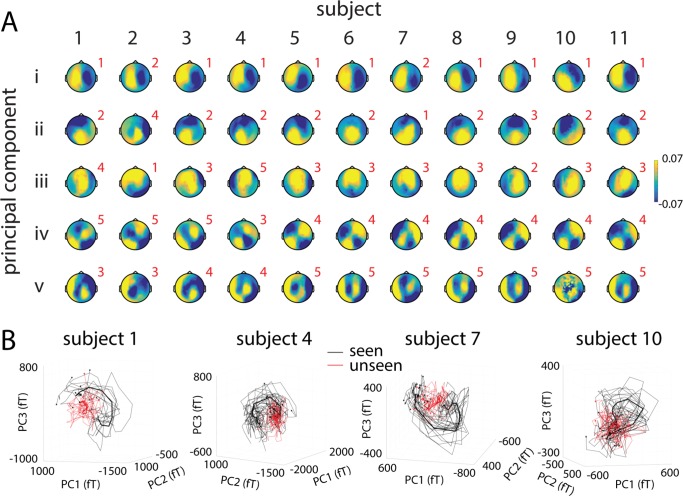
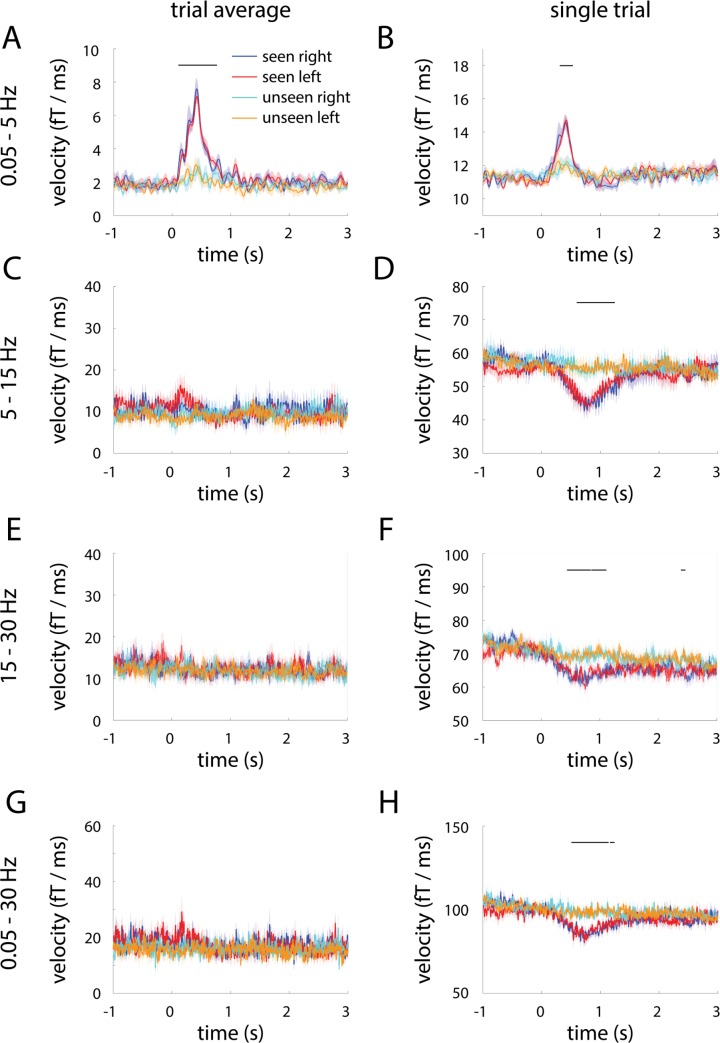
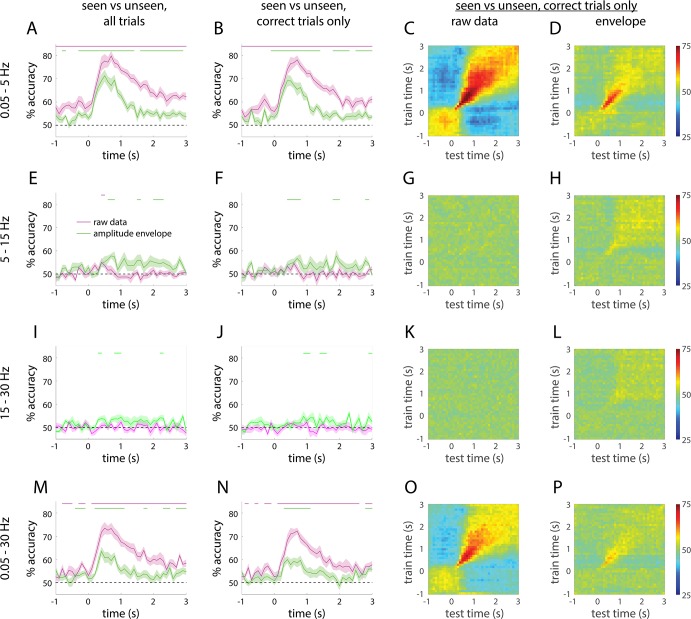
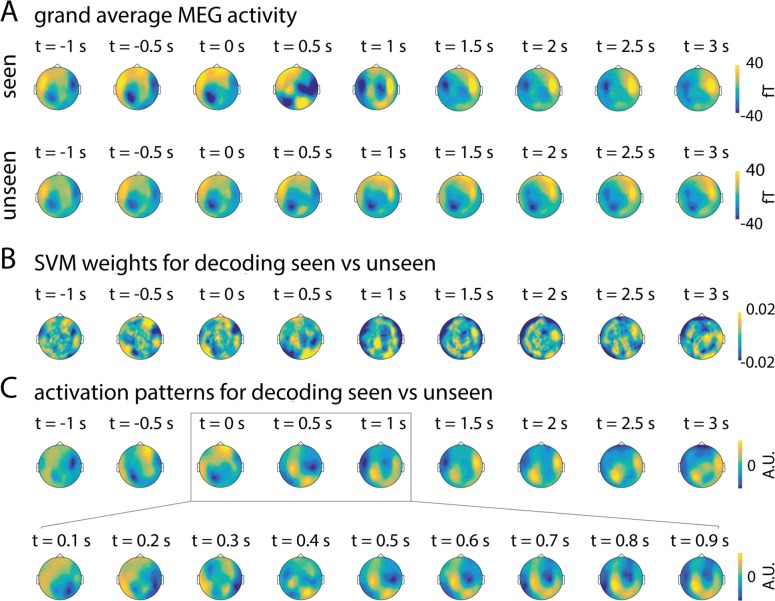
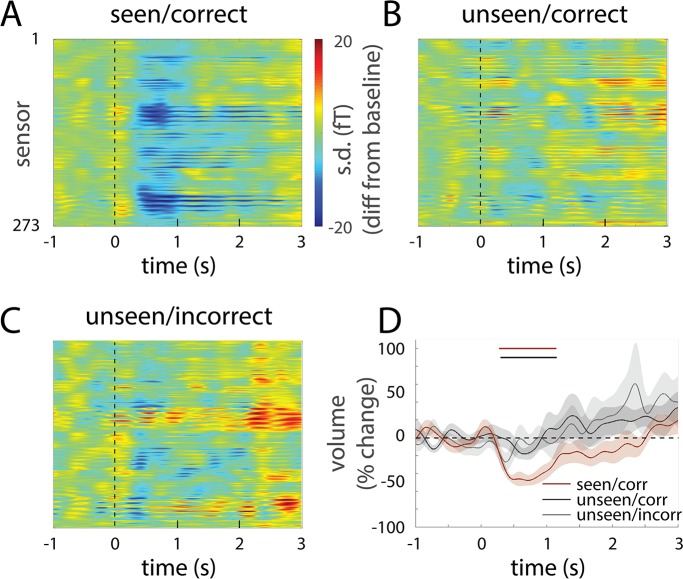
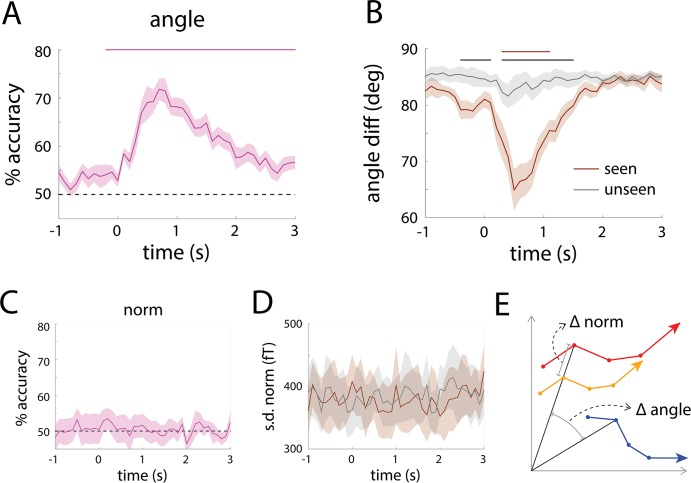
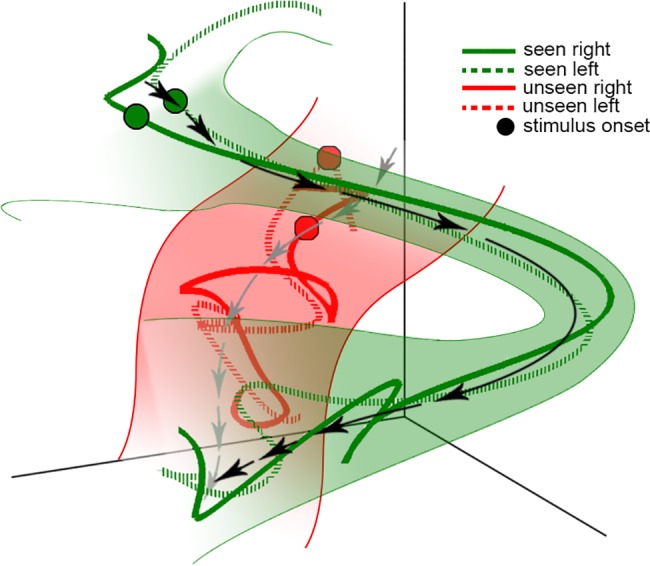
Recent research has identified late-latency, long-lasting neural activity as a robust correlate of conscious perception. Yet, the dynamical nature of this activity is poorly understood, and the mechanisms governing its presence or absence and the associated conscious perception remain elusive. We applied dynamic-pattern analysis to whole-brain slow (< 5 Hz) cortical dynamics recorded by magnetoencephalography (MEG) in human subjects performing a threshold-level visual perception task. Up to 1 second before stimulus onset, brain activity pattern across widespread cortices significantly predicted whether a threshold-level visual stimulus was later consciously perceived. This initial state of brain activity interacts nonlinearly with stimulus input to shape the evolving cortical activity trajectory, with seen and unseen trials following well separated trajectories. We observed that cortical activity trajectories during conscious perception are fast evolving and robust to small variations in the initial state. In addition, spontaneous brain activity pattern prior to stimulus onset also influences unconscious perceptual making in unseen trials. Together, these results suggest that brain dynamics underlying conscious visual perception belongs to the class of initial-state-dependent, robust, transient neural dynamics.
Overview
The claims and statistics of this paper haven’t been checked yet.
Free: it reads the open-access text and checks the first 5 claims that cite a source we can check. Create a free account to check every claim.
Integrity signals
Registry
Cites
Statistics
Figures
Verification
Claims the paper makes
The claims and statistics of this paper haven’t been checked yet.
Free: it reads the open-access text and checks the first 5 claims that cite a source we can check. Create a free account to check every claim.
Claims other papers make about this one
Each is checked against this paper’s own text: does it say what the citing paper says it does?
The source backs part of the claim, not all of it — or backs it for a different population, condition or comparison.
In the citing paper
“In this framework, ignition is seen as a sudden, high-speed divergence of the trajectories on trials reported as consciously perceived, generating a series of metastable activity states”
From Conscious Processing and the Global Neuronal Workspace Hypothesis (2020) · cites this paper as Baria et al., 2017
Experimental — accuracy not yet measured
Self-check
Percentages, sums and reported differences re-computed from the paper’s own numbers.
The self-check needs the paper’s full text.
Citations
Cites
LIBSVM: A library for support vector machines
Chang, C.-C., & Lin, C.-J. (2011) · ACM Transactions on Intelligent Systems and Technology · doi:10.1145/1961189.1961199 · Cited by 40,918 · cited 1×
“Using the LIBSVM package [62], we implemented a SVM at each time point”
MethodComplex brain networks: graph theoretical analysis of structural and functional systems
Bullmore, E., & Sporns, O. (2009) · Nature Reviews Neuroscience · doi:10.1038/nrn2575 · Cited by 11,820 · cited 1×
“Our study illustrates that given the high degree of connectedness across the cerebral cortex [59, 60], analysis of distributed spatial patterns of activity complements traditional region-by-region analysis in the investigation of the neural mechanisms of conscious perception.”
Background(1966) · Medical Entomology and Zoology · Cited by 10,293
Libsvm : A library for support vector machines
Ferrari, V. (2008) · Medical Entomology and Zoology · Cited by 10,122
Nonparametric statistical testing of EEG- and MEG-data
Maris, E., & Oostenveld, R. (2007) · Journal of Neuroscience Methods · doi:10.1016/j.jneumeth.2007.03.024 · Cited by 8,496 · cited 1×
“All statistical results using a time-point-by-time-point analysis were corrected for multiple comparisons using cluster-based permutation tests [61], as described below.”
MethodSpontaneous fluctuations in brain activity observed with functional magnetic resonance imaging
Fox, M. D., & Raichle, M. E. (2007) · Nature Reviews Neuroscience · doi:10.1038/nrn2201 · Cited by 6,700 · cited 1×
“Depending on its initial state, which may reflect cognitive state (such as attention or expectation) and spontaneous activity fluctuations [54], neural activity may reach a desired state – a particular region in the state space – at different post-stimulus latencies.”
BackgroundMaass, W., Natschläger, T., & Markram, H. (2002) · Neural Computation · doi:10.1162/089976602760407955 · Cited by 4,025 · cited 1×
“transient neural dynamics (‘trajectories’), whereby computation arises from the voyage through state space rather than the arrival at a fixed location [26, 28, 49].”
BackgroundCircStat : A MATLAB Toolbox for Circular Statistics
Berens, P. (2009) · Journal of Statistical Software · doi:10.18637/jss.v031.i10 · Cited by 3,099 · cited 2×
“Separately for seen and unseen trials, we tested whether across-trial angle variability differed between each post-stimulus time point and the pre-stimulus period (from 1 sec before to stimulus onset) by using a non-parametric two-sample test for equal medians [63] as implemented in circ_cmtest function of the CircSta…”
MethodExperimental and theoretical approaches to conscious processing
Dehaene, S., & Changeux, J.-P. (2011) · Neuron · doi:10.1016/j.neuron.2011.03.018 · Cited by 2,573 · cited 2×
“4 activity across widely distributed brain regions underlies conscious processing [16, 17].”
BackgroundConscious, preconscious, and subliminal processing: a testable taxonomy
Dehaene, S., Changeux, J.-P., Naccache, L., Sackur, J., & Sergent, C. (2006) · Trends in Cognitive Sciences · doi:10.1016/j.tics.2006.03.007 · Cited by 2,067
Cited by
Conscious Processing and the Global Neuronal Workspace Hypothesis
Mashour, G. A., Roelfsema, P., Changeux, J.-P., & Dehaene, S. (2020) · Neuron · doi:10.1016/j.neuron.2020.01.026 · Cited by 1,164
“…the observed dynamic states are not just non-specific correlates of attention and perception; they demonstrably contain detailed, decodable information about the specific stimulus that was consciously seen (Baria et al., 2017; King et al., 2016; Salti et al., 2015; Tr € ubutschek et al., 2017).”
BackgroundNeuromodulation of brain state and behavior
McCormick, D. A., Nestvogel, D. B., & He, B. J. (2020) · Annual Review of Neuroscience · doi:10.1146/annurev-neuro-100219-105424 · Cited by 303
Self-citationIs it time to put rest to rest?
Finn, E. S. (2021) · Trends in Cognitive Sciences · doi:10.1016/j.tics.2021.09.005 · Cited by 243
Northoff, G., & Lamme, V. (2020) · Neuroscience & Biobehavioral Reviews · doi:10.1016/j.neubiorev.2020.07.019 · Cited by 247
Bifurcation in brain dynamics reveals a signature of conscious processing independent of report
Sergent, C., Corazzol, M., Labouret, G., Stockart, F., Wexler, M., King, J.-R., Meyniel, F., & Pressnitzer, D. (2021) · Nature Communications · doi:10.1038/s41467-021-21393-z · Cited by 200
Metadata
- Authors
- Baria, A. T., Maniscalco, B., & He, B. J.
- Affiliations
- Northwestern University (US)
- National Institutes of Health (US)
- Corresponding author
- He, Biyu J.
- Venue
- PLOS Computational Biology
- Publisher
- Public Library of Science (PLoS)
- Published
- 2017-11-27
- Volume
- 13
- Issue
- 11
- Pages
- e1005806
- ISSN
- 1553-734X (ISSN-L)
- 1553-7358
- PMC
- PMC5720802
- OpenAlex
- W2951522238
- Cited by
- 70
- References
- 71
- Citations by year
- 2026: 3 · 2025: 4 · 2024: 13 · 2023: 5 · 2022: 6 · 2021: 16 · 2020: 12 · 2019: 5 · 2018: 6
- FWCI
- 3.61
- Type
- journal article
- Language
- en
- Update notices
- new_version (2017-12-07)
- Open access
- gold
- doi.org
- Licence
- public-domain
- creativecommons.org/publicdomain/zero/1.0/ (vor)
- Locations
- PLoS Computational Biology (publishedVersion, public-domain)
- bioRxiv (Cold Spring Harbor Laboratory) (acceptedVersion)
- Europe PMC (PubMed Central) (publishedVersion, public-domain)
- PubMed Central (publishedVersion, public-domain)
- PubMed (publishedVersion)
- RePEc: Research Papers in Economics (submittedVersion)
- DOAJ (DOAJ: Directory of Open Access Journals) (submittedVersion, cc-by-sa)
- Figshare (submittedVersion, cc-by)
- Funders
- National Institute of Neurological Disorders and Stroke
- Leon Levy Foundation
- Esther A. and Joseph Klingenstein Fund
- Topics
- Life Sciences › Neuroscience › Cognitive Neuroscience › Neural dynamics and brain function
- Life Sciences › Neuroscience › Cognitive Neuroscience › Visual perception and processing mechanisms
- Social Sciences › Arts and Humanities › Philosophy › Philosophy and Theoretical Science
- Keywords
- visual awareness, unconscious perception, spontaneous brain activity, nonlinear dynamics
- MeSH terms
- Adult, Brain, Female, Humans, Male, Models, Neurological, Signal Processing, Computer-Assisted, Task Performance and Analysis, Visual Perception, Magnetoencephalography, Computational Biology, Young Adult
About these checks
Registry, retraction, Cites and statistics results are computed, not judged, with one exception: a printed reference that no index lists is read once by a model before it counts as a citation error. Claims are extracted by a model and kept only when their quote appears verbatim in the text; each cited source is then checked, with a model’s help, for whether it says what the claim relies on. Those verdicts can be wrong — read the claim’s quote and the cited source before relying on one.
Statistics and arithmetic are recomputed, not judged.
Confidence bands are shown only for fields calibrated on our annotated test set. None is calibrated yet, so no band is shown.
What counts as a claim ›How we measure confidence ›How we check this ›
Are you an author, or do you see a problem with this page? Request a review
How to cite
Cite CoChat for the checks on this page, and the paper for its own findings.
- This page
- CoChat. (2026). Citation check: Initial-state-dependent, robust, transient neural dynamics encode conscious visual perception. https://app.cochat.ai/papers/10.1371/journal.pcbi.1005806
- The paper
- Baria, A. T., Maniscalco, B., & He, B. J. (2017). Initial-state-dependent, robust, transient neural dynamics encode conscious visual perception. PLOS Computational Biology. https://doi.org/10.1371/journal.pcbi.1005806
Data sources
Bibliographic data: Semantic Scholar, OpenAlex, Crossref.
Contains information from the Semantic Scholar Academic Graph Datasets, made available under the ODC Attribution License (ODC-BY 1.0).
Semantic Scholar’s data is described in: Kinney, R., et al. (2023). The Semantic Scholar Open Data Platform. arXiv:2301.10140.
