

The DOI matches its Crossref record; 74 of the 74 references it cites were found in a registry or an index.
Unraveling the Genetics of Human Obesity
Open accessAbstract
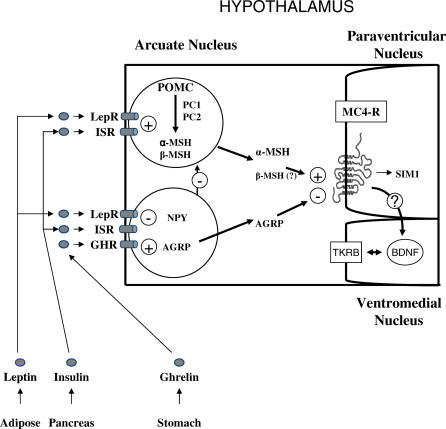
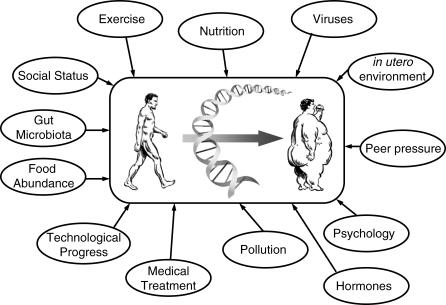
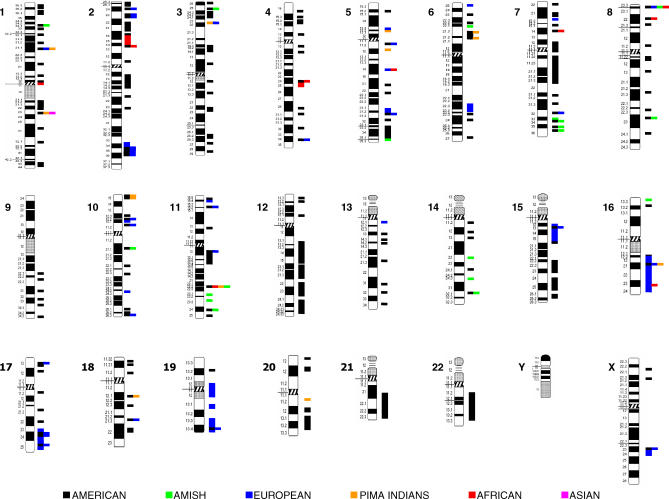
The use of modern molecular biology tools in deciphering the perturbed biochemistry and physiology underlying the obese state has proven invaluable. Identifying the hypothalamic leptin/melanocortin pathway as critical in many cases of monogenic obesity has permitted targeted, hypothesis-driven experiments to be performed, and has implicated new candidates as causative for previously uncharacterized clinical cases of obesity. Meanwhile, the effects of mutations in the melanocortin-4 receptor gene, for which the obese phenotype varies in the degree of severity among individuals, are now thought to be influenced by one's environmental surroundings. Molecular approaches have revealed that syndromes (Prader-Willi and Bardet-Biedl) previously assumed to be controlled by a single gene are, conversely, regulated by multiple elements. Finally, the application of comprehensive profiling technologies coupled with creative statistical analyses has revealed that interactions between genetic and environmental factors are responsible for the common obesity currently challenging many Westernized societies. As such, an improved understanding of the different "types" of obesity not only permits the development of potential therapies, but also proposes novel and often unexpected directions in deciphering the dysfunctional state of obesity.
Overview
The claims and statistics of this paper haven’t been checked yet.
Run the check — free, no account needed. It reads the open-access text and checks the sources it cites.
Integrity signals
Registry
Cites
Statistics
Figures
Verification
Claims the paper makes
The claims and statistics of this paper haven’t been checked yet.
Run the check — free, no account needed. It reads the open-access text and checks the sources it cites.
Claims other papers make about this one
Each is checked against this paper’s own text: does it say what the citing paper says it does?
In the citing paper
“In the initial phase, behavioral and environmental factors could play a key role in the constitution of adipose tissue excess on a genetically predisposed background [61].”
From Adipose tissue transcriptomic signature highlights the pathological relevance of extracellular matrix in human obesity (2008) · cites this paper as [61]
Self-check
Percentages, sums and reported differences re-computed from the paper’s own numbers.
The self-check needs the paper’s full text.
Citations
Cites
Krude, H., Biebermann, H., Luck, W., Horn, R., Brabant, G. E., & Grüters, A. (1998) · Nature Genetics · doi:10.1038/509 · Cited by 1,769
Farooqi, I. S., Matarese, G., Lord, G. M., Keogh, J. M., Lawrence, E., Agwu, C., Sanna, V., Jebb, S. A., Perna, F., Fontana, S., et al. (2002) · Journal of Clinical Investigation · doi:10.1172/jci15693 · Cited by 1,374
A frameshift mutation in MC4R associated with dominantly inherited human obesity
Yeo, G. S. H., Farooqi, I. S., Aminian, S., Halsall, D. J., Stanhope, R. G., & O'Rahilly, S. (1998) · Nature Genetics · doi:10.1038/2404 · Cited by 1,159
Patterns of linkage disequilibrium in the human genome
Ardlie, K., Kruglyak, L., & Seielstad, M. T. (2002) · Nature Reviews Genetics · doi:10.1038/nrg777 · Cited by 1,133
Gene–environment interactions in human diseases
Hunter, D. J. (2005) · Nature Reviews Genetics · doi:10.1038/nrg1578 · Cited by 1,132
The Human Obesity Gene Map: The 2005 Update
Rankinen, T., Zuberi, A., Chagnon, Y. C., Weisnagel, S. J., Argyropoulos, G., Walts, B., Pérusse, L., & Bouchard, C. (2006) · Obesity · doi:10.1038/oby.2006.71 · Cited by 1,119
A frameshift mutation in human MC4R is associated with a dominant form of obesity
Vaisse, C., Clément, K., Guy-grand, B., & Froguel, P. (1998) · Nature Genetics · doi:10.1038/2407 · Cited by 1,091
Self-citationMelanocortin-4 receptor mutations are a frequent and heterogeneous cause of morbid obesity
Vaisse, C., Clement, K., Durand, E., Hercberg, S., Guy-Grand, B., & Froguel, P. (2000) · Journal of Clinical Investigation · doi:10.1172/jci9238 · Cited by 897
Self-citationBrain-derived neurotrophic factor regulates energy balance downstream of melanocortin-4 receptor
Xu, B., Goulding, E. H., Zang, K., Cepoi, D., Cone, R. D., Jones, K. R., Tecott, L. H., & Reichardt, L. F. (2003) · Nature Neuroscience · doi:10.1038/nn1073 · Cited by 896
Finding genes that underlie complex traits.
Glazier, A. M., Nadeau, J. H., & Aitman, T. J. (2002) · Science · doi:10.1126/science.1076641 · Cited by 855
Research works printed but not linked: 71
- Lunshof, 2006, Pharmacogenomics, 7, 237
- Hunter, 2005, Nat Rev Genet, 6, 287
- Mutch, 2005, FASEB J, 19, 1602
- Kaput, 2005, Br J Nutr, 94, 623
- Gorman, 2006, Time, 167, 69
- Rankinen, 2006, Obesity (Silver Spring), 14, 529
- Bell, 2005, Nat Rev Genet, 6, 221
- Farooqi, 2005, Annu Rev Med, 56, 443
- Ardlie, 2002, Nat Rev Genet, 3, 299
- Barsh, 2000, Nature, 404, 644
- Ellacott, 2006, Philos Trans R Soc Lond B Biol Sci, 361, 1265
- Coll, 2004, J Clin Endocrinol Metab, 89, 2557
- Harrold, 2006, Peptides, 27, 365
- Clement, 2005, Proc Nutr Soc, 64, 133
- Holder, 2000, Hum Mol Genet, 9, 101
- Kublaoui, 2006, Mol Endocrinol, 20, 2483
- Kernie, 2000, EMBO J, 19, 1290
- Xu, 2003, Nat Neurosci, 6, 736
- Gray, 2006, Int J Obes (Lond)
- Yeo, 2004, Nat Neurosci, 7, 1187
- Vaisse, 1998, Nat Genet, 20, 113
- Yeo, 1998, Nat Genet, 20, 111
- Vaisse, 2000, J Clin Invest, 106, 253
- Farooqi, 2000, J Clin Invest, 106, 271
- Hinney, 2006, J Clin Endocrinol Metab, 91, 1761
- Lubrano-Berthelier, 2006, J Clin Endocrinol Metab, 91, 1811
- Lubrano-Berthelier, 2003, Ann N Y Acad Sci, 994, 49
- Ho, 1999, J Biol Chem, 274, 35816
- Krude, 1998, Nat Genet, 19, 155
- Lee, 2006, Cell Metab, 3, 135
- Farooqi, 2002, J Clin Invest, 110, 1093
- Getting, 2006, Pharmacol Ther, 111, 1
- de Luca, 2005, J Clin Invest, 115, 3484
- Li, 2005, Diabetologia, 48, 2376
- Seeley, 2005, Endocrinology, 146, 3732
- Molinoff, 2003, Ann N Y Acad Sci, 994, 96
- Sebhat, 2002, J Med Chem, 45, 4589
- Wessells, 2003, Ann N Y Acad Sci, 994, 90
- Chung, 2005, Trends Endocrinol Metab, 16, 267
- Goldstone, 2004, Trends Endocrinol Metab, 15, 12
- Cummings, 2002, Nat Med, 8, 643
- Franzese, 2006, J Pediatr, 148, 846
- Carrel, 2004, J Pediatr, 145, 744
- Katsanis, 2001, Hum Mol Genet, 10, 2293
- Stoetzel, 2006, Nat Genet, 38, 521
- Nishimura, 2005, Am J Hum Genet, 77, 1021
- Chiang, 2006, Proc Natl Acad Sci U S A, 103, 6287
- Eichers, 2004, Ann Med, 36, 262
- Slavotinek, 2002, Hum Genet, 110, 561
- Fan, 2004, Nat Genet, 36, 989
- Marshall, 2006, Curr Biol, 16, R604
- Mykytyn, 2004, Proc Natl Acad Sci U S A, 101, 8664
- Mak, 2006, Nat Genet, 38, 363
- Roche, 2005, Proc Nutr Soc, 64, 371
- Swarbrick, 2003, Curr Opin Clin Nutr Metab Care, 6, 369
- Hebebrand, 2003, Obes Rev, 4, 139
- Gallou-Kabani, 2005, Diabetes, 54, 1899
- Mager, 2005, Nat Genet, 37, 1194
- Mutch, 2006, Curr Opin Endocrinol Diabetes, 13, 431
- Laird, 2006, Nat Rev Genet, 7, 385
- Glazier, 2002, Science, 298, 2345
- Clayton, 2005, Nat Genet, 37, 1243
- Tiwari, 2005, Nutr Rev, 63, 315
- Abiola, 2003, Nat Rev Genet, 4, 911
- Herbert, 2006, Science, 312, 279
- Todd, 2006, Nat Genet, 38, 731
- Saris, 2005, Obes Rev, 6, 175
- Sørensen, 2006, PLoS Clin Trials, 1
- Bronner, 2006, J Clin Endocrinol Metab, 91, 535
- Heid, 2005, J Med Genet, 42, e21
- Geller, 2004, Am J Hum Genet, 74, 572
Cited by
Sorted by citations
Dietary intervention impact on gut microbial gene richness
Cotillard, A., Kennedy, S. P., Kong, L. C., Prifti, E., Pons, N., Le Chatelier, E., Almeida, M., Quinquis, B., Levenez, F., Galleron, N., et al. (2013) · Nature · doi:10.1038/nature12480 · Cited by 1,832
Self-citationThorleifsson, G., Walters, G. B., Gudbjartsson, D. F., Steinthorsdottir, V., Sulem, P., Helgadottir, A., Styrkarsdottir, U., Gretarsdottir, S., Thorlacius, S., Jonsdottir, I., et al. (2009) · Nature Genetics · doi:10.1038/ng.274 · Cited by 1,375
Childhood and Adolescent Obesity: A Review
Kansra, A. R., Lakkunarajah, S., & Jay, M. S. (2021) · Frontiers in Pediatrics · doi:10.3389/fped.2020.581461 · Cited by 631
Henegar, C., Tordjman, J., Achard, V., Lacasa, D., Cremer, I., Guerre-Millo, M., Poitou, C., Basdevant, A., Stich, V., Viguerie, N., et al. (2008) · Genome Biology · doi:10.1186/gb-2008-9-1-r14 · Cited by 471
Pallejá, A., Kashani, A., Allin, K. H., Nielsen, T., Zhang, C., Li, Y., Brach, T., Liang, S., Feng, Q., Jørgensen, N. B., et al. (2016) · Genome Medicine · doi:10.1186/s13073-016-0312-1 · Cited by 320
Metadata
- Authors
- Mutch, D. M., & Clément, K.
- Affiliations
- Inserm (FR)
- University College London (GB)
- Corresponding author
- Clément, Karine
- Venue
- PLoS Genetics
- Publisher
- Public Library of Science (PLoS)
- Published
- 2006
- Volume
- 2
- Issue
- 12
- Pages
- e188
- ISSN
- 1553-7390 (ISSN-L)
- 1553-7404
- PMC
- PMC1756898
- OpenAlex
- W1977583120
- Cited by
- 169
- References
- 74
- Citations by year
- 2026: 1 · 2023: 3 · 2022: 5 · 2021: 4 · 2020: 6 · 2019: 8 · 2018: 7 · 2017: 10 · 2016: 12 · 2015: 7 · 2014: 11 · 2013: 13 · 2012: 13
- FWCI
- 1.43
- Type
- journal article
- Language
- en
- Open access
- gold
- doi.org
- Locations
- PLoS Genetics (publishedVersion, cc-by)
- Europe PMC (PubMed Central) (publishedVersion, cc-by)
- PubMed Central (publishedVersion, cc-by)
- PubMed (publishedVersion)
- DOAJ (DOAJ: Directory of Open Access Journals) (submittedVersion, cc-by-sa)
- Topics
- Life Sciences › Neuroscience › Endocrine and Autonomic Systems › Regulation of Appetite and Obesity
- Life Sciences › Biochemistry, Genetics and Molecular Biology › Genetics › Genetic Associations and Epidemiology
- Health Sciences › Medicine › Endocrinology, Diabetes and Metabolism › Adipokines, Inflammation, and Metabolic Diseases
- Keywords
- human obesity, monogenic obesity, leptin, melanocortin pathway, melanocortin-4 receptor, Prader-Willi syndrome, Bardet-Biedl syndrome, gene-environment interaction, obesity phenotypes, obesity treatment
- MeSH terms
- Animals, Chromosome Mapping, Environment, Humans, Hypothalamus, Mutation, Obesity, Phenotype, Syndrome, Gene Expression Profiling
About these checks
Registry, retraction, Cites and statistics results are computed, not judged, with one exception: a printed reference that no index lists is read once by a model before it counts as a citation error. Claims are extracted by a model and kept only when their quote appears verbatim in the text; each cited source is then checked, with a model’s help, for whether it says what the claim relies on. Those verdicts can be wrong — read the claim’s quote and the cited source before relying on one.
Statistics and arithmetic are recomputed, not judged.
Confidence bands are shown only for fields calibrated on our annotated test set. None is calibrated yet, so no band is shown.
What counts as a claim ›How we measure confidence ›How we check this ›
Are you an author, or do you see a problem with this page? Request a review
