

A Phenotypic Profile of the Candida albicans Regulatory Network
Open accessThe DOI matches its Crossref record; 66 of the 66 references it cites were found in a registry or an index.
Abstract
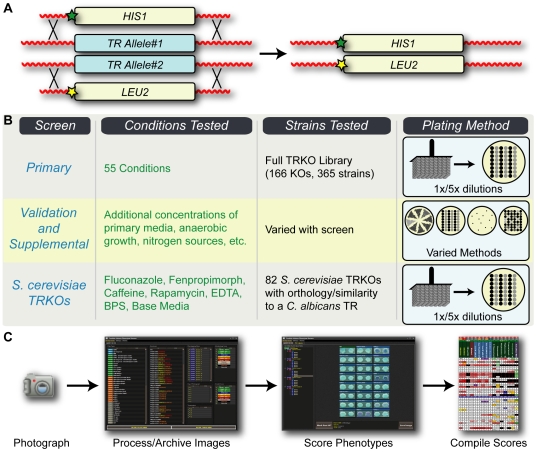
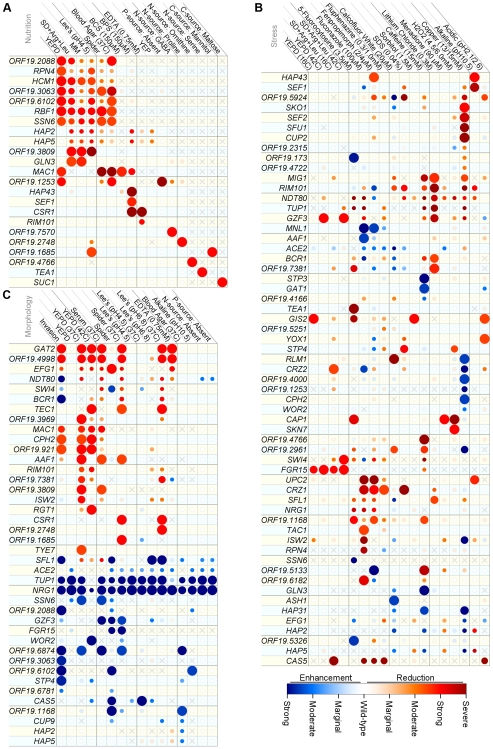
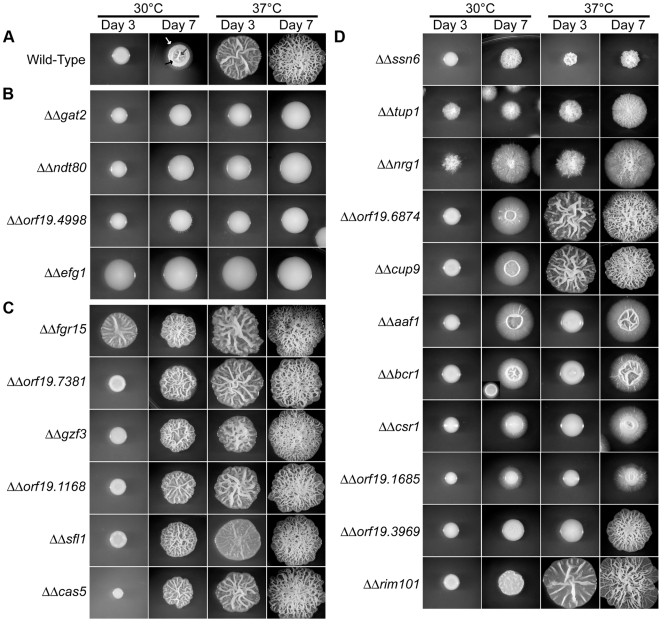
Candida albicans is a normal resident of the gastrointestinal tract and also the most prevalent fungal pathogen of humans. It last shared a common ancestor with the model yeast Saccharomyces cerevisiae over 300 million years ago. We describe a collection of 143 genetically matched strains of C. albicans, each of which has been deleted for a specific transcriptional regulator. This collection represents a large fraction of the non-essential transcription circuitry. A phenotypic profile for each mutant was developed using a screen of 55 growth conditions. The results identify the biological roles of many individual transcriptional regulators; for many, this work represents the first description of their functions. For example, a quarter of the strains showed altered colony formation, a phenotype reflecting transitions among yeast, pseudohyphal, and hyphal cell forms. These transitions, which have been closely linked to pathogenesis, have been extensively studied, yet our work nearly doubles the number of transcriptional regulators known to influence them. As a second example, nearly a quarter of the knockout strains affected sensitivity to commonly used antifungal drugs; although a few transcriptional regulators have previously been implicated in susceptibility to these drugs, our work indicates many additional mechanisms of sensitivity and resistance. Finally, our results inform how transcriptional networks evolve. Comparison with the existing S. cerevisiae data (supplemented by additional S. cerevisiae experiments reported here) allows the first systematic analysis of phenotypic conservation by orthologous transcriptional regulators over a large evolutionary distance. We find that, despite the many specific wiring changes documented between these species, the general phenotypes of orthologous transcriptional regulator knockouts are largely conserved. These observations support the idea that many wiring changes affect the detailed architecture of the circuit, but not its overall output.
Overview
The claims and statistics of this paper haven’t been checked yet.
Free: it reads the open-access text and checks the first 5 claims that cite a source we can check. Create a free account to check every claim.
Integrity signals
Registry
Cites
Statistics
Figures
Verification
Claims the paper makes
The claims and statistics of this paper haven’t been checked yet.
Free: it reads the open-access text and checks the first 5 claims that cite a source we can check. Create a free account to check every claim.
Claims other papers make about this one
Each is checked against this paper’s own text: does it say what the citing paper says it does?
The cited source says what the claim attributes to it.
In the citing paper
“Amongst the 165 TFs represented in the library31, rtg1- and rtg3-deletion strains showed the greatest growth defect (Fig. 3a).”
From Multifactor transcriptional control of alternative oxidase induction integrates diverse environmental inputs to enable fungal virulence (2023) · cites this paper as [31]
Self-check
Percentages, sums and reported differences re-computed from the paper’s own numbers.
The self-check needs the paper’s full text.
Citations
Cites
Functional profiling of the Saccharomyces cerevisiae genome
Giaever, G., Chu, A. M., Ni, L., Connelly, C., Riles, L., Véronneau, S., Dow, S., Lucau-Danila, A., Anderson, K., André, B., et al. (2002) · Nature · doi:10.1038/nature00935 · Cited by 4,316 · cited 1×
“deletion strains were obtained from the Saccharomyces Genome Deletion Project collection”
MethodTranscriptional Regulatory Networks in Saccharomyces cerevisiae
Lee, T. I., Rinaldi, N. J., Robert, F., Odom, D. T., Bar-Joseph, Z., Gerber, G. K., Hannett, N. M., Harbison, C. T., Thompson, C. M., Simon, I., et al. (2002) · Science · doi:10.1126/science.1075090 · Cited by 2,956
InterProScan – an integration platform for the signature-recognition methods in InterPro
Zdobnov, E. M., & Apweiler, R. (2001) · Bioinformatics · doi:10.1093/bioinformatics/17.9.847 · Cited by 2,939 · cited 1×
“The list of candidate genes for inclusion in our transcriptional regulator knockout (TRKO) library was compiled from multiple sources (Dataset S1; [7,15–22]).”
MethodDujon, B., Sherman, D., Fischer, G., Durrens, P., Casaregola, S., Lafontaine, I., de Montigny, J., Marck, C., Neuvéglise, C., Talla, E., et al. (2004) · Nature · doi:10.1038/nature02579 · Cited by 1,623 · cited 1×
“those of fish and humans [3].”
Pfam: A comprehensive database of protein domain families based on seed alignments
Sonnhammer, E. L. L., Eddy, S. R., & Durbin, R. (1997) · Proteins: Structure, Function, and Genetics · doi:10.1002/(sici)1097-0134(199707)28:3<405::aid-prot10>3.0.co;2-l · Cited by 1,221
Automatic clustering of orthologs and in-paralogs from pairwise species comparisons
Remm, M., Storm, C. E. V., & Sonnhammer, E. L. L. (2001) · Journal of Molecular Biology · doi:10.1006/jmbi.2000.5197 · Cited by 1,174 · cited 2×
“algorithms, SYNERGY [59] and INPARANOID [60] supple-”
SGD: Saccharomyces Genome Database
Cherry, J. (1998) · Nucleic Acids Research · doi:10.1093/nar/26.1.73 · Cited by 1,159
The Chemical Genomic Portrait of Yeast: Uncovering a Phenotype for All Genes
Hillenmeyer, M. E., Fung, E., Wildenhain, J., Pierce, S. E., Hoon, S., Lee, W., Proctor, M., St.Onge, R. P., Tyers, M., Koller, D., et al. (2008) · Science · doi:10.1126/science.1150021 · Cited by 1,003 · cited 2×
“[8,9,12,14]), the extent of concordance between these studies is sufficiently low that these data are not suitable for inter-species comparison.”
BackgroundThe distinct morphogenic states of Candida albicans
Sudbery, P., Gow, N., & Berman, J. (2004) · Trends in Microbiology · doi:10.1016/j.tim.2004.05.008 · Cited by 876 · cited 1×
“reflect the transitions among these three cell forms [54].”
BackgroundThe origin and evolution of model organisms
Hedges, S. B. (2002) · Nature Reviews Genetics · doi:10.1038/nrg929 · Cited by 806 · cited 1×
“ancestor some 300–900 million years ago [1,2], and, in terms of coding sequences, their genomes are approximately as divergent as”
Background
Cited by
A Recently Evolved Transcriptional Network Controls Biofilm Development in Candida albicans
Nobile, C. J., Fox, E. P., Nett, J. E., Sorrells, T. R., Mitrovich, Q. M., Hernday, A. D., Tuch, B. B., Andes, D. R., & Johnson, A. D. (2012) · Cell · doi:10.1016/j.cell.2011.10.048 · Cited by 711
“albicans library of 165 fully vetted transcription regulator (TR) deletion mutants consisting of two independently constructed mutants for each strain (Homann et al., 2009).”
BackgroundMethodSelf-citationRegulatory circuitry governing fungal development, drug resistance, and disease.
Shapiro, R. S., Robbins, N., & Cowen, L. E. (2011) · Microbiology and Molecular Biology Reviews · doi:10.1128/mmbr.00045-10 · Cited by 576
“At present, high-throughput analyses of known and uncharacterized transcriptional regulators are facilitating the discovery of many novel pathways and factors regulating morphogenetic transitions (228).”
BackgroundAntifungal Resistance and New Strategies to Control Fungal Infections
Vandeputte, P., Ferrari, S., & Coste, A. T. (2012) · International Journal of Microbiology · doi:10.1155/2012/713687 · Cited by 505
“First of all, treating strains with already known antifungal drugs and analyzing for example, growth modification and later transcriptional rewiring, some authors try to better understand drugs mechanisms of action and/or to find synergistic effect between them [272, 274].”
BackgroundLaFayette, S. L., Collins, C., Zaas, A. K., Schell, W. A., Betancourt-Quiroz, M., Gunatilaka, A. A. L., Perfect, J. R., & Cowen, L. E. (2010) · PLoS Pathogens · doi:10.1371/journal.ppat.1001069 · Cited by 329
“cerevisiae, deletion of RLM1 on its own had no impact on tolerance to the ergosterol biosynthesis inhibitors (Figure 5), consistent with recent findings [58].”
ResultChen, C., Pande, K., French, S. D., Tuch, B. B., & Noble, S. M. (2011) · Cell Host & Microbe · doi:10.1016/j.chom.2011.07.005 · Cited by 314
“Transcriptional Rewiring in a Commensal Pathogen”
InfluentialSelf-citation
Metadata
- Authors
- Homann, O. R., Dea, J., Noble, S. M., & Johnson, A. D.
- Affiliations
- University of California, San Francisco (US)
- Corresponding author
- Homann, Oliver R.
- Venue
- PLoS Genetics
- Publisher
- Public Library of Science (PLoS)
- Published
- 2009-12-24
- Volume
- 5
- Issue
- 12
- Pages
- e1000783
- ISSN
- 1553-7390 (ISSN-L)
- 1553-7404
- PMC
- PMC2790342
- OpenAlex
- W2041611856
- Cited by
- 444
- References
- 66
- Citations by year
- 2026: 16 · 2025: 18 · 2024: 30 · 2023: 30 · 2022: 30 · 2021: 30 · 2020: 28 · 2019: 29 · 2018: 26 · 2017: 29 · 2016: 28 · 2015: 28 · 2014: 26 · 2013: 32 · 2012: 33
- FWCI
- 8.60
- Type
- journal article
- Language
- en
- Open access
- gold
- doi.org
- Locations
- PLoS Genetics (publishedVersion, cc-by)
- PubMed Central (publishedVersion, cc-by)
- PubMed (publishedVersion)
- DOAJ (DOAJ: Directory of Open Access Journals) (submittedVersion, cc-by-sa)
- eScholarship (California Digital Library) (submittedVersion)
- eScholarship (California Digital Library) (submittedVersion, cc-by)
- Figshare (submittedVersion, cc-by)
- Funders
- National Institutes of Health
- National Institute of General Medical Sciences (R01GM037049, 5R01GM37049-22)
- National Institute of Allergy and Infectious Diseases (K08AI062800)
- Topics
- Life Sciences › Biochemistry, Genetics and Molecular Biology › Molecular Biology › Fungal and yeast genetics research
- Health Sciences › Medicine › Infectious Diseases › Antifungal resistance and susceptibility
- Life Sciences › Biochemistry, Genetics and Molecular Biology › Molecular Biology › Gene Regulatory Network Analysis
- Keywords
- Candida albicans, transcription factors, transcriptional regulatory networks, deletion mutants, phenotypic profiling, colony morphology, antifungal susceptibility, antifungal resistance, Saccharomyces cerevisiae, fungal pathogenesis
- MeSH terms
- Candida albicans, Homeostasis, Models, Biological, Phenotype, Saccharomyces cerevisiae, Transcription, Genetic, Colony Count, Microbial, Gene Library, Databases, Genetic, Gene Regulatory Networks, Gene Knockout Techniques
About these checks
Registry, retraction, Cites and statistics results are computed, not judged, with one exception: a printed reference that no index lists is read once by a model before it counts as a citation error. Claims are extracted by a model and kept only when their quote appears verbatim in the text; each cited source is then checked, with a model’s help, for whether it says what the claim relies on. Those verdicts can be wrong — read the claim’s quote and the cited source before relying on one.
Statistics and arithmetic are recomputed, not judged.
Confidence bands are shown only for fields calibrated on our annotated test set. None is calibrated yet, so no band is shown.
What counts as a claim ›How we measure confidence ›How we check this ›
Are you an author, or do you see a problem with this page? Request a review
How to cite
Cite CoChat for the checks on this page, and the paper for its own findings.
- This page
- CoChat. (2026). Citation check: A Phenotypic Profile of the Candida albicans Regulatory Network. https://app.cochat.ai/papers/10.1371/journal.pgen.1000783
- The paper
- Homann, O. R., Dea, J., Noble, S. M., & Johnson, A. D. (2009). A Phenotypic Profile of the Candida albicans Regulatory Network. PLoS Genetics. https://doi.org/10.1371/journal.pgen.1000783
Data sources
Bibliographic data: Semantic Scholar, OpenAlex, Crossref.
Contains information from the Semantic Scholar Academic Graph Datasets, made available under the ODC Attribution License (ODC-BY 1.0).
Semantic Scholar’s data is described in: Kinney, R., et al. (2023). The Semantic Scholar Open Data Platform. arXiv:2301.10140.
