

The DOI matches its Crossref record; 63 of the 63 references it cites were found in a registry or an index.
Detecting Individual Sites Subject to Episodic Diversifying Selection
Open accessAbstract
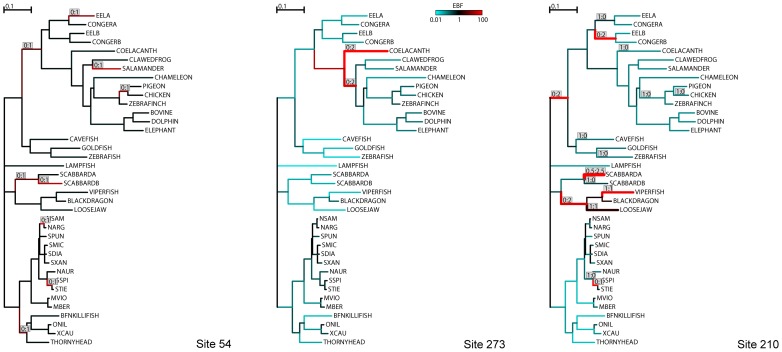
The imprint of natural selection on protein coding genes is often difficult to identify because selection is frequently transient or episodic, i.e. it affects only a subset of lineages. Existing computational techniques, which are designed to identify sites subject to pervasive selection, may fail to recognize sites where selection is episodic: a large proportion of positively selected sites. We present a mixed effects model of evolution (MEME) that is capable of identifying instances of both episodic and pervasive positive selection at the level of an individual site. Using empirical and simulated data, we demonstrate the superior performance of MEME over older models under a broad range of scenarios. We find that episodic selection is widespread and conclude that the number of sites experiencing positive selection may have been vastly underestimated.
Overview
The claims and statistics of this paper haven’t been checked yet.
Run the check — free, no account needed. It reads the open-access text and checks the sources it cites.
Integrity signals
Registry
Cites
Statistics
Figures
Verification
Claims the paper makes
The claims and statistics of this paper haven’t been checked yet.
Run the check — free, no account needed. It reads the open-access text and checks the sources it cites.
Claims other papers make about this one
Each is checked against this paper’s own text: does it say what the citing paper says it does?
The source backs part of the claim, not all of it — or backs it for a different population, condition or comparison.
In the citing paper
“Positively selected sites were identified using two different methods: the Bayes Empirical Bayes (BEB) analysis from MA (with a cutoff of 0.90) and the Mixed Effects Model of Evolution (MEME) (with the default cutoff of 0.1)34.”
From Distinct selective forces and Neanderthal introgression shaped genetic diversity at genes involved in neurodevelopmental disorders (2017) · cites this paper as [34]
Experimental — accuracy not yet measuredThe source backs part of the claim, not all of it — or backs it for a different population, condition or comparison.
In the citing paper
“However, this test can be misleading because estimates of ! can be increased by processes such as intensification of positive selection when selective pressures vary both along branches and sites (Murrell et al. 2012).”
From RELAX: Detecting Relaxed Selection in a Phylogenetic Framework (2015) · cites this paper as Murrell et al. 2012
Experimental — accuracy not yet measuredThe source backs part of the claim, not all of it — or backs it for a different population, condition or comparison.
In the citing paper
“Standard methods for estimating the strength and extent of purifying or positive selection from molecular sequence data are not suitable for detecting relaxed selection, because they lack power and can mistake an increase in the intensity of positive selection for relaxation of both purifying and positive selection.”
From RELAX: Detecting Relaxed Selection in a Phylogenetic Framework (2015) · cites this paper as Murrell et al. 2012
Experimental — accuracy not yet measuredThe cited source says what the claim attributes to it.
In the citing paper
“To be conservative, we considered as positively selected only sites also detected by the Mixed Effects Model of Evolution (MEME) method34.”
From Distinct selective forces and Neanderthal introgression shaped genetic diversity at genes involved in neurodevelopmental disorders (2017) · cites this paper as [34]
The cited source says what the claim attributes to it.
In the citing paper
“This development vastly increased the detectable instances of positive selection (Murrell et al. 2012).”
From RELAX: Detecting Relaxed Selection in a Phylogenetic Framework (2015) · cites this paper as Murrell et al. 2012
The cited source says what the claim attributes to it.
In the citing paper
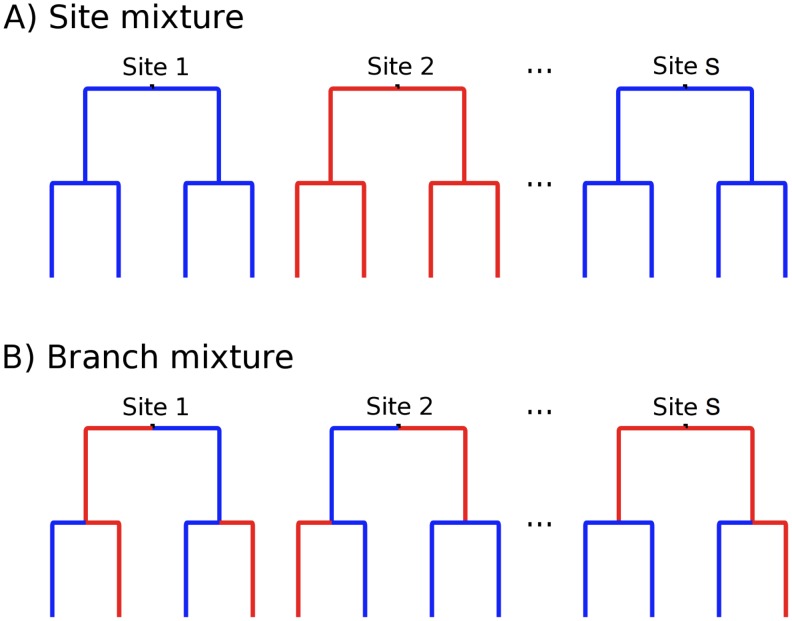
“Our random effects (Kosakovsky Pond et al. 2011) and mixed effects (Murrell et al. 2012) branch-site models allow detection of individual branches on which only a subset of sites are under positive selection or, conversely, individual sites which are under positive selection on only a subset of branches.”
From RELAX: Detecting Relaxed Selection in a Phylogenetic Framework (2015) · cites this paper as Murrell et al. 2012
Self-check
Percentages, sums and reported differences re-computed from the paper’s own numbers.
The self-check needs the paper’s full text.
Citations
Cites
Controlling the False Discovery Rate: A Practical and Powerful Approach to Multiple Testing
Benjamini, Y., & Hochberg, Y. (1995) · Journal of the Royal Statistical Society Series B: Statistical Methodology · doi:10.1111/j.2517-6161.1995.tb02031.x · Cited by 109,482
Evolutionary trees from DNA sequences: A maximum likelihood approach.
Felsenstein, J. (1981) · Journal of Molecular Evolution · doi:10.1007/bf01734359 · Cited by 14,571
Evolutionary Rate at the Molecular Level
KIMURA, M. (1968) · Nature · doi:10.1038/217624a0 · Cited by 3,747
Adaptive protein evolution at the Adh locus in Drosophila
McDonald, J. H., & Kreitman, M. (1991) · Nature · doi:10.1038/351652a0 · Cited by 3,313
Self, S., & Liang, K.-Y. (1987) · Journal of the American Statistical Association · doi:10.1080/01621459.1987.10478472 · Cited by 2,861
Not So Different After All: A Comparison of Methods for Detecting Amino Acid Sites Under Selection
Pond, S. L. K., & Frost, S. D. W. (2005) · Molecular Biology and Evolution · doi:10.1093/molbev/msi105 · Cited by 2,320
Codon-substitution models for heterogeneous selection pressure at amino acid sites
Yang, Z., Nielsen, R., Goldman, N., & Pedersen, A.-M. K. (2000) · Genetics · doi:10.1093/genetics/155.1.431 · Cited by 2,286
Hughes, A. L., & Nei, M. (1988) · Nature · doi:10.1038/335167a0 · Cited by 1,976
A codon-based model of nucleotide substitution for protein-coding DNA sequences.
(1994) · Molecular Biology and Evolution · doi:10.1093/oxfordjournals.molbev.a040153 · Cited by 1,960
Nielsen, R., & Yang, Z. (1998) · Genetics · doi:10.1093/genetics/148.3.929 · Cited by 1,622
Cited by
Sorted by citations
Detection of a SARS-CoV-2 variant of concern in South Africa
Tegally, H., Wilkinson, E., Giovanetti, M., Iranzadeh, A., Fonseca, V., Giandhari, J., Doolabh, D., Pillay, S., San, E. J., Msomi, N., et al. (2021) · Nature · doi:10.1038/s41586-021-03402-9 · Cited by 2,510
Rapid epidemic expansion of the SARS-CoV-2 Omicron variant in southern Africa
Viana, R. P. E. S., Moyo, S. M., Amoako, D. G., Tegally, H., Scheepers, C., Althaus, C. L., Anyaneji, U. J., Bester, P. A., Boni, M. F., Chand, M., et al. (2022) · Nature · doi:10.1038/s41586-022-04411-y · Cited by 1,678
Genomics and epidemiology of the P.1 SARS-CoV-2 lineage in Manaus, Brazil
Faria, N. R., Mellan, T. A., Whittaker, C., Claro, I. M., Candido, D. D. S., Mishra, S., Crispim, M. A. E., Sales, F. C. S., Hawryluk, I., McCrone, J. T., et al. (2021) · Science · doi:10.1126/science.abh2644 · Cited by 1,461
FUBAR: A Fast, Unconstrained Bayesian AppRoximation for Inferring Selection
Murrell, B., Moola, S., Mabona, A., Weighill, T., Sheward, D. J., Pond, S. L. K., & Scheffler, K. (2013) · Molecular Biology and Evolution · doi:10.1093/molbev/mst030 · Cited by 1,404
Self-citationTegally, H., Wilkinson, E., Giovanetti, M., Iranzadeh, A., Fonseca, V., Giandhari, J., Doolabh, D., Pillay, S., San, E. J., Msomi, N., et al. (2020) · doi:10.1101/2020.12.21.20248640 · Cited by 2,535
“…in multiple epidemiologically unlinked lineages that have statistical support for non-neutral evolution (Mixed Effects Model of Evolution, MEME) 25 , (ii) sites where these polymorphisms have support for a greater than expected ratio of non-synonymous:synonymous nucleotide substitution rates…”
Self-citation
Metadata
- Authors
- Murrell, B., Wertheim, J. O., Moola, S., Weighill, T., Scheffler, K., & Kosakovsky Pond, S. L.
- Affiliations
- Stellenbosch University (ZA)
- University of California San Diego (US)
- Venue
- PLoS Genetics
- Publisher
- Public Library of Science (PLoS)
- Published
- 2012-07-12
- Volume
- 8
- Issue
- 7
- Pages
- e1002764
- ISSN
- 1553-7390 (ISSN-L)
- 1553-7404
- PMC
- PMC3395634
- OpenAlex
- W2118982822
- Cited by
- 1,811
- References
- 63
- Citations by year
- 2026: 147 · 2025: 135 · 2024: 169 · 2023: 162 · 2022: 161 · 2021: 183 · 2020: 172 · 2019: 123 · 2018: 115 · 2017: 99 · 2016: 87 · 2015: 100 · 2014: 83 · 2013: 66 · 2012: 9
- FWCI
- 49.72
- Type
- journal article
- Language
- en
- Open access
- gold
- doi.org
- Locations
- PLoS Genetics (publishedVersion, cc-by)
- Europe PMC (PubMed Central) (publishedVersion, cc-by)
- PubMed Central (publishedVersion, cc-by)
- PubMed (publishedVersion)
- RePEc: Research Papers in Economics (submittedVersion)
- DOAJ (DOAJ: Directory of Open Access Journals) (submittedVersion, cc-by-sa)
- Figshare (submittedVersion, cc-by)
- TUScholarShare (Temple University) (submittedVersion, cc-by)
- SUNScholar (Stellenbosch University) (submittedVersion)
- Funders
- National Science Foundation (0714991)
- European Commission
- National Research Foundation
- National Institutes of Health (AI47745, AI74621, AI-36214, AI57167, GM093939)
- Center for AIDS Research, University of Washington
- University of California, San Diego
- National Institute of General Medical Sciences (GM093939, R01GM093939)
- National Institute of Allergy and Infectious Diseases (R01AI057167, AI-74621, AI-47745, AI57167, R21AI047745, AI 43638, R24AI106039, R56AI047745, AI-36214, R01AI047745, U01AI043638, P01AI074621, P30AI036214, T32AI007384)
- Topics
- Life Sciences › Biochemistry, Genetics and Molecular Biology › Genetics › Evolution and Genetic Dynamics
- Life Sciences › Biochemistry, Genetics and Molecular Biology › Molecular Biology › Genomics and Phylogenetic Studies
- Life Sciences › Biochemistry, Genetics and Molecular Biology › Genetics › Genetic diversity and population structure
- Keywords
- episodic selection, positive selection, memes, protein-coding genes, natural selection
- MeSH terms
- Amino Acids, Animals, Computer Simulation, Models, Theoretical, Phylogeny, Rhodopsin, Selection, Genetic, Vertebrates, Open Reading Frames, Evolution, Molecular, Computational Biology
About these checks
Registry, retraction, Cites and statistics results are computed, not judged, with one exception: a printed reference that no index lists is read once by a model before it counts as a citation error. Claims are extracted by a model and kept only when their quote appears verbatim in the text; each cited source is then checked, with a model’s help, for whether it says what the claim relies on. Those verdicts can be wrong — read the claim’s quote and the cited source before relying on one.
Statistics and arithmetic are recomputed, not judged.
Confidence bands are shown only for fields calibrated on our annotated test set. None is calibrated yet, so no band is shown.
What counts as a claim ›How we measure confidence ›How we check this ›
Are you an author, or do you see a problem with this page? Request a review
