

The DOI matches its Crossref record; 79 of the 79 references it cites were found in a registry or an index.
Classic Selective Sweeps Revealed by Massive Sequencing in Cattle
Open accessAbstract
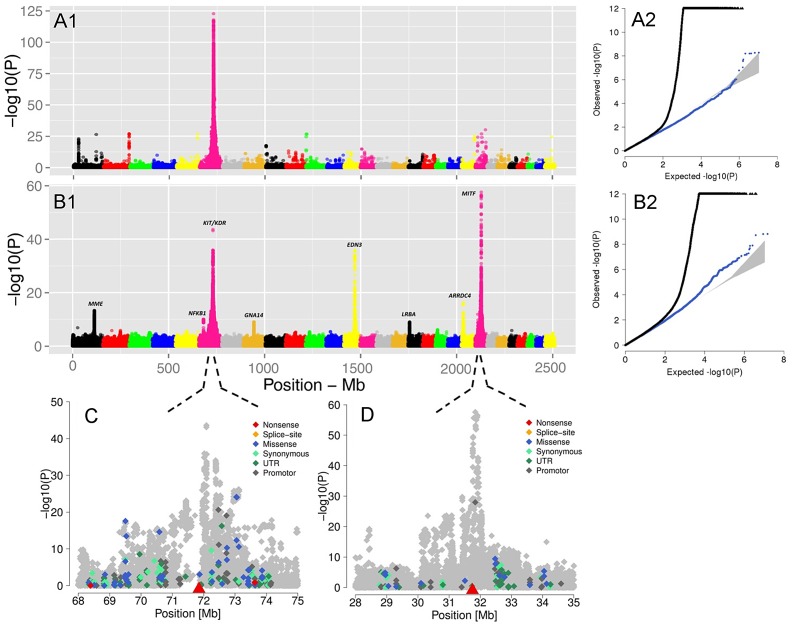
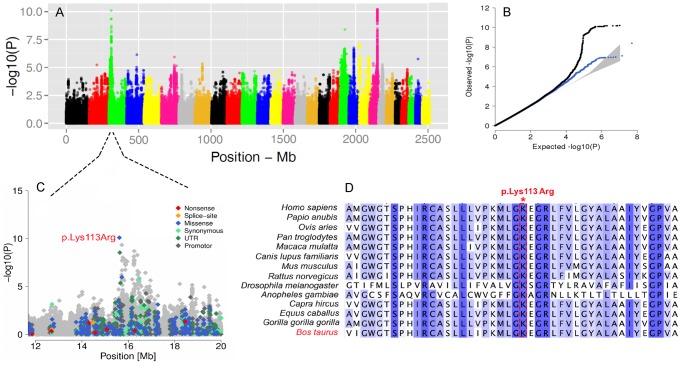
Human driven selection during domestication and subsequent breed formation has likely left detectable signatures within the genome of modern cattle. The elucidation of these signatures of selection is of interest from the perspective of evolutionary biology, and for identifying domestication-related genes that ultimately may help to further genetically improve this economically important animal. To this end, we employed a panel of more than 15 million autosomal SNPs identified from re-sequencing of 43 Fleckvieh animals. We mainly applied two somewhat complementary statistics, the integrated Haplotype Homozygosity Score (iHS) reflecting primarily ongoing selection, and the Composite of Likelihood Ratio (CLR) having the most power to detect completed selection after fixation of the advantageous allele. We find 106 candidate selection regions, many of which are harboring genes related to phenotypes relevant in domestication, such as coat coloring pattern, neurobehavioral functioning and sensory perception including KIT, MITF, MC1R, NRG4, Erbb4, TMEM132D and TAS2R16, among others. To further investigate the relationship between genes with signatures of selection and genes identified in QTL mapping studies, we use a sample of 3062 animals to perform four genome-wide association analyses using appearance traits, body size and somatic cell count. We show that regions associated with coat coloring significantly (P<0.0001) overlap with the candidate selection regions, suggesting that the selection signals we identify are associated with traits known to be affected by selection during domestication. Results also provide further evidence regarding the complexity of the genetics underlying coat coloring in cattle. This study illustrates the potential of population genetic approaches for identifying genomic regions affecting domestication-related phenotypes and further helps to identify specific regions targeted by selection during speciation, domestication and breed formation of cattle. We also show that Linkage Disequilibrium (LD) decays in cattle at a much faster rate than previously thought.
Overview
The claims and statistics of this paper haven’t been checked yet.
Run the check — free, no account needed. It reads the open-access text and checks the sources it cites.
Integrity signals
Registry
Cites
Statistics
Figures
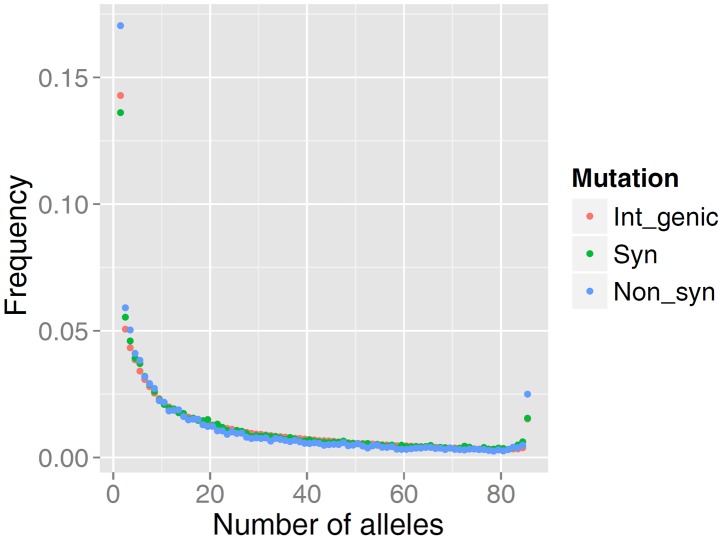
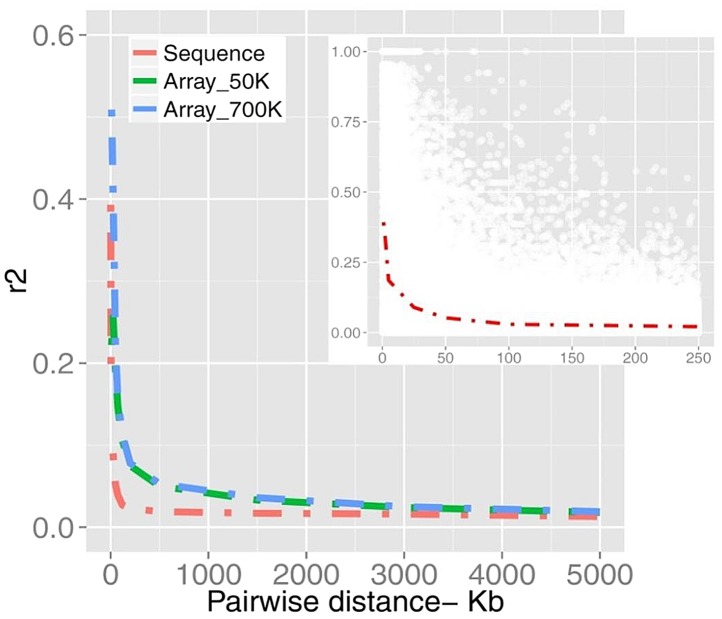
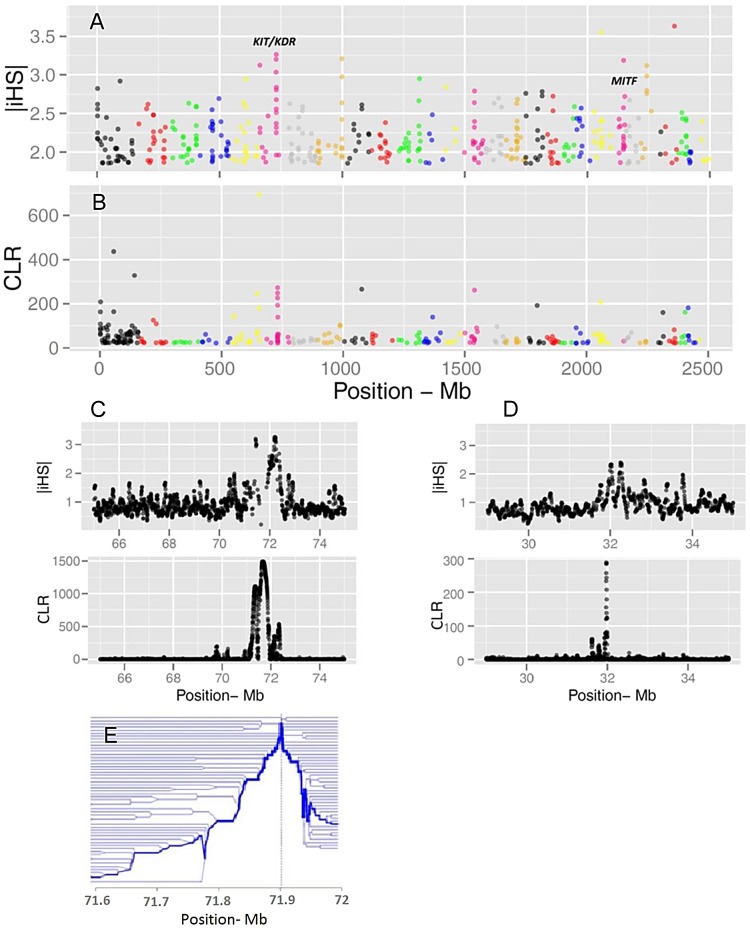
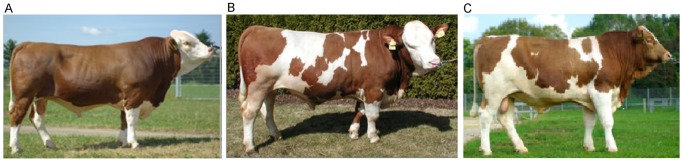
Verification
Claims the paper makes
The claims and statistics of this paper haven’t been checked yet.
Run the check — free, no account needed. It reads the open-access text and checks the sources it cites.
Claims other papers make about this one
Each is checked against this paper’s own text: does it say what the citing paper says it does?
In the citing paper
“This gene has been targeted in modern human evolution and in multiple domestication events, including in dogs, sheep, yaks, and across multiple cattle breeds [16, 19, 20].”
From Gene expression profiles underlying aggressive behavior in the prefrontal cortex of cattle (2021) · cites this paper as [20]
Self-check
Percentages, sums and reported differences re-computed from the paper’s own numbers.
The self-check needs the paper’s full text.
Citations
Cites
Systematic and integrative analysis of large gene lists using DAVID bioinformatics resources
Huang, D. W., Sherman, B. T., & Lempicki, R. A. (2009) · Nature Protocols · doi:10.1038/nprot.2008.211 · Cited by 35,890
Statistical method for testing the neutral mutation hypothesis by DNA polymorphism.
Tajima, F. (1989) · Genetics · doi:10.1093/genetics/123.3.585 · Cited by 14,056
GCTA: a tool for genome-wide complex trait analysis
Yang, J., Lee, S. H., Goddard, M. E., & Visscher, P. M. (2011) · The American Journal of Human Genetics · doi:10.1016/j.ajhg.2010.11.011 · Cited by 8,279
The hitch-hiking effect of a favourable gene
Smith, J. M., & Haigh, J. (1974) · Genetical Research · doi:10.1017/s0016672300014634 · Cited by 3,415
A Map of Recent Positive Selection in the Human Genome
Voight, B. F., Kudaravalli, S., Wen, X., & Pritchard, J. K. (2006) · PLoS Biology · doi:10.1371/journal.pbio.0040072 · Cited by 2,925
Variance component model to account for sample structure in genome-wide association studies
Kang, H. M., Sul, J. H., Service, S. K., Zaitlen, N. A., Kong, S.-Y., Freimer, N. B., Sabatti, C., & Eskin, E. (2010) · Nature Genetics · doi:10.1038/ng.548 · Cited by 2,817
The hitch-hiking effect of a favourable gene
Smith, J. M., & Haigh, J. (2007) · Genetics Research · doi:10.1017/s0016672308009579 · Cited by 2,675
Detecting recent positive selection in the human genome from haplotype structure
Sabeti, P. C., Reich, D. E., Higgins, J. M., Levine, H. Z. P., Richter, D. J., Schaffner, S. F., Gabriel, S. B., Platko, J. V., Patterson, N. J., McDonald, G. J., et al. (2002) · Nature · doi:10.1038/nature01140 · Cited by 2,106
Hitchhiking Under Positive Darwinian Selection
Fay, J. C., & Wu, C.-I. (2000) · Genetics · doi:10.1093/genetics/155.3.1405 · Cited by 1,819
Fast and accurate genotype imputation in genome-wide association studies through pre-phasing
Howie, B., Fuchsberger, C., Stephens, M., Marchini, J., & Abecasis, G. R. (2012) · Nature Genetics · doi:10.1038/ng.2354 · Cited by 1,737
Cited by
Sorted by citations
Sequencing pools of individuals — mining genome-wide polymorphism data without big funding
Schlötterer, C., Tobler, R., Kofler, R., & Nolte, V. (2014) · Nature Reviews Genetics · doi:10.1038/nrg3803 · Cited by 803
Genome-Wide Scan for Adaptive Divergence and Association with Population-Specific Covariates
Gautier, M. (2015) · Genetics · doi:10.1534/genetics.115.181453 · Cited by 532
Prehistoric genomes reveal the genetic foundation and cost of horse domestication
Schubert, M., Jónsson, H., Chang, D., Der Sarkissian, C., Ermini, L., Ginolhac, A., Albrechtsen, A., Dupanloup, I., Foucal, A., Petersen, B., et al. (2014) · Proceedings of the National Academy of Sciences · doi:10.1073/pnas.1416991111 · Cited by 324
Self-citationPervasive introgression facilitated domestication and adaptation in the Bos species complex
Wu, D., Ding, X., Wang, S., Wójcik, J. M., Zhang, Y., Tokarska, M., Li, Y., Wang, M.-S., Faruque, O., Nielsen, R., et al. (2018) · Nature Ecology & Evolution · doi:10.1038/s41559-018-0562-y · Cited by 249
Self-citationPark, S. D. E., Magee, D. A., McGettigan, P., Teasdale, M. D., Edwards, C. J., Lohan, A. J., Murphy, A., Braud, M., Donoghue, M. T. A., Liu, Y., et al. (2015) · Genome biology · doi:10.1186/s13059-015-0790-2 · Cited by 234
Metadata
- Authors
- Qanbari, S., Pausch, H., Jansen, S., Somel, M., Strom, T. M., Fries, R., Nielsen, R., & Simianer, H.
- Affiliations
- University of Göttingen (DE)
- Technical University of Munich (DE)
- University of California, Berkeley (US)
- Helmholtz Munich (DE)
- Corresponding author
- Qanbari, Saber
- Venue
- PLoS Genetics
- Publisher
- Public Library of Science (PLoS)
- Published
- 2014-02-27
- Volume
- 10
- Issue
- 2
- Pages
- e1004148
- ISSN
- 1553-7390 (ISSN-L)
- 1553-7404
- PMC
- PMC3937232
- OpenAlex
- W2047669864
- Semantic Scholar
- b97615af7d0e16d1c4ecfdba9de4183b17efa05b
- Cited by
- 233
- References
- 79
- Citations by year
- 2026: 8 · 2025: 12 · 2024: 12 · 2023: 13 · 2022: 16 · 2021: 26 · 2020: 24 · 2019: 20 · 2018: 20 · 2017: 17 · 2016: 23 · 2015: 32 · 2014: 10
- FWCI
- 17.90
- Type
- journal article
- Language
- en
- Open access
- gold
- doi.org
- Locations
- PLoS Genetics (publishedVersion, cc-by)
- Europe PMC (PubMed Central) (publishedVersion, cc-by)
- PubMed Central (publishedVersion, cc-by)
- PubMed (publishedVersion)
- DOAJ (DOAJ: Directory of Open Access Journals) (submittedVersion)
- eScholarship (California Digital Library) (submittedVersion)
- eScholarship (California Digital Library) (submittedVersion, cc-by)
- Figshare (submittedVersion, cc-by)
- GoeScholar The Publication Server of the Georg-August-Universität Göttingen (Georg-August-Universität Göttingen) (submittedVersion, cc-by)
- OpenMETU (Middle East Technical University) (submittedVersion, cc-by-nc-nd)
- Site cant be reached (submittedVersion, cc-by)
- GRO (submittedVersion, cc-by)
- Repository for Publications and Research Data (ETH Zurich) (submittedVersion, cc-by)
- ETH Zürich Research Collection (cc-by)
- Funders
- Deutsche Forschungsgemeinschaft
- Bundesministerium für Bildung und Forschung (FKZ 0315528, 0315528)
- Topics
- Life Sciences › Biochemistry, Genetics and Molecular Biology › Genetics › Genetic and phenotypic traits in livestock
- Life Sciences › Biochemistry, Genetics and Molecular Biology › Genetics › Genetic Mapping and Diversity in Plants and Animals
- Life Sciences › Biochemistry, Genetics and Molecular Biology › Genetics › Genetic diversity and population structure
- Keywords
- cattle domestication, selective sweeps, Simmental cattle, coat color inheritance, KIT, MITF, MC1R, ErbB4, TAS2R16, linkage disequilibrium decay, genome-wide association study, body size, somatic cell count, breed formation
- MeSH terms
- Animals, Animals, Domestic, Breeding, Cattle, Genetics, Population, Haplotypes, Humans, Selection, Genetic, Linkage Disequilibrium, Polymorphism, Single Nucleotide, Genome-Wide Association Study
About these checks
Registry, retraction, Cites and statistics results are computed, not judged, with one exception: a printed reference that no index lists is read once by a model before it counts as a citation error. Claims are extracted by a model and kept only when their quote appears verbatim in the text; each cited source is then checked, with a model’s help, for whether it says what the claim relies on. Those verdicts can be wrong — read the claim’s quote and the cited source before relying on one.
Statistics and arithmetic are recomputed, not judged.
Confidence bands are shown only for fields calibrated on our annotated test set. None is calibrated yet, so no band is shown.
What counts as a claim ›How we measure confidence ›How we check this ›
Are you an author, or do you see a problem with this page? Request a review
