

The DOI matches its Crossref record; 54 of the 54 references it cites were found in a registry or an index.
Mitochondrial and Cytoplasmic ROS Have Opposing Effects on Lifespan
Open accessAbstract
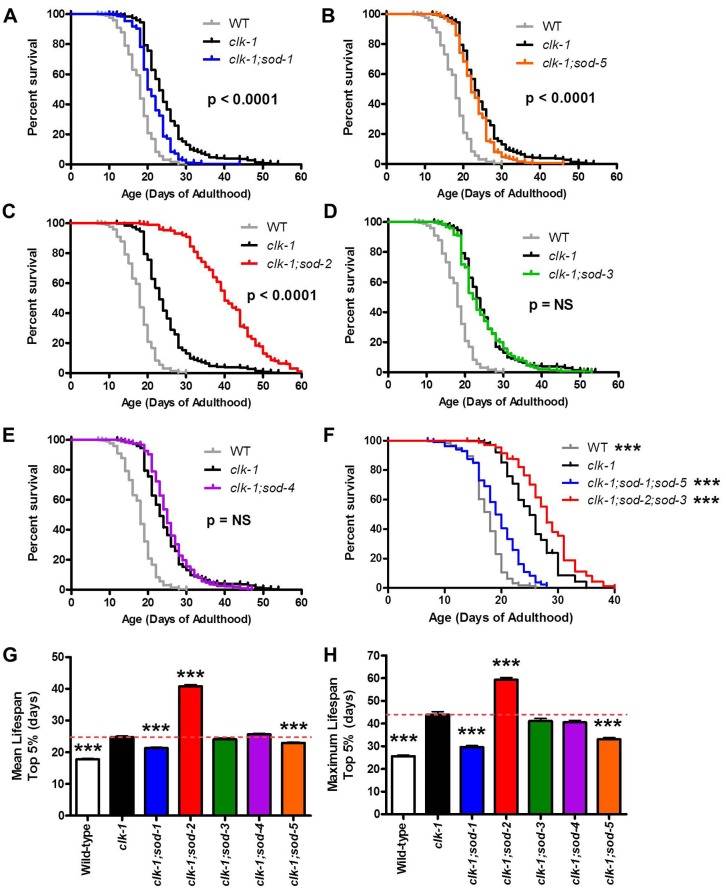
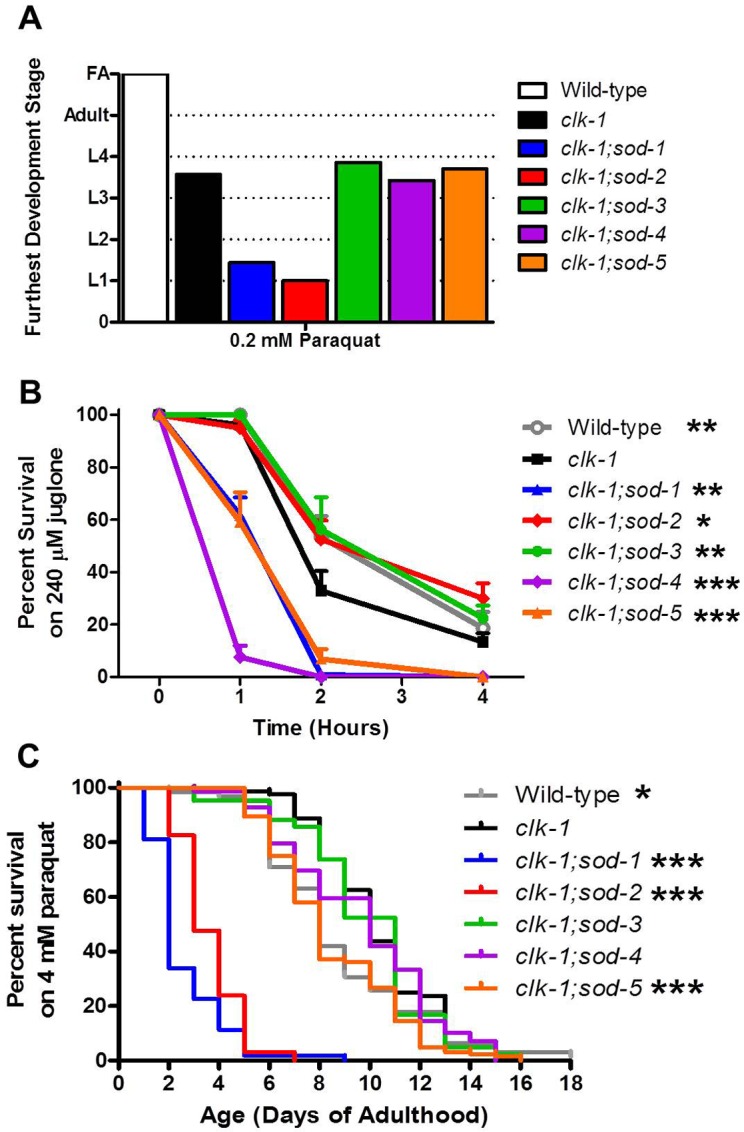
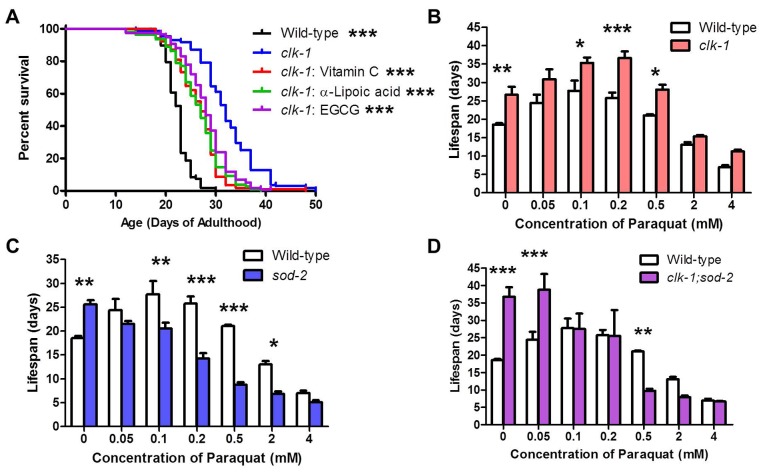
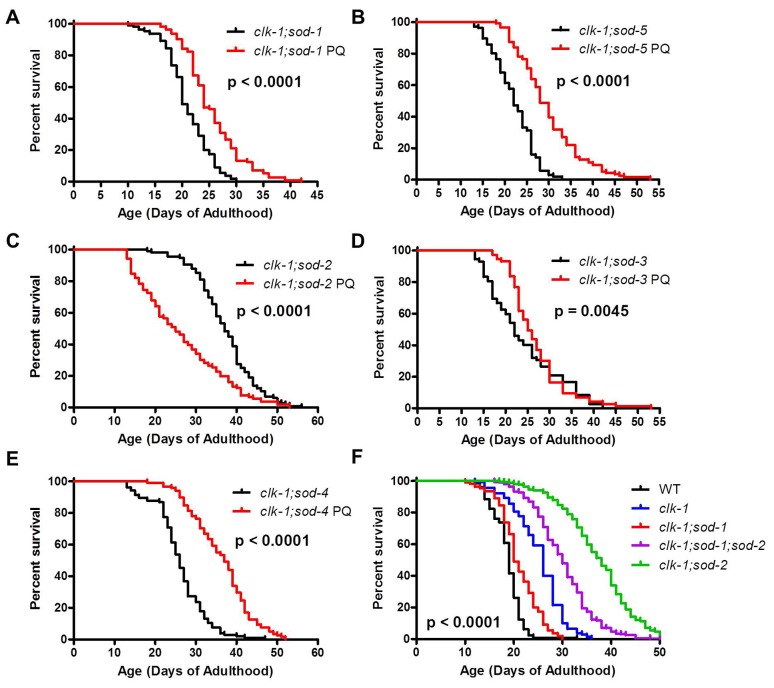
Reactive oxygen species (ROS) are highly reactive, oxygen-containing molecules that can cause molecular damage within the cell. While the accumulation of ROS-mediated damage is widely believed to be one of the main causes of aging, ROS also act in signaling pathways. Recent work has demonstrated that increasing levels of superoxide, one form of ROS, through treatment with paraquat, results in increased lifespan. Interestingly, treatment with paraquat robustly increases the already long lifespan of the clk-1 mitochondrial mutant, but not other long-lived mitochondrial mutants such as isp-1 or nuo-6. To genetically dissect the subcellular compartment in which elevated ROS act to increase lifespan, we deleted individual superoxide dismutase (sod) genes in clk-1 mutants, which are sensitized to ROS. We find that only deletion of the primary mitochondrial sod gene, sod-2 results in increased lifespan in clk-1 worms. In contrast, deletion of either of the two cytoplasmic sod genes, sod-1 or sod-5, significantly decreases the lifespan of clk-1 worms. Further, we show that increasing mitochondrial superoxide levels through deletion of sod-2 or treatment with paraquat can still increase lifespan in clk-1;sod-1 double mutants, which live shorter than clk-1 worms. The fact that mitochondrial superoxide can increase lifespan in worms with a detrimental level of cytoplasmic superoxide demonstrates that ROS have a compartment specific effect on lifespan - elevated ROS in the mitochondria acts to increase lifespan, while elevated ROS in the cytoplasm decreases lifespan. This work also suggests that both ROS-dependent and ROS-independent mechanisms contribute to the longevity of clk-1 worms.
Overview
The claims and statistics of this paper haven’t been checked yet.
Run the check — free, no account needed. It reads the open-access text and checks the sources it cites.
Integrity signals
Registry
Cites
Statistics
Figures
Verification
Claims the paper makes
The claims and statistics of this paper haven’t been checked yet.
Run the check — free, no account needed. It reads the open-access text and checks the sources it cites.
Claims other papers make about this one
Each is checked against this paper’s own text: does it say what the citing paper says it does?
In the citing paper
“The oxidative damage to cell proteins, lipids and most importantly nuclear DNA is now believed to be a critical element of the aging process [94,95,96,97,98,99,100].”
From The mitochondrial permeability transition: Nexus of aging, disease and longevity (2021) · cites this paper as [94]
Self-check
Percentages, sums and reported differences re-computed from the paper’s own numbers.
The self-check needs the paper’s full text.
Citations
Cites
1 retracted
A cytosolic catalase is needed to extend adult lifespan in C. elegans daf-C and clk-1 mutants
Taub, J. J., Lau, J. F., Ma, C., Hahn, J. H., Hoque, R., Rothblatt, J. A., & Chalfie, M. (1999) · Nature · doi:10.1038/20208 · Cited by 243
RetractedAging: a theory based on free radical and radiation chemistry
Harman, D. (1956) · Journal of Gerontology · doi:10.1093/geronj/11.3.298 · Cited by 8,567
ROS as signalling molecules: Mechanisms that generate specificity in ROS homeostasis
D'Autréaux, B., & Toledano, M. B. (2007) · Nature Reviews Molecular Cell Biology · doi:10.1038/nrm2256 · Cited by 3,642
Schulz, T. J., Zarse, K., Voigt, A., Urban, N., Birringer, M., & Ristow, M. (2007) · Cell Metabolism · doi:10.1016/j.cmet.2007.08.011 · Cited by 1,209
Honda, Y., & Honda, S. (1999) · The FASEB Journal · doi:10.1096/fasebj.13.11.1385 · Cited by 730
Mitochondrial Electron Transport Is a Key Determinant of Life Span in Caenorhabditis elegans
Feng, J., Bussière, F., & Hekimi, S. (2001) · Developmental Cell · doi:10.1016/s1534-5807(01)00071-5 · Cited by 675
Self-citationA Mitochondrial Superoxide Signal Triggers Increased Longevity in Caenorhabditis elegans
Yang, W., & Hekimi, S. (2010) · PLoS Biology · doi:10.1371/journal.pbio.1000556 · Cited by 649
Self-citationYoneda, T., Benedetti, C., Urano, F., Clark, S. G., Harding, H. P., & Ron, D. (2004) · Journal of Cell Science · doi:10.1242/jcs.01275 · Cited by 636
Determination of Life-Span in Caenorhabditis elegans by Four Clock Genes
Lakowski, B., & Hekimi, S. (1996) · Science · doi:10.1126/science.272.5264.1010 · Cited by 539
Self-citationDeletion of the mitochondrial superoxide dismutase sod-2 extends lifespan in Caenorhabditis elegans
Van Raamsdonk, J. M., & Hekimi, S. (2009) · PLoS Genetics · doi:10.1371/journal.pgen.1000361 · Cited by 511
Self-citation
Research works printed but not linked: 2
- X Liu, 2005, Evolutionary conservation of the clk-1-dependent mechanism of longevity: loss of mclk1 increases cellular fitness and lifespan in mice, Genes Dev, 19, 2424, 10.1101/gad.1352905 · DOI · Paper page
- BP Braeckman, 2002, No reduction of energy metabolism in Clk mutants, Mech Ageing Dev, 123, 1447, 10.1016/S0047-6374(02)00085-4 · DOI
Cited by
Sorted by citations
Superoxide dismutases: Dual roles in controlling ROS damage and regulating ROS signaling
Wang, Y., Branicky, R. S., Noë, A., & Hekimi, S. (2018) · The Journal of Cell Biology · doi:10.1083/jcb.201708007 · Cited by 2,274
Self-citationROS, Cell Senescence, and Novel Molecular Mechanisms in Aging and Age‐Related Diseases
Davalli, P., Mitic, T., Caporali, A., Lauriola, A., & D’Arca, D. (2016) · Oxidative Medicine and Cellular Longevity · doi:10.1155/2016/3565127 · Cited by 1,059
Brand, M. D. (2016) · Free Radical Biology and Medicine · doi:10.1016/j.freeradbiomed.2016.04.001 · Cited by 1,063
Mitonuclear communication in homeostasis and stress
Quirós, P. M., Mottis, A., & Auwerx, J. (2016) · Nature Reviews Molecular Cell Biology · doi:10.1038/nrm.2016.23 · Cited by 787
Exercise Promotes Healthy Aging of Skeletal Muscle
Cartee, G. D., Hepple, R. T., Bamman, M. M., & Zierath, J. R. (2016) · Cell Metabolism · doi:10.1016/j.cmet.2016.05.007 · Cited by 483
Metadata
- Authors
- Schaar, C. E., Dues, D. J., Spielbauer, K. K., Machiela, E., Cooper, J. F., Senchuk, M., Hekimi, S., & Van Raamsdonk, J. M.
- Affiliations
- Van Andel Institute (US)
- McGill University (CA)
- Venue
- PLOS Genetics
- Publisher
- Public Library of Science (PLoS)
- Published
- 2015-02-11
- Volume
- 11
- Issue
- 2
- Pages
- e1004972
- ISSN
- 1553-7390 (ISSN-L)
- 1553-7404
- PMC
- PMC4335496
- OpenAlex
- W1964274784
- Cited by
- 203
- References
- 54
- Citations by year
- 2026: 7 · 2025: 11 · 2024: 22 · 2023: 13 · 2022: 12 · 2021: 29 · 2020: 15 · 2019: 19 · 2018: 18 · 2017: 22 · 2016: 25 · 2015: 10
- FWCI
- 10.01
- Type
- journal article
- Language
- en
- Open access
- gold
- doi.org
- Licence
- Locations
- PLoS Genetics (publishedVersion, cc-by)
- Europe PMC (PubMed Central) (publishedVersion, cc-by)
- PubMed Central (publishedVersion, cc-by)
- PubMed (publishedVersion)
- DOAJ (DOAJ: Directory of Open Access Journals) (submittedVersion)
- Figshare (submittedVersion, cc-by)
- Funders
- Van Andel Research Institute
- McGill University
- Canadian Institutes of Health Research (123295_1, 114891_1, 97869, MOP-97869)
- Topics
- Life Sciences › Biochemistry, Genetics and Molecular Biology › Aging › Genetics, Aging, and Longevity in Model Organisms
- Life Sciences › Biochemistry, Genetics and Molecular Biology › Molecular Biology › Mitochondrial Function and Pathology
- Life Sciences › Biochemistry, Genetics and Molecular Biology › Molecular Biology › Redox biology and oxidative stress
- Keywords
- reactive oxygen species, lifespan extension, mitochondrial superoxide, superoxide dismutase, paraquat, Caenorhabditis elegans, aging, manganese superoxide dismutase, SOD1, longevity
- MeSH terms
- Aging, Animals, Electron Transport, Longevity, Mitochondria, Superoxides, Superoxide Dismutase, Electron Transport Complex III, Signal Transduction, Caenorhabditis elegans, Reactive Oxygen Species, Oxidative Stress, Caenorhabditis elegans Proteins
About these checks
Registry, retraction, Cites and statistics results are computed, not judged, with one exception: a printed reference that no index lists is read once by a model before it counts as a citation error. Claims are extracted by a model and kept only when their quote appears verbatim in the text; each cited source is then checked, with a model’s help, for whether it says what the claim relies on. Those verdicts can be wrong — read the claim’s quote and the cited source before relying on one.
Statistics and arithmetic are recomputed, not judged.
Confidence bands are shown only for fields calibrated on our annotated test set. None is calibrated yet, so no band is shown.
What counts as a claim ›How we measure confidence ›How we check this ›
Are you an author, or do you see a problem with this page? Request a review
