

Mitochondrial proline catabolism activates Ras1/cAMP/PKA-induced filamentation in Candida albicans
Open accessPublished version of a preprint
The DOI matches its Crossref record; 107 of the 108 references it cites were found in a registry or an index.
Abstract
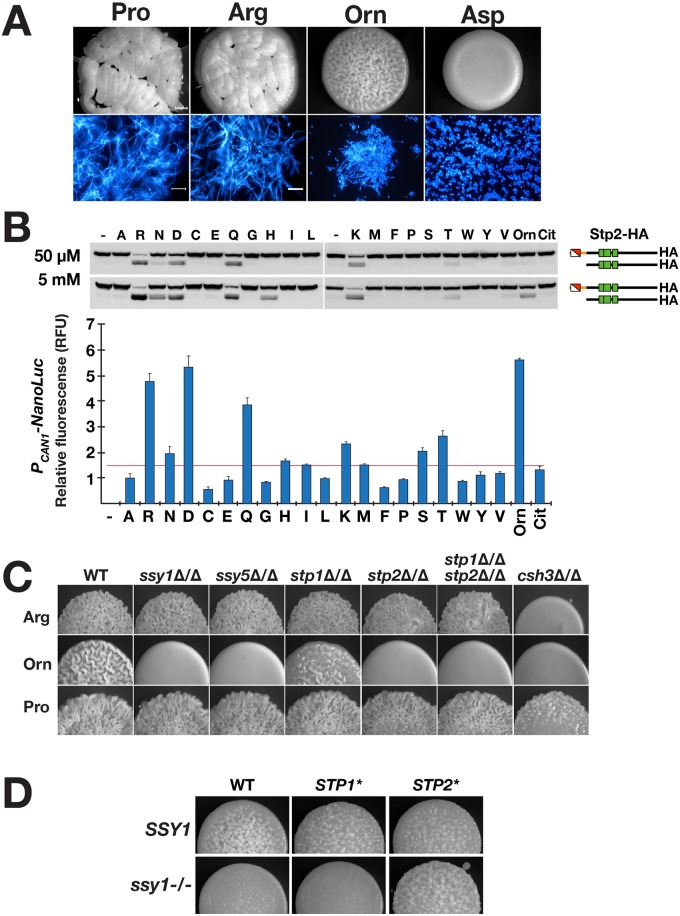
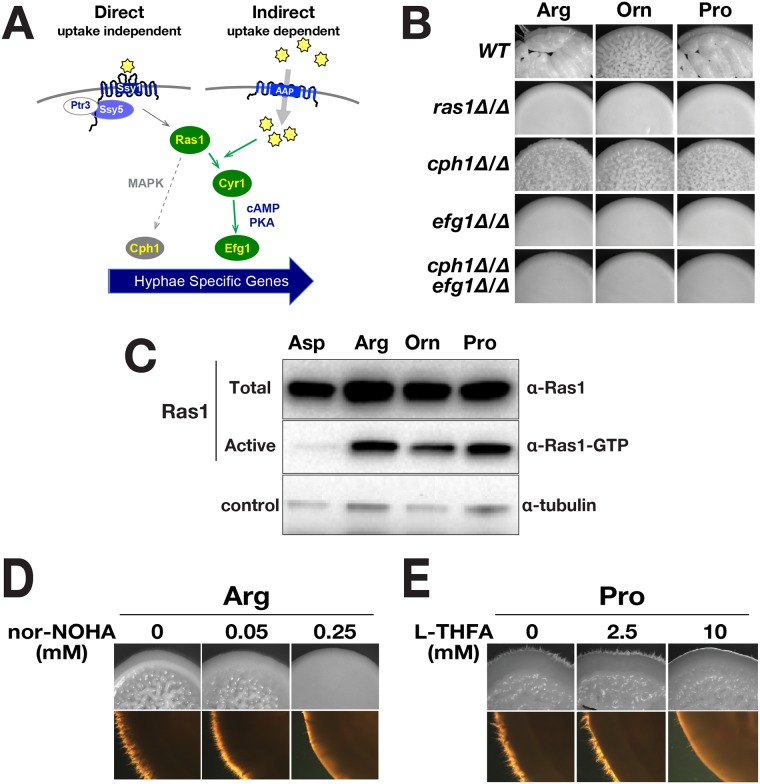
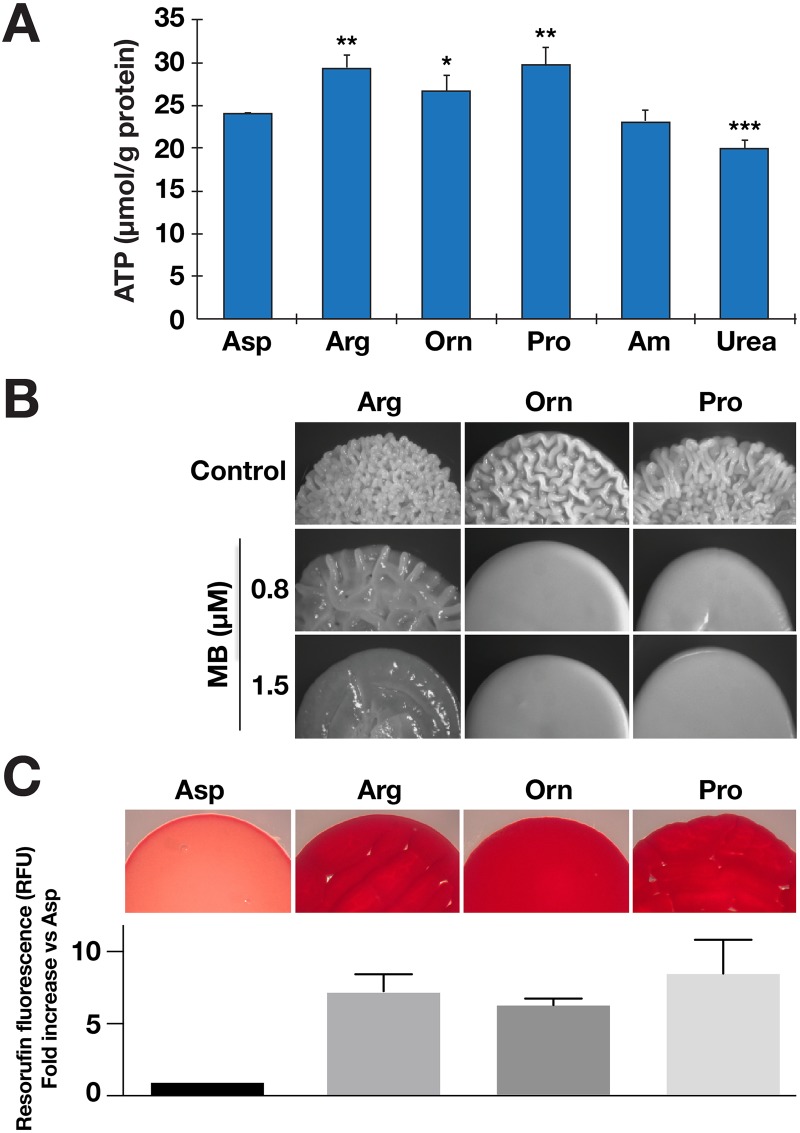
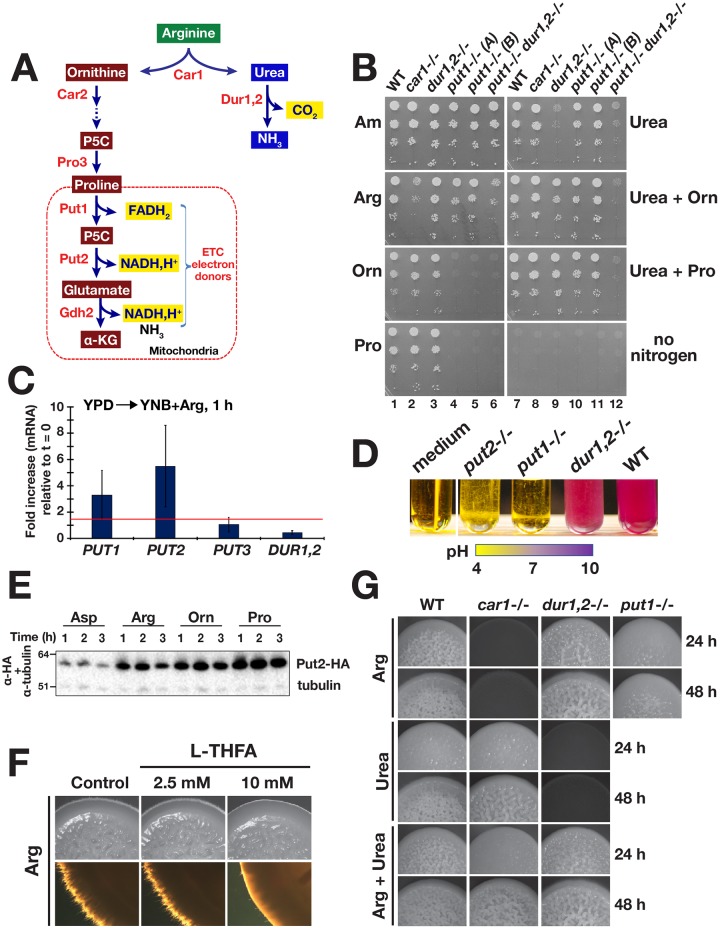
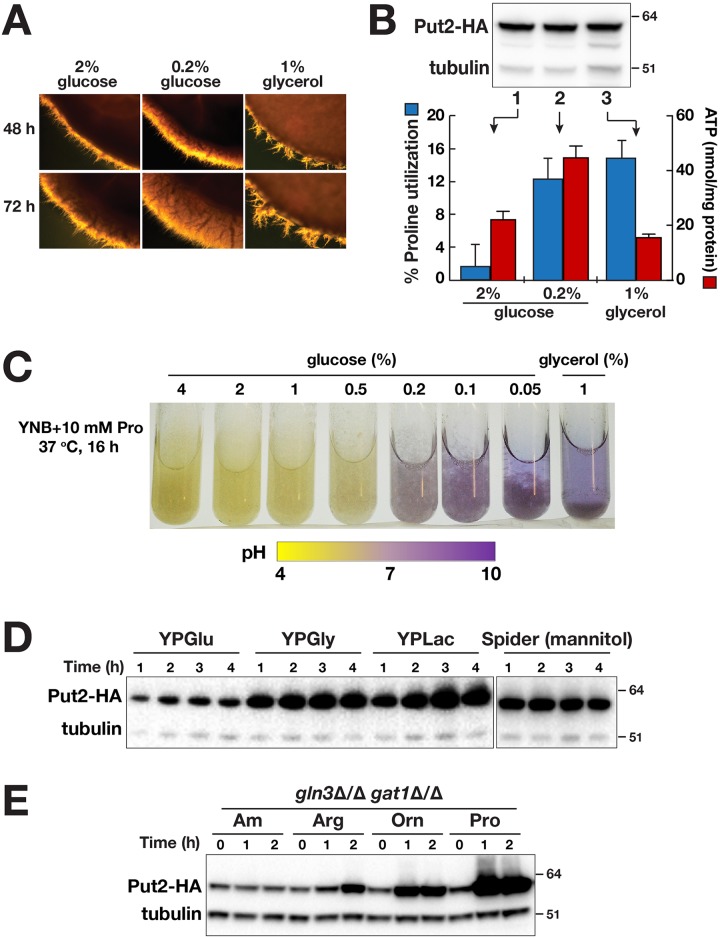
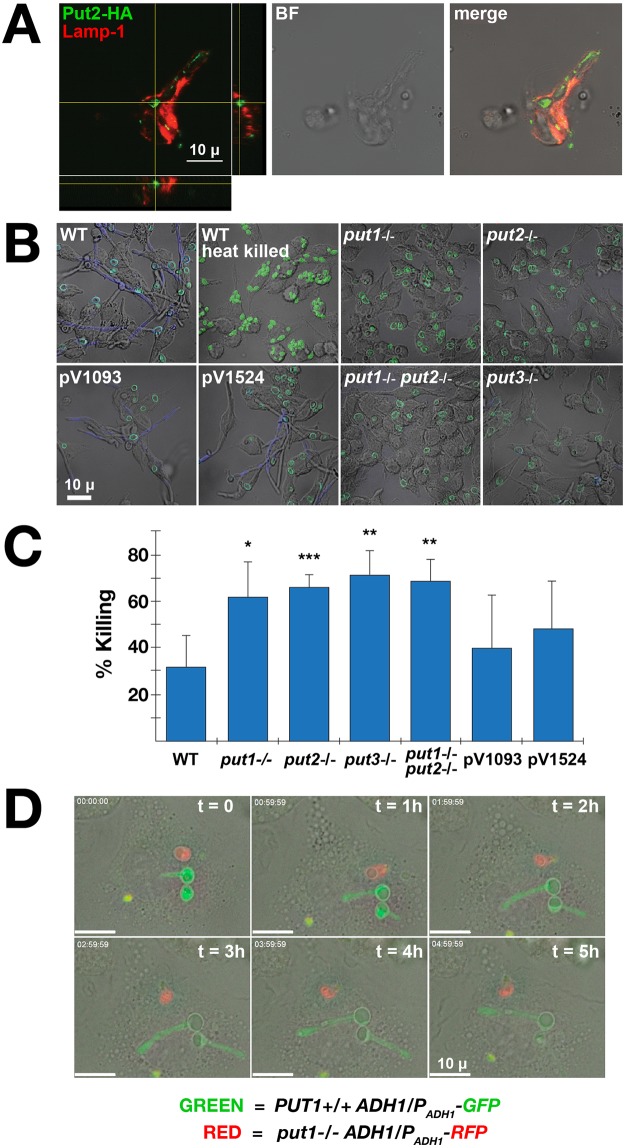
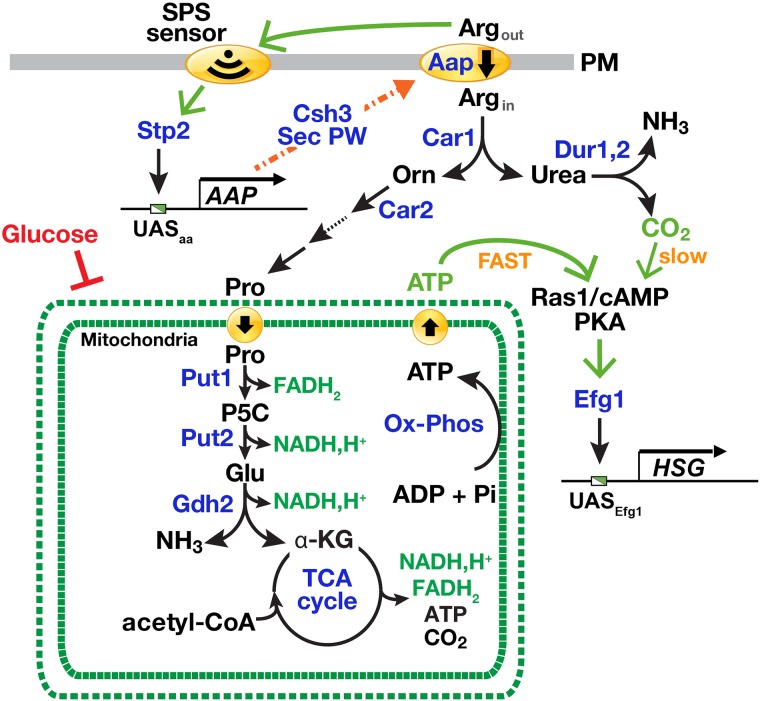
Abstract Amino acids are among the earliest identified inducers of yeast-to-hyphal transitions in Candida albicans , an opportunistic fungal pathogen of humans. Here, we show that the morphogenic amino acids arginine, ornithine and proline are internalized and metabolized in mitochondria via a PUT1 - and PUT2 -dependent pathway that results in enhanced ATP production. Elevated ATP levels correlate with Ras1/cAMP/PKA pathway activation and Efg1-induced gene expression. The magnitude of amino acid-induced filamentation is linked to glucose availability; high levels of glucose repress mitochondrial function thereby dampening filamentation. Furthermore, arginine-induced morphogenesis occurs more rapidly and independently of Dur1,2-catalyzed urea degradation, indicating that mitochondrial-generated ATP, not CO 2 , is the primary morphogenic signal derived from arginine metabolism. The important role of the SPS-sensor of extracellular amino acids in morphogenesis is the consequence of induced amino acid permease gene expression, i.e., SPS-sensor activation enhances the capacity of cells to take up morphogenic amino acids, a requisite for their catabolism. C. albicans cells engulfed by murine macrophages filament, resulting in macrophage lysis. Phagocytosed put1-/- and put2 -/- cells do not filament and do not lyse macrophages, consistent with a critical role of mitochondrial proline metabolism in virulence.
Overview
The claims and statistics of this paper haven’t been checked yet.
Free: it reads the open-access text and checks the first 5 claims that cite a source we can check. Create a free account to check every claim.
Integrity signals
Registry
Cites
Statistics
Figures
Verification
Claims the paper makes
The claims and statistics of this paper haven’t been checked yet.
Free: it reads the open-access text and checks the first 5 claims that cite a source we can check. Create a free account to check every claim.
Claims other papers make about this one
Each is checked against this paper’s own text: does it say what the citing paper says it does?
The source backs part of the claim, not all of it — or backs it for a different population, condition or comparison.
In the citing paper
“Proline dehydrogenase (Put1) and ∆1-pyrroline-5-carboxylate dehydrogenase (Put2), localized in mitochondria, are two key enzymes essential for amino acid catabolism in C. albicans to produce NH3 to alkalinize environment [32,33].”
From The F 1 F o -ATP synthase α subunit of Candida albicans induces inflammatory responses by controlling amino acid catabolism (2023) · cites this paper as [33]
Experimental — accuracy not yet measuredThe source backs part of the claim, not all of it — or backs it for a different population, condition or comparison.
In the citing paper
“Put1 and Put2 are two essential enzymes in amino acid catabolism in C. albicans to alkalinize environment [33].”
From The F 1 F o -ATP synthase α subunit of Candida albicans induces inflammatory responses by controlling amino acid catabolism (2023) · cites this paper as [33]
Experimental — accuracy not yet measuredThe source backs part of the claim, not all of it — or backs it for a different population, condition or comparison.
In the citing paper
“Mitochondrial proline dehydrogenase (Put1) and ∆1-pyrroline-5-carboxylate dehydrogenase (Put2) are two essential enzymes of amino acid catabolism and their deletion dramatically prevents C. albicans from alkalizing environment [33].”
From The F 1 F o -ATP synthase α subunit of Candida albicans induces inflammatory responses by controlling amino acid catabolism (2023) · cites this paper as [33]
Experimental — accuracy not yet measured
Self-check
Percentages, sums and reported differences re-computed from the paper’s own numbers.
The self-check needs the paper’s full text.
Citations
Cites
QUAST: quality assessment tool for genome assemblies
Gurevich, A., Saveliev, V., Vyahhi, N., & Tesler, G. (2013) · Bioinformatics · doi:10.1093/bioinformatics/btt086 · Cited by 11,172
Nonfilamentous C. albicans Mutants Are Avirulent
Lo, H.-J., Köhler, J. R., DiDomenico, B., Loebenberg, D., Cacciapuoti, A., & Fink, G. R. (1997) · Cell · doi:10.1016/s0092-8674(00)80358-x · Cited by 1,809
Engineered Luciferase Reporter from a Deep Sea Shrimp Utilizing a Novel Imidazopyrazinone Substrate
Hall, M. P., Unch, J., Binkowski, B. F., Valley, M. P., Butler, B. L., Wood, M. G., Otto, P., Zimmerman, K., Vidugiris, G., Machleidt, T., et al. (2012) · ACS Chemical Biology · doi:10.1021/cb3002478 · Cited by 1,598
Assembling Single-Cell Genomes and Mini-Metagenomes From Chimeric MDA Products
Nurk, S., Bankevich, A., Antipov, D., Gurevich, A. A., Korobeynikov, A., Lapidus, A., Prjibelski, A. D., Pyshkin, A., Sirotkin, A., Sirotkin, Y., et al. (2013) · Journal of Computational Biology · doi:10.1089/cmb.2013.0084 · Cited by 1,327
Kullberg, B. J., & Arendrup, M. C. (2015) · New England Journal of Medicine · doi:10.1056/nejmra1315399 · Cited by 1,315 · cited 1×
“Immunosuppression, or microbial dysbiosis, can predispose an 42 individual to infection, enabling this fungus to initiate and develop a spectrum of pathologies, 43 including superficial mucocutaneous or even life-threatening invasive infections [1, 2].”
BackgroundYeast Carbon Catabolite Repression
Gancedo, J. M. (1998) · Microbiology and Molecular Biology Reviews · doi:10.1128/mmbr.62.2.334-361.1998 · Cited by 1,273
Growth of Candida albicans hyphae
Sudbery, P. E. (2011) · Nature Reviews Microbiology · doi:10.1038/nrmicro2636 · Cited by 1,110
Bone Marrow-Derived Macrophages (BMM): Isolation and Applications
Weischenfeldt, J., & Porse, B. (2008) · Cold Spring Harbor Protocols · doi:10.1101/pdb.prot5080 · Cited by 955
The distinct morphogenic states of Candida albicans
Sudbery, P., Gow, N., & Berman, J. (2004) · Trends in Microbiology · doi:10.1016/j.tim.2004.05.008 · Cited by 876
Pyruvate Metabolism inSaccharomyces cerevisiae
PRONK, J. T., YDE STEENSMA, H., & VAN DIJKEN, J. P. (1996) · Yeast · doi:10.1002/(sici)1097-0061(199612)12:16<1607::aid-yea70>3.0.co;2-4 · Cited by 792
Cited by
Candida albicans and Candida glabrata : global priority pathogens
Katsipoulaki, M., Stappers, M. H. T., Malavia-Jones, D., Brunke, S., Hube, B., & Gow, N. A. R. (2024) · Microbiology and Molecular Biology Reviews · doi:10.1128/mmbr.00021-23 · Cited by 180
From Jekyll to Hyde: The Yeast–Hyphal Transition of Candida albicans
Chow, E. W. L., Pang, L. M., & Wang, Y. (2021) · Pathogens · doi:10.3390/pathogens10070859 · Cited by 178
The Multifaceted Roles of Proline in Cell Behavior
Patriarca, E. J., Cermola, F., D’Aniello, C., Fico, A., Guardiola, O., Cesare, D. D., & Minchiotti, G. (2021) · Frontiers in Cell and Developmental Biology · doi:10.3389/fcell.2021.728576 · Cited by 153
Arginine metabolism in myeloid cells in health and disease
Karadima, E., Chavakis, T., & Alexaki, V. I. (2025) · Seminars in Immunopathology · doi:10.1007/s00281-025-01038-9 · Cited by 97
“Finally, proline catabolism in Candida albicans cells was shown to be essential for its hyphal growth in phagosomes of engulfing macrophages, a process that C. albicans uses to escape killing by macrophages [111].”
Jin, X., Zhang, M., Lu, J., Duan, X., Chen, J., Liu, Y., Chang, W., & Lou, H. (2021) · Journal of Advanced Research · doi:10.1016/j.jare.2021.06.016 · Cited by 75
Chen, Y., Sun, R., Sun, T., Chen, P., Yu, Z., Ding, L., Jiang, Y., Wang, X., Dai, C., & Sun, B. (2020) · Soil Biology and Biochemistry · doi:10.1016/j.soilbio.2020.107900 · Cited by 81
Role of Amino Acid Metabolism in the Virulence of Human Pathogenic Fungi
Garbe, E., & Vylkova, S. (2019) · Current Clinical Microbiology Reports · doi:10.1007/s40588-019-00124-5 · Cited by 59
König, A., Hube, B., & Kasper, L. (2020) · Toxins · doi:10.3390/toxins12080469 · Cited by 49
Austermeier, S., Kasper, L., Westman, J., & Gresnigt, M. S. (2020) · Current Opinion in Microbiology · doi:10.1016/j.mib.2020.05.007 · Cited by 55
Land-use-driven change in soil labile carbon affects microbial community composition and function
Zhang, H., Fang, Y., Zhang, B., Luo, Y., Yi, X., Wu, J., Chen, Y., Sarker, T. C., Cai, Y., & Chang, S. X. (2022) · Geoderma · doi:10.1016/j.geoderma.2022.116056 · Cited by 57
Mirhakkak, M. H., Schäuble, S., Klassert, T. E., Brunke, S., Brandt, P., Loos, D., Vazquez-Uribe, R., Lino, F. S. D. O., Ni, Y., Vylkova, S., et al. (2020) · The ISME Journal · doi:10.1038/s41396-020-00848-z · Cited by 57
The potential of respiration inhibition as a new approach to combat human fungal pathogens
Duvenage, L., Munro, C. A., & Gourlay, C. W. (2019) · Current Genetics · doi:10.1007/s00294-019-01001-w · Cited by 52
CRISPR-Based Genetic Manipulation of Candida Species: Historical Perspectives and Current Approaches
Uthayakumar, D., Sharma, J., Wensing, L. F., & Shapiro, R. S. (2021) · Frontiers in Genome Editing · doi:10.3389/fgeed.2020.606281 · Cited by 57
“albicans, screening mutants has identified genes and pathways involved in filamentation (Vyas et al., 2015; Hollomon et al., 2016; Mendelsohn et al., 2017; Naseem et al., 2017; Veri et al., 2018; Lu et al., 2019; Rai et al., 2019; Silao et al., 2019; Xie et al., 2020) and biofilm formation, (Huang M.”
BackgroundUnique, Diverged, and Conserved Mitochondrial Functions Influencing Candida albicans Respiration
Sun, N., Parrish, R. S., Calderone, R. A., & Fonzi, W. A. (2019) · mBio · doi:10.1128/mbio.00300-19 · Cited by 51
Black, B., Lee, C., Horianopoulos, L. C., Jung, W. H., & Kronstad, J. W. (2021) · PLOS Pathogens · doi:10.1371/journal.ppat.1009661 · Cited by 51
Recent advances in understanding Candida albicans hyphal growth
Arkowitz, R. A., & Bassilana, M. (2019) · F1000Research · doi:10.12688/f1000research.18546.1 · Cited by 51
Song, J., Zhou, J., Zhang, L., & Li, R. (2020) · Microorganisms · doi:10.3390/microorganisms8101574 · Cited by 51
“albicans to switch from yeast cells to mycelium growth [20,64,65].”
BackgroundAmino Acid Sensing and Assimilation by the Fungal Pathogen Candida albicans in the Human Host
Silao, F. G. S., & Ljungdahl, P. O. (2021) · Pathogens · doi:10.3390/pathogens11010005 · Cited by 40
“Cytosolic proline (Procyto), derived from uptake, biosynthetic reactions or from the catabolism of arginine or ornithine [59], is imported into the mitochondria (Promito) via a still-unidentified mitochondrial transporter.”
BackgroundInfluentialSelf-citationTian, F., Lee, S. Y., Woo, S. Y., & Chun, H. S. (2020) · Frontiers in Microbiology · doi:10.3389/fmicb.2020.00419 · Cited by 40
Mechanisms for Induction of Microbial Extracellular Proteases in Response to Exterior Proteins
Zhang, Y., Zhang, W., & Chen, X. (2020) · Applied and Environmental Microbiology · doi:10.1128/aem.01036-20 · Cited by 43
“So far, although the specificity of amino acids that efficiently activate the SPS sensor and subsequently CaStp2 processing to initiate amino acid uptake has been studied (39), the exact amino acid(s) and its concentrations that the SPS sensor senses to activate CaStp1 processing and initiate ex-protease gene expressi…”
Background“Under Pressure” – How fungi evade, exploit, and modulate cells of the innate immune system
Lange, T., Kasper, L., Gresnigt, M. S., Brunke, S., & Hube, B. (2023) · Seminars in Immunology · doi:10.1016/j.smim.2023.101738 · Cited by 36
Silao, F. G. S., Ryman, K., Jiang, T., Ward, M., Hansmann, N., Molenaar, C., Liu, N.-N., Chen, C., & Ljungdahl, P. O. (2020) · PLOS Pathogens · doi:10.1371/journal.ppat.1008328 · Cited by 32
“The proline catabolic pathway is the 117 primary route of arginine utilization (15) and operates independently of the cytosolic 118 Dur1,2-catalyzed urea-CO2 pathway (15, 16).”
BackgroundResultInfluentialSelf-citationLiang, X., Chen, D., Wang, J., Liao, B., Shen, J., Ye, X., Wang, Z., Zhu, C., Gou, L., Zhou, X., et al. (2023) · International Journal of Oral Science · doi:10.1038/s41368-023-00245-0 · Cited by 32
“ATP and cAMP are critical signaling molecules to activate this pathway.(29,32,40) In this study, we for the first time found themechanism of artemisinins on C.”
BackgroundSchaefer, K., Wagener, J., Ames, R. M., Christou, S., MacCallum, D. M., Bates, S., & Gow, N. A. R. (2020) · mBio · doi:10.1128/mbio.01845-20 · Cited by 34
“A mutation of the urea amidolyase gene (DUR1,2), which functions downstream of arginase and hydrolyses urea to NH3 and CO2, has been found to be defective in arginine-induced hypha formation (34).”
BackgroundInfluentialWang, Q., Verma, J., Vidan, N., Wang, Y., Tucey, T. M., Lo, T. L., Harrison, P. F., See, M., Swaminathan, A., Kuchler, K., et al. (2020) · Cell Reports · doi:10.1016/j.celrep.2020.107528 · Cited by 31
“, 2018) and drive the cell biology that dictates commensal and virulent states, including gut colonization, biofilm formation, cell wall structure, and the morphological switch from yeast to hyphal cells (Ene et al., 2012; Grahl et al., 2015; Koch et al., 2018; Lindsay et al., 2014; Morales et al., 2013; Pérez et al.,…”
BackgroundIntraspecies Transcriptional Profiling Reveals Key Regulators of Candida albicans Pathogenic Traits
Wang, J. M., Woodruff, A. L., Dunn, M. J., Fillinger, R. J., Bennett, R. J., & Anderson, M. Z. (2021) · mBio · doi:10.1128/mbio.00586-21 · Cited by 25
Liboro, K., Yu, S.-R., Lim, J., So, Y.-S., Bahn, Y., Eoh, H., & Park, H. (2021) · Frontiers in Cellular and Infection Microbiology · doi:10.3389/fcimb.2021.636834 · Cited by 25
“PKA activates the transcriptional regulator Efg1p, which regulates white-opaque switching and hyphae formation (Grahl et al., 2015; Silao et al., 2019).”
BackgroundProline catabolism is a key factor facilitating Candida albicans pathogenicity
Silao, F. G. S., Jiang, T., Bereczky-Veress, B., Kühbacher, A., Ryman, K., Uwamohoro, N., Jenull, S., Nogueira, F., Ward, M., Lion, T., et al. (2023) · PLoS Pathogens · doi:10.1371/journal.ppat.1011677 · Cited by 24
“In C . albicans PRODH and P5CDH are encoded by PUT1 (C5_02600W) and PUT2 (C5_04880C), respectively [10].”
BackgroundResultInfluentialSelf-citationZheng, Y., Cabassa, C., Eubel, H., Chevreux, G., Lignières, L., Crilat, E., Braun, H., Lebreton, S., & Savouré, A. (2023) · Journal of Experimental Botany · doi:10.1093/jxb/erad406 · Cited by 20
Impaired amino acid uptake leads to global metabolic imbalance of Candida albicans biofilms
Böttcher, B., Driesch, D., Krüger, T., Garbe, E., Gerwien, F., Kniemeyer, O., Brakhage, A. A., & Vylkova, S. (2022) · npj Biofilms and Microbiomes · doi:10.1038/s41522-022-00341-9 · Cited by 22
Zheng, Y., Cabassa, C., Planchais, S., Crilat, E., Clément, G., Dacher, M., Durand, N., Bordenave, M., Guivarc’h, A., Dourmap, C., et al. (2022) · Plant Cell & Environment · doi:10.1111/pce.14529 · Cited by 19
Wu, Y., Sun, A., Chen, F., Zhao, Y., Zhu, X., Zhang, T., Ni, G., & Wang, R. (2024) · Bioorganic Chemistry · doi:10.1016/j.bioorg.2024.107293 · Cited by 19
Jenull, S., Mair, T., Tscherner, M., Penninger, P., Zwolanek, F., Silao, F. G. S., Vicente, K. M. D. S., Riedelberger, M., Bandari, N. C., Shivarathri, R., et al. (2021) · Cell Reports · doi:10.1016/j.celrep.2021.109406 · Cited by 20
“Stp1 processing was confirmed by treating cultures with arginine and proline to trigger or not the SPS sensor, respectively (Silao et al., 2019) (Figure S4G).”
Self-citationRen, G., Zhang, X., Xin, X., Li, M., Wang, M., Yang, W., Zhong, X., & Zhu, A. (2023) · The Science of The Total Environment · doi:10.1016/j.scitotenv.2023.168397 · Cited by 20
Integrative functional analysis uncovers metabolic differences between Candida species
Begum, N., Lee, S., Portlock, T., Pellón, A., Nasab, S. D. S., Nielsen, J., Uhlén, M., Moyes, D. L., & Shoaie, S. (2022) · Communications Biology · doi:10.1038/s42003-022-03955-z · Cited by 21
Al-Askar, A. A., Ghoneem, K. M., Hafez, E. E., & Saber, W. I. A. (2022) · Plants · doi:10.3390/plants11060829 · Cited by 17
Pick, E. (2020) · Redox Biology · doi:10.1016/j.redox.2020.101765 · Cited by 17
SWL-1 Reverses Fluconazole Resistance in Candida albicans by Regulating the Glycolytic Pathway
Li, X.-N., Zhang, L., Wang, Y., Zhang, Y., Jin, Z., Li, J., Wang, R., & Xiao, W. (2020) · Frontiers in Microbiology · doi:10.3389/fmicb.2020.572608 · Cited by 17
GNP2 Encodes a High-Specificity Proline Permease in Candida albicans
Garbe, E., Miramón, P., Gerwien, F., Ueberschaar, N., Hansske-Braun, L., Brandt, P., Böttcher, B., Lorenz, M. C., & Vylkova, S. (2022) · mBio · doi:10.1128/mbio.03142-21 · Cited by 18
“This metabolic pathway was shown to be directly connected to fungal survival upon macrophage phagocytosis, as mutants defective in proline catabolism were impaired in intraphagosomal filamentation and macrophage survival (28).”
BackgroundInfluentialBöttcher, B., Hoffmann, B., Garbe, E., Weise, T., Cseresnyés, Z., Brandt, P., Dietrich, S., Driesch, D., Figge, M. T., & Vylkova, S. (2020) · Frontiers in Microbiology · doi:10.3389/fmicb.2020.00794 · Cited by 18
Garbe, E., Gerwien, F., Driesch, D., Müller, T., Böttcher, B., Gräler, M. H., & Vylkova, S. (2022) · mSystems · doi:10.1128/msystems.00539-22 · Cited by 17
Exploring the druggable proteome of Candida species through comprehensive computational analysis
Mukherjee, S., Kundu, I., Askari, M., Barai, R. S., Venkatesh, K. V., & Idicula‐Thomas, S. (2021) · Genomics · doi:10.1016/j.ygeno.2020.12.040 · Cited by 15
“Nutrient–fungi–host” tripartite interaction in cancer progression
Wu, D., Guan, Y., Li, C., Zheng, Q., Yin, Z., Wang, H., & Liu, N. (2024) · iMeta · doi:10.1002/imt2.170 · Cited by 15
Sato, T., Hoshida, H., & Akada, R. (2020) · BioMed Research International · doi:10.1155/2020/7245782 · Cited by 13
“Moreover, it was reported that arginine induced hyphal formation along with proline [18]; other studies demonstrated that alanine, arginine, histidine, isoleucine, and lysine induced hyphal formation [16, 17]; however, these amino acids did not show hyphal formation in our simple condition.”
BackgroundWilson, H. B., & Lorenz, M. C. (2023) · Infection and Immunity · doi:10.1128/iai.00087-23 · Cited by 14
“an important source of ATP during phagocyte interactions (40).”
BackgroundInfluentialZeng, G., Xu, X., Kok, Y. J., Deng, F.-S., Chow, E. W. L., Gao, J., Bi, X., & Wang, Y. (2023) · Cell Reports · doi:10.1016/j.celrep.2023.113473 · Cited by 14
Vicencio, J., & Cerón, J. (2021) · The CRISPR Journal · doi:10.1089/crispr.2020.0103 · Cited by 17
“…¢ GG motif immediately before the PAM to increase the frequency of genome editing have been adapted to and/or confirmed in other organisms such as fungi, including various Candida species, 69–71 plants such as Arabidopsis 72–74 and Solanum , 75 Drosophila 76,77 and other non-model flies, 78 and mice.”
Tuan, D. A., & Masák, J. (2026) · Current Microbiology · doi:10.1007/s00284-025-04713-0 · Cited by 10
Santiago, K. A. A., Wong, W. C., Goh, Y. K., Tey, S. H., & Ting, A. S. Y. (2024) · Scientific Reports · doi:10.1038/s41598-024-56129-8 · Cited by 10
“These amino acids are involved in fungal growth and pathogenicity as well as nitrogen metabolism and protein synthesis in fungi 34,35 .”
BackgroundLuther, C. H., Brandt, P., Vylkova, S., Dandekar, T., Müller, T., & Dittrich, M. T. (2023) · Frontiers in Cellular and Infection Microbiology · doi:10.3389/fcimb.2023.1108235 · Cited by 10
“Since in this arginine catabolic pathway glutamate is used to fuel the TCA cycle (Silao et al., 2019), the sky2D strain seems to allocate glutamate for the generation of ornithine and arginine and instead of NADPH and ADP production.”
BackgroundHost albumin redirects Candida albicans metabolism to engage an alternative pathogenicity pathway
Hitzler, S. U. J., Fernández-Fernández, C., Günther, K., Dietschmann, A., Hovhannisyan, H., Möslinger, A., Austermeier, S., Cristóvão, B., Vascelli, G., Zelante, T., et al. (2025) · Nature Communications · doi:10.1038/s41467-025-61701-5 · Cited by 10
“In line with this, several amino acids have been shown to drive TCA-cycle activity 55,56 .”
Rupert, C. B., & Rusché, L. N. (2022) · mSphere · doi:10.1128/msphere.00029-22 · Cited by 10
Cortacans, M., Arch, M., Fuentes, E., & Cardona, P.-J. (2024) · Frontiers in Immunology · doi:10.3389/fimmu.2024.1474516 · Cited by 9
Research progress on the function and regulatory pathways of amino acid permeases in fungi
Yang, Y., Li, Y., & Zhu, J. K. (2024) · World Journal of Microbiology and Biotechnology · doi:10.1007/s11274-024-04199-1 · Cited by 10
“Extracellular methionine can activate is of significant importance, providing a theoretical foundation for the development of antifungal drugs. induce filamentation, which is key for it to evade killing and promote its survival (Silao et al. 2019; Garbe et al. 2022 ).”
Kumar, R., Maulik, M., Pathirana, R. U., Cullen, P. J., & Edgerton, M. (2020) · mSphere · doi:10.1128/msphere.00366-20 · Cited by 11
“reduce the transcription of genes controlling functions such as filamentation (32, 45).”
BackgroundAlternative Oxidase – Aid or obstacle to combat the rise of fungal pathogens?
Edrich, E. S. M., Duvenage, L., & Gourlay, C. W. (2024) · Biochimica et Biophysica Acta (BBA) - Bioenergetics · doi:10.1016/j.bbabio.2024.149031 · Cited by 13
Li, L., Adamson, C., Ng, E. W. L., & Qiao, Y. (2025) · Nature Communications · doi:10.1038/s41467-025-62097-y · Cited by 7
Diverse mechanisms control amino acid‐dependent environmental alkalization by Candida albicans
Silao, F. G. S., Valeriano, V. D., Uddström, E., Falconer, E., & Ljungdahl, P. O. (2024) · Molecular Microbiology · doi:10.1111/mmi.15216 · Cited by 10
“The PUT3 vector (pFS084), RT (p2/p3), and verification primers (p4/p5) were previously described (Silao et al., 2019).”
BackgroundMethodResultInfluentialSelf-citationEl-Sayed, H., Osman, M., Abdelsalam, A., Boroujerdi, A. F. B., Sonbol, H. S., & Elsaba, Y. M. (2022) · Journal of Fungi · doi:10.3390/jof8111149 · Cited by 6
“Arginine, proline, and ornithine are essential for yeast-to-hyphal conversions in the human pathogen Candida albicans [37].”
BackgroundYang, Z., Lin, J., Chen, X., Xing, X., Yang, H., & Wang, Z. (2025) · Veterinary Sciences · doi:10.3390/vetsci12070630 · Cited by 5
“…is prioritized for protein synthesis over oxidation due to disulfide bond formation [29]; proline‘s unique mitochondrial catabolism less tightly coupled to glucose availability [30]; and histidine/arginine are reserved for signaling molecule synthesis (e.g., histamine, nitric oxide) [31–33].”
Editing Candida: Origins and Advances of CRISPR Tools
Schulze, A., Kainz, K., Bauer, M. A., & Carmona‐Gutiérrez, D. (2026) · Biomolecules · doi:10.3390/biom16020245 · Cited by 4
Zhao, Y., Zou, W., Su, C., & Lu, Y. (2026) · iFungi · doi:10.26599/ifungi.2026.9670011 · Cited by 4
Surviving the Storm: How Candida Species Master Adaptation for Pathogenesis
Rana, A., Gupta, N., Asif, S., & Thakur, A. (2024) · Springer eBooks · doi:10.1007/978-981-97-4909-6_5 · Cited by 5
Wang, Y., Feng, C., Xing, Y., Hu, Q., Li, X., Bao, J., & Jiang, H. (2024) · Aquaculture · doi:10.1016/j.aquaculture.2024.741921 · Cited by 4
Ring, A., Martins, A., & Ljungdahl, P. O. (2019) · Traffic · doi:10.1111/tra.12681 · Cited by 4
Self-citationLi, S., Liu, Y., Weng, L., Zhao, Y., Zhang, Y., Zhang, Z., Yang, Y., Chen, Q., Liu, X., & Zhang, H. (2023) · Virulence · doi:10.1080/21505594.2023.2190645 · Cited by 3
“RT-qPCR indicated that the mRNA expressions of encoding-genes of important proteins Cyr1 [30,33] and Tpk2 [30] in the cAMP/PKA pathway, the core signalling pathway regulating filamentation in C. albicans [30], and the transcription factors Efg1 and Flo8 [30,33], located in the downstream of this pathway, were all nota…”
BackgroundResultInfluentialSadaf, A., Brock, M., & Perry, C. C. (2024) · Fungal Biology · doi:10.1016/j.funbio.2024.05.010 · Cited by 3
Stevens, I., Silao, F. G. S., Huch, S., Liu, H., Ryman, K., Carvajal-Jimenez, A., Ljungdahl, P. O., & Pelechano, V. (2024) · Scientific Reports · doi:10.1038/s41598-024-80435-w · Cited by 3
Self-citationHu, S., Buser, E., Arredondo, J., Relyea, D., Rocha, C. S., & Dandekar, S. (2022) · Frontiers in Microbiology · doi:10.3389/fmicb.2022.879152 · Cited by 3
High Resolution Respirometry in Candida albicans
Duvenage, L., Munro, C. A., & Gourlay, C. W. (2019) · BIO-PROTOCOL · doi:10.21769/bioprotoc.3361 · Cited by 3
Scott, J., & Amich, J. (2021) · Elsevier eBooks · doi:10.1016/b978-0-12-818731-9.00059-8 · Cited by 5
Silao, F. G. S., Ryman, K., Jiang, T., Ward, M., Hansmann, N., Molenaar, C., Liu, N., Chen, C., & Ljungdahl, P. O. (2021) · PLoS Pathogens · doi:10.1371/journal.ppat.1009877 · Cited by 3
“These time-lapse images provide qualitative, yet strong evidence that Gdh2 and Put2 expression is induced upon macrophage engulfment; the Put2 result is consistent to our previous data obtained by immunocytochemistry using Put2-HA construct [8].”
BackgroundResultSelf-citationCandida albicans PPR proteins are required for the expression of respiratory Complex I subunits
Wenda, J. M., Drzewicka, K., Mulica, P., Tetaud, E., di Rago, J. P., Golik, P., & Łabędzka-Dmoch, K. (2024) · GENETICS · doi:10.1093/genetics/iyae124 · Cited by 2
“Generally it is considered a Crabtree-negative organism, although a recent study suggests that in particular cases glucose may suppress respiratory metabolism (Silao et al .”
Boronic acid derivatives inhibit Candida albicans growth by compromising energy metabolism
Wu, S., Mayandi, V., Goh, E. T. L., Wang, W., Han, N., Zhong, R., Luo, Z., Wang, Y., Chen, M., Lakshminarayanan, R., et al. (2025) · Journal of Advanced Research · doi:10.1016/j.jare.2025.07.044 · Cited by 3
“Mitochondria not only provide the energy required for hyphal growth and differentiation but also participate in intracellular signaling, affecting hyphal growth and differentiation [21,50,51].”
Tang, J., Liu, Y., Lai, F., Zhou, Y., Zhang, H., Ni, B., & Lv, W. (2026) · Journal of environmental chemical engineering · doi:10.1016/j.jece.2026.121504 · Cited by 1
VdEGe1, a cell wall-degrading enzyme gene from Verticillium dahliae required for cotton pathogenesis
Li, Y., Yuan, R., Li, Y., Sun, T., Wei, Y., Yang, Q., Liu, F., Zhang, X., Li, Y., & Sun, J. (2026) · BMC Microbiology · doi:10.1186/s12866-026-04977-x · Cited by 1
Hu, X., Deng, X., Huang, Z., He, W., Hu, L., Wu, G., Zhou, X., & Chen, H. L. (2026) · Food Microbiology · doi:10.1016/j.fm.2026.105098 · Cited by 1
Patiño-Medina, J. A., Camacho, E., & Casadevall, A. (2026) · bioRxiv (Cold Spring Harbor Laboratory) · doi:10.64898/2026.02.06.704083 · Cited by 1
Sriram, K. (2022) · FEBS Open Bio · doi:10.1002/2211-5463.13470 · Cited by 1
Li, L., Wang, H., Li, T., Wang, J., Jia, M., & Lv, L. (2024) · Microchemical Journal · doi:10.1016/j.microc.2024.112378
Wang, Z., & Lu, Y. (2025) · Research in Microbiology · doi:10.1016/j.resmic.2025.104322
Garbe, E., Schäuble, S., Böttcher, B., Jesse, R., Driesch, D., van Wijlick, L., Elshafee, O., Schille, T. B., Hube, B., Panagiotou, G., et al. (2025) · mSystems · doi:10.1128/msystems.00226-25 · Cited by 1
Poulsen, P., & Kielland‐Brandt, M. C. (2025) · G3 Genes Genomes Genetics · doi:10.1093/g3journal/jkaf312
“Remarkably, the preferences/specificities for amino acids are very different from those of S. cerevisiae (Martínez and Ljungdahl 2005; Silao et al. 2019).”
Mousa, H. R. F., Abiko, Y., Washio, J., Sato, S., & Takahashi, N. (2026) · Journal of Oral Microbiology · doi:10.1080/20002297.2026.2626130
“However, increasing evidence suggests that glucose actually inhibits the respiration of C. albicans , which shares some characteristics of Crabtree-positive yeasts [44,45].”
The Functional Genomic Assessment of Candida albicans Genes Involved in Morphogenesis
Farheen, A. (2024) · TSpace (University of Toronto)
Rana, A., Gangber, S. K., Tanwar, A., & Thakur, A. (2026) · bioRxiv (Cold Spring Harbor Laboratory) · doi:10.64898/2026.03.05.709770
Shi, Z., Lin, J., Zhang, W., Xie, Y., Li, W., Feng, C. H. E. N., Yue, Y. A. N. G., Wang, T., & Ma, K. (2026) · International Immunopharmacology · doi:10.1016/j.intimp.2026.116584
Assessment of the metabolome in genomically diverse Candida albicans isolates
Alaban, L. R. (2022) · theses.fr (ABES) · doi:10.70675/6127ebd7z2b67z4728z960dzdc64762b4c70
Mo, J., Hu, Y., Li, M., Yue, M., & Hu, Y. (2026) · Physiologia Plantarum · doi:10.1111/ppl.70896
Sun, Q., Huang, Z., He, W., Hu, L., Li, Y., Zhou, X., Chen, H., & Tao, S. (2026) · Food Research International · doi:10.1016/j.foodres.2026.119669
Sonnberger, J., Böhm, E., Tomás-Morales, J. A., Lange, T., Bagola, K., Denner, L., Kasper, L., Brunke, S., van Zandbergen, G., Sprague, J. L., et al. (2026) · Disease Models & Mechanisms · doi:10.1242/dmm.052865
“Commonly used systems include murine macrophage cell lines (Ghosh et al., 2009; O ’ Meara et al., 2018; Silao et al., 2019; Vylkova and Lorenz, 2017) or primary mouse cells (Ding et al., 2021; Kasper et al., 2018; Olivier et al., 2022), which are genetically tractable but limited by…”
Huang, H., Wei, L., Zheng, J., Xing, S., Tang, Y., Chen, S., Shen, K., Chen, J., & Sun, S. (2026) · Food Bioscience · doi:10.1016/j.fbio.2026.109718
From confrontation to co-adaptation: the dynamic dialogue of Candida albicans and macrophages
Miramón, P., Wilson, H. B., & Lorenz, M. C. (2026) · Microbiology and Molecular Biology Reviews · doi:10.1128/mmbr.00191-22
Carbon and nitrogen sources can fuel fungal virulence
Patiño-Medina, J. A., & Casadevall, A. (2026) · Infection and Immunity · doi:10.1128/iai.00460-26
Metadata
- Authors
- Silao, F. G. S., Ward, M., Ryman, K., Wallström, A., Brindefalk, B., Udekwu, K., & Ljungdahl, P. O.
- Affiliations
- Stockholm University (SE)
- Corresponding author
- Ljungdahl, Per O.
- ORCID
- Venue
- PLOS Genetics
- Publisher
- Public Library of Science (PLoS)
- Published
- 2019-02-11
- Volume
- 15
- Issue
- 2
- Pages
- e1007976
- ISSN
- 1553-7390 (ISSN-L)
- 1553-7404
- PMC
- PMC6386415
- OpenAlex
- W2950010168
- Cited by
- 93
- References
- 108
- Citations by year
- 2026: 14 · 2025: 8 · 2024: 14 · 2023: 10 · 2022: 12 · 2021: 14 · 2020: 15 · 2019: 6
- FWCI
- 3.87
- Type
- journal article
- Language
- en
- Update notices
- new_version (2019-02-22)
- Open access
- gold
- doi.org
- Licence
- Locations
- PLoS Genetics (publishedVersion, cc-by)
- bioRxiv (Cold Spring Harbor Laboratory) (acceptedVersion)
- Europe PMC (PubMed Central) (publishedVersion, cc-by)
- PubMed Central (publishedVersion, cc-by)
- PubMed (publishedVersion)
- DOAJ (DOAJ: Directory of Open Access Journals) (submittedVersion, cc-by-sa)
- Figshare (submittedVersion, cc-by)
- Funders
- Vetenskapsrådet (2015-04202)
- FP7 People: Marie-Curie Actions (MC-ITN-606786)
- Topics
- Life Sciences › Biochemistry, Genetics and Molecular Biology › Molecular Biology › Fungal and yeast genetics research
- Health Sciences › Medicine › Infectious Diseases › Antifungal resistance and susceptibility
- Health Sciences › Medicine › Infectious Diseases › Fungal Infections and Studies
- Keywords
- Candida albicans, yeast-to-hypha transition, arginine metabolism, ornithine metabolism, amino acid uptake, EFG1, amino acid permease, ATP production, macrophage phagocytosis, fungal virulence, immune evasion
- MeSH terms
- RAW 264.7 Cells, Cyclic AMP, Adenosine Triphosphate, Amino Acids, Animals, Candida albicans, Fungal Proteins, Humans, Macrophages, Mitochondria, Morphogenesis, Proline, Proline Oxidase, Virulence, Signal Transduction, Cyclic AMP-Dependent Protein Kinases, ras Proteins, Hyphae, Mice
About these checks
Registry, retraction, Cites and statistics results are computed, not judged, with one exception: a printed reference that no index lists is read once by a model before it counts as a citation error. Claims are extracted by a model and kept only when their quote appears verbatim in the text; each cited source is then checked, with a model’s help, for whether it says what the claim relies on. Those verdicts can be wrong — read the claim’s quote and the cited source before relying on one.
Statistics and arithmetic are recomputed, not judged.
Confidence bands are shown only for fields calibrated on our annotated test set. None is calibrated yet, so no band is shown.
What counts as a claim ›How we measure confidence ›How we check this ›
Are you an author, or do you see a problem with this page? Request a review
Data sources
Bibliographic data: Semantic Scholar, OpenAlex, Crossref.
Contains information from the Semantic Scholar Academic Graph Datasets, made available under the ODC Attribution License (ODC-BY 1.0).
Semantic Scholar’s data is described in: Kinney, R., et al. (2023). The Semantic Scholar Open Data Platform. arXiv:2301.10140.
