

eQTL Catalogue 2023: New datasets, X chromosome QTLs, and improved detection and visualisation of transcript-level QTLs
Open accessPublished version of a preprint
The DOI matches its Crossref record; 98 of the 98 references it cites were found in a registry or an index; none of the 30 sources its claims cite is checked for support yet.
Abstract
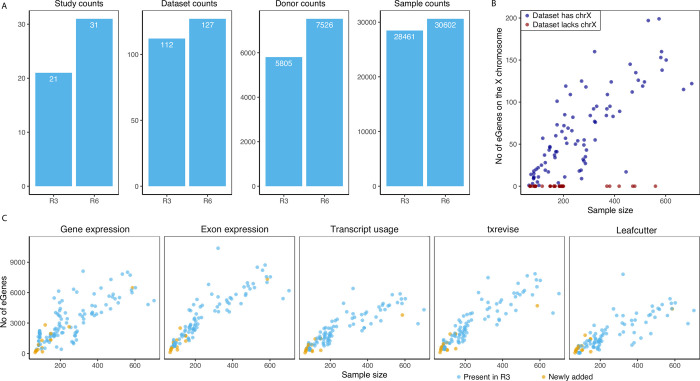
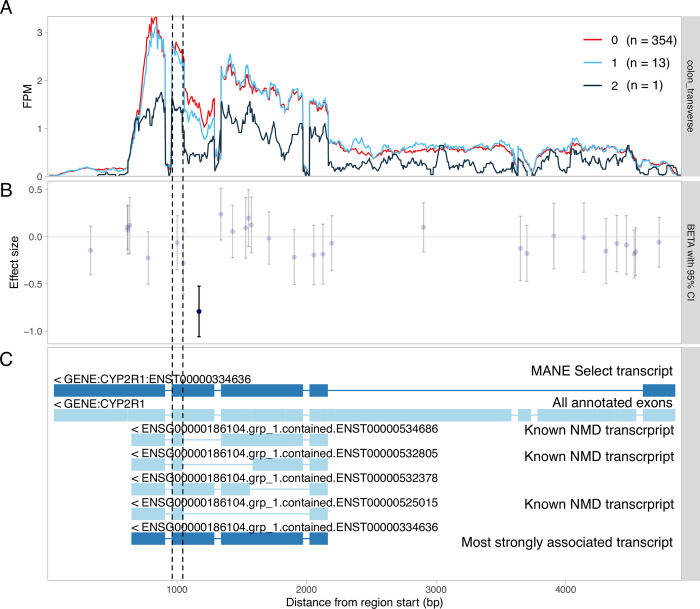
The eQTL Catalogue is an open database of uniformly processed human molecular quantitative trait loci (QTLs). We are continuously updating the resource to further increase its utility for interpreting genetic associations with complex traits. Over the past two years, we have increased the number of uniformly processed studies from 21 to 31 and added X chromosome QTLs for 19 compatible studies. We have also implemented Leafcutter to directly identify splice-junction usage QTLs in all RNA sequencing datasets. Finally, to improve the interpretability of transcript-level QTLs, we have developed static QTL coverage plots that visualise the association between the genotype and average RNA sequencing read coverage in the region for all 1.7 million fine mapped associations. To illustrate the utility of these updates to the eQTL Catalogue, we performed colocalisation analysis between vitamin D levels in the UK Biobank and all molecular QTLs in the eQTL Catalogue. Although most GWAS loci colocalised both with eQTLs and transcript-level QTLs, we found that visual inspection could sometimes be used to distinguish primary splicing QTLs from those that appear to be secondary consequences of large-effect gene expression QTLs. While these visually confirmed primary splicing QTLs explain just 6/53 of the colocalising signals, they are significantly less pleiotropic than eQTLs and identify a prioritised causal gene in 4/6 cases.
Overview
CoChat Summary
TL;DR
eQTL Catalogue release 6 expands the uniformly processed human molecular QTL resource to 31 studies, 127 datasets, 7,526 donors and 30,602 samples, adding X chromosome QTLs, Leafcutter splice-junction QTLs, and static QTL coverage plots for 1,716,482 independent signals. In a vitamin D GWAS colocalisation case study, visual inspection helped distinguish primary splicing QTLs from secondary consequences of large-effect eQTLs, although primary sQTLs explained fewer signals (6/53) and were less pleiotropic.
Key findings
- The resource increased from 21 to 31 studies, with 127 datasets, 7,526 donors and 30,602 samples. X chromosome QTLs were added for 19 compatible studies in the abstract; the Results report that summary statistics for 18 of 31 studies contain X chromosome variants, with at least one significant eQTL (FDR <1%) for 853 unique X chromosome genes, accounting for ~1.6% of all significant eQTLs.
- Leafcutter was implemented to directly identify splice-junction usage QTLs, txrevise promoter annotations were augmented with FANTOM5 promoters, and reference annotations were updated to Ensembl 105 and GENCODE 39. Fine-mapping-based filtering reduced transcript-level summary statistics file size by ~98%, and static QTL coverage plots were generated for all 1,716,482 independent signals.
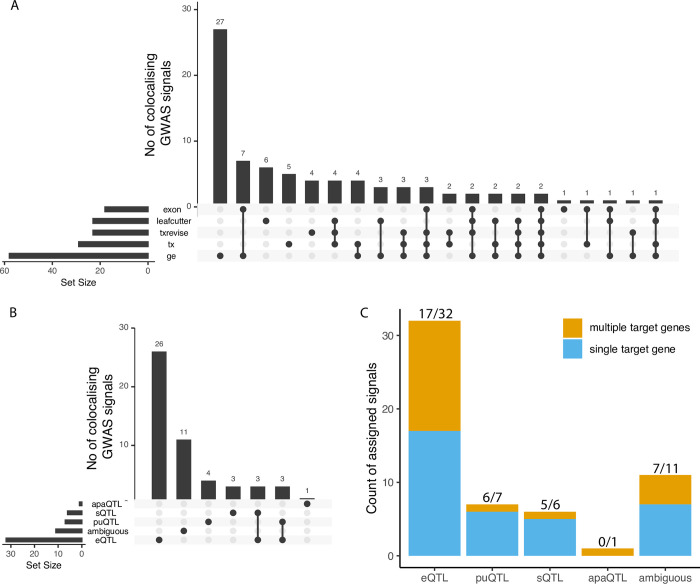
- In the vitamin D UK Biobank colocalisation case study, at PP4 > 0.9, 53/83 signals from 34/48 regions colocalised with 81 protein-coding genes. Visual review assigned an empirical functional consequence for 42/53 loci, leaving 11 ambiguous; transcript-level methods detected at least one colocalisation for 37/53 independent signals, but only 14 were classified as primary transcript-level QTLs (7 puQTLs, 6 sQTLs, 1 apaQTL), and visually confirmed primary sQTLs explained just 6/53 colocalising signals.
- Confirmed eQTLs were more pleiotropic: 15/32 colocalised with more than one gene, versus 1/7 puQTLs and 1/6 sQTLs. For 4/6 sQTL signals, the colocalising gene overlapped the manually prioritised causal gene; for eQTLs, the most likely causal gene was prioritised at 19/32 loci, with complete overlap in 11/19 cases.
Methods
- Release 6 includes phenotype data from 25 RNA-seq studies and 7 microarray studies. Genotypes were lifted to GRCh38, imputed to the 1000 Genomes 30x GRCh38 reference panel with Eagle v2.4.1 and Minimac4, with X chromosome imputation performed separately for pseudoautosomal and non-pseudoautosomal regions; QC included Hardy-Weinberg p < 10−6, missingness > 0.05, MAF < 0.01 and imputation R2 < 0.4 exclusions.
- Five molecular traits were quantified: gene expression (HISAT2/featureCounts), exon expression (DEXSeq annotation/featureCounts), transcript usage and txrevise event usage (Salmon), and Leafcutter splice-junction usage (regtools/LeafCutter). Gene and exon counts were normalised with cqn; transcript and event usage were TPM-ratio normalised; all traits were inverse-normal transformed.
- Association testing used a ±1 Mb cis window with FastQTL for nominal statistics and QTLtools for permutations; fine mapping used SuSiE. Transcript-level summary statistics were filtered using a connected-components approach, and colocalisation with vitamin D GWAS used coloc.susie with SuSiE log Bayes factors. QTL coverage plots were generated with deepTools bamCoverage and wiggleplotr.
Limitations
- The paper states that assigning mechanisms to molecular QTLs relied on manual visual inspection, which is inherently subjective and noisy and carries a small risk of inadvertent confirmation bias, such as classifying less pleiotropic loci as sQTLs. It also notes that the vitamin D case study involved a small number of loci.
- The paper states that X chromosome QTLs are available for only a subset of studies; ten of the other 13 studies lacked X chromosome genotypes, and three male-only studies did not pass genotype QC. The text also notes that visualisations detected three likely cases of reference mapping bias at DHCR7, NUDT9 and JUND, and that the authors opted not to correct for reference mapping bias during molecular trait quantification.
- The text makes evident that the vitamin D analysis is a proof-of-concept case study rather than a general evaluation, and it states that eQTL colocalisation alone often achieves low precision in causal gene identification.
Model-written summary. Check it against the paper before relying on it.
Integrity signals
Registry
Cites
Statistics
Figures
Verification
Claims the paper makes
0 Valid · 0 Not valid · 11 Not checked · 57 Own results and interpretations
A result the paper reports from its own data — it cites no other source for it, so there is none to check. The quote shows it is in the paper.
In the paper
“Across these 18 datasets, we detected at least one significant eQTL (FDR <1%) for 853 unique genes on the X chromosome (Fig 1B).”
§ eQTL Catalogue 2023: New datasets, X chromosome QTLs, and improved detection and visualisation of transcript-level QTLs > Results > Updates to the eQTL Catalogue resource
plain- Asserted: passes — The authors put it forward as true.
- Checkable: passes — It can be checked against evidence.
- Load-bearing: passes — The paper’s conclusions depend on it.
- Based: passes — The paper gives a reason why it holds.
A result the paper reports from its own data — it cites no other source for it, so there is none to check. The quote shows it is in the paper.
In the paper
“These X chromosome eQTLs account for ~1.6% of all significant eQTLs (FDR < = 1%).”
§ eQTL Catalogue 2023: New datasets, X chromosome QTLs, and improved detection and visualisation of transcript-level QTLs > Results > Updates to the eQTL Catalogue resource
plain- Asserted: passes — The authors put it forward as true.
- Checkable: passes — It can be checked against evidence.
- Load-bearing: unclear — It is unclear whether the paper’s conclusions depend on it.
- Based: passes — The paper gives a reason why it holds.
A result the paper reports from its own data — it cites no other source for it, so there is none to check. The quote shows it is in the paper.
In the paper
“While these visually confirmed primary splicing QTLs explain just 6/53 of the colocalising signals”
§ eQTL Catalogue 2023: New datasets, X chromosome QTLs, and improved detection and visualisation of transcript-level QTLs > Abstract
plain- Asserted: passes — The authors put it forward as true.
- Checkable: passes — It can be checked against evidence.
- Load-bearing: passes — The paper’s conclusions depend on it.
- Based: passes — The paper gives a reason why it holds.
- Rests on an assumption not shown here.
A result the paper reports from its own data — it cites no other source for it, so there is none to check. The quote shows it is in the paper.
In the paper
“and identify a prioritised causal gene in 4/6 cases.”
§ eQTL Catalogue 2023: New datasets, X chromosome QTLs, and improved detection and visualisation of transcript-level QTLs > Abstract
plainstates a causen = 6- Asserted: passes — The authors put it forward as true.
- Checkable: passes — It can be checked against evidence.
- Load-bearing: passes — The paper’s conclusions depend on it.
- Based: passes — The paper gives a reason why it holds.
- Rests on an assumption not shown here.
A result the paper reports from its own data — it cites no other source for it, so there is none to check. The quote shows it is in the paper.
In the paper
“they are significantly less pleiotropic than eQTLs”
§ eQTL Catalogue 2023: New datasets, X chromosome QTLs, and improved detection and visualisation of transcript-level QTLs > Abstract
plainstates an associationn = 6- Asserted: passes — The authors put it forward as true.
- Checkable: passes — It can be checked against evidence.
- Load-bearing: passes — The paper’s conclusions depend on it.
- Based: passes — The paper gives a reason why it holds.
- Rests on an assumption not shown here.
28 more claims
Create a free account to see all 68 claims and to verify the 30 references still open.
- It may state two separate claims as one. 24
- The quote only partly states this claim. 1
- Probably not a substantial claim. 15
Self-check
Percentages, sums and reported differences re-computed from the paper’s own numbers.
Each contradiction between two passages listed here was confirmed by an independent check.
Rated minor: it would not touch a result — a value no result rests on, a p-value that stays on the same side of the significance level, or a conflict that is clerical, resolved elsewhere in the paper, or outside its own findings.
In the paper
§ eQTL Catalogue 2023: New datasets, X chromosome QTLs, and improved detection and visualisation of transcript-level QTLs > Abstract
“added X chromosome QTLs for 19 compatible studies.”
§ eQTL Catalogue 2023: New datasets, X chromosome QTLs, and improved detection and visualisation of transcript-level QTLs > Results > Updates to the eQTL Catalogue resource
“summary statistics for 18 of the 31 studies now also contain variants from the X chromosome.”
Rated minor: it would not touch a result — a value no result rests on, a p-value that stays on the same side of the significance level, or a conflict that is clerical, resolved elsewhere in the paper, or outside its own findings.
In the paper
§ eQTL Catalogue 2023: New datasets, X chromosome QTLs, and improved detection and visualisation of transcript-level QTLs > Results > Case study: Target gene prioritisation for vitamin D GWAS
“only 14 of those (7 puQTLs, 6 sQTLs and 1 apaQTL) could be classified as primary transcript-level QTLs”
§ eQTL Catalogue 2023: New datasets, X chromosome QTLs, and improved detection and visualisation of transcript-level QTLs > Results > Case study: Target gene prioritisation for vitamin D GWAS
“Leafcutter detected all seven visually confirmed sQTLs”
Citations
Cites
STAR: ultrafast universal RNA-seq aligner
Dobin, A., Davis, C. A., Schlesinger, F., Drenkow, J., Zaleski, C., Jha, S., Batut, P., Chaisson, M., & Gingeras, T. R. (2013) · Bioinformatics · doi:10.1093/bioinformatics/bts635 · Cited by 51,709
BEDTools: a flexible suite of utilities for comparing genomic features
Quinlan, A. R., & Hall, I. M. (2010) · Bioinformatics · doi:10.1093/bioinformatics/btq033 · Cited by 27,437
featureCounts: an efficient general purpose program for assigning sequence reads to genomic features
Liao, Y., Smyth, G. K., & Shi, W. (2014) · Bioinformatics · doi:10.1093/bioinformatics/btt656 · Cited by 27,219
Graph-based genome alignment and genotyping with HISAT2 and HISAT-genotype
Kim, D., Paggi, J. M., Park, C., Bennett, C., & Salzberg, S. L. (2019) · Nature Biotechnology · doi:10.1038/s41587-019-0201-4 · Cited by 15,022
Salmon provides fast and bias-aware quantification of transcript expression
Patro, R., Duggal, G., Love, M. I., Irizarry, R. A., & Kingsford, C. (2017) · Nature Methods · doi:10.1038/nmeth.4197 · Cited by 12,700
Wickham, H. (2016) · Use R! · doi:10.1007/978-3-319-24277-4_9 · Cited by 12,516
deepTools2: a next generation web server for deep-sequencing data analysis
Ramírez, F., Ryan, D. P., Grüning, B., Bhardwaj, V., Kilpert, F., Richter, A. S., Heyne, S., Dündar, F., & Manke, T. (2016) · Nucleic Acids Research · doi:10.1093/nar/gkw257 · Cited by 8,096
The GTEx Consortium atlas of genetic regulatory effects across human tissues
The GTEx Consortium, Aguet, F., Anand, S., Ardlie, K. G., Gabriel, S., Getz, G. A., Graubert, A., Hadley, K., Handsaker, R. E., Huang, K. H., et al. (2020) · Science · doi:10.1126/science.aaz1776 · Cited by 5,547 · cited 3×
“eQTL Catalogue release 6 contains phenotype data from the following 25 RNAseq studies: ROSMAP [50], BrainSeq [51], TwinsUK [52], FUSION [53], BLUEPRINT [54,55], Quach_2016 [56], Schmiedel_2018 [57], GENCORD [58], GEUVADIS [59], Alasoo_2018 [11], Nedelec_2016 [60], Lepik_2017 [61], HipSci [62], van_de_Bunt_2015 [63], S…”
BackgroundSelf-citationAligning sequence reads, clone sequences and assembly contigs with BWA-MEM
Li, H. (2013) · DROPS (Schloss Dagstuhl – Leibniz Center for Informatics) · doi:10.48550/arxiv.1303.3997 · Cited by 5,159
Aligning sequence reads, clone sequences and assembly con*gs with BWA-MEM
Li, H. (2014) · arXiv (Cornell University) · doi:10.6084/m9.figshare.963153.v1 · Cited by 4,932
Cited by
AlphaGenome: advancing regulatory variant effect prediction with a unified DNA sequence model
Avsec, Ž., Latysheva, N., Cheng, J., Novati, G., Taylor, K. R., Ward, T., Bycroft, C., Nicolaisen, L., Arvaniti, E., Pan, J., et al. (2025) · doi:10.1101/2025.06.25.661532 · Cited by 395
Advancing regulatory variant effect prediction with AlphaGenome
Avsec, Ž., Latysheva, N., Cheng, J., Novati, G., Taylor, K. R., Ward, T., Bycroft, C., Nicolaisen, L., Arvaniti, E., Pan, J., et al. (2026) · Nature · doi:10.1038/s41586-025-10014-0 · Cited by 698
Pampari, A., Shcherbina, A., Kvon, E. Z., Kosicki, M., Nair, S., Kundu, S., Kathiria, A. S., Risca, V. I., Kuningas, K., Alasoo, K., et al. (2024) · bioRxiv (Cold Spring Harbor Laboratory) · doi:10.1101/2024.12.25.630221 · Cited by 222
Self-citationHumphrey, J., Brophy, E., Kosoy, R., Zeng, B., Coccia, E., Mattei, D., Ravi, A., Naito, T., Efthymiou, A. G., Navarro, E., et al. (2025) · Nature Genetics · doi:10.1038/s41588-025-02099-0 · Cited by 44
Genetic and Genomic Pathways to Improved Wheat (Triticum aestivum L.) Yields: A Review
Chachar, Z., Fan, L., Chachar, S., Ahmed, N., Narejo, M.-U.-N., Ahmed, N., Lai, R., & Yongwen, Q. (2024) · Agronomy · doi:10.3390/agronomy14061201 · Cited by 41
Metadata
- Authors
- Kerimov, N., Tambets, R., Hayhurst, J. D., Rahu, I., Kolberg, P., Raudvere, U., Kuzmin, I., Chowdhary, A., Vija, A., Teras, H. J., Kanai, M., Ulirsch, J., Ryten, M., Hardy, J., Guelfi, S., Trabzuni, D., Kim-Hellmuth, S., Rayner, W., Finucane, H., Peterson, H., Mosaku, A., Parkinson, H., & Alasoo, K.
- Affiliations
- Open Targets (GB)
- University of Tartu (EE)
- European Bioinformatics Institute (GB)
- Helmholtz Munich (DE)
- Broad Institute (US)
- University College London (GB)
- Corresponding author
- Alasoo, Kaur
- ORCID
- Venue
- PLOS Genetics
- Publisher
- Public Library of Science (PLoS)
- Published
- 2023-09-18
- Volume
- 19
- Issue
- 9
- Pages
- e1010932
- ISSN
- 1553-7390 (ISSN-L)
- 1553-7404
- PMC
- PMC10538656
- OpenAlex
- W4386825686
- Semantic Scholar
- 1ed09e06d9ee11d6d51869bdf73a80b6f9adfaf1
- Cited by
- 65
- References
- 93
- Citations by year
- 2026: 28 · 2025: 22 · 2024: 14 · 2023: 1
- FWCI
- 7.05
- Type
- journal article
- Language
- en
- Update notices
- new_version (2023-09-28)
- Open access
- gold
- doi.org
- Licence
- Locations
- PLoS Genetics (publishedVersion, cc-by)
- bioRxiv (Cold Spring Harbor Laboratory) (submittedVersion, cc-by)
- PubMed Central (publishedVersion, cc-by)
- PubMed (publishedVersion)
- PubMed Central (submittedVersion, cc-by)
- UCL Discovery (University College London) (submittedVersion, cc-by)
- PuSH - Publication Server of Helmholtz Zentrum München (submittedVersion, cc-by)
- PubMed (submittedVersion)
- DOAJ (DOAJ: Directory of Open Access Journals) (submittedVersion)
- Funders
- Open Targets (OTAR2077)
- European Molecular Biology Laboratory
- Horizon 2020 (825775)
- Eesti Teadusagentuur (PGS415, IUT34-4)
- Estonian Centre of Excellence in ICT Research (EXCITE)
- European Regional Development Fund (2014-2020.4.01.16-0271)
- Emmy Noether Programme (KI 2091/2-1 (459153572))
- Deutsche Forschungsgemeinschaft (SFB/TRR237-B29 (369799452), SFB/TRR359-B06 (491676693))
- Topics
- Life Sciences › Biochemistry, Genetics and Molecular Biology › Genetics › Genetic Associations and Epidemiology
- Life Sciences › Biochemistry, Genetics and Molecular Biology › Genetics › Genetic Mapping and Diversity in Plants and Animals
- Life Sciences › Biochemistry, Genetics and Molecular Biology › Molecular Biology › RNA Research and Splicing
- Keywords
- expression quantitative trait loci, Leafcutter, vitamin D levels, pleiotropy, gene expression regulation, fine mapping
- MeSH terms
- Base Sequence, Genotype, Humans, Multifactorial Inheritance, Polymorphism, Single Nucleotide, Quantitative Trait Loci, Genome-Wide Association Study
About these checks
Registry, retraction, Cites and statistics results are computed, not judged, with one exception: a printed reference that no index lists is read once by a model before it counts as a citation error. Claims are extracted by a model and kept only when their quote appears verbatim in the text; each cited source is then checked, with a model’s help, for whether it says what the claim relies on. Those verdicts can be wrong — read the claim’s quote and the cited source before relying on one.
A language model drew the claims from the paper on 2026-11-24, under version 3 of the claim definition (model deepseek-v4.1-flash, prompt extract-v3).
A second model labelled each claim on 2026-11-24 (model jev-1.13-20260917, definition revision gold-guideline-v0.2).
Statistics and arithmetic are recomputed, not judged.
Confidence bands are shown only for fields calibrated on our annotated test set. None is calibrated yet, so no band is shown.
What counts as a claim ›How we measure confidence ›How we check this ›
Are you an author, or do you see a problem with this page? Request a review
How to cite
Cite CoChat for the checks on this page, and the paper for its own findings.
- This page
- CoChat. (2026). Citation check: eQTL Catalogue 2023: New datasets, X chromosome QTLs, and improved detection and visualisation of transcript-level QTLs. https://app.cochat.ai/papers/10.1371/journal.pgen.1010932
- The paper
- Kerimov, N., Tambets, R., Hayhurst, J. D., Rahu, I., Kolberg, P., Raudvere, U., Kuzmin, I., Chowdhary, A., Vija, A., Teras, H. J., Kanai, M., Ulirsch, J., Ryten, M., Hardy, J., Guelfi, S., Trabzuni, D., Kim-Hellmuth, S., Rayner, W., Finucane, H., . . . Alasoo, K. (2023). eQTL Catalogue 2023: New datasets, X chromosome QTLs, and improved detection and visualisation of transcript-level QTLs. PLOS Genetics. https://doi.org/10.1371/journal.pgen.1010932
Data sources
Bibliographic data: Semantic Scholar, OpenAlex, Crossref.
Contains information from the Semantic Scholar Academic Graph Datasets, made available under the ODC Attribution License (ODC-BY 1.0).
Semantic Scholar’s data is described in: Kinney, R., et al. (2023). The Semantic Scholar Open Data Platform. arXiv:2301.10140.
