

Eight Americas: investigating mortality disparities across races, counties, and race-counties in the United States.
Open accessThe DOI matches its Crossref record; 50 of the 50 references it cites were found in a registry or an index.
Abstract
BACKGROUND: The gap between the highest and lowest life expectancies for race-county combinations in the United States is over 35 y. We divided the race-county combinations of the US population into eight distinct groups, referred to as the "eight Americas," to explore the causes of the disparities that can inform specific public health intervention policies and programs. METHODS AND FINDINGS: The eight Americas were defined based on race, location of the county of residence, population density, race-specific county-level per capita income, and cumulative homicide rate. Data sources for population and mortality figures were the Bureau of the Census and the National Center for Health Statistics. We estimated life expectancy, the risk of mortality from specific diseases, health insurance, and health-care utilization for the eight Americas. The life expectancy gap between the 3.4 million high-risk urban black males and the 5.6 million Asian females was 20.7 y in 2001. Within the sexes, the life expectancy gap between the best-off and the worst-off groups was 15.4 y for males (Asians versus high-risk urban blacks) and 12.8 y for females (Asians versus low-income southern rural blacks). Mortality disparities among the eight Americas were largest for young (15-44 y) and middle-aged (45-59 y) adults, especially for men. The disparities were caused primarily by a number of chronic diseases and injuries with well-established risk factors. Between 1982 and 2001, the ordering of life expectancy among the eight Americas and the absolute difference between the advantaged and disadvantaged groups remained largely unchanged. Self-reported health plan coverage was lowest for western Native Americans and low-income southern rural blacks. Crude self-reported health-care utilization, however, was slightly higher for the more disadvantaged populations. CONCLUSIONS: Disparities in mortality across the eight Americas, each consisting of millions or tens of millions of Americans, are enormous by all international standards. The observed disparities in life expectancy cannot be explained by race, income, or basic health-care access and utilization alone. Because policies aimed at reducing fundamental socioeconomic inequalities are currently practically absent in the US, health disparities will have to be at least partly addressed through public health strategies that reduce risk factors for chronic diseases and injuries.
Overview
The claims and statistics of this paper haven’t been checked yet.
Free: it reads the open-access text and checks the first 5 claims that cite a source we can check. Create a free account to check every claim.
Integrity signals
Registry
Cites
Statistics
Figures
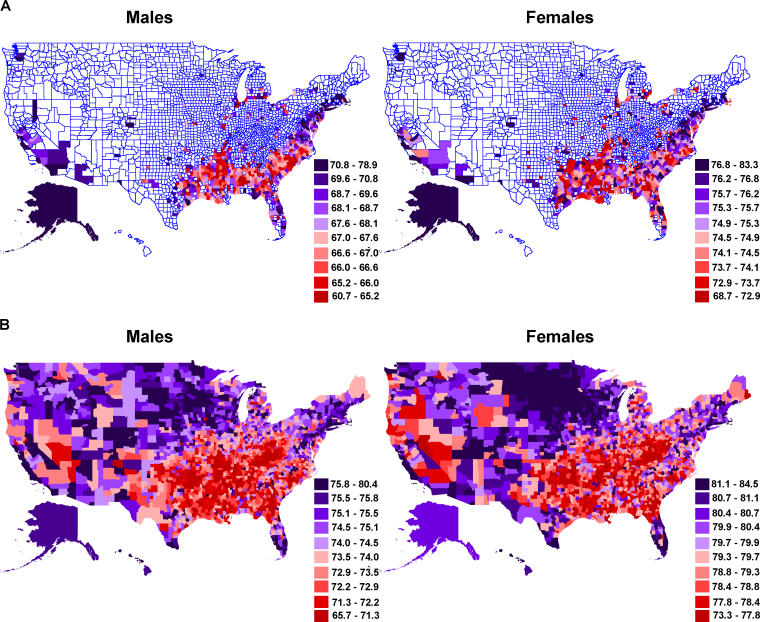
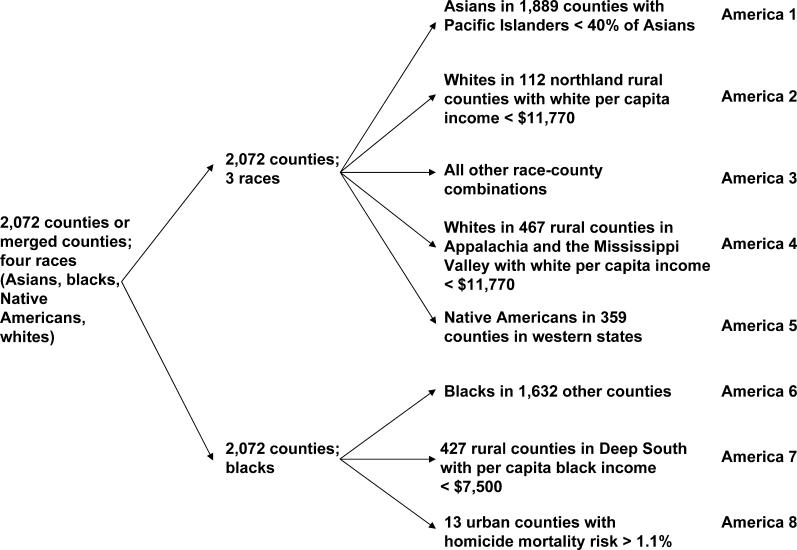
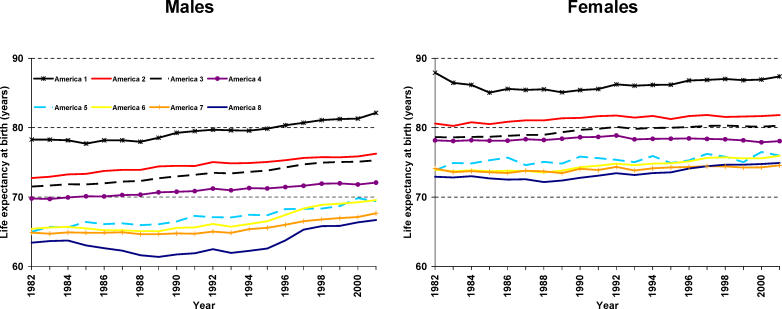
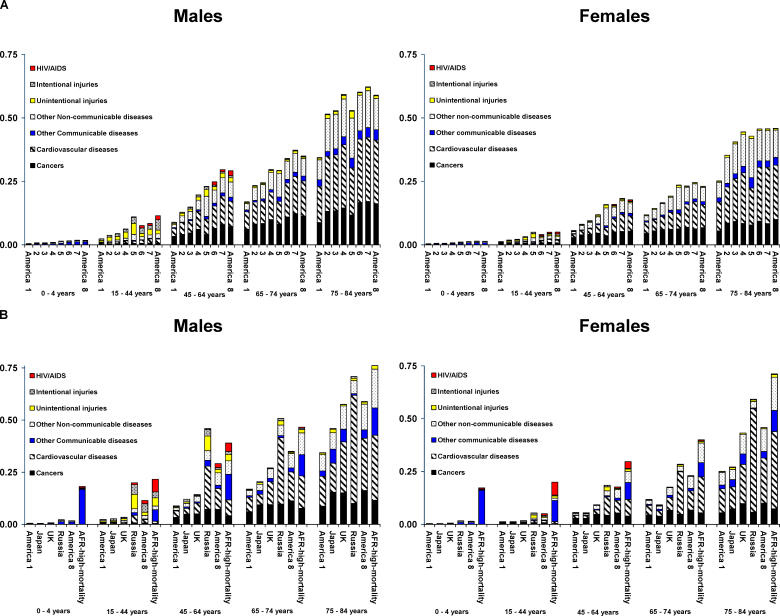
Verification
Claims the paper makes
The claims and statistics of this paper haven’t been checked yet.
Free: it reads the open-access text and checks the first 5 claims that cite a source we can check. Create a free account to check every claim.
Claims other papers make about this one
Each is checked against this paper’s own text: does it say what the citing paper says it does?
The check wasn’t confident either way, so it gives no verdict — never disputed.
In the citing paper
“Site-specific differences in the incidence of candidemia might be due to differences in the percentages of patients with underlying conditions such as diabetes and other immunosuppressive conditions (40,41), differences in practice patterns and use of antibiotics, and differences in use of antifungals and CVCs, all of which contribute to the risk for candidemia.”
From Population-Based Active Surveillance for Culture-Confirmed Candidemia — Four Sites, United States, 2012–2016 (2019) · cites this paper as [41]
Experimental — accuracy not yet measured
Self-check
Percentages, sums and reported differences re-computed from the paper’s own numbers.
The self-check needs the paper’s full text.
Citations
Cites
Yusuf, S., Hawken, S., Ôunpuu, S., Dans, T., Avezum, A., Lanas, F., McQueen, M., Budaj, A., Pais, P., Varigos, J., et al. (2004) · The Lancet · doi:10.1016/s0140-6736(04)17018-9 · Cited by 12,026
Unequal treatment: confronting racial and ethnic disparities in health care
(2003) · Choice Reviews Online · doi:10.5860/choice.40-5843 · Cited by 7,043
The World Health Report 2002 - Reducing Risks, Promoting Healthy Life
Not Available, N. A. (2003) · Education for Health: Change in Learning & Practice · doi:10.1080/1357628031000116808 · Cited by 6,046
Selected major risk factors and global and regional burden of disease
Ezzati, M., Lopez, A. D., Rodgers, A., Vander Hoorn, S., & Murray, C. J. (2002) · The Lancet · doi:10.1016/s0140-6736(02)11403-6 · Cited by 3,594
Self-citationGlobal Burden of Disease and Risk Factors
(2006) · World Bank, Washington, DC eBooks · doi:10.1596/978-0-8213-6262-4 · Cited by 2,605
Self-citationDemography, Measuring and Modeling Population Processes
Veron, J., Preston, S. H., Heuveline, P., & Guillot, M. (2002) · Population (French Edition) · doi:10.2307/1535065 · Cited by 1,709
Pappas, G., Queen, S., Hadden, W., & Fisher, G. (1993) · New England Journal of Medicine · doi:10.1056/nejm199307083290207 · Cited by 1,524
Area Deprivation and Widening Inequalities in US Mortality, 1969–1998
Singh, G. K. (2003) · American Journal of Public Health · doi:10.2105/ajph.93.7.1137 · Cited by 1,423 · cited 1×
“Researchers have also drawn attention to substantial disparities in mortality and functional health status nationally and within race groups in relation to income, social class, education, and community characteristics [6–16].”
BackgroundThe Influence Of Income On Health: Views Of An Epidemiologist
Marmot, M. (2002) · Health Affairs · doi:10.1377/hlthaff.21.2.31 · Cited by 848 · cited 1×
“Important research in the past few decades has illustrated the critical role of individual and community-level socioeconomic factors, be it in absolute or relative terms, in health outcomes [11,24,37,38].”
BackgroundCooper, R., Cutler, J., Desvigne-Nickens, P., Fortmann, S. P., Friedman, L., Havlik, R., Hogelin, G., Marler, J., McGovern, P., Morosco, G., et al. (2000) · Circulation · doi:10.1161/01.cir.102.25.3137 · Cited by 831 · cited 1×
“Multiple investigations have documented the consistent gap in all measures of mortality by race, particularly between black and white Americans [1–5].”
Background
Research works printed but not linked: 1
- Nelson DE Holtzman D Waller M Leutzinger CL Condon K 1998 Objectives and design of the Behavioral Risk Factor Surveillance System Proceedings of the Survey Research Methods Section, American Statistical Association National Meeting (1998) Alexandria (Virginia) American Statistical Association Available: http://www.amstat.org/sections/srms/proceedings/papers/1998_032.pdf. Accessed 11 July 2006.
Cited by
Items 801–833 of 833
US life expectancy gap widens to 20 years
Delgado, C. (2024) · BMJ · doi:10.1136/bmj.q2612
Bramajo, O. N., & Zazueta-Borboa, J.-D. (2025) · Canadian Studies in Population · doi:10.1007/s42650-025-00088-6
“In contrast, rural areas often show higher mortality rates due to greater material deprivation (Cosby et al., 2008 , 2019 ; García, 2020; Murray et al., 2006).”
Paternina-Caicedo, Á. J., Espinosa, O., Sheth, S. S., Hupert, N., & Saghafian, S. (2025) · Annals of Internal Medicine · doi:10.7326/annals-24-02794
Life expectancy disparities in the USA: the Ten Americas study
Yuan, J., Li, M., Zhao, J., & Lu, K. (2025) · The Lancet · doi:10.1016/s0140-6736(25)01111-0
Xu, Y., Gao, Y., Sun, Y., Zhang, J., & Li, L. J. (2025) · Research Square · doi:10.21203/rs.3.rs-6412170/v1
Pre‐COVID‐19 Geographic Inequalities in Non‐Hispanic Black US Life Expectancy, 1990–2019
Elo, I. T., Luck, A. N., & Tuder, S. (2025) · Population and Development Review · doi:10.1111/padr.70018
“…historically persistent Black–White disparity in longevity (Benjamins et al. 2021; Cross, Califf, and Warraich 2021; Cun-ningham et al. 2017; Dwyer-Lindgren et al. 2022, 2023; Harper, MacLehose, and Kaufman 2014; Johnson et al. 2022; Macinko and Elo 2009; Murray et al. 2006; Schwandt et al. 2021).”
Credit Markets and Racial Mortality InequalityPreprint
Hasan, I., Krause, T., Manfredonia, S., & Noth, F. (2025) · SSRN Electronic Journal · doi:10.2139/ssrn.5571876
Krumov, K., & Larsen, K. S. (2013) · Emerald Group Publishing Limited eBooks · doi:10.1108/978-1-62396-318-720251014
Ekström, M., & Mannino, D. M. (2022) · Figshare · doi:10.6084/m9.figshare.21258711
Rangachari, P., Govindarajan, A., Mehta, R., Seehusen, D. A., & Rethemeyer, R. K. (2022) · Figshare · doi:10.6084/m9.figshare.19126289
Cross-country Variation in the Stigmatization of People with Schizophrenia
Gostelow, R. D. S. (2020) · Knowledge@UChicago (University of Chicago) · doi:10.6082/uchicago.2617
Scruggs, S. (2021) · Digital Archive @ GSU · doi:10.57709/24062602
Rangachari, P., Govindarajan, A., Mehta, R., Seehusen, D. A., & Rethemeyer, R. K. (2022) · Figshare · doi:10.6084/m9.figshare.19126292
Perceived social status and oral health outcomes
Sukalski, J. M. C. (2025) · Iowa Research Online (The University of Iowa) · doi:10.25820/etd.007105
The Impact of Disease-Specific Health Insurance Reform on Mortality and Healthcare
Menares, F. (2023) · eScholarship (California Digital Library)
Aguilar, J. (2025) · AIS Electronic Library (AISeL)
Langer, P. D. (2024) · eScholarship (California Digital Library)
Inequality in mortality: Portugal Vs United States, Canada and France
Gouveia, I. S. A. R. (2023) · Portuguese National Funding Agency for Science, Research and Technology (RCAAP Project by FCT)
Suarez, E. C. (2015) · WakeSpace Scholarship (Wake Forest University)
Goler, T. (2019) · OhioLink ETD Center (Ohio Library and Information Network)
Essays in empirical health economics
Redler, P. (2025) · doi:10.5282/edoc.35781
Ristovska, L. (2023) · Digital Access to Scholarship at Harvard (DASH) (Harvard University)
Quality of Care and Hospital Bypass Among Rural Heart Failure Patients
Friedman, H. (2023) · Carolina Digital Repository (University of North Carolina at Chapel Hill) · doi:10.17615/6hn5-y182
Shamsa, E. H., Ponnana, S. R., Siraspalli, S., Chen, Z., Dazard, J.-E., Zhang, A., Okyere, R., Khawaja, T., Sivanantham, K., Neeland, I. J., et al. (2026) · American Journal of Preventive Cardiology · doi:10.1016/j.ajpc.2026.101517
“These conclusions are consistent with previous studies which suggested that access to and utilization of preventive care may be critical to community-level health outcomes [46,47].”
Redd, A., Mayes, T., & Jacobs, M. (2026) · Family & Community Health · doi:10.1097/fch.0000000000000455
How Has Health Inequality Been Problematised—And What Has Been Normalised?
Adegoke, A. A. (2026) · International Journal on Sustainable Industrial Revolution · doi:10.53982/ijsir.2026.0101.09-j
Gorbunova, G., Yashkin, A. P., Kravchenko, J. S., Ukraintseva, S., Stallard, E., Yashin, A., & Akushevich, I. (2026) · Innovation in Aging · doi:10.1093/geroni/igag065
Structural vulnerabilities? Trends in preventable deaths of despair in the Netherlands, 2013-2023
Marco, M. H. D., Vrinzen, S., Berkelmans, G., Schweren, L., Mérelle, S. Y. M., & Liem, M. C. A. (2026) · Public Health · doi:10.1016/j.puhe.2026.106447
JIANG, P. (2020) · Institutional Repositories DataBase (IRDB)
U.S. State Policy Contexts, County Economic Contexts, and Working-Age Mortality
Gutin, I., Montez, J. K., Monnat, S. M., Wiemers, E., & Wolf, D. A. (2026) · Demography · doi:10.1215/00703370-12863652
McCart, A. L., Parks, A., & McCart, D. R. (2026) · Journal of Public Health Issues and Practices · doi:10.33790/jphip1100265
ETHNO-RACIAL DISPARITIES IN HEALTH OUTCOMES: EVIDENCE FROM THE AGING POPULATION
Odufuwa, O. O. (2015) · UNM’s Digital Repository (University of New Mexico)
Metadata
- Authors
- Murray, C. J. L., Kulkarni, S. C., Michaud, C., Tomijima, N., Bulzacchelli, M. T., Iandiorio, T. J., & Ezzati, M.
- Affiliations
- Harvard University (US)
- Corresponding author
- Ezzati, Majid
- Venue
- PLoS Medicine
- Publisher
- Public Library of Science (PLoS)
- Published
- 2006-09-12
- Volume
- 3
- Issue
- 9
- Pages
- e260
- ISSN
- 1549-1277 (ISSN-L)
- 1549-1676
- PMC
- PMC1564165
- OpenAlex
- W2163209812
- Cited by
- 762
- References
- 48
- Citations by year
- 2026: 8 · 2025: 19 · 2024: 16 · 2023: 21 · 2022: 34 · 2021: 81 · 2020: 39 · 2019: 45 · 2018: 32 · 2017: 35 · 2016: 60 · 2015: 30 · 2014: 46 · 2013: 47 · 2012: 53
- FWCI
- 28.53
- Type
- journal article
- Language
- en
- Update notices
- correction (2006-12-26)
- Open access
- gold
- doi.org
- Locations
- PLoS Medicine (publishedVersion, cc-by)
- Europe PMC (PubMed Central) (publishedVersion, cc-by)
- PubMed (publishedVersion)
- Digital Access to Scholarship at Harvard (DASH) (Harvard University) (submittedVersion, cc-by)
- RePEc: Research Papers in Economics (submittedVersion)
- DOAJ (DOAJ: Directory of Open Access Journals) (submittedVersion, cc-by-sa)
- University Libraries (University of Maryland) (submittedVersion)
- Figshare (submittedVersion, cc-by)
- Digital Repository at the University of Maryland (University of Maryland College Park)
- Funders
- Centers for Disease Control and Prevention
- U.S. Public Health Service (U36 CCU300430-23)
- National Institute on Aging (P01 AG17625, P01AG017625)
- Topics
- Social Sciences › Health › Health disparities and outcomes
- Health Sciences › Medicine › Oncology › Global Cancer Incidence and Screening
- Social Sciences › Demography › Insurance, Mortality, Demography, Risk Management
- Keywords
- health disparities, mortality disparities, life expectancy, racial disparities, socioeconomic disparities, county income, homicide, chronic disease, injuries, health insurance coverage, health care utilization, Native Americans, African Americans, Asian Americans, urban-rural differences, risk factors
- MeSH terms
- Adolescent, Adult, Age Factors, Delivery of Health Care, Female, Geography, Health Services Accessibility, Humans, Life Expectancy, Male, Middle Aged, Mortality, Patient Acceptance of Health Care, Risk Factors, Sex Factors, Socioeconomic Factors, United States, Racial Groups
About these checks
Registry, retraction, Cites and statistics results are computed, not judged, with one exception: a printed reference that no index lists is read once by a model before it counts as a citation error. Claims are extracted by a model and kept only when their quote appears verbatim in the text; each cited source is then checked, with a model’s help, for whether it says what the claim relies on. Those verdicts can be wrong — read the claim’s quote and the cited source before relying on one.
Statistics and arithmetic are recomputed, not judged.
Confidence bands are shown only for fields calibrated on our annotated test set. None is calibrated yet, so no band is shown.
What counts as a claim ›How we measure confidence ›How we check this ›
Are you an author, or do you see a problem with this page? Request a review
Data sources
Bibliographic data: Semantic Scholar, OpenAlex, Crossref.
Contains information from the Semantic Scholar Academic Graph Datasets, made available under the ODC Attribution License (ODC-BY 1.0).
Semantic Scholar’s data is described in: Kinney, R., et al. (2023). The Semantic Scholar Open Data Platform. arXiv:2301.10140.
