

Determinants of Disease Presentation and Outcome during Cryptococcosis: The CryptoA/D Study
Open accessThe DOI matches its Crossref record; 60 of the 62 references it cites were found in a registry or an index.
Abstract
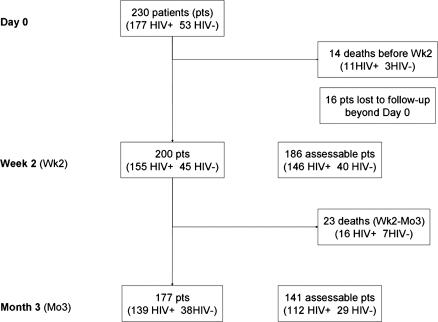
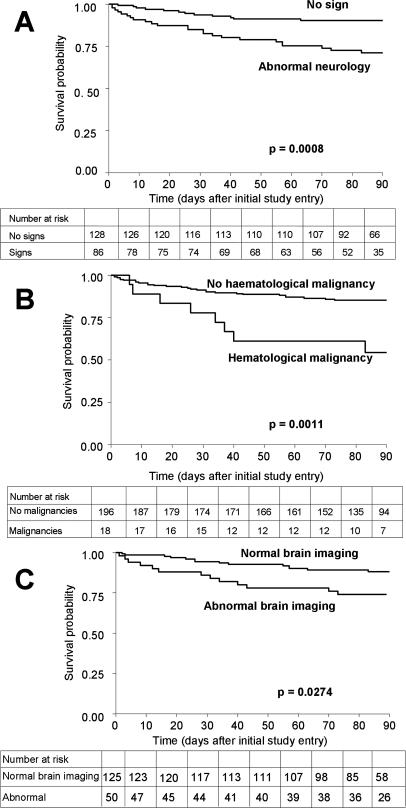
BACKGROUND: Cryptococcosis is a life-threatening opportunistic fungal infection in both HIV-positive and -negative patients. Information on clinical presentation and therapeutic guidelines, derived mostly from clinical trials performed before introduction of highly active antiretroviral therapy in patients with cryptococcal meningoencephalitis, is missing data on extrameningeal involvement and infections by serotype D as opposed to serotype A of Cryptococcus neoformans. METHODS AND FINDINGS: The prospective multicenter study CryptoA/D was designed in France (1997-2001) to analyse the factors influencing clinical presentation and outcome without the bias of inclusion into therapeutic trials. Of the 230 patients enrolled, 177 (77%) were HIV-positive, 50 (22%) were female, and 161 (72.5%) were infected with serotype A. Based on culture results at baseline, cryptococcosis was more severe in men, in HIV-positive patients, and in patients infected with serotype A. Factors independently associated with mycological failure at week 2 independent of HIV status were initial dissemination (OR, 2.4 [95% confidence interval (CI), 1.2-4.9]), high (>1:512) serum antigen titre (OR, 2.6 [1.3-5.4]), and lack of flucytosine during induction therapy (OR, 3.8 [1.9-7.8]). The three-month survival was shorter in patients with abnormal neurology or brain imaging at baseline, and in those with haematological malignancy. CONCLUSIONS: Thus sex, HIV status, and infecting serotype are major determinants of presentation and outcome during cryptococcosis. We propose a modification of current guidelines for the initial management of cryptococcosis based on systematic fungal burden evaluation.
Overview
The claims and statistics of this paper haven’t been checked yet.
Free: it reads the open-access text and checks the first 5 claims that cite a source we can check. Create a free account to check every claim.
Integrity signals
Registry
Cites
Statistics
Figures
Verification
Claims the paper makes
The claims and statistics of this paper haven’t been checked yet.
Free: it reads the open-access text and checks the first 5 claims that cite a source we can check. Create a free account to check every claim.
Claims other papers make about this one
Each is checked against this paper’s own text: does it say what the citing paper says it does?
In the citing paper
“Early studies have demonstrated that brain infections occur following fungemia, and that there is a direct correlation between the severity of the infection and the magnitude of fungemia [70–72].”
From Mechanisms of fungal dissemination (2021) · cites this paper as [72]
Self-check
Percentages, sums and reported differences re-computed from the paper’s own numbers.
The self-check needs the paper’s full text.
Citations
Cites
No adjustments are needed for multiple comparisons.
Rothman, K. J. (1990) · Epidemiology · doi:10.1097/00001648-199001000-00010 · Cited by 5,965 · cited 1×
“Finally, the question of multiple comparisons adjustment is a subject of debate in epidemiological research [30,34], arising because of the increased risk of type I errors (findings of false significance) when numerous hypotheses are tested simultaneously at set pvalues.”
BackgroundCastro, K. G., Ward, J. W., Slutsker, L., Buehler, J. W., Jaffe, H. W., Berkelman, R. L., & Curran, J. W. (1993) · Clinical Infectious Diseases · doi:10.1093/clinids/17.4.802 · Cited by 4,349
J Antimicrob Chemother 1994; 33: 350–351
O'SHAUGHNESSY, E. M., & DAS, S. S. (1994) · Journal of Antimicrobial Chemotherapy · doi:10.1093/jac/33.2.350 · Cited by 3,746
Multiple significance tests: the Bonferroni method
Bland, J. M., & Altman, D. G. (1995) · BMJ · doi:10.1136/bmj.310.6973.170 · Cited by 3,341 · cited 1×
“Finally, the question of multiple comparisons adjustment is a subject of debate in epidemiological research [30,34], arising because of the increased risk of type I errors (findings of false significance) when numerous hypotheses are tested simultaneously at set pvalues.”
Do multiple outcome measures require p-value adjustment?
Feise, R. J. (2002) · BMC Medical Research Methodology · doi:10.1186/1471-2288-2-8 · Cited by 1,299 · cited 1×
“We thus limited the adjustment to the main outcomes and engaged other comparisons to present exploratory but relevant results [35].”
ResultCryptococcosis in the era of AIDS--100 years after the discovery of Cryptococcus neoformans
Mitchell, T. G., & Perfect, J. R. (1995) · Clinical Microbiology Reviews · doi:10.1128/cmr.8.4.515 · Cited by 1,213 · cited 2×
“Only small series of computerized tomographies or magnetic resonance imaging of the brain have been published so far, and none has clearly addressed the relationship between cerebral lesions and prognosis [1].”
BackgroundPractice Guidelines for the Management of Cryptococcal Disease
Saag, M. S., Graybill, R. J., Larsen, R. A., Pappas, P. G., Perfect, J. R., Powderly, W. G., Sobel, J. D., Dismukes, W. E., & Mycoses Study Group Cryptococcal Subproject (2000) · Clinical Infectious Diseases · doi:10.1086/313757 · Cited by 1,105
(1993) · JAMA: The Journal of the American Medical Association · doi:10.1001/jama.1993.03500040022009 · Cited by 958
Bennett, J. E., Dismukes, W. E., Duma, R. J., Medoff, G., Sande, M. A., Gallis, H., Leonard, J., Fields, B. T., Bradshaw, M., Haywood, H., et al. (1979) · New England Journal of Medicine · doi:10.1056/nejm197907193010303 · Cited by 863 · cited 3×
“Flucytosine prescription has been associated with toxicity [19,24,48], but lower dosages and monitoring of plasma drug levels can prevent this problem.”
BackgroundMethodTreatment of Cryptococcal Meningitis Associated with the Acquired Immunodeficiency Syndrome
van der Horst, C. M., Saag, M. S., Cloud, G. A., Hamill, R. J., Graybill, J. R., Sobel, J. D., Johnson, P. C., Tuazon, C. U., Kerkering, T., Moskovitz, B. L., et al. (1997) · New England Journal of Medicine · doi:10.1056/nejm199707033370103 · Cited by 820
Research works printed but not linked: 1
- Chrétien, 2002, J Infect Dis, 186, 522
Cited by
Perfect, J. R., Dismukes, W. E., Dromer, F., Goldman, D. L., Graybill, J. R., Hamill, R. J., Harrison, T. S., Larsen, R. A., Lortholary, O., Nguyen, M.-H., et al. (2010) · Clinical Infectious Diseases · doi:10.1086/649858 · Cited by 2,660
“coccal meningoencephalitis approximates 20% [14, 15].”
MethodSelf-citationMaziarz, E. K., & Perfect, J. R. (2016) · Infectious Disease Clinics of North America · doi:10.1016/j.idc.2015.10.006 · Cited by 698
Recognition of seven species in the Cryptococcus gattii/Cryptococcus neoformans species complex
Hagen, F., Khayhan, K., Theelen, B., Kolecka, A., Polacheck, I., Sionov, E., Falk, R., Parnmen, S., Lumbsch, H. T., & Boekhout, T. (2015) · Fungal Genetics and Biology · doi:10.1016/j.fgb.2015.02.009 · Cited by 687
Charlier, C., Perrodeau, É., Leclercq, A., Cazenave, B., Pilmis, B., Henry, B., Lopes, A., Maury, M. M., Moura, A., Goffinet, F., et al. (2017) · The Lancet Infectious Diseases · doi:10.1016/s1473-3099(16)30521-7 · Cited by 581
Self-citationCombination Antifungal Therapy for Cryptococcal Meningitis
Day, J. N., Chau, T. T. H., Wolbers, M., Mai, P. P., Dung, N. T., Mai, N. H., Phu, N. H., Nghia, H. D., Phong, N. D., Thai, C. Q., et al. (2013) · New England Journal of Medicine · doi:10.1056/nejmoa1110404 · Cited by 545
“Grades 3 and 4 20 (20) 22 (22) 13 (13) 0.”
Metadata
- Authors
- Dromer, F., Mathoulin-Pélissier, S., Launay, O., Lortholary, O., & the French Cryptococcosis Study Group
- Affiliations
- Centre National de la Recherche Scientifique (FR)
- Hôpital Cochin (FR)
- Hôpital Necker-Enfants Malades (FR)
- Corresponding author
- Dromer, Françoise
- Venue
- PLoS Medicine
- Publisher
- Public Library of Science (PLoS)
- Published
- 2007-02-06
- Volume
- 4
- Issue
- 2
- Pages
- e21
- ISSN
- 1549-1277 (ISSN-L)
- 1549-1676
- PMC
- PMC1808080
- OpenAlex
- W2064009861
- Cited by
- 374
- References
- 62
- Citations by year
- 2026: 4 · 2025: 8 · 2024: 12 · 2023: 19 · 2022: 15 · 2021: 11 · 2020: 16 · 2019: 15 · 2018: 17 · 2017: 24 · 2016: 34 · 2015: 17 · 2014: 26 · 2013: 24 · 2012: 27
- FWCI
- 19.95
- Type
- journal article
- Language
- en
- Open access
- gold
- doi.org
- Locations
- PLoS Medicine (publishedVersion, cc-by)
- PubMed Central (publishedVersion, cc-by)
- PubMed (publishedVersion)
- DOAJ (DOAJ: Directory of Open Access Journals) (submittedVersion, cc-by-sa)
- Figshare (submittedVersion, cc-by)
- Funders
- Styrelsen för Internationellt Utvecklingssamarbete
- Sidaction
- Topics
- Health Sciences › Medicine › Infectious Diseases › Fungal Infections and Studies
- Health Sciences › Medicine › Infectious Diseases › Infectious Diseases and Tuberculosis
- Health Sciences › Medicine › Infectious Diseases › Antifungal resistance and susceptibility
- Keywords
- cryptococcosis, serotype D, cryptococcal meningoencephalitis, HIV infection, clinical features, treatment outcomes, serum cryptococcal antigen, 5-fluorocytosine, survival, sex differences, hematologic malignancies, fungal burden
- MeSH terms
- Adult, Amphotericin B, Antifungal Agents, Cryptococcosis, Cryptococcus neoformans, Female, Flucytosine, France, Humans, Male, Meningoencephalitis, Prospective Studies, Severity of Illness Index, Treatment Outcome, AIDS-Related Opportunistic Infections
About these checks
Registry, retraction, Cites and statistics results are computed, not judged, with one exception: a printed reference that no index lists is read once by a model before it counts as a citation error. Claims are extracted by a model and kept only when their quote appears verbatim in the text; each cited source is then checked, with a model’s help, for whether it says what the claim relies on. Those verdicts can be wrong — read the claim’s quote and the cited source before relying on one.
Statistics and arithmetic are recomputed, not judged.
Confidence bands are shown only for fields calibrated on our annotated test set. None is calibrated yet, so no band is shown.
What counts as a claim ›How we measure confidence ›How we check this ›
Are you an author, or do you see a problem with this page? Request a review
How to cite
Cite CoChat for the checks on this page, and the paper for its own findings.
- This page
- CoChat. (2026). Citation check: Determinants of Disease Presentation and Outcome during Cryptococcosis: The CryptoA/D Study. https://app.cochat.ai/papers/10.1371/journal.pmed.0040021
- The paper
- Dromer, F., Mathoulin-Pélissier, S., Launay, O., Lortholary, O., & the French Cryptococcosis Study Group. (2007). Determinants of Disease Presentation and Outcome during Cryptococcosis: The CryptoA/D Study. PLoS Medicine. https://doi.org/10.1371/journal.pmed.0040021
Data sources
Bibliographic data: Semantic Scholar, OpenAlex, Crossref.
Contains information from the Semantic Scholar Academic Graph Datasets, made available under the ODC Attribution License (ODC-BY 1.0).
Semantic Scholar’s data is described in: Kinney, R., et al. (2023). The Semantic Scholar Open Data Platform. arXiv:2301.10140.
