

Epidemiology and reporting characteristics of systematic reviews.
Open accessThe DOI matches its Crossref record; 36 of the 36 references it cites were found in a registry or an index; none of the 9 sources its claims cite is checked for support yet.
Abstract
BACKGROUND: Systematic reviews (SRs) have become increasingly popular to a wide range of stakeholders. We set out to capture a representative cross-sectional sample of published SRs and examine them in terms of a broad range of epidemiological, descriptive, and reporting characteristics, including emerging aspects not previously examined. METHODS AND FINDINGS: We searched Medline for SRs indexed during November 2004 and written in English. Citations were screened and those meeting our inclusion criteria were retained. Data were collected using a 51-item data collection form designed to assess the epidemiological and reporting details and the bias-related aspects of the reviews. The data were analyzed descriptively. In total 300 SRs were identified, suggesting a current annual publication rate of about 2,500, involving more than 33,700 separate studies including one-third of a million participants. The majority (272 [90.7%]) of SRs were reported in specialty journals. Most reviews (213 [71.0%]) were categorized as therapeutic, and included a median of 16 studies involving 1,112 participants. Funding sources were not reported in more than one-third (122 [40.7%]) of the reviews. Reviews typically searched a median of three electronic databases and two other sources, although only about two-thirds (208 [69.3%]) of them reported the years searched. Most (197/295 [66.8%]) reviews reported information about quality assessment, while few (68/294 [23.1%]) reported assessing for publication bias. A little over half (161/300 [53.7%]) of the SRs reported combining their results statistically, of which most (147/161 [91.3%]) assessed for consistency across studies. Few (53 [17.7%]) SRs reported being updates of previously completed reviews. No review had a registration number. Only half (150 [50.0%]) of the reviews used the term "systematic review" or "meta-analysis" in the title or abstract. There were large differences between Cochrane reviews and non-Cochrane reviews in the quality of reporting several characteristics. CONCLUSIONS: SRs are now produced in large numbers, and our data suggest that the quality of their reporting is inconsistent. This situation might be improved if more widely agreed upon evidence-based reporting guidelines were endorsed and adhered to by authors and journals. These results substantiate the view that readers should not accept SRs uncritically.
Overview
CoChat Summary
TL;DR
This cross-sectional study sampled 300 systematic reviews (SRs) indexed in Medline in November 2004 and found that SRs were being published in large numbers, but reporting quality was inconsistent. Cochrane reviews generally reported methods more completely than non-Cochrane reviews, and the authors argue that stronger reporting guidelines are needed.
Key findings
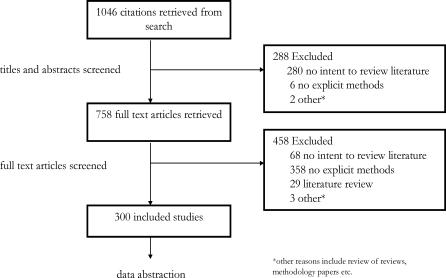
- The search identified 1,046 records; 300 eligible SR reports were included after screening, with excellent inter-reviewer agreement across screening phases (kappa = 0.86).
- The 300 SRs were indexed in Medline in November 2004 and corresponded to an estimated annual publication rate of about 2,500 SRs; Cochrane reviews made up 125/300 (41.7%) of the sample.
- Reporting was often incomplete: 122/300 (40.7%) did not report funding sources, 68/294 (23.1%) reported assessing publication bias, and 0 reviews had a registration number.
- Only 150/300 (50.0%) used the term “systematic review” or “meta-analysis” in the title or abstract; 161/300 (53.7%) reported statistical combination of results, and 197/295 (66.8%) reported quality assessment.
Methods
- Cross-sectional descriptive study of SR reports indexed in Medline during November 2004 and written in English.
- SRs were defined broadly as reports whose stated objective was to summarize evidence from multiple studies and that described explicit methods; 300 eligible reports were retained.
- Data were collected with a 51-item form and analyzed descriptively in SPSS; one a priori subgroup analysis compared Cochrane versus non-Cochrane reviews.
Limitations
- The paper states that it examined only one month from a single database and only English-language publications, so the annual publication estimate is an underestimate of total non-Cochrane SRs.
- The authors note that most of the sample was therapeutic, so findings for other review categories should be interpreted cautiously.
- The study relied on what authors reported in the papers, so incomplete reporting may reflect omission rather than poor conduct; the text says this explicitly.
- The broad SR definition may have included some literature reviews with detailed search methods rather than clearly intended SRs; this is an evident limitation from the text.
Model-written summary. Check it against the paper before relying on it.
Integrity signals
Registry
Cites
Statistics
Figures
Verification
Claims the paper makes
0 Valid · 0 Not valid · 5 Not checked · 41 Own results and interpretations
A result the paper reports from its own data — it cites no other source for it, so there is none to check. The quote shows it is in the paper.
In the paper
“There were large differences between Cochrane reviews and non-Cochrane reviews in the quality of reporting several characteristics.”
§ Epidemiology and Reporting Characteristics of Systematic Reviews > Abstract > Methods and Findings We searched Medline for SRs indexed during November 2004 and written in English. Citations were screened and those meeting our inclusion criteria were retained. Data were collected using a 51-item data collection form designed to assess the epidemiological and reporting details and the bias-related aspects of the reviews. The data were analyzed descriptively. In total 300 SRs were identified, suggesting a current annual publication rate of about 2,500, involving more than 33,700 separate studies including one-third of a million participants. The majority (272 [90.7%]) of SRs were reported in specialty journals. Most reviews (213 [71.0%]) were categorized as therapeutic, and included a median of 16 studies involving 1,112 participants. Funding sources were not reported in more than one-third (122 [40.7%]) of the reviews. Reviews typically searched a median of three electronic databases and two other sources, although only about two-thirds (208 [69.3%]) of them reported the years searched. Most (197/295 [66.8%]) reviews reported information about quality assessment, while few (68/294 [23.1%]) reported assessing for publication bias. A little over half (161/300 [53.7%]) of the SRs reported combining their results statistically, of which most (147/161 [91.3%]) assessed for consistency across studies. Few (53 [17.7%]) SRs reported being updates of previously completed reviews. No review had a registration number. Only half (150 [50.0%]) of the reviews used the term “systematic review” or “meta-analysis” in the title or abstract. There were large differences between Cochrane reviews and non-Cochrane reviews in the quality of reporting several characteristics.
plainstates an association- Asserted: passes — The authors put it forward as true.
- Checkable: passes — It can be checked against evidence.
- Load-bearing: passes — The paper’s conclusions depend on it.
- Based: passes — The paper gives a reason why it holds.
A result the paper reports from its own data — it cites no other source for it, so there is none to check. The quote shows it is in the paper.
In the paper
“Nearly half (134 [44.7%]) of the SRs did not report whether they had eligibility criteria based on language of reports.”
§ Epidemiology and Reporting Characteristics of Systematic Reviews > Results > Reporting Characteristics Related to Potential for Bias
plain- Asserted: passes — The authors put it forward as true.
- Checkable: passes — It can be checked against evidence.
- Load-bearing: unclear — It is unclear whether the paper’s conclusions depend on it.
- Based: passes — The paper gives a reason why it holds.
A result the paper reports from its own data — it cites no other source for it, so there is none to check. The quote shows it is in the paper.
In the paper
“The 300 reviews were published in 132 journals”
§ Epidemiology and Reporting Characteristics of Systematic Reviews > Results > Overall Epidemiology Characteristics
plain- Asserted: passes — The authors put it forward as true.
- Checkable: passes — It can be checked against evidence.
- Load-bearing: unclear — It is unclear whether the paper’s conclusions depend on it.
- Based: passes — The paper gives a reason why it holds.
A result the paper reports from its own data — it cites no other source for it, so there is none to check. The quote shows it is in the paper.
In the paper
“Cochrane reviews contributed nearly half of these reviews (125 [41.7%]).”
§ Epidemiology and Reporting Characteristics of Systematic Reviews > Results > Prevalence of Publishing SRs
hedged- Asserted: passes — The authors put it forward as true.
- Checkable: passes — It can be checked against evidence.
- Load-bearing: unclear — It is unclear whether the paper’s conclusions depend on it.
- Based: passes — The paper gives a reason why it holds.
None of the sources cited for this claim have been checked yet.
In the paper
“publication bias was considered or assessed in only a minority of reports despite much evidence for its existence and potential influence on the results of reviews [20,21].”
§ Epidemiology and Reporting Characteristics of Systematic Reviews > Discussion
What the sources say
- Not checked yetcites [20] Dickersin, 2005, Publication Bias in Meta-Analysis—Prevention, Assessment and Adjustments
- Not checked yetcites [21] Sutton, 2005, Publication Bias in Meta-Analysis—Prevention, Assessment and Adjustments
plain- Asserted: passes — The authors put it forward as true.
- Checkable: passes — It can be checked against evidence.
- Load-bearing: passes — The paper’s conclusions depend on it.
- Based: passes — The paper gives a reason why it holds.
26 more claims
Create a free account to see all 46 claims and to verify the 9 references still open.
- It may state two separate claims as one. 14
- Probably not a substantial claim. 4
Claims other papers make about this one
Each is checked against this paper’s own text: does it say what the citing paper says it does?
The source backs part of the claim, not all of it — or backs it for a different population, condition or comparison.
In the citing paper
“However, conducting a SR is still a complex, challenging and time-consuming process [20, 21]”
From Machine learning computational tools to assist the performance of systematic reviews: A mapping review. (2022) · cites this paper as [21]
Experimental — accuracy not yet measuredThe source backs part of the claim, not all of it — or backs it for a different population, condition or comparison.
In the citing paper
“The Preferred Reporting Items for Systematic reviews and Meta-Analyses (PRISMA) statement published in 2009 (hereafter referred to as PRISMA 2009)[4–10] is a reporting guideline designed to address poor reporting of systematic reviews.[11]”
From The PRISMA 2020 statement: An updated guideline for reporting systematic reviews (2021) · cites this paper as [11]
Experimental — accuracy not yet measuredThe source backs part of the claim, not all of it — or backs it for a different population, condition or comparison.
In the citing paper
“A recent survey found that 50% of 300 authors did not mention the terms “systematic review” or “meta-analysis” in the title or abstract of their systematic review [3].”
From The PRISMA Statement for Reporting Systematic Reviews and Meta-Analyses of Studies That Evaluate Health Care Interventions: Explanation and Elaboration (2009) · cites this paper as [3]
Experimental — accuracy not yet measuredThe source backs part of the claim, not all of it — or backs it for a different population, condition or comparison.
In the citing paper
“However, despite advances, the quality of the conduct and reporting of systematic reviews remains well short of ideal [3],[4],[5],[6].”
From The PRISMA Statement for Reporting Systematic Reviews and Meta-Analyses of Studies That Evaluate Health Care Interventions: Explanation and Elaboration (2009) · cites this paper as [3]
Experimental — accuracy not yet measuredThe source backs part of the claim, not all of it — or backs it for a different population, condition or comparison.
In the citing paper
“In a survey of 300 systematic reviews published in November 2004, funding sources were not reported in 41% of the reviews [3].”
From The PRISMA Statement for Reporting Systematic Reviews and Meta-Analyses of Studies That Evaluate Health Care Interventions: Explanation and Elaboration (2009) · cites this paper as [3]
Experimental — accuracy not yet measured
20 more claims about this paper
Create a free account to see every claim other papers make about this one.
Citations
Cites
Moher, D., Schulz, K. F., & Altman, D. G. (2001) · The Lancet · doi:10.1016/s0140-6736(00)04337-3 · Cited by 5,373
Self-citationMoher, D., Cook, D. J., Eastwood, S., Olkin, I., Rennie, D., & Stroup, D. F. (1999) · The Lancet · doi:10.1016/s0140-6736(99)04149-5 · Cited by 4,826
Self-citationMoher, D., Schulz, K. F., & Altman, D. G. (2001) · BMC Medical Research Methodology · doi:10.1186/1471-2288-1-2 · Cited by 2,755
Self-citationPublication Bias in Meta‐Analysis: Prevention, Assessment and Adjustments
(2005) · doi:10.1002/0470870168 · Cited by 2,368
Pharmaceutical industry sponsorship and research outcome and quality: systematic review
Lexchin, J., Bero, L. A., Djulbegovic, B., & Clark, O. (2003) · BMJ · doi:10.1136/bmj.326.7400.1167 · Cited by 2,147 · cited 1×
“Similarly, very few reviews reported being funded by commercial sources, for which such funding has been associated with bias in the results of clinical trials [19].”
BackgroundChan, A.-W., Hróbjartsson, A., Haahr, M. T., Gøtzsche, P. C., & Altman, D. G. (2004) · JAMA · doi:10.1001/jama.291.20.2457 · Cited by 1,845 · cited 1×
“Strong evidence of outcome reporting bias was recently reported within clinical trials [ 23 ,24].”
ResultSelf-citationEvaluation of the Quality of Prognosis Studies in Systematic Reviews
Hayden, J. A., Côté, P., & Bombardier, C. (2006) · Annals of Internal Medicine · doi:10.7326/0003-4819-144-6-200603210-00010 · Cited by 1,452 · cited 1×
“Typically the focus of such examinations is in specific health care areas [8–11] or type of SR [12,13].”
BackgroundMoher, D., Schulz, K. F., Altman, D. G., & for the CONSORT Group* (2001) · Annals of Internal Medicine · doi:10.7326/0003-4819-134-8-200104170-00011 · Cited by 1,426
Self-citationMeta-Analyses of Randomized Controlled Trials
Sacks, H. S., Berrier, J., Reitman, D., Ancona-Berk, V. A., & Chalmers, T. C. (1987) · New England Journal of Medicine · doi:10.1056/nejm198702193160806 · Cited by 1,250
Clinical Trial Registration: A Statement from the International Committee of Medical Journal Editors
De Angelis, C., Drazen, J. M., Frizelle, F. A., Haug, C., Hoey, J., Horton, R., Kotzin, S., Laine, C., Marusic, A., Overbeke, A. J. P. M., et al. (2004) · New England Journal of Medicine · doi:10.1056/nejme048225 · Cited by 1,241
Research works printed but not linked: 33
- Young, 2005, Lancet, 366, 107
- Sacks, 1987, N Engl J Med, 316, 450
- McAlister, 1999, Ann Intern Med, 131, 947
- Mulrow, 1987, Ann Intern Med, 106, 485
- Jadad, 1996, J Clin Epidemiol, 49, 235
- Shea, 2002, Eval Health Prof, 25, 116
- Jadad, 2000, BMJ, 320, 537
- Delaney, 2005, Crit Care, 9, R575
- Bhandari, 2001, J Bone Joint Surg Am, 83A, 15
- Glenny, 2003, Eur J Oral Sci, 111, 85
- Hayden, 2006, Ann Inter Med, 144, 427
- Whiting, 2005, J Clin Epidemiol, 58, 1
- Montori, 2005, BMJ, 330, 68
- Fritsche, 2004, Am J Transplant, 4, 738
- Mallett, 2002, Int J Technol Assess Health Care, 18, 820
- Chan, 2005, Lancet, 365, 1159
- Moja, 2005, BMJ, 330, 1053
- Lexchin, 2003, BMJ, 326, 1167
- Sutton, 2005, Publication Bias in Meta-Analysis—Prevention, Assessment and Adjustments
- Silagy, 2002, JAMA, 287, 2831
- Chan, 2004, JAMA, 291, 2457
- Chan, 2004, CMAJ, 171, 735
- Moher, 2006, Lancet, 367, 881
- Simes, 1986, J Clin Oncol, 4, 1529
- Whittington, 2004, Lancet, 363, 1341
- De Angelis, 2004, CMAJ, 171, 606
- Plint, 2006, Med J Aust, 185, 263
- Moher, 2001, Ann Intern Med, 134, 657
- Rennie, 1997, JAMA, 276, 649
- Moher, 1999, Lancet, 354, 1896
- Delaney, 2005, Crit Care, 9, R575
- Montori, 2005, BMJ, 330, 68
- Schulman, 2005, BMJ eLetters, 330
Cited by
Items 101–159 of 159
Kung, J., Chiappelli, F., Cajulis, O. O., Avezova, R., Kossan, G., Chew, L., & Maida, C. A. (2010) · The Open Dentistry Journal · doi:10.2174/1874210601004010084 · Cited by 184
Revisiones sistemáticas y metaanálisis: bases conceptuales e interpretación
Ferreira González, I., Urrútia, G., & Alonso-Coello, P. (2011) · Revista Española de Cardiología · doi:10.1016/j.recesp.2011.03.029 · Cited by 180
Halladay, C. W., Trikalinos, T. A., Schmid, I. T., Schmid, C. H., & Dahabreh, I. J. (2015) · Journal of Clinical Epidemiology · doi:10.1016/j.jclinepi.2014.12.017 · Cited by 166
Bias Due to Changes in Specified Outcomes during the Systematic Review Process
Kirkham, J. J., Altman, D. G., & Williamson, P. R. (2010) · PLoS ONE · doi:10.1371/journal.pone.0009810 · Cited by 164
“Only 11% of non-Cochrane therapeutic reviews in 2004 mentioned a protocol [3].”
BackgroundSelf-citationManchikanti, L. (2009) · Pain Physician · doi:10.36076/ppj.2009/12/819 · Cited by 168
Koffel, J. B. (2015) · PLOS ONE · doi:10.1371/journal.pone.0125931 · Cited by 159
Pereira, T. V., & Ioannidis, J. P. A. (2011) · Journal of Clinical Epidemiology · doi:10.1016/j.jclinepi.2010.12.012 · Cited by 160
Using Existing Systematic Reviews in Complex Systematic Reviews
Whitlock, E. P., Lin, J. S., Chou, R., Shekelle, P., & Robinson, K. A. (2008) · Annals of Internal Medicine · doi:10.7326/0003-4819-148-10-200805200-00010 · Cited by 144
Analysis of the reporting of search strategies in Cochrane systematic reviews
Yoshii, A., Plaut, D. A., McGraw, K. A., Anderson, M. J., & Wellik, K. E. (2009) · Journal of the Medical Library Association : JMLA · doi:10.3163/1536-5050.97.1.004 · Cited by 137
“The results of this study were consistent with the findings of 2 previously mentioned studies that specifically examined search reporting and included a large set of Cochrane reviews on a wide range of topics [18, 19].”
BackgroundResultExercise for Adults with Fibromyalgia: An Umbrella Systematic Review with Synthesis of Best Evidence
Bidonde, J., Busch, A., Bath, B., & Milosavljevic, S. (2014) · Current Rheumatology Reviews · doi:10.2174/1573403x10666140914155304 · Cited by 132
Finding the power to reduce publication bias
Stanley, T. D., Doucouliagos, H., & Ioannidis, J. P. A. (2017) · Statistics in Medicine · doi:10.1002/sim.7228 · Cited by 131
“Because this systematic review of 112 NRT trials is very large compared to the number of studies found in the typical Cochrane review or meta-analysis of randomized trials in general, we also use a wide array of smaller meta-analysis sample sizes, m={5, 10, 20, 40, 80}, to capture more common numbers of studies typica…”
ResultWorswick, J., Wayne, S. C., Bennett, R., Fiander, M., Mayhew, A., Weir, M. C., Sullivan, K. J., & Grimshaw, J. M. (2013) · Systematic Reviews · doi:10.1186/2046-4053-2-26 · Cited by 130
“In addition, available systematic reviews are of variable quality, complexity and length, and are published in a variety of sources [14].”
BackgroundGentles, S. J., Charles, C., Nicholas, D. B., Ploeg, J., & McKibbon, K. A. (2016) · Systematic Reviews · doi:10.1186/s13643-016-0343-0 · Cited by 128
“Such reviews are often used to highlight gaps in the reporting practices regarding specific methods, which may be used to justify items to address in reporting guidelines (for example, [14–16]).”
BackgroundGates, M., Gates, A., Guitard, S., Pollock, M., & Hartling, L. (2020) · Systematic Reviews · doi:10.1186/s13643-020-01509-0 · Cited by 115
The contribution of databases to the results of systematic reviews: a cross-sectional study
Hartling, L., Featherstone, R., Nuspl, M., Shave, K., Dryden, D. M., & Vandermeer, B. (2016) · BMC Medical Research Methodology · doi:10.1186/s12874-016-0232-1 · Cited by 118
“The CDSR was chosen for this analysis as Cochrane reviews: 1) provide tabulated data from the component trials allowing for re-analysis; 2) provide a detailed list of references for all relevant trials; and, 3) have been reported to be of higher methodological quality [26, 27], which may translate into more comprehens…”
MethodKitsiou, S., Paré, G., & Jaana, M. (2013) · Journal of Medical Internet Research · doi:10.2196/jmir.2770 · Cited by 118
Reproducible research practices are underused in systematic reviews of biomedical interventions
Page, M. J., Altman, D. G., Shamseer, L., McKenzie, J. E., Ahmadzai, N., Wolfe, D., Yazdi, F., Catalá-López, F., Tricco, A. C., & Moher, D. (2018) · Journal of Clinical Epidemiology · doi:10.1016/j.jclinepi.2017.10.017 · Cited by 115
“to retrieve SRs [20], which was restricted to February 2014.”
BackgroundSelf-citationHow to reduce unnecessary duplication: use PROSPERO
Moher, D., Booth, A., & Stewart, L. (2014) · BJOG: An International Journal of Obstetrics & Gynaecology · doi:10.1111/1471-0528.12657 · Cited by 113
Self-citationMeert, D., Torabi, N., & Costella, J. (2016) · Journal of the Medical Library Association : JMLA · doi:10.3163/1536-5050.104.4.004 · Cited by 108
Registering systematic reviews
Straus, S., & Moher, D. (2010) · Canadian Medical Association Journal · doi:10.1503/cmaj.081849 · Cited by 108
“Slightly less than half of reports from systematic reviews indicate the existence of a protocol for their development.(2) We believe it is time to consider creating a registry of protocols for systematic reviews and of completed reviews.”
BackgroundSelf-citationBaudard, M., Yavchitz, A., Ravaud, P., Perrodeau, E., & Boutron, I. (2017) · BMJ · doi:10.1136/bmj.j448 · Cited by 107
Find Duplicates among the PubMed, EMBASE, and Cochrane Library Databases in Systematic Review
Qi, X., Yang, M., Ren, W., Jia, J., Wang, J., Han, G., & Fan, D. (2013) · PLoS ONE · doi:10.1371/journal.pone.0071838 · Cited by 98
“In conclusions, a high prevalence of duplicates could be identified among the PubMed, EMBASE, and Cochrane Library databases in systematic review.”
BackgroundInfluentialEbrahim, S., Bance, S., Athale, A., Malachowski, C., & Ioannidis, J. P. A. (2016) · Journal of Clinical Epidemiology · doi:10.1016/j.jclinepi.2015.08.021 · Cited by 107
Introduction to systematic reviews and meta‐analysis
McKenzie, J. E., Beller, E. M., & Forbes, A. B. (2016) · Respirology · doi:10.1111/resp.12783 · Cited by 101
Pitfalls of Systematic Reviews and Meta-Analyses in Imaging Research
McInnes, M. D. F., & Bossuyt, P. M. M. (2015) · Radiology · doi:10.1148/radiol.2015142779 · Cited by 99
Cochrane and non-Cochrane systematic reviews in leading orthodontic journals: a quality paradigm?
Fleming, P. S., Seehra, J., Polychronopoulou, A., Fedorowicz, Z., & Pandis, N. (2013) · The European Journal of Orthodontics · doi:10.1093/ejo/cjs016 · Cited by 95
Overview of systematic reviews in allergy epidemiology
Genuneit, J., Seibold, A. M., Apfelbacher, C. J., Konstantinou, G. N., Koplin, J. J., La Grutta, S., Logan, K., Perkin, M. R., Flohr, C., & the Task Force ‘Overview of Systematic Reviews in Allergy Epidemiology (OSRAE)’ of the EAACI Interest Group on Epidemiology (2017) · Allergy · doi:10.1111/all.13123 · Cited by 96
“More recently, these users are faced with a larger and larger number of systematic reviews, which can cloud the issue or be impossible to grasp in detail, much as when these users used to be faced with large numbers of original articles (17, 18).”
BackgroundPanagiotou, O. A., Contopoulos-Ioannidis, D. G., & Ioannidis, J. P. A. (2013) · BMJ · doi:10.1136/bmj.f707 · Cited by 89
Forest plots in reports of systematic reviews: a cross-sectional study reviewing current practice
Schriger, D. L., Altman, D. G., Vetter, J. A., Heafner, T., & Moher, D. (2010) · International Journal of Epidemiology · doi:10.1093/ije/dyp370 · Cited by 87
Self-citationGlobal Burden of Skin Disease as Reflected in Cochrane Database of Systematic Reviews
Karimkhani, C., Boyers, L. N., Prescott, L., Welch, V., Delamere, F. M., Nasser, M., Zaveri, A., Hay, R. J., Vos, T., Murray, C. J. L., et al. (2014) · JAMA Dermatology · doi:10.1001/jamadermatol.2014.709 · Cited by 87
Cierco Jimenez, R., Lee, T., Rosillo, N., Cordova, R., Cree, I. A., Gonzalez, A., & Indave Ruiz, B. I. (2022) · BMC Medical Research Methodology · doi:10.1186/s12874-022-01805-4 · Cited by 85
“However, conducting a SR is still a complex, challenging and time-consuming process [20, 21], and it requires a multi-disciplinary team with at least one experienced reviewer [22].”
BackgroundPage, M. J., Altman, D. G., McKenzie, J. E., Shamseer, L., Ahmadzai, N., Wolfe, D., Yazdi, F., Catalá-López, F., Tricco, A. C., & Moher, D. (2018) · Journal of Clinical Epidemiology · doi:10.1016/j.jclinepi.2017.11.022 · Cited by 82
Self-citationPrecision of healthcare systematic review searches in a cross‐sectional sample
Sampson, M., Tetzlaff, J., & Urquhart, C. (2011) · Research Synthesis Methods · doi:10.1002/jrsm.42 · Cited by 80
Self-citationQuality of systematic reviews in pediatric oncology – A systematic review
Lundh, A., Knijnenburg, S. L., Jørgensen, A. W., van Dalen, E. C., & Kremer, L. C. M. (2009) · Cancer Treatment Reviews · doi:10.1016/j.ctrv.2009.08.010 · Cited by 78
Hopewell, S., Boutron, I., Altman, D. G., & Ravaud, P. (2013) · BMJ Open · doi:10.1136/bmjopen-2013-003342 · Cited by 66
“For example, in a study of 213 systematic reviews of randomised trials published in 2004 and identified by searching MEDLINE, all Cochrane reviews reported information about quality assessment (risk of bias) compared to only half of the non-Cochrane reviews.(19) This is similar to a study by Jadad et al(20) of 75 syst…”
ResultSelf-citationThe provision of midwife-led care in low-and middle-income countries: an integrative review
Michel-Schuldt, M., McFadden, A., Renfrew, M., & Homer, C. (2020) · Midwifery · doi:10.1016/j.midw.2020.102659 · Cited by 65
No consensus exists on search reporting methods for systematic reviews
Sampson, M., McGowan, J., Tetzlaff, J., Cogo, E., & Moher, D. (2008) · Journal of Clinical Epidemiology · doi:10.1016/j.jclinepi.2007.10.009 · Cited by 63
Self-citationHoffmann, F., Eggers, D., Pieper, D., Zeeb, H., & Allers, K. (2020) · Journal of Clinical Epidemiology · doi:10.1016/j.jclinepi.2019.12.003 · Cited by 56
Ma, B., Guo, J., Qi, G., Li, H., Peng, J., Zhang, Y., Ding, Y., & Yang, K. (2011) · PLoS ONE · doi:10.1371/journal.pone.0020185 · Cited by 56
“Examination of changes in reporting quality of MAs published in Medline, Embase and the Cochrane Database of Systematic Reviews, suggested that quality had improved after the release of the QUORUM reporting guidelines [18,19].”
BackgroundInfluentialDechartres, A., Atal, I., Riveros, C., Meerpohl, J., & Ravaud, P. (2018) · Annals of Internal Medicine · doi:10.7326/m18-1517 · Cited by 59
The influence of the team in conducting a systematic review
Uttley, L., & Montgomery, P. (2017) · Systematic Reviews · doi:10.1186/s13643-017-0548-x · Cited by 54
Results reporting in single case experiments and single case meta-analysis
Vannest, K. J., Peltier, C., & Haas, A. (2018) · Research in Developmental Disabilities · doi:10.1016/j.ridd.2018.04.029 · Cited by 51
Faggion, C. M., Huivin, R., Aranda, L., Pandis, N., & Alarcon, M. (2018) · Journal of Clinical Epidemiology · doi:10.1016/j.jclinepi.2018.02.011 · Cited by 49
Reporting quality of systematic review abstracts in leading oral implantology journals
Kiriakou, J., Pandis, N., Fleming, P. S., Madianos, P., & Polychronopoulou, A. (2013) · Journal of Dentistry · doi:10.1016/j.jdent.2013.09.006 · Cited by 49
Hjørland, B. (2015) · Journal of the Association for Information Science and Technology · doi:10.1002/asi.23250 · Cited by 47
“Moher et al. (2007) concluded that the standards of reporting of systematic reviews vary widely and that readers should therefore not accept the conclusions of systematic reviews uncriti-cally.”
BackgroundBeyer, F. R., & Wright, K. (2013) · Health Information & Libraries Journal · doi:10.1111/hir.12009 · Cited by 47
Saltaji, H., Armijo-Olivo, S., Cummings, G. G., Amin, M., & Flores-Mir, C. (2017) · PLoS ONE · doi:10.1371/journal.pone.0190089 · Cited by 43
Faggion, C. M., Liu, J., Huda, F., & Atieh, M. (2014) · Journal of Periodontal Research · doi:10.1111/jre.12092 · Cited by 31
Seehra, J., Fleming, P. S., Polychronopoulou, A., & Pandis, N. (2013) · European Journal of Oral Sciences · doi:10.1111/eos.12027 · Cited by 31
Pandis, N., Fleming, P. S., Worthington, H., Dwan, K., & Salanti, G. (2015) · PLOS ONE · doi:10.1371/journal.pone.0137667 · Cited by 30
Multiple systematic reviews: methods for assessing discordances of results
Moja, L., Fernandez del Rio, M. P., Banzi, R., Cusi, C., D’Amico, R., Liberati, A., Lodi, G., Lucenteforte, E., Minozzi, S., Pecoraro, V., et al. (2012) · Internal and Emergency Medicine · doi:10.1007/s11739-012-0846-1 · Cited by 27
The art and science of study identification: a comparative analysis of two systematic reviews
Rosen, L., & Suhami, R. (2016) · BMC Medical Research Methodology · doi:10.1186/s12874-016-0118-2 · Cited by 22
“The scientific community has approached this issue by 1 – creating reporting standards [4–6]; 2 – developing tools to validate SR quality [7] and risk of bias [8]; and 3 – applying those standards and tools to published SRs [4, 9–16].”
BackgroundPotthast, R., Vervölgyi, V., McGauran, N., Kerekes, M. F., Wieseler, B., & Kaiser, T. (2014) · PLoS ONE · doi:10.1371/journal.pone.0092067 · Cited by 20
“Cochrane reviews are generally of better reporting quality and typically search substantially more databases than non- Cochrane reviews [50]; in addition, the Cochrane Handbook acknowledges the increasing importance of searching trial registries [51].”
BackgroundLeyrat, C., Caille, A., Eldridge, S., Kerry, S., Dechartres, A., & Giraudeau, B. (2019) · International Journal of Epidemiology · doi:10.1093/ije/dyy229 · Cited by 20
Systematic reviews and meta‐analyses in coloproctology: interpretation and potential pitfalls
Wille‐Jørgensen, P., & Renehan, A. G. (2008) · Colorectal Disease · doi:10.1111/j.1463-1318.2007.01421.x · Cited by 19
Pandis, N., Fleming, P. S., Koletsi, D., & Hopewell, S. (2016) · Trials · doi:10.1186/s13063-016-1713-6 · Cited by 18
Lau, O., & Golder, S. (2025) · Cochrane Evidence Synthesis and Methods · doi:10.1002/cesm.70050 · Cited by 29
El Ansari, W., AlRumaihi, K., El-Ansari, K., Arafa, M., Elbardisi, H., Majzoub, A., Shamsodini, A., & Al Ansari, A. (2023) · Arab Journal of Urology · doi:10.1080/2090598x.2022.2113127 · Cited by 6
“a particular problem in an unbiased and systematic manner [24].”
BackgroundGriebler, U., Dobrescu, A., Ledinger, D., Klingenstein, P., Sommer, I., Emprechtinger, R., Persad, E., Gadinger, A., Trivella, M., Klerings, I., et al. (2023) · Research Synthesis Methods · doi:10.1002/jrsm.1656 · Cited by 5
Metadata
- Authors
- Moher, D., Tetzlaff, J., Tricco, A. C., Sampson, M., & Altman, D. G.
- Affiliations
- University of Ottawa (CA)
- Children's Hospital of Eastern Ontario (CA)
- University of Oxford (GB)
- Corresponding author
- Moher, David
- Venue
- PLoS Medicine
- Publisher
- Public Library of Science (PLoS)
- Published
- 2007-03-27
- Volume
- 4
- Issue
- 3
- Pages
- e78
- ISSN
- 1549-1277 (ISSN-L)
- 1549-1676
- PMC
- PMC1831728
- OpenAlex
- W2066896354
- Semantic Scholar
- e545753c909f6720973dfbda956821e441c3a38a
- Cited by
- 891
- References
- 36
- Citations by year
- 2026: 14 · 2025: 22 · 2024: 41 · 2023: 27 · 2022: 42 · 2021: 65 · 2020: 50 · 2019: 35 · 2018: 35 · 2017: 57 · 2016: 56 · 2015: 58 · 2014: 62 · 2013: 58 · 2012: 67
- FWCI
- 10.29
- Type
- journal article
- Language
- en
- Open access
- gold
- doi.org
- Locations
- PLoS Medicine (publishedVersion, cc-by)
- PubMed Central (publishedVersion, cc-by)
- PubMed (publishedVersion)
- RePEc: Research Papers in Economics (publishedVersion)
- DOAJ (DOAJ: Directory of Open Access Journals) (submittedVersion, cc-by-sa)
- Funders
- University of Ottawa
- Cancer Research UK
- National Institutes of Health
- U.S. Public Health Service (MZ402054)
- Canadian Institutes of Health Research
- U.S. National Library of Medicine
- Topics
- Social Sciences › Decision Sciences › Statistics, Probability and Uncertainty › Meta-analysis and systematic reviews
- Social Sciences › Library and Information Sciences › scientometrics and bibliometrics research
- Health Sciences › Medicine › Public Health, Environmental and Occupational Health › Clinical practice guidelines implementation
- Keywords
- systematic reviews, reporting quality, reporting guidelines, publication bias, funding disclosure, quality assessment, meta-analysis, research registration, evidence-based medicine, research transparency, publication rates, study heterogeneity
- MeSH terms
- Epidemiology, Health Services, Health Services Research, Humans, Periodicals as Topic, Research Design, Review Literature as Topic, Bias, Outcome Assessment, Health Care, Evidence-Based Medicine, Biomedical Research
About these checks
Registry, retraction, Cites and statistics results are computed, not judged, with one exception: a printed reference that no index lists is read once by a model before it counts as a citation error. Claims are extracted by a model and kept only when their quote appears verbatim in the text; each cited source is then checked, with a model’s help, for whether it says what the claim relies on. Those verdicts can be wrong — read the claim’s quote and the cited source before relying on one.
A language model drew the claims from the paper on 2026-10-11, under version 3 of the claim definition (model deepseek-v4.1-flash, prompt extract-v3).
A second model labelled each claim on 2026-10-11 (model jev-1.13-20260917, definition revision gold-guideline-v0.2).
Statistics and arithmetic are recomputed, not judged.
Confidence bands are shown only for fields calibrated on our annotated test set. None is calibrated yet, so no band is shown.
What counts as a claim ›How we measure confidence ›How we check this ›
Are you an author, or do you see a problem with this page? Request a review
Data sources
Bibliographic data: Semantic Scholar, OpenAlex, Crossref.
Contains information from the Semantic Scholar Academic Graph Datasets, made available under the ODC Attribution License (ODC-BY 1.0).
Semantic Scholar’s data is described in: Kinney, R., et al. (2023). The Semantic Scholar Open Data Platform. arXiv:2301.10140.
