

The DOI matches its Crossref record; 36 of the 36 references it cites were found in a registry or an index; none of the 22 sources its claims cite is checked for support yet.
Combined Impact of Health Behaviours and Mortality in Men and Women: The EPIC-Norfolk Prospective Population Study
Open accessAbstract
BACKGROUND: There is overwhelming evidence that behavioural factors influence health, but their combined impact on the general population is less well documented. We aimed to quantify the potential combined impact of four health behaviours on mortality in men and women living in the general community. METHODS AND FINDINGS: We examined the prospective relationship between lifestyle and mortality in a prospective population study of 20,244 men and women aged 45-79 y with no known cardiovascular disease or cancer at baseline survey in 1993-1997, living in the general community in the United Kingdom, and followed up to 2006. Participants scored one point for each health behaviour: current non-smoking, not physically inactive, moderate alcohol intake (1-14 units a week) and plasma vitamin C >50 mmol/l indicating fruit and vegetable intake of at least five servings a day, for a total score ranging from zero to four. After an average 11 y follow-up, the age-, sex-, body mass-, and social class-adjusted relative risks (95% confidence intervals) for all-cause mortality(1,987 deaths) for men and women who had three, two, one, and zero compared to four health behaviours were respectively, 1.39 (1.21-1.60), 1.95 (1.70--2.25), 2.52 (2.13-3.00), and 4.04 (2.95-5.54) p < 0.001 trend. The relationships were consistent in subgroups stratified by sex, age, body mass index, and social class, and after excluding deaths within 2 y. The trends were strongest for cardiovascular causes. The mortality risk for those with four compared to zero health behaviours was equivalent to being 14 y younger in chronological age. CONCLUSIONS: Four health behaviours combined predict a 4-fold difference in total mortality in men and women, with an estimated impact equivalent to 14 y in chronological age.
Overview
AI snapshot
Written from the paper’s full text.
TL;DR
In EPIC-Norfolk, four simple health behaviours—nonsmoking, not physically inactive, moderate alcohol intake, and plasma vitamin C consistent with ≥5 fruit/vegetable servings/day—were combined into a 0–4 score. Over an average 11 years, adults with zero behaviours had about four times the all-cause mortality risk of those with all four, equivalent to roughly 14 years of chronological age.
Key findings
- Among 20,244 men and women aged 45–79 without known cardiovascular disease or cancer at baseline, adjusted all-cause mortality relative risks versus a score of 4 were 1.39 (95% CI 1.21–1.60) for score 3, 1.95 (1.70–2.25) for score 2, 2.52 (2.13–3.00) for score 1, and 4.04 (2.95–5.54) for score 0; p < 0.001 for trend.
- Cardiovascular mortality showed the strongest gradient: score 0 versus score 4 had RR 5.02 (95% CI 2.93–8.61). Cancer mortality score 0 versus 4 was RR 3.74 (2.34–5.98), and non-CVD/noncancer mortality was RR 3.56 (1.77–7.16).
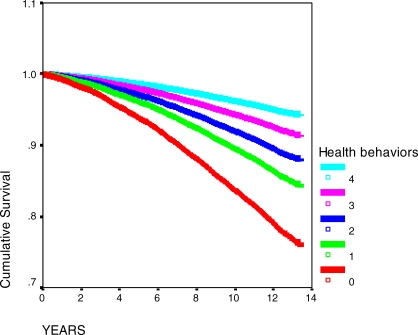
- Adjusted cumulative survival was about 75% for those scoring zero and 95% for those scoring four. The mortality risk difference between score 0 and score 4 was equivalent to approximately 14 years of chronological age.
- Relationships were consistent in subgroups stratified by sex, age, BMI, and social class, and after excluding deaths within 2 years; similar trends were seen in 2,057 individuals with prevalent disease excluded from main analyses.
Methods
- Prospective population study: EPIC-Norfolk, UK, baseline survey 1993–1997, follow-up to July 2006 (average 11 years). Of 22,301 with complete data, 2,057 with history of heart disease, stroke, or cancer were excluded, leaving 20,244 participants aged 45–79.
- Health behaviour score: one point each for current nonsmoking, not physically inactive, moderate alcohol intake (1–14 units/week), and plasma vitamin C >50 mmol/l indicating at least five fruit/vegetable servings daily; total score 0–4.
- Cox proportional hazards models estimated relative risks for all-cause and cause-specific mortality, adjusted for age, sex, body mass index, and social class; analyses included subgroup stratification and exclusion of deaths within 2 years.
Limitations
- The paper states potential large measurement errors in exposure assessment, use of only one baseline measure without accounting for lifestyle changes over follow-up, no weighting of different behaviours, and dichotomizing physical activity as inactive versus not inactive, which may obscure gradients between moderately inactive and active people.
- The paper states residual confounding cannot be excluded, and the analyses examined only mortality, not functional health or quality of life.
- Evident from the text: the cohort was 99.5% white, resident in Norfolk, UK, and middle-aged/older, so findings may not generalize to other populations; the observational design cannot establish causality.
Model-written summary. Check it against the paper before relying on it.
Integrity signals
Registry
Cites
Statistics
Figures
Verification
Claims the paper makes
19 Own result · 14 Not checked yet · 10 Own method · 6 Own interpretation · 1 No basis given
A result the paper reports from its own data — it cites no other source for it, so there is none to check. The quote shows it is in the paper.
In the paper
“The relationships were consistent in subgroups stratified by sex, age, body mass index, and social class, and after excluding deaths within 2 y.”
§ Combined Impact of Health Behaviours and Mortality in Men and Women: The EPIC-Norfolk Prospective Population Study > Abstract
plain- Asserted: passes — The authors put it forward as true.
- Checkable: passes — It can be checked against evidence.
- Load-bearing: passes — The paper’s conclusions depend on it.
- Based: passes — The paper gives a reason why it holds.
- Rests on an assumption: Death certification at the Office of National Statistics, United Kingdom, is virtually complete.
A result the paper reports from its own data — it cites no other source for it, so there is none to check. The quote shows it is in the paper.
In the paper
“The trends were strongest for cardiovascular causes.”
§ Combined Impact of Health Behaviours and Mortality in Men and Women: The EPIC-Norfolk Prospective Population Study > Abstract
plaincorrelational- Asserted: passes — The authors put it forward as true.
- Checkable: passes — It can be checked against evidence.
- Load-bearing: unclear — It is unclear whether the paper’s conclusions depend on it.
- Based: passes — The paper gives a reason why it holds.
- Rests on an assumption: Death certification at the Office of National Statistics, United Kingdom, is virtually complete.
A result the paper reports from its own data — it cites no other source for it, so there is none to check. The quote shows it is in the paper.
In the paper
“As might be expected, there were some differentials in the observed risk reductions observed for different health behaviours and cause-specific mortality in men and women; current smoking was the most consistent and strongest risk factor.”
§ Combined Impact of Health Behaviours and Mortality in Men and Women: The EPIC-Norfolk Prospective Population Study > Results
plaincorrelational- Asserted: passes — The authors put it forward as true.
- Checkable: passes — It can be checked against evidence.
- Load-bearing: passes — The paper’s conclusions depend on it.
- Based: passes — The paper gives a reason why it holds.
- Rests on an assumption: Death certification at the Office of National Statistics, United Kingdom, is virtually complete.
A result the paper reports from its own data — it cites no other source for it, so there is none to check. The quote shows it is in the paper.
In the paper
“None of the interaction terms for health score with sex, age, body mass index, and social class were significant in multivariate analyses.”
§ Combined Impact of Health Behaviours and Mortality in Men and Women: The EPIC-Norfolk Prospective Population Study > Results
plain- Asserted: passes — The authors put it forward as true.
- Checkable: passes — It can be checked against evidence.
- Load-bearing: passes — The paper’s conclusions depend on it.
- Based: passes — The paper gives a reason why it holds.
- Rests on an assumption: Death certification at the Office of National Statistics, United Kingdom, is virtually complete.
A result the paper reports from its own data — it cites no other source for it, so there is none to check. The quote shows it is in the paper.
In the paper
“From the Cox model, the beta coefficient for mortality associated with each year increase in chronological age was 0.10 (6 standard error 0.004).”
§ Combined Impact of Health Behaviours and Mortality in Men and Women: The EPIC-Norfolk Prospective Population Study > Results
plaincorrelational- Asserted: passes — The authors put it forward as true.
- Checkable: passes — It can be checked against evidence.
- Load-bearing: unclear — It is unclear whether the paper’s conclusions depend on it.
- Based: passes — The paper gives a reason why it holds.
- Rests on an assumption: Death certification at the Office of National Statistics, United Kingdom, is virtually complete.
A result the paper reports from its own data — it cites no other source for it, so there is none to check. The quote shows it is in the paper.
In the paper
“The mortality risk for those with four compared to zero health behaviours was equivalent to being 14 y younger in chronological age.”
- Also stated in: § Results · hedged
“The difference in beta coefficients between a health score of zero versus four was 1.43, that is, equivalent to approximately 14 y in chronological age for mortality risk.”
§ Combined Impact of Health Behaviours and Mortality in Men and Women: The EPIC-Norfolk Prospective Population Study > Abstract
plaincorrelational- Asserted: passes — The authors put it forward as true.
- Checkable: passes — It can be checked against evidence.
- Load-bearing: passes — The paper’s conclusions depend on it.
- Based: passes — The paper gives a reason why it holds.
- Rests on an assumption: Death certification at the Office of National Statistics, United Kingdom, is virtually complete.
- Also stated in: § Results · hedged
A result the paper reports from its own data — it cites no other source for it, so there is none to check. The quote shows it is in the paper.
In the paper
“After an average 11 y follow-up, the age-, sex-, body mass-, and social class-adjusted relative risks (95% confidence intervals) for allcause mortality(1,987 deaths) for men and women who had three, two, one, and zero compared to four health behaviours were respectively, 1.39 (1.21-1.60),1.95 (1.70--2.25),2.52 (2.13-3.00),and 4.04 (2.95-5.54)p , 0.001 trend.”
§ Combined Impact of Health Behaviours and Mortality in Men and Women: The EPIC-Norfolk Prospective Population Study > Abstract
plaincorrelational- Asserted: passes — The authors put it forward as true.
- Checkable: passes — It can be checked against evidence.
- Load-bearing: passes — The paper’s conclusions depend on it.
- Based: passes — The paper gives a reason why it holds.
- Rests on an assumption: Death certification at the Office of National Statistics, United Kingdom, is virtually complete.
A result the paper reports from its own data — it cites no other source for it, so there is none to check. The quote shows it is in the paper.
In the paper
“As with the relative risks of mortality, the adjusted cumulative survival was about 75% for those scoring zero and 95% for those scoring four, respectively, for health behaviours.”
§ Combined Impact of Health Behaviours and Mortality in Men and Women: The EPIC-Norfolk Prospective Population Study > Results
plaincorrelational- Asserted: passes — The authors put it forward as true.
- Checkable: passes — It can be checked against evidence.
- Load-bearing: passes — The paper’s conclusions depend on it.
- Based: passes — The paper gives a reason why it holds.
- Rests on an assumption: Death certification at the Office of National Statistics, United Kingdom, is virtually complete.
A result the paper reports from its own data — it cites no other source for it, so there is none to check. The quote shows it is in the paper.
In the paper
“The difference in beta coefficients between a health score of zero versus four was 1.43, that is, equivalent to approximately 14 y in chronological age for mortality risk.”
§ Combined Impact of Health Behaviours and Mortality in Men and Women: The EPIC-Norfolk Prospective Population Study > Results
plaincorrelational- Asserted: passes — The authors put it forward as true.
- Checkable: passes — It can be checked against evidence.
- Load-bearing: passes — The paper’s conclusions depend on it.
- Based: passes — The paper gives a reason why it holds.
- Rests on an assumption: Death certification at the Office of National Statistics, United Kingdom, is virtually complete.
A result the paper reports from its own data — it cites no other source for it, so there is none to check. The quote shows it is in the paper.
In the paper
“Cancer | 839/20,244 | 1 | 1.21 (0,99-1.48) | 1.81 (1.48-2.22) | 1.94 (1.48-2.54) | 3.74 (2.34-5.98)”
§ Combined Impact of Health Behaviours and Mortality in Men and Women: The EPIC-Norfolk Prospective Population Study > Additional Information.
plaincorrelational- Asserted: passes — The authors put it forward as true.
- Checkable: passes — It can be checked against evidence.
- Load-bearing: passes — The paper’s conclusions depend on it.
- Based: passes — The paper gives a reason why it holds.
- Rests on an assumption: The observed associations between health behaviour score and mortality are not explained by unmeasured or residual confounding.
- It may state two separate claims as one. 14
- The quote only partly states this claim. 4
- Probably not a substantial claim. 15
A result the paper reports from its own data — it cites no other source for it, so there is none to check. The quote shows it is in the paper.
In the paper
“Each of the health behaviours: smoking, being physically inactive, not having a moderate alcohol intake, and a low fruit and vegetable intake as indicated by plasma vitamin C level ,50 mmol/l.were associated with significantly higher risks of mortality from all causes.”
§ Combined Impact of Health Behaviours and Mortality in Men and Women: The EPIC-Norfolk Prospective Population Study > Results
plaincorrelational- Asserted: passes — The authors put it forward as true.
- Checkable: passes — It can be checked against evidence.
- Load-bearing: passes — The paper’s conclusions depend on it.
- Based: passes — The paper gives a reason why it holds.
It may state two separate claims as one.
- Rests on an assumption: Death certification at the Office of National Statistics, United Kingdom, is virtually complete.
In the paper
“In this cohort, vitamin supplement use was not associated with mortality, and results were similar after adjusting for vitamin supplement use or excluding vitamin users from the analyses (unpublished data and [19]).”
§ Combined Impact of Health Behaviours and Mortality in Men and Women: The EPIC-Norfolk Prospective Population Study > Results
What the sources say
- Not checked yetcites [19] Khaw, 2001, Lancet
plain- Asserted: passes — The authors put it forward as true.
- Checkable: passes — It can be checked against evidence.
- Load-bearing: unclear — It is unclear whether the paper’s conclusions depend on it.
- Based: passes — The paper gives a reason why it holds.
It may state two separate claims as one.
- Rests on an assumption: Death certification at the Office of National Statistics, United Kingdom, is virtually complete.
A result the paper reports from its own data — it cites no other source for it, so there is none to check. The quote shows it is in the paper.
In the paper
“All Cause | RR (95% CI) | n ¼ 1,977 events | 1.77 (1.55-2.01) | 1.24 (1.13-1.36) | 1.26 (1.14-1.38) | 1.44 (1.31-1.59)”
§ Combined Impact of Health Behaviours and Mortality in Men and Women: The EPIC-Norfolk Prospective Population Study > Additional Information.
plaincorrelational- Asserted: passes — The authors put it forward as true.
- Checkable: passes — It can be checked against evidence.
- Load-bearing: passes — The paper’s conclusions depend on it.
- Based: passes — The paper gives a reason why it holds.
The quote only partly states this claim.
- Rests on an assumption: The observed associations between health behaviour score and mortality are not explained by unmeasured or residual confounding.
A result the paper reports from its own data — it cites no other source for it, so there is none to check. The quote shows it is in the paper.
In the paper
“All cause | 1,977/20,244 | 1 | 1.39 (1.21-1.60) | 1.95 (1.70-2.25) | 2.52 (2.13-3.00) | 4.04 (2.95-5.54)”
§ Combined Impact of Health Behaviours and Mortality in Men and Women: The EPIC-Norfolk Prospective Population Study > Additional Information.
plaindirectn = 20,244- Asserted: passes — The authors put it forward as true.
- Checkable: passes — It can be checked against evidence.
- Load-bearing: passes — The paper’s conclusions depend on it.
- Based: passes — The paper gives a reason why it holds.
It may state two separate claims as one.
- Rests on an assumption: The observed associations between health behaviour score and mortality are not explained by unmeasured or residual confounding.
The paper states this without a source or data behind it here, so there is nothing to check it against. The quote shows it is in the paper.
In the paper
“The four health behaviours were within the usual range found in a free-living population.”
§ Combined Impact of Health Behaviours and Mortality in Men and Women: The EPIC-Norfolk Prospective Population Study > Implications
plain- Asserted: passes — The authors put it forward as true.
- Checkable: passes — It can be checked against evidence.
- Load-bearing: fails — The paper’s conclusions may not depend on it.
- Based: fails — The paper may give no reason why it holds.
Probably not a substantial claim. The paper’s conclusions may not depend on it. The paper may give no reason why it holds.
A result the paper reports from its own data — it cites no other source for it, so there is none to check. The quote shows it is in the paper.
In the paper
“All Cause | RR (95% CI) | n ¼ 1,977 events | 1.77 (1.55-2.01) | 1.24 (1.13-1.36) | 1.26 (1.14-1.38) | 1.44 (1.31-1.59)”
§ Combined Impact of Health Behaviours and Mortality in Men and Women: The EPIC-Norfolk Prospective Population Study > Additional Information.
plaincorrelational- Asserted: passes — The authors put it forward as true.
- Checkable: passes — It can be checked against evidence.
- Load-bearing: passes — The paper’s conclusions depend on it.
- Based: passes — The paper gives a reason why it holds.
The quote only partly states this claim.
- Rests on an assumption: The observed associations between health behaviour score and mortality are not explained by unmeasured or residual confounding.
A result the paper reports from its own data — it cites no other source for it, so there is none to check. The quote shows it is in the paper.
In the paper
“All Cause | RR (95% CI) | n ¼ 1,977 events | 1.77 (1.55-2.01) | 1.24 (1.13-1.36) | 1.26 (1.14-1.38) | 1.44 (1.31-1.59)”
§ Combined Impact of Health Behaviours and Mortality in Men and Women: The EPIC-Norfolk Prospective Population Study > Additional Information.
plaincorrelational- Asserted: passes — The authors put it forward as true.
- Checkable: passes — It can be checked against evidence.
- Load-bearing: passes — The paper’s conclusions depend on it.
- Based: passes — The paper gives a reason why it holds.
The quote only partly states this claim.
- Rests on an assumption: The observed associations between health behaviour score and mortality are not explained by unmeasured or residual confounding.
None of the sources cited for this claim have been checked yet.
In the paper
“Nevertheless, there is a large body of experimental and epidemiologic evidence indicating a high intake of fruit and vegetables is beneficially associated with health [5,7,11,32]”
§ Combined Impact of Health Behaviours and Mortality in Men and Women: The EPIC-Norfolk Prospective Population Study > Discussion
What the sources say
- Not checked yetcites [5] Joshipura, 2001, Ann Intern Med
- Not checked yetcites [7] Law, 1998, Eur J Clin Nutr
- Not checked yetcites [11] Ness, 1997, Int J Epidemiol
- Not checked yetcites [32] Rimm, 1996, JAMA
hedgedcorrelational- Asserted: passes — The authors put it forward as true.
- Checkable: passes — It can be checked against evidence.
- Load-bearing: fails — The paper’s conclusions may not depend on it.
- Based: passes — The paper gives a reason why it holds.
Probably not a substantial claim. The paper’s conclusions may not depend on it.
What the paper did — it cites no source for this, so there is none to check. The quote shows it is in the paper.
In the paper
“Of the 22,301 with available data, 2,057 had a history of heart disease, stroke, or cancer at the baseline visit and were excluded from the main analyses, leaving 20,244 individuals.”
§ Combined Impact of Health Behaviours and Mortality in Men and Women: The EPIC-Norfolk Prospective Population Study > Methods
plain- Asserted: passes — The authors put it forward as true.
- Checkable: passes — It can be checked against evidence.
- Load-bearing: passes — The paper’s conclusions depend on it.
- Based: passes — The paper gives a reason why it holds.
Probably not a substantial claim.
None of the sources cited for this claim have been checked yet.
In the paper
“A huge body of evidence indicates that lifestyles such as smoking, diet, and physical activity have a major influence on health [1][2][3][4][5][6][7][8][9][10][11][12][13][14][15][16].”
§ Combined Impact of Health Behaviours and Mortality in Men and Women: The EPIC-Norfolk Prospective Population Study > Introduction
What the sources say
- Not checked yetcites [1]
- Not checked yetcites [2] Chiuve, 2006, Circulation
- Not checked yetcites [3] Doll, 2004, BMJ
hedgeddirect- Asserted: passes — The authors put it forward as true.
- Checkable: passes — It can be checked against evidence.
- Load-bearing: fails — The paper’s conclusions may not depend on it.
- Based: passes — The paper gives a reason why it holds.
Probably not a substantial claim. The paper’s conclusions may not depend on it.
None of the sources cited for this claim have been checked yet.
In the paper
“Because humans do not manufacture vitamin C and have to rely on exogenous sources, plasma vitamin C is a good biomarker of plant food intake; previous studies have reported that a blood value of 50 mmol/l or more indicates an intake of at least five servings of fruit and vegetables daily [19;26].”
§ Combined Impact of Health Behaviours and Mortality in Men and Women: The EPIC-Norfolk Prospective Population Study > Methods
What the sources say
- Not checked yetcites [19] Khaw, 2001, Lancet
- Not checked yetcites [26] Bingham, 1995, Br J Nutr
hedgedcorrelational- Asserted: passes — The authors put it forward as true.
- Checkable: passes — It can be checked against evidence.
- Load-bearing: unclear — It is unclear whether the paper’s conclusions depend on it.
- Based: passes — The paper gives a reason why it holds.
It may state two separate claims as one.
What the paper did — it cites no source for this, so there is none to check. The quote shows it is in the paper.
In the paper
“The score, though simple, was based on instruments that have been extensively previously validated.”
§ Combined Impact of Health Behaviours and Mortality in Men and Women: The EPIC-Norfolk Prospective Population Study > Discussion
plain- Asserted: passes — The authors put it forward as true.
- Checkable: passes — It can be checked against evidence.
- Load-bearing: fails — The paper’s conclusions may not depend on it.
- Based: passes — The paper gives a reason why it holds.
Probably not a substantial claim. The paper’s conclusions may not depend on it.
In the paper
“Nevertheless, a recent report from 2,339 men and women aged 70-90 y in 11 European countries indicated that adherence to a Mediterranean diet, nonsmoking, any alcohol use, and moderate physical activity were associated with more than 50% lower rate of all-cause and cause-specific mortality [6].”
§ Combined Impact of Health Behaviours and Mortality in Men and Women: The EPIC-Norfolk Prospective Population Study > Introduction
What the sources say
- Not checked yetcites [6] Knoops, 2004, JAMA
hedgedcorrelationaln = 2,339- Asserted: passes — The authors put it forward as true.
- Checkable: passes — It can be checked against evidence.
- Load-bearing: passes — The paper’s conclusions depend on it.
- Based: passes — The paper gives a reason why it holds.
Probably not a substantial claim.
In the paper
“The Norfolk cohort was comparable to national population samples with respect to characteristics including anthropometry, blood pressure, and lipids, but with a lower prevalence of current smokers [21].”
§ Combined Impact of Health Behaviours and Mortality in Men and Women: The EPIC-Norfolk Prospective Population Study > Methods
What the sources say
- Not checked yetcites [21] Day, 1999, Br J Cancer
plain- Asserted: passes — The authors put it forward as true.
- Checkable: passes — It can be checked against evidence.
- Load-bearing: unclear — It is unclear whether the paper’s conclusions depend on it.
- Based: passes — The paper gives a reason why it holds.
It may state two separate claims as one.
A conclusion the paper draws from its own results — it cites no other source for it, so there is none to check. The quote shows it is in the paper.
In the paper
“Four health behaviours combined predict a 4-fold difference in total mortality in men and women, with an estimated impact equivalent to 14 y in chronological age.”
§ Combined Impact of Health Behaviours and Mortality in Men and Women: The EPIC-Norfolk Prospective Population Study > Abstract
hedgedcorrelational- Asserted: passes — The authors put it forward as true.
- Checkable: passes — It can be checked against evidence.
- Load-bearing: passes — The paper’s conclusions depend on it.
- Based: passes — The paper gives a reason why it holds.
It may state two separate claims as one.
- Rests on an assumption: Death certification at the Office of National Statistics, United Kingdom, is virtually complete.
In the paper
“We have also previously shown that low work and leisure-time physical activity predicts all-cause mortality and cardiovascular disease incidence [20].”
§ Combined Impact of Health Behaviours and Mortality in Men and Women: The EPIC-Norfolk Prospective Population Study > Introduction
What the sources say
- Not checked yetcites [20] Khaw, 2006, Int J Epidemiol
plaincorrelational- Asserted: passes — The authors put it forward as true.
- Checkable: passes — It can be checked against evidence.
- Load-bearing: unclear — It is unclear whether the paper’s conclusions depend on it.
- Based: passes — The paper gives a reason why it holds.
It may state two separate claims as one.
What the paper did — it cites no source for this, so there is none to check. The quote shows it is in the paper.
In the paper
“The authors have declared that no competing interests exist.”
§ Combined Impact of Health Behaviours and Mortality in Men and Women: The EPIC-Norfolk Prospective Population Study > Conflict
plain- Asserted: passes — The authors put it forward as true.
- Checkable: passes — It can be checked against evidence.
- Load-bearing: fails — The paper’s conclusions may not depend on it.
- Based: passes — The paper gives a reason why it holds.
Probably not a substantial claim. The paper’s conclusions may not depend on it.
What the paper did — it cites no source for this, so there is none to check. The quote shows it is in the paper.
In the paper
“We used only a measure at one point in time to characterize individuals and did not take into account likely changes in lifestyles over the follow-up period.”
§ Combined Impact of Health Behaviours and Mortality in Men and Women: The EPIC-Norfolk Prospective Population Study > Discussion
plain- Asserted: passes — The authors put it forward as true.
- Checkable: passes — It can be checked against evidence.
- Load-bearing: unclear — It is unclear whether the paper’s conclusions depend on it.
- Based: passes — The paper gives a reason why it holds.
It may state two separate claims as one.
A conclusion the paper draws from its own results — it cites no other source for it, so there is none to check. The quote shows it is in the paper.
In the paper
“These results may provide further support for the idea that even small differences in lifestyle may make a big difference to health in the population and encourage behaviour change.”
§ Combined Impact of Health Behaviours and Mortality in Men and Women: The EPIC-Norfolk Prospective Population Study > Implications
hedgedconditional- Asserted: passes — The authors put it forward as true.
- Checkable: fails — It may be too vague to check against evidence.
- Load-bearing: passes — The paper’s conclusions depend on it.
- Based: passes — The paper gives a reason why it holds.
Probably not a substantial claim. It may be too vague to check against evidence. It may state two separate claims as one.
- Rests on an assumption: The EPIC-Norfolk cohort is representative of middle-aged and older people in the general population.
What the paper did — it cites no source for this, so there is none to check. The quote shows it is in the paper.
In the paper
“Mortality Rates and Relative Risk of All-Cause Mortality by Number of Health Behaviours, Adjusted by Age, Sex, and Body Mass Index, and Stratified by Cause, Sex, Age, Body Mass Index, and Social Class in 20,244 Men and Women Aged 45-79 y without Known Cardiovascular Disease or Cancer in EPIC-Norfolk 1993-2006, Cox Regression Model”
§ Combined Impact of Health Behaviours and Mortality in Men and Women: The EPIC-Norfolk Prospective Population Study > Additional Information.
plainn = 20,244- Asserted: passes — The authors put it forward as true.
- Checkable: passes — It can be checked against evidence.
- Load-bearing: passes — The paper’s conclusions depend on it.
- Based: passes — The paper gives a reason why it holds.
Probably not a substantial claim.
In the paper
“Thirdly, the proportions of the population with some or all positive health behaviours were relatively high since the definitions for health behaviours were not necessarily optimal, for example, for physical activity [20], and dichotomizing behaviours between inactive and not inactive may have obscured the gradient in mortality between those who were moderately inactive and those who were active.”
§ Combined Impact of Health Behaviours and Mortality in Men and Women: The EPIC-Norfolk Prospective Population Study > Discussion
What the sources say
- Not checked yetcites [20] Khaw, 2006, Int J Epidemiol
hedgedconditional- Asserted: passes — The authors put it forward as true.
- Checkable: passes — It can be checked against evidence.
- Load-bearing: unclear — It is unclear whether the paper’s conclusions depend on it.
- Based: passes — The paper gives a reason why it holds.
It may state two separate claims as one.
A conclusion the paper draws from its own results — it cites no other source for it, so there is none to check. The quote shows it is in the paper.
In the paper
“Nevertheless, random measurement error is likely to attenuate any associations observed, so the estimated differences in risk are likely to be larger than those observed.”
§ Combined Impact of Health Behaviours and Mortality in Men and Women: The EPIC-Norfolk Prospective Population Study > Discussion
hedgeddirect- Asserted: passes — The authors put it forward as true.
- Checkable: passes — It can be checked against evidence.
- Load-bearing: unclear — It is unclear whether the paper’s conclusions depend on it.
- Based: passes — The paper gives a reason why it holds.
It may state two separate claims as one.
What the paper did — it cites no source for this, so there is none to check. The quote shows it is in the paper.
In the paper
“The sponsors had no role in the design and conduct of the study, collection, management, analysis and interpretation of the data, and preparation, review, or approval of the manuscript.”
§ Combined Impact of Health Behaviours and Mortality in Men and Women: The EPIC-Norfolk Prospective Population Study > Funding
plain- Asserted: passes — The authors put it forward as true.
- Checkable: passes — It can be checked against evidence.
- Load-bearing: fails — The paper’s conclusions may not depend on it.
- Based: passes — The paper gives a reason why it holds.
Probably not a substantial claim. The paper’s conclusions may not depend on it.
What the paper did — it cites no source for this, so there is none to check. The quote shows it is in the paper.
In the paper
“Though we cannot exclude residual confounding, our results are consistent with the existing evidence indicating these behavioural factors are beneficial for health.”
§ Combined Impact of Health Behaviours and Mortality in Men and Women: The EPIC-Norfolk Prospective Population Study > Discussion
plain- Asserted: passes — The authors put it forward as true.
- Checkable: passes — It can be checked against evidence.
- Load-bearing: fails — The paper’s conclusions may not depend on it.
- Based: passes — The paper gives a reason why it holds.
Probably not a substantial claim. The paper’s conclusions may not depend on it.
A conclusion the paper draws from its own results — it cites no other source for it, so there is none to check. The quote shows it is in the paper.
In the paper
“their combined impact was associated with an estimated 4-fold difference in mortality risk, equivalent to 14 y in chronological age.”
§ Combined Impact of Health Behaviours and Mortality in Men and Women: The EPIC-Norfolk Prospective Population Study > Implications
hedgedcorrelational- Asserted: passes — The authors put it forward as true.
- Checkable: passes — It can be checked against evidence.
- Load-bearing: passes — The paper’s conclusions depend on it.
- Based: passes — The paper gives a reason why it holds.
It may state two separate claims as one.
- Rests on an assumption: The observed associations between health behaviour score and mortality are not explained by unmeasured or residual confounding.
What the paper did — it cites no source for this, so there is none to check. The quote shows it is in the paper.
In the paper
“KTK conducted the data analyses, wrote the paper with coauthors, had full access to all of the data in the study, and takes responsibility for the integrity of the data and the accuracy of the data analysis.”
§ Combined Impact of Health Behaviours and Mortality in Men and Women: The EPIC-Norfolk Prospective Population Study > Contribution
plain- Asserted: passes — The authors put it forward as true.
- Checkable: passes — It can be checked against evidence.
- Load-bearing: fails — The paper’s conclusions may not depend on it.
- Based: passes — The paper gives a reason why it holds.
Probably not a substantial claim. The paper’s conclusions may not depend on it. It may state two separate claims as one.
In the paper
“subjective functional health is also predictive of mortality [36]”
§ Combined Impact of Health Behaviours and Mortality in Men and Women: The EPIC-Norfolk Prospective Population Study > Implications
What the sources say
- Not checked yetcites [36] Myint, 2006, Ann Epidemiol
plaincorrelational- Asserted: passes — The authors put it forward as true.
- Checkable: passes — It can be checked against evidence.
- Load-bearing: fails — The paper’s conclusions may not depend on it.
- Based: passes — The paper gives a reason why it holds.
Probably not a substantial claim. The paper’s conclusions may not depend on it.
In the paper
“In the UK, the recommendations are up to 21 drinks weekly for men and 14 drinks weekly for women [33].”
§ Combined Impact of Health Behaviours and Mortality in Men and Women: The EPIC-Norfolk Prospective Population Study > Discussion
What the sources say
- Not checked yetcites [33]
plain- Asserted: passes — The authors put it forward as true.
- Checkable: passes — It can be checked against evidence.
- Load-bearing: fails — The paper’s conclusions may not depend on it.
- Based: passes — The paper gives a reason why it holds.
Probably not a substantial claim. The paper’s conclusions may not depend on it. It may state two separate claims as one.
What the paper did — it cites no source for this, so there is none to check. The quote shows it is in the paper.
In the paper
“NW developed and validated the physical activity measures and scales.”
§ Combined Impact of Health Behaviours and Mortality in Men and Women: The EPIC-Norfolk Prospective Population Study > Contribution
plain- Asserted: passes — The authors put it forward as true.
- Checkable: passes — It can be checked against evidence.
- Load-bearing: passes — The paper’s conclusions depend on it.
- Based: passes — The paper gives a reason why it holds.
Probably not a substantial claim.
The paper relies on this without support.
Health behaviours such as smoking, diet, and physical activity are highly correlated.
“Many health behaviours such as smoking habit, diet, and physical activity are highly correlated and, in aetiologically focused papers, treated as covariates.”
The paper relies on this without support.
Death certification at the Office of National Statistics, United Kingdom, is virtually complete.
“All participants are flagged for death certification at the Office of National Statistics, United Kingdom which is virtually complete.”
The paper relies on this without support.
The observed associations between health behaviour score and mortality are not explained by unmeasured or residual confounding.
“After allowing for other factors that might have affected their likelihood of dying (for example, age)”
The paper relies on this without support.
The EPIC-Norfolk cohort is representative of middle-aged and older people in the general population.
“These findings indicate that the combination of four simply defined health behaviors predicts a 4-fold difference in the risk of dying over an average period of 11 years for middle-aged and older people.”
The paper relies on this without support.
Mortality follow-up via record linkage was complete and accurate.
“Deaths among the participants were then recorded until 2006.”
Claims other papers make about this one
Each is checked against this paper’s own text: does it say what the citing paper says it does?
In the citing paper
“Moreover, regular physical activity appears to protect against premature death independent of obesity [10, 11].”
From Exercise as a Mean to Control Low‐Grade Systemic Inflammation (2008) · cites this paper as [10]
In the citing paper
“regular exercise offers protection against all causes of mortality, primarily by protection against atherosclerosis and insulin resistance”
From Exercise as a Mean to Control Low‐Grade Systemic Inflammation (2008) · cites this paper as [10]
Self-check
Percentages, sums and reported differences re-computed from the paper’s own numbers.
Each contradiction between two passages listed here was confirmed by an independent check.
Rated major: it would touch a result — a value a result rests on, reported and recomputed p-values on opposite sides of the significance level, two passages that conflict with no sign which is right, or a cited work retracted before this paper was published.
In the paper
§ Combined Impact of Health Behaviours and Mortality in Men and Women: The EPIC-Norfolk Prospective Population Study > Additional Information.
“| | at least half an hour of leisure time activity |”
§ Combined Impact of Health Behaviours and Mortality in Men and Women: The EPIC-Norfolk Prospective Population Study > Methods
“For the purposes of the current study, we dichotomised the population into physically inactive (sedentary job and no recreational activity) and not physically inactive (any category with activity levels above the latter).”
Rated minor: it would not touch a result — a value no result rests on, a p-value that stays on the same side of the significance level, or a conflict that is clerical, resolved elsewhere in the paper, or outside its own findings.
In the paper
“| | 21 or more units a week | 15.1 (1,389) | 1.2 (254) |”
§ Combined Impact of Health Behaviours and Mortality in Men and Women: The EPIC-Norfolk Prospective Population Study > Additional Information.
Reported 1.2 · recomputed 2.295941
Rated minor: it would not touch a result — a value no result rests on, a p-value that stays on the same side of the significance level, or a conflict that is clerical, resolved elsewhere in the paper, or outside its own findings.
In the paper
“| | III nonmanual | 12.3 (1,108) | 119.9 (2,145) |”
§ Combined Impact of Health Behaviours and Mortality in Men and Women: The EPIC-Norfolk Prospective Population Study > Additional Information.
Reported 119.9 · recomputed 19.388954
Rated minor: it would not touch a result — a value no result rests on, a p-value that stays on the same side of the significance level, or a conflict that is clerical, resolved elsewhere in the paper, or outside its own findings.
In the paper
§ Combined Impact of Health Behaviours and Mortality in Men and Women: The EPIC-Norfolk Prospective Population Study > Additional Information.
“| Alcohol intake | One or more, but less than 14 units, a |”
§ Combined Impact of Health Behaviours and Mortality in Men and Women: The EPIC-Norfolk Prospective Population Study > Methods
“For these analyses, a moderate drinker was defined as someone who drank one or more units a week (that is, not a nondrinker), but not more than 14 units a week.”
Citations
Cites
Mortality in relation to smoking: 40 years' observations on male British doctors
Doll, R., Peto, R., Wheatley, K., Gray, R., & Sutherland, I. (1994) · BMJ · doi:10.1136/bmj.309.6959.901 · Cited by 5,932
Diet, nutrition and the prevention of chronic diseases
Joint, W. (2002) · Medical Entomology and Zoology · Cited by 4,890
Adherence to a Mediterranean diet and survival in a Greek population
Trichopoulou, A., Costacou, T., Bamia, C., & Trichopoulos, D. (2003) · New England Journal of Medicine · doi:10.1056/nejmoa025039 · Cited by 4,397
Thompson, P. D., Buchner, D., Piña, I. L., Balady, G. J., Williams, M. A., Marcus, B. H., Berra, K., Blair, S. N., Costa, F., Franklin, B., et al. (2003) · Circulation · doi:10.1161/01.cir.0000075572.40158.77 · Cited by 2,132
Primary Prevention of Coronary Heart Disease in Women through Diet and Lifestyle
Stampfer, M. J., Hu, F. B., Manson, J. E., Rimm, E. B., & Willett, W. C. (2000) · New England Journal of Medicine · doi:10.1056/nejm200007063430103 · Cited by 1,794
Diet, Nutrition, and the Prevention of Chronic Diseases
Leong, A. (1992) · Pathology · doi:10.1016/s0031-3025(16)36541-2 · Cited by 1,633
The Effect of Fruit and Vegetable Intake on Risk for Coronary Heart Disease
Joshipura, K. J., Hu, F. B., Manson, J. E., Stampfer, M. J., Rimm, E. B., Speizer, F. E., Colditz, G., Ascherio, A., Rosner, B., Spiegelman, D., et al. (2001) · Annals of Internal Medicine · doi:10.7326/0003-4819-134-12-200106190-00010 · Cited by 1,396
Fruit and vegetables, and cardiovascular disease: A review
Ness, A. R., & Powles, J. W. (1997) · International Journal of Epidemiology · doi:10.1093/ije/26.1.1 · Cited by 1,368
McCullough, M. L., Feskanich, D., Stampfer, M. J., Giovannucci, E. L., Rimm, E. B., Hu, F. B., Spiegelman, D., Hunter, D. J., Colditz, G. A., & Willett, W. C. (2002) · The American Journal of Clinical Nutrition · doi:10.1093/ajcn/76.6.1261 · Cited by 1,191
Howard, B. V., Van Horn, L., Hsia, J., Manson, J. E., Stefanick, M. L., Wassertheil-Smoller, S., Kuller, L. H., LaCroix, A. Z., Langer, R. D., Lasser, N. L., et al. (2006) · JAMA · doi:10.1001/jama.295.6.655 · Cited by 1,091
Research works printed but not linked: 34
- Chiuve, 2006, Circulation, 114, 160
- Doll, 2004, BMJ, 328, 1519
- Hu, 2000, Am J Clin Nutr, 72, 912
- Joshipura, 2001, Ann Intern Med, 134, 1106
- Knoops, 2004, JAMA, 292, 1433
- Law, 1998, Eur J Clin Nutr, 52, 549
- Manson, 1996, N Engl J Med, 334, 1325
- McCullough, 2002, Am J Clin Nutr, 76, 1261
- Mukamal, 2006, Arch Intern Med, 166, 2145
- Ness, 1997, Int J Epidemiol, 26, 1
- Oguma, 2002, Br J Sports Med, 36, 162
- Sesso, 1999, Am J Epidemiol, 150, 408
- Stampfer, 2000, N Engl J Med, 343, 16
- Thompson, 2003, Circulation, 107, 3109
- Trichopoulou, 2003, N Engl J Med, 348, 2599
- Alonso, 2005, JAMA, 293, 674
- Craighead, 2005, JAMA, 293, 674
- Khaw, 2001, Lancet, 357, 657
- Khaw, 2006, Int J Epidemiol, 35, 1034
- Day, 1999, Br J Cancer, 80, 95
- Wareham, 2002, Int J Epidemiol, 31, 168
- Wareham, 2003, Public Health Nutr, 6, 407
- Shohaimi, 2004, Eur Respir J, 24, 157
- Riemersma, 1990, Eur J Clin Nutr, 44, 143
- Bingham, 1995, Br J Nutr, 73, 531
- Liese, 2000, Am J Epidemiol, 152, 884
- Rimm, 2004, JAMA, 292, 1490
- Anderson, 2006, JAMA, 295, 693
- Howard, 2006, JAMA, 295, 655
- Prentice, 2006, JAMA, 295, 629
- Rimm, 1996, JAMA, 275, 447
- Myint, 2006, Prev Med, 44, 109
- Myint, 2007, Public Health Nutr, 10, 34
- Myint, 2006, Ann Epidemiol, 16, 492
Cited by
Sorted by citations
Items 101–200 of 836
Nutritional biomarkers for objective dietary assessment
Kuhnle, G. (2012) · Journal of the Science of Food and Agriculture · doi:10.1002/jsfa.5631 · Cited by 108
Petersen, K. E. N., Johnsen, N. F., Olsen, A., Albieri, V., Olsen, L. K. H., Dragsted, L. O., Overvad, K., Tjønneland, A. M., & Egeberg, R. (2015) · British Journal Of Nutrition · doi:10.1017/s0007114515000070 · Cited by 114
Papandreou, C., Becerra-Tomás, N., Bulló, M., Martínez-González, M. Á., Corella, D., Estruch, R., Ros, E., Arós, F., Schroder, H., Fitó, M., et al. (2019) · Clinical Nutrition · doi:10.1016/j.clnu.2017.12.019 · Cited by 106
Lahiri, M., Luben, R., Morgan, C., Bunn, D. K., Marshall, T., Lunt, M., Verstappen, S. M. M., Symmons, D. P. M., Khaw, K., Wareham, N. J., et al. (2013) · Annals of the Rheumatic Diseases · doi:10.1136/annrheumdis-2012-202481 · Cited by 106
Self-citationFord, E. S., Li, C., Zhao, G., Pearson, W. S., & Capewell, S. (2009) · Circulation · doi:10.1161/circulationaha.108.835728 · Cited by 106
Bates, C. J., Hamer, M., & Mishra, G. D. (2010) · British Journal Of Nutrition · doi:10.1017/s0007114510003053 · Cited by 105
Black, A. P., Brimblecombe, J. K., Eyles, H. C., Morris, P. S., Vally, H., & O’Dea, K. (2012) · BMC Public Health · doi:10.1186/1471-2458-12-1099 · Cited by 109
Södergren, M., McNaughton, S. A., Salmon, J., Ball, K., & Crawford, D. A. (2012) · BMC Public Health · doi:10.1186/1471-2458-12-551 · Cited by 102
Behrens, G., Fischer, B., Kohler, S., Park, Y., Hollenbeck, A. R., & Leitzmann, M. F. (2013) · European Journal of Epidemiology · doi:10.1007/s10654-013-9796-9 · Cited by 106
Woo, J., Chan, R., Leung, J. C. S., & Wong, M. (2010) · PLoS ONE · doi:10.1371/journal.pone.0008775 · Cited by 101
Algren, M. H., Bak, C. K., Berg‐Beckhoff, G., & Andersen, P. T. (2015) · PLoS ONE · doi:10.1371/journal.pone.0139297 · Cited by 100
Venkataraman, A. V., Kalk, N. J., Sewell, G. W., Ritchie, C. W., & Lingford-Hughes, A. R. (2016) · Alcohol and Alcoholism · doi:10.1093/alcalc/agw092 · Cited by 104
Hayat, S. A., Luben, R., Keevil, V. L., Moore, S., Dalzell, N., Bhaniani, A., Khawaja, A. P., Foster, P. J., Brayne, C., Wareham, N. J., et al. (2013) · International Journal of Epidemiology · doi:10.1093/ije/dyt086 · Cited by 97
Self-citationDiet and Inflammation: Possible Effects on Immunity, Chronic Diseases, and Life Span
Ricordi, C., García-Contreras, M., & Farnetti, S. (2015) · Journal of the American College of Nutrition · doi:10.1080/07315724.2015.1080101 · Cited by 95
Lakshman, R., McConville, A., How, S., Flowers, J., Wareham, N. J., & Cosford, P. A. (2010) · Journal of Public Health · doi:10.1093/pubmed/fdq072 · Cited by 98
Self-citationTsai, J. H., Ford, E. S., Li, C., Zhao, G., Pearson, W. S., & Balluz, L. S. (2010) · Preventive Medicine · doi:10.1016/j.ypmed.2010.07.010 · Cited by 94
Review: Are there modifiable risk factors which will reduce the excess mortality in schizophrenia?
Wildgust, H. J., & Beary, M. (2010) · Journal of Psychopharmacology · doi:10.1177/1359786810384639 · Cited by 97
Arsandaux, J., Montagni, I., Macalli, M., Bouteloup, V., Tzourio, C., & Galéra, C. (2020) · International Journal of Behavioral Medicine · doi:10.1007/s12529-020-09857-w · Cited by 100
From lifespan to healthspan: the role of nutrition in healthy ageing
Wickramasinghe, K. K., Mathers, J. C., Wopereis, S., Marsman, D. S., & Griffiths, J. C. (2020) · Journal of Nutritional Science · doi:10.1017/jns.2020.26 · Cited by 96
L’obésité et l’économie de la prévention
Organisation de coopération et de développement économiques. (2010) · doi:10.1787/9789264084889-fr · Cited by 91
Liu, G., Li, Y., Pan, A., Hu, Y., Chen, S., Qian, F., Rimm, E. B., Manson, J. E., Stampfer, M. J., Giatsidis, G., et al. (2023) · JAMA Network Open · doi:10.1001/jamanetworkopen.2022.52239 · Cited by 94
Farholm, A., & Sørensen, M. (2016) · International Journal of Mental Health Nursing · doi:10.1111/inm.12214 · Cited by 104
Survey of Surgery and Anesthesia Infrastructure in Ethiopia
Chao, T. E., Burdic, M., Ganjawalla, K. P., Derbew, M., Keshian, C., Meara, J. G., & McQueen, K. (2012) · World Journal of Surgery · doi:10.1007/s00268-012-1729-3 · Cited by 88
Lachman, S., Peters, R. J. G., Lentjes, M. A. H., Mulligan, A. A., Luben, R., Wareham, N. J., Khaw, K., & Boekholdt, S. M. (2015) · European Journal of Preventive Cardiology · doi:10.1177/2047487315602015 · Cited by 87
Self-citationWorkplace Wellness Recognition for Optimizing Workplace Health
Fonarow, G. C., Calitz, C., Arena, R. A., Baase, C. M., Isaac, F. W., Lloyd‐Jones, D. M., Peterson, E. D., Pronk, N., Sánchez, E., Terry, P. E., et al. (2015) · Circulation · doi:10.1161/cir.0000000000000206 · Cited by 86
Sociodemographic, health and lifestyle predictors of poor diets
Harrington, J. M., Fitzgerald, T., Layte, R., Lutomski, J. E., Molcho, M., & Perry, I. J. (2011) · Public Health Nutrition · doi:10.1017/s136898001100098x · Cited by 86
de Winter, A. F., Leenke Visser, A., Verhulst, F. C., Vollebergh, W., & Reijneveld, S. A. (2015) · Preventive Medicine · doi:10.1016/j.ypmed.2015.11.028 · Cited by 86
Lee, C. (2009) · Archives of Internal Medicine · doi:10.1001/archinternmed.2009.414 · Cited by 84
Palomäki, S. H., Hirvensalo, M. H., Smith, K. J., Raitakari, O. T., Männistö, S., Hutri‐Kähönen, N., & Tammelin, T. (2018) · Scandinavian Journal of Medicine and Science in Sports · doi:10.1111/sms.13205 · Cited by 82
Harrington, J., Perry, I. J., Lutomski, J. E., Morgan, K., Mc Gee, H., Shelley, E., Watson, D., & Barry, M. (2019) · doi:10.25419/rcsi.10770695 · Cited by 82
Martínez‐Gómez, D., Guallar‐Castillón, P., León-Muñoz, L. M., López‐García, E., & Rodríguez‐Artalejo, F. (2013) · BMC Medicine · doi:10.1186/1741-7015-11-47 · Cited by 81
Role Modeling, Risk, and Resilience in California Adolescents
Yancey, A. K., Grant, D., Kurosky, S. K., Kravitz‐Wirtz, N., & Mistry, R. (2010) · Journal of Adolescent Health · doi:10.1016/j.jadohealth.2010.05.001 · Cited by 86
Beary, M., Hodgson, R., & Wildgust, H. J. (2012) · Journal of Psychopharmacology · doi:10.1177/0269881112440512 · Cited by 79
The relationship between lifestyle and self-reported health in a general population
Pisinger, C. H., Toft, U., Aadahl, M., Glümer, C., & Jørgensen, T. (2009) · Preventive Medicine · doi:10.1016/j.ypmed.2009.08.011 · Cited by 78
Schröder, H., Ramos, R., Baena-Díez, J. M., Méndez, M. A., Canal, D. J., Fitó, M., Sala, J., & Elosúa, R. (2013) · European Journal of Nutrition · doi:10.1007/s00394-013-0635-2 · Cited by 78
Lara, J., O’Brien, N., Godfrey, A., Heaven, B., Evans, E. H., Lloyd, S., Moffatt, S. M., Moynihan, P. J., Meyer, T. D., Rochester, L., et al. (2016) · PLoS ONE · doi:10.1371/journal.pone.0159703 · Cited by 76
Kim, J. Y., Ko, Y.-J., Rhee, C. W., Park, B., Kim, D.-H., Bae, J., Shin, M., Lee, M.-S., Li, Z. M., & Ahn, Y. (2013) · Journal of Preventive Medicine and Public Health · doi:10.3961/jpmph.2013.46.6.319 · Cited by 75
Lifestyle factors and health-related quality of life in colorectal cancer survivors
Schlesinger, S., Walter, J., Hampe, J., Schönfels, W. V., Hinz, S., Küchler, T., Jacobs, G., Schafmayer, C., & Nöthlings, U. (2013) · Cancer Causes & Control · doi:10.1007/s10552-013-0313-y · Cited by 74
Gonzalo Grandes, O., Sánchez, Á., Cortada, J. M., Balague, L., Calderon, C., Arrazola, A., Vergara, I., Millán, E., & the "Prescribe Vida Saludable" group (2008) · BMC Health Services Research · doi:10.1186/1472-6963-8-213 · Cited by 74
Association of Healthy Lifestyle Factors and Obesity-Related Diseases in Adults in the UK
Rassy, N., Straaten, A. V., Carette, C., Hamer, M., Rives‐Lange, C., & Czernichow, S. (2023) · JAMA Network Open · doi:10.1001/jamanetworkopen.2023.14741 · Cited by 80
Revisiting the impact of lifestyle on colorectal cancer risk in a gender perspective
Conti, L., Cornò, M. D., & Gessani, S. (2019) · Critical Reviews in Oncology/Hematology · doi:10.1016/j.critrevonc.2019.102834 · Cited by 75
Lee, S., Ko, Y., Kwak, C., & Yim, E. (2016) · BMC Geriatrics · doi:10.1186/s12877-016-0202-9 · Cited by 71
Rabel, M., Laxy, M., Thorand, B., Peters, A., Schwettmann, L., & Mess, F. (2019) · Frontiers in Public Health · doi:10.3389/fpubh.2018.00387 · Cited by 70
Robinson, S. M., Jameson, K. A., Syddall, H. E., Dennison, E. M., Cooper, C. C., Sayer, A. A., & The Hertfordshire Cohort Study Group (2013) · Journal of the American Geriatrics Society · doi:10.1111/jgs.12457 · Cited by 70
Lin, C., Li, C.-I., Liu, C.-S., Lin, W., Fuh, M. M.-T., Yang, S.-Y., Lee, C.-C., & Li, T. (2011) · Diabetes Care · doi:10.2337/dc11-0930 · Cited by 70
Schmidt, H. (2008) · Journal of Medical Ethics · doi:10.1136/jme.2008.024315 · Cited by 71
Eckstrom, E., Feeny, D. H., Walter, L. C., Perdue, L. A., & Whitlock, E. P. (2012) · Journal of General Internal Medicine · doi:10.1007/s11606-012-2227-x · Cited by 70
Association between Five Lifestyle Habits and Cancer Risk: Results from the E3N Cohort
Dartois, L., Fagherazzi, G., Boutron‐Ruault, M., Mesrine, S., & Clavel‐Chapelon, F. (2014) · Cancer Prevention Research · doi:10.1158/1940-6207.capr-13-0325 · Cited by 69
Díaz‐Gutiérrez, J., Ruiz‐Canela, M., Gea, A., Fernández‐Montero, A., & Martínez‐González, M. Á. (2017) · Revista Española de Cardiología (English Edition) · doi:10.1016/j.rec.2017.10.038 · Cited by 72
Gil‐Salcedo, A., Dugravot, A., Fayossé, A., Dumurgier, J., Bouillon, K., Schnitzler, A., Mika Kivimaki, B., Singh‐Manoux, A., & Sabia, S. (2020) · PLoS Medicine · doi:10.1371/journal.pmed.1003147 · Cited by 68
Nöthlings, U., Ford, E. S., Kröger, J., & Boeing, H. (2010) · Journal of Diabetes · doi:10.1111/j.1753-0407.2010.00069.x · Cited by 68
Bonuses as Incentives and Rewards for Health Responsibility: A Good Thing?
Schmidt, H. (2008) · The Journal of Medicine and Philosophy A Forum for Bioethics and Philosophy of Medicine · doi:10.1093/jmp/jhn007 · Cited by 68
Transforming our health care system: ten priorities for commissioners
Imison, C. (2015) · Cited by 67
Invited Commentary: Physical Activity Over the Life Course--Whose Behavior Changes, When, and Why?
Corder, K. L., Ogilvie, D., & van Sluijs, E. M. F. (2009) · American Journal of Epidemiology · doi:10.1093/aje/kwp273 · Cited by 67
Combined impact of healthy lifestyle factors on lifespan: two prospective cohorts
Larsson, S. C., Kałuża, J., & Wolk, A. (2017) · Journal of Internal Medicine · doi:10.1111/joim.12637 · Cited by 66
Hormesis can and Does Work in Humans
Rattan, S. I. S., & Demirovic, D. (2009) · Dose-Response · doi:10.2203/dose-response.09-041.rattan · Cited by 66
Szulc, P., Feyt, C., & Chapurlat, R. D. (2015) · Journal of Cachexia Sarcopenia and Muscle · doi:10.1002/jcsm.12066 · Cited by 66
Estimating EQ-5D utility values for major health behavioural risk factors in England
Maheswaran, H., Petrou, S., Rees, K., & Stranges, S. (2013) · Journal of Epidemiology and Community Health · doi:10.1136/jech-2012-201019 · Cited by 65
Lifestyle changes and prevention of metabolic syndrome in the Heart of New Ulm Project
VanWormer, J. J., Boucher, J. L., Sidebottom, A. C., Sillah, A., & Knickelbine, T. (2017) · Preventive Medicine Reports · doi:10.1016/j.pmedr.2017.03.018 · Cited by 64
Mhurchú, C. N., Morenga, L. T., Firestone, R. T., Grey, J., Jiang, Y., Jull, A., Whittaker, R., Dobson, R., Dalhousie, S., Funaki, T., et al. (2019) · The Lancet Digital Health · doi:10.1016/s2589-7500(19)30130-x · Cited by 70
Risk factors for noncommunicable chronic diseases in women in China: surveillance efforts
Yichong, L., Wang, L., Jiang, Y., Zhang, M., & Wang, L. (2013) · Bulletin of the World Health Organization · doi:10.2471/blt.13.117549 · Cited by 63
The Long and Short of Telomere Length and Diabetes
Elks, C. E., & Scott, R. A. (2013) · Diabetes · doi:10.2337/db13-1469 · Cited by 63
The Comparative Effectiveness of Heart Disease Prevention and Treatment Strategies
Kottke, T. E., Faith, D., Jordan, C. O., Pronk, N. P., Thomas, R. J., & Capewell, S. (2008) · American Journal of Preventive Medicine · doi:10.1016/j.amepre.2008.09.010 · Cited by 61
Hastert, T. A., Beresford, S. A. A., Sheppard, L. A., & White, E. (2014) · Cancer Causes & Control · doi:10.1007/s10552-014-0358-6 · Cited by 60
Södergren, M., Wang, W., Salmon, J., Ball, K., Crawford, D. A., & McNaughton, S. A. (2013) · Maturitas · doi:10.1016/j.maturitas.2013.09.010 · Cited by 60
Li, Y., Gu, M., Jing, F., Cai, S., Bao, C., Wang, J., Jin, M., & Chen, K. (2015) · International Journal of Cancer · doi:10.1002/ijc.29828 · Cited by 60
Leisure-Time Physical Activity and All-Cause Mortality
Lahti, J., Holstila, A., Lahelma, E. T., & Rahkonen, O. (2014) · PLoS ONE · doi:10.1371/journal.pone.0101548 · Cited by 59
Baker, A., RICHMOND, R. L., KAY‐LAMBKIN, F. J., Filia, S., Castle, D. J., Williams, J. M., Lewin, T. J., Clark, V. L., Callister, R., & Weaver, N. (2015) · Nicotine & Tobacco Research · doi:10.1093/ntr/ntv039 · Cited by 61
Carter, P., Gray, L. J., Talbot, D. C. S., Morris, D. H., Khunti, K. K., & Davies, M. J. (2012) · European Journal of Clinical Nutrition · doi:10.1038/ejcn.2012.174 · Cited by 58
Alageel, S., Gulliford, M. C., McDermott, L. M., & Wright, A. J. (2017) · BMJ Open · doi:10.1136/bmjopen-2016-015375 · Cited by 58
Heath, G. W., & Brown, D. W. (2009) · Journal of Physical Activity and Health · doi:10.1123/jpah.6.4.403 · Cited by 57
Kahn, T. L., & Schwarzkopf, R. M. (2015) · The Journal of Arthroplasty · doi:10.1016/j.arth.2015.03.016 · Cited by 56
The Influence of Health Promoting Practices on the Quality of Life of Community Adults in Hong Kong
Mo, P. K. H., & Mak, W. W. S. (2009) · Social Indicators Research · doi:10.1007/s11205-009-9523-9 · Cited by 56
Environmental and Lifestyle Factors Associated with Perceived Facial Age in Chinese Women
Mayes, A. E., Murray, P., Gunn, D. A., Tomlin, C. C., Catt, S. D., Wen, Y. B., Zhou, L. P., Wang, H. Q., Catt, M., & Granger, S. P. (2010) · PLoS ONE · doi:10.1371/journal.pone.0015270 · Cited by 56
Kaplan, M. S., Huguet, N., Feeny, D. H., McFarland, B. H., Caetano, R., Bernier, J., Giesbrecht, N., Oliver, L., & Ross, N. A. (2012) · Journal of Studies on Alcohol and Drugs · doi:10.15288/jsad.2012.73.581 · Cited by 56
Bulló, M., Garcia‐Aloy, M., Martínez‐González, M. Á., Corella, D., Fernandez-Ballart, J. D., Fiol, M., Gómez‐Gracia, E., Estruch, R., Ortega‐Calvo, M., Francisco, S., et al. (2011) · Preventive Medicine · doi:10.1016/j.ypmed.2011.06.008 · Cited by 56
Prediction of stage transitions in fruit and vegetable intake
Wiedemann, A. U., Lippke, S., Reuter, T., Schüz, B., Ziegelmann, J. P., & Schwarzer, R. (2008) · Health Education Research · doi:10.1093/her/cyn061 · Cited by 56
Psychographic Profiling for Effective Health Behavior Change Interventions
Hardcastle, S. J., & Hagger, M. S. (2016) · Frontiers in Psychology · doi:10.3389/fpsyg.2015.01988 · Cited by 56
Healthy lifestyle impact on breast cancer-specific and all-cause mortality
Heitz, A., Baumgartner, R., Baumgartner, K. B., & Boone, S. D. (2017) · Breast Cancer Research and Treatment · doi:10.1007/s10549-017-4467-2 · Cited by 57
KONES, R. J. (2010) · Therapeutic Advances in Cardiovascular Disease · doi:10.1177/1753944710391350 · Cited by 58
Incentives, health promotion and equality
Voigt, K. (2010) · Health Economics Policy and Law · doi:10.1017/s1744133110000277 · Cited by 54
Psychosocial complexity in multimorbidity: the legacy of adverse childhood experiences
Sinnott, C., McHugh, S., Fitzgerald, T., Bradley, C., & Kearney, P. M. (2015) · Family Practice · doi:10.1093/fampra/cmv016 · Cited by 54
Bovet, P., Romain, S., Shamlaye, C. F., Mendis, S., Darioli, R., Riesen, W., Tappy, L., & Paccaud, F. M. (2009) · Cardiovascular Diabetology · doi:10.1186/1475-2840-8-34 · Cited by 56
Hamer, M., Malan, L., Schutte, A. E., Huisman, H. W., van Rooyen, J. M., Schutte, R., Fourie, C. M. T., Malan, N. T., & Seedat, Y. K. (2010) · Atherosclerosis · doi:10.1016/j.atherosclerosis.2010.12.015 · Cited by 54
Clustering of health behaviours in adult survivors of childhood cancer and the general population
for the Swiss Paediatric Oncology Group (SPOG), Rebholz, C. E., Rueegg, C. S., Michel, G., Ammann, R. A., von der Weid, N., Kuehni, C. E., & Spycher, B. D. (2012) · British Journal of Cancer · doi:10.1038/bjc.2012.250 · Cited by 53
A prospective cohort study of health behavior profiles after age 50 and mortality risk
Shaw, B. A., & Agahi, N. (2012) · BMC Public Health · doi:10.1186/1471-2458-12-803 · Cited by 53
Arsenault, B. J., Pelletier, W., Kaiser, Y., Perrot, N., Couture, C., Khaw, K., Wareham, N. J., Bossé, Y., Pîbarot, P., Stroes, E. S. G., et al. (2020) · JAMA Network Open · doi:10.1001/jamanetworkopen.2020.0129 · Cited by 55
Self-citationWu, J., Feng, Y., Zhao, Y., Guo, Z., Liu, R., Zeng, X., Yang, F., Liu, B., Gu, J., Tarimo, C. S., et al. (2024) · International Journal of Behavioral Nutrition and Physical Activity · doi:10.1186/s12966-024-01586-7 · Cited by 52
Corder, K. L., Brown, H. E., Schiff, A., & van Sluijs, E. M. F. (2016) · BMJ Open · doi:10.1136/bmjopen-2016-012335 · Cited by 52
Pronk, N. P., Lowry, M., Kottke, T. E., Austin, E. E., Gallagher, J. M., & Katz, A. S. (2010) · Population Health Management · doi:10.1089/pop.2009.0075 · Cited by 51
Patient health information materials in waiting rooms of family physicians: do patients care?
Devroey, D., Moerenhout, T., Borgermans, Schol, Vansintejan, J., & Vijver, V. D. (2013) · Patient Preference and Adherence · doi:10.2147/ppa.s45777 · Cited by 51
Pringle, A., Zwolinsky, S., Smith, A., Robertson, S., McKenna, J., & White, A. (2011) · Public Health · doi:10.1016/j.puhe.2011.04.013 · Cited by 50
Villegas, R., Kearney, P. M., & Perry, I. J. (2008) · BMC Public Health · doi:10.1186/1471-2458-8-210 · Cited by 50
Long, G. H., Cooper, A., Wareham, N. J., Griffin, S. J., & Simmons, R. K. (2014) · Diabetes Care · doi:10.2337/dc13-1731 · Cited by 51
Self-citationCorder, K. L., Craggs, C., Jones, A., Ekelund, U., Griffin, S. J., & van Sluijs, E. M. F. (2013) · International Journal of Behavioral Nutrition and Physical Activity · doi:10.1186/1479-5868-10-69 · Cited by 50
Dale, L. P., Whittaker, R., Jiang, Y., Stewart, R., Rolleston, A. K., & Maddison, R. (2014) · Trials · doi:10.1186/1745-6215-15-71 · Cited by 52
Velicer, W. F., Redding, C. A., Paiva, A. L., Mauriello, L. M., Blissmer, B. J., Oatley, K., Meier, K. S., Babbin, S. F., McGee, H. A., Prochaska, J. O., et al. (2013) · Translational Behavioral Medicine · doi:10.1007/s13142-013-0197-0 · Cited by 50
Díaz‐Gutiérrez, J., Ruiz‐Canela, M., Gea, A., Fernández‐Montero, A., & Martínez‐González, M. Á. (2017) · Revista Española de Cardiología · doi:10.1016/j.recesp.2017.09.026 · Cited by 50
Sasazuki, S., Inoue, M., Iwasaki, M., Sawada, N., Shimazu, T., Yamaji, T., & Tsugane, S. (2011) · Preventive Medicine · doi:10.1016/j.ypmed.2011.11.003 · Cited by 51
The dynamics of food, alcohol and cigarette consumption in Russia during transition
Herzfeld, T., Huffman, S. K., & Rizov, M. (2013) · Economics & Human Biology · doi:10.1016/j.ehb.2013.02.002 · Cited by 48
Metadata
- Authors
- Khaw, K.-T., Wareham, N., Bingham, S., Welch, A., Luben, R., & Day, N.
- Affiliations
- University of Cambridge (GB)
- MRC Epidemiology Unit (GB)
- Medical Research Council (GB)
- Corresponding author
- Khaw, Kay-Tee
- Venue
- PLoS Medicine
- Publisher
- Public Library of Science (PLoS)
- Published
- 2008-01-08
- Volume
- 5
- Issue
- 1
- Pages
- e12
- ISSN
- 1549-1277 (ISSN-L)
- 1549-1676
- PMC
- PMC2174962
- OpenAlex
- W2109585014
- Cited by
- 840
- References
- 36
- Citations by year
- 2026: 21 · 2025: 21 · 2024: 27 · 2023: 20 · 2022: 28 · 2021: 38 · 2020: 50 · 2019: 41 · 2018: 37 · 2017: 54 · 2016: 59 · 2015: 67 · 2014: 60 · 2013: 73 · 2012: 54
- FWCI
- 45.36
- Type
- journal article
- Language
- en
- Update notices
- correction (2008-03-25)
- Open access
- gold
- doi.org
- Licence
- cc-by
- Locations
- PLoS Medicine (publishedVersion, cc-by)
- PubMed Central (publishedVersion, cc-by)
- PubMed (publishedVersion)
- DOAJ (DOAJ: Directory of Open Access Journals) (submittedVersion, cc-by-sa)
- UEA Digital Repository (University of East Anglia) (submittedVersion, cc-by)
- Funders
- British Heart Foundation
- Stroke Association
- Medical Research Council
- Topics
- Health Sciences › Medicine › Cardiology and Cardiovascular Medicine › Cardiovascular Health and Risk Factors
- Health Sciences › Medicine › Public Health, Environmental and Occupational Health › Health and Lifestyle Studies
- Health Sciences › Medicine › Public Health, Environmental and Occupational Health › Nutritional Studies and Diet
- Keywords
- health behavior, mortality, lifestyle, all-cause mortality, cardiovascular mortality, smoking, physical inactivity, alcohol consumption, vitamin C, fruit and vegetable intake, sex differences, EPIC-Norfolk
- MeSH terms
- Aged, Alcohol Drinking, Ascorbic Acid, Diet, England, Female, Fruit, Humans, Life Expectancy, Life Style, Male, Middle Aged, Morbidity, Mortality, Motor Activity, Physical Examination, Prospective Studies, Surveys and Questionnaires, Risk, Sex Factors, Smoking, Vegetables, Health Behavior
About these checks
Registry, retraction, Cites and statistics results are computed, not judged, with one exception: a printed reference that no index lists is read once by a model before it counts as a citation error. Claims are extracted by a model and kept only when their quote appears verbatim in the text; each cited source is then checked, with a model’s help, for whether it says what the claim relies on. Those verdicts can be wrong — read the claim’s quote and the cited source before relying on one.
A language model drew the claims from the paper on 2026-10-10, under version 3 of the claim definition (model deepseek-v4.1-flash, prompt extract-v3).
A second model labelled each claim on 2026-10-10 (model jev-1.13-20260917, definition revision gold-guideline-v0.2).
Statistics and arithmetic are recomputed, not judged.
Confidence bands are shown only for fields calibrated on our annotated test set. None is calibrated yet, so no band is shown.
What counts as a claim ›How we measure confidence ›How we check this ›
Are you an author, or do you see a problem with this page? Request a review
