

The DOI matches its Crossref record; 36 of the 36 references it cites were found in a registry or an index; none of the 22 sources its claims cite is checked for support yet.
Combined Impact of Health Behaviours and Mortality in Men and Women: The EPIC-Norfolk Prospective Population Study
Open accessAbstract
BACKGROUND: There is overwhelming evidence that behavioural factors influence health, but their combined impact on the general population is less well documented. We aimed to quantify the potential combined impact of four health behaviours on mortality in men and women living in the general community. METHODS AND FINDINGS: We examined the prospective relationship between lifestyle and mortality in a prospective population study of 20,244 men and women aged 45-79 y with no known cardiovascular disease or cancer at baseline survey in 1993-1997, living in the general community in the United Kingdom, and followed up to 2006. Participants scored one point for each health behaviour: current non-smoking, not physically inactive, moderate alcohol intake (1-14 units a week) and plasma vitamin C >50 mmol/l indicating fruit and vegetable intake of at least five servings a day, for a total score ranging from zero to four. After an average 11 y follow-up, the age-, sex-, body mass-, and social class-adjusted relative risks (95% confidence intervals) for all-cause mortality(1,987 deaths) for men and women who had three, two, one, and zero compared to four health behaviours were respectively, 1.39 (1.21-1.60), 1.95 (1.70--2.25), 2.52 (2.13-3.00), and 4.04 (2.95-5.54) p < 0.001 trend. The relationships were consistent in subgroups stratified by sex, age, body mass index, and social class, and after excluding deaths within 2 y. The trends were strongest for cardiovascular causes. The mortality risk for those with four compared to zero health behaviours was equivalent to being 14 y younger in chronological age. CONCLUSIONS: Four health behaviours combined predict a 4-fold difference in total mortality in men and women, with an estimated impact equivalent to 14 y in chronological age.
Overview
AI snapshot
Written from the paper’s full text.
TL;DR
In EPIC-Norfolk, four simple health behaviours—nonsmoking, not physically inactive, moderate alcohol intake, and plasma vitamin C consistent with ≥5 fruit/vegetable servings/day—were combined into a 0–4 score. Over an average 11 years, adults with zero behaviours had about four times the all-cause mortality risk of those with all four, equivalent to roughly 14 years of chronological age.
Key findings
- Among 20,244 men and women aged 45–79 without known cardiovascular disease or cancer at baseline, adjusted all-cause mortality relative risks versus a score of 4 were 1.39 (95% CI 1.21–1.60) for score 3, 1.95 (1.70–2.25) for score 2, 2.52 (2.13–3.00) for score 1, and 4.04 (2.95–5.54) for score 0; p < 0.001 for trend.
- Cardiovascular mortality showed the strongest gradient: score 0 versus score 4 had RR 5.02 (95% CI 2.93–8.61). Cancer mortality score 0 versus 4 was RR 3.74 (2.34–5.98), and non-CVD/noncancer mortality was RR 3.56 (1.77–7.16).
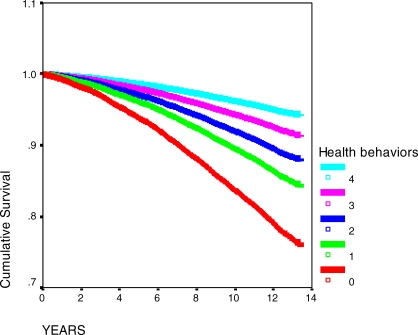
- Adjusted cumulative survival was about 75% for those scoring zero and 95% for those scoring four. The mortality risk difference between score 0 and score 4 was equivalent to approximately 14 years of chronological age.
- Relationships were consistent in subgroups stratified by sex, age, BMI, and social class, and after excluding deaths within 2 years; similar trends were seen in 2,057 individuals with prevalent disease excluded from main analyses.
Methods
- Prospective population study: EPIC-Norfolk, UK, baseline survey 1993–1997, follow-up to July 2006 (average 11 years). Of 22,301 with complete data, 2,057 with history of heart disease, stroke, or cancer were excluded, leaving 20,244 participants aged 45–79.
- Health behaviour score: one point each for current nonsmoking, not physically inactive, moderate alcohol intake (1–14 units/week), and plasma vitamin C >50 mmol/l indicating at least five fruit/vegetable servings daily; total score 0–4.
- Cox proportional hazards models estimated relative risks for all-cause and cause-specific mortality, adjusted for age, sex, body mass index, and social class; analyses included subgroup stratification and exclusion of deaths within 2 years.
Limitations
- The paper states potential large measurement errors in exposure assessment, use of only one baseline measure without accounting for lifestyle changes over follow-up, no weighting of different behaviours, and dichotomizing physical activity as inactive versus not inactive, which may obscure gradients between moderately inactive and active people.
- The paper states residual confounding cannot be excluded, and the analyses examined only mortality, not functional health or quality of life.
- Evident from the text: the cohort was 99.5% white, resident in Norfolk, UK, and middle-aged/older, so findings may not generalize to other populations; the observational design cannot establish causality.
Model-written summary. Check it against the paper before relying on it.
Integrity signals
Registry
Cites
Statistics
Figures
Verification
Claims the paper makes
19 Own result · 14 Not checked yet · 10 Own method · 6 Own interpretation · 1 No basis given
A result the paper reports from its own data — it cites no other source for it, so there is none to check. The quote shows it is in the paper.
In the paper
“The relationships were consistent in subgroups stratified by sex, age, body mass index, and social class, and after excluding deaths within 2 y.”
§ Combined Impact of Health Behaviours and Mortality in Men and Women: The EPIC-Norfolk Prospective Population Study > Abstract
plain- Asserted: passes — The authors put it forward as true.
- Checkable: passes — It can be checked against evidence.
- Load-bearing: passes — The paper’s conclusions depend on it.
- Based: passes — The paper gives a reason why it holds.
- Rests on an assumption: Death certification at the Office of National Statistics, United Kingdom, is virtually complete.
A result the paper reports from its own data — it cites no other source for it, so there is none to check. The quote shows it is in the paper.
In the paper
“The trends were strongest for cardiovascular causes.”
§ Combined Impact of Health Behaviours and Mortality in Men and Women: The EPIC-Norfolk Prospective Population Study > Abstract
plaincorrelational- Asserted: passes — The authors put it forward as true.
- Checkable: passes — It can be checked against evidence.
- Load-bearing: unclear — It is unclear whether the paper’s conclusions depend on it.
- Based: passes — The paper gives a reason why it holds.
- Rests on an assumption: Death certification at the Office of National Statistics, United Kingdom, is virtually complete.
A result the paper reports from its own data — it cites no other source for it, so there is none to check. The quote shows it is in the paper.
In the paper
“As might be expected, there were some differentials in the observed risk reductions observed for different health behaviours and cause-specific mortality in men and women; current smoking was the most consistent and strongest risk factor.”
§ Combined Impact of Health Behaviours and Mortality in Men and Women: The EPIC-Norfolk Prospective Population Study > Results
plaincorrelational- Asserted: passes — The authors put it forward as true.
- Checkable: passes — It can be checked against evidence.
- Load-bearing: passes — The paper’s conclusions depend on it.
- Based: passes — The paper gives a reason why it holds.
- Rests on an assumption: Death certification at the Office of National Statistics, United Kingdom, is virtually complete.
A result the paper reports from its own data — it cites no other source for it, so there is none to check. The quote shows it is in the paper.
In the paper
“None of the interaction terms for health score with sex, age, body mass index, and social class were significant in multivariate analyses.”
§ Combined Impact of Health Behaviours and Mortality in Men and Women: The EPIC-Norfolk Prospective Population Study > Results
plain- Asserted: passes — The authors put it forward as true.
- Checkable: passes — It can be checked against evidence.
- Load-bearing: passes — The paper’s conclusions depend on it.
- Based: passes — The paper gives a reason why it holds.
- Rests on an assumption: Death certification at the Office of National Statistics, United Kingdom, is virtually complete.
A result the paper reports from its own data — it cites no other source for it, so there is none to check. The quote shows it is in the paper.
In the paper
“From the Cox model, the beta coefficient for mortality associated with each year increase in chronological age was 0.10 (6 standard error 0.004).”
§ Combined Impact of Health Behaviours and Mortality in Men and Women: The EPIC-Norfolk Prospective Population Study > Results
plaincorrelational- Asserted: passes — The authors put it forward as true.
- Checkable: passes — It can be checked against evidence.
- Load-bearing: unclear — It is unclear whether the paper’s conclusions depend on it.
- Based: passes — The paper gives a reason why it holds.
- Rests on an assumption: Death certification at the Office of National Statistics, United Kingdom, is virtually complete.
A result the paper reports from its own data — it cites no other source for it, so there is none to check. The quote shows it is in the paper.
In the paper
“The mortality risk for those with four compared to zero health behaviours was equivalent to being 14 y younger in chronological age.”
- Also stated in: § Results · hedged
“The difference in beta coefficients between a health score of zero versus four was 1.43, that is, equivalent to approximately 14 y in chronological age for mortality risk.”
§ Combined Impact of Health Behaviours and Mortality in Men and Women: The EPIC-Norfolk Prospective Population Study > Abstract
plaincorrelational- Asserted: passes — The authors put it forward as true.
- Checkable: passes — It can be checked against evidence.
- Load-bearing: passes — The paper’s conclusions depend on it.
- Based: passes — The paper gives a reason why it holds.
- Rests on an assumption: Death certification at the Office of National Statistics, United Kingdom, is virtually complete.
- Also stated in: § Results · hedged
A result the paper reports from its own data — it cites no other source for it, so there is none to check. The quote shows it is in the paper.
In the paper
“After an average 11 y follow-up, the age-, sex-, body mass-, and social class-adjusted relative risks (95% confidence intervals) for allcause mortality(1,987 deaths) for men and women who had three, two, one, and zero compared to four health behaviours were respectively, 1.39 (1.21-1.60),1.95 (1.70--2.25),2.52 (2.13-3.00),and 4.04 (2.95-5.54)p , 0.001 trend.”
§ Combined Impact of Health Behaviours and Mortality in Men and Women: The EPIC-Norfolk Prospective Population Study > Abstract
plaincorrelational- Asserted: passes — The authors put it forward as true.
- Checkable: passes — It can be checked against evidence.
- Load-bearing: passes — The paper’s conclusions depend on it.
- Based: passes — The paper gives a reason why it holds.
- Rests on an assumption: Death certification at the Office of National Statistics, United Kingdom, is virtually complete.
A result the paper reports from its own data — it cites no other source for it, so there is none to check. The quote shows it is in the paper.
In the paper
“As with the relative risks of mortality, the adjusted cumulative survival was about 75% for those scoring zero and 95% for those scoring four, respectively, for health behaviours.”
§ Combined Impact of Health Behaviours and Mortality in Men and Women: The EPIC-Norfolk Prospective Population Study > Results
plaincorrelational- Asserted: passes — The authors put it forward as true.
- Checkable: passes — It can be checked against evidence.
- Load-bearing: passes — The paper’s conclusions depend on it.
- Based: passes — The paper gives a reason why it holds.
- Rests on an assumption: Death certification at the Office of National Statistics, United Kingdom, is virtually complete.
A result the paper reports from its own data — it cites no other source for it, so there is none to check. The quote shows it is in the paper.
In the paper
“The difference in beta coefficients between a health score of zero versus four was 1.43, that is, equivalent to approximately 14 y in chronological age for mortality risk.”
§ Combined Impact of Health Behaviours and Mortality in Men and Women: The EPIC-Norfolk Prospective Population Study > Results
plaincorrelational- Asserted: passes — The authors put it forward as true.
- Checkable: passes — It can be checked against evidence.
- Load-bearing: passes — The paper’s conclusions depend on it.
- Based: passes — The paper gives a reason why it holds.
- Rests on an assumption: Death certification at the Office of National Statistics, United Kingdom, is virtually complete.
A result the paper reports from its own data — it cites no other source for it, so there is none to check. The quote shows it is in the paper.
In the paper
“Cancer | 839/20,244 | 1 | 1.21 (0,99-1.48) | 1.81 (1.48-2.22) | 1.94 (1.48-2.54) | 3.74 (2.34-5.98)”
§ Combined Impact of Health Behaviours and Mortality in Men and Women: The EPIC-Norfolk Prospective Population Study > Additional Information.
plaincorrelational- Asserted: passes — The authors put it forward as true.
- Checkable: passes — It can be checked against evidence.
- Load-bearing: passes — The paper’s conclusions depend on it.
- Based: passes — The paper gives a reason why it holds.
- Rests on an assumption: The observed associations between health behaviour score and mortality are not explained by unmeasured or residual confounding.
- It may state two separate claims as one. 14
- The quote only partly states this claim. 4
- Probably not a substantial claim. 15
A result the paper reports from its own data — it cites no other source for it, so there is none to check. The quote shows it is in the paper.
In the paper
“Each of the health behaviours: smoking, being physically inactive, not having a moderate alcohol intake, and a low fruit and vegetable intake as indicated by plasma vitamin C level ,50 mmol/l.were associated with significantly higher risks of mortality from all causes.”
§ Combined Impact of Health Behaviours and Mortality in Men and Women: The EPIC-Norfolk Prospective Population Study > Results
plaincorrelational- Asserted: passes — The authors put it forward as true.
- Checkable: passes — It can be checked against evidence.
- Load-bearing: passes — The paper’s conclusions depend on it.
- Based: passes — The paper gives a reason why it holds.
It may state two separate claims as one.
- Rests on an assumption: Death certification at the Office of National Statistics, United Kingdom, is virtually complete.
In the paper
“In this cohort, vitamin supplement use was not associated with mortality, and results were similar after adjusting for vitamin supplement use or excluding vitamin users from the analyses (unpublished data and [19]).”
§ Combined Impact of Health Behaviours and Mortality in Men and Women: The EPIC-Norfolk Prospective Population Study > Results
What the sources say
- Not checked yetcites [19] Khaw, 2001, Lancet
plain- Asserted: passes — The authors put it forward as true.
- Checkable: passes — It can be checked against evidence.
- Load-bearing: unclear — It is unclear whether the paper’s conclusions depend on it.
- Based: passes — The paper gives a reason why it holds.
It may state two separate claims as one.
- Rests on an assumption: Death certification at the Office of National Statistics, United Kingdom, is virtually complete.
A result the paper reports from its own data — it cites no other source for it, so there is none to check. The quote shows it is in the paper.
In the paper
“All Cause | RR (95% CI) | n ¼ 1,977 events | 1.77 (1.55-2.01) | 1.24 (1.13-1.36) | 1.26 (1.14-1.38) | 1.44 (1.31-1.59)”
§ Combined Impact of Health Behaviours and Mortality in Men and Women: The EPIC-Norfolk Prospective Population Study > Additional Information.
plaincorrelational- Asserted: passes — The authors put it forward as true.
- Checkable: passes — It can be checked against evidence.
- Load-bearing: passes — The paper’s conclusions depend on it.
- Based: passes — The paper gives a reason why it holds.
The quote only partly states this claim.
- Rests on an assumption: The observed associations between health behaviour score and mortality are not explained by unmeasured or residual confounding.
A result the paper reports from its own data — it cites no other source for it, so there is none to check. The quote shows it is in the paper.
In the paper
“All cause | 1,977/20,244 | 1 | 1.39 (1.21-1.60) | 1.95 (1.70-2.25) | 2.52 (2.13-3.00) | 4.04 (2.95-5.54)”
§ Combined Impact of Health Behaviours and Mortality in Men and Women: The EPIC-Norfolk Prospective Population Study > Additional Information.
plaindirectn = 20,244- Asserted: passes — The authors put it forward as true.
- Checkable: passes — It can be checked against evidence.
- Load-bearing: passes — The paper’s conclusions depend on it.
- Based: passes — The paper gives a reason why it holds.
It may state two separate claims as one.
- Rests on an assumption: The observed associations between health behaviour score and mortality are not explained by unmeasured or residual confounding.
The paper states this without a source or data behind it here, so there is nothing to check it against. The quote shows it is in the paper.
In the paper
“The four health behaviours were within the usual range found in a free-living population.”
§ Combined Impact of Health Behaviours and Mortality in Men and Women: The EPIC-Norfolk Prospective Population Study > Implications
plain- Asserted: passes — The authors put it forward as true.
- Checkable: passes — It can be checked against evidence.
- Load-bearing: fails — The paper’s conclusions may not depend on it.
- Based: fails — The paper may give no reason why it holds.
Probably not a substantial claim. The paper’s conclusions may not depend on it. The paper may give no reason why it holds.
A result the paper reports from its own data — it cites no other source for it, so there is none to check. The quote shows it is in the paper.
In the paper
“All Cause | RR (95% CI) | n ¼ 1,977 events | 1.77 (1.55-2.01) | 1.24 (1.13-1.36) | 1.26 (1.14-1.38) | 1.44 (1.31-1.59)”
§ Combined Impact of Health Behaviours and Mortality in Men and Women: The EPIC-Norfolk Prospective Population Study > Additional Information.
plaincorrelational- Asserted: passes — The authors put it forward as true.
- Checkable: passes — It can be checked against evidence.
- Load-bearing: passes — The paper’s conclusions depend on it.
- Based: passes — The paper gives a reason why it holds.
The quote only partly states this claim.
- Rests on an assumption: The observed associations between health behaviour score and mortality are not explained by unmeasured or residual confounding.
A result the paper reports from its own data — it cites no other source for it, so there is none to check. The quote shows it is in the paper.
In the paper
“All Cause | RR (95% CI) | n ¼ 1,977 events | 1.77 (1.55-2.01) | 1.24 (1.13-1.36) | 1.26 (1.14-1.38) | 1.44 (1.31-1.59)”
§ Combined Impact of Health Behaviours and Mortality in Men and Women: The EPIC-Norfolk Prospective Population Study > Additional Information.
plaincorrelational- Asserted: passes — The authors put it forward as true.
- Checkable: passes — It can be checked against evidence.
- Load-bearing: passes — The paper’s conclusions depend on it.
- Based: passes — The paper gives a reason why it holds.
The quote only partly states this claim.
- Rests on an assumption: The observed associations between health behaviour score and mortality are not explained by unmeasured or residual confounding.
None of the sources cited for this claim have been checked yet.
In the paper
“Nevertheless, there is a large body of experimental and epidemiologic evidence indicating a high intake of fruit and vegetables is beneficially associated with health [5,7,11,32]”
§ Combined Impact of Health Behaviours and Mortality in Men and Women: The EPIC-Norfolk Prospective Population Study > Discussion
What the sources say
- Not checked yetcites [5] Joshipura, 2001, Ann Intern Med
- Not checked yetcites [7] Law, 1998, Eur J Clin Nutr
- Not checked yetcites [11] Ness, 1997, Int J Epidemiol
- Not checked yetcites [32] Rimm, 1996, JAMA
hedgedcorrelational- Asserted: passes — The authors put it forward as true.
- Checkable: passes — It can be checked against evidence.
- Load-bearing: fails — The paper’s conclusions may not depend on it.
- Based: passes — The paper gives a reason why it holds.
Probably not a substantial claim. The paper’s conclusions may not depend on it.
What the paper did — it cites no source for this, so there is none to check. The quote shows it is in the paper.
In the paper
“Of the 22,301 with available data, 2,057 had a history of heart disease, stroke, or cancer at the baseline visit and were excluded from the main analyses, leaving 20,244 individuals.”
§ Combined Impact of Health Behaviours and Mortality in Men and Women: The EPIC-Norfolk Prospective Population Study > Methods
plain- Asserted: passes — The authors put it forward as true.
- Checkable: passes — It can be checked against evidence.
- Load-bearing: passes — The paper’s conclusions depend on it.
- Based: passes — The paper gives a reason why it holds.
Probably not a substantial claim.
None of the sources cited for this claim have been checked yet.
In the paper
“A huge body of evidence indicates that lifestyles such as smoking, diet, and physical activity have a major influence on health [1][2][3][4][5][6][7][8][9][10][11][12][13][14][15][16].”
§ Combined Impact of Health Behaviours and Mortality in Men and Women: The EPIC-Norfolk Prospective Population Study > Introduction
What the sources say
- Not checked yetcites [1]
- Not checked yetcites [2] Chiuve, 2006, Circulation
- Not checked yetcites [3] Doll, 2004, BMJ
hedgeddirect- Asserted: passes — The authors put it forward as true.
- Checkable: passes — It can be checked against evidence.
- Load-bearing: fails — The paper’s conclusions may not depend on it.
- Based: passes — The paper gives a reason why it holds.
Probably not a substantial claim. The paper’s conclusions may not depend on it.
None of the sources cited for this claim have been checked yet.
In the paper
“Because humans do not manufacture vitamin C and have to rely on exogenous sources, plasma vitamin C is a good biomarker of plant food intake; previous studies have reported that a blood value of 50 mmol/l or more indicates an intake of at least five servings of fruit and vegetables daily [19;26].”
§ Combined Impact of Health Behaviours and Mortality in Men and Women: The EPIC-Norfolk Prospective Population Study > Methods
What the sources say
- Not checked yetcites [19] Khaw, 2001, Lancet
- Not checked yetcites [26] Bingham, 1995, Br J Nutr
hedgedcorrelational- Asserted: passes — The authors put it forward as true.
- Checkable: passes — It can be checked against evidence.
- Load-bearing: unclear — It is unclear whether the paper’s conclusions depend on it.
- Based: passes — The paper gives a reason why it holds.
It may state two separate claims as one.
What the paper did — it cites no source for this, so there is none to check. The quote shows it is in the paper.
In the paper
“The score, though simple, was based on instruments that have been extensively previously validated.”
§ Combined Impact of Health Behaviours and Mortality in Men and Women: The EPIC-Norfolk Prospective Population Study > Discussion
plain- Asserted: passes — The authors put it forward as true.
- Checkable: passes — It can be checked against evidence.
- Load-bearing: fails — The paper’s conclusions may not depend on it.
- Based: passes — The paper gives a reason why it holds.
Probably not a substantial claim. The paper’s conclusions may not depend on it.
In the paper
“Nevertheless, a recent report from 2,339 men and women aged 70-90 y in 11 European countries indicated that adherence to a Mediterranean diet, nonsmoking, any alcohol use, and moderate physical activity were associated with more than 50% lower rate of all-cause and cause-specific mortality [6].”
§ Combined Impact of Health Behaviours and Mortality in Men and Women: The EPIC-Norfolk Prospective Population Study > Introduction
What the sources say
- Not checked yetcites [6] Knoops, 2004, JAMA
hedgedcorrelationaln = 2,339- Asserted: passes — The authors put it forward as true.
- Checkable: passes — It can be checked against evidence.
- Load-bearing: passes — The paper’s conclusions depend on it.
- Based: passes — The paper gives a reason why it holds.
Probably not a substantial claim.
In the paper
“The Norfolk cohort was comparable to national population samples with respect to characteristics including anthropometry, blood pressure, and lipids, but with a lower prevalence of current smokers [21].”
§ Combined Impact of Health Behaviours and Mortality in Men and Women: The EPIC-Norfolk Prospective Population Study > Methods
What the sources say
- Not checked yetcites [21] Day, 1999, Br J Cancer
plain- Asserted: passes — The authors put it forward as true.
- Checkable: passes — It can be checked against evidence.
- Load-bearing: unclear — It is unclear whether the paper’s conclusions depend on it.
- Based: passes — The paper gives a reason why it holds.
It may state two separate claims as one.
A conclusion the paper draws from its own results — it cites no other source for it, so there is none to check. The quote shows it is in the paper.
In the paper
“Four health behaviours combined predict a 4-fold difference in total mortality in men and women, with an estimated impact equivalent to 14 y in chronological age.”
§ Combined Impact of Health Behaviours and Mortality in Men and Women: The EPIC-Norfolk Prospective Population Study > Abstract
hedgedcorrelational- Asserted: passes — The authors put it forward as true.
- Checkable: passes — It can be checked against evidence.
- Load-bearing: passes — The paper’s conclusions depend on it.
- Based: passes — The paper gives a reason why it holds.
It may state two separate claims as one.
- Rests on an assumption: Death certification at the Office of National Statistics, United Kingdom, is virtually complete.
In the paper
“We have also previously shown that low work and leisure-time physical activity predicts all-cause mortality and cardiovascular disease incidence [20].”
§ Combined Impact of Health Behaviours and Mortality in Men and Women: The EPIC-Norfolk Prospective Population Study > Introduction
What the sources say
- Not checked yetcites [20] Khaw, 2006, Int J Epidemiol
plaincorrelational- Asserted: passes — The authors put it forward as true.
- Checkable: passes — It can be checked against evidence.
- Load-bearing: unclear — It is unclear whether the paper’s conclusions depend on it.
- Based: passes — The paper gives a reason why it holds.
It may state two separate claims as one.
What the paper did — it cites no source for this, so there is none to check. The quote shows it is in the paper.
In the paper
“The authors have declared that no competing interests exist.”
§ Combined Impact of Health Behaviours and Mortality in Men and Women: The EPIC-Norfolk Prospective Population Study > Conflict
plain- Asserted: passes — The authors put it forward as true.
- Checkable: passes — It can be checked against evidence.
- Load-bearing: fails — The paper’s conclusions may not depend on it.
- Based: passes — The paper gives a reason why it holds.
Probably not a substantial claim. The paper’s conclusions may not depend on it.
What the paper did — it cites no source for this, so there is none to check. The quote shows it is in the paper.
In the paper
“We used only a measure at one point in time to characterize individuals and did not take into account likely changes in lifestyles over the follow-up period.”
§ Combined Impact of Health Behaviours and Mortality in Men and Women: The EPIC-Norfolk Prospective Population Study > Discussion
plain- Asserted: passes — The authors put it forward as true.
- Checkable: passes — It can be checked against evidence.
- Load-bearing: unclear — It is unclear whether the paper’s conclusions depend on it.
- Based: passes — The paper gives a reason why it holds.
It may state two separate claims as one.
A conclusion the paper draws from its own results — it cites no other source for it, so there is none to check. The quote shows it is in the paper.
In the paper
“These results may provide further support for the idea that even small differences in lifestyle may make a big difference to health in the population and encourage behaviour change.”
§ Combined Impact of Health Behaviours and Mortality in Men and Women: The EPIC-Norfolk Prospective Population Study > Implications
hedgedconditional- Asserted: passes — The authors put it forward as true.
- Checkable: fails — It may be too vague to check against evidence.
- Load-bearing: passes — The paper’s conclusions depend on it.
- Based: passes — The paper gives a reason why it holds.
Probably not a substantial claim. It may be too vague to check against evidence. It may state two separate claims as one.
- Rests on an assumption: The EPIC-Norfolk cohort is representative of middle-aged and older people in the general population.
What the paper did — it cites no source for this, so there is none to check. The quote shows it is in the paper.
In the paper
“Mortality Rates and Relative Risk of All-Cause Mortality by Number of Health Behaviours, Adjusted by Age, Sex, and Body Mass Index, and Stratified by Cause, Sex, Age, Body Mass Index, and Social Class in 20,244 Men and Women Aged 45-79 y without Known Cardiovascular Disease or Cancer in EPIC-Norfolk 1993-2006, Cox Regression Model”
§ Combined Impact of Health Behaviours and Mortality in Men and Women: The EPIC-Norfolk Prospective Population Study > Additional Information.
plainn = 20,244- Asserted: passes — The authors put it forward as true.
- Checkable: passes — It can be checked against evidence.
- Load-bearing: passes — The paper’s conclusions depend on it.
- Based: passes — The paper gives a reason why it holds.
Probably not a substantial claim.
In the paper
“Thirdly, the proportions of the population with some or all positive health behaviours were relatively high since the definitions for health behaviours were not necessarily optimal, for example, for physical activity [20], and dichotomizing behaviours between inactive and not inactive may have obscured the gradient in mortality between those who were moderately inactive and those who were active.”
§ Combined Impact of Health Behaviours and Mortality in Men and Women: The EPIC-Norfolk Prospective Population Study > Discussion
What the sources say
- Not checked yetcites [20] Khaw, 2006, Int J Epidemiol
hedgedconditional- Asserted: passes — The authors put it forward as true.
- Checkable: passes — It can be checked against evidence.
- Load-bearing: unclear — It is unclear whether the paper’s conclusions depend on it.
- Based: passes — The paper gives a reason why it holds.
It may state two separate claims as one.
A conclusion the paper draws from its own results — it cites no other source for it, so there is none to check. The quote shows it is in the paper.
In the paper
“Nevertheless, random measurement error is likely to attenuate any associations observed, so the estimated differences in risk are likely to be larger than those observed.”
§ Combined Impact of Health Behaviours and Mortality in Men and Women: The EPIC-Norfolk Prospective Population Study > Discussion
hedgeddirect- Asserted: passes — The authors put it forward as true.
- Checkable: passes — It can be checked against evidence.
- Load-bearing: unclear — It is unclear whether the paper’s conclusions depend on it.
- Based: passes — The paper gives a reason why it holds.
It may state two separate claims as one.
What the paper did — it cites no source for this, so there is none to check. The quote shows it is in the paper.
In the paper
“The sponsors had no role in the design and conduct of the study, collection, management, analysis and interpretation of the data, and preparation, review, or approval of the manuscript.”
§ Combined Impact of Health Behaviours and Mortality in Men and Women: The EPIC-Norfolk Prospective Population Study > Funding
plain- Asserted: passes — The authors put it forward as true.
- Checkable: passes — It can be checked against evidence.
- Load-bearing: fails — The paper’s conclusions may not depend on it.
- Based: passes — The paper gives a reason why it holds.
Probably not a substantial claim. The paper’s conclusions may not depend on it.
What the paper did — it cites no source for this, so there is none to check. The quote shows it is in the paper.
In the paper
“Though we cannot exclude residual confounding, our results are consistent with the existing evidence indicating these behavioural factors are beneficial for health.”
§ Combined Impact of Health Behaviours and Mortality in Men and Women: The EPIC-Norfolk Prospective Population Study > Discussion
plain- Asserted: passes — The authors put it forward as true.
- Checkable: passes — It can be checked against evidence.
- Load-bearing: fails — The paper’s conclusions may not depend on it.
- Based: passes — The paper gives a reason why it holds.
Probably not a substantial claim. The paper’s conclusions may not depend on it.
A conclusion the paper draws from its own results — it cites no other source for it, so there is none to check. The quote shows it is in the paper.
In the paper
“their combined impact was associated with an estimated 4-fold difference in mortality risk, equivalent to 14 y in chronological age.”
§ Combined Impact of Health Behaviours and Mortality in Men and Women: The EPIC-Norfolk Prospective Population Study > Implications
hedgedcorrelational- Asserted: passes — The authors put it forward as true.
- Checkable: passes — It can be checked against evidence.
- Load-bearing: passes — The paper’s conclusions depend on it.
- Based: passes — The paper gives a reason why it holds.
It may state two separate claims as one.
- Rests on an assumption: The observed associations between health behaviour score and mortality are not explained by unmeasured or residual confounding.
What the paper did — it cites no source for this, so there is none to check. The quote shows it is in the paper.
In the paper
“KTK conducted the data analyses, wrote the paper with coauthors, had full access to all of the data in the study, and takes responsibility for the integrity of the data and the accuracy of the data analysis.”
§ Combined Impact of Health Behaviours and Mortality in Men and Women: The EPIC-Norfolk Prospective Population Study > Contribution
plain- Asserted: passes — The authors put it forward as true.
- Checkable: passes — It can be checked against evidence.
- Load-bearing: fails — The paper’s conclusions may not depend on it.
- Based: passes — The paper gives a reason why it holds.
Probably not a substantial claim. The paper’s conclusions may not depend on it. It may state two separate claims as one.
In the paper
“subjective functional health is also predictive of mortality [36]”
§ Combined Impact of Health Behaviours and Mortality in Men and Women: The EPIC-Norfolk Prospective Population Study > Implications
What the sources say
- Not checked yetcites [36] Myint, 2006, Ann Epidemiol
plaincorrelational- Asserted: passes — The authors put it forward as true.
- Checkable: passes — It can be checked against evidence.
- Load-bearing: fails — The paper’s conclusions may not depend on it.
- Based: passes — The paper gives a reason why it holds.
Probably not a substantial claim. The paper’s conclusions may not depend on it.
In the paper
“In the UK, the recommendations are up to 21 drinks weekly for men and 14 drinks weekly for women [33].”
§ Combined Impact of Health Behaviours and Mortality in Men and Women: The EPIC-Norfolk Prospective Population Study > Discussion
What the sources say
- Not checked yetcites [33]
plain- Asserted: passes — The authors put it forward as true.
- Checkable: passes — It can be checked against evidence.
- Load-bearing: fails — The paper’s conclusions may not depend on it.
- Based: passes — The paper gives a reason why it holds.
Probably not a substantial claim. The paper’s conclusions may not depend on it. It may state two separate claims as one.
What the paper did — it cites no source for this, so there is none to check. The quote shows it is in the paper.
In the paper
“NW developed and validated the physical activity measures and scales.”
§ Combined Impact of Health Behaviours and Mortality in Men and Women: The EPIC-Norfolk Prospective Population Study > Contribution
plain- Asserted: passes — The authors put it forward as true.
- Checkable: passes — It can be checked against evidence.
- Load-bearing: passes — The paper’s conclusions depend on it.
- Based: passes — The paper gives a reason why it holds.
Probably not a substantial claim.
The paper relies on this without support.
Health behaviours such as smoking, diet, and physical activity are highly correlated.
“Many health behaviours such as smoking habit, diet, and physical activity are highly correlated and, in aetiologically focused papers, treated as covariates.”
The paper relies on this without support.
Death certification at the Office of National Statistics, United Kingdom, is virtually complete.
“All participants are flagged for death certification at the Office of National Statistics, United Kingdom which is virtually complete.”
The paper relies on this without support.
The observed associations between health behaviour score and mortality are not explained by unmeasured or residual confounding.
“After allowing for other factors that might have affected their likelihood of dying (for example, age)”
The paper relies on this without support.
The EPIC-Norfolk cohort is representative of middle-aged and older people in the general population.
“These findings indicate that the combination of four simply defined health behaviors predicts a 4-fold difference in the risk of dying over an average period of 11 years for middle-aged and older people.”
The paper relies on this without support.
Mortality follow-up via record linkage was complete and accurate.
“Deaths among the participants were then recorded until 2006.”
Claims other papers make about this one
Each is checked against this paper’s own text: does it say what the citing paper says it does?
In the citing paper
“Moreover, regular physical activity appears to protect against premature death independent of obesity [10, 11].”
From Exercise as a Mean to Control Low‐Grade Systemic Inflammation (2008) · cites this paper as [10]
In the citing paper
“regular exercise offers protection against all causes of mortality, primarily by protection against atherosclerosis and insulin resistance”
From Exercise as a Mean to Control Low‐Grade Systemic Inflammation (2008) · cites this paper as [10]
Self-check
Percentages, sums and reported differences re-computed from the paper’s own numbers.
Each contradiction between two passages listed here was confirmed by an independent check.
Rated major: it would touch a result — a value a result rests on, reported and recomputed p-values on opposite sides of the significance level, two passages that conflict with no sign which is right, or a cited work retracted before this paper was published.
In the paper
§ Combined Impact of Health Behaviours and Mortality in Men and Women: The EPIC-Norfolk Prospective Population Study > Additional Information.
“| | at least half an hour of leisure time activity |”
§ Combined Impact of Health Behaviours and Mortality in Men and Women: The EPIC-Norfolk Prospective Population Study > Methods
“For the purposes of the current study, we dichotomised the population into physically inactive (sedentary job and no recreational activity) and not physically inactive (any category with activity levels above the latter).”
Rated minor: it would not touch a result — a value no result rests on, a p-value that stays on the same side of the significance level, or a conflict that is clerical, resolved elsewhere in the paper, or outside its own findings.
In the paper
“| | 21 or more units a week | 15.1 (1,389) | 1.2 (254) |”
§ Combined Impact of Health Behaviours and Mortality in Men and Women: The EPIC-Norfolk Prospective Population Study > Additional Information.
Reported 1.2 · recomputed 2.295941
Rated minor: it would not touch a result — a value no result rests on, a p-value that stays on the same side of the significance level, or a conflict that is clerical, resolved elsewhere in the paper, or outside its own findings.
In the paper
“| | III nonmanual | 12.3 (1,108) | 119.9 (2,145) |”
§ Combined Impact of Health Behaviours and Mortality in Men and Women: The EPIC-Norfolk Prospective Population Study > Additional Information.
Reported 119.9 · recomputed 19.388954
Rated minor: it would not touch a result — a value no result rests on, a p-value that stays on the same side of the significance level, or a conflict that is clerical, resolved elsewhere in the paper, or outside its own findings.
In the paper
§ Combined Impact of Health Behaviours and Mortality in Men and Women: The EPIC-Norfolk Prospective Population Study > Additional Information.
“| Alcohol intake | One or more, but less than 14 units, a |”
§ Combined Impact of Health Behaviours and Mortality in Men and Women: The EPIC-Norfolk Prospective Population Study > Methods
“For these analyses, a moderate drinker was defined as someone who drank one or more units a week (that is, not a nondrinker), but not more than 14 units a week.”
Citations
Cites
Mortality in relation to smoking: 40 years' observations on male British doctors
Doll, R., Peto, R., Wheatley, K., Gray, R., & Sutherland, I. (1994) · BMJ · doi:10.1136/bmj.309.6959.901 · Cited by 5,932
Diet, nutrition and the prevention of chronic diseases
Joint, W. (2002) · Medical Entomology and Zoology · Cited by 4,890
Adherence to a Mediterranean diet and survival in a Greek population
Trichopoulou, A., Costacou, T., Bamia, C., & Trichopoulos, D. (2003) · New England Journal of Medicine · doi:10.1056/nejmoa025039 · Cited by 4,397
Thompson, P. D., Buchner, D., Piña, I. L., Balady, G. J., Williams, M. A., Marcus, B. H., Berra, K., Blair, S. N., Costa, F., Franklin, B., et al. (2003) · Circulation · doi:10.1161/01.cir.0000075572.40158.77 · Cited by 2,132
Primary Prevention of Coronary Heart Disease in Women through Diet and Lifestyle
Stampfer, M. J., Hu, F. B., Manson, J. E., Rimm, E. B., & Willett, W. C. (2000) · New England Journal of Medicine · doi:10.1056/nejm200007063430103 · Cited by 1,794
Diet, Nutrition, and the Prevention of Chronic Diseases
Leong, A. (1992) · Pathology · doi:10.1016/s0031-3025(16)36541-2 · Cited by 1,633
The Effect of Fruit and Vegetable Intake on Risk for Coronary Heart Disease
Joshipura, K. J., Hu, F. B., Manson, J. E., Stampfer, M. J., Rimm, E. B., Speizer, F. E., Colditz, G., Ascherio, A., Rosner, B., Spiegelman, D., et al. (2001) · Annals of Internal Medicine · doi:10.7326/0003-4819-134-12-200106190-00010 · Cited by 1,396
Fruit and vegetables, and cardiovascular disease: A review
Ness, A. R., & Powles, J. W. (1997) · International Journal of Epidemiology · doi:10.1093/ije/26.1.1 · Cited by 1,368
McCullough, M. L., Feskanich, D., Stampfer, M. J., Giovannucci, E. L., Rimm, E. B., Hu, F. B., Spiegelman, D., Hunter, D. J., Colditz, G. A., & Willett, W. C. (2002) · The American Journal of Clinical Nutrition · doi:10.1093/ajcn/76.6.1261 · Cited by 1,191
Howard, B. V., Van Horn, L., Hsia, J., Manson, J. E., Stefanick, M. L., Wassertheil-Smoller, S., Kuller, L. H., LaCroix, A. Z., Langer, R. D., Lasser, N. L., et al. (2006) · JAMA · doi:10.1001/jama.295.6.655 · Cited by 1,091
Research works printed but not linked: 34
- Chiuve, 2006, Circulation, 114, 160
- Doll, 2004, BMJ, 328, 1519
- Hu, 2000, Am J Clin Nutr, 72, 912
- Joshipura, 2001, Ann Intern Med, 134, 1106
- Knoops, 2004, JAMA, 292, 1433
- Law, 1998, Eur J Clin Nutr, 52, 549
- Manson, 1996, N Engl J Med, 334, 1325
- McCullough, 2002, Am J Clin Nutr, 76, 1261
- Mukamal, 2006, Arch Intern Med, 166, 2145
- Ness, 1997, Int J Epidemiol, 26, 1
- Oguma, 2002, Br J Sports Med, 36, 162
- Sesso, 1999, Am J Epidemiol, 150, 408
- Stampfer, 2000, N Engl J Med, 343, 16
- Thompson, 2003, Circulation, 107, 3109
- Trichopoulou, 2003, N Engl J Med, 348, 2599
- Alonso, 2005, JAMA, 293, 674
- Craighead, 2005, JAMA, 293, 674
- Khaw, 2001, Lancet, 357, 657
- Khaw, 2006, Int J Epidemiol, 35, 1034
- Day, 1999, Br J Cancer, 80, 95
- Wareham, 2002, Int J Epidemiol, 31, 168
- Wareham, 2003, Public Health Nutr, 6, 407
- Shohaimi, 2004, Eur Respir J, 24, 157
- Riemersma, 1990, Eur J Clin Nutr, 44, 143
- Bingham, 1995, Br J Nutr, 73, 531
- Liese, 2000, Am J Epidemiol, 152, 884
- Rimm, 2004, JAMA, 292, 1490
- Anderson, 2006, JAMA, 295, 693
- Howard, 2006, JAMA, 295, 655
- Prentice, 2006, JAMA, 295, 629
- Rimm, 1996, JAMA, 275, 447
- Myint, 2006, Prev Med, 44, 109
- Myint, 2007, Public Health Nutr, 10, 34
- Myint, 2006, Ann Epidemiol, 16, 492
Cited by
Sorted by citations
Items 601–700 of 836
Xia, Y., & Song, J. (2026) · International Dental Journal · doi:10.1016/j.identj.2025.109394 · Cited by 4
Smokers’ Perception of Their Health Status and Health-Seeking Behaviour: A Narrative Review
Ismail, M. A.-M., Shariff, N. M., Nurumal, M. S., Rahman, R. A., & Mokhtar, H. H. M. (2022) · INTERNATIONAL JOURNAL OF CARE SCHOLARS · doi:10.31436/ijcs.v5i3.261 · Cited by 4
Health Promotion - Principles and Approaches
Garg, B. S. (2023) · IntechOpen eBooks · doi:10.5772/intechopen.107637 · Cited by 4
Association between US Residents’ Health Behavior and Good Health Status at the City Level
Seo, B., Nan, H., Monahan, P. O., Duszynski, T. J., Thompson, W. R., Zollinger, T. W., & Han, J. (2024) · Translational Journal of the American College of Sports Medicine · doi:10.1249/tjx.0000000000000258 · Cited by 4
Decreasing the aging velocity in industry workers
Kristjuhan, Ü. (2010) · Annals of the New York Academy of Sciences · doi:10.1111/j.1749-6632.2009.05371.x · Cited by 4
Food Intake, Life Style, Aging and Human Longevity
Everitt, A. V., Heilbronn, L. K., & Couteur, D. G. L. (2010) · Springer eBooks · doi:10.1007/978-90-481-8556-6_2 · Cited by 4
Atreya, A. R., Kamath, A., Varma, M. D., & Nair, S. (2010) · International journal of collaborative research on internal medicine & public health · Cited by 4
Intelligent Internet Technology for Personalized Health-Saving Support
Krut`ko, V. N., Bolshakov, A. M., Иванович, Д. В., Mamikonova, O. A., Markova, A. M., Molodchenkov, A. I., Potemkina, N. S., & Smirnov, I. (2017) · Advances in intelligent systems and computing · doi:10.1007/978-3-319-67349-3_14 · Cited by 4
Nduka, I., Kabasinguzi, I., Ali, N., Ochepo, P., Abdy, D., Cook, E., Egbutah, C., Cartwright, S., & Randhawa, G. (2023) · BMC Public Health · doi:10.1186/s12889-023-15978-0 · Cited by 4
Shan, J., Liu, Z., Yu, J., Zhang, Q., Shi, H., & Ma, L. (2024) · Annals of Surgical Oncology · doi:10.1245/s10434-024-15982-7 · Cited by 4
An anatomy of the way composite scores work
Bamia, C., & Trichopoulos, D. (2015) · European Journal of Epidemiology · doi:10.1007/s10654-015-0003-z · Cited by 4
Nutritional intake of various groups of Flemish vegetarians
Deriemaeker, P., Alewaeters, K., Hebbelinck, M., & Clarys, P. (2011) · Archives of Public Health · doi:10.1186/0778-7367-68-4-121 · Cited by 4
Changing health behavior motivation from I-must to I-want
Knecht, S., & Kenning, P. (2016) · Progress in brain research · doi:10.1016/bs.pbr.2016.06.013 · Cited by 4
SES, Dietary and Lifestyle Habits, Three Health-Related Dimensions, and Healthy Survival Days
Hoshi, T. (2017) · International perspectives on aging · doi:10.1007/978-981-10-6629-0_8 · Cited by 4
Baker, M. R., Tessier, J. M., Meyer, H. B., Sones, A. C., Sachinvala, N., & Ames, D. (2015) · Europe PMC (PubMed Central) · Cited by 4
Understanding food and nutrition‐related behaviours: Putting together the pieces of the puzzle
McNaughton, S. A. (2012) · Nutrition & Dietetics · doi:10.1111/j.1747-0080.2012.01595.x · Cited by 4
Flatz, A., Pfeifer, N., Radtke, T., Kriemler, S., Klerings, I., Wolfenden, L., & von Elm, E. B. (2016) · Cochrane Database of Systematic Reviews · doi:10.1002/14651858.cd012170 · Cited by 4
Dividing Attention and Metacognition
Peng, Y., & Tullis, J. G. (2022) · Advances in higher education and professional development book series · doi:10.4018/978-1-7998-9243-4.ch004 · Cited by 4
Chen, Y., & Huffman, W. E. (2009) · RePEc: Research Papers in Economics · doi:10.22004/ag.econ.49291 · Cited by 4
High Baseline Vitamin C Levels Do Not Prevent a Positive Outcome of a Lifestyle Intervention
Blüher, M., Stümvoll, M., Kahn, C. R., & Ristow, M. (2009) · Diabetes Care · doi:10.2337/dc09-1725 · Cited by 4
Avoidable vs. non‐avoidable causes of deaths in schizophrenia and bipolar disorders
Saha, S. (2013) · Acta Psychiatrica Scandinavica · doi:10.1111/acps.12060 · Cited by 4
Wildner, M. (2009) · Das Gesundheitswesen · doi:10.1055/s-0029-1234067 · Cited by 4
Vital aldring og samhold mellom generasjoner
Daatland, S. O., & Slagsvold, B. (2013) · NOVA-rapport · doi:10.7577/nova/rapporter/2013/15 · Cited by 4
Gao, Y., Luben, R., Hayat, S. A., Brayne, C., Amin, N., van Duijn, C. M., Hunter, D., & Littlejohns, T. J. (2025) · Age and Ageing · doi:10.1093/ageing/afaf339 · Cited by 3
Self-citationCovariate Selection in Physical Activity Epidemiology: Too Little, Too Much, or Just Right?
Blodgett, J. M., Mitchell, J. J., Steele, E. M., Milton, K. E., Hamer, M., Lee, I.-M. M., & Hallal, P. C. (2026) · Journal of Physical Activity and Health · doi:10.1123/jpah.2026-0426 · Cited by 3
Säfsten, E., Forsell, Y., Ramstedt, M., & Galanti, M. R. (2017) · European Journal of Public Health · doi:10.1093/eurpub/ckx193 · Cited by 3
A study on clustering of Cardiovascular Risk Factors among a rural adult population in Tamil Nadu
Ramraj, B., Muthunarayanan, L., & John, K. R. (2015) · Journal of Cardiovascular Disease Research · doi:10.5530/jcdr.2015.2.7 · Cited by 3
Chen, Y., & Huffman, W. E. (2011) · American Journal of Agricultural Economics · doi:10.1093/ajae/aaq105 · Cited by 3
Fu, F. H. K., Guo, L., & Zang, Y. (2013) · Open Journal of Preventive Medicine · doi:10.4236/ojpm.2013.33036 · Cited by 3
Life-course and Cohort Trajectories of Chronic Non-communicable Diseases Risk Factors in China.
Yang, F., Qian, D., & Hu, D. (2017) · Europe PMC (PubMed Central) · Cited by 3
A Systematic Review of the Association between Dietary Patterns and Breast Cancer Risk
Morgan, A. (2018) · Journal of Clinical Nutrition & Dietetics · doi:10.4172/2472-1921.100065 · Cited by 3
Smithdorf, G., Reynders, J., Meyer, E., November, R. V.-C., & Malema, M. J. (2022) · The Open Public Health Journal · doi:10.2174/18749445-v15-e2208100 · Cited by 3
Carter, P., Gray, L. J., Morris, D. H., Davies, M. J., & Khunti, K. (2013) · Journal of Nutritional Science · doi:10.1017/jns.2013.15 · Cited by 3
Dziankowska–Zaborszczyk, E., Bryła, M., & Maniecka‐Bryła, I. (2014) · Medycyna Pracy · doi:10.13075/mp.5893.2014.032 · Cited by 3
Morgan, G. (2012) · International Journal of Health Promotion and Education · doi:10.1080/14635240.2012.661959 · Cited by 3
On the potential contribution of aspirin to healthy ageing programmes
Morgan, G. P. (2011) · Age and Ageing · doi:10.1093/ageing/afr139 · Cited by 3
SES, Environmental Condition, Three Health-Related Dimensions, and Healthy Life Expectancy
Hoshi, T. (2017) · International perspectives on aging · doi:10.1007/978-981-10-6629-0_11 · Cited by 3
BMI self-selection: Exploring alternatives to self-reported BMI
Shiely, F., & Millar, S. (2021) · Research Methods in Medicine & Health Sciences · doi:10.1177/26320843211010061 · Cited by 3
Fan, J., Wang, J., Yang, H., Dawsey, S. M., Taylor, P. R., Qiao, Y., & Abnet, C. C. (2022) · Frontiers in Cardiovascular Medicine · doi:10.3389/fcvm.2022.772617 · Cited by 3
Nutrition, Health and Dietary Trends
Sievenpiper, J. L., Riccardi, G., Ricordi, C., & Dembska, K. (2019) · Springer eBooks · doi:10.1007/978-3-030-23969-5_4 · Cited by 3
Kern, M. L., & Sun, J. (2020) · Wiley eBooks · doi:10.1002/9781119057840.ch130 · Cited by 4
Timm, C., Tiede, A., Krolo-Wicovsky, F., Spielmann, M., Bischof, G., Meyer, C., John, U., & Freyer‐Adam, J. (2025) · BMC Health Services Research · doi:10.1186/s12913-025-13425-x · Cited by 2
Dolan, G., Millar, S., Perry, I. J., & Phillips, C. M. (2025) · Hepatology Research · doi:10.1111/hepr.70063 · Cited by 2
Dragnic, N. R., Harhaji, S., Mijatović-Jovanović, V., Čanković, S., Ukropina, S., & Radić, I. (2025) · Slovenian Journal of Public Health · doi:10.2478/sjph-2025-0027 · Cited by 2
Millar, S., Perry, I. J., & Phillips, C. M. (2026) · European Journal of Nutrition · doi:10.1007/s00394-026-04000-z · Cited by 2
Co-occurrence of protective health behaviours and perceived psychosocial job characteristics
Carthy, V. J. C. M., Perry, I. J., Harrington, J. M., & Greiner, B. A. (2015) · Preventive Medicine Reports · doi:10.1016/j.pmedr.2015.09.012 · Cited by 3
Heilsufarslegar breytingar sjúklinga í atferlismiðaðri offitumeðferð
Hannesdóttir, S. H., Hannesdóttir, S. H., Guðmundsson, L. Á., & Jóhannsson, E. (2011) · Læknablaðið · doi:10.17992/lbl.2011.11.396 · Cited by 2
The Reasons for the Success of Non-pharmacological Interventions
Ninot, G. (2020) · Springer eBooks · doi:10.1007/978-3-030-60971-9_2 · Cited by 2
Multiple Behavior Change as Prevention
Prochaska, J. O., & Prochaska, J. M. (2021) · Springer eBooks · doi:10.1007/978-3-030-83469-2_5 · Cited by 2
Cosmi, D., Mariottoni, B., & Cosmi, F. (2019) · Clinical Cardiology · doi:10.1002/clc.23250 · Cited by 2
Becker, L., Negash, S., Kartschmit, N., Kluttig, A., & Mikolajczyk, R. (2021) · International Journal of Environmental Research and Public Health · doi:10.3390/ijerph19010082 · Cited by 2
The Influence of Health Promoting Practices on the Quality of Life of Community Adults in Hong Kong
Mo, P. K. H., & Mak, W. W. S. (2009) · Social indicators research series · doi:10.1007/978-94-007-0224-0_11 · Cited by 2
Hoshi, T. (2023) · IntechOpen eBooks · doi:10.5772/intechopen.111910 · Cited by 2
Chronische Inflammation und Biomarker
Schmidt, D., Kwetkat, A., & Gogol, M. (2011) · Zeitschrift für Gerontologie und Geriatrie · doi:10.1007/s00391-011-0198-x · Cited by 2
Combined Impact of Health Risk Factors on Mortality of a Petroleum Industry Population
Tsai, S. P., Bhojani, F. A., & Wendt, J. K. (2009) · Journal of Occupational and Environmental Medicine · doi:10.1097/jom.0b013e3181ab59b0 · Cited by 2
EU‐LIFE revives funding debate
Hunter, P. (2013) · EMBO Reports · doi:10.1038/embor.2013.183 · Cited by 2
Tuberculosis in Quebec: A Review of Trends
Klotz, A., Harouna, A., & Smith, A. F. (2012) · Journal of Public Health Research · doi:10.4081/jphr.2012.e25 · Cited by 2
Parri, A., Moreno, M. V., Benaiges, D., Ramón, J. M., Roux, J. A. F., & Goday, A. (2018) · Nutrición Hospitalaria · doi:10.20960/nh.2239 · Cited by 2
Legumes as Preventive Nutraceuticals for Chronic Diseases
Guaâdaoui, A., Elyadini, M., & Hamal, A. (2020) · Sustainable agriculture reviews · doi:10.1007/978-3-030-53017-4_6 · Cited by 2
Private Sector Presence in Healthcare in India: Econometric Analysis of Patterns and Consequences
Yadav, P., & Ray, A. (2020) · South Asia Economic Journal · doi:10.1177/13915614221113406 · Cited by 2
Cardiovascular health, sleeping duration, and risk of mortality in current and former smokers
Yu, B., Sun, Y., Yu, Y., Yu, Y., Wang, Y., Wang, B., Tan, X. W., Wang, Y., Lu, Y., & Wang, N. (2024) · Nutrition Metabolism and Cardiovascular Diseases · doi:10.1016/j.numecd.2024.01.005 · Cited by 2
Khaw, K. (2008) · Nutrition Bulletin · doi:10.1111/j.1467-3010.2008.00690.x · Cited by 2
Self-citationLin, X. (2016) · Journal of Nutritional Health & Food Engineering · doi:10.15406/jnhfe.2016.04.00134 · Cited by 2
Gray, C. M., Carroll, R. J., Lentjes, M. A. H., & Keogh, R. H. (2019) · Biometrical Journal · doi:10.1002/bimj.201700279 · Cited by 2
Socioeconomic Determinants of Health Status Among Older Adults in Poland
Kludacz-Alessandri, M., & Cygańska, M. (2020) · Eurasian studies in business and economics · doi:10.1007/978-3-030-53536-0_17 · Cited by 2
Effects of Tabata workouts on the immune cell response in physically inactive individuals
Noor, N. A. S. M., Muhamad, A. S., & Malik, A. A. (2021) · Malaysian Journal of Movement Health & Exercise · doi:10.4103/mohe.mohe_21_21 · Cited by 2
Overcoming systemic roadblocks to sustainable health
Knecht, S. (2009) · Proceedings of the National Academy of Sciences · doi:10.1073/pnas.0902558106 · Cited by 2
Does the liver accelerate ageing: Talking muscles and liver?
Trenell, M. I., & Marchesini, G. (2016) · Journal of Hepatology · doi:10.1016/j.jhep.2016.10.018 · Cited by 2
Health creates welfare - the role of the health system in Norwegian society
Sanne, A.-P., Bakkerud, J., Andersen, K., Claudi, T., Nore, V., Sælensminde, K., Sørheim, S. E., Torgersen, T. P., Braut, G. S., Røttingen, J., et al. (2008) · Cited by 2
Social and Community Aspects of Ageing
Morley, J. E., & Tumosa, N. (2012) · Wiley eBooks · doi:10.1002/9781119952930.ch7 · Cited by 2
Developmental origins of exceptional health and survival: a four-generation family cohort study
Keys, M. T., Netra, S., Pedersen, D. A., Larsen, P. S., Kulminski, A. M., Feitosa, M. F., Wojczynski, M. K., Province, M. A., & Christensen, K. (2026) · Nature Communications · doi:10.1038/s41467-026-72433-5 · Cited by 1
Helvich, J., Jozefiaková, B., Živná, K., Novák, L., & Tavel, P. (2026) · Human Behavior and Emerging Technologies · doi:10.1155/hbe2/9961890 · Cited by 1
Crawford, J., Åsberg, K., Blomqvist, J., Lundgren, O., Henriksson, H., Henriksson, P., Bendtsen, P., Löf, M., & Bendtsen, M. (2026) · Journal of Medical Internet Research · doi:10.2196/88881 · Cited by 1
An Overview on Dementia: A Major Symptom of Alzheimer's Disease
Kaur, J., Melkani, I., Singh, A., Singh, A. P., & Bala, K. (2022) · Journal of Drug Delivery and Therapeutics · doi:10.22270/jddt.v12i4.5445 · Cited by 1
Michael, G. C., Ehalaiye, D. N., Ibrahim, H., Falaki, F. A., Suleiman, A. K., Grema, B. A., Mutalub, Y. B., Mohammed, A. A., Ogwuche, E., Fikin, A. G., et al. (2024) · Journal of preventive medicine and hygiene · doi:10.15167/2421-4248/jpmh2024.65.1.3171 · Cited by 1
Determinantes sociales y su asociación en el gasto alimentario en adultos mayores de Yucatán.
Solis, A. L. G., Ávila-Nava, A., Garrido-Dzib, Á. G., Universidad Autónoma de Yucatán, M., & Lugo, R. (2025) · doi:10.64507/34357d43 · Cited by 1
Kolić, P. V., Hearn, J. H., Jacques, M. F., Ramdharry, G. M., & Morse, C. I. (2026) · Journal of Health Psychology · doi:10.1177/13591053261417031 · Cited by 1
Toward practical screening of mortality risk: Insights from interpretable machine learning in NHANES
Lin, Y., Lin, L.-Y., & Chuang, K.-J. (2026) · International Journal of Cardiology Cardiovascular Risk and Prevention · doi:10.1016/j.ijcrp.2026.200595 · Cited by 1
Zhang, Y., Ding, Y., Li, S., Yu, C., Pei, P., Yang, L., Chen, Y., Du, H., Schmidt, D., Wang, J., et al. (2026) · American Journal of Preventive Medicine · doi:10.1016/j.amepre.2026.108337 · Cited by 1
Kuehnel, M., Möhring, A., Tiede, A., Krolo-Wicovsky, F., Timm, C., Baumann, S., John, U., & Freyer‐Adam, J. (2026) · General Hospital Psychiatry · doi:10.1016/j.genhosppsych.2026.07.004 · Cited by 1
Social and Community Aspects of Aging
Coe, R. M., Morley, J. E., & Tumosa, N. (2005) · Wiley eBooks · doi:10.1002/047009057x.ch10 · Cited by 1
Practice of Postponing Human Aging
Kristjuhan, Ü. (2010) · Rejuvenation Research · doi:10.1089/rej.2009.0952 · Cited by 1
Nieman, D. C. (2012) · Yearbook of Sports Medicine · doi:10.1016/j.yspm.2011.12.012 · Cited by 1
An Academic Educational Program for Providing Eye Care to Older Individuals
Kergoat, H., & Kergoat, M. (2016) · Creative Education · doi:10.4236/ce.2016.76083 · Cited by 1
Krause, M. (2016) · Springer eBooks · doi:10.1007/978-3-662-48849-2_8 · Cited by 1
The five-point heart healthy lifestyle
Opie, L. H. (2017) · SA Heart · doi:10.24170/8-3-1894 · Cited by 1
Estilos de vida saudável e autoavaliação de saúde como boa: uma análise dos dados da PNS/2013
Triaca, L. M., França, M. T. A., Guttier, M. C., & Tejada, C. A. O. (2017) · Jornal Brasileiro de Economia da Saúde · doi:10.21115/jbes.v9.n3.p260-66 · Cited by 1
Nutrition with Movement for Better Energy and Health
Wilhelmsson, P. (2020) · Springer eBooks · doi:10.1007/978-3-030-30730-1_35 · Cited by 1
Morley, J. E., Dominguez, L. J., & Barbagallo, M. (2010) · Elsevier eBooks · doi:10.1016/b978-1-4160-6231-8.10024-8 · Cited by 1
Castillo, F. B., Goodman, W., Lally, P. J., Fisher, A., & Beeken, R. J. (2025) · Supportive Care in Cancer · doi:10.1007/s00520-025-09305-z · Cited by 1
Possibilities of prolonging human life in the near future.
Kristjuhan, Ü. (2013) · Agronomy Research · Cited by 1
Lifestyle Management Practice of 40 - 59 Years Cohort in Hong Kong
Fu, F. H. K., An, N., & Li, S. C. (2013) · Advances in Physical Education · doi:10.4236/ape.2013.32009 · Cited by 1
Mumford, E. A., Gitchell, J. G., Kelley‐Baker, T., & Romano, E. O. (2010) · Substance Use & Misuse · doi:10.3109/10826084.2010.494697 · Cited by 1
Nicolaus, J., Ritterbach, U., Schleider, K., Spörhase-Eichmann, U., & Wohlfarth, R. (2009) · Pedocs (German Institute for International Educational Research) · doi:10.25656/01:2252 · Cited by 1
Lifestyle Interventions and Behavior Change
Kopes-Kerr, C. P. (2012) · Elsevier eBooks · doi:10.1016/b978-1-4377-1160-8.10007-7 · Cited by 1
Łacko, A. (2016) · Nowotwory Journal of Oncology · doi:10.5603/njo.2016.0044 · Cited by 1
Interventions to Support Healthy Eating in Later Life
Lara, J., Celis-Morales, C. A., Livingstone, K. M., & Mathers, J. C. (2016) · Elsevier eBooks · doi:10.1016/b978-0-08-100348-0.00014-7 · Cited by 1
Consultations start in the waiting room
Wilkinson, M. (2017) · British Journal of General Practice · doi:10.3399/bjgp17x694205 · Cited by 1
Rakel, D. P., Rindfleisch, J. A., & Gaudet, T. (2017) · Elsevier eBooks · doi:10.1016/b978-0-323-35868-2.00004-9 · Cited by 1
Dominguez, L. J., & Barbagallo, M. (2019) · Elsevier eBooks · doi:10.1016/b978-0-12-801238-3.11370-4 · Cited by 2
Metadata
- Authors
- Khaw, K.-T., Wareham, N., Bingham, S., Welch, A., Luben, R., & Day, N.
- Affiliations
- University of Cambridge (GB)
- MRC Epidemiology Unit (GB)
- Medical Research Council (GB)
- Corresponding author
- Khaw, Kay-Tee
- Venue
- PLoS Medicine
- Publisher
- Public Library of Science (PLoS)
- Published
- 2008-01-08
- Volume
- 5
- Issue
- 1
- Pages
- e12
- ISSN
- 1549-1277 (ISSN-L)
- 1549-1676
- PMC
- PMC2174962
- OpenAlex
- W2109585014
- Cited by
- 840
- References
- 36
- Citations by year
- 2026: 21 · 2025: 21 · 2024: 27 · 2023: 20 · 2022: 28 · 2021: 38 · 2020: 50 · 2019: 41 · 2018: 37 · 2017: 54 · 2016: 59 · 2015: 67 · 2014: 60 · 2013: 73 · 2012: 54
- FWCI
- 45.36
- Type
- journal article
- Language
- en
- Update notices
- correction (2008-03-25)
- Open access
- gold
- doi.org
- Licence
- cc-by
- Locations
- PLoS Medicine (publishedVersion, cc-by)
- PubMed Central (publishedVersion, cc-by)
- PubMed (publishedVersion)
- DOAJ (DOAJ: Directory of Open Access Journals) (submittedVersion, cc-by-sa)
- UEA Digital Repository (University of East Anglia) (submittedVersion, cc-by)
- Funders
- British Heart Foundation
- Stroke Association
- Medical Research Council
- Topics
- Health Sciences › Medicine › Cardiology and Cardiovascular Medicine › Cardiovascular Health and Risk Factors
- Health Sciences › Medicine › Public Health, Environmental and Occupational Health › Health and Lifestyle Studies
- Health Sciences › Medicine › Public Health, Environmental and Occupational Health › Nutritional Studies and Diet
- Keywords
- health behavior, mortality, lifestyle, all-cause mortality, cardiovascular mortality, smoking, physical inactivity, alcohol consumption, vitamin C, fruit and vegetable intake, sex differences, EPIC-Norfolk
- MeSH terms
- Aged, Alcohol Drinking, Ascorbic Acid, Diet, England, Female, Fruit, Humans, Life Expectancy, Life Style, Male, Middle Aged, Morbidity, Mortality, Motor Activity, Physical Examination, Prospective Studies, Surveys and Questionnaires, Risk, Sex Factors, Smoking, Vegetables, Health Behavior
About these checks
Registry, retraction, Cites and statistics results are computed, not judged, with one exception: a printed reference that no index lists is read once by a model before it counts as a citation error. Claims are extracted by a model and kept only when their quote appears verbatim in the text; each cited source is then checked, with a model’s help, for whether it says what the claim relies on. Those verdicts can be wrong — read the claim’s quote and the cited source before relying on one.
A language model drew the claims from the paper on 2026-10-10, under version 3 of the claim definition (model deepseek-v4.1-flash, prompt extract-v3).
A second model labelled each claim on 2026-10-10 (model jev-1.13-20260917, definition revision gold-guideline-v0.2).
Statistics and arithmetic are recomputed, not judged.
Confidence bands are shown only for fields calibrated on our annotated test set. None is calibrated yet, so no band is shown.
What counts as a claim ›How we measure confidence ›How we check this ›
Are you an author, or do you see a problem with this page? Request a review
