

The DOI matches its Crossref record; 36 of the 36 references it cites were found in a registry or an index; none of the 22 sources its claims cite is checked for support yet.
Combined Impact of Health Behaviours and Mortality in Men and Women: The EPIC-Norfolk Prospective Population Study
Open accessAbstract
BACKGROUND: There is overwhelming evidence that behavioural factors influence health, but their combined impact on the general population is less well documented. We aimed to quantify the potential combined impact of four health behaviours on mortality in men and women living in the general community. METHODS AND FINDINGS: We examined the prospective relationship between lifestyle and mortality in a prospective population study of 20,244 men and women aged 45-79 y with no known cardiovascular disease or cancer at baseline survey in 1993-1997, living in the general community in the United Kingdom, and followed up to 2006. Participants scored one point for each health behaviour: current non-smoking, not physically inactive, moderate alcohol intake (1-14 units a week) and plasma vitamin C >50 mmol/l indicating fruit and vegetable intake of at least five servings a day, for a total score ranging from zero to four. After an average 11 y follow-up, the age-, sex-, body mass-, and social class-adjusted relative risks (95% confidence intervals) for all-cause mortality(1,987 deaths) for men and women who had three, two, one, and zero compared to four health behaviours were respectively, 1.39 (1.21-1.60), 1.95 (1.70--2.25), 2.52 (2.13-3.00), and 4.04 (2.95-5.54) p < 0.001 trend. The relationships were consistent in subgroups stratified by sex, age, body mass index, and social class, and after excluding deaths within 2 y. The trends were strongest for cardiovascular causes. The mortality risk for those with four compared to zero health behaviours was equivalent to being 14 y younger in chronological age. CONCLUSIONS: Four health behaviours combined predict a 4-fold difference in total mortality in men and women, with an estimated impact equivalent to 14 y in chronological age.
Overview
AI snapshot
Written from the paper’s full text.
TL;DR
In EPIC-Norfolk, four simple health behaviours—nonsmoking, not physically inactive, moderate alcohol intake, and plasma vitamin C consistent with ≥5 fruit/vegetable servings/day—were combined into a 0–4 score. Over an average 11 years, adults with zero behaviours had about four times the all-cause mortality risk of those with all four, equivalent to roughly 14 years of chronological age.
Key findings
- Among 20,244 men and women aged 45–79 without known cardiovascular disease or cancer at baseline, adjusted all-cause mortality relative risks versus a score of 4 were 1.39 (95% CI 1.21–1.60) for score 3, 1.95 (1.70–2.25) for score 2, 2.52 (2.13–3.00) for score 1, and 4.04 (2.95–5.54) for score 0; p < 0.001 for trend.
- Cardiovascular mortality showed the strongest gradient: score 0 versus score 4 had RR 5.02 (95% CI 2.93–8.61). Cancer mortality score 0 versus 4 was RR 3.74 (2.34–5.98), and non-CVD/noncancer mortality was RR 3.56 (1.77–7.16).
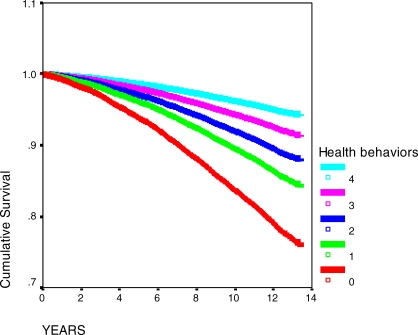
- Adjusted cumulative survival was about 75% for those scoring zero and 95% for those scoring four. The mortality risk difference between score 0 and score 4 was equivalent to approximately 14 years of chronological age.
- Relationships were consistent in subgroups stratified by sex, age, BMI, and social class, and after excluding deaths within 2 years; similar trends were seen in 2,057 individuals with prevalent disease excluded from main analyses.
Methods
- Prospective population study: EPIC-Norfolk, UK, baseline survey 1993–1997, follow-up to July 2006 (average 11 years). Of 22,301 with complete data, 2,057 with history of heart disease, stroke, or cancer were excluded, leaving 20,244 participants aged 45–79.
- Health behaviour score: one point each for current nonsmoking, not physically inactive, moderate alcohol intake (1–14 units/week), and plasma vitamin C >50 mmol/l indicating at least five fruit/vegetable servings daily; total score 0–4.
- Cox proportional hazards models estimated relative risks for all-cause and cause-specific mortality, adjusted for age, sex, body mass index, and social class; analyses included subgroup stratification and exclusion of deaths within 2 years.
Limitations
- The paper states potential large measurement errors in exposure assessment, use of only one baseline measure without accounting for lifestyle changes over follow-up, no weighting of different behaviours, and dichotomizing physical activity as inactive versus not inactive, which may obscure gradients between moderately inactive and active people.
- The paper states residual confounding cannot be excluded, and the analyses examined only mortality, not functional health or quality of life.
- Evident from the text: the cohort was 99.5% white, resident in Norfolk, UK, and middle-aged/older, so findings may not generalize to other populations; the observational design cannot establish causality.
Model-written summary. Check it against the paper before relying on it.
Integrity signals
Registry
Cites
Statistics
Figures
Verification
Claims the paper makes
19 Own result · 14 Not checked yet · 10 Own method · 6 Own interpretation · 1 No basis given
A result the paper reports from its own data — it cites no other source for it, so there is none to check. The quote shows it is in the paper.
In the paper
“The relationships were consistent in subgroups stratified by sex, age, body mass index, and social class, and after excluding deaths within 2 y.”
§ Combined Impact of Health Behaviours and Mortality in Men and Women: The EPIC-Norfolk Prospective Population Study > Abstract
plain- Asserted: passes — The authors put it forward as true.
- Checkable: passes — It can be checked against evidence.
- Load-bearing: passes — The paper’s conclusions depend on it.
- Based: passes — The paper gives a reason why it holds.
- Rests on an assumption: Death certification at the Office of National Statistics, United Kingdom, is virtually complete.
A result the paper reports from its own data — it cites no other source for it, so there is none to check. The quote shows it is in the paper.
In the paper
“The trends were strongest for cardiovascular causes.”
§ Combined Impact of Health Behaviours and Mortality in Men and Women: The EPIC-Norfolk Prospective Population Study > Abstract
plaincorrelational- Asserted: passes — The authors put it forward as true.
- Checkable: passes — It can be checked against evidence.
- Load-bearing: unclear — It is unclear whether the paper’s conclusions depend on it.
- Based: passes — The paper gives a reason why it holds.
- Rests on an assumption: Death certification at the Office of National Statistics, United Kingdom, is virtually complete.
A result the paper reports from its own data — it cites no other source for it, so there is none to check. The quote shows it is in the paper.
In the paper
“As might be expected, there were some differentials in the observed risk reductions observed for different health behaviours and cause-specific mortality in men and women; current smoking was the most consistent and strongest risk factor.”
§ Combined Impact of Health Behaviours and Mortality in Men and Women: The EPIC-Norfolk Prospective Population Study > Results
plaincorrelational- Asserted: passes — The authors put it forward as true.
- Checkable: passes — It can be checked against evidence.
- Load-bearing: passes — The paper’s conclusions depend on it.
- Based: passes — The paper gives a reason why it holds.
- Rests on an assumption: Death certification at the Office of National Statistics, United Kingdom, is virtually complete.
A result the paper reports from its own data — it cites no other source for it, so there is none to check. The quote shows it is in the paper.
In the paper
“None of the interaction terms for health score with sex, age, body mass index, and social class were significant in multivariate analyses.”
§ Combined Impact of Health Behaviours and Mortality in Men and Women: The EPIC-Norfolk Prospective Population Study > Results
plain- Asserted: passes — The authors put it forward as true.
- Checkable: passes — It can be checked against evidence.
- Load-bearing: passes — The paper’s conclusions depend on it.
- Based: passes — The paper gives a reason why it holds.
- Rests on an assumption: Death certification at the Office of National Statistics, United Kingdom, is virtually complete.
A result the paper reports from its own data — it cites no other source for it, so there is none to check. The quote shows it is in the paper.
In the paper
“From the Cox model, the beta coefficient for mortality associated with each year increase in chronological age was 0.10 (6 standard error 0.004).”
§ Combined Impact of Health Behaviours and Mortality in Men and Women: The EPIC-Norfolk Prospective Population Study > Results
plaincorrelational- Asserted: passes — The authors put it forward as true.
- Checkable: passes — It can be checked against evidence.
- Load-bearing: unclear — It is unclear whether the paper’s conclusions depend on it.
- Based: passes — The paper gives a reason why it holds.
- Rests on an assumption: Death certification at the Office of National Statistics, United Kingdom, is virtually complete.
A result the paper reports from its own data — it cites no other source for it, so there is none to check. The quote shows it is in the paper.
In the paper
“The mortality risk for those with four compared to zero health behaviours was equivalent to being 14 y younger in chronological age.”
- Also stated in: § Results · hedged
“The difference in beta coefficients between a health score of zero versus four was 1.43, that is, equivalent to approximately 14 y in chronological age for mortality risk.”
§ Combined Impact of Health Behaviours and Mortality in Men and Women: The EPIC-Norfolk Prospective Population Study > Abstract
plaincorrelational- Asserted: passes — The authors put it forward as true.
- Checkable: passes — It can be checked against evidence.
- Load-bearing: passes — The paper’s conclusions depend on it.
- Based: passes — The paper gives a reason why it holds.
- Rests on an assumption: Death certification at the Office of National Statistics, United Kingdom, is virtually complete.
- Also stated in: § Results · hedged
A result the paper reports from its own data — it cites no other source for it, so there is none to check. The quote shows it is in the paper.
In the paper
“After an average 11 y follow-up, the age-, sex-, body mass-, and social class-adjusted relative risks (95% confidence intervals) for allcause mortality(1,987 deaths) for men and women who had three, two, one, and zero compared to four health behaviours were respectively, 1.39 (1.21-1.60),1.95 (1.70--2.25),2.52 (2.13-3.00),and 4.04 (2.95-5.54)p , 0.001 trend.”
§ Combined Impact of Health Behaviours and Mortality in Men and Women: The EPIC-Norfolk Prospective Population Study > Abstract
plaincorrelational- Asserted: passes — The authors put it forward as true.
- Checkable: passes — It can be checked against evidence.
- Load-bearing: passes — The paper’s conclusions depend on it.
- Based: passes — The paper gives a reason why it holds.
- Rests on an assumption: Death certification at the Office of National Statistics, United Kingdom, is virtually complete.
A result the paper reports from its own data — it cites no other source for it, so there is none to check. The quote shows it is in the paper.
In the paper
“As with the relative risks of mortality, the adjusted cumulative survival was about 75% for those scoring zero and 95% for those scoring four, respectively, for health behaviours.”
§ Combined Impact of Health Behaviours and Mortality in Men and Women: The EPIC-Norfolk Prospective Population Study > Results
plaincorrelational- Asserted: passes — The authors put it forward as true.
- Checkable: passes — It can be checked against evidence.
- Load-bearing: passes — The paper’s conclusions depend on it.
- Based: passes — The paper gives a reason why it holds.
- Rests on an assumption: Death certification at the Office of National Statistics, United Kingdom, is virtually complete.
A result the paper reports from its own data — it cites no other source for it, so there is none to check. The quote shows it is in the paper.
In the paper
“The difference in beta coefficients between a health score of zero versus four was 1.43, that is, equivalent to approximately 14 y in chronological age for mortality risk.”
§ Combined Impact of Health Behaviours and Mortality in Men and Women: The EPIC-Norfolk Prospective Population Study > Results
plaincorrelational- Asserted: passes — The authors put it forward as true.
- Checkable: passes — It can be checked against evidence.
- Load-bearing: passes — The paper’s conclusions depend on it.
- Based: passes — The paper gives a reason why it holds.
- Rests on an assumption: Death certification at the Office of National Statistics, United Kingdom, is virtually complete.
A result the paper reports from its own data — it cites no other source for it, so there is none to check. The quote shows it is in the paper.
In the paper
“Cancer | 839/20,244 | 1 | 1.21 (0,99-1.48) | 1.81 (1.48-2.22) | 1.94 (1.48-2.54) | 3.74 (2.34-5.98)”
§ Combined Impact of Health Behaviours and Mortality in Men and Women: The EPIC-Norfolk Prospective Population Study > Additional Information.
plaincorrelational- Asserted: passes — The authors put it forward as true.
- Checkable: passes — It can be checked against evidence.
- Load-bearing: passes — The paper’s conclusions depend on it.
- Based: passes — The paper gives a reason why it holds.
- Rests on an assumption: The observed associations between health behaviour score and mortality are not explained by unmeasured or residual confounding.
- It may state two separate claims as one. 14
- The quote only partly states this claim. 4
- Probably not a substantial claim. 15
A result the paper reports from its own data — it cites no other source for it, so there is none to check. The quote shows it is in the paper.
In the paper
“Each of the health behaviours: smoking, being physically inactive, not having a moderate alcohol intake, and a low fruit and vegetable intake as indicated by plasma vitamin C level ,50 mmol/l.were associated with significantly higher risks of mortality from all causes.”
§ Combined Impact of Health Behaviours and Mortality in Men and Women: The EPIC-Norfolk Prospective Population Study > Results
plaincorrelational- Asserted: passes — The authors put it forward as true.
- Checkable: passes — It can be checked against evidence.
- Load-bearing: passes — The paper’s conclusions depend on it.
- Based: passes — The paper gives a reason why it holds.
It may state two separate claims as one.
- Rests on an assumption: Death certification at the Office of National Statistics, United Kingdom, is virtually complete.
In the paper
“In this cohort, vitamin supplement use was not associated with mortality, and results were similar after adjusting for vitamin supplement use or excluding vitamin users from the analyses (unpublished data and [19]).”
§ Combined Impact of Health Behaviours and Mortality in Men and Women: The EPIC-Norfolk Prospective Population Study > Results
What the sources say
- Not checked yetcites [19] Khaw, 2001, Lancet
plain- Asserted: passes — The authors put it forward as true.
- Checkable: passes — It can be checked against evidence.
- Load-bearing: unclear — It is unclear whether the paper’s conclusions depend on it.
- Based: passes — The paper gives a reason why it holds.
It may state two separate claims as one.
- Rests on an assumption: Death certification at the Office of National Statistics, United Kingdom, is virtually complete.
A result the paper reports from its own data — it cites no other source for it, so there is none to check. The quote shows it is in the paper.
In the paper
“All Cause | RR (95% CI) | n ¼ 1,977 events | 1.77 (1.55-2.01) | 1.24 (1.13-1.36) | 1.26 (1.14-1.38) | 1.44 (1.31-1.59)”
§ Combined Impact of Health Behaviours and Mortality in Men and Women: The EPIC-Norfolk Prospective Population Study > Additional Information.
plaincorrelational- Asserted: passes — The authors put it forward as true.
- Checkable: passes — It can be checked against evidence.
- Load-bearing: passes — The paper’s conclusions depend on it.
- Based: passes — The paper gives a reason why it holds.
The quote only partly states this claim.
- Rests on an assumption: The observed associations between health behaviour score and mortality are not explained by unmeasured or residual confounding.
A result the paper reports from its own data — it cites no other source for it, so there is none to check. The quote shows it is in the paper.
In the paper
“All cause | 1,977/20,244 | 1 | 1.39 (1.21-1.60) | 1.95 (1.70-2.25) | 2.52 (2.13-3.00) | 4.04 (2.95-5.54)”
§ Combined Impact of Health Behaviours and Mortality in Men and Women: The EPIC-Norfolk Prospective Population Study > Additional Information.
plaindirectn = 20,244- Asserted: passes — The authors put it forward as true.
- Checkable: passes — It can be checked against evidence.
- Load-bearing: passes — The paper’s conclusions depend on it.
- Based: passes — The paper gives a reason why it holds.
It may state two separate claims as one.
- Rests on an assumption: The observed associations between health behaviour score and mortality are not explained by unmeasured or residual confounding.
The paper states this without a source or data behind it here, so there is nothing to check it against. The quote shows it is in the paper.
In the paper
“The four health behaviours were within the usual range found in a free-living population.”
§ Combined Impact of Health Behaviours and Mortality in Men and Women: The EPIC-Norfolk Prospective Population Study > Implications
plain- Asserted: passes — The authors put it forward as true.
- Checkable: passes — It can be checked against evidence.
- Load-bearing: fails — The paper’s conclusions may not depend on it.
- Based: fails — The paper may give no reason why it holds.
Probably not a substantial claim. The paper’s conclusions may not depend on it. The paper may give no reason why it holds.
A result the paper reports from its own data — it cites no other source for it, so there is none to check. The quote shows it is in the paper.
In the paper
“All Cause | RR (95% CI) | n ¼ 1,977 events | 1.77 (1.55-2.01) | 1.24 (1.13-1.36) | 1.26 (1.14-1.38) | 1.44 (1.31-1.59)”
§ Combined Impact of Health Behaviours and Mortality in Men and Women: The EPIC-Norfolk Prospective Population Study > Additional Information.
plaincorrelational- Asserted: passes — The authors put it forward as true.
- Checkable: passes — It can be checked against evidence.
- Load-bearing: passes — The paper’s conclusions depend on it.
- Based: passes — The paper gives a reason why it holds.
The quote only partly states this claim.
- Rests on an assumption: The observed associations between health behaviour score and mortality are not explained by unmeasured or residual confounding.
A result the paper reports from its own data — it cites no other source for it, so there is none to check. The quote shows it is in the paper.
In the paper
“All Cause | RR (95% CI) | n ¼ 1,977 events | 1.77 (1.55-2.01) | 1.24 (1.13-1.36) | 1.26 (1.14-1.38) | 1.44 (1.31-1.59)”
§ Combined Impact of Health Behaviours and Mortality in Men and Women: The EPIC-Norfolk Prospective Population Study > Additional Information.
plaincorrelational- Asserted: passes — The authors put it forward as true.
- Checkable: passes — It can be checked against evidence.
- Load-bearing: passes — The paper’s conclusions depend on it.
- Based: passes — The paper gives a reason why it holds.
The quote only partly states this claim.
- Rests on an assumption: The observed associations between health behaviour score and mortality are not explained by unmeasured or residual confounding.
None of the sources cited for this claim have been checked yet.
In the paper
“Nevertheless, there is a large body of experimental and epidemiologic evidence indicating a high intake of fruit and vegetables is beneficially associated with health [5,7,11,32]”
§ Combined Impact of Health Behaviours and Mortality in Men and Women: The EPIC-Norfolk Prospective Population Study > Discussion
What the sources say
- Not checked yetcites [5] Joshipura, 2001, Ann Intern Med
- Not checked yetcites [7] Law, 1998, Eur J Clin Nutr
- Not checked yetcites [11] Ness, 1997, Int J Epidemiol
- Not checked yetcites [32] Rimm, 1996, JAMA
hedgedcorrelational- Asserted: passes — The authors put it forward as true.
- Checkable: passes — It can be checked against evidence.
- Load-bearing: fails — The paper’s conclusions may not depend on it.
- Based: passes — The paper gives a reason why it holds.
Probably not a substantial claim. The paper’s conclusions may not depend on it.
What the paper did — it cites no source for this, so there is none to check. The quote shows it is in the paper.
In the paper
“Of the 22,301 with available data, 2,057 had a history of heart disease, stroke, or cancer at the baseline visit and were excluded from the main analyses, leaving 20,244 individuals.”
§ Combined Impact of Health Behaviours and Mortality in Men and Women: The EPIC-Norfolk Prospective Population Study > Methods
plain- Asserted: passes — The authors put it forward as true.
- Checkable: passes — It can be checked against evidence.
- Load-bearing: passes — The paper’s conclusions depend on it.
- Based: passes — The paper gives a reason why it holds.
Probably not a substantial claim.
None of the sources cited for this claim have been checked yet.
In the paper
“A huge body of evidence indicates that lifestyles such as smoking, diet, and physical activity have a major influence on health [1][2][3][4][5][6][7][8][9][10][11][12][13][14][15][16].”
§ Combined Impact of Health Behaviours and Mortality in Men and Women: The EPIC-Norfolk Prospective Population Study > Introduction
What the sources say
- Not checked yetcites [1]
- Not checked yetcites [2] Chiuve, 2006, Circulation
- Not checked yetcites [3] Doll, 2004, BMJ
hedgeddirect- Asserted: passes — The authors put it forward as true.
- Checkable: passes — It can be checked against evidence.
- Load-bearing: fails — The paper’s conclusions may not depend on it.
- Based: passes — The paper gives a reason why it holds.
Probably not a substantial claim. The paper’s conclusions may not depend on it.
None of the sources cited for this claim have been checked yet.
In the paper
“Because humans do not manufacture vitamin C and have to rely on exogenous sources, plasma vitamin C is a good biomarker of plant food intake; previous studies have reported that a blood value of 50 mmol/l or more indicates an intake of at least five servings of fruit and vegetables daily [19;26].”
§ Combined Impact of Health Behaviours and Mortality in Men and Women: The EPIC-Norfolk Prospective Population Study > Methods
What the sources say
- Not checked yetcites [19] Khaw, 2001, Lancet
- Not checked yetcites [26] Bingham, 1995, Br J Nutr
hedgedcorrelational- Asserted: passes — The authors put it forward as true.
- Checkable: passes — It can be checked against evidence.
- Load-bearing: unclear — It is unclear whether the paper’s conclusions depend on it.
- Based: passes — The paper gives a reason why it holds.
It may state two separate claims as one.
What the paper did — it cites no source for this, so there is none to check. The quote shows it is in the paper.
In the paper
“The score, though simple, was based on instruments that have been extensively previously validated.”
§ Combined Impact of Health Behaviours and Mortality in Men and Women: The EPIC-Norfolk Prospective Population Study > Discussion
plain- Asserted: passes — The authors put it forward as true.
- Checkable: passes — It can be checked against evidence.
- Load-bearing: fails — The paper’s conclusions may not depend on it.
- Based: passes — The paper gives a reason why it holds.
Probably not a substantial claim. The paper’s conclusions may not depend on it.
In the paper
“Nevertheless, a recent report from 2,339 men and women aged 70-90 y in 11 European countries indicated that adherence to a Mediterranean diet, nonsmoking, any alcohol use, and moderate physical activity were associated with more than 50% lower rate of all-cause and cause-specific mortality [6].”
§ Combined Impact of Health Behaviours and Mortality in Men and Women: The EPIC-Norfolk Prospective Population Study > Introduction
What the sources say
- Not checked yetcites [6] Knoops, 2004, JAMA
hedgedcorrelationaln = 2,339- Asserted: passes — The authors put it forward as true.
- Checkable: passes — It can be checked against evidence.
- Load-bearing: passes — The paper’s conclusions depend on it.
- Based: passes — The paper gives a reason why it holds.
Probably not a substantial claim.
In the paper
“The Norfolk cohort was comparable to national population samples with respect to characteristics including anthropometry, blood pressure, and lipids, but with a lower prevalence of current smokers [21].”
§ Combined Impact of Health Behaviours and Mortality in Men and Women: The EPIC-Norfolk Prospective Population Study > Methods
What the sources say
- Not checked yetcites [21] Day, 1999, Br J Cancer
plain- Asserted: passes — The authors put it forward as true.
- Checkable: passes — It can be checked against evidence.
- Load-bearing: unclear — It is unclear whether the paper’s conclusions depend on it.
- Based: passes — The paper gives a reason why it holds.
It may state two separate claims as one.
A conclusion the paper draws from its own results — it cites no other source for it, so there is none to check. The quote shows it is in the paper.
In the paper
“Four health behaviours combined predict a 4-fold difference in total mortality in men and women, with an estimated impact equivalent to 14 y in chronological age.”
§ Combined Impact of Health Behaviours and Mortality in Men and Women: The EPIC-Norfolk Prospective Population Study > Abstract
hedgedcorrelational- Asserted: passes — The authors put it forward as true.
- Checkable: passes — It can be checked against evidence.
- Load-bearing: passes — The paper’s conclusions depend on it.
- Based: passes — The paper gives a reason why it holds.
It may state two separate claims as one.
- Rests on an assumption: Death certification at the Office of National Statistics, United Kingdom, is virtually complete.
In the paper
“We have also previously shown that low work and leisure-time physical activity predicts all-cause mortality and cardiovascular disease incidence [20].”
§ Combined Impact of Health Behaviours and Mortality in Men and Women: The EPIC-Norfolk Prospective Population Study > Introduction
What the sources say
- Not checked yetcites [20] Khaw, 2006, Int J Epidemiol
plaincorrelational- Asserted: passes — The authors put it forward as true.
- Checkable: passes — It can be checked against evidence.
- Load-bearing: unclear — It is unclear whether the paper’s conclusions depend on it.
- Based: passes — The paper gives a reason why it holds.
It may state two separate claims as one.
What the paper did — it cites no source for this, so there is none to check. The quote shows it is in the paper.
In the paper
“The authors have declared that no competing interests exist.”
§ Combined Impact of Health Behaviours and Mortality in Men and Women: The EPIC-Norfolk Prospective Population Study > Conflict
plain- Asserted: passes — The authors put it forward as true.
- Checkable: passes — It can be checked against evidence.
- Load-bearing: fails — The paper’s conclusions may not depend on it.
- Based: passes — The paper gives a reason why it holds.
Probably not a substantial claim. The paper’s conclusions may not depend on it.
What the paper did — it cites no source for this, so there is none to check. The quote shows it is in the paper.
In the paper
“We used only a measure at one point in time to characterize individuals and did not take into account likely changes in lifestyles over the follow-up period.”
§ Combined Impact of Health Behaviours and Mortality in Men and Women: The EPIC-Norfolk Prospective Population Study > Discussion
plain- Asserted: passes — The authors put it forward as true.
- Checkable: passes — It can be checked against evidence.
- Load-bearing: unclear — It is unclear whether the paper’s conclusions depend on it.
- Based: passes — The paper gives a reason why it holds.
It may state two separate claims as one.
A conclusion the paper draws from its own results — it cites no other source for it, so there is none to check. The quote shows it is in the paper.
In the paper
“These results may provide further support for the idea that even small differences in lifestyle may make a big difference to health in the population and encourage behaviour change.”
§ Combined Impact of Health Behaviours and Mortality in Men and Women: The EPIC-Norfolk Prospective Population Study > Implications
hedgedconditional- Asserted: passes — The authors put it forward as true.
- Checkable: fails — It may be too vague to check against evidence.
- Load-bearing: passes — The paper’s conclusions depend on it.
- Based: passes — The paper gives a reason why it holds.
Probably not a substantial claim. It may be too vague to check against evidence. It may state two separate claims as one.
- Rests on an assumption: The EPIC-Norfolk cohort is representative of middle-aged and older people in the general population.
What the paper did — it cites no source for this, so there is none to check. The quote shows it is in the paper.
In the paper
“Mortality Rates and Relative Risk of All-Cause Mortality by Number of Health Behaviours, Adjusted by Age, Sex, and Body Mass Index, and Stratified by Cause, Sex, Age, Body Mass Index, and Social Class in 20,244 Men and Women Aged 45-79 y without Known Cardiovascular Disease or Cancer in EPIC-Norfolk 1993-2006, Cox Regression Model”
§ Combined Impact of Health Behaviours and Mortality in Men and Women: The EPIC-Norfolk Prospective Population Study > Additional Information.
plainn = 20,244- Asserted: passes — The authors put it forward as true.
- Checkable: passes — It can be checked against evidence.
- Load-bearing: passes — The paper’s conclusions depend on it.
- Based: passes — The paper gives a reason why it holds.
Probably not a substantial claim.
In the paper
“Thirdly, the proportions of the population with some or all positive health behaviours were relatively high since the definitions for health behaviours were not necessarily optimal, for example, for physical activity [20], and dichotomizing behaviours between inactive and not inactive may have obscured the gradient in mortality between those who were moderately inactive and those who were active.”
§ Combined Impact of Health Behaviours and Mortality in Men and Women: The EPIC-Norfolk Prospective Population Study > Discussion
What the sources say
- Not checked yetcites [20] Khaw, 2006, Int J Epidemiol
hedgedconditional- Asserted: passes — The authors put it forward as true.
- Checkable: passes — It can be checked against evidence.
- Load-bearing: unclear — It is unclear whether the paper’s conclusions depend on it.
- Based: passes — The paper gives a reason why it holds.
It may state two separate claims as one.
A conclusion the paper draws from its own results — it cites no other source for it, so there is none to check. The quote shows it is in the paper.
In the paper
“Nevertheless, random measurement error is likely to attenuate any associations observed, so the estimated differences in risk are likely to be larger than those observed.”
§ Combined Impact of Health Behaviours and Mortality in Men and Women: The EPIC-Norfolk Prospective Population Study > Discussion
hedgeddirect- Asserted: passes — The authors put it forward as true.
- Checkable: passes — It can be checked against evidence.
- Load-bearing: unclear — It is unclear whether the paper’s conclusions depend on it.
- Based: passes — The paper gives a reason why it holds.
It may state two separate claims as one.
What the paper did — it cites no source for this, so there is none to check. The quote shows it is in the paper.
In the paper
“The sponsors had no role in the design and conduct of the study, collection, management, analysis and interpretation of the data, and preparation, review, or approval of the manuscript.”
§ Combined Impact of Health Behaviours and Mortality in Men and Women: The EPIC-Norfolk Prospective Population Study > Funding
plain- Asserted: passes — The authors put it forward as true.
- Checkable: passes — It can be checked against evidence.
- Load-bearing: fails — The paper’s conclusions may not depend on it.
- Based: passes — The paper gives a reason why it holds.
Probably not a substantial claim. The paper’s conclusions may not depend on it.
What the paper did — it cites no source for this, so there is none to check. The quote shows it is in the paper.
In the paper
“Though we cannot exclude residual confounding, our results are consistent with the existing evidence indicating these behavioural factors are beneficial for health.”
§ Combined Impact of Health Behaviours and Mortality in Men and Women: The EPIC-Norfolk Prospective Population Study > Discussion
plain- Asserted: passes — The authors put it forward as true.
- Checkable: passes — It can be checked against evidence.
- Load-bearing: fails — The paper’s conclusions may not depend on it.
- Based: passes — The paper gives a reason why it holds.
Probably not a substantial claim. The paper’s conclusions may not depend on it.
A conclusion the paper draws from its own results — it cites no other source for it, so there is none to check. The quote shows it is in the paper.
In the paper
“their combined impact was associated with an estimated 4-fold difference in mortality risk, equivalent to 14 y in chronological age.”
§ Combined Impact of Health Behaviours and Mortality in Men and Women: The EPIC-Norfolk Prospective Population Study > Implications
hedgedcorrelational- Asserted: passes — The authors put it forward as true.
- Checkable: passes — It can be checked against evidence.
- Load-bearing: passes — The paper’s conclusions depend on it.
- Based: passes — The paper gives a reason why it holds.
It may state two separate claims as one.
- Rests on an assumption: The observed associations between health behaviour score and mortality are not explained by unmeasured or residual confounding.
What the paper did — it cites no source for this, so there is none to check. The quote shows it is in the paper.
In the paper
“KTK conducted the data analyses, wrote the paper with coauthors, had full access to all of the data in the study, and takes responsibility for the integrity of the data and the accuracy of the data analysis.”
§ Combined Impact of Health Behaviours and Mortality in Men and Women: The EPIC-Norfolk Prospective Population Study > Contribution
plain- Asserted: passes — The authors put it forward as true.
- Checkable: passes — It can be checked against evidence.
- Load-bearing: fails — The paper’s conclusions may not depend on it.
- Based: passes — The paper gives a reason why it holds.
Probably not a substantial claim. The paper’s conclusions may not depend on it. It may state two separate claims as one.
In the paper
“subjective functional health is also predictive of mortality [36]”
§ Combined Impact of Health Behaviours and Mortality in Men and Women: The EPIC-Norfolk Prospective Population Study > Implications
What the sources say
- Not checked yetcites [36] Myint, 2006, Ann Epidemiol
plaincorrelational- Asserted: passes — The authors put it forward as true.
- Checkable: passes — It can be checked against evidence.
- Load-bearing: fails — The paper’s conclusions may not depend on it.
- Based: passes — The paper gives a reason why it holds.
Probably not a substantial claim. The paper’s conclusions may not depend on it.
In the paper
“In the UK, the recommendations are up to 21 drinks weekly for men and 14 drinks weekly for women [33].”
§ Combined Impact of Health Behaviours and Mortality in Men and Women: The EPIC-Norfolk Prospective Population Study > Discussion
What the sources say
- Not checked yetcites [33]
plain- Asserted: passes — The authors put it forward as true.
- Checkable: passes — It can be checked against evidence.
- Load-bearing: fails — The paper’s conclusions may not depend on it.
- Based: passes — The paper gives a reason why it holds.
Probably not a substantial claim. The paper’s conclusions may not depend on it. It may state two separate claims as one.
What the paper did — it cites no source for this, so there is none to check. The quote shows it is in the paper.
In the paper
“NW developed and validated the physical activity measures and scales.”
§ Combined Impact of Health Behaviours and Mortality in Men and Women: The EPIC-Norfolk Prospective Population Study > Contribution
plain- Asserted: passes — The authors put it forward as true.
- Checkable: passes — It can be checked against evidence.
- Load-bearing: passes — The paper’s conclusions depend on it.
- Based: passes — The paper gives a reason why it holds.
Probably not a substantial claim.
The paper relies on this without support.
Health behaviours such as smoking, diet, and physical activity are highly correlated.
“Many health behaviours such as smoking habit, diet, and physical activity are highly correlated and, in aetiologically focused papers, treated as covariates.”
The paper relies on this without support.
Death certification at the Office of National Statistics, United Kingdom, is virtually complete.
“All participants are flagged for death certification at the Office of National Statistics, United Kingdom which is virtually complete.”
The paper relies on this without support.
The observed associations between health behaviour score and mortality are not explained by unmeasured or residual confounding.
“After allowing for other factors that might have affected their likelihood of dying (for example, age)”
The paper relies on this without support.
The EPIC-Norfolk cohort is representative of middle-aged and older people in the general population.
“These findings indicate that the combination of four simply defined health behaviors predicts a 4-fold difference in the risk of dying over an average period of 11 years for middle-aged and older people.”
The paper relies on this without support.
Mortality follow-up via record linkage was complete and accurate.
“Deaths among the participants were then recorded until 2006.”
Claims other papers make about this one
Each is checked against this paper’s own text: does it say what the citing paper says it does?
In the citing paper
“Moreover, regular physical activity appears to protect against premature death independent of obesity [10, 11].”
From Exercise as a Mean to Control Low‐Grade Systemic Inflammation (2008) · cites this paper as [10]
In the citing paper
“regular exercise offers protection against all causes of mortality, primarily by protection against atherosclerosis and insulin resistance”
From Exercise as a Mean to Control Low‐Grade Systemic Inflammation (2008) · cites this paper as [10]
Self-check
Percentages, sums and reported differences re-computed from the paper’s own numbers.
Each contradiction between two passages listed here was confirmed by an independent check.
Rated major: it would touch a result — a value a result rests on, reported and recomputed p-values on opposite sides of the significance level, two passages that conflict with no sign which is right, or a cited work retracted before this paper was published.
In the paper
§ Combined Impact of Health Behaviours and Mortality in Men and Women: The EPIC-Norfolk Prospective Population Study > Additional Information.
“| | at least half an hour of leisure time activity |”
§ Combined Impact of Health Behaviours and Mortality in Men and Women: The EPIC-Norfolk Prospective Population Study > Methods
“For the purposes of the current study, we dichotomised the population into physically inactive (sedentary job and no recreational activity) and not physically inactive (any category with activity levels above the latter).”
Rated minor: it would not touch a result — a value no result rests on, a p-value that stays on the same side of the significance level, or a conflict that is clerical, resolved elsewhere in the paper, or outside its own findings.
In the paper
“| | 21 or more units a week | 15.1 (1,389) | 1.2 (254) |”
§ Combined Impact of Health Behaviours and Mortality in Men and Women: The EPIC-Norfolk Prospective Population Study > Additional Information.
Reported 1.2 · recomputed 2.295941
Rated minor: it would not touch a result — a value no result rests on, a p-value that stays on the same side of the significance level, or a conflict that is clerical, resolved elsewhere in the paper, or outside its own findings.
In the paper
“| | III nonmanual | 12.3 (1,108) | 119.9 (2,145) |”
§ Combined Impact of Health Behaviours and Mortality in Men and Women: The EPIC-Norfolk Prospective Population Study > Additional Information.
Reported 119.9 · recomputed 19.388954
Rated minor: it would not touch a result — a value no result rests on, a p-value that stays on the same side of the significance level, or a conflict that is clerical, resolved elsewhere in the paper, or outside its own findings.
In the paper
§ Combined Impact of Health Behaviours and Mortality in Men and Women: The EPIC-Norfolk Prospective Population Study > Additional Information.
“| Alcohol intake | One or more, but less than 14 units, a |”
§ Combined Impact of Health Behaviours and Mortality in Men and Women: The EPIC-Norfolk Prospective Population Study > Methods
“For these analyses, a moderate drinker was defined as someone who drank one or more units a week (that is, not a nondrinker), but not more than 14 units a week.”
Citations
Cites
Mortality in relation to smoking: 40 years' observations on male British doctors
Doll, R., Peto, R., Wheatley, K., Gray, R., & Sutherland, I. (1994) · BMJ · doi:10.1136/bmj.309.6959.901 · Cited by 5,932
Diet, nutrition and the prevention of chronic diseases
Joint, W. (2002) · Medical Entomology and Zoology · Cited by 4,890
Adherence to a Mediterranean diet and survival in a Greek population
Trichopoulou, A., Costacou, T., Bamia, C., & Trichopoulos, D. (2003) · New England Journal of Medicine · doi:10.1056/nejmoa025039 · Cited by 4,397
Thompson, P. D., Buchner, D., Piña, I. L., Balady, G. J., Williams, M. A., Marcus, B. H., Berra, K., Blair, S. N., Costa, F., Franklin, B., et al. (2003) · Circulation · doi:10.1161/01.cir.0000075572.40158.77 · Cited by 2,132
Primary Prevention of Coronary Heart Disease in Women through Diet and Lifestyle
Stampfer, M. J., Hu, F. B., Manson, J. E., Rimm, E. B., & Willett, W. C. (2000) · New England Journal of Medicine · doi:10.1056/nejm200007063430103 · Cited by 1,794
Diet, Nutrition, and the Prevention of Chronic Diseases
Leong, A. (1992) · Pathology · doi:10.1016/s0031-3025(16)36541-2 · Cited by 1,633
The Effect of Fruit and Vegetable Intake on Risk for Coronary Heart Disease
Joshipura, K. J., Hu, F. B., Manson, J. E., Stampfer, M. J., Rimm, E. B., Speizer, F. E., Colditz, G., Ascherio, A., Rosner, B., Spiegelman, D., et al. (2001) · Annals of Internal Medicine · doi:10.7326/0003-4819-134-12-200106190-00010 · Cited by 1,396
Fruit and vegetables, and cardiovascular disease: A review
Ness, A. R., & Powles, J. W. (1997) · International Journal of Epidemiology · doi:10.1093/ije/26.1.1 · Cited by 1,368
McCullough, M. L., Feskanich, D., Stampfer, M. J., Giovannucci, E. L., Rimm, E. B., Hu, F. B., Spiegelman, D., Hunter, D. J., Colditz, G. A., & Willett, W. C. (2002) · The American Journal of Clinical Nutrition · doi:10.1093/ajcn/76.6.1261 · Cited by 1,191
Howard, B. V., Van Horn, L., Hsia, J., Manson, J. E., Stefanick, M. L., Wassertheil-Smoller, S., Kuller, L. H., LaCroix, A. Z., Langer, R. D., Lasser, N. L., et al. (2006) · JAMA · doi:10.1001/jama.295.6.655 · Cited by 1,091
Research works printed but not linked: 34
- Chiuve, 2006, Circulation, 114, 160
- Doll, 2004, BMJ, 328, 1519
- Hu, 2000, Am J Clin Nutr, 72, 912
- Joshipura, 2001, Ann Intern Med, 134, 1106
- Knoops, 2004, JAMA, 292, 1433
- Law, 1998, Eur J Clin Nutr, 52, 549
- Manson, 1996, N Engl J Med, 334, 1325
- McCullough, 2002, Am J Clin Nutr, 76, 1261
- Mukamal, 2006, Arch Intern Med, 166, 2145
- Ness, 1997, Int J Epidemiol, 26, 1
- Oguma, 2002, Br J Sports Med, 36, 162
- Sesso, 1999, Am J Epidemiol, 150, 408
- Stampfer, 2000, N Engl J Med, 343, 16
- Thompson, 2003, Circulation, 107, 3109
- Trichopoulou, 2003, N Engl J Med, 348, 2599
- Alonso, 2005, JAMA, 293, 674
- Craighead, 2005, JAMA, 293, 674
- Khaw, 2001, Lancet, 357, 657
- Khaw, 2006, Int J Epidemiol, 35, 1034
- Day, 1999, Br J Cancer, 80, 95
- Wareham, 2002, Int J Epidemiol, 31, 168
- Wareham, 2003, Public Health Nutr, 6, 407
- Shohaimi, 2004, Eur Respir J, 24, 157
- Riemersma, 1990, Eur J Clin Nutr, 44, 143
- Bingham, 1995, Br J Nutr, 73, 531
- Liese, 2000, Am J Epidemiol, 152, 884
- Rimm, 2004, JAMA, 292, 1490
- Anderson, 2006, JAMA, 295, 693
- Howard, 2006, JAMA, 295, 655
- Prentice, 2006, JAMA, 295, 629
- Rimm, 1996, JAMA, 275, 447
- Myint, 2006, Prev Med, 44, 109
- Myint, 2007, Public Health Nutr, 10, 34
- Myint, 2006, Ann Epidemiol, 16, 492
Cited by
Sorted by citations
Items 401–500 of 836
박은자, 김남순, & 전진아 (2015) · Health and Social Welfare Review · doi:10.15709/hswr.2015.35.1.136 · Cited by 18
Healthy Life Expectancy Is Expanding
Clarfield, A. M. (2017) · Journal of the American Geriatrics Society · doi:10.1111/jgs.15165 · Cited by 22
Junker, K., Buckley, C. M., Millar, S., Flynn, S., Harrington, J. M., Kearney, P. M., & Perry, I. J. (2021) · PLoS ONE · doi:10.1371/journal.pone.0253537 · Cited by 17
Jonsdottir, S. E., Brader, L., Gunnarsdóttir, I., Magnúsdóttir, Ó. K., Schwab, U., Kolehmainen, M., Risérus, U., Herzig, K., Cloetens, L., Helgegren, H., et al. (2013) · Food & Nutrition Research · doi:10.3402/fnr.v57i0.21391 · Cited by 18
Comportamentos saudáveis e escolaridade no Brasil: tendência temporal de 2008 a 2013
Camelo, L. D. V., de Figueiredo, R. C., Oliveira-Campos, M., Giatti, L., & Barreto, S. M. (2016) · Ciência & Saúde Coletiva · doi:10.1590/1413-81232015214.09742015 · Cited by 17
Busnelli, A., Somigliana, E., & Vercellini, P. (2017) · Human Reproduction · doi:10.1093/humrep/dex032 · Cited by 17
Prevalence, Co-Occurrence and Clustering of Lifestyle Risk Factors Among UK Men
Zwolinsky, S., Raine, G., & Robertson, S. (2016) · Journal of Men s Health · doi:10.31083/jomh.v12i2.24 · Cited by 17
Dinis, M. A. P., Sousa, H. F. P. E., de Moura, A., Viterbo, L. M. F., & Pinto, R. J. (2019) · International Journal of Environmental Research and Public Health · doi:10.3390/ijerph16132392 · Cited by 15
Freyer‐Adam, J., Noetzel, F., Baumann, S., Aghdassi, A. A., Siewert‐Markus, U., Gaertner, B., & John, U. (2019) · BMC Public Health · doi:10.1186/s12889-019-7931-6 · Cited by 17
Associations Between Positive and Negative Affect and the Way People Perceive Their Health Goals
Plys, E., & Desrichard, O. (2020) · Frontiers in Psychology · doi:10.3389/fpsyg.2020.00334 · Cited by 17
Cancelliere, C., Boyle, E., Côté, P., Holm, L. W., Salmi, L., & Cassidy, J. D. (2020) · Accident Analysis & Prevention · doi:10.1016/j.aap.2020.105580 · Cited by 17
Ots, P., van Zon, S. K. R., Schram, J. L., Alex Burdorf, A., Robroek, S. J., Hengel, K. M. O., & Brouwer, S. (2020) · Preventive Medicine · doi:10.1016/j.ypmed.2020.106228 · Cited by 18
Przybylko, G., Morton, D. P., & Renfrew, M. E. (2021) · Frontiers in Psychology · doi:10.3389/fpsyg.2021.644337 · Cited by 19
Baigi, A., Lindgren, E., Starrin, B., & Bergh, H. (2008) · BioPsychoSocial Medicine · doi:10.1186/1751-0759-2-15 · Cited by 17
Myint, P. K., Luben, R., Surtees, P. G., Wainwright, N. W. J., Wareham, N. J., & Khaw, K. (2010) · International Journal of Epidemiology · doi:10.1093/ije/dyq061 · Cited by 17
Self-citationMaddison, R., Stewart, R., Doughty, R. N., Scott, T., Kerr, A., Benatar, J. R., Whittaker, R., Rawstorn, J. C., Rolleston, A. K., Jiang, Y., et al. (2018) · Trials · doi:10.1186/s13063-018-2468-z · Cited by 19
Clinical Update on Nursing Home Medicine: 2008
Messinger‐Rapport, B. J., Thomas, D. R., Gammack, J. K., & Morley, J. E. (2008) · Journal of the American Medical Directors Association · doi:10.1016/j.jamda.2008.07.006 · Cited by 17
Ahmad, K., Keramat, S. A., Ormsby, G., Kabir, E., & Khanam, R. (2023) · BMC Public Health · doi:10.1186/s12889-023-15724-6 · Cited by 16
van Hooijdonk, K. J. M., Simons, S. S. H., van Noorden, T. H. J., Geurts, S. A. E., & Vink, J. M. (2023) · Preventive Medicine Reports · doi:10.1016/j.pmedr.2023.102307 · Cited by 19
Ding, J., Fu, R., Yuan, T., Brenner, H., & Hoffmeister, M. (2025) · BMC Public Health · doi:10.1186/s12889-025-21537-6 · Cited by 17
Lifestyle factors and p53 mutation patterns in colorectal cancer patients in the EPIC-Norfolk study
Park, J. Y., Mitrou, P. N., Keen, J., Dahm, C. C., Gay, L. J., Luben, R., McTaggart, A., Khaw, K., Ball, R. Y., Arends, M. J., et al. (2010) · Mutagenesis · doi:10.1093/mutage/geq012 · Cited by 16
Self-citationMeasuring health care access and quality to improve health in populations.
Kottke, T. E., & Isham, G. J. (2010) · PubMed Central · Cited by 16
Patterson, K. A. E., Ferrar, K., Gall, S., Venn, A., Blizzard, L., Dwyer, T., & Cleland, V. J. (2019) · Preventive Medicine · doi:10.1016/j.ypmed.2019.105861 · Cited by 16
Education of the Patients Living with Heart Disease
Podvorica, E., Bekteshi, T., Oruqi, M., & Kalo, I. (2021) · Materia Socio Medica · doi:10.5455/msm.2021.33.10-15 · Cited by 16
Iversen, L., Hannaford, P. C., Lee, A. J., Elliott, A. M., & Fielding, S. (2010) · British Journal of General Practice · doi:10.3399/bjgp10x515052 · Cited by 16
Leslie, J. H., Braun, K. L., Novotny, R., & Mokuau, N. K. (2013) · Europe PMC (PubMed Central) · Cited by 16
Dash, S. R., Hoare, E., Varsamis, P., Jennings, G., & Kingwell, B. A. (2019) · International Journal of Environmental Research and Public Health · doi:10.3390/ijerph16020224 · Cited by 16
Assessment of stress and its relationship with health behaviour in daily life: a systematic review
Bamert, M., Schaffter, Y., Bally, F., O'Connor, D. B., & Inauen, J. (2025) · Health Psychology Review · doi:10.1080/17437199.2025.2534000 · Cited by 16
La mortalité à l’hôpital psychiatrique de Tunis : étude rétrospective sur 11ans
Zgueb, Y., Jomli, R., Ouertani, A., Hechmi, S. E., Ouanes, S., Nacef, F., & Banaser, A. (2014) · L Encéphale · doi:10.1016/j.encep.2014.07.007 · Cited by 15
Anthropometric measures, predicted visceral adipose tissue and biomarkers of chronic inflammation
Millar, S., Perry, I. J., & Phillips, C. M. (2023) · European Journal of Clinical Investigation · doi:10.1111/eci.14104 · Cited by 15
Du, T., Sun, X., Yin, P., Yuan, G., Zhang, M., Zhou, X., & Yu, X. (2014) · BMC Public Health · doi:10.1186/1471-2458-14-961 · Cited by 15
Unicycle steering by brakes: A passive guidance support for an assistive cart
Fontanelli, D., Giannitrapani, A., Palopoli, L., & Prattichizzo, D. (2013) · IEEE Conference on Decision and Control (CDC) · doi:10.1109/cdc.2013.6760220 · Cited by 15
Morley, J. E. (2010) · Clinics in Geriatric Medicine · doi:10.1016/j.cger.2010.02.008 · Cited by 16
Laws, R., Chan, B., Williams, A., Davies, G. P., Jayasinghe, U. W., Fanaian, M., Harris, M., & the CN SNAP Project Team (2010) · BMC Nursing · doi:10.1186/1472-6955-9-4 · Cited by 15
Winstein, C. J., Requejo, P. S., Zelinski, E. M., Mulroy, S. J., & Crimmins, E. M. (2012) · Frontiers in Psychology · doi:10.3389/fpsyg.2012.00340 · Cited by 15
Mediterranean Diet and Health Promotion: evidence and current concerns
Ciancarelli, M. G. T., Massimo, C. D., Amicis, D. D., & Ciancarelli, I. (2017) · Medical Research Archives · doi:10.18103/mra.v5i7.1385 · Cited by 15
Healthy living and cancer: evidence from UK Biobank
Elwood, P. C., Whitmarsh, A., Gallacher, J., Bayer, A. J., Adams, R., Heslop, L., Pickering, J. E., Morgan, G., Galante, J., Dolwani, S., et al. (2018) · ecancermedicalscience · doi:10.3332/ecancer.2018.792 · Cited by 15
Pronk, N. (2012) · ACSMʼs Health & Fitness Journal · doi:10.1249/01.fit.0000414748.25945.58 · Cited by 15
Survival to Age 90 in Men: The Tromsø Study 1974–2018
Brenn, T. (2019) · International Journal of Environmental Research and Public Health · doi:10.3390/ijerph16112028 · Cited by 15
Implementing Adaptive Health Practice: A Complexity-Based Philosophy of Health Care
Thygeson, N. M. (2012) · Springer eBooks · doi:10.1007/978-1-4614-4998-0_38 · Cited by 16
Over-Nutrition and Changing Health Status in High Income Countries
Huffman, W. E., Huffman, S. K., Rickertsen, K., & Tegene, A. (2010) · Forum for Health Economics & Policy · doi:10.2202/1558-9544.1181 · Cited by 15
Ecology and environmental omics
Kesheri, M., Kanchan, S., Srivastava, U., Chittoori, B. C. S., Ratna-Raj, R., Sinha, R. P., Vaishampayan, A., Rastogi, R. P., & Primerano, D. A. (2024) · Elsevier eBooks · doi:10.1016/b978-0-443-16092-9.00019-9 · Cited by 14
Accelerating the Control and Prevention of Non-communicable Diseases in Ghana: the Key Issues
Bosu, W. K. (2022) · Postgraduate Medical Journal of Ghana · doi:10.60014/pmjg.v2i1.25 · Cited by 14
Luo, T.-Y., Liu, X., Dai, T. Y., Liu, X. M., Zhang, Q., & Dong, J. (2016) · PubMed · doi:10.3967/bes2016.063 · Cited by 14
Li, L., He, J., Ouyang, F., Qiu, D., Li, Y., Luo, D., Yu, Y., & Xiao, S. (2021) · BMJ Open · doi:10.1136/bmjopen-2020-047462 · Cited by 14
Yang, H., Wang, X., Wang, J., Zhao, F., Fan, J., Qiao, Y., Taylor, P. R., & Abnet, C. C. (2022) · International Journal of Cancer · doi:10.1002/ijc.34160 · Cited by 14
Šilarova, B., Lucas, J., Butterworth, A. S., Angelantonio, E. D., Girling, C., Lawrence, K., Mackintosh, S., Moore, C. S., Payne, R., Sharp, S. J., et al. (2015) · BMC Public Health · doi:10.1186/s12889-015-2192-5 · Cited by 15
Meyer, U., Schindler, C., Bloesch, T., Schmocker, E., Zahner, L., Puder, J. J., & Kriemler, S. (2014) · Journal of Adolescent Health · doi:10.1016/j.jadohealth.2014.07.007 · Cited by 14
Anti-aging medicine: pitfalls and hopes
Dominguez, L. J., Barbagallo, M., & Morley, J. E. (2009) · The Aging Male · doi:10.1080/13685530902814434 · Cited by 14
Fruit and Vegetables and Health: An Overview
Desjardins, Y. (2014) · Springer eBooks · doi:10.1007/978-94-017-8560-0_2 · Cited by 14
Sustainability in Everyday Life: Integrating Environmental, Social, and Economic Goals
Salonen, A. O., & Åhlberg, M. (2011) · Sustainability The Journal of Record · doi:10.1089/sus.2011.9693 · Cited by 14
Healthy lifestyle intervention for people with severe mental disorders
Baker, A., KAY‐LAMBKIN, F. J., RICHMOND, R. L., Filia, S., Castle, D. J., Williams, J. M., & Thornton, L. K. (2011) · Mental Health and Substance Use · doi:10.1080/17523281.2011.555086 · Cited by 16
Socioeconomic inequality in health-related behaviors: a lifestyle approach
Glorioso, V., & Pisati, M. (2013) · Quality & Quantity · doi:10.1007/s11135-013-9929-y · Cited by 14
Abraham, C. (2014) · Health Psychology Review · doi:10.1080/17437199.2014.905967 · Cited by 14
Verbiest, M., Borrell, S., Dalhousie, S., Tupa'i-Firestone, R., Funaki, T., Goodwin, D., Grey, J., Henry, A., Hughes, E., Humphrey, G., et al. (2018) · JMIR Research Protocols · doi:10.2196/10789 · Cited by 13
Chawłowska, E., Staszewski, R., Jóźwiak, P., Lipiak, A., & Zawiejska, A. (2022) · Behavioral Sciences · doi:10.3390/bs12100378 · Cited by 13
Malkowski, O. S., Harvey, J., Townsend, N. P., Kelson, M. J., Foster, C. E., Western, M. J., AlKhatib, A. H., Bourassa, K. J., Burnett, H., Cajita, M., et al. (2025) · International Journal of Behavioral Nutrition and Physical Activity · doi:10.1186/s12966-025-01775-y · Cited by 13
Investigating Self-Reported Health Behaviors in Australian Adults with Mental Illness
Scott, D. S., Happell, B., Strange, S., & Platania‐Phung, C. (2013) · Behavioral Medicine · doi:10.1080/08964289.2012.726289 · Cited by 13
Pan, Y., Yeh, L., Chen, Y., Kuo, K., & Chang, C. (2016) · BJPsych Open · doi:10.1192/bjpo.bp.115.000810 · Cited by 14
Graham, H. M., Hutchinson, J., Law, C., Platt, L., & Wardle, H. (2016) · SSM - Population Health · doi:10.1016/j.ssmph.2016.10.011 · Cited by 13
An online cross‐sectional survey of the health risk behaviours among informal caregivers
Denham, A. M. J., Wynne, O., Baker, A. L., Spratt, N. J., Turner, A., Magin, P. J., Palazzi, K. L., & Bonevski, B. (2019) · Health Promotion Journal of Australia · doi:10.1002/hpja.296 · Cited by 13
dos Santos, F. B., Schneider, B. C., Valença, M. S., Peter, N. B., & Muniz, L. C. (2021) · Cadernos de Saúde Pública · doi:10.1590/0102-311x00241119 · Cited by 13
Syddall, H. E., Westbury, L. D., Simmonds, S. J., Robinson, S. M., Cooper, C. C., & Sayer, A. A. (2015) · Journal of Epidemiology & Community Health · doi:10.1136/jech-2015-206425 · Cited by 13
Luben, R., Hayat, S. A., Wareham, N. J., Pharoah, P. D. P., & Khaw, K. (2020) · BMJ Open · doi:10.1136/bmjopen-2020-042115 · Cited by 13
Self-citationMillar, S., Harrington, J. M., Perry, I. J., & Phillips, C. M. (2024) · Clinical Nutrition · doi:10.1016/j.clnu.2024.07.007 · Cited by 12
Nüesch, E., Dale, C. E., Amuzu, A., Kuper, H., Bowling, A., Ploubidis, G. B., Lowe, G. D. O., Rumley, A., Ebrahim, S. B. J., & Casas, J. P. (2012) · European Journal of Epidemiology · doi:10.1007/s10654-012-9706-6 · Cited by 12
Psychosocial determinants of clustering health-compromising behaviors among Saudi male adolescents
Alzahrani, S. G., Sheiham, A., Tsakos, G., & Watt, R. G. (2017) · International Journal of Pediatrics and Adolescent Medicine · doi:10.1016/j.ijpam.2016.11.002 · Cited by 12
Guo, M., Zhu, Z., Dong, T., Mi, H., & Wu, B. (2019) · INQUIRY The Journal of Health Care Organization Provision and Financing · doi:10.1177/0046958019895897 · Cited by 12
Empirically derived dietary-lifestyle patterns and cardiometabolic health in young men: a review
Lonnie, M., & Wądołowska, L. (2020) · Proceedings of The Nutrition Society · doi:10.1017/s002966512000693x · Cited by 12
Madero-Cabib, I., & Claudia Bambs, S. (2021) · International Journal of Environmental Research and Public Health · doi:10.3390/ijerph182111275 · Cited by 12
Bressington, D. T., & White, J. (2015) · Journal of Psychiatric and Mental Health Nursing · doi:10.1111/jpm.12249 · Cited by 14
McKeown, P., Logan, K., McKinley, M. C., Young, I. S., & Woodside, J. V. (2009) · Proceedings of The Nutrition Society · doi:10.1017/s0029665109991856 · Cited by 13
Maher, G. M., Perry, C. P., Perry, I. J., & Harrington, J. M. (2016) · Public Health Nutrition · doi:10.1017/s1368980016001105 · Cited by 12
Corpas, R., Solana, E., la Rosa, A. D., Sarroca, S., Griñán‐Ferré, C., Oriol, M., Corbella, E., Rodrı́guez-Farré, E., Viña, J., Pallàs, M., et al. (2019) · Frontiers in Aging Neuroscience · doi:10.3389/fnagi.2019.00352 · Cited by 13
Healthy ageing: the role of nutrition and lifestyle
Rahelu, K. (2009) · Nutrition Bulletin · doi:10.1111/j.1467-3010.2009.01744.x · Cited by 12
Celorrio, D., Muñoz, X., Amiano, P., Dorronsoro, M., Bujanda, L., Sánchez, M., Molina‐Montes, E., Navarro, C., Chirlaque, M. D., Huerta, J. M., et al. (2015) · Alcohol and Alcoholism · doi:10.1093/alcalc/agv114 · Cited by 12
Livingstone, K. M., Celis-Morales, C. A., Lara, J., Woolhead, C., O’Donovan, C. B., Forster, H., Marsaux, C. F. M., Macready, A. L., Fallaize, R., Navas‐Carretero, S., et al. (2016) · Public Health Nutrition · doi:10.1017/s1368980016001932 · Cited by 12
The longitudinal exercise trend among older Swedes aged 53–84 years – a 16-year follow-up study
Midlöv, P., Leijon, M. E., Sundquist, J., Sundquist, K., & Johansson, S. (2014) · BMC Public Health · doi:10.1186/1471-2458-14-1327 · Cited by 11
Chuang, S. P., Wu, J. Y., Wang, C. S., Liu, C. H., & Pan, L. H. (2016) · Comprehensive Psychiatry · doi:10.1016/j.comppsych.2016.06.014 · Cited by 11
Frimpong, E., McVeigh, J. A., & Meiring, R. M. (2017) · Journal of Aging and Physical Activity · doi:10.1123/japa.2017-0214 · Cited by 11
Enes, C. C., & Nucci, L. B. (2017) · Journal of Public Health · doi:10.1093/pubmed/fdx183 · Cited by 11
Filippidis, F. T., Agaku, I. T., & Vardavas, C. I. (2015) · Journal of Public Health · doi:10.1093/pubmed/fdv061 · Cited by 11
A Health Plan Perspective on Worksite-Based Health Promotion Programs
Thygeson, N. M. (2010) · American Journal of Preventive Medicine · doi:10.1016/j.amepre.2009.11.004 · Cited by 11
One in 30 people in the UK take part in cohort studies
Pell, J. P., Valentine, J., & Inskip, H. M. (2014) · The Lancet · doi:10.1016/s0140-6736(14)60412-8 · Cited by 11
Mutowo, M. P., Owen, A. J., Billah, B., Lorgelly, P. K., Gumbie, K. E., Mangwiro, J. C., & Renzaho, A. M. N. (2015) · BMC Public Health · doi:10.1186/s12889-015-2554-z · Cited by 11
Associations between daily sitting time and the combinations of lifestyle risk factors in men
Zwolinsky, S., Pringle, A., Daly-Smith, A., McKenna, J., Robertson, S., & White, A. (2012) · Journal of Men s Health · doi:10.1016/j.jomh.2012.02.003 · Cited by 11
Aarabi, G., Raedel, M., Kreutzburg, T., Hischke, S., Debus, E. S., Marschall, U., Seedorf, U., & Behrendt, C. (2020) · VASA · doi:10.1024/0301-1526/a000846 · Cited by 11
Park, J., Miyashita, M., Takahashi, M., Kawanishi, N., Bae, S.-R., Kim, H.-S., Suzuki, K., & Nakamura, Y. (2013) · Nutrition & Metabolism · doi:10.1186/1743-7075-10-38 · Cited by 11
Peterhans, E., Worth, A., & Wöll, A. (2013) · Journal of Adolescent Health · doi:10.1016/j.jadohealth.2013.02.011 · Cited by 11
Ortíz, C., López‐Cuadrado, T., Ayuso-Álvarez, A., Rodríguez‐Blázquez, C., & Galán, I. (2025) · BMJ Open · doi:10.1136/bmjopen-2024-093037 · Cited by 10
Singh, M., Singh, S., Pandey, M. K., & Singh, S. (2024) · Current Problems in Cardiology · doi:10.1016/j.cpcardiol.2024.102778 · Cited by 10
Allara, E., Angelini, P., Gorini, G., Bosi, S., Carreras, G., Gozzi, C., Martini, A., Tamelli, M., Storani, S., & Faggiano, F. (2014) · Preventive Medicine · doi:10.1016/j.ypmed.2014.12.002 · Cited by 10
E-counseling as an emerging preventive strategy for hypertension
Nolan, R. P., Liu, S., & Payne, A. Y. M. (2014) · Current Opinion in Cardiology · doi:10.1097/hco.0000000000000080 · Cited by 10
Paul, C. L., Tzelepis, F., Bisquera, A., Noble, N., & Wiggers, J. (2016) · Preventive Medicine · doi:10.1016/j.ypmed.2016.09.021 · Cited by 10
Alterations in microRNA expression associated with alcohol consumption in rectal cancer subjects
Mullany, L. E., Herrick, J. S., Wolff, R. K., Stevens, J. R., & Slattery, M. L. (2017) · Cancer Causes & Control · doi:10.1007/s10552-017-0882-2 · Cited by 10
Children in Global Adversity: Physical, Mental, Behavioral, and Symbolic Dimensions of Health
Panter‐Brick, C., Lende, D. H., & Kohrt, B. A. (2012) · Oxford University Press eBooks · doi:10.1093/oxfordhb/9780199769100.013.0033 · Cited by 10
Okube, O. T., Kimani, S. T., & Mirie, W. (2020) · High Blood Pressure & Cardiovascular Prevention · doi:10.1007/s40292-020-00360-7 · Cited by 10
Adverse Lifestyle Leads to an Annual Excess of 2 Million Deaths in China
Thomas, G. N., Wang, M. P., Ho, S. Y., Mak, K. H., Cheng, K. K., & Lam, T. H. (2014) · PLoS ONE · doi:10.1371/journal.pone.0089650 · Cited by 10
Nuadu Concept for personal management of lifestyle related health risks
Mattila, E., Korhonen, I., Lappalainen, R. I., Ahtinen, A., Hopsu, L., & Leino, T. (2008) · Annual International Conference of the IEEE Engineering in Medicine and Biology Society (EMBC) · doi:10.1109/iembs.2008.4650544 · Cited by 10
Tuckett, A. G., & Henwood, T. R. (2014) · International Journal of Health Promotion and Education · doi:10.1080/14635240.2014.978949 · Cited by 10
Metadata
- Authors
- Khaw, K.-T., Wareham, N., Bingham, S., Welch, A., Luben, R., & Day, N.
- Affiliations
- University of Cambridge (GB)
- MRC Epidemiology Unit (GB)
- Medical Research Council (GB)
- Corresponding author
- Khaw, Kay-Tee
- Venue
- PLoS Medicine
- Publisher
- Public Library of Science (PLoS)
- Published
- 2008-01-08
- Volume
- 5
- Issue
- 1
- Pages
- e12
- ISSN
- 1549-1277 (ISSN-L)
- 1549-1676
- PMC
- PMC2174962
- OpenAlex
- W2109585014
- Cited by
- 840
- References
- 36
- Citations by year
- 2026: 21 · 2025: 21 · 2024: 27 · 2023: 20 · 2022: 28 · 2021: 38 · 2020: 50 · 2019: 41 · 2018: 37 · 2017: 54 · 2016: 59 · 2015: 67 · 2014: 60 · 2013: 73 · 2012: 54
- FWCI
- 45.36
- Type
- journal article
- Language
- en
- Update notices
- correction (2008-03-25)
- Open access
- gold
- doi.org
- Licence
- cc-by
- Locations
- PLoS Medicine (publishedVersion, cc-by)
- PubMed Central (publishedVersion, cc-by)
- PubMed (publishedVersion)
- DOAJ (DOAJ: Directory of Open Access Journals) (submittedVersion, cc-by-sa)
- UEA Digital Repository (University of East Anglia) (submittedVersion, cc-by)
- Funders
- British Heart Foundation
- Stroke Association
- Medical Research Council
- Topics
- Health Sciences › Medicine › Cardiology and Cardiovascular Medicine › Cardiovascular Health and Risk Factors
- Health Sciences › Medicine › Public Health, Environmental and Occupational Health › Health and Lifestyle Studies
- Health Sciences › Medicine › Public Health, Environmental and Occupational Health › Nutritional Studies and Diet
- Keywords
- health behavior, mortality, lifestyle, all-cause mortality, cardiovascular mortality, smoking, physical inactivity, alcohol consumption, vitamin C, fruit and vegetable intake, sex differences, EPIC-Norfolk
- MeSH terms
- Aged, Alcohol Drinking, Ascorbic Acid, Diet, England, Female, Fruit, Humans, Life Expectancy, Life Style, Male, Middle Aged, Morbidity, Mortality, Motor Activity, Physical Examination, Prospective Studies, Surveys and Questionnaires, Risk, Sex Factors, Smoking, Vegetables, Health Behavior
About these checks
Registry, retraction, Cites and statistics results are computed, not judged, with one exception: a printed reference that no index lists is read once by a model before it counts as a citation error. Claims are extracted by a model and kept only when their quote appears verbatim in the text; each cited source is then checked, with a model’s help, for whether it says what the claim relies on. Those verdicts can be wrong — read the claim’s quote and the cited source before relying on one.
A language model drew the claims from the paper on 2026-10-10, under version 3 of the claim definition (model deepseek-v4.1-flash, prompt extract-v3).
A second model labelled each claim on 2026-10-10 (model jev-1.13-20260917, definition revision gold-guideline-v0.2).
Statistics and arithmetic are recomputed, not judged.
Confidence bands are shown only for fields calibrated on our annotated test set. None is calibrated yet, so no band is shown.
What counts as a claim ›How we measure confidence ›How we check this ›
Are you an author, or do you see a problem with this page? Request a review
