

The DOI matches its Crossref record; 36 of the 36 references it cites were found in a registry or an index; none of the 22 sources its claims cite is checked for support yet.
Combined Impact of Health Behaviours and Mortality in Men and Women: The EPIC-Norfolk Prospective Population Study
Open accessAbstract
BACKGROUND: There is overwhelming evidence that behavioural factors influence health, but their combined impact on the general population is less well documented. We aimed to quantify the potential combined impact of four health behaviours on mortality in men and women living in the general community. METHODS AND FINDINGS: We examined the prospective relationship between lifestyle and mortality in a prospective population study of 20,244 men and women aged 45-79 y with no known cardiovascular disease or cancer at baseline survey in 1993-1997, living in the general community in the United Kingdom, and followed up to 2006. Participants scored one point for each health behaviour: current non-smoking, not physically inactive, moderate alcohol intake (1-14 units a week) and plasma vitamin C >50 mmol/l indicating fruit and vegetable intake of at least five servings a day, for a total score ranging from zero to four. After an average 11 y follow-up, the age-, sex-, body mass-, and social class-adjusted relative risks (95% confidence intervals) for all-cause mortality(1,987 deaths) for men and women who had three, two, one, and zero compared to four health behaviours were respectively, 1.39 (1.21-1.60), 1.95 (1.70--2.25), 2.52 (2.13-3.00), and 4.04 (2.95-5.54) p < 0.001 trend. The relationships were consistent in subgroups stratified by sex, age, body mass index, and social class, and after excluding deaths within 2 y. The trends were strongest for cardiovascular causes. The mortality risk for those with four compared to zero health behaviours was equivalent to being 14 y younger in chronological age. CONCLUSIONS: Four health behaviours combined predict a 4-fold difference in total mortality in men and women, with an estimated impact equivalent to 14 y in chronological age.
Overview
AI snapshot
Written from the paper’s full text.
TL;DR
In EPIC-Norfolk, four simple health behaviours—nonsmoking, not physically inactive, moderate alcohol intake, and plasma vitamin C consistent with ≥5 fruit/vegetable servings/day—were combined into a 0–4 score. Over an average 11 years, adults with zero behaviours had about four times the all-cause mortality risk of those with all four, equivalent to roughly 14 years of chronological age.
Key findings
- Among 20,244 men and women aged 45–79 without known cardiovascular disease or cancer at baseline, adjusted all-cause mortality relative risks versus a score of 4 were 1.39 (95% CI 1.21–1.60) for score 3, 1.95 (1.70–2.25) for score 2, 2.52 (2.13–3.00) for score 1, and 4.04 (2.95–5.54) for score 0; p < 0.001 for trend.
- Cardiovascular mortality showed the strongest gradient: score 0 versus score 4 had RR 5.02 (95% CI 2.93–8.61). Cancer mortality score 0 versus 4 was RR 3.74 (2.34–5.98), and non-CVD/noncancer mortality was RR 3.56 (1.77–7.16).
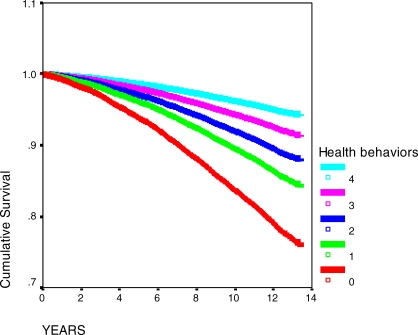
- Adjusted cumulative survival was about 75% for those scoring zero and 95% for those scoring four. The mortality risk difference between score 0 and score 4 was equivalent to approximately 14 years of chronological age.
- Relationships were consistent in subgroups stratified by sex, age, BMI, and social class, and after excluding deaths within 2 years; similar trends were seen in 2,057 individuals with prevalent disease excluded from main analyses.
Methods
- Prospective population study: EPIC-Norfolk, UK, baseline survey 1993–1997, follow-up to July 2006 (average 11 years). Of 22,301 with complete data, 2,057 with history of heart disease, stroke, or cancer were excluded, leaving 20,244 participants aged 45–79.
- Health behaviour score: one point each for current nonsmoking, not physically inactive, moderate alcohol intake (1–14 units/week), and plasma vitamin C >50 mmol/l indicating at least five fruit/vegetable servings daily; total score 0–4.
- Cox proportional hazards models estimated relative risks for all-cause and cause-specific mortality, adjusted for age, sex, body mass index, and social class; analyses included subgroup stratification and exclusion of deaths within 2 years.
Limitations
- The paper states potential large measurement errors in exposure assessment, use of only one baseline measure without accounting for lifestyle changes over follow-up, no weighting of different behaviours, and dichotomizing physical activity as inactive versus not inactive, which may obscure gradients between moderately inactive and active people.
- The paper states residual confounding cannot be excluded, and the analyses examined only mortality, not functional health or quality of life.
- Evident from the text: the cohort was 99.5% white, resident in Norfolk, UK, and middle-aged/older, so findings may not generalize to other populations; the observational design cannot establish causality.
Model-written summary. Check it against the paper before relying on it.
Integrity signals
Registry
Cites
Statistics
Figures
Verification
Claims the paper makes
19 Own result · 14 Not checked yet · 10 Own method · 6 Own interpretation · 1 No basis given
A result the paper reports from its own data — it cites no other source for it, so there is none to check. The quote shows it is in the paper.
In the paper
“The relationships were consistent in subgroups stratified by sex, age, body mass index, and social class, and after excluding deaths within 2 y.”
§ Combined Impact of Health Behaviours and Mortality in Men and Women: The EPIC-Norfolk Prospective Population Study > Abstract
plain- Asserted: passes — The authors put it forward as true.
- Checkable: passes — It can be checked against evidence.
- Load-bearing: passes — The paper’s conclusions depend on it.
- Based: passes — The paper gives a reason why it holds.
- Rests on an assumption: Death certification at the Office of National Statistics, United Kingdom, is virtually complete.
A result the paper reports from its own data — it cites no other source for it, so there is none to check. The quote shows it is in the paper.
In the paper
“The trends were strongest for cardiovascular causes.”
§ Combined Impact of Health Behaviours and Mortality in Men and Women: The EPIC-Norfolk Prospective Population Study > Abstract
plaincorrelational- Asserted: passes — The authors put it forward as true.
- Checkable: passes — It can be checked against evidence.
- Load-bearing: unclear — It is unclear whether the paper’s conclusions depend on it.
- Based: passes — The paper gives a reason why it holds.
- Rests on an assumption: Death certification at the Office of National Statistics, United Kingdom, is virtually complete.
A result the paper reports from its own data — it cites no other source for it, so there is none to check. The quote shows it is in the paper.
In the paper
“As might be expected, there were some differentials in the observed risk reductions observed for different health behaviours and cause-specific mortality in men and women; current smoking was the most consistent and strongest risk factor.”
§ Combined Impact of Health Behaviours and Mortality in Men and Women: The EPIC-Norfolk Prospective Population Study > Results
plaincorrelational- Asserted: passes — The authors put it forward as true.
- Checkable: passes — It can be checked against evidence.
- Load-bearing: passes — The paper’s conclusions depend on it.
- Based: passes — The paper gives a reason why it holds.
- Rests on an assumption: Death certification at the Office of National Statistics, United Kingdom, is virtually complete.
A result the paper reports from its own data — it cites no other source for it, so there is none to check. The quote shows it is in the paper.
In the paper
“None of the interaction terms for health score with sex, age, body mass index, and social class were significant in multivariate analyses.”
§ Combined Impact of Health Behaviours and Mortality in Men and Women: The EPIC-Norfolk Prospective Population Study > Results
plain- Asserted: passes — The authors put it forward as true.
- Checkable: passes — It can be checked against evidence.
- Load-bearing: passes — The paper’s conclusions depend on it.
- Based: passes — The paper gives a reason why it holds.
- Rests on an assumption: Death certification at the Office of National Statistics, United Kingdom, is virtually complete.
A result the paper reports from its own data — it cites no other source for it, so there is none to check. The quote shows it is in the paper.
In the paper
“From the Cox model, the beta coefficient for mortality associated with each year increase in chronological age was 0.10 (6 standard error 0.004).”
§ Combined Impact of Health Behaviours and Mortality in Men and Women: The EPIC-Norfolk Prospective Population Study > Results
plaincorrelational- Asserted: passes — The authors put it forward as true.
- Checkable: passes — It can be checked against evidence.
- Load-bearing: unclear — It is unclear whether the paper’s conclusions depend on it.
- Based: passes — The paper gives a reason why it holds.
- Rests on an assumption: Death certification at the Office of National Statistics, United Kingdom, is virtually complete.
A result the paper reports from its own data — it cites no other source for it, so there is none to check. The quote shows it is in the paper.
In the paper
“The mortality risk for those with four compared to zero health behaviours was equivalent to being 14 y younger in chronological age.”
- Also stated in: § Results · hedged
“The difference in beta coefficients between a health score of zero versus four was 1.43, that is, equivalent to approximately 14 y in chronological age for mortality risk.”
§ Combined Impact of Health Behaviours and Mortality in Men and Women: The EPIC-Norfolk Prospective Population Study > Abstract
plaincorrelational- Asserted: passes — The authors put it forward as true.
- Checkable: passes — It can be checked against evidence.
- Load-bearing: passes — The paper’s conclusions depend on it.
- Based: passes — The paper gives a reason why it holds.
- Rests on an assumption: Death certification at the Office of National Statistics, United Kingdom, is virtually complete.
- Also stated in: § Results · hedged
A result the paper reports from its own data — it cites no other source for it, so there is none to check. The quote shows it is in the paper.
In the paper
“After an average 11 y follow-up, the age-, sex-, body mass-, and social class-adjusted relative risks (95% confidence intervals) for allcause mortality(1,987 deaths) for men and women who had three, two, one, and zero compared to four health behaviours were respectively, 1.39 (1.21-1.60),1.95 (1.70--2.25),2.52 (2.13-3.00),and 4.04 (2.95-5.54)p , 0.001 trend.”
§ Combined Impact of Health Behaviours and Mortality in Men and Women: The EPIC-Norfolk Prospective Population Study > Abstract
plaincorrelational- Asserted: passes — The authors put it forward as true.
- Checkable: passes — It can be checked against evidence.
- Load-bearing: passes — The paper’s conclusions depend on it.
- Based: passes — The paper gives a reason why it holds.
- Rests on an assumption: Death certification at the Office of National Statistics, United Kingdom, is virtually complete.
A result the paper reports from its own data — it cites no other source for it, so there is none to check. The quote shows it is in the paper.
In the paper
“As with the relative risks of mortality, the adjusted cumulative survival was about 75% for those scoring zero and 95% for those scoring four, respectively, for health behaviours.”
§ Combined Impact of Health Behaviours and Mortality in Men and Women: The EPIC-Norfolk Prospective Population Study > Results
plaincorrelational- Asserted: passes — The authors put it forward as true.
- Checkable: passes — It can be checked against evidence.
- Load-bearing: passes — The paper’s conclusions depend on it.
- Based: passes — The paper gives a reason why it holds.
- Rests on an assumption: Death certification at the Office of National Statistics, United Kingdom, is virtually complete.
A result the paper reports from its own data — it cites no other source for it, so there is none to check. The quote shows it is in the paper.
In the paper
“The difference in beta coefficients between a health score of zero versus four was 1.43, that is, equivalent to approximately 14 y in chronological age for mortality risk.”
§ Combined Impact of Health Behaviours and Mortality in Men and Women: The EPIC-Norfolk Prospective Population Study > Results
plaincorrelational- Asserted: passes — The authors put it forward as true.
- Checkable: passes — It can be checked against evidence.
- Load-bearing: passes — The paper’s conclusions depend on it.
- Based: passes — The paper gives a reason why it holds.
- Rests on an assumption: Death certification at the Office of National Statistics, United Kingdom, is virtually complete.
A result the paper reports from its own data — it cites no other source for it, so there is none to check. The quote shows it is in the paper.
In the paper
“Cancer | 839/20,244 | 1 | 1.21 (0,99-1.48) | 1.81 (1.48-2.22) | 1.94 (1.48-2.54) | 3.74 (2.34-5.98)”
§ Combined Impact of Health Behaviours and Mortality in Men and Women: The EPIC-Norfolk Prospective Population Study > Additional Information.
plaincorrelational- Asserted: passes — The authors put it forward as true.
- Checkable: passes — It can be checked against evidence.
- Load-bearing: passes — The paper’s conclusions depend on it.
- Based: passes — The paper gives a reason why it holds.
- Rests on an assumption: The observed associations between health behaviour score and mortality are not explained by unmeasured or residual confounding.
- It may state two separate claims as one. 14
- The quote only partly states this claim. 4
- Probably not a substantial claim. 15
A result the paper reports from its own data — it cites no other source for it, so there is none to check. The quote shows it is in the paper.
In the paper
“Each of the health behaviours: smoking, being physically inactive, not having a moderate alcohol intake, and a low fruit and vegetable intake as indicated by plasma vitamin C level ,50 mmol/l.were associated with significantly higher risks of mortality from all causes.”
§ Combined Impact of Health Behaviours and Mortality in Men and Women: The EPIC-Norfolk Prospective Population Study > Results
plaincorrelational- Asserted: passes — The authors put it forward as true.
- Checkable: passes — It can be checked against evidence.
- Load-bearing: passes — The paper’s conclusions depend on it.
- Based: passes — The paper gives a reason why it holds.
It may state two separate claims as one.
- Rests on an assumption: Death certification at the Office of National Statistics, United Kingdom, is virtually complete.
In the paper
“In this cohort, vitamin supplement use was not associated with mortality, and results were similar after adjusting for vitamin supplement use or excluding vitamin users from the analyses (unpublished data and [19]).”
§ Combined Impact of Health Behaviours and Mortality in Men and Women: The EPIC-Norfolk Prospective Population Study > Results
What the sources say
- Not checked yetcites [19] Khaw, 2001, Lancet
plain- Asserted: passes — The authors put it forward as true.
- Checkable: passes — It can be checked against evidence.
- Load-bearing: unclear — It is unclear whether the paper’s conclusions depend on it.
- Based: passes — The paper gives a reason why it holds.
It may state two separate claims as one.
- Rests on an assumption: Death certification at the Office of National Statistics, United Kingdom, is virtually complete.
A result the paper reports from its own data — it cites no other source for it, so there is none to check. The quote shows it is in the paper.
In the paper
“All Cause | RR (95% CI) | n ¼ 1,977 events | 1.77 (1.55-2.01) | 1.24 (1.13-1.36) | 1.26 (1.14-1.38) | 1.44 (1.31-1.59)”
§ Combined Impact of Health Behaviours and Mortality in Men and Women: The EPIC-Norfolk Prospective Population Study > Additional Information.
plaincorrelational- Asserted: passes — The authors put it forward as true.
- Checkable: passes — It can be checked against evidence.
- Load-bearing: passes — The paper’s conclusions depend on it.
- Based: passes — The paper gives a reason why it holds.
The quote only partly states this claim.
- Rests on an assumption: The observed associations between health behaviour score and mortality are not explained by unmeasured or residual confounding.
A result the paper reports from its own data — it cites no other source for it, so there is none to check. The quote shows it is in the paper.
In the paper
“All cause | 1,977/20,244 | 1 | 1.39 (1.21-1.60) | 1.95 (1.70-2.25) | 2.52 (2.13-3.00) | 4.04 (2.95-5.54)”
§ Combined Impact of Health Behaviours and Mortality in Men and Women: The EPIC-Norfolk Prospective Population Study > Additional Information.
plaindirectn = 20,244- Asserted: passes — The authors put it forward as true.
- Checkable: passes — It can be checked against evidence.
- Load-bearing: passes — The paper’s conclusions depend on it.
- Based: passes — The paper gives a reason why it holds.
It may state two separate claims as one.
- Rests on an assumption: The observed associations between health behaviour score and mortality are not explained by unmeasured or residual confounding.
The paper states this without a source or data behind it here, so there is nothing to check it against. The quote shows it is in the paper.
In the paper
“The four health behaviours were within the usual range found in a free-living population.”
§ Combined Impact of Health Behaviours and Mortality in Men and Women: The EPIC-Norfolk Prospective Population Study > Implications
plain- Asserted: passes — The authors put it forward as true.
- Checkable: passes — It can be checked against evidence.
- Load-bearing: fails — The paper’s conclusions may not depend on it.
- Based: fails — The paper may give no reason why it holds.
Probably not a substantial claim. The paper’s conclusions may not depend on it. The paper may give no reason why it holds.
A result the paper reports from its own data — it cites no other source for it, so there is none to check. The quote shows it is in the paper.
In the paper
“All Cause | RR (95% CI) | n ¼ 1,977 events | 1.77 (1.55-2.01) | 1.24 (1.13-1.36) | 1.26 (1.14-1.38) | 1.44 (1.31-1.59)”
§ Combined Impact of Health Behaviours and Mortality in Men and Women: The EPIC-Norfolk Prospective Population Study > Additional Information.
plaincorrelational- Asserted: passes — The authors put it forward as true.
- Checkable: passes — It can be checked against evidence.
- Load-bearing: passes — The paper’s conclusions depend on it.
- Based: passes — The paper gives a reason why it holds.
The quote only partly states this claim.
- Rests on an assumption: The observed associations between health behaviour score and mortality are not explained by unmeasured or residual confounding.
A result the paper reports from its own data — it cites no other source for it, so there is none to check. The quote shows it is in the paper.
In the paper
“All Cause | RR (95% CI) | n ¼ 1,977 events | 1.77 (1.55-2.01) | 1.24 (1.13-1.36) | 1.26 (1.14-1.38) | 1.44 (1.31-1.59)”
§ Combined Impact of Health Behaviours and Mortality in Men and Women: The EPIC-Norfolk Prospective Population Study > Additional Information.
plaincorrelational- Asserted: passes — The authors put it forward as true.
- Checkable: passes — It can be checked against evidence.
- Load-bearing: passes — The paper’s conclusions depend on it.
- Based: passes — The paper gives a reason why it holds.
The quote only partly states this claim.
- Rests on an assumption: The observed associations between health behaviour score and mortality are not explained by unmeasured or residual confounding.
None of the sources cited for this claim have been checked yet.
In the paper
“Nevertheless, there is a large body of experimental and epidemiologic evidence indicating a high intake of fruit and vegetables is beneficially associated with health [5,7,11,32]”
§ Combined Impact of Health Behaviours and Mortality in Men and Women: The EPIC-Norfolk Prospective Population Study > Discussion
What the sources say
- Not checked yetcites [5] Joshipura, 2001, Ann Intern Med
- Not checked yetcites [7] Law, 1998, Eur J Clin Nutr
- Not checked yetcites [11] Ness, 1997, Int J Epidemiol
- Not checked yetcites [32] Rimm, 1996, JAMA
hedgedcorrelational- Asserted: passes — The authors put it forward as true.
- Checkable: passes — It can be checked against evidence.
- Load-bearing: fails — The paper’s conclusions may not depend on it.
- Based: passes — The paper gives a reason why it holds.
Probably not a substantial claim. The paper’s conclusions may not depend on it.
What the paper did — it cites no source for this, so there is none to check. The quote shows it is in the paper.
In the paper
“Of the 22,301 with available data, 2,057 had a history of heart disease, stroke, or cancer at the baseline visit and were excluded from the main analyses, leaving 20,244 individuals.”
§ Combined Impact of Health Behaviours and Mortality in Men and Women: The EPIC-Norfolk Prospective Population Study > Methods
plain- Asserted: passes — The authors put it forward as true.
- Checkable: passes — It can be checked against evidence.
- Load-bearing: passes — The paper’s conclusions depend on it.
- Based: passes — The paper gives a reason why it holds.
Probably not a substantial claim.
None of the sources cited for this claim have been checked yet.
In the paper
“A huge body of evidence indicates that lifestyles such as smoking, diet, and physical activity have a major influence on health [1][2][3][4][5][6][7][8][9][10][11][12][13][14][15][16].”
§ Combined Impact of Health Behaviours and Mortality in Men and Women: The EPIC-Norfolk Prospective Population Study > Introduction
What the sources say
- Not checked yetcites [1]
- Not checked yetcites [2] Chiuve, 2006, Circulation
- Not checked yetcites [3] Doll, 2004, BMJ
hedgeddirect- Asserted: passes — The authors put it forward as true.
- Checkable: passes — It can be checked against evidence.
- Load-bearing: fails — The paper’s conclusions may not depend on it.
- Based: passes — The paper gives a reason why it holds.
Probably not a substantial claim. The paper’s conclusions may not depend on it.
None of the sources cited for this claim have been checked yet.
In the paper
“Because humans do not manufacture vitamin C and have to rely on exogenous sources, plasma vitamin C is a good biomarker of plant food intake; previous studies have reported that a blood value of 50 mmol/l or more indicates an intake of at least five servings of fruit and vegetables daily [19;26].”
§ Combined Impact of Health Behaviours and Mortality in Men and Women: The EPIC-Norfolk Prospective Population Study > Methods
What the sources say
- Not checked yetcites [19] Khaw, 2001, Lancet
- Not checked yetcites [26] Bingham, 1995, Br J Nutr
hedgedcorrelational- Asserted: passes — The authors put it forward as true.
- Checkable: passes — It can be checked against evidence.
- Load-bearing: unclear — It is unclear whether the paper’s conclusions depend on it.
- Based: passes — The paper gives a reason why it holds.
It may state two separate claims as one.
What the paper did — it cites no source for this, so there is none to check. The quote shows it is in the paper.
In the paper
“The score, though simple, was based on instruments that have been extensively previously validated.”
§ Combined Impact of Health Behaviours and Mortality in Men and Women: The EPIC-Norfolk Prospective Population Study > Discussion
plain- Asserted: passes — The authors put it forward as true.
- Checkable: passes — It can be checked against evidence.
- Load-bearing: fails — The paper’s conclusions may not depend on it.
- Based: passes — The paper gives a reason why it holds.
Probably not a substantial claim. The paper’s conclusions may not depend on it.
In the paper
“Nevertheless, a recent report from 2,339 men and women aged 70-90 y in 11 European countries indicated that adherence to a Mediterranean diet, nonsmoking, any alcohol use, and moderate physical activity were associated with more than 50% lower rate of all-cause and cause-specific mortality [6].”
§ Combined Impact of Health Behaviours and Mortality in Men and Women: The EPIC-Norfolk Prospective Population Study > Introduction
What the sources say
- Not checked yetcites [6] Knoops, 2004, JAMA
hedgedcorrelationaln = 2,339- Asserted: passes — The authors put it forward as true.
- Checkable: passes — It can be checked against evidence.
- Load-bearing: passes — The paper’s conclusions depend on it.
- Based: passes — The paper gives a reason why it holds.
Probably not a substantial claim.
In the paper
“The Norfolk cohort was comparable to national population samples with respect to characteristics including anthropometry, blood pressure, and lipids, but with a lower prevalence of current smokers [21].”
§ Combined Impact of Health Behaviours and Mortality in Men and Women: The EPIC-Norfolk Prospective Population Study > Methods
What the sources say
- Not checked yetcites [21] Day, 1999, Br J Cancer
plain- Asserted: passes — The authors put it forward as true.
- Checkable: passes — It can be checked against evidence.
- Load-bearing: unclear — It is unclear whether the paper’s conclusions depend on it.
- Based: passes — The paper gives a reason why it holds.
It may state two separate claims as one.
A conclusion the paper draws from its own results — it cites no other source for it, so there is none to check. The quote shows it is in the paper.
In the paper
“Four health behaviours combined predict a 4-fold difference in total mortality in men and women, with an estimated impact equivalent to 14 y in chronological age.”
§ Combined Impact of Health Behaviours and Mortality in Men and Women: The EPIC-Norfolk Prospective Population Study > Abstract
hedgedcorrelational- Asserted: passes — The authors put it forward as true.
- Checkable: passes — It can be checked against evidence.
- Load-bearing: passes — The paper’s conclusions depend on it.
- Based: passes — The paper gives a reason why it holds.
It may state two separate claims as one.
- Rests on an assumption: Death certification at the Office of National Statistics, United Kingdom, is virtually complete.
In the paper
“We have also previously shown that low work and leisure-time physical activity predicts all-cause mortality and cardiovascular disease incidence [20].”
§ Combined Impact of Health Behaviours and Mortality in Men and Women: The EPIC-Norfolk Prospective Population Study > Introduction
What the sources say
- Not checked yetcites [20] Khaw, 2006, Int J Epidemiol
plaincorrelational- Asserted: passes — The authors put it forward as true.
- Checkable: passes — It can be checked against evidence.
- Load-bearing: unclear — It is unclear whether the paper’s conclusions depend on it.
- Based: passes — The paper gives a reason why it holds.
It may state two separate claims as one.
What the paper did — it cites no source for this, so there is none to check. The quote shows it is in the paper.
In the paper
“The authors have declared that no competing interests exist.”
§ Combined Impact of Health Behaviours and Mortality in Men and Women: The EPIC-Norfolk Prospective Population Study > Conflict
plain- Asserted: passes — The authors put it forward as true.
- Checkable: passes — It can be checked against evidence.
- Load-bearing: fails — The paper’s conclusions may not depend on it.
- Based: passes — The paper gives a reason why it holds.
Probably not a substantial claim. The paper’s conclusions may not depend on it.
What the paper did — it cites no source for this, so there is none to check. The quote shows it is in the paper.
In the paper
“We used only a measure at one point in time to characterize individuals and did not take into account likely changes in lifestyles over the follow-up period.”
§ Combined Impact of Health Behaviours and Mortality in Men and Women: The EPIC-Norfolk Prospective Population Study > Discussion
plain- Asserted: passes — The authors put it forward as true.
- Checkable: passes — It can be checked against evidence.
- Load-bearing: unclear — It is unclear whether the paper’s conclusions depend on it.
- Based: passes — The paper gives a reason why it holds.
It may state two separate claims as one.
A conclusion the paper draws from its own results — it cites no other source for it, so there is none to check. The quote shows it is in the paper.
In the paper
“These results may provide further support for the idea that even small differences in lifestyle may make a big difference to health in the population and encourage behaviour change.”
§ Combined Impact of Health Behaviours and Mortality in Men and Women: The EPIC-Norfolk Prospective Population Study > Implications
hedgedconditional- Asserted: passes — The authors put it forward as true.
- Checkable: fails — It may be too vague to check against evidence.
- Load-bearing: passes — The paper’s conclusions depend on it.
- Based: passes — The paper gives a reason why it holds.
Probably not a substantial claim. It may be too vague to check against evidence. It may state two separate claims as one.
- Rests on an assumption: The EPIC-Norfolk cohort is representative of middle-aged and older people in the general population.
What the paper did — it cites no source for this, so there is none to check. The quote shows it is in the paper.
In the paper
“Mortality Rates and Relative Risk of All-Cause Mortality by Number of Health Behaviours, Adjusted by Age, Sex, and Body Mass Index, and Stratified by Cause, Sex, Age, Body Mass Index, and Social Class in 20,244 Men and Women Aged 45-79 y without Known Cardiovascular Disease or Cancer in EPIC-Norfolk 1993-2006, Cox Regression Model”
§ Combined Impact of Health Behaviours and Mortality in Men and Women: The EPIC-Norfolk Prospective Population Study > Additional Information.
plainn = 20,244- Asserted: passes — The authors put it forward as true.
- Checkable: passes — It can be checked against evidence.
- Load-bearing: passes — The paper’s conclusions depend on it.
- Based: passes — The paper gives a reason why it holds.
Probably not a substantial claim.
In the paper
“Thirdly, the proportions of the population with some or all positive health behaviours were relatively high since the definitions for health behaviours were not necessarily optimal, for example, for physical activity [20], and dichotomizing behaviours between inactive and not inactive may have obscured the gradient in mortality between those who were moderately inactive and those who were active.”
§ Combined Impact of Health Behaviours and Mortality in Men and Women: The EPIC-Norfolk Prospective Population Study > Discussion
What the sources say
- Not checked yetcites [20] Khaw, 2006, Int J Epidemiol
hedgedconditional- Asserted: passes — The authors put it forward as true.
- Checkable: passes — It can be checked against evidence.
- Load-bearing: unclear — It is unclear whether the paper’s conclusions depend on it.
- Based: passes — The paper gives a reason why it holds.
It may state two separate claims as one.
A conclusion the paper draws from its own results — it cites no other source for it, so there is none to check. The quote shows it is in the paper.
In the paper
“Nevertheless, random measurement error is likely to attenuate any associations observed, so the estimated differences in risk are likely to be larger than those observed.”
§ Combined Impact of Health Behaviours and Mortality in Men and Women: The EPIC-Norfolk Prospective Population Study > Discussion
hedgeddirect- Asserted: passes — The authors put it forward as true.
- Checkable: passes — It can be checked against evidence.
- Load-bearing: unclear — It is unclear whether the paper’s conclusions depend on it.
- Based: passes — The paper gives a reason why it holds.
It may state two separate claims as one.
What the paper did — it cites no source for this, so there is none to check. The quote shows it is in the paper.
In the paper
“The sponsors had no role in the design and conduct of the study, collection, management, analysis and interpretation of the data, and preparation, review, or approval of the manuscript.”
§ Combined Impact of Health Behaviours and Mortality in Men and Women: The EPIC-Norfolk Prospective Population Study > Funding
plain- Asserted: passes — The authors put it forward as true.
- Checkable: passes — It can be checked against evidence.
- Load-bearing: fails — The paper’s conclusions may not depend on it.
- Based: passes — The paper gives a reason why it holds.
Probably not a substantial claim. The paper’s conclusions may not depend on it.
What the paper did — it cites no source for this, so there is none to check. The quote shows it is in the paper.
In the paper
“Though we cannot exclude residual confounding, our results are consistent with the existing evidence indicating these behavioural factors are beneficial for health.”
§ Combined Impact of Health Behaviours and Mortality in Men and Women: The EPIC-Norfolk Prospective Population Study > Discussion
plain- Asserted: passes — The authors put it forward as true.
- Checkable: passes — It can be checked against evidence.
- Load-bearing: fails — The paper’s conclusions may not depend on it.
- Based: passes — The paper gives a reason why it holds.
Probably not a substantial claim. The paper’s conclusions may not depend on it.
A conclusion the paper draws from its own results — it cites no other source for it, so there is none to check. The quote shows it is in the paper.
In the paper
“their combined impact was associated with an estimated 4-fold difference in mortality risk, equivalent to 14 y in chronological age.”
§ Combined Impact of Health Behaviours and Mortality in Men and Women: The EPIC-Norfolk Prospective Population Study > Implications
hedgedcorrelational- Asserted: passes — The authors put it forward as true.
- Checkable: passes — It can be checked against evidence.
- Load-bearing: passes — The paper’s conclusions depend on it.
- Based: passes — The paper gives a reason why it holds.
It may state two separate claims as one.
- Rests on an assumption: The observed associations between health behaviour score and mortality are not explained by unmeasured or residual confounding.
What the paper did — it cites no source for this, so there is none to check. The quote shows it is in the paper.
In the paper
“KTK conducted the data analyses, wrote the paper with coauthors, had full access to all of the data in the study, and takes responsibility for the integrity of the data and the accuracy of the data analysis.”
§ Combined Impact of Health Behaviours and Mortality in Men and Women: The EPIC-Norfolk Prospective Population Study > Contribution
plain- Asserted: passes — The authors put it forward as true.
- Checkable: passes — It can be checked against evidence.
- Load-bearing: fails — The paper’s conclusions may not depend on it.
- Based: passes — The paper gives a reason why it holds.
Probably not a substantial claim. The paper’s conclusions may not depend on it. It may state two separate claims as one.
In the paper
“subjective functional health is also predictive of mortality [36]”
§ Combined Impact of Health Behaviours and Mortality in Men and Women: The EPIC-Norfolk Prospective Population Study > Implications
What the sources say
- Not checked yetcites [36] Myint, 2006, Ann Epidemiol
plaincorrelational- Asserted: passes — The authors put it forward as true.
- Checkable: passes — It can be checked against evidence.
- Load-bearing: fails — The paper’s conclusions may not depend on it.
- Based: passes — The paper gives a reason why it holds.
Probably not a substantial claim. The paper’s conclusions may not depend on it.
In the paper
“In the UK, the recommendations are up to 21 drinks weekly for men and 14 drinks weekly for women [33].”
§ Combined Impact of Health Behaviours and Mortality in Men and Women: The EPIC-Norfolk Prospective Population Study > Discussion
What the sources say
- Not checked yetcites [33]
plain- Asserted: passes — The authors put it forward as true.
- Checkable: passes — It can be checked against evidence.
- Load-bearing: fails — The paper’s conclusions may not depend on it.
- Based: passes — The paper gives a reason why it holds.
Probably not a substantial claim. The paper’s conclusions may not depend on it. It may state two separate claims as one.
What the paper did — it cites no source for this, so there is none to check. The quote shows it is in the paper.
In the paper
“NW developed and validated the physical activity measures and scales.”
§ Combined Impact of Health Behaviours and Mortality in Men and Women: The EPIC-Norfolk Prospective Population Study > Contribution
plain- Asserted: passes — The authors put it forward as true.
- Checkable: passes — It can be checked against evidence.
- Load-bearing: passes — The paper’s conclusions depend on it.
- Based: passes — The paper gives a reason why it holds.
Probably not a substantial claim.
The paper relies on this without support.
Health behaviours such as smoking, diet, and physical activity are highly correlated.
“Many health behaviours such as smoking habit, diet, and physical activity are highly correlated and, in aetiologically focused papers, treated as covariates.”
The paper relies on this without support.
Death certification at the Office of National Statistics, United Kingdom, is virtually complete.
“All participants are flagged for death certification at the Office of National Statistics, United Kingdom which is virtually complete.”
The paper relies on this without support.
The observed associations between health behaviour score and mortality are not explained by unmeasured or residual confounding.
“After allowing for other factors that might have affected their likelihood of dying (for example, age)”
The paper relies on this without support.
The EPIC-Norfolk cohort is representative of middle-aged and older people in the general population.
“These findings indicate that the combination of four simply defined health behaviors predicts a 4-fold difference in the risk of dying over an average period of 11 years for middle-aged and older people.”
The paper relies on this without support.
Mortality follow-up via record linkage was complete and accurate.
“Deaths among the participants were then recorded until 2006.”
Claims other papers make about this one
Each is checked against this paper’s own text: does it say what the citing paper says it does?
In the citing paper
“Moreover, regular physical activity appears to protect against premature death independent of obesity [10, 11].”
From Exercise as a Mean to Control Low‐Grade Systemic Inflammation (2008) · cites this paper as [10]
In the citing paper
“regular exercise offers protection against all causes of mortality, primarily by protection against atherosclerosis and insulin resistance”
From Exercise as a Mean to Control Low‐Grade Systemic Inflammation (2008) · cites this paper as [10]
Self-check
Percentages, sums and reported differences re-computed from the paper’s own numbers.
Each contradiction between two passages listed here was confirmed by an independent check.
Rated major: it would touch a result — a value a result rests on, reported and recomputed p-values on opposite sides of the significance level, two passages that conflict with no sign which is right, or a cited work retracted before this paper was published.
In the paper
§ Combined Impact of Health Behaviours and Mortality in Men and Women: The EPIC-Norfolk Prospective Population Study > Additional Information.
“| | at least half an hour of leisure time activity |”
§ Combined Impact of Health Behaviours and Mortality in Men and Women: The EPIC-Norfolk Prospective Population Study > Methods
“For the purposes of the current study, we dichotomised the population into physically inactive (sedentary job and no recreational activity) and not physically inactive (any category with activity levels above the latter).”
Rated minor: it would not touch a result — a value no result rests on, a p-value that stays on the same side of the significance level, or a conflict that is clerical, resolved elsewhere in the paper, or outside its own findings.
In the paper
“| | 21 or more units a week | 15.1 (1,389) | 1.2 (254) |”
§ Combined Impact of Health Behaviours and Mortality in Men and Women: The EPIC-Norfolk Prospective Population Study > Additional Information.
Reported 1.2 · recomputed 2.295941
Rated minor: it would not touch a result — a value no result rests on, a p-value that stays on the same side of the significance level, or a conflict that is clerical, resolved elsewhere in the paper, or outside its own findings.
In the paper
“| | III nonmanual | 12.3 (1,108) | 119.9 (2,145) |”
§ Combined Impact of Health Behaviours and Mortality in Men and Women: The EPIC-Norfolk Prospective Population Study > Additional Information.
Reported 119.9 · recomputed 19.388954
Rated minor: it would not touch a result — a value no result rests on, a p-value that stays on the same side of the significance level, or a conflict that is clerical, resolved elsewhere in the paper, or outside its own findings.
In the paper
§ Combined Impact of Health Behaviours and Mortality in Men and Women: The EPIC-Norfolk Prospective Population Study > Additional Information.
“| Alcohol intake | One or more, but less than 14 units, a |”
§ Combined Impact of Health Behaviours and Mortality in Men and Women: The EPIC-Norfolk Prospective Population Study > Methods
“For these analyses, a moderate drinker was defined as someone who drank one or more units a week (that is, not a nondrinker), but not more than 14 units a week.”
Citations
Cites
Mortality in relation to smoking: 40 years' observations on male British doctors
Doll, R., Peto, R., Wheatley, K., Gray, R., & Sutherland, I. (1994) · BMJ · doi:10.1136/bmj.309.6959.901 · Cited by 5,932
Diet, nutrition and the prevention of chronic diseases
Joint, W. (2002) · Medical Entomology and Zoology · Cited by 4,890
Adherence to a Mediterranean diet and survival in a Greek population
Trichopoulou, A., Costacou, T., Bamia, C., & Trichopoulos, D. (2003) · New England Journal of Medicine · doi:10.1056/nejmoa025039 · Cited by 4,397
Thompson, P. D., Buchner, D., Piña, I. L., Balady, G. J., Williams, M. A., Marcus, B. H., Berra, K., Blair, S. N., Costa, F., Franklin, B., et al. (2003) · Circulation · doi:10.1161/01.cir.0000075572.40158.77 · Cited by 2,132
Primary Prevention of Coronary Heart Disease in Women through Diet and Lifestyle
Stampfer, M. J., Hu, F. B., Manson, J. E., Rimm, E. B., & Willett, W. C. (2000) · New England Journal of Medicine · doi:10.1056/nejm200007063430103 · Cited by 1,794
Diet, Nutrition, and the Prevention of Chronic Diseases
Leong, A. (1992) · Pathology · doi:10.1016/s0031-3025(16)36541-2 · Cited by 1,633
The Effect of Fruit and Vegetable Intake on Risk for Coronary Heart Disease
Joshipura, K. J., Hu, F. B., Manson, J. E., Stampfer, M. J., Rimm, E. B., Speizer, F. E., Colditz, G., Ascherio, A., Rosner, B., Spiegelman, D., et al. (2001) · Annals of Internal Medicine · doi:10.7326/0003-4819-134-12-200106190-00010 · Cited by 1,396
Fruit and vegetables, and cardiovascular disease: A review
Ness, A. R., & Powles, J. W. (1997) · International Journal of Epidemiology · doi:10.1093/ije/26.1.1 · Cited by 1,368
McCullough, M. L., Feskanich, D., Stampfer, M. J., Giovannucci, E. L., Rimm, E. B., Hu, F. B., Spiegelman, D., Hunter, D. J., Colditz, G. A., & Willett, W. C. (2002) · The American Journal of Clinical Nutrition · doi:10.1093/ajcn/76.6.1261 · Cited by 1,191
Howard, B. V., Van Horn, L., Hsia, J., Manson, J. E., Stefanick, M. L., Wassertheil-Smoller, S., Kuller, L. H., LaCroix, A. Z., Langer, R. D., Lasser, N. L., et al. (2006) · JAMA · doi:10.1001/jama.295.6.655 · Cited by 1,091
Research works printed but not linked: 34
- Chiuve, 2006, Circulation, 114, 160
- Doll, 2004, BMJ, 328, 1519
- Hu, 2000, Am J Clin Nutr, 72, 912
- Joshipura, 2001, Ann Intern Med, 134, 1106
- Knoops, 2004, JAMA, 292, 1433
- Law, 1998, Eur J Clin Nutr, 52, 549
- Manson, 1996, N Engl J Med, 334, 1325
- McCullough, 2002, Am J Clin Nutr, 76, 1261
- Mukamal, 2006, Arch Intern Med, 166, 2145
- Ness, 1997, Int J Epidemiol, 26, 1
- Oguma, 2002, Br J Sports Med, 36, 162
- Sesso, 1999, Am J Epidemiol, 150, 408
- Stampfer, 2000, N Engl J Med, 343, 16
- Thompson, 2003, Circulation, 107, 3109
- Trichopoulou, 2003, N Engl J Med, 348, 2599
- Alonso, 2005, JAMA, 293, 674
- Craighead, 2005, JAMA, 293, 674
- Khaw, 2001, Lancet, 357, 657
- Khaw, 2006, Int J Epidemiol, 35, 1034
- Day, 1999, Br J Cancer, 80, 95
- Wareham, 2002, Int J Epidemiol, 31, 168
- Wareham, 2003, Public Health Nutr, 6, 407
- Shohaimi, 2004, Eur Respir J, 24, 157
- Riemersma, 1990, Eur J Clin Nutr, 44, 143
- Bingham, 1995, Br J Nutr, 73, 531
- Liese, 2000, Am J Epidemiol, 152, 884
- Rimm, 2004, JAMA, 292, 1490
- Anderson, 2006, JAMA, 295, 693
- Howard, 2006, JAMA, 295, 655
- Prentice, 2006, JAMA, 295, 629
- Rimm, 1996, JAMA, 275, 447
- Myint, 2006, Prev Med, 44, 109
- Myint, 2007, Public Health Nutr, 10, 34
- Myint, 2006, Ann Epidemiol, 16, 492
Cited by
Sorted by citations
Items 501–600 of 836
Bérard, E., Bongard, V., Haas, B., Dallongeville, J., Moitry, M., Cottel, D., Ruidavets, J., & Ferrières, J. (2017) · Canadian Journal of Cardiology · doi:10.1016/j.cjca.2017.06.008 · Cited by 10
Hankonen, N. E. (2011) · Työväentutkimus Vuosikirja · Cited by 10
Weinman, J. A., O’Carroll, R. E., & Petrie, K. J. (2011) · Wiley eBooks · doi:10.1002/9781444395150.ch3 · Cited by 10
Lifestyle and Breast Cancer Risk: The Way Forward?
Chlebowski, R. T. (2010) · Journal of Clinical Oncology · doi:10.1200/jco.2009.26.7898 · Cited by 10
Behavioral Interventions to Reduce Cardiovascular Risk Among People with Severe Mental Disorder
Baker, A. L., Forbes, E., Pohlman, S., & McCarter, K. (2022) · Annual Review of Clinical Psychology · doi:10.1146/annurev-clinpsy-072720-012042 · Cited by 9
Wang, T., Ding, C., Zhou, W., Zhu, L., Yu, C., Huang, X. B., Bao, H., & Cheng, X. (2022) · Frontiers in Public Health · doi:10.3389/fpubh.2022.942113 · Cited by 9
Injecting care and negotiating pleasures with weight loss pharmaceuticals
Warin, M. J., Bombak, A. E., & George, B. (2024) · Thesis Eleven · doi:10.1177/07255136241285046 · Cited by 9
Vaezi, A., Karimi, K., Mirzad, M., Khosravi, S., Rezaei, N., Golestani, A., Akbarpour, S., & Azadbakht, L. (2025) · Scientific Reports · doi:10.1038/s41598-025-16024-2 · Cited by 9
Technology-based Health Education Resources for Indigenous Adults: A Scoping Review
STOTZ, S. A., Hebert, L. E., Brega, A. G., Lockhart, S., Henderson, J. N., Roubideaux, Y. D., DeSanto, K., & MOORE, K. R. (2021) · Journal of Health Care for the Poor and Underserved · doi:10.1353/hpu.2021.0066 · Cited by 9
Srour, B., Hynes, L. C., Johnson, T., Kuhn, T. E., Katzke, V. A., & Kaaks, R. (2021) · Age and Ageing · doi:10.1093/ageing/afab271 · Cited by 9
Bielecka-Dabrowa, A. M., Lewek, J., Sakowicz, A., Paduszyńska, A., Dąbrowa, M., Orszulak–Michalak, D., Banach, M., & CARDIOPLUS Investigators (2022) · Journal of Personalized Medicine · doi:10.3390/jpm12101583 · Cited by 9
Silva, L., Bezzo, F. B., & van Ham, M. (2023) · Social Science & Medicine · doi:10.1016/j.socscimed.2023.115917 · Cited by 10
Spielmann, M., Krolo-Wicovsky, F., Tiede, A., Krause, K., Baumann, S., Siewert‐Markus, U., John, U., & Freyer‐Adam, J. (2023) · Patient Education and Counseling · doi:10.1016/j.pec.2023.107841 · Cited by 9
Rosella, L. C., & Buajitti, E. (2024) · SSM - Population Health · doi:10.1016/j.ssmph.2024.101638 · Cited by 9
Jentsch, F., Allen, J., Fuchs, J., & von der Lippe, E. (2017) · BMC Women s Health · doi:10.1186/s12905-017-0380-4 · Cited by 9
Hicks-Roof, K. K., & Murano, P. S. (2017) · Advances in Medical Education and Practice · doi:10.2147/amep.s138278 · Cited by 9
Kobayashi, L. C., Frank, S. M., Riumalló‐Herl, C., Canning, D., & Berkman, L. F. (2018) · International Journal of Public Health · doi:10.1007/s00038-018-1173-8 · Cited by 9
Categorising a problem: alcohol and dementia
Cipriani, G., Nuti, A., Carlesi, C., Lucetti, C., Fiorino, M. D., & Danti, S. (2020) · Acta Neurologica Belgica · doi:10.1007/s13760-020-01515-y · Cited by 12
Trevisan, C., Capodaglio, G., Ferroni, E., Fedeli, U., Noale, M., Baggio, G., Manzato, E., Maggi, S., Corti, M. C., & Sergi, G. (2021) · European Journal of Ageing · doi:10.1007/s10433-021-00620-y · Cited by 9
Gogol, M., Hartmann, H., Wustmann, S., & Simm, A. (2014) · Zeitschrift für Gerontologie und Geriatrie · doi:10.1007/s00391-014-0654-5 · Cited by 10
Ethical considerations in relation to aspirin prophylaxis.
Morgan, G. (2008) · PubMed · Cited by 9
Health behaviour changes and onset of chronic health problems in later life
Veenstra, M., & Syse, A. (2012) · Norsk Epidemiologi · doi:10.5324/nje.v22i2.1559 · Cited by 9
Hickman, M., Caldwell, D. M., Busse, H., MacArthur, G. J., Faggiano, F., FOXCROFT, D. R., Kaner, E., Macleod, J., Patton, G. C., White, J., et al. (2014) · Cochrane Database of Systematic Reviews · doi:10.1002/14651858.cd011374 · Cited by 9
Using QR Codes to Improve Mobile Wellness Applications
Vázquez-Briseño, M., Hipólito, J. I. N., & Jiménez-García, E. (2010) · Cited by 9
Dambha‐Miller, H., Cooper, A., Simmons, R. K., Kinmonth, A. L., & Griffin, S. J. (2016) · BMJ Open · doi:10.1136/bmjopen-2015-008931 · Cited by 9
Health Psychology interventions
O’Carroll, R. E. (2013) · British Journal of Health Psychology · doi:10.1111/bjhp.12082 · Cited by 9
RKI (2017) · PubMed Central · doi:10.17886/rki-gbe-2017-037 · Cited by 8
Wang, S., Sanderson, K. A., Dwyer, T., Venn, A., & Gall, S. (2017) · Journal of Occupational and Environmental Medicine · doi:10.1097/jom.0000000000001234 · Cited by 8
Agbaria, N., Husseini, M. N., Barakat, R. A., Leiter, E., Greenberg, K. L., Karjawally, M., Keidar, O., Donchin, M., & Zwas, D. R. (2020) · International Journal of Environmental Research and Public Health · doi:10.3390/ijerph17249184 · Cited by 8
Millar, S., Harrington, J. M., Perry, I. J., & Phillips, C. M. (2024) · Brain Behavior & Immunity - Health · doi:10.1016/j.bbih.2024.100759 · Cited by 8
Timm, C., Krolo-Wicovsky, F., Tiede, A., Spielmann, M., Gaertner, B., John, U., & Freyer‐Adam, J. (2024) · BMC Public Health · doi:10.1186/s12889-024-20410-2 · Cited by 8
Cardiovascular Prevention: Components, Levels, Early Origins, and Metrics
KONES, R. J., & Rumana, U. (2014) · Hospital Practice · doi:10.3810/hp.2014.08.1121 · Cited by 8
Linke, S., Strong, D. R., Myers, M. G., Edland, S. D., Hofstetter, C. R., & Al‐Delaimy, W. K. (2016) · Public Health · doi:10.1016/j.puhe.2016.09.028 · Cited by 8
Socioeconomic inequalities in clustering of health-compromising behaviours among Indian adolescents
Mathur, M. R., Singh, A., Mishra, V. K., Parmar, P., Nagrath, D., Watt, R. G., & Tsakos, G. (2020) · Indian Journal of Community Medicine · doi:10.4103/ijcm.ijcm_349_19 · Cited by 8
Choi, S. H., Stommel, M., Broman, C. L., & Raheb-Rauckis, C. (2022) · Behavioral Medicine · doi:10.1080/08964289.2022.2060930 · Cited by 9
Johnson, J. L., Prochaska, J. O., Paiva, A. L., Fernandez, A. C., DeWees, S. L., & Prochaska, J. M. (2013) · Population Health Management · doi:10.1089/pop.2012.0094 · Cited by 8
Zhang, Y., & Ji, Y. (2015) · Chinese Medical Journal · doi:10.4103/0366-6999.158289 · Cited by 8
Supporting lifestyle risk reduction: promoting men’s health through professional football
Zwolinsky, S., McKenna, J., Pringle, A., Daly-Smith, A., Robertson, S., & White, A. (2015) · Soccer and Society · doi:10.1080/14660970.2015.1082767 · Cited by 8
Malekshah, A. F., Zaroudi, M., Etemadi, A., Islami, F., Sepanlou, S. G., Sharafkhah, M., Keshtkar, A., Khademi, H., Poustchi, H., Hekmatdoost, A., et al. (2016) · PubMed · Cited by 8
Stroke in Older Survivors of Ischemic Stroke: Standard Care or Something Different?
Hubbard, I. J., Wass, S., & Pepper, E. (2017) · Geriatrics · doi:10.3390/geriatrics2020018 · Cited by 9
Life course approach to understanding inequalities in health in later life
Bell, R., & Marmot, M. G. (2017) · Oxford University Press eBooks · doi:10.1093/med/9780198701590.003.0010 · Cited by 8
Bento, J. A. (2016) · Digital Library of Theses and Dissertations (Universidade de São Paulo) · doi:10.11606/t.6.2016.tde-28062016-133607 · Cited by 8
Benson, G. A., Sidebottom, A. C., Sillah, A., Vock, D. M., Vacquier, M. C., Miedema, M. D., & VanWormer, J. J. (2019) · Preventive Medicine Reports · doi:10.1016/j.pmedr.2019.01.018 · Cited by 7
Predicting nonrecovery in adults with incident traffic injuries including post-traumatic headache
Cancelliere, C., Boyle, E., Côté, P., Holm, L. W., Salmi, L., & Cassidy, J. D. (2021) · Accident Analysis & Prevention · doi:10.1016/j.aap.2021.106265 · Cited by 8
Carey, M. T., Millar, S., Elliott, P. S., Navarro, P., Harrington, J. M., Perry, I. J., & Phillips, C. M. (2024) · European Journal of Nutrition · doi:10.1007/s00394-024-03399-7 · Cited by 7
Chen, J., Xiao, Y., Yan, C., Li, X., Zhang, Y., Chen, Y., Huang, Y. C., & Deng, R. (2024) · Journal of Multidisciplinary Healthcare · doi:10.2147/jmdh.s463640 · Cited by 7
The role of tea parties to elicit technology requirements to support the mobility of older adults
Coventry, L., & Jones, E. (2012) · International Conference on PErvasive Technologies Related to Assistive Environments (PETRA) · doi:10.1145/2413097.2413117 · Cited by 7
What explains the link between reproductive events and women’s longevity?
Crawford, S. L. (2014) · Menopause The Journal of The North American Menopause Society · doi:10.1097/gme.0000000000000387 · Cited by 7
Cadar, D. (2018) · InTech eBooks · doi:10.5772/intechopen.79119 · Cited by 7
Makino, K., Raina, P. S., Griffith, L. E., Lee, S., Harada, K., Chiba, I., Katayama, O., Tomida, K., Morikawa, M., Makizako, H., et al. (2023) · Journal of the American Geriatrics Society · doi:10.1111/jgs.18725 · Cited by 7
Multiple health behaviors and serum hepatic enzymes among US adults with obesity
Tsai, J. H., Ford, E. S., Zhao, G., & Croft, J. B. (2011) · Preventive Medicine · doi:10.1016/j.ypmed.2011.08.028 · Cited by 7
Finally, a Regimen to Extend Human Life Expectancy
Larrick, J. W., & Mendelsohn, A. R. (2018) · Rejuvenation Research · doi:10.1089/rej.2018.2088 · Cited by 8
Lüngen, M., Schröer-Günther, M., Passon, A. M., Gerber, A., & Lauterbach, K. W. (2009) · Medizinische Klinik - Intensivmedizin und Notfallmedizin · doi:10.1007/s00063-009-1021-y · Cited by 6
Peiris, R., Ross, H. J., Chan, C. T., Poon, S., Auguste, B. L., Rac, V. E., Farkouh, M. E., McDonald, M. A., Kaczorowski, J. A., Code, J., et al. (2022) · BMJ Open · doi:10.1136/bmjopen-2021-059635 · Cited by 6
Aljuraiban, G. S., Gibson, R., Chan, D. S. M., Elliott, P., Chan, Q. M., & Griep, L. M. O. (2023) · International Journal of Environmental Research and Public Health · doi:10.3390/ijerph20054029 · Cited by 7
Millar, S., Navarro, P., Harrington, J. M., Perry, I. J., & Phillips, C. M. (2024) · Atherosclerosis · doi:10.1016/j.atherosclerosis.2024.117559 · Cited by 6
Spielmann, M., Krolo-Wicovsky, F., Tiede, A., John, U., & Freyer‐Adam, J. (2025) · European Journal of Public Health · doi:10.1093/eurpub/ckaf035 · Cited by 6
Nutrition and the Older Diabetic
Senkottaiyan, N. (2008) · Clinics in Geriatric Medicine · doi:10.1016/j.cger.2008.03.010 · Cited by 6
Physical activity and body mass index in the adult Portuguese Population
dos Santos, O., do Carmo, I., Camolas, J., & Vieira, J. (2011) · Biomedical and Biopharmaceutical Research · doi:10.19277/bbr.8.2.13 · Cited by 6
Ruling the Control Authority of a Service Robot Based on Information Precision
Magnago, V., Andreetto, M., Divan, S., Fontanelli, D., & Palopoli, L. (2018) · Proceedings - IEEE International Conference on Robotics and Automation/Proceedings · doi:10.1109/icra.2018.8460714 · Cited by 6
Freyer‐Adam, J., Krolo-Wicovsky, F., Tiede, A., Goeze, C., Sadewasser, K., Spielmann, M., Krause, K., & John, U. (2022) · BMJ Open · doi:10.1136/bmjopen-2022-065136 · Cited by 6
Job control and ambulatory blood pressure
Carthy, V. J. C. M., Perry, I. J., & Greiner, B. A. (2014) · Scandinavian Journal of Work Environment & Health · doi:10.5271/sjweh.3435 · Cited by 7
Role models and occupational ambitions of in-school male adolescents
Ahmad, A., Azmi, S., Khalique, N., & Khan, Z. (2014) · Industrial Psychiatry Journal · doi:10.4103/0972-6748.144954 · Cited by 6
Hoshi, T., Yuasa, M., Yang, S., Kurimori, S., Sakurai, N., & Fujiwara, Y. (2013) · Health · doi:10.4236/health.2013.58177 · Cited by 6
Correlation between the FINish diabetes risk score and the severity of coronary artery disease
Djuric, P., Mladenović, Z., Grdinić, A., Tavčiovski, D., Jović, Z., Spasić, M., & Davicevic-Elez, Ž. (2014) · Vojnosanitetski pregled · doi:10.2298/vsp1405474d · Cited by 6
Retracted article: Football and physical health: what do we know?
Parnell, D., Cope, E., Bailey, R. P., Krustrup, P., & Curran, K. (2016) · Sport in Society · doi:10.1080/17430437.2016.1207787 · Cited by 6
RetractedMetabolic syndrome in urban and rural communities of Bangladesh
Billah, S. M. B., & Jahan, M. (2018) · International Journal of Human and Health Sciences (IJHHS) · doi:10.31344/ijhhs.v2i2.29 · Cited by 6
Allara, E., Angelini, P., Gorini, G., Bosi, S., Carreras, G., Gozzi, C., Martini, A., Tamelli, M., Punreddy, R. R., & Faggiano, F. (2019) · Preventive Medicine · doi:10.1016/j.ypmed.2019.04.001 · Cited by 6
Risk and protective behaviors for chronic non-communicable diseases among Brazilian adults
de Carvalho, R. B. N., Rauber, F., Claro, R. M., & Levy, R. B. (2021) · Public Health · doi:10.1016/j.puhe.2021.03.028 · Cited by 6
Nouri, F., Haghighatdoost, F., Mohammadifard, N., Mansourian, M., Sadeghi, M., Roohafza, H., Khani, A., & Sarrafzadegan, N. (2021) · British Food Journal · doi:10.1108/bfj-08-2020-0699 · Cited by 6
Integrating Religion and Spirituality into Clinical Practice
Hefti, R., & Büssing, A. (2018) · MDPI eBooks · doi:10.3390/books978-3-03842-929-6 · Cited by 6
Siewert‐Markus, U., Ulbricht, S., Gaertner, B., Zyriax, B., Dörr, M., Tobschall, S., Baumann, S., John, U., & Freyer‐Adam, J. (2022) · Nutrients · doi:10.3390/nu14091963 · Cited by 7
Myint, P. K., Smith, R., Luben, R., Surtees, P. G., Wainwright, N. W. J., Wareham, N. J., Bingham, S. A., & Khaw, K. (2009) · Journal of Clinical Epidemiology · doi:10.1016/j.jclinepi.2009.05.002 · Cited by 6
Self-citationVanWormer, J. J., Boucher, J. L., & Sidebottom, A. C. (2015) · Occupational and Environmental Medicine · doi:10.1136/oemed-2014-102620 · Cited by 6
Park, Y. S., & Kim, H. (2016) · 보건교육·건강증진학회지 · doi:10.14367/kjhep.2016.33.1.1 · Cited by 6
Morley, J. E. (2017) · Journal of the American Medical Directors Association · doi:10.1016/j.jamda.2016.11.014 · Cited by 6
From Theory to Practice: Translating Research into Health Outcomes
Editors, T. P. M. (2008) · PLoS Medicine · doi:10.1371/journal.pmed.0050015 · Cited by 6
Gardner, B., Broström, A., Nilsén, P., Hrubos‐Strøm, H., Ulander, M., Fridlund, B., Skagerström, J., & Johansson, P. (2014) · European Journal of Cardiovascular Nursing · doi:10.1177/1474515114531688 · Cited by 6
Miao, Y., Zhao, B., Yang, Y., Yu, K., Liao, L. M., Weinstein, S. J., Fang, F., Lü, B., Albanes, D., & Huang, J. (2025) · BMC Medicine · doi:10.1186/s12916-025-04399-y · Cited by 5
Spielmann, M., Tiede, A., Krolo-Wicovsky, F., Sadewasser, K., Aghdassi, A. A., Busch, C., Hinz, P., van der Linde, J., John, U., & Freyer‐Adam, J. (2022) · International Journal of Public Health · doi:10.3389/ijph.2022.1605215 · Cited by 5
Salway, R., Rejon, C. S., Forte, C., Grey, E., Jessiman, P., McLeod, H., Harkes, R., Stokes, P., de Vocht, F., Campbell, R. M., et al. (2024) · BMJ Open · doi:10.1136/bmjopen-2024-091417 · Cited by 5
Ahn, S., Son, E. H., Mogos, M. F., Muchira, J. M., Sheng, Y., Park, C., & Lee, L. J. (2025) · Frontiers in Public Health · doi:10.3389/fpubh.2025.1593898 · Cited by 5
Development of health behaviour questionnaire for breast cancer women in Mainland China
Xu, H., Jiang, G., Zhang, X., Wang, D., Xu, L., & Wang, A. (2020) · Nursing Open · doi:10.1002/nop2.737 · Cited by 5
Relationship between Skeletal Muscle Thickness and Physical Activity in 4- to 6-Year-Olds in Japan
Deng, P., Ozaki, H., Natsume, T., Ishihara, Y., Ke, D., Suzuki, K., & Naıto, H. (2023) · Children · doi:10.3390/children10030455 · Cited by 5
Eldemire‐Shearer, D., Holder-Nevins, D., Morris, C., & James, K. (2009) · PubMed · Cited by 5
Cardiovascular Risk Factor Screening Satisfaction in the Heart of New Ulm Project
Bekwelem, W., VanWormer, J. J., Boucher, J. L., & Pereira, R. F. (2011) · Clinical Medicine & Research · doi:10.3121/cmr.2011.1011 · Cited by 5
Associations between Subjective Stress Level, Health-Related Habits, and Obesity according to Gender
Doo, M. (2015) · The Korean Journal of Obesity · doi:10.7570/kjo.2015.24.3.156 · Cited by 5
The Patient-Centered Medical Home
Rakel, D. P., & Jonas, W. B. (2011) · Elsevier eBooks · doi:10.1016/b978-1-4377-1160-8.10002-8 · Cited by 5
Flannigan, R. K., Oliffe, J. L., McCreary, D. R., Punjani, N., Kasabwala, K., Black, N., Rachert, J., & Goldenberg, L. S. (2018) · Canadian Urological Association Journal · doi:10.5489/cuaj.5454 · Cited by 5
Pfammatter, A. F., Champion, K. E., Finch, L. E., Siddique, J., Hedeker, D., & Spring, B. J. (2020) · Contemporary Clinical Trials · doi:10.1016/j.cct.2020.106162 · Cited by 5
Efficiency of “Prescribe Vida Saludable”, a health promotion innovation. Pilot phase
Sanz-Guinea, A., Espinosa, M., Gonzalo Grandes, O., Sánchez, Á., Martínez, C., Pombo, H., Bully, P., & Cortada, J. M. (2017) · Gaceta Sanitaria · doi:10.1016/j.gaceta.2016.11.010 · Cited by 5
Gäbler, G., Lycett, D., & Hefti, R. (2017) · Religions · doi:10.3390/rel8100210 · Cited by 5
Simpson, M., Woodman, S., Hiden, H., Stein, S., Dowsland, S., Turner, M., Hanson, V. L., & Watson, P. (2017) · IEEE International Conference on eScience · doi:10.1109/escience.2017.36 · Cited by 5
Hobbs, M., Moltchanova, E. V., Wicks, C. L., Pringle, A., Griffiths, C., Radley, D., & Zwolinsky, S. (2020) · Preventive Medicine · doi:10.1016/j.ypmed.2020.106334 · Cited by 5
Políticas tutelares asimétricas: conciliando preferencias individuales y sociales en salud pública
Labrador, J. R. R. (2009) · Gaceta Sanitaria · doi:10.1016/j.gaceta.2008.09.003 · Cited by 5
Stéatopathie métabolique : prise en charge
Pariente, A. E. (2009) · Gastroentérologie Clinique et Biologique · doi:10.1016/j.gcb.2009.02.028 · Cited by 5
Creating Optimal Healing Environments
Rakel, D. P., Sakallaris, B. R., & Jonas, W. B. (2017) · Elsevier eBooks · doi:10.1016/b978-0-323-35868-2.00002-5 · Cited by 6
Nutrition in Clinical Medicine: A Core Competency for Healthcare Providers
Kahan, S. I., & Kushner, R. F. (2016) · Medical Clinics of North America · doi:10.1016/j.mcna.2016.09.001 · Cited by 5
Importance of Optimization of Cardiovascular Risk Factors and Lifestyle Behaviours
Anderson, T. J. (2017) · Canadian Journal of Cardiology · doi:10.1016/j.cjca.2017.07.011 · Cited by 5
Factors involved in human healthy aging: insights from longevity individuals
Yin, F.-Q., Xiao, F., & Kong, Q.-P. (2025) · Frontiers of Medicine · doi:10.1007/s11684-024-1120-4 · Cited by 4
Metadata
- Authors
- Khaw, K.-T., Wareham, N., Bingham, S., Welch, A., Luben, R., & Day, N.
- Affiliations
- University of Cambridge (GB)
- MRC Epidemiology Unit (GB)
- Medical Research Council (GB)
- Corresponding author
- Khaw, Kay-Tee
- Venue
- PLoS Medicine
- Publisher
- Public Library of Science (PLoS)
- Published
- 2008-01-08
- Volume
- 5
- Issue
- 1
- Pages
- e12
- ISSN
- 1549-1277 (ISSN-L)
- 1549-1676
- PMC
- PMC2174962
- OpenAlex
- W2109585014
- Cited by
- 840
- References
- 36
- Citations by year
- 2026: 21 · 2025: 21 · 2024: 27 · 2023: 20 · 2022: 28 · 2021: 38 · 2020: 50 · 2019: 41 · 2018: 37 · 2017: 54 · 2016: 59 · 2015: 67 · 2014: 60 · 2013: 73 · 2012: 54
- FWCI
- 45.36
- Type
- journal article
- Language
- en
- Update notices
- correction (2008-03-25)
- Open access
- gold
- doi.org
- Licence
- cc-by
- Locations
- PLoS Medicine (publishedVersion, cc-by)
- PubMed Central (publishedVersion, cc-by)
- PubMed (publishedVersion)
- DOAJ (DOAJ: Directory of Open Access Journals) (submittedVersion, cc-by-sa)
- UEA Digital Repository (University of East Anglia) (submittedVersion, cc-by)
- Funders
- British Heart Foundation
- Stroke Association
- Medical Research Council
- Topics
- Health Sciences › Medicine › Cardiology and Cardiovascular Medicine › Cardiovascular Health and Risk Factors
- Health Sciences › Medicine › Public Health, Environmental and Occupational Health › Health and Lifestyle Studies
- Health Sciences › Medicine › Public Health, Environmental and Occupational Health › Nutritional Studies and Diet
- Keywords
- health behavior, mortality, lifestyle, all-cause mortality, cardiovascular mortality, smoking, physical inactivity, alcohol consumption, vitamin C, fruit and vegetable intake, sex differences, EPIC-Norfolk
- MeSH terms
- Aged, Alcohol Drinking, Ascorbic Acid, Diet, England, Female, Fruit, Humans, Life Expectancy, Life Style, Male, Middle Aged, Morbidity, Mortality, Motor Activity, Physical Examination, Prospective Studies, Surveys and Questionnaires, Risk, Sex Factors, Smoking, Vegetables, Health Behavior
About these checks
Registry, retraction, Cites and statistics results are computed, not judged, with one exception: a printed reference that no index lists is read once by a model before it counts as a citation error. Claims are extracted by a model and kept only when their quote appears verbatim in the text; each cited source is then checked, with a model’s help, for whether it says what the claim relies on. Those verdicts can be wrong — read the claim’s quote and the cited source before relying on one.
A language model drew the claims from the paper on 2026-10-10, under version 3 of the claim definition (model deepseek-v4.1-flash, prompt extract-v3).
A second model labelled each claim on 2026-10-10 (model jev-1.13-20260917, definition revision gold-guideline-v0.2).
Statistics and arithmetic are recomputed, not judged.
Confidence bands are shown only for fields calibrated on our annotated test set. None is calibrated yet, so no band is shown.
What counts as a claim ›How we measure confidence ›How we check this ›
Are you an author, or do you see a problem with this page? Request a review
