

The DOI matches its Crossref record; 30 of the 30 references it cites were found in a registry or an index.
Misrepresentation of Randomized Controlled Trials in Press Releases and News Coverage: A Cohort Study
Open accessAbstract
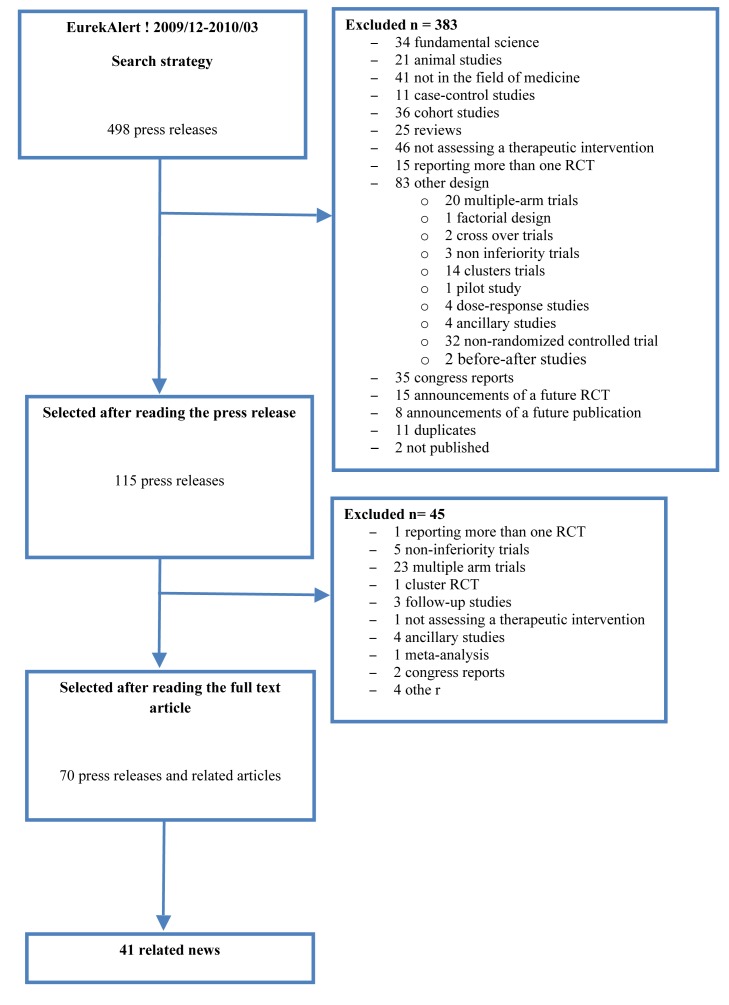
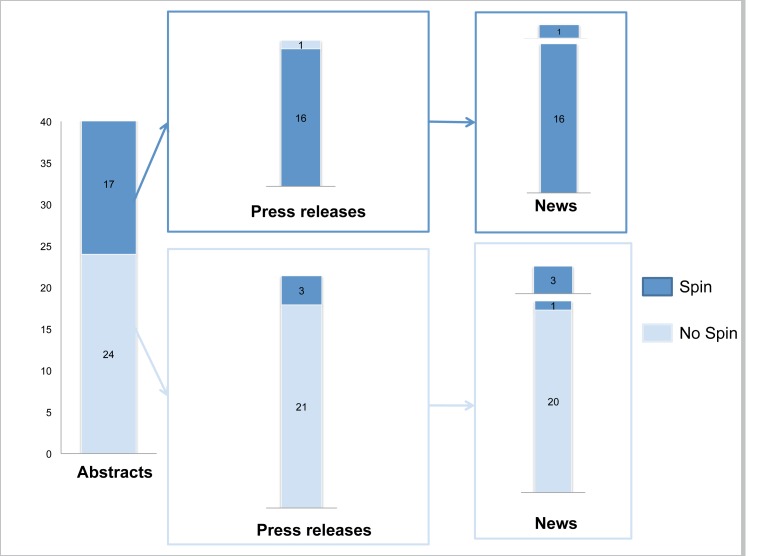
BACKGROUND: Previous studies indicate that in published reports, trial results can be distorted by the use of "spin" (specific reporting strategies, intentional or unintentional, emphasizing the beneficial effect of the experimental treatment). We aimed to (1) evaluate the presence of "spin" in press releases and associated media coverage; and (2) evaluate whether findings of randomized controlled trials (RCTs) based on press releases and media coverage are misinterpreted. METHODS AND FINDINGS: We systematically searched for all press releases indexed in the EurekAlert! database between December 2009 and March 2010. Of the 498 press releases retrieved and screened, we included press releases for all two-arm, parallel-group RCTs (n = 70). We obtained a copy of the scientific article to which the press release related and we systematically searched for related news items using Lexis Nexis. "Spin," defined as specific reporting strategies (intentional or unintentional) emphasizing the beneficial effect of the experimental treatment, was identified in 28 (40%) scientific article abstract conclusions and in 33 (47%) press releases. From bivariate and multivariable analysis assessing the journal type, funding source, sample size, type of treatment (drug or other), results of the primary outcomes (all nonstatistically significant versus other), author of the press release, and the presence of "spin" in the abstract conclusion, the only factor associated, with "spin" in the press release was "spin" in the article abstract conclusions (relative risk [RR] 5.6, [95% CI 2.8-11.1], p < 0.001). Findings of RCTs based on press releases were overestimated for 19 (27%) reports. News items were identified for 41 RCTs; 21 (51%) were reported with "spin," mainly the same type of "spin" as those identified in the press release and article abstract conclusion. Findings of RCTs based on the news item was overestimated for ten (24%) reports. CONCLUSION: "Spin" was identified in about half of press releases and media coverage. In multivariable analysis, the main factor associated with "spin" in press releases was the presence of "spin" in the article abstract conclusion.
Overview
The claims and statistics of this paper haven’t been checked yet.
Free: it reads the open-access text and checks the first 5 claims that cite a source we can check. Create a free account to check every claim.
Integrity signals
Registry
Cites
Statistics
Figures
Verification
Claims the paper makes
The claims and statistics of this paper haven’t been checked yet.
Free: it reads the open-access text and checks the first 5 claims that cite a source we can check. Create a free account to check every claim.
Claims other papers make about this one
Each is checked against this paper’s own text: does it say what the citing paper says it does?
The source backs part of the claim, not all of it — or backs it for a different population, condition or comparison.
In the citing paper
“Media outlets may spin [26–28] and encourage dissemination of eye-catching, potentially overstated, inaccurate [29], and/or misleading headlines in order to gain larger audience size [28, 30, 31].”
From Causal language and strength of inference in academic and media articles shared in social media (CLAIMS): A systematic review (2018) · cites this paper as [31]
Experimental — accuracy not yet measuredThe source backs part of the claim, not all of it — or backs it for a different population, condition or comparison.
In the citing paper
“Indeed, in a study on “spin” in the reporting of randomised controlled trials (70 press releases and associated journal abstracts, 41 news stories), in only four cases the news contained spin where the associated journal abstract did not.22”
From The association between exaggeration in health related science news and academic press releases: retrospective observational study (2014) · cites this paper as [22]
Experimental — accuracy not yet measuredThe cited source says what the claim attributes to it.
In the citing paper
“Although lay media have contributed to sensationalism and misrepresentation of science, many of these mistaken messages originate from the scientific community itself (78).”
From Issues with data and analyses: Errors, underlying themes, and potential solutions (2018) · cites this paper as [78]
The cited source says what the claim attributes to it.
In the citing paper
“spin in journal articles can shape press releases 86 , which in turn affect the accuracy of media reports 87”
From Quantifying the prevalence and impact of overreaching causal claims in social science (2026) · cites this paper as [86]
The cited source says what the claim attributes to it.
In the citing paper
“many journal articles may contain statements that are already exaggerated relative to a consensus of scientific opinion, or at least spun to emphasise positive findings,22”
From The association between exaggeration in health related science news and academic press releases: retrospective observational study (2014) · cites this paper as [22]
3 more claims about this paper
Create a free account to see every claim other papers make about this one.
Self-check
Percentages, sums and reported differences re-computed from the paper’s own numbers.
The self-check needs the paper’s full text.
Citations
Cites
Evidence based medicine: what it is and what it isn't
Sackett, D. L., Rosenberg, W. M. C., Gray, J. A. M., Haynes, R. B., & Richardson, W. S. (1996) · BMJ · doi:10.1136/bmj.312.7023.71 · Cited by 15,769 · cited 1×
“Randomized controlled trials (RCTs) are considered the gold standard for therapeutic evaluation [10].”
BackgroundA Modified Poisson Regression Approach to Prospective Studies with Binary Data
Zou, G. (2004) · American Journal of Epidemiology · doi:10.1093/aje/kwh090 · Cited by 9,615
Boutron, I. (2010) · JAMA · doi:10.1001/jama.2010.651 · Cited by 842 · cited 2×
“However, a recent study showed that research findings can be distorted in published articles, by the use of ‘‘spin,’’ which is defined as specific reporting emphasizing the beneficial effect of the experimental treatment [12].”
BackgroundSelf-citationAls-Nielsen, B., Chen, W., Gluud, C., & Kjaergard, L. L. (2003) · JAMA · doi:10.1001/jama.290.7.921 · Cited by 746 · cited 1×
“For this purpose, we developed a standardized data-abstraction form using previous work on the same topics [12–14].”
MethodHopewell, S., Clarke, M., Moher, D., Wager, E., Middleton, P., Altman, D. G., Schulz, K. F., & and the CONSORT Group (2008) · PLoS Medicine · doi:10.1371/journal.pmed.0050020 · Cited by 674 · cited 1×
“Readers often base their initial assessment of a trial on the information reported in an abstract conclusion, and in some geographic areas, the abstract of an RCT report may be all that health professionals have easy access to [25,26].”
BackgroundBootstrap Methods for Developing Predictive Models
Austin, P. C., & Tu, J. V. (2004) · The American Statistician · doi:10.1198/0003130043277 · Cited by 622 · cited 1×
“For the multivariable analysis, we performed a Poisson regression with robust error variance [16] with a bootstrap model selection variable method [17] to assess all relevant variables.”
MethodMass media interventions: effects on health services utilisation
Grilli, R., Ramsay, C., & Minozzi, S. (2002) · Cochrane Database of Systematic Reviews · doi:10.1002/14651858.cd000389 · Cited by 533
Coverage by the news media of the benefits and risks of medications
Moynihan, R., Bero, L., Ross-Degnan, D., Henry, D., Lee, K., Watkins, J., Mah, C., & Soumerai, S. B. (2000) · New England Journal of Medicine · doi:10.1056/nejm200006013422206 · Cited by 500 · cited 1×
“An assessment of the reporting of medical news in the mainstream media highlighted the inadequate accuracy and balance of the news media in reporting medical science [21–23].”
BackgroundImportance of the Lay Press in the Transmission of Medical Knowledge to the Scientific Community
Phillips, D. P., Kanter, E. J., Bednarczyk, B., & Tastad, P. L. (1991) · New England Journal of Medicine · doi:10.1056/nejm199110173251620 · Cited by 399 · cited 2×
“This influence has been clearly shown in a quasi-experimental study evaluating the impact of media coverage [11].”
BackgroundNaylor, C. D., Chen, E., & Strauss, B. (1992) · Annals of Internal Medicine · doi:10.7326/0003-4819-117-11-916 · Cited by 378 · cited 1×
“An assessment of the reporting of medical news in the mainstream media highlighted the inadequate accuracy and balance of the news media in reporting medical science [21–23].”
Background
Research works printed but not linked: 1
- [2]2. Jaques H (2011) BMJ Careers -get your research reported well in the news. Available: http://careers.bmj.com/careers/advice/view-article.html?id = 20001805. Accessed 8 August 2012.
Cited by
Items 101–200 of 291
Automatically Assessing Quality of Online Health Articles
Afsana, F., Kabir, M. A., Hassan, N., & Paul, M. (2020) · IEEE Journal of Biomedical and Health Informatics · doi:10.1109/jbhi.2020.3032479 · Cited by 19
“These studies aimed at judging the quality of written consumer health information [20], [21], [22], [23], [24] and health reports in lay media [25], [26], [27], [28], [29], [30].”
BackgroundPanteleimon Ekkekakis, A. (2020) · Kinesiology Review · doi:10.1123/kr.2020-0036 · Cited by 20
Causal theory error in college students’ understanding of science studies
Seifert, C. M., Harrington, M. B., Michal, A. L., & Shah, P. (2022) · Cognitive Research Principles and Implications · doi:10.1186/s41235-021-00347-5 · Cited by 29
“However, for many research questions, collecting experimental evidence from human subjects is expensive, impractical, or unethical (Bensley et al., 2010; Stanovich, 2010), so causal conclusions are sometimes drawn without experimental evidence (Yavchitz et al., 2012).”
BackgroundWang, M. T. M., Bolland, M. J., Gamble, G. D., & Grey, A. B. (2015) · PLoS ONE · doi:10.1371/journal.pone.0145294 · Cited by 22
“journal press releases, which influence the content of subsequent news stories [4,5], were more common for observational studies than RCTs.”
BackgroundSiebert, M., Gaba, J. F., Renault, A., Laviolle, B., Locher, C., Moher, D., & Naudet, F. (2022) · BMC Medicine · doi:10.1186/s12916-022-02377-2 · Cited by 17
“who described it as being “a specific way of reporting, intentional or not, to highlight that the beneficial effect of the experimental treatment in terms of efficacy or safety is greater than that shown by the results” [31].”
ResultExtraction of natal and neonatal teeth can leave odontogenic remnants.
Nedley, M. P., Stanley, R. T., & Cohen, D. M. (1995) · PubMed · Cited by 15
Rapid, accurate publication and dissemination of clinical trial results: benefits and challenges
Zannad, F. M., Crea, F., Keaney, J. F., Spencer, S., Hill, J. A., Pfeffer, M. A., Pocock, S., Raderschadt, E., Ross, J. S., Sacks, C. A., et al. (2023) · European Heart Journal · doi:10.1093/eurheartj/ehad279 · Cited by 15
Vaganay, A. (2016) · PLoS ONE · doi:10.1371/journal.pone.0163702 · Cited by 18
Lehmkuhl, M., & Promies, N. (2020) · PLoS ONE · doi:10.1371/journal.pone.0241376 · Cited by 23
Overstatement of Results in the Nutrition and Obesity Peer-Reviewed Literature
Menachemi, N., Tajeu, G. S., Sen, B., Ferdinand, A. O., Singleton, C. R., Utley, J., Affuso, O., & Allison, D. B. (2013) · American Journal of Preventive Medicine · doi:10.1016/j.amepre.2013.06.019 · Cited by 15
SPIN-PM: a consensus framework to evaluate the presence of spin in studies on prediction models
Navarro, C. L. A., Damen, J. A., Ghannad, M., Dhiman, P., van Smeden, M., Reitsma, J. B., Collins, P. G. S., Riley, R. D., Moons, K. G. M., & Hooft, L. (2024) · Journal of Clinical Epidemiology · doi:10.1016/j.jclinepi.2024.111364 · Cited by 16
Why Bolstering Trust in Journalism Could Help Strengthen Trust in Medicine
Arora, V. M., Rousseau, D., & Schwitzer, G. (2019) · JAMA · doi:10.1001/jama.2019.0636 · Cited by 13
A systematic review of psychotherapy research topics (2000-2016): a computer-assisted approach
Gennaro, A., Gelo, O. C. G., Lagetto, G., & Salvatore, S. (2019) · Research in Psychotherapy Psychopathology Process and Outcome · doi:10.4081/ripppo.2019.429 · Cited by 16
“…the limitations of abstracts, as for example that sometimes research results are not accurately reported or over-interpreted (Pitkin & Branagan, 1998; Yavchitz et al., 2012), or that the information provided could be incomplete compared with the content of the full publication (Hopewell, 2008).”
BackgroundEvaluationsmethoden der Wissenschaftskommunikation
Niemann, P., van den Bogaert, V., & Ziegler, R. (2023) · Springer eBooks · doi:10.1007/978-3-658-39582-7 · Cited by 17
Vom Public Understanding of Science zum Public Understanding of Journalism
Wormer, H. (2016) · Springer eBooks · doi:10.1007/978-3-658-12898-2_23 · Cited by 12
Nutritional epidemiology in practice: learning from data or promulgating beliefs?
Bohan Brown, M. M., Brown, A. W., & Allison, D. B. (2013) · The American Journal of Clinical Nutrition · doi:10.3945/ajcn.112.052472 · Cited by 11
“When results are presented in a biased manner, the distorted results are disseminated to the public through lay media (10).”
BackgroundPresence and consequences of positive words in scientific abstracts
Edlinger, M., Buchrieser, F., & Wood, G. M. D. O. (2023) · Scientometrics · doi:10.1007/s11192-023-04864-6 · Cited by 14
“Firstly, a certain degree of overinterpretation, exaggeration and misrepresentation of scientific findings is well documented in the literature (Chiu et al., 2017; Ochodo et al., 2013; Yavchitz et al., 2012).”
BackgroundResultHow can we make sound replication decisions?
Davis‐Stober, C. P., Sarafoglou, A., Aczél, B., Chandramouli, S., Errington, T. M., Field, S. M., Fishbach, A., Freire, J., Ioannidis, J. P. A., Oberauer, K., et al. (2025) · Proceedings of the National Academy of Sciences · doi:10.1073/pnas.2401236121 · Cited by 14
Wie evidenzbasiert berichten Print- und Online-Medien in Österreich? Eine quantitative Analyse
Kerschner, B., Wipplinger, J., Klerings, I., & Gartlehner, G. (2015) · Zeitschrift für Evidenz Fortbildung und Qualität im Gesundheitswesen · doi:10.1016/j.zefq.2015.05.014 · Cited by 12
“Diese verzerrten Darstellungen werden zum Großteil von den Medien übernommen, was dazu führt dass die Qualität medizinischer Pressemitteilungen die Qualität der anschließenden Medienberichterstattung beeinflusst [5,6].”
BackgroundWang, M. T. M., Gamble, G. D., Bolland, M. J., & Grey, A. B. (2014) · PLoS ONE · doi:10.1371/journal.pone.0101533 · Cited by 10
“Press releases influence news stories [10,11] and news stories influence health behaviors [65–67].”
BackgroundMethodInfluentialPanteleimon Ekkekakis, A., Hartman, M. E., & Ladwig, M. A. (2018) · Journal of Sports Sciences · doi:10.1080/02640414.2018.1423856 · Cited by 9
“Analyses also suggest that “spin” in the original article typically finds its way into press releases (Yavchitz et al., 2012) and subsequently into news reports (Schwartz, Woloshin, Andrews, & Stukel, 2012).”
BackgroundRetos y perspectivas en el ecosistema de la información biomédica
Casino, G. (2019) · El Profesional de la Informacion · doi:10.3145/epi.2019.mar.05 · Cited by 9
Khine, S. K., Kyaw, N. T. T., Thekkur, P., Lin, Z., & Thi, A. (2019) · Tropical Medicine and Health · doi:10.1186/s41182-019-0184-3 · Cited by 10
Brown, P. (2012) · EMBO Reports · doi:10.1038/embor.2012.147 · Cited by 12
“Research has also revealed that overemphasis on the beneficial effects of experimental medical treatments seen in press releases and news coverage, often called ‘spin’, can stem from bias in the abstract of the original scientific article itself [6].”
Cita periodística: impacto de las revistas y los artículos científicos en la prensa generalista
Casino, G. (2018) · El Profesional de la Informacion · doi:10.3145/epi.2018.may.22 · Cited by 10
Irish Media Coverage of COVID-19 Evidence-Based Research Reports From One National Agency
Sharp, M. K., Forde, Z., McGeown, C., Murchú, É. Ó., Smith, S. M., O’Neill, M., Ryan, M., & Clyne, B. (2021) · International Journal of Health Policy and Management · doi:10.34172/ijhpm.2021.169 · Cited by 10
An Empirical Assessment of the Qualitative Aspects of Misinformation in Health News
Zuo, C., Zhang, Q., & Banerjee, R. (2021) · Workshop on Natural Language Processing for Internet Freedom: Censorship, Disinformation, and Propaganda (NLP4IF) · doi:10.18653/v1/2021.nlp4if-1.11 · Cited by 9
“For instance, in surveys where expert panels have judged the accuracy of health news articles, nearly half were found to be inaccurate (Moynihan et al., 2000; Yavchitz et al., 2012).”
BackgroundWormer, H., & Anhäuser, M. (2014) · Springer eBooks · doi:10.1007/978-3-658-02427-7_2 · Cited by 9
“Dass bereits die erste Stufe der Zusammenfassung von Forschungsergebnissen („Abstract“ im Fachjournal selbst) ursächlich für einen „Spin“ in der Informationsqualität sein kann, zeigen Yavchitz et al. (2012) am Beispiel von randomisierten klinischen Studien.”
BackgroundGerrits, R. G., Kringos, D. S., van den Berg, M. J., & Klazinga, N. (2018) · Health Research Policy and Systems · doi:10.1186/s12961-018-0279-z · Cited by 8
“Inadequate communication of the construction of these figures may result in a misreporting of estimates such as prevalence, disease severity and outcomes of research [3, 22, 23], eventually leading to wrongful interpretation of figures by readers of such publications [24].”
BackgroundAggarwal, A. K., Batura, R., & Sullivan, R. J. (2016) · ecancermedicalscience · doi:10.3332/ecancer.2014.423 · Cited by 10
“During the last two decades, the media has inundated the public with often contradictory and imbalanced stories regarding cancer [3, 4].”
BackgroundDuran, M., Boutron, I., Hopewell, S., Bonnet, H., & Sidorkiewicz, S. (2024) · Journal of Clinical Epidemiology · doi:10.1016/j.jclinepi.2024.111544 · Cited by 8
Self-citationTherapeutic Hypothermia After In-Hospital Cardiac Arrest: A Critique
Hessel, E. A. (2014) · Journal of Cardiothoracic and Vascular Anesthesia · doi:10.1053/j.jvca.2014.01.015 · Cited by 8
“This is known as “spin,” which has been explored by Yavchitz et al.14 The scientific hypothesis underlying the use of TH is that postarrest ischemia-reperfusion results in further neurologic injury and cerebral edema15,16 and that postischemic hypothermia may minimize these adverse effects.16–23 Animal experimental da…”
Guo, F., Zhao, T., Zhai, Q., Fang, X., Yue, H., Hua, F., & He, H. (2023) · SLEEP · doi:10.1093/sleep/zsad041 · Cited by 10
Spin of results in scientific articles might kill you
Nascimento, D. P., & Costa, L. O. P. (2019) · Brazilian Journal of Physical Therapy · doi:10.1016/j.bjpt.2019.07.007 · Cited by 9
Identifying and mitigating bias in multiple aspects of modern clinical research
Thambiraj, G., & Armoundas, A. A. (2026) · Communications Medicine · doi:10.1038/s43856-026-01721-4 · Cited by 10
“As research is now widely disseminated not only in journal publications but also in the lay press and social media, there is even more potential for misinterpretation (intentionally or non-intentionally) of the fi ndings 64 .”
Beijers, L., Jeronimus, B. F., Turner, E. H., de Jonge, P., & Roest, A. M. (2017) · BMJ Open · doi:10.1136/bmjopen-2016-012886 · Cited by 9
“8 12–16 However, the fact that a primary outcome is positive does not preclude spin.(11) Researchers might, for example, emphasise the most favourable-looking variable or manipulate figures.”
BackgroundZiakas, P. D., & Mylonakis, E. E. (2020) · Medicine · doi:10.1097/md.0000000000020005 · Cited by 7
Ketone ester supplementation in endurance athletes: a miracle drink or ‘spin’?
Korevaar, D. A., Cohen, J. F., & McInnes, M. D. F. (2019) · The Journal of Physiology · doi:10.1113/jp278296 · Cited by 7
Abeysinghe, S., Tao, Y., Kyei-Baffour, P. A., & Adrion, E. (2024) · Social Science & Medicine · doi:10.1016/j.socscimed.2024.117554 · Cited by 8
Serong, J., Anhäuser, M., & Wormer, H. (2015) · Zeitschrift für Evidenz Fortbildung und Qualität im Gesundheitswesen · doi:10.1016/j.zefq.2015.04.016 · Cited by 7
Forbidden Fruit: On the Analysis of Recurrent Events in Randomized Clinical Trials
Diamond, G. A., & Kaul, S. (2013) · The American Journal of Cardiology · doi:10.1016/j.amjcard.2013.01.310 · Cited by 6
Research press releases need better policing
McCartney, M. (2014) · BMJ · doi:10.1136/bmj.g2868 · Cited by 6
Proposition: family based treatment is overvalued Position: proposer
Strober, M. A. (2014) · Advances in Eating Disorders · doi:10.1080/21662630.2014.898390 · Cited by 7
“It has been shown empirically (Boutron, Dutton, Ravaud, & Altman, 2010; Yavchitz et al., 2012) that media coverage of a trial often reports benefit of the experimental therapy when the primary outcome findings are statistically non-significant.”
BackgroundBeyond the Impact Factor: Enhancing the Impact of Imaging Research Published inRadiology
Kressel, H. Y. (2013) · Radiology · doi:10.1148/radiol.13132314 · Cited by 6
Synthetic Biology in the Press: Media Portrayal in Sweden and Italy
Ancillotti, M., & Eriksson, S. (2015) · Ethics of science and technology assessment/Wissenschaftsethik und Technikfolgenbeurteilung · doi:10.1007/978-3-319-21088-9_7 · Cited by 7
Robustness of the reproductive number estimates in vector-borne disease systems
Tennant, W. S. D., & Recker, M. (2018) · PLoS neglected tropical diseases · doi:10.1371/journal.pntd.0006999 · Cited by 6
Evaluation of “Spin” in the Abstracts of Randomized Controlled Trial Reports in Cardiology
Roberts, W., Cooper, C. M., Khattab, M., Neff, P., Wildes, D. E., Wayant, C., & Vassar, M. B. (2020) · Journal of Osteopathic Medicine · doi:10.7556/jaoa.2020.133 · Cited by 7
The Write Stuff: How Good Writing Can Enhance Patient Care and Professional Growth
Simon, H. B. (2013) · The American Journal of Medicine · doi:10.1016/j.amjmed.2012.11.020 · Cited by 7
Radecki, R. P., Chathampally, Y. G., & Press, G. M. (2013) · Annals of Emergency Medicine · doi:10.1016/j.annemergmed.2012.12.008 · Cited by 6
Spin in Radiology Research: Let the Data Speak for Themselves
Levine, D., Bankier, A. A., & Kressel, H. Y. (2013) · Radiology · doi:10.1148/radiol.13130108 · Cited by 5
Koroleva, A., & Paroubek, P. (2019) · BioNLP Workshop and Shared Task (BioNLP) · doi:10.18653/v1/w19-5038 · Cited by 8
Misrepresentation of mild traumatic brain injury research in press releases
Choi, A. R., & Feller, E. R. (2021) · PM&R · doi:10.1002/pmrj.12656 · Cited by 8
“Analyses of academic press releases spanning a variety of topics indicate a high prevalence of spin, which seems to be growing over time.(4,5,21) 24,25,27 There is evidence to suggest that press release deficiencies may affect the quality of media reporting.”
BackgroundMethodInfluentialResveratrol and Wine: An Overview of Thirty Years in the Digital News
Silva, P., Portillo, M. P., & Fernández‐Quintela, A. (2022) · International Journal of Environmental Research and Public Health · doi:10.3390/ijerph192315815 · Cited by 6
“However, misleading claims are common [11,12] and may have adverse consequences for public health and create confusion and suspicion [12,13].”
BackgroundCrossman, M. K., & Herzog, H. (2019) · Elsevier eBooks · doi:10.1016/b978-0-12-815395-6.00031-6 · Cited by 5
Beyond belief: a cross-genre study on perception and validation of health information online
Zuo, C., Mathur, K., Kela, D., Faramarzi, N. S., & Banerjee, R. (2022) · International Journal of Data Science and Analytics · doi:10.1007/s41060-022-00310-7 · Cited by 5
“Scientists in various fields—medical research in particular— have decried the misrepresentation of their work in news [71,95].”
BackgroundTosatto, D., Bonacina, D., Signori, A., Pellicciari, L., Cecchi, F., Cornaggia, C., & Piscitelli, D. (2022) · Restorative Neurology and Neuroscience · doi:10.3233/rnn-211247 · Cited by 8
Steegmans, P. A. J., Girolamo, N. D., & Reynders, R. M. (2023) · Systematic Reviews · doi:10.1186/s13643-023-02269-3 · Cited by 8
“The findings of this research study are important not only for patients and clinicians but also for researchers, peer reviewers, and editors because they have a crucial role in reducing the prevalence of spin [34].”
BackgroundWronski, P., Wensing, M., Ghosh, S., Gärttner, L., Müller, W., & Koetsenruijter, J. (2021) · BMC Medical Informatics and Decision Making · doi:10.1186/s12911-021-01401-4 · Cited by 6
Indispensable but deceptive evidence-based medicine
Funck‐Brentano, C. (2020) · Diabetes & Metabolism · doi:10.1016/j.diabet.2020.09.006 · Cited by 5
Focusing the Spotlight on Lack of Access to Health Information
Editors, T. P. M. (2013) · PLoS Medicine · doi:10.1371/journal.pmed.1001438 · Cited by 5
“Despite the recognition of the importance of evidence-based health information, the problems of publication bias [2], missing trial data [3], influence from commercial organizations [4], and distortion of study implications [5] are well known and continue to haunt medical science and the information available to healt…”
BackgroundInvisibilidades 15: Arte como Escultura Social
Saldanha, Â., & Balsa, R. (2023) · doi:10.24981/16470508.15 · Cited by 5
Spin in dental publications: a scoping review
Cruz, L. R., Braga, S. F., Nadanovsky, P., & dos Santos, A. P. P. (2024) · Brazilian Oral Research · doi:10.1590/1807-3107bor-2024.vol38.0065 · Cited by 6
He, Q., Kang, W., Tian, D., Huang, Y., Gao, L., Deng, X., Li, L., & Hu, G. (2013) · Injury Prevention · doi:10.1136/injuryprev-2013-040843 · Cited by 4
Nault, D., Beccia, A. L., Ito, H., Kashdan, S., & Senders, A. (2018) · Interactive Journal of Medical Research · doi:10.2196/ijmr.8981 · Cited by 4
“Prior research has taken a similar approach to ours in looking at the information presented by both press releases and corresponding print newspapers [10,12,66].”
BackgroundMethodResultImproving medical research in the United Kingdom
Bradley, S. H., DeVito, N., Lloyd, K. E., Logullo, P., & Butler, J. E. (2022) · BMC Research Notes · doi:10.1186/s13104-022-06050-y · Cited by 4
Public acceptance of the use of Far-UVC for virus inactivation: Challenges and opportunities
Ross, A., Eadie, E., Ibbotson, S. H., & O’Mahoney, P. (2023) · IPEM-Translation · doi:10.1016/j.ipemt.2023.100017 · Cited by 4
An attention‐based deep learning model for credibility assessment of online health information
Padhy, S., & Rathore, S. S. (2023) · Computational Intelligence · doi:10.1111/coin.12596 · Cited by 6
“3,4 28-30 While many qualitative methods have focused on judging credibility by identifying a checklist of components and criteria, 31,32 this needs manual interference and judgment.”
Purohit, U., Sacks, C. A., Raissi, A., Hughes, E., Boctor, M., Manzoor, S., Hodzic-Santor, B. H., Zhu, K. X., Raudanskis, A., Ross, J. S., et al. (2023) · Journal of General Internal Medicine · doi:10.1007/s11606-023-08313-1 · Cited by 4
Salinas, L. B. (2014) · Historia y Comunicación Social · doi:10.5209/rev_hics.2013.v18.44352 · Cited by 7
“Los sesgos positivos que se incluyen en los comunicados acerca de ensayos médicos también permanecen en las historias posteriores redactadas por los periodistas (Yavchitz et al., 2012).”
BackgroundUnexpected findings and promoting monocausal claims, a cautionary tale
Copeland, S. M. (2016) · Journal of Evaluation in Clinical Practice · doi:10.1111/jep.12584 · Cited by 4
Shadowcasting tourism knowledge through media: Self-driving sex cars?
Cohen, S., Stienmetz, J. L., Hanna, P., Humbracht, M., & Hopkins, D. (2020) · Annals of Tourism Research · doi:10.1016/j.annals.2020.103061 · Cited by 6
Pharmaceutical company funding of cancer patient advocacy organizations in the Netherlands
Somers, A. M. J., Duits, A. J., Samson, M. J., & Schnog, J. B. (2024) · Journal of Cancer Policy · doi:10.1016/j.jcpo.2024.100493 · Cited by 4
"Spin" in media coverage of research can be traced to abstracts
Roehr, B. (2012) · BMJ · doi:10.1136/bmj.e6106 · Cited by 4
Characterizing the spread of exaggerated news content over social mediaPreprint
Patro, J., Baruah, S., Gupta, V., Choudhury, M., Goyal, P., & Mukherjee, A. (2018) · arXiv (Cornell University) · doi:10.48550/arxiv.1811.07853 · Cited by 6
Definitely Maybe: Hedges And Boosters in the HCI LiteraturePreprint
Besançon, L., Jansen, Y., Cockburn, A., & Dragicevic, P. (2021) · OSF Preprints (OSF Preprints) · doi:10.31219/osf.io/mjg7h · Cited by 7
“Finally, abstracts are rarely hidden behind a paywall, so they are more broadly accessible to the public [9, 116].”
BackgroundPlastic surgery spin : Suppressing clarity
Freshwater, M. F. (2015) · Journal of Plastic Reconstructive & Aesthetic Surgery · doi:10.1016/j.bjps.2014.10.029 · Cited by 3
Gerrits, R. G., Klazinga, N., van den Berg, M. J., & Kringos, D. S. (2019) · BMC Medical Research Methodology · doi:10.1186/s12874-019-0797-6 · Cited by 4
DeSpin: a prototype system for detecting spin in biomedical publications
Koroleva, A., Kamath, S., Bossuyt, P. M., & Paroubek, P. (2020) · Workshop on Biomedical Language Processing (BioNLP) · doi:10.18653/v1/2020.bionlp-1.5 · Cited by 3
“Besides, spin in research articles is linked to spin in press releases and health news (Haneef et al., 2015; Yavchitz et al., 2012), which has the negative impact of raising false expectations regarding the intervention among the public.”
BackgroundSumner, P., Schwartz, L., Woloshin, S., Bratton, L., & Chambers, C. (2021) · BMJ Open · doi:10.1136/bmjopen-2020-041385 · Cited by 4
Valsecchi, A. A., Conte, C., Fiore, N. M., Iacovino, M. L., Ierace, D., Galeasso, L., Paganoni, E., Ciani, O., Perrone, F., & Maïo, M. D. (2025) · Journal of Cancer Policy · doi:10.1016/j.jcpo.2025.100587 · Cited by 3
“Data communication often occurs through a press release (PR) to inform quickly and effectively a large number of readers through mass communication channels [1,2].”
Ponkilainen, V., Panula, V. J., Laaksonen, J., Laurema, A., Miettinen, M., Mattila, V. M., & Karjalainen, T. (2025) · Acta Orthopaedica · doi:10.2340/17453674.2025.44330 · Cited by 4
“These selectively interpreted conclusions highlight a second concerning practice referred to as spin [ 50,51 ].”
Evaluating Spin in the Abstracts of Systematic Reviews and Meta-Analyses on Cannabis use Disorder
Corcoran, A., Neale, M., Arthur, W., Ottwell, R., Roberts, W., Hartwell, M. L., Cates, S., Wright, D., Beaman, J., & Vassar, M. B. (2021) · Substance Abuse · doi:10.1080/08897077.2021.1944953 · Cited by 3
What Predicts Media Coverage of Health Science Articles?
Wallace, B., & Paul, M. J. (2016) · Cited by 3
Spin in Randomised Clinical Trial Reports of Interventions for Obesity
Lee, S., Won, J., Kim, S.-Y., Park, S. J., & Lee, H. (2017) · Korean Journal of Acupuncture · doi:10.14406/acu.2017.029 · Cited by 3
Cosgrove, L., & Vaswani, A. (2018) · Springer eBooks · doi:10.1007/978-3-030-02732-2_3 · Cited by 3
Wissenschaftskommunikation im Gesundheitsbereich
Serong, J., Lang, B., & Wormer, H. (2019) · Springer eBooks · doi:10.1007/978-3-658-10727-7_7 · Cited by 4
Kumar, J., Prakash, V., Hariohm, K., & Kumar, I. N. (2023) · Physiotherapy Practice and Research · doi:10.3233/ppr-230747 · Cited by 2
“This can potentially lead to inappropriate adoption of a treat-ment, resulting in harmful or ineffective outcomes [4, 22].”
Decoding Causality in Periodontal Medicine: Background Factors and Other Sources of Uncertainty
Bouchard, P. (2026) · Journal of Periodontal Research · doi:10.1111/jre.70106 · Cited by 2
Hersh, W. (2020) · Health informatics · doi:10.1007/978-3-030-47686-1_2 · Cited by 2
What the Neuroscience and Psychology of Magic Reveal about Misinformation
Alexander, R. G., Macknik, S. L., & Martínez‐Conde, S. (2022) · Publications · doi:10.3390/publications10040033 · Cited by 7
Chauhan, A., Kotlier, J. L., Thompson, A. A., Mayfield, C. K., Abu-Zahra, M., Hwang, N. M., Bolia, I. K., Petrigliano, F. A., & Liu, J. N. (2023) · Journal of Shoulder and Elbow Surgery · doi:10.1016/j.jse.2023.09.030 · Cited by 2
Low prevalence of spin in conclusions of interventional pediatric orthopedic studies
Amen, J., Kamel, S. A., & EL-Sobky, T. A. (2024) · Journal of Musculoskeletal Surgery and Research · doi:10.25259/jmsr_249_2024 · Cited by 2
From Claim to Evidence: Verifying Chinese Health Claims with Medical Literature
Zuo, C., Liu, Y., Wang, C., & Banerjee, R. (2024) · Lecture notes in computer science · doi:10.1007/978-981-97-9440-9_14 · Cited by 2
Encouraging the use of the best available evidence in journal clubs for practising clinicians
Neumann, I., Bottaro, F. J., Izcovich, A., Bengolea, A., Agnoletti, C., Ragusa, M. A., Tortosa, F. G., Karzulovic, L., Luz María Letelier, S., Catalano, H. N., et al. (2025) · BMJ Evidence-Based Medicine · doi:10.1136/bmjebm-2024-113448 · Cited by 2
Promoting informed health choices: the long and winding road
Oxman, A. D., Chalmers, I., & Glasziou, P. (2025) · Journal of the Royal Society of Medicine · doi:10.1177/01410768251384317 · Cited by 2
McAlister, C. N. (2016) · Journal of Cataract & Refractive Surgery · doi:10.1016/j.jcrs.2016.01.017 · Cited by 2
“In a multivariate analysis, the misrepresented benefit of medical trials emphasized by the lay press was found to be associated with the presence of similar “spin” in the original research abstract conclusions.(7) One difficulty facing surgeons adopting expensive new technologies such as femtosecond laser–assisted cat…”
BackgroundConfidence Levels in Scientific Writing: Automated Mining of Primary Literature and Press Releases.
Fox, W., & Donoghue, T. (2018) · eScholarship (California Digital Library) · Cited by 2
Weber, R. P. (2019) · Technical Communication Quarterly · doi:10.1080/10572252.2019.1689298 · Cited by 2
“Some studies raise concerns that the promotional function of press releases may prevent them from including negative, balanced, or “ behind the scenes ” information (Schroeder, 2010; Sumner et al., 2016; Williams & Gajevic, 2013; Yavchitz et al., 2012).”
BackgroundEthical and Legal Considerations
Flanagin, A. (2020) · Oxford University Press eBooks · doi:10.1093/jama/9780190246556.003.0005 · Cited by 6
Metadata
- Authors
- Yavchitz, A., Boutron, I., Bafeta, A., Marroun, I., Charles, P., Mantz, J., & Ravaud, P.
- Affiliations
- Inserm (FR)
- Hôpital Foch (FR)
- Hôpital Beaujon (FR)
- Corresponding author
- Boutron, Isabelle
- Venue
- PLoS Medicine
- Publisher
- Public Library of Science (PLoS)
- Published
- 2012-09-11
- Volume
- 9
- Issue
- 9
- Pages
- e1001308
- ISSN
- 1549-1277 (ISSN-L)
- 1549-1676
- PMC
- PMC3439420
- OpenAlex
- W2014279397
- Semantic Scholar
- c9395a0ec8a047b497194dc67193fd9e1928d254
- Cited by
- 293
- References
- 30
- Citations by year
- 2026: 18 · 2025: 15 · 2024: 11 · 2023: 18 · 2022: 27 · 2021: 27 · 2020: 33 · 2019: 27 · 2018: 26 · 2017: 10 · 2016: 22 · 2015: 20 · 2014: 16 · 2013: 18 · 2012: 4
- FWCI
- 37.83
- Type
- journal article
- Language
- en
- Open access
- gold
- doi.org
- Locations
- PLoS Medicine (publishedVersion, cc-by)
- Europe PMC (PubMed Central) (publishedVersion, cc-by)
- PubMed Central (publishedVersion, cc-by)
- PubMed (publishedVersion)
- RePEc: Research Papers in Economics (acceptedVersion)
- DOAJ (DOAJ: Directory of Open Access Journals) (submittedVersion, cc-by-sa)
- Figshare (submittedVersion, cc-by)
- Topics
- Social Sciences › Library and Information Sciences › Academic Publishing and Open Access
- Health Sciences › Nursing › Issues, ethics and legal aspects › Pharmaceutical industry and healthcare
- Social Sciences › Decision Sciences › Statistics, Probability and Uncertainty › Meta-analysis and systematic reviews
- Keywords
- press releases, media coverage, spin, randomized controlled trials, overestimation of treatment effects, science journalism
- MeSH terms
- Humans, Mass Media, Publishing, Cohort Studies, Randomized Controlled Trials as Topic
About these checks
Registry, retraction, Cites and statistics results are computed, not judged, with one exception: a printed reference that no index lists is read once by a model before it counts as a citation error. Claims are extracted by a model and kept only when their quote appears verbatim in the text; each cited source is then checked, with a model’s help, for whether it says what the claim relies on. Those verdicts can be wrong — read the claim’s quote and the cited source before relying on one.
Statistics and arithmetic are recomputed, not judged.
Confidence bands are shown only for fields calibrated on our annotated test set. None is calibrated yet, so no band is shown.
What counts as a claim ›How we measure confidence ›How we check this ›
Are you an author, or do you see a problem with this page? Request a review
Data sources
Bibliographic data: Semantic Scholar, OpenAlex, Crossref.
Contains information from the Semantic Scholar Academic Graph Datasets, made available under the ODC Attribution License (ODC-BY 1.0).
Semantic Scholar’s data is described in: Kinney, R., et al. (2023). The Semantic Scholar Open Data Platform. arXiv:2301.10140.
