

The DOI matches its Crossref record; 30 of the 30 references it cites were found in a registry or an index.
Misrepresentation of Randomized Controlled Trials in Press Releases and News Coverage: A Cohort Study
Open accessAbstract
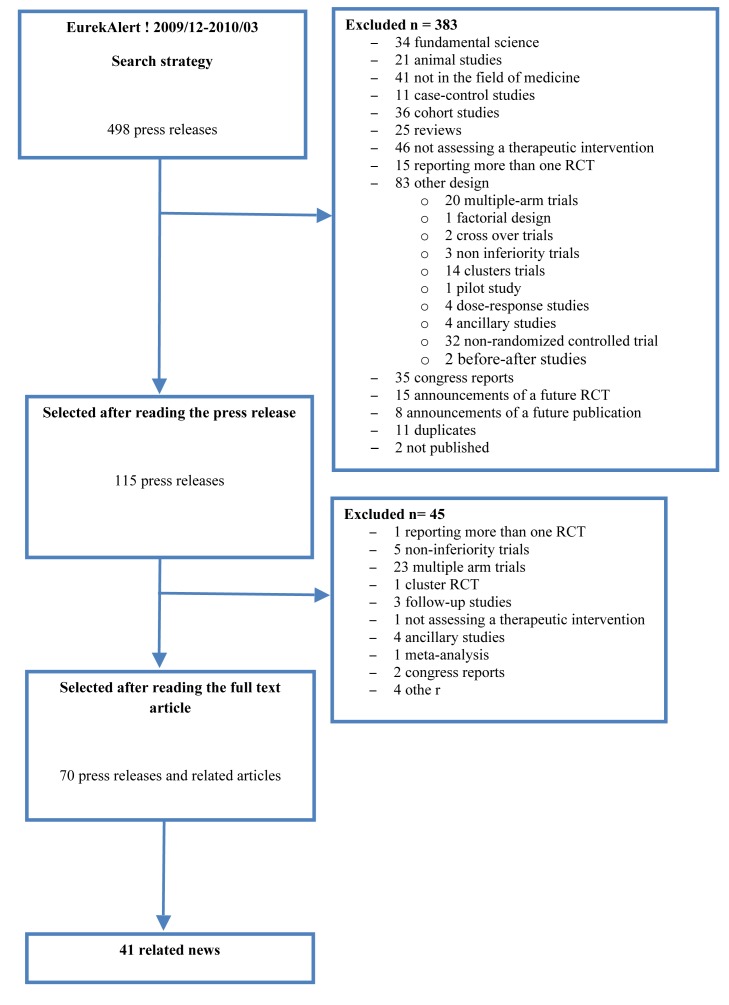
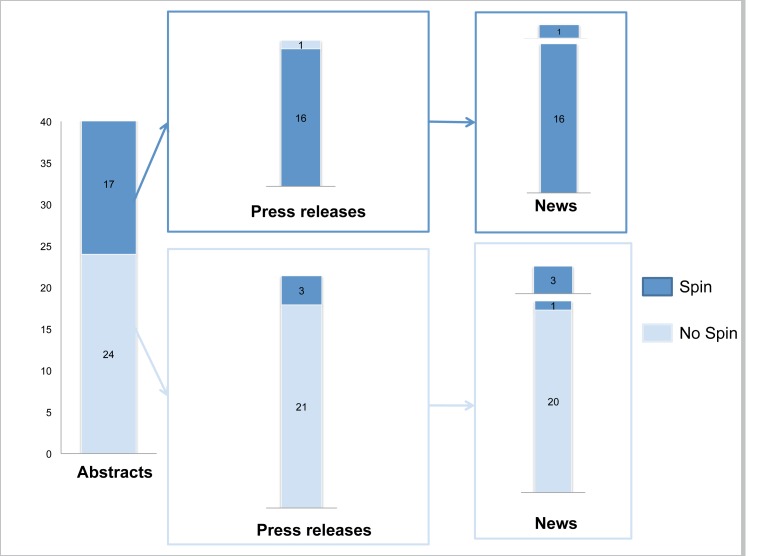
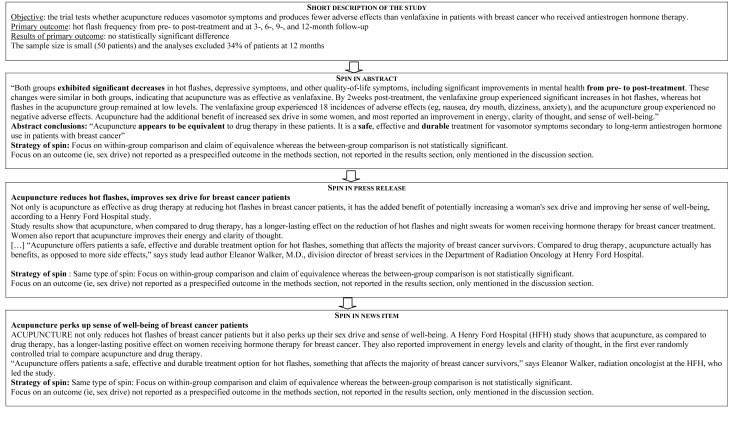
BACKGROUND: Previous studies indicate that in published reports, trial results can be distorted by the use of "spin" (specific reporting strategies, intentional or unintentional, emphasizing the beneficial effect of the experimental treatment). We aimed to (1) evaluate the presence of "spin" in press releases and associated media coverage; and (2) evaluate whether findings of randomized controlled trials (RCTs) based on press releases and media coverage are misinterpreted. METHODS AND FINDINGS: We systematically searched for all press releases indexed in the EurekAlert! database between December 2009 and March 2010. Of the 498 press releases retrieved and screened, we included press releases for all two-arm, parallel-group RCTs (n = 70). We obtained a copy of the scientific article to which the press release related and we systematically searched for related news items using Lexis Nexis. "Spin," defined as specific reporting strategies (intentional or unintentional) emphasizing the beneficial effect of the experimental treatment, was identified in 28 (40%) scientific article abstract conclusions and in 33 (47%) press releases. From bivariate and multivariable analysis assessing the journal type, funding source, sample size, type of treatment (drug or other), results of the primary outcomes (all nonstatistically significant versus other), author of the press release, and the presence of "spin" in the abstract conclusion, the only factor associated, with "spin" in the press release was "spin" in the article abstract conclusions (relative risk [RR] 5.6, [95% CI 2.8-11.1], p < 0.001). Findings of RCTs based on press releases were overestimated for 19 (27%) reports. News items were identified for 41 RCTs; 21 (51%) were reported with "spin," mainly the same type of "spin" as those identified in the press release and article abstract conclusion. Findings of RCTs based on the news item was overestimated for ten (24%) reports. CONCLUSION: "Spin" was identified in about half of press releases and media coverage. In multivariable analysis, the main factor associated with "spin" in press releases was the presence of "spin" in the article abstract conclusion.
Overview
The claims and statistics of this paper haven’t been checked yet.
Free: it reads the open-access text and checks the first 5 claims that cite a source we can check. Create a free account to check every claim.
Integrity signals
Registry
Cites
Statistics
Figures
Verification
Claims the paper makes
The claims and statistics of this paper haven’t been checked yet.
Free: it reads the open-access text and checks the first 5 claims that cite a source we can check. Create a free account to check every claim.
Claims other papers make about this one
Each is checked against this paper’s own text: does it say what the citing paper says it does?
The source backs part of the claim, not all of it — or backs it for a different population, condition or comparison.
In the citing paper
“Media outlets may spin [26–28] and encourage dissemination of eye-catching, potentially overstated, inaccurate [29], and/or misleading headlines in order to gain larger audience size [28, 30, 31].”
From Causal language and strength of inference in academic and media articles shared in social media (CLAIMS): A systematic review (2018) · cites this paper as [31]
Experimental — accuracy not yet measuredThe source backs part of the claim, not all of it — or backs it for a different population, condition or comparison.
In the citing paper
“Indeed, in a study on “spin” in the reporting of randomised controlled trials (70 press releases and associated journal abstracts, 41 news stories), in only four cases the news contained spin where the associated journal abstract did not.22”
From The association between exaggeration in health related science news and academic press releases: retrospective observational study (2014) · cites this paper as [22]
Experimental — accuracy not yet measuredThe cited source says what the claim attributes to it.
In the citing paper
“Although lay media have contributed to sensationalism and misrepresentation of science, many of these mistaken messages originate from the scientific community itself (78).”
From Issues with data and analyses: Errors, underlying themes, and potential solutions (2018) · cites this paper as [78]
The cited source says what the claim attributes to it.
In the citing paper
“spin in journal articles can shape press releases 86 , which in turn affect the accuracy of media reports 87”
From Quantifying the prevalence and impact of overreaching causal claims in social science (2026) · cites this paper as [86]
The cited source says what the claim attributes to it.
In the citing paper
“many journal articles may contain statements that are already exaggerated relative to a consensus of scientific opinion, or at least spun to emphasise positive findings,22”
From The association between exaggeration in health related science news and academic press releases: retrospective observational study (2014) · cites this paper as [22]
3 more claims about this paper
Create a free account to see every claim other papers make about this one.
Self-check
Percentages, sums and reported differences re-computed from the paper’s own numbers.
The self-check needs the paper’s full text.
Citations
Cites
Evidence based medicine: what it is and what it isn't
Sackett, D. L., Rosenberg, W. M. C., Gray, J. A. M., Haynes, R. B., & Richardson, W. S. (1996) · BMJ · doi:10.1136/bmj.312.7023.71 · Cited by 15,769 · cited 1×
“Randomized controlled trials (RCTs) are considered the gold standard for therapeutic evaluation [10].”
BackgroundA Modified Poisson Regression Approach to Prospective Studies with Binary Data
Zou, G. (2004) · American Journal of Epidemiology · doi:10.1093/aje/kwh090 · Cited by 9,615
Boutron, I. (2010) · JAMA · doi:10.1001/jama.2010.651 · Cited by 842 · cited 2×
“However, a recent study showed that research findings can be distorted in published articles, by the use of ‘‘spin,’’ which is defined as specific reporting emphasizing the beneficial effect of the experimental treatment [12].”
BackgroundSelf-citationAls-Nielsen, B., Chen, W., Gluud, C., & Kjaergard, L. L. (2003) · JAMA · doi:10.1001/jama.290.7.921 · Cited by 746 · cited 1×
“For this purpose, we developed a standardized data-abstraction form using previous work on the same topics [12–14].”
MethodHopewell, S., Clarke, M., Moher, D., Wager, E., Middleton, P., Altman, D. G., Schulz, K. F., & and the CONSORT Group (2008) · PLoS Medicine · doi:10.1371/journal.pmed.0050020 · Cited by 674 · cited 1×
“Readers often base their initial assessment of a trial on the information reported in an abstract conclusion, and in some geographic areas, the abstract of an RCT report may be all that health professionals have easy access to [25,26].”
BackgroundBootstrap Methods for Developing Predictive Models
Austin, P. C., & Tu, J. V. (2004) · The American Statistician · doi:10.1198/0003130043277 · Cited by 622 · cited 1×
“For the multivariable analysis, we performed a Poisson regression with robust error variance [16] with a bootstrap model selection variable method [17] to assess all relevant variables.”
MethodMass media interventions: effects on health services utilisation
Grilli, R., Ramsay, C., & Minozzi, S. (2002) · Cochrane Database of Systematic Reviews · doi:10.1002/14651858.cd000389 · Cited by 533
Coverage by the news media of the benefits and risks of medications
Moynihan, R., Bero, L., Ross-Degnan, D., Henry, D., Lee, K., Watkins, J., Mah, C., & Soumerai, S. B. (2000) · New England Journal of Medicine · doi:10.1056/nejm200006013422206 · Cited by 500 · cited 1×
“An assessment of the reporting of medical news in the mainstream media highlighted the inadequate accuracy and balance of the news media in reporting medical science [21–23].”
BackgroundImportance of the Lay Press in the Transmission of Medical Knowledge to the Scientific Community
Phillips, D. P., Kanter, E. J., Bednarczyk, B., & Tastad, P. L. (1991) · New England Journal of Medicine · doi:10.1056/nejm199110173251620 · Cited by 399 · cited 2×
“This influence has been clearly shown in a quasi-experimental study evaluating the impact of media coverage [11].”
BackgroundNaylor, C. D., Chen, E., & Strauss, B. (1992) · Annals of Internal Medicine · doi:10.7326/0003-4819-117-11-916 · Cited by 378 · cited 1×
“An assessment of the reporting of medical news in the mainstream media highlighted the inadequate accuracy and balance of the news media in reporting medical science [21–23].”
Background
Research works printed but not linked: 1
- [2]2. Jaques H (2011) BMJ Careers -get your research reported well in the news. Available: http://careers.bmj.com/careers/advice/view-article.html?id = 20001805. Accessed 8 August 2012.
Cited by
Items 201–291 of 291
Grundlagenbeitrag: Inhaltsanalysen inklusive Medienanalysen
Kessler, S. H., & Wicke, N. (2023) · Springer eBooks · doi:10.1007/978-3-658-39582-7_14 · Cited by 2
How publishers can fight misinformation in and about science and medicine
Bergstrom, C. T., & West, J. D. (2023) · Nature Medicine · doi:10.1038/s41591-023-02411-7 · Cited by 2
Effect of In-Vitro Alpha Lipoic Acid Addition on Spermatozoa Motility in Sperm Preparation Process
Buanayuda, G. W., Lunardhi, H., & Mansur, I. G. (2021) · Folia Medica Indonesiana · doi:10.20473/fmi.v55i4.24382 · Cited by 2
Brown, A. W., Altman, D. G., Baranowski, T., Bland, J., Ja, D., Dhurandhar, N., Dowla, S. A., Fontaine, K. R., Gelman, A., Heymsfield, S., et al. (2020) · Yearbook of pediatric endocrinology · doi:10.1530/ey.17.15.7 · Cited by 2
The Effects of Media and Technology on Provider–Patient Interaction and Health Outcomes
Fitzpatrick, M. A., & Kyweluk, M. A. (2020) · Wiley eBooks · doi:10.1002/9781119399926.ch48 · Cited by 2
Bradley, S. H., DeVito, N., Lloyd, K. E., Richards, G. C., Rombey, T., Wayant, C., & Gill, P. J. (2020) · MetArXiv (OSF Preprints) · doi:10.31222/osf.io/jy37f · Cited by 2
Sharp, M. K., Haneef, R., Ravaud, P., & Boutron, I. (2017) · BMJ Open · doi:10.1136/bmjopen-2016-014503 · Cited by 1
Self-citationSebo, P., Nie, B., & Wang, T. (2025) · F1000Research · doi:10.12688/f1000research.173647.1 · Cited by 5
“17,18 Recent advancements in natural language processing (NLP) have opened new avenues in scientific writing.”
Teimouri, N., Sievert, K., Hannah, A., Meciar, S., Gill, K.-A., Senior, H. J., & Cullerton, K. B. (2026) · Obesity Reviews · doi:10.1111/obr.70153 · Cited by 1
“A 2012 study of spin in press releases [26] identified spin in abstract conclusions as the single strongest predictor for spin in press releases.”
Spin bias in scientific publishing: upholding integrity in research reporting
Montagner, A. F., Sarkis-Onofre, R., dos Santos, A. P. P., Puljak, L., Raggio, D. P., & Pereira‐Cenci, T. (2026) · BDJ · doi:10.1038/s41415-026-9786-4 · Cited by 1
Necesidad de compartir y difundir las publicaciones científicas en salud con la población general
Arroyo-Hernández, H., Alarco, J. J., & Cabezas, C. (2016) · Revista Peruana de Medicina Experimental y Salud Pública · doi:10.17843/rpmesp.2016.332.2198 · Cited by 1
Wissenschaftskommunikation als demokratisches Grundprinzip
Weingart, P., & Wormer, H. (2016) · TATuP Zeitschrift für Technikfolgenabschätzung in Theorie und Praxis · doi:10.14512/tatup.25.1.8 · Cited by 1
Wissenschaftskommunikation im Gesundheitsbereich
Serong, J., Lang, B., & Wormer, H. (2017) · Springer eBooks · doi:10.1007/978-3-658-10948-6_7-1 · Cited by 1
Von der „Pressemitteilung“ zur „An-alle-Mitteilung“: Der Medien-Doktor PR Watch an der TU Dortmund
Anhäuser, M., & Wormer, H. (2017) · Medizinisch Wissenschaftliche Verlagsgesellschaft eBooks · doi:10.32745/9783954663637-2.6 · Cited by 1
Barrios, C. L., Aguirre, V., Parra, A., Pavletic, C., Bustos-López, C., Perez, S., Urrutia, C., Ramirez, J., & Fatjó, J. (2021) · Animals · doi:10.3390/ani11030893 · Cited by 1
“As explained at the beginning of this discussion, the scientific literature aims to explain the problem through objective writing and with the minimum possible bias [26], very different from the characteristics of press literature, which is influenced by public relations in the medium that writes the news [51], the so…”
BackgroundHensel, P. G. (2022) · Strategic Organization · doi:10.1177/14761270211067162 · Cited by 1
Linguistic spin in randomized controlled trials about age-related macular degeneration
Veldhuis, N., Nuijts, M. A., Isphording, L., Lee-Kong, F. V. Y. L., Imhof, S. M., & Stegeman, I. (2022) · Frontiers in Epidemiology · doi:10.3389/fepid.2022.961996 · Cited by 2
Analysis of Spin in the Reporting of Studies on Electroanalgesia for Musculoskeletal Pain
Batista, A. K. S., Matias, F. L., Mendes, C. K. T. T., Ferreira, J. J. D. A., de Andrade, P. R., & de Oliveira, V. M. A. (2022) · Journal of Manipulative and Physiological Therapeutics · doi:10.1016/j.jmpt.2023.04.006 · Cited by 1
Engineering Writing for the General Public: A Classroom Approach
Warford, E. (2020) · ASEE Annual Conference & Exposition · doi:10.18260/1-2--19540 · Cited by 1
Annotating Spin in Biomedical Scientific Publications : the case of Random Controlled Trials (RCTs)
Koroleva, A., & Paroubek, P. (2018) · Language Resources and Evaluation Conference (LREC) · doi:10.63317/4ydwv7555nce · Cited by 1
“From previous research on spin classification (Boutron et al. 2010; Lazarus et al. 2015, Yavchitz et al. 2012], we can outline three main types and their subtypes of spin in RCT reports: 1. misleading reporting of study results: • selective reporting of outcomes (omission of the primary outcome;…”
MethodHealthNewsReview.org: Touchstone and Treasure
Barnard, P. (2018) · Journal of Hospital Librarianship · doi:10.1080/15323269.2018.1509196 · Cited by 1
“spin in the press releases and news coverage of published reports of randomized trial results (4).”
BackgroundCausal claims about correlations reduced in press releases following academic study of health news
Bratton, L., Adams, R. C., Challenger, A., Boivin, J., Bott, L. A., Chambers, C., & Sumner, P. (2020) · Wellcome Open Research · doi:10.12688/wellcomeopenres.15647.1 · Cited by 4
“Introduction News media help disseminate health information to millions of readers, but appealing news stories can contain misleading claims, with associated risks to public health (Buhse et al., 2018; Grilli et al., 2002; Haneef et al., 2015; Matthews et al., 2016; Ramsay, 2013; Schwitzer, 2008; Sharma et al., 2003;…”
Will improvements in health journalism improve health literacy?
Oransky, I. (2020) · Information Services & Use · doi:10.3233/isu-200081 · Cited by 2
Sarantou, M., & Tessmer, V. (2021) · doi:10.24981/16470508.15.9 · Cited by 1
Content Analysis in the Research Field of Science Communication
Wicke, N. (2022) · Springer eBooks · doi:10.1007/978-3-658-36179-2_35 · Cited by 1
Promoting Dialogue by Thinking Differently about Framing and Correcting Misinformation
Gesser‐Edelsburg, A. (2023) · Springer eBooks · doi:10.1007/978-3-031-24490-2_9 · Cited by 1
Vaganay, A. (2014) · London School of Economics and Political Science Theses Online (London School of Economics and Political Science) · Cited by 5
Fowler, A. J. (2013) · Annals of Medicine and Surgery · doi:10.1016/s2049-0801(13)70036-0 · Cited by 2
Lehmkuhl, M., & Promies, N. (2020) · SocArXiv (OSF Preprints) · doi:10.31235/osf.io/jszt7 · Cited by 1
Kotlier, J. L., Kumaran, P., Fathi, A., Yazditabar, J. M., Lin, E. H., Mayfield, C. K., Petrigliano, F. A., & Liu, J. N. (2025) · The Knee · doi:10.1016/j.knee.2024.12.013 · Cited by 1
Quantifying the prevalence and impact of overreaching causal claims in social science
Isch, C., Dörr, T., Fasching, N., Jennings, G., & Watts, D. J. (2026) · Nature Human Behaviour · doi:10.1038/s41562-026-02553-x
Hoe schrijven Nederlandse kranten over hersenonderzoek
van Atteveldt, N., van Aalderen-Smeets, S. I., Jacobi, C., & Ruigrok, N. (2014) · Nederlandsch tijdschrift voor geneeskunde/Nederlands tijdschrift voor geneeskunde/NTvG-databank
Skilled use of the media by vested interests to promote drugs and other health products
Menkes, D. B., & Lexchin, J. (2016) · BMJ · doi:10.1136/bmj.i1179
Boissons « light » et risque de diabète : ou comment l’information est biaisée
Guy-grand, B. (2013) · Cahiers de Nutrition et de Diététique · doi:10.1016/j.cnd.2013.03.003
Concealment, Lying, and Exaggeration in Research
Silver, J. (2012) · Journal watch · doi:10.1056/jp201210290000005
Pitfalls of s ystematic Reviews and m eta- analyses in i maging
McInnes, M. D. F., & Bossuyt, P. M. (2015)
Plastic surgery spin : Suppressing clarity
America, L. F. (2015)
The Harmful Consequences of Living with HIV in Contemporary Society
Medeiros, P. (2016) · NEXUS The Canadian Student Journal of Anthropology · doi:10.15173/nexus.v24i1.890
Dal‐Ré, R. (2018) · Medicina Clínica · doi:10.1016/j.medcli.2018.03.026
Lost in Translation: How Science Communicators are Depriving Modern Society of Science
Jacobs, J. (2013) · Iowa State University Summer Symposium on Science Communication · doi:10.31274/sciencecommunication-180809-35
Recommending research articles to consumers of online vaccination information
Harrison, E., Martin, P. B., Surian, D., & Dunn, A. G. (2020) · Quantitative Science Studies · doi:10.1162/qss_a_00030
Trethewey, S. P. (2020) · Postgraduate Medical Journal · doi:10.1136/postgradmedj-2020-137790
A Glimpse at the Future of Animal-Assisted Interventions
Turner, D. (2015) · Elsevier eBooks · doi:10.1016/b978-0-12-801292-5.00028-6 · Cited by 1
Serving two masters? Shared corporate leadership and conflict of interest
Campbell, D. G. (2020) · Healthcare Management Forum · doi:10.1177/0840470420963440
Dormire, K., Whitehead, A. J., Wayant, C., Bowers, A., & Vassar, M. B. (2020) · The Clinical Respiratory Journal · doi:10.1111/crj.13295
2020 vision? A retrospective study of time-bound curative claims in British and Irish newspapers
McKechnie, D. G., Rashid, M. A., & McCartney, M. (2022) · British Journal of General Practice · doi:10.3399/bjgp22x719261
Alves, C. P. D. L., da Costa, G. G., Segundo, J. D. D. B., & Helal, L. C. A. S. (2020) · OSF Preprints (OSF Preprints) · doi:10.31219/osf.io/7hdur
Comment: Spinning prions, doppels and shadoos.Preprint
Premzl, M. (2018) · OSF Preprints (OSF Preprints) · doi:10.31219/osf.io/pem2s
Misleading information generated in medical journals that reaches the citizen electronically
Dal‐Ré, R. (2018) · Medicina Clínica (English Edition) · doi:10.1016/j.medcle.2018.03.029
Multi-Word Combinations in Science Communication: A Corpus-Driven Study of University Press Releases
Petrocelli, E., Ferrante, L. D., & Ghia, E. (2022) · Online Journal of Communication and Media Technologies · doi:10.30935/ojcmt/12247 · Cited by 5
Are We Scared of Clinical Trials if Not Sufficiently Informed and Educated?
Burnazović-Ristić, L., Todic, A., Kapo, S. M., Kusturica, J., Kulo, A., Loga-Zec, S., Aganović-Mušinović, I., & Todić, M. (2022) · Advances in Medical Education and Practice · doi:10.2147/amep.s375904
How to facilitate mainstream media coverage of physiotherapy research
Zadro, J. R. (2022) · Journal of physiotherapy · doi:10.1016/j.jphys.2022.11.009
Misrepresentation of Scientific Figures
Leaphart, D. M., Cronley, A. C., & Brothers, T. E. (2022) · Springer eBooks · doi:10.1007/978-3-030-99680-2_15
Critical Gaps in Medical Research Reporting by Online News Media
Heston, T. F. (2024) · Cureus · doi:10.7759/cureus.57457 · Cited by 3
“This "spin" led to an overestimation of the benefit of the experimental treatment in 27% of reports based on the press release and 24% of reports based on the news item, compared to the full-text peer-reviewed article [16].”
BackgroundAbstract versus Full Paper: A quantitative approach
Calipolitis, D., & Pleştiu, C. (2025) · Journal of Social and Economic Statistics · doi:10.2478/jses-2025-0003
Expert statements: Where science communication discourse meets peer review discourse
Ivanova, M. (2025) · Discourse and Interaction · doi:10.5817/di2025-1-58
Parikh, P. M., Prasad, N., Thirumalairaj, R., Mohapatra, P. R., Lavingia, V. K., Menon, H., Bapna, A., Chitalkar, P. G., Kanakasetty, G. B., Gupta, V. G., et al. (2025) · Indian Journal of Cancer · doi:10.4103/ijc.ijc_170_24
Wronski, P., Wensing, M., Ghosh, S., Gärttner, L., Müller, W., & Koetsenruijter, J. (2021) · Figshare · doi:10.6084/m9.figshare.13662489
Wronski, P., Wensing, M., Ghosh, S., Gärttner, L., Müller, W., & Koetsenruijter, J. (2021) · Figshare · doi:10.6084/m9.figshare.13662507
Wronski, P., Wensing, M., Ghosh, S., Gärttner, L., Müller, W., & Koetsenruijter, J. (2021) · Figshare · doi:10.6084/m9.figshare.13662501
Siebert, M., Gaba, J. F., Renault, A., Laviolle, B., Locher, C., Moher, D., & Naudet, F. (2022) · Figshare · doi:10.6084/m9.figshare.19802441
Siebert, M., Gaba, J. F., Renault, A., Laviolle, B., Locher, C., Moher, D., & Naudet, F. (2022) · Figshare · doi:10.6084/m9.figshare.19802426
Siebert, M., Gaba, J. F., Renault, A., Laviolle, B., Locher, C., Moher, D., & Naudet, F. (2022) · Figshare · doi:10.6084/m9.figshare.19802432
Steegmans, P. A. J., Di Girolamo, N., & Reynders, R. M. (2024) · Figshare · doi:10.6084/m9.figshare.26598293
Steegmans, P. A. J., Di Girolamo, N., & Reynders, R. M. (2024) · Figshare · doi:10.6084/m9.figshare.26598299
Steegmans, P. A. J., Di Girolamo, N., & Reynders, R. M. (2024) · Figshare · doi:10.6084/m9.figshare.26598296
Siebert, M., Gaba, J. F., Renault, A., Laviolle, B., Locher, C., Moher, D., & Naudet, F. (2022) · Figshare · doi:10.6084/m9.figshare.19802429
Wronski, P., Wensing, M., Ghosh, S., Gärttner, L., Müller, W., & Koetsenruijter, J. (2021) · Figshare · doi:10.6084/m9.figshare.13662483
Wronski, P., Wensing, M., Ghosh, S., Gärttner, L., Müller, W., & Koetsenruijter, J. (2021) · Figshare · doi:10.6084/m9.figshare.13662495
Siebert, M., Gaba, J. F., Renault, A., Laviolle, B., Locher, C., Moher, D., & Naudet, F. (2022) · Figshare · doi:10.6084/m9.figshare.19802438
Siebert, M., Gaba, J. F., Renault, A., Laviolle, B., Locher, C., Moher, D., & Naudet, F. (2022) · Figshare · doi:10.6084/m9.figshare.19802435
Saginur, M., Fergusson, D. A., Zhang, T., Yeates, K., Ramsay, T., Wells, G., & Moher, D. (2020) · Figshare · doi:10.6084/m9.figshare.11978877
Misleading readers without lies: understanding spin and its relevance to acupuncture research
Bae, I., Ji, Y.-J., & Lee, H. (2025) · Integrative Medicine Research · doi:10.1016/j.imr.2025.101288
“36 Such distorted presentations and interpretations of research findings may have serious consequences.”
Misrepresentation of results from the DANCAVAS II trial
Jørgensen, K. J., Jørgensen, T., & Støvring, H. (2025) · European Heart Journal · doi:10.1093/eurheartj/ehaf1110
Zuo, C., Wang, C., & Banerjee, R. (2025) · IEEE International Conference on Bioinformatics and Biomedicine (BIBM) · doi:10.1109/bibm66473.2025.11356094
“As clinical evidence rapidly evolves, including emerging therapeutic approaches and novel epidemiological findings, the need for connecting these claims to domain-specific researchers has become critical [3].”
HDCR: Cross-Lingual Medical Misinformation Detection Through Contrastive Claim-Evidence Reasoning
Zuo, C., & Banerjee, R. (2025) · IEEE International Conference on Bioinformatics and Biomedicine (BIBM) · doi:10.1109/bibm66473.2025.11356375
Su, N., van der Linden, M. W., van der Heijden, G. J. M. G., Listl, S., & Faggion, C. M. (2026) · Journal of Clinical Epidemiology · doi:10.1016/j.jclinepi.2026.112264
Assisted authoring for avoiding inadequate claims in scientific reporting
Koroleva, A. (2020) · theses.fr (ABES) · doi:10.70675/f035bb8azddf1z4a7dzbf39zdf86c6947bb9 · Cited by 2
“Besides, spin in research articles provokes spin in health news and press releases (Haneef et al., 2015; Yavchitz et al., 2012), which can raise false expectations regarding the treatment among the readers.”
BackgroundInfluentialStopping Spin at the Source: Learning From an Example in Obesity
Brown, A. W., Jensen, M. D., & Allison, D. B. (2026) · Obesity · doi:10.1002/oby.70159
Ein Abstract sagt mehr als 1.000 Worte? – Leider nicht so ganz …
Friederichs, H. (2026) · doi:10.59350/9fyra-sz611
Ein Abstract sagt mehr als 1.000 Worte? – Leider nicht so ganz …
Friederichs, H. (2026) · doi:10.59350/w9dqx-nse76
Fournier, J., Khouri, C., Bellier, A., Seigneurin, A., Laporte, S., & Roustit, M. (2026) · Journal of Clinical Epidemiology · doi:10.1016/j.jclinepi.2026.112536
Reporting of primary endpoint and associated spin in randomized myeloma trials
Singstock, M., Khader, A. H. S. A., Wayant, C., Lemieux, M., Mainou, M., & Mohyuddin, G. R. (2026) · The Oncologist · doi:10.1093/oncolo/oyag221
Constructing newsworthiness in institutional research press releases: An applied corpus study
Breeze, R. (2026) · Applied Corpus Linguistics · doi:10.1016/j.acorp.2026.100228
Amplification Chambers and Belief Persistence in Commercial Health Communication
Elden, Å., Goth, U. S., & Ardigò, L. P. (2026) · Journal of Health Communication · doi:10.1080/10810730.2026.2693890
Eagle, S. R., & Sherry, N. S. (2026) · Frontiers in Neurology · doi:10.3389/fneur.2026.1882586
Szromek, A. R. (2026) · Publications · doi:10.3390/publications14030041 · Cited by 1
“It is the abstract that most often becomes the basis for the secondary circulation of information, while also being especially vulnerable to compression and spin, as shown by the previously cited studies by Boutron et al. (2010, 2014), Yavchitz et al. (2012), and Haneef et al. (2015).”
La psychiatrie n’est pas une discipline médicale comme les autres
Gonon, F. (2026) · Santé Publique · doi:10.3917/spub.hs1.2026.0229
Anwar, A. I., Apgar, T. L., Hegazi, A.-R. A., Dolan, J. L., Corona, L. M., & Kaye, A. D. (2026) · Pain and Therapy · doi:10.1007/s40122-026-00888-x
Metadata
- Authors
- Yavchitz, A., Boutron, I., Bafeta, A., Marroun, I., Charles, P., Mantz, J., & Ravaud, P.
- Affiliations
- Inserm (FR)
- Hôpital Foch (FR)
- Hôpital Beaujon (FR)
- Corresponding author
- Boutron, Isabelle
- Venue
- PLoS Medicine
- Publisher
- Public Library of Science (PLoS)
- Published
- 2012-09-11
- Volume
- 9
- Issue
- 9
- Pages
- e1001308
- ISSN
- 1549-1277 (ISSN-L)
- 1549-1676
- PMC
- PMC3439420
- OpenAlex
- W2014279397
- Semantic Scholar
- c9395a0ec8a047b497194dc67193fd9e1928d254
- Cited by
- 293
- References
- 30
- Citations by year
- 2026: 18 · 2025: 15 · 2024: 11 · 2023: 18 · 2022: 27 · 2021: 27 · 2020: 33 · 2019: 27 · 2018: 26 · 2017: 10 · 2016: 22 · 2015: 20 · 2014: 16 · 2013: 18 · 2012: 4
- FWCI
- 37.83
- Type
- journal article
- Language
- en
- Open access
- gold
- doi.org
- Locations
- PLoS Medicine (publishedVersion, cc-by)
- Europe PMC (PubMed Central) (publishedVersion, cc-by)
- PubMed Central (publishedVersion, cc-by)
- PubMed (publishedVersion)
- RePEc: Research Papers in Economics (acceptedVersion)
- DOAJ (DOAJ: Directory of Open Access Journals) (submittedVersion, cc-by-sa)
- Figshare (submittedVersion, cc-by)
- Topics
- Social Sciences › Library and Information Sciences › Academic Publishing and Open Access
- Health Sciences › Nursing › Issues, ethics and legal aspects › Pharmaceutical industry and healthcare
- Social Sciences › Decision Sciences › Statistics, Probability and Uncertainty › Meta-analysis and systematic reviews
- Keywords
- press releases, media coverage, spin, randomized controlled trials, overestimation of treatment effects, science journalism
- MeSH terms
- Humans, Mass Media, Publishing, Cohort Studies, Randomized Controlled Trials as Topic
About these checks
Registry, retraction, Cites and statistics results are computed, not judged, with one exception: a printed reference that no index lists is read once by a model before it counts as a citation error. Claims are extracted by a model and kept only when their quote appears verbatim in the text; each cited source is then checked, with a model’s help, for whether it says what the claim relies on. Those verdicts can be wrong — read the claim’s quote and the cited source before relying on one.
Statistics and arithmetic are recomputed, not judged.
Confidence bands are shown only for fields calibrated on our annotated test set. None is calibrated yet, so no band is shown.
What counts as a claim ›How we measure confidence ›How we check this ›
Are you an author, or do you see a problem with this page? Request a review
Data sources
Bibliographic data: Semantic Scholar, OpenAlex, Crossref.
Contains information from the Semantic Scholar Academic Graph Datasets, made available under the ODC Attribution License (ODC-BY 1.0).
Semantic Scholar’s data is described in: Kinney, R., et al. (2023). The Semantic Scholar Open Data Platform. arXiv:2301.10140.
