

A Transdiagnostic Community-Based Mental Health Treatment for Comorbid Disorders: Development and Outcomes of a Randomized Controlled Trial among Burmese Refugees in Thailand
Open accessThe DOI matches its Crossref record; 39 of the 40 references it cites were found in a registry or an index.
Abstract
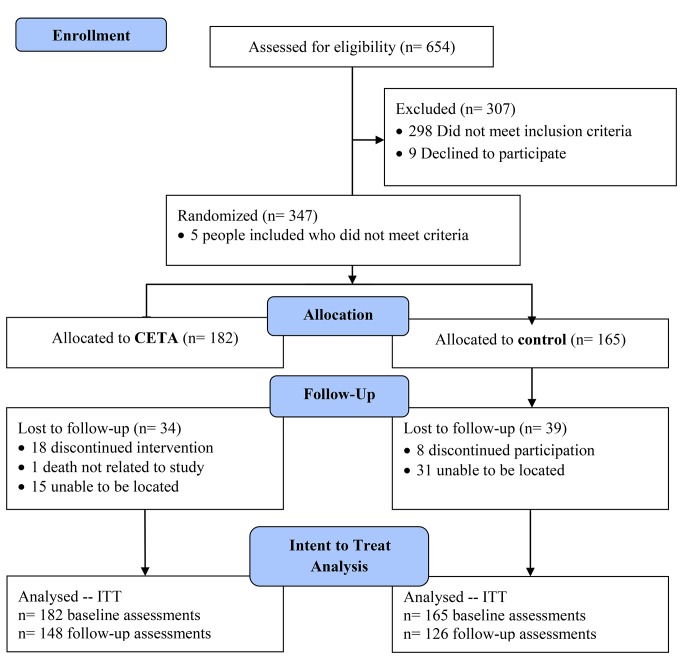
BACKGROUND: Existing studies of mental health interventions in low-resource settings have employed highly structured interventions delivered by non-professionals that typically do not vary by client. Given high comorbidity among mental health problems and implementation challenges with scaling up multiple structured evidence-based treatments (EBTs), a transdiagnostic treatment could provide an additional option for approaching community-based treatment of mental health problems. Our objective was to test such an approach specifically designed for flexible treatments of varying and comorbid disorders among trauma survivors in a low-resource setting. METHODS AND FINDINGS: We conducted a single-blinded, wait-list randomized controlled trial of a newly developed transdiagnostic psychotherapy, Common Elements Treatment Approach (CETA), for low-resource settings, compared with wait-list control (WLC). CETA was delivered by lay workers to Burmese survivors of imprisonment, torture, and related traumas, with flexibility based on client presentation. Eligible participants reported trauma exposure and met severity criteria for depression and/or posttraumatic stress (PTS). Participants were randomly assigned to CETA (n = 182) or WLC (n = 165). Outcomes were assessed by interviewers blinded to participant allocation using locally adapted standard measures of depression and PTS (primary outcomes) and functional impairment, anxiety symptoms, aggression, and alcohol use (secondary outcomes). Primary analysis was intent-to-treat (n = 347), including 73 participants lost to follow-up. CETA participants experienced significantly greater reductions of baseline symptoms across all outcomes with the exception of alcohol use (alcohol use analysis was confined to problem drinkers). The difference in mean change from pre-intervention to post-intervention between intervention and control groups was -0.49 (95% CI: -0.59, -0.40) for depression, -0.43 (95% CI: -0.51, -0.35) for PTS, -0.42 (95% CI: -0.58, -0.27) for functional impairment, -0.48 (95% CI: -0.61, -0.34) for anxiety, -0.24 (95% CI: -0.34, -0.15) for aggression, and -0.03 (95% CI: -0.44, 0.50) for alcohol use. This corresponds to a 77% reduction in mean baseline depression score among CETA participants compared to a 40% reduction among controls, with respective values for the other outcomes of 76% and 41% for anxiety, 75% and 37% for PTS, 67% and 22% for functional impairment, and 71% and 32% for aggression. Effect sizes (Cohen's d) were large for depression (d = 1.16) and PTS (d = 1.19); moderate for impaired function (d = 0.63), anxiety (d = 0.79), and aggression (d = 0.58); and none for alcohol use. There were no adverse events. Limitations of the study include the lack of long-term follow-up, non-blinding of service providers and participants, and no placebo or active comparison intervention. CONCLUSIONS: CETA provided by lay counselors was highly effective across disorders among trauma survivors compared to WLCs. These results support the further development and testing of transdiagnostic approaches as possible treatment options alongside existing EBTs. TRIAL REGISTRATION: ClinicalTrials.gov NCT01459068 Please see later in the article for the Editors' Summary.
Overview
The claims and statistics of this paper haven’t been checked yet.
Free: it reads the open-access text and checks the first 5 claims that cite a source we can check. Create a free account to check every claim.
Integrity signals
Registry
Cites
Statistics
Figures
Verification
Claims the paper makes
The claims and statistics of this paper haven’t been checked yet.
Free: it reads the open-access text and checks the first 5 claims that cite a source we can check. Create a free account to check every claim.
Claims other papers make about this one
Each is checked against this paper’s own text: does it say what the citing paper says it does?
The cited source doesn’t support the claim as written.
In the citing paper
“Sample sizes ranged from 33 in Bolton 2014 to 1400 in Schaub 2021 (Median = 157.5, interquartile range (IQR) = 92.5 to 371).”
From Psychosocial and pharmacologic interventions to reduce harmful alcohol use in low- and middle-income countries (2023) · cites this paper as Bolton 2014
Checked by a reasoning model — may be wrong.
Experimental — accuracy not yet measuredThe cited source doesn’t support the claim as written.
In the citing paper
“Blinding of outcome assessment (detection bias) All outcomes High risk”
From Psychosocial and pharmacologic interventions to reduce harmful alcohol use in low- and middle-income countries (2023) · cites this paper as Bolton 2014
Checked by a reasoning model — may be wrong.
Experimental — accuracy not yet measuredThe source backs part of the claim, not all of it — or backs it for a different population, condition or comparison.
In the citing paper
“Incomplete outcome data (attrition bias) All outcomes High risk”
From Psychosocial and pharmacologic interventions to reduce harmful alcohol use in low- and middle-income countries (2023) · cites this paper as Bolton 2014
Experimental — accuracy not yet measuredThe cited source says what the claim attributes to it.
In the citing paper
“Of these, 2 were based in the workplace [26,38], 5 in the community [23,37,43,84], 6 in schools [33,40,65,85,86], and 7 in clinics [39,55–57], of which 1 was focused on women sex workers [95].”
From Patient-level interventions to reduce alcohol-related harms in low- and middle-income countries: A systematic review and meta-summary (2022) · cites this paper as [37]
The cited source says what the claim attributes to it.
In the citing paper
“Twelve included psychosocial treatment trials with 2106 participants reported on harmful alcohol use. All of these trials reported harmful alcohol use on a continuous scale (Bolton 2014; Jordans 2019; Kane 2022; Madhombiro 2019; Madhombiro 2020; Moraes 2010; Murray 2020; Nadkarni 2017; Nadkarni 2019; Omeje 2018; Schaub 2021; Witte 2011).”
From Psychosocial and pharmacologic interventions to reduce harmful alcohol use in low- and middle-income countries (2023) · cites this paper as Bolton 2014
11 more claims about this paper
Create a free account to see every claim other papers make about this one.
Self-check
Percentages, sums and reported differences re-computed from the paper’s own numbers.
The self-check needs the paper’s full text.
Citations
Cites
Statistical power analysis for the behavioral sciences
(1990) · Computers, Environment and Urban Systems · doi:10.1016/0198-9715(90)90050-4 · Cited by 65,269
Coefficient Alpha and the Internal Structure of Tests
Cronbach, L. J. (1951) · Psychometrika · doi:10.1007/bf02310555 · Cited by 43,931 · cited 1×
“Validation consisted of an exploratory factor analysis, an internal consistency measure (using Cronbach’s a) [30], and a combined test-retest/inter-rater reliability measure (using Pearson’s product moment correlation coefficient r) [31] for each scale used to measure outcomes.”
MethodMultiple Imputation for Nonresponse in Surveys
Rubin, D. B. (1987) · Wiley Series in Probability and Statistics · doi:10.1002/9780470316696 · Cited by 20,701
Specification Tests in Econometrics
Hausman, J. A. (1978) · Econometrica · doi:10.2307/1913827 · Cited by 18,820 · cited 1×
“To explore whether NGO affiliation should be treated as a random or fixed effect, a Hausman test [38] was utilized, with significance set at p,0.”
MethodSAUNDERS, J. B., AASLAND, O. G., BABOR, T. F., DE LA FUENTE, J. R., & GRANT, M. (1993) · Addiction · doi:10.1111/j.1360-0443.1993.tb02093.x · Cited by 13,597
Motivational interviewing: preparing people for change.
Miller, W. R., & Rollnick, S. (2002) · Guilford Press eBooks · Cited by 7,896
Multiple imputation by chained equations: what is it and how does it work?
Azur, M. J., Stuart, E. A., Frangakis, C., & Leaf, P. J. (2011) · International Journal of Methods in Psychiatric Research · doi:10.1002/mpr.329 · Cited by 3,542 · cited 1×
“Missing data, including follow-up scores for those lost to follow-up, were imputed using STATA’s chained equations command for multiple imputation, which pools data according to Rubin’s rules [35,36].”
MethodVII. Note on regression and inheritance in the case of two parents
Pearson, K. (1895) · Proceedings of the Royal Society of London · doi:10.1098/rspl.1895.0041 · Cited by 3,424
United Nations High Commissioner for Refugees (UNHCR)
(2014) · International Year Book and Statesmen's Who's Who · doi:10.1163/1570-6664_iyb_sim_org_40277 · Cited by 1,489
Fendall, N. R. E. (1978) · The Lancet · doi:10.1016/s0140-6736(78)92066-4 · Cited by 1,089
Research works printed but not linked: 2
- Lingam R (2003) An assessment of the mental health beliefs and needs of refugees from burma. In: Barnes D, editor. Asylum seekers and refugees in Australia: issues of mental health and wellbeing. Parramatta (Australia): Transcultural Mental Health Centre. pp. 148–162.
- Mollica RF, McDonald LS, Massagli MP, Silove DM (2004) Measuring trauma, measuring torture. Cambridge (Massachusetts): Harvard University Press.
Cited by
Items 201–300 of 319
Challenges and strategies for implementers and evaluators working in conflict settings
Bond, L., Klein, E. K., & Gates, E. (2023) · Evaluation · doi:10.1177/13563890231171608 · Cited by 6
Nguyen, A. J., Russell, T., Skavenski, S. V. W., Bogdanov, S., Lomakina, K., Іванюк, І. В., Aldridge, L. R., Bolton, P. A., Murray, L. K., & Bass, J. (2023) · Global Health Science and Practice · doi:10.9745/ghsp-d-22-00488 · Cited by 13
Self-citationPsychotherapy for refugees and other populations exposed to conflict
Silove, D. M., Tay, A. K., & Rees, S. J. (2019) · Elsevier eBooks · doi:10.1016/b978-0-12-814932-4.00016-1 · Cited by 5
Gagnon, K. W., Levy, S. M., Figge, C. J., Wolford‐Clevenger, C., Murray, L. K., Kane, J. C., Bosomprah, S., Sharma, A., Nghiem, V. T. H., Chitambi, C., et al. (2023) · Contemporary Clinical Trials Communications · doi:10.1016/j.conctc.2023.101123 · Cited by 4
Self-citationDowrick, C. F., Rosala‐Hallas, A., Rawlinson, R., Khan, N., Winrow, E., Chiumento, A., Burnside, G., Aslam, R. W., Billows, L., Eriksson-Lee, M., et al. (2022) · Public Health Research · doi:10.3310/nzxa0081 · Cited by 8
Kurath, J., Keyan, D., Akhtar, A., Martins, W. V., Komenda, B., Maurer, V., Turgut, K., Bryant, R. A., & Morina, N. (2025) · Clinical Psychology Review · doi:10.1016/j.cpr.2025.102619 · Cited by 4
Sijbrandij, M., Bass, J., Carswell, K., Hamdani, S. U., & Karyotaki, E. (2024) · Journal of Traumatic Stress · doi:10.1002/jts.23085 · Cited by 3
Self-citationOutcomes of an individual counselling programme in Grozny, Chechnya: a randomised controlled study
Lenglet, A., Lopes-Cardozo, B., Shanks, L., Blanton, C., Feo, C., Tsatsaeva, Z., Idrisov, K. A., Bolton, P. A., & Pintaldi, G. (2018) · BMJ Open · doi:10.1136/bmjopen-2017-019794 · Cited by 3
Self-citationPsychotherapy for PTSD and stress disorders
Sikkema, K. J., & Coleman, J. N. (2019) · Elsevier eBooks · doi:10.1016/b978-0-12-814932-4.00009-4 · Cited by 4
Outcomes for Internally Displaced Persons and Refugees in Low and Middle-Income Countries
Schuettler, K., & Do, Q. (2023) · World Bank policy research working paper · doi:10.1596/1813-9450-10278 · Cited by 3
“Therapy and other socio-emotional support interventions have a very good track record in improving the mental well-being of refugees and IDPs (Acarturk et al., 2016; Bolton et al., 2016; Islam et al., 2022; Knaevelsrud et al., 2015; Neuner et al., 2004, 2008).”
Barageine, J. K., Nalubwama, H., Obore, S., Mirembe, E., Mubiru, D., Jean, A., Akori, S., Opio, S., Keyser, L. E., McKinney, J. L., et al. (2024) · International Urogynecology Journal · doi:10.1007/s00192-024-05814-3 · Cited by 2
Ng, L. C., Bowers, G., Tesfaye, D., Serba, E. G., Fekadu, A., Hook, K., Ametaj, A., Henderson, D. C., Mueser, K. T., & Hanlon, C. (2025) · SSM - Mental Health · doi:10.1016/j.ssmmh.2025.100502 · Cited by 2
Burkinshaw, M., & Wilcockson, M. (2025) · International Journal of Migration Health and Social Care · doi:10.1108/ijmhsc-03-2024-0031 · Cited by 4
Imtiaz, S., Khaleeq, N., Sanauddin, N., Afaq, S., Jennings, H. M., Tahir, A., Abdeali, M., Khan, Z., Khan, F., Zafar, R., et al. (2026) · Global Health Action · doi:10.1080/16549716.2025.2599011 · Cited by 6
Gonçalves, R., Marques, M. J., Sibéoni, J., & Dias, S. (2026) · BMC Medicine · doi:10.1186/s12916-026-04619-z · Cited by 5
Practice Responses to Climigration
Palinkas, L. A. (2020) · Springer eBooks · doi:10.1007/978-3-030-41890-8_9 · Cited by 3
Russette, H., Grubin, F., Ingalls, A., Martin, L., Leonard, A., Kushman, E., Cisler, A., Leffler, E., Herman, A., & Haroz, E. (2022) · Infant Mental Health Journal · doi:10.1002/imhj.22012 · Cited by 2
Self-citationTreatment of Co-occurring PTSD and Aggression: Current Psychotherapy and Pharmacological Approaches
Krauss, A., McCloskey, M. S., Creech, S. K., & Goodman, M. S. (2023) · Current Treatment Options in Psychiatry · doi:10.1007/s40501-023-00282-w · Cited by 2
Bontilao-Lagare, R. S., Mordeno, I. G., & Nalipay, M. J. N. (2024) · Journal of College Student Mental Health · doi:10.1080/28367138.2024.2333752 · Cited by 3
“There is strong empirical support for the development of transdiagnostic treatments (Brown & Barlow, 2009; Harvey et al., 2004) and its applicability and feasibility for addressing several disorders, including comorbidity (Bolton et al., 2014).”
Sarfan, L. D., Bajwa, Z., Diaz, M., Tiab, S. S., Fisher, K., Agnew, E. R., Howlett, S. A., Oliver, S., Callaway, C. A., & Harvey, A. G. (2024) · Administration and Policy in Mental Health and Mental Health Services Research · doi:10.1007/s10488-024-01410-1 · Cited by 4
“Emerging research suggests that transdiagnostic EBPTs can be effective in community set - tings (e.g., Bolton et al., 2014 ; Harvey et al., 2021 ; Liddle, 2016 ) and are acceptable to clients (e.g., Huynh et al., 2022 ).”
Papathanasiou, C., & Kougioumtzi, A. (2024) · Mental Health Science · doi:10.1002/mhs2.86 · Cited by 3
“To ensure consistency between the structured PM+ and flexible PCM, an integrated training program for both interventions was established (Murray et al., 2014).”
Anderson, J. (2025) · Mental Health Science · doi:10.1002/mhs2.70024 · Cited by 2
Savani, S., Sirrianni, L., Germany, A., & Droesch, R. M. (2025) · Journal of Mental Health and Social Behaviour · doi:10.33790/jmhsb1100197 · Cited by 2
Cossu, G., Galletta, M., & Giovanni, C. M. (2017) · Principles of specialty nursing · doi:10.1007/978-3-319-31772-4_41 · Cited by 3
Lee, N., Osborne, M. C., Massetti, G. M., Watson, A. E. N., & Brown, S. (2021) · Violence Against Women · doi:10.1177/10778012211038973 · Cited by 3
“In addition, mental health interventions that build resilience among those who experience violence and address the psychological impacts of violence have been successfully implemented in Thailand and Zambia, and may be appropriate for Nigeria (Bolton et al., 2014; Murray et al., 2015, 2020).”
BackgroundKane, J. C., Kamanga, M., Skavenski, S. V. W., Murray, L. K., Shawa, M., Bwalya, B., Metz, K. L., Paul, R., Mushabati, N., Ventevogel, P., et al. (2023) · Intervention · doi:10.4103/intv.intv_21_22 · Cited by 5
“…anxiety, trauma symptoms, functional impairment and unhealthy alcohol use (Bogdanov et al., 2021; Bonilla-Escobar et al., 2018; Kane et al., 2022; Murray et al., 2014, 2020; Weiss et al., 2015) (www.cetaglobal.org), including with displaced populations (Bolton et al., 2014; Murray et al., 2018).”
BackgroundSelf-citationAizik-Reebs, A., Yuval, K., Hadash, Y., Gebremariam, S. G., & Bernstein, A. (2020) · MindRxiv (OSF Preprints) · doi:10.31231/osf.io/jyhwa · Cited by 3
Unhealthy substance use among unaccompanied refugees in Germany
Walg, M., Rosenbusch, S., Bender, S., & Hapfelmeier, G. (2023) · Drugs Education Prevention and Policy · doi:10.1080/09687637.2023.2260548 · Cited by 3
“Such structured programs have been found to be highly effective across disorders for trauma survivors in low-resource settings (Bolton et al., 2014).”
Boettcher, J., Heinrich, M., Boettche, M., Burchert, S., Glaesmer, H., Gouzoulis‐Mayfrank, E., Heeke, C., Hernek, M., Knaevelsrud, C., Konnopka, A., et al. (2024) · Trials · doi:10.1186/s13063-023-07845-5 · Cited by 1
“CETA was evaluated as a face-to-face treatment in three large RCTs in samples of Burmese refugees [29], survivors of torture and militant attacks in Iraq [30], and couples experiencing alcohol misuse and partner violence in Zambia [31].”
BackgroundMethodPence, B. W., Darnell, D. A., Ranna-Stewart, M., Psaros, C., Gaynes, B. N., Grimes, L., Henderson, S., Parman, M. A., Filipowicz, T., Gaddis, K., et al. (2024) · JAIDS Journal of Acquired Immune Deficiency Syndromes · doi:10.1097/qai.0000000000003457 · Cited by 2
“47,48 Transdiagnostic approaches further provide a platform for directly supporting HIV medication adherence and engagement, by integrating cognitive behavioral therapy for depression and HIV care engagement which improves both outcomes.”
Self-citationIm, H., Amona, E. B., & Saleh, M. (2025) · BMC Psychiatry · doi:10.1186/s12888-025-07332-y · Cited by 1
“This focus on individual disorders, however, frequently overlooks the high prevalence of comorbidity in refugee populations, where PTSD often co-occurs with other disorders [15, 16], and depression and anxiety symptoms can develop through prolonged learned helplessness [18].”
Rangel, R., Brown, A. D., Galea, J. T., Rai, S., Ross, N., Raji, M., Shrestha, P., Cheng, B., Akellot, J., & Kohrt, B. A. (2025) · PLOS Global Public Health · doi:10.1371/journal.pgph.0005123 · Cited by 1
“PTSD: Improvement in post-traumatic stress symptoms was observed in all three studies where it was evaluated; in Thailand [80], assessed by the HTQ, and in Colombia [82], measured by the HTQ and the PCL-C, the only significant outcome found across two municipalities.”
InfluentialMiller, A. P., Nakigozi, G. F., Menya, E., Figge, C. J., Lukwata, H., Byansi, W., Mugamba, S., Tuhebwe, D., Murray, L. K., Nalugoda, F. K., et al. (2025) · SSM - Mental Health · doi:10.1016/j.ssmmh.2025.100569 · Cited by 1
“This flexibility is inherent to CETA’s design and roll out of CETA in numerous settings, including Thailand, Iraq, Ukraine (Bolton et al., 2014; Murray et al., 2018; Murray et al., 2018) has successfully utilized a “meet patients where they prefer to meet” approach.”
Self-citationZheng, A., Kane, J. C., Mngadi-Ncube, S., Fox, M. P., Manganye, P., Long, L. C., Metz, K. L., Sardana, S. M., Alto, M. E., Greener, R., et al. (2026) · BMJ Mental Health · doi:10.1136/bmjment-2025-302246 · Cited by 1
Self-citationPatel, A., Ramirez, G., Fernandes, L., Bariya-Sousa, A., McGuinness, E., Taha, S., Biswal, B., Awasthi, A., Wilson, D., Dixon, K. E., et al. (2026) · The Lancet Psychiatry · doi:10.1016/s2215-0366(26)00123-9 · Cited by 2
Lasater, M. E., Kanguya, T., Chipungu, J., Kane, J. C., Skavenski, S. V. W., Murray, L. K., Vinikoor, M. J., & Sharma, A. (2023) · SSM - Mental Health · doi:10.1016/j.ssmmh.2023.100195 · Cited by 2
Self-citationDarnell, D. A., Ranna-Stewart, M., Psaros, C., Filipowicz, T., Grimes, L., Henderson, S., Parman, M. A., Gaddis, K., Gaynes, B. N., Mugavero, M. J., et al. (2023) · JMIR Formative Research · doi:10.2196/45106 · Cited by 3
“Owing to limited professional mental health care providers in LMICs, lay counselors, who had little to no previous mental health training or experience delivering therapy, were trained to deliver CETA under supervision [10], which involved using simplified treatment language and providing lay counselors with in-sessio…”
BackgroundSelf-citationFine, S. L., Augustinavicius, J., Barnabas, E., Poli, M. K., Tierney, D. W., & Bolton, P. A. (2024) · Journal of Pacific Rim Psychology · doi:10.1177/18344909241249593 · Cited by 2
“War-related violence, deprivation, and displacement contribute to a range of short-and long-term mental health problems including depression, anxiety, and post-traumatic stress disorder (PTSD) (Bogic et al., 2015; Charlson et al., 2019; Jong et al., 2003; Steel et al., 2009).”
InfluentialSelf-citationRefugees: An examination of the Post-Traumatic Stress Disorder NICE guidelines
Sansom, H. (2025) · European Journal of Trauma & Dissociation · doi:10.1016/j.ejtd.2025.100574 · Cited by 2
Tsai, A. C. (2017) · PLoS Medicine · doi:10.1371/journal.pmed.1002372 · Cited by 1
Gladstone, T. R. G., Ugueto, A. M., Muleta, M., Meshesha, T. M., Ambaafris, G. G., Patwa, M. C., Zhong, C., & Buchholz, K. R. (2022) · Frontiers in Public Health · doi:10.3389/fpubh.2022.862351 · Cited by 2
“Cognitive behavioral therapy is an effective, evidence-based treatment, which has been successfully implemented in LMIC by lay counselors (39) and has been used with obstetric fistula patients in Tanzania (27).”
MethodSelf-citationFigge, C. J., Kane, J. C., Skavenski, S. V. W., Haroz, E. E., Mwenge, M., Munthali, S., Aldridge, L. R., Vinikoor, M. J., Sharma, A., Inoue, S., et al. (2022) · Research Square · doi:10.21203/rs.3.rs-1321327/v1 · Cited by 1
Self-citationReview: Scalable interventions for refugees — R1/PR10
Bryant, R. A. (2022) · Cambridge Prisms Global Mental Health · doi:10.1017/gmh.2022.59.pr10 · Cited by 1
Author comment: Scalable interventions for refugees — R1/PR8
Bryant, R. A. (2022) · Cambridge Prisms Global Mental Health · doi:10.1017/gmh.2022.59.pr8 · Cited by 1
Transdiagnostic Approaches With Children
Temkin, A. B., Yadegar, M., Cho, C., & Chu, B. C. (2018) · Oxford University Press eBooks · doi:10.1093/oxfordhb/9780190634841.013.48
Bolton, P. A. (2018) · Springer eBooks · doi:10.1007/978-3-319-97046-2_18 · Cited by 1
Self-citationPsychotherapy adaptation for children and adolescents
Dorsey, S., Lucid, L., Leith, J., Eise, L. M., Amanya, C., & Dong, L. X. (2019) · Elsevier eBooks · doi:10.1016/b978-0-12-814932-4.00013-6 · Cited by 1
Self-citationRobles, V. A. G. (2019) · Tesis Doctorals en Xarxa (Consorci de Serveis Universitaris de Catalunya) · doi:10.6035/14109.2019.233592
Lund, C., Bemme, D., & Bass, J. (2020) · doi:10.1093/med/9780198713005.003.0003 · Cited by 1
Self-citationRefugees and populations exposed to mass conflict
Fazel, M. S., Rees, S. J., & Silove, D. M. (2020) · doi:10.1093/med/9780198713005.003.0138
Historical Origins of Global Mental Health
Kohrt, B. A. (2021) · Springer eBooks · doi:10.1007/978-3-030-66296-7_2
Mental Health and Treatment Considerations for Refugees
Bryant, R. A. (2021) · Elsevier eBooks · doi:10.1016/b978-0-12-818697-8.00208-9
Psychiatric Comorbidity Populations
Long, L. J., Smith, L. J., & Gallagher, M. W. (2021) · Elsevier eBooks · doi:10.1016/b978-0-12-818697-8.00196-5
Global Mental Health Issues: Culture and Psychopathology
Bass, J., Haroz, E. E., & Sartorius, N. (2019) · Oxford University Press eBooks · doi:10.1093/oso/9780190916602.003.0004 · Cited by 1
Self-citationPatel, V. (2016) · The British Journal of Psychiatry · doi:10.1192/bjp.209.3.264
Innovative Interventions to Improve Global Mental Health
Bryant, R. A. (2022) · Springer eBooks · doi:10.1007/978-3-030-97802-0_16
Kaysen, D. L., van Stolk‐Cooke, K., Kaminer, D., et al. (2022) · Cambridge Prisms Global Mental Health · doi:10.1017/gmh.2022.63.pr10
Kaysen, D. L. (2022) · Cambridge Prisms Global Mental Health · doi:10.1017/gmh.2022.63.pr8
Kaysen, D. L., van Stolk‐Cooke, K., Kaminer, D., et al. (2022) · Cambridge Prisms Global Mental Health · doi:10.1017/gmh.2022.63.pr9
Kaysen, D. L., van Stolk‐Cooke, K., Kaminer, D., et al. (2022) · Cambridge Prisms Global Mental Health · doi:10.1017/gmh.2022.63.pr11
Kaysen, D. L., van Stolk‐Cooke, K., Kaminer, D., et al. (2022) · Cambridge Prisms Global Mental Health · doi:10.1017/gmh.2022.63.pr7
Kaysen, D. L., van Stolk‐Cooke, K., Kaminer, D., et al. (2022) · Cambridge Prisms Global Mental Health · doi:10.1017/gmh.2022.63.pr12
Kaysen, D. L., van Stolk‐Cooke, K., Kaminer, D., et al. (2022) · Cambridge Prisms Global Mental Health · doi:10.1017/gmh.2022.63.pr6
Kaysen, D. L., van Stolk‐Cooke, K., Kaminer, D., et al. (2022) · Cambridge Prisms Global Mental Health · doi:10.1017/gmh.2022.63.pr5
Kaysen, D. L. (2022) · Cambridge Prisms Global Mental Health · doi:10.1017/gmh.2022.63.pr1
Kaysen, D. L., van Stolk‐Cooke, K., Kaminer, D., et al. (2022) · Cambridge Prisms Global Mental Health · doi:10.1017/gmh.2022.63.pr3
Kaysen, D. L., van Stolk‐Cooke, K., Kaminer, D., et al. (2022) · Cambridge Prisms Global Mental Health · doi:10.1017/gmh.2022.63.pr2
Kaysen, D. L., van Stolk‐Cooke, K., Kaminer, D., et al. (2022) · Cambridge Prisms Global Mental Health · doi:10.1017/gmh.2022.63.pr4
Decision: Scalable interventions for refugees — R0/PR7
Bryant, R. A. (2022) · Cambridge Prisms Global Mental Health · doi:10.1017/gmh.2022.59.pr7
Review: Scalable interventions for refugees — R1/PR9
Bryant, R. A. (2022) · Cambridge Prisms Global Mental Health · doi:10.1017/gmh.2022.59.pr9
Recommendation: Scalable interventions for refugees — R0/PR5
Bryant, R. A. (2022) · Cambridge Prisms Global Mental Health · doi:10.1017/gmh.2022.59.pr5
Author comment: Scalable interventions for refugees — R0/PR1
Bryant, R. A. (2022) · Cambridge Prisms Global Mental Health · doi:10.1017/gmh.2022.59.pr1
Review: Scalable interventions for refugees — R0/PR4
Bryant, R. A. (2022) · Cambridge Prisms Global Mental Health · doi:10.1017/gmh.2022.59.pr4
Review: Scalable interventions for refugees — R0/PR3
Bryant, R. A. (2022) · Cambridge Prisms Global Mental Health · doi:10.1017/gmh.2022.59.pr3
Recommendation: Scalable interventions for refugees — R1/PR12
Bryant, R. A. (2022) · Cambridge Prisms Global Mental Health · doi:10.1017/gmh.2022.59.pr12
Review: Scalable interventions for refugees — R1/PR11
Bryant, R. A. (2022) · Cambridge Prisms Global Mental Health · doi:10.1017/gmh.2022.59.pr11
Decision: Scalable interventions for refugees — R0/PR6
Bryant, R. A. (2022) · Cambridge Prisms Global Mental Health · doi:10.1017/gmh.2022.59.pr6
Decision: Scalable interventions for refugees — R1/PR13
Bryant, R. A. (2022) · Cambridge Prisms Global Mental Health · doi:10.1017/gmh.2022.59.pr13
Review: Scalable interventions for refugees — R0/PR2
Bryant, R. A. (2022) · Cambridge Prisms Global Mental Health · doi:10.1017/gmh.2022.59.pr2
Mental Health and Social Support Interventions
Emmelkamp, P. M. G. (2023) · Springer eBooks · doi:10.1007/978-3-031-34078-9_6
Substance Abuse, Personality Disorders, and Severe Mental Illness
Emmelkamp, P. M. G. (2023) · Springer eBooks · doi:10.1007/978-3-031-34078-9_9
The impact of continuous calorie restriction and fasting on cognition in adults
Bajal, N., Sangwan, V., Yadav, R., Priyanka, & Rani, R. (2024) · International Journal of Agriculture Extension and Social Development · doi:10.33545/26180723.2024.v7.i7c.793
Individualized Psychotherapy: A Review
Uzun, N. B., & Yorulmaz, O. (2025) · Psikiyatride Guncel Yaklasimlar - Current Approaches in Psychiatry · doi:10.18863/pgy.1518900
Bentley, J. A., Feeny, N. C., Alsubaie, M. K., Ibrahim, S. H., Tubeec, A. M., Asim, A., Klein, A. B., Levine, D. S., Pandey, S., Payat, S., et al. (2024) · CBT: science into practice · doi:10.1007/978-3-031-72720-7_9
Michalopoulos, L., Meinhart, M., Walton, E. C., Robertson, D., Thompson, A., Northrup, T. F., Kim, J. S., Aggarwal, N., & Conway, A. (2025) · European Journal of Psychotraumatology · doi:10.1080/20008066.2025.2520635
“Further, the LEC-5 did not assess the potentially traumatic event related to being a care-giver of a child living with HIV, although research has indicated this as such (Bolton et al., 2014).”
Zheng, A., Kane, J. C., Mngadi-Ncube, S., Fox, M. P., Manganye, P., Long, L. C., Metz, K. L., Sardana, S., Alto, M. E., Greener, R., et al. (2025) · medRxiv · doi:10.1101/2025.10.14.25337970
Self-citationMiller, A. P., Mugamba, S., & Kiene, S. M. (2025) · Sustainable development goals series · doi:10.1007/978-3-031-98528-7_7
Ryan, G. K., Bauer, A., Endale, T., Qureshi, O., Doukani, A., Pashoja, A. C., Brar, S. K., Eaton, J., & Bass, J. K. (2021) · Figshare · doi:10.6084/m9.figshare.14478527
Self-citationKantor, V., Weindl, D., Schieß-Jokanovic, J., Verginer, L., Lueger‐Schuster, B., & Knefel, M. (2024) · Figshare · doi:10.6084/m9.figshare.26635650
Boettcher, J., Heinrich, M., Boettche, M., Burchert, S., Glaesmer, H., Gouzoulis‐Mayfrank, E., Heeke, C., Hernek, M., Knaevelsrud, C., Konnopka, A., et al. (2024) · Figshare · doi:10.6084/m9.figshare.26658565
Kantor, V., Weindl, D., Schieß-Jokanovic, J., Verginer, L., Lueger‐Schuster, B., & Knefel, M. (2023) · Figshare · doi:10.6084/m9.figshare.24499416
Ryan, G. K., Bauer, A., Endale, T., Qureshi, O., Doukani, A., Pashoja, A. C., Brar, S. K., Eaton, J., & Bass, J. K. (2021) · Figshare · doi:10.6084/m9.figshare.14478521
Self-citationMcEwen, F. S., Khatib, H. E., Hadfield, K., Pluess, K., Chehade, N., Bosqui, T. J., Skavenski, S. V. W., Murray, L. K., Weierstall‐Pust, R., Karam, E., et al. (2024) · Figshare · doi:10.6084/m9.figshare.26667259
Self-citationKantor, V., Weindl, D., Schieß-Jokanovic, J., Verginer, L., Lueger‐Schuster, B., & Knefel, M. (2024) · Figshare · doi:10.6084/m9.figshare.26635644
Ryan, G. K., Bauer, A., Endale, T., Qureshi, O., Doukani, A., Pashoja, A. C., Brar, S. K., Eaton, J., & Bass, J. K. (2021) · Figshare · doi:10.6084/m9.figshare.14478530
Self-citationNg, L. C., Serba, E. G., Dubale, B. W., Fekadu, A., & Hanlon, C. (2021) · Figshare · doi:10.6084/m9.figshare.15086116
Kantor, V., Weindl, D., Schieß-Jokanovic, J., Verginer, L., Lueger‐Schuster, B., & Knefel, M. (2024) · Figshare · doi:10.6084/m9.figshare.24499476
Fine, S. L., Kane, J. C., Spiegel, P. B., Tol, W. A., & Ventevogel, P. (2022) · Figshare · doi:10.6084/m9.figshare.19769172
Metadata
- Authors
- Bolton, P., Lee, C., Haroz, E. E., Murray, L., Dorsey, S., Robinson, C., Ugueto, A. M., & Bass, J.
- Affiliations
- Johns Hopkins University (US)
- University of Washington (US)
- Corresponding author
- Bolton, Paul
- ORCID
- Venue
- PLoS Medicine
- Publisher
- Public Library of Science (PLoS)
- Published
- 2014-11-11
- Volume
- 11
- Issue
- 11
- Pages
- e1001757
- ISSN
- 1549-1277 (ISSN-L)
- 1549-1676
- PMC
- PMC4227644
- OpenAlex
- W2039190068
- Semantic Scholar
- d40e364559c9e722d6b2fb013181427bab75893c
- Cited by
- 319
- References
- 40
- Citations by year
- 2026: 17 · 2025: 13 · 2024: 29 · 2023: 23 · 2022: 57 · 2021: 36 · 2020: 28 · 2019: 37 · 2018: 31 · 2017: 24 · 2016: 14 · 2015: 7 · 2014: 3
- FWCI
- 18.89
- Type
- journal article
- Language
- en
- Open access
- gold
- doi.org
- Locations
- PLoS Medicine (publishedVersion, cc-by)
- Europe PMC (PubMed Central) (publishedVersion, cc-by)
- PubMed Central (publishedVersion, cc-by)
- PubMed (publishedVersion)
- DOAJ (DOAJ: Directory of Open Access Journals) (submittedVersion, cc-by-sa)
- Figshare (submittedVersion, cc-by)
- Funders
- United States Agency for International Development
- University of Washington
- National Institute of Mental Health (T32MH014592)
- Topics
- Social Sciences › Psychology › Clinical Psychology › Migration, Health and Trauma
- Health Sciences › Medicine › Psychiatry and Mental health › Mental Health Treatment and Access
- Social Sciences › Psychology › Clinical Psychology › Posttraumatic Stress Disorder Research
- Keywords
- transdiagnostic psychotherapy, Common Elements Treatment Approach, comorbid mental disorders, trauma survivors, Burmese refugees, post-traumatic stress disorder, depression, resource-limited settings, torture survivors, functional disability, alcohol consumption, aggression, anxiety, treatment flexibility, refugee mental health services
- MeSH terms
- Adolescent, Adult, Aged, Aged, 80 and over, Aggression, Alcoholism, Anxiety, Myanmar, Depression, Depressive Disorder, Humans, Male, Mental Health, Middle Aged, Prisons, Psychotherapy, Refugees, Stress Disorders, Post-Traumatic, Stress, Psychological, Thailand, Torture, Single-Blind Method, Young Adult, Intention to Treat Analysis
About these checks
Registry, retraction, Cites and statistics results are computed, not judged, with one exception: a printed reference that no index lists is read once by a model before it counts as a citation error. Claims are extracted by a model and kept only when their quote appears verbatim in the text; each cited source is then checked, with a model’s help, for whether it says what the claim relies on. Those verdicts can be wrong — read the claim’s quote and the cited source before relying on one.
Statistics and arithmetic are recomputed, not judged.
Confidence bands are shown only for fields calibrated on our annotated test set. None is calibrated yet, so no band is shown.
What counts as a claim ›How we measure confidence ›How we check this ›
Are you an author, or do you see a problem with this page? Request a review
Data sources
Bibliographic data: Semantic Scholar, OpenAlex, Crossref.
Contains information from the Semantic Scholar Academic Graph Datasets, made available under the ODC Attribution License (ODC-BY 1.0).
Semantic Scholar’s data is described in: Kinney, R., et al. (2023). The Semantic Scholar Open Data Platform. arXiv:2301.10140.
