

A Transdiagnostic Community-Based Mental Health Treatment for Comorbid Disorders: Development and Outcomes of a Randomized Controlled Trial among Burmese Refugees in Thailand
Open accessThe DOI matches its Crossref record; 39 of the 40 references it cites were found in a registry or an index.
Abstract
BACKGROUND: Existing studies of mental health interventions in low-resource settings have employed highly structured interventions delivered by non-professionals that typically do not vary by client. Given high comorbidity among mental health problems and implementation challenges with scaling up multiple structured evidence-based treatments (EBTs), a transdiagnostic treatment could provide an additional option for approaching community-based treatment of mental health problems. Our objective was to test such an approach specifically designed for flexible treatments of varying and comorbid disorders among trauma survivors in a low-resource setting. METHODS AND FINDINGS: We conducted a single-blinded, wait-list randomized controlled trial of a newly developed transdiagnostic psychotherapy, Common Elements Treatment Approach (CETA), for low-resource settings, compared with wait-list control (WLC). CETA was delivered by lay workers to Burmese survivors of imprisonment, torture, and related traumas, with flexibility based on client presentation. Eligible participants reported trauma exposure and met severity criteria for depression and/or posttraumatic stress (PTS). Participants were randomly assigned to CETA (n = 182) or WLC (n = 165). Outcomes were assessed by interviewers blinded to participant allocation using locally adapted standard measures of depression and PTS (primary outcomes) and functional impairment, anxiety symptoms, aggression, and alcohol use (secondary outcomes). Primary analysis was intent-to-treat (n = 347), including 73 participants lost to follow-up. CETA participants experienced significantly greater reductions of baseline symptoms across all outcomes with the exception of alcohol use (alcohol use analysis was confined to problem drinkers). The difference in mean change from pre-intervention to post-intervention between intervention and control groups was -0.49 (95% CI: -0.59, -0.40) for depression, -0.43 (95% CI: -0.51, -0.35) for PTS, -0.42 (95% CI: -0.58, -0.27) for functional impairment, -0.48 (95% CI: -0.61, -0.34) for anxiety, -0.24 (95% CI: -0.34, -0.15) for aggression, and -0.03 (95% CI: -0.44, 0.50) for alcohol use. This corresponds to a 77% reduction in mean baseline depression score among CETA participants compared to a 40% reduction among controls, with respective values for the other outcomes of 76% and 41% for anxiety, 75% and 37% for PTS, 67% and 22% for functional impairment, and 71% and 32% for aggression. Effect sizes (Cohen's d) were large for depression (d = 1.16) and PTS (d = 1.19); moderate for impaired function (d = 0.63), anxiety (d = 0.79), and aggression (d = 0.58); and none for alcohol use. There were no adverse events. Limitations of the study include the lack of long-term follow-up, non-blinding of service providers and participants, and no placebo or active comparison intervention. CONCLUSIONS: CETA provided by lay counselors was highly effective across disorders among trauma survivors compared to WLCs. These results support the further development and testing of transdiagnostic approaches as possible treatment options alongside existing EBTs. TRIAL REGISTRATION: ClinicalTrials.gov NCT01459068 Please see later in the article for the Editors' Summary.
Overview
The claims and statistics of this paper haven’t been checked yet.
Free: it reads the open-access text and checks the first 5 claims that cite a source we can check. Create a free account to check every claim.
Integrity signals
Registry
Cites
Statistics
Figures
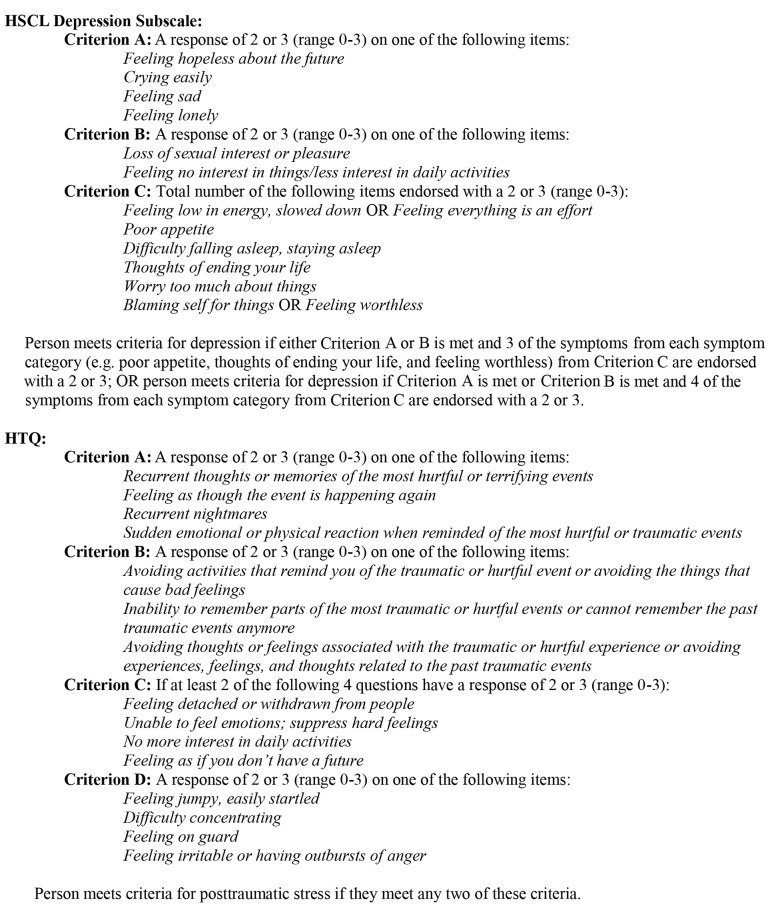
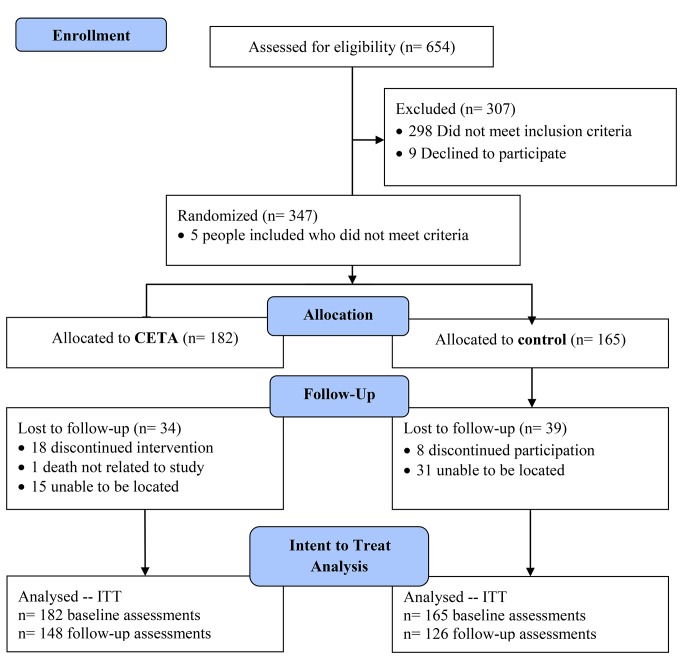
Verification
Claims the paper makes
The claims and statistics of this paper haven’t been checked yet.
Free: it reads the open-access text and checks the first 5 claims that cite a source we can check. Create a free account to check every claim.
Claims other papers make about this one
Each is checked against this paper’s own text: does it say what the citing paper says it does?
The cited source doesn’t support the claim as written.
In the citing paper
“Sample sizes ranged from 33 in Bolton 2014 to 1400 in Schaub 2021 (Median = 157.5, interquartile range (IQR) = 92.5 to 371).”
From Psychosocial and pharmacologic interventions to reduce harmful alcohol use in low- and middle-income countries (2023) · cites this paper as Bolton 2014
Checked by a reasoning model — may be wrong.
Experimental — accuracy not yet measuredThe cited source doesn’t support the claim as written.
In the citing paper
“Blinding of outcome assessment (detection bias) All outcomes High risk”
From Psychosocial and pharmacologic interventions to reduce harmful alcohol use in low- and middle-income countries (2023) · cites this paper as Bolton 2014
Checked by a reasoning model — may be wrong.
Experimental — accuracy not yet measuredThe source backs part of the claim, not all of it — or backs it for a different population, condition or comparison.
In the citing paper
“Incomplete outcome data (attrition bias) All outcomes High risk”
From Psychosocial and pharmacologic interventions to reduce harmful alcohol use in low- and middle-income countries (2023) · cites this paper as Bolton 2014
Experimental — accuracy not yet measuredThe cited source says what the claim attributes to it.
In the citing paper
“Of these, 2 were based in the workplace [26,38], 5 in the community [23,37,43,84], 6 in schools [33,40,65,85,86], and 7 in clinics [39,55–57], of which 1 was focused on women sex workers [95].”
From Patient-level interventions to reduce alcohol-related harms in low- and middle-income countries: A systematic review and meta-summary (2022) · cites this paper as [37]
The cited source says what the claim attributes to it.
In the citing paper
“Twelve included psychosocial treatment trials with 2106 participants reported on harmful alcohol use. All of these trials reported harmful alcohol use on a continuous scale (Bolton 2014; Jordans 2019; Kane 2022; Madhombiro 2019; Madhombiro 2020; Moraes 2010; Murray 2020; Nadkarni 2017; Nadkarni 2019; Omeje 2018; Schaub 2021; Witte 2011).”
From Psychosocial and pharmacologic interventions to reduce harmful alcohol use in low- and middle-income countries (2023) · cites this paper as Bolton 2014
11 more claims about this paper
Create a free account to see every claim other papers make about this one.
Self-check
Percentages, sums and reported differences re-computed from the paper’s own numbers.
The self-check needs the paper’s full text.
Citations
Cites
Statistical power analysis for the behavioral sciences
(1990) · Computers, Environment and Urban Systems · doi:10.1016/0198-9715(90)90050-4 · Cited by 65,269
Coefficient Alpha and the Internal Structure of Tests
Cronbach, L. J. (1951) · Psychometrika · doi:10.1007/bf02310555 · Cited by 43,931 · cited 1×
“Validation consisted of an exploratory factor analysis, an internal consistency measure (using Cronbach’s a) [30], and a combined test-retest/inter-rater reliability measure (using Pearson’s product moment correlation coefficient r) [31] for each scale used to measure outcomes.”
MethodMultiple Imputation for Nonresponse in Surveys
Rubin, D. B. (1987) · Wiley Series in Probability and Statistics · doi:10.1002/9780470316696 · Cited by 20,701
Specification Tests in Econometrics
Hausman, J. A. (1978) · Econometrica · doi:10.2307/1913827 · Cited by 18,820 · cited 1×
“To explore whether NGO affiliation should be treated as a random or fixed effect, a Hausman test [38] was utilized, with significance set at p,0.”
MethodSAUNDERS, J. B., AASLAND, O. G., BABOR, T. F., DE LA FUENTE, J. R., & GRANT, M. (1993) · Addiction · doi:10.1111/j.1360-0443.1993.tb02093.x · Cited by 13,597
Motivational interviewing: preparing people for change.
Miller, W. R., & Rollnick, S. (2002) · Guilford Press eBooks · Cited by 7,896
Multiple imputation by chained equations: what is it and how does it work?
Azur, M. J., Stuart, E. A., Frangakis, C., & Leaf, P. J. (2011) · International Journal of Methods in Psychiatric Research · doi:10.1002/mpr.329 · Cited by 3,542 · cited 1×
“Missing data, including follow-up scores for those lost to follow-up, were imputed using STATA’s chained equations command for multiple imputation, which pools data according to Rubin’s rules [35,36].”
MethodVII. Note on regression and inheritance in the case of two parents
Pearson, K. (1895) · Proceedings of the Royal Society of London · doi:10.1098/rspl.1895.0041 · Cited by 3,424
United Nations High Commissioner for Refugees (UNHCR)
(2014) · International Year Book and Statesmen's Who's Who · doi:10.1163/1570-6664_iyb_sim_org_40277 · Cited by 1,489
Fendall, N. R. E. (1978) · The Lancet · doi:10.1016/s0140-6736(78)92066-4 · Cited by 1,089
Research works printed but not linked: 2
- Lingam R (2003) An assessment of the mental health beliefs and needs of refugees from burma. In: Barnes D, editor. Asylum seekers and refugees in Australia: issues of mental health and wellbeing. Parramatta (Australia): Transcultural Mental Health Centre. pp. 148–162.
- Mollica RF, McDonald LS, Massagli MP, Silove DM (2004) Measuring trauma, measuring torture. Cambridge (Massachusetts): Harvard University Press.
Cited by
Items 301–319 of 319
Kantor, V., Weindl, D., Schieß-Jokanovic, J., Verginer, L., Lueger‐Schuster, B., & Knefel, M. (2024) · Figshare · doi:10.6084/m9.figshare.26635638
Kantor, V., Weindl, D., Schieß-Jokanovic, J., Verginer, L., Lueger‐Schuster, B., & Knefel, M. (2024) · Figshare · doi:10.6084/m9.figshare.26635641
Kantor, V., Weindl, D., Schieß-Jokanovic, J., Verginer, L., Lueger‐Schuster, B., & Knefel, M. (2024) · Figshare · doi:10.6084/m9.figshare.26635647
Ng, L. C., Serba, E. G., Dubale, B. W., Fekadu, A., & Hanlon, C. (2021) · Figshare · doi:10.6084/m9.figshare.15086113
Ryan, G. K., Bauer, A., Endale, T., Qureshi, O., Doukani, A., Pashoja, A. C., Brar, S. K., Eaton, J., & Bass, J. K. (2021) · Figshare · doi:10.6084/m9.figshare.14478524
Self-citationRyan, G. K., Bauer, A., Endale, T., Qureshi, O., Doukani, A., Pashoja, A. C., Brar, S. K., Eaton, J., & Bass, J. K. (2021) · Figshare · doi:10.6084/m9.figshare.14478533
Self-citationNelson, L., Lopez, L. M., Archuleta, S., Skavenski, S. V. W., Kushman, E., Martin, L., Mitchell, K., Leffler, E., Werwie, T. R., Kemp, C. G., et al. (2026) · BMC Public Health · doi:10.1186/s12889-026-26593-0
Self-citationVasileva, A. V., Караваева, Т. А., & Radionov, D. S. (2026) · V M BEKHTEREV REVIEW OF PSYCHIATRY AND MEDICAL PSYCHOLOGY · doi:10.31363/2313-7053-2026-1-1185
Carroll, H. A., Guevara, T., Gamarra, P., Mukunta, C., Dorsey, S., Gelaye, B., Henderson, D. C., Bird, M., & Freier, L. F. (2026) · medRxiv · doi:10.64898/2026.03.19.26348265
“The Common Elements Treatment Approach has been used with promising results in various global settings including with Bhurmese migrants in Thailand 23 and in Somalian refugee camps 24 .”
Self-citationPapola, D., Patania, F., Pedersen, G. A., Patel, A., Cristofalo, D., Purgato, M., Patel, V., & Barbui, C. (2026) · Journal of Behavioral and Cognitive Therapy · doi:10.1016/j.jbct.2026.100590 · Cited by 1
Drake, G., Greene, M. C., & Murdoch, A. (2026) · PLOS mental health. · doi:10.1371/journal.pmen.0000602
Carroll, H. A., Guevara, T., Gamarra, P., Mukunta, C., Dorsey, S., Gelaye, B., Henderson, D. C., Bird, M., & Freier, L. F. (2026) · PLoS ONE · doi:10.1371/journal.pone.0345837
“The Common Elements Treatment Approach has been used with promising results in various global settings including with Bhurmese migrants in Thailand [23] and in Somalian refugee camps [24].”
Self-citationDow, B. R., Simpson, S. B., McQuillin, S. D., Limberg, D., Hills, K. J., & Huebner, E. S. (2026) · Behavioral Sciences · doi:10.3390/bs16060835
“Evidence suggests that evidence-based ingredients can be task-shifted to paraprofessionals (e.g., peers, counselors, lay workers) with great success (Barbui et al., 2020; Bolton et al., 2014; Depping et al., 2021; Patel et al., 2017; Singla et al., 2021; Taha et al., 2026).”
Gustafson, E. L., Quezada, N., Blaisdell, K. N., Bobadilla, G., Stiles‐Shields, C., McCabe, K., Ignoffo, S., Kidambi, A., Staszko, G., Medina, B., et al. (2026) · Implementation Science Communications · doi:10.1186/s43058-026-00980-5
Self-citationImpact of Specialized Pediatric Palliative Care on Bereaved Parents’ Mental and Physical Health
Delgado‐Corcoran, C., Meeks, H., Wawrzynski, S. E., Markovitz, B. P., Harman, B., Masih, J. R., Li, K., Harousseau, M. E., Moore, D., Wilkes, J., et al. (2026) · Journal of Pain and Symptom Management · doi:10.1016/j.jpainsymman.2026.05.014 · Cited by 1
Fox, M. P., Kane, J. C., Mngadi-Ncube, S., Zheng, A., Metz, K. L., Manganye, P., Long, L. C., Greener, R., Sardana, S. M., Allen, T., et al. (2026) · Journal of the International AIDS Society · doi:10.1002/jia2.70172
“CETA has shown effectiveness at improving mental health and reducing IPV in clinical trials in Iraq [ 24 ], Thailand [ 25 ], Zambia [ 26, 27 ] and Colombia [ 28 ].”
Self-citationBere, T. C., Abas, M., Lund, C., & van der Westhuizen, C. (2026) · Psychology International · doi:10.3390/psycholint8030054
“In Thailand, the CETA intervention was adapted to local culture by incorporating Burmese folktales, personal stories, expressions, and proverbs to convey key concepts (Bolton et al., 2014).”
InfluentialMuis, A. M. R. A., Hajimin, M. N. H. H., & Paulus, A. A. (2026) · SN Social Sciences · doi:10.1007/s43545-026-01855-1
“For example, Bolton et al. ( 2014) 2010 ) on culturally specific expressions of distress among Cambodian refugees illustrate the scholarly attention to psychological and sociocultural dimensions of displacement.”
Piloting a stepped care model for treating women’s depression in Tajikistan
Weine, S. M., Pirova, G., Smith, C. P., Jonbekov, J., Langenecker, S. A., Kunguratov, K., Rajabzoda, S., Demirtaş, H., & Cook, J. Α. (2026) · International Journal of Mental Health · doi:10.1080/00207411.2026.2737882
Metadata
- Authors
- Bolton, P., Lee, C., Haroz, E. E., Murray, L., Dorsey, S., Robinson, C., Ugueto, A. M., & Bass, J.
- Affiliations
- Johns Hopkins University (US)
- University of Washington (US)
- Corresponding author
- Bolton, Paul
- ORCID
- Venue
- PLoS Medicine
- Publisher
- Public Library of Science (PLoS)
- Published
- 2014-11-11
- Volume
- 11
- Issue
- 11
- Pages
- e1001757
- ISSN
- 1549-1277 (ISSN-L)
- 1549-1676
- PMC
- PMC4227644
- OpenAlex
- W2039190068
- Semantic Scholar
- d40e364559c9e722d6b2fb013181427bab75893c
- Cited by
- 319
- References
- 40
- Citations by year
- 2026: 17 · 2025: 13 · 2024: 29 · 2023: 23 · 2022: 57 · 2021: 36 · 2020: 28 · 2019: 37 · 2018: 31 · 2017: 24 · 2016: 14 · 2015: 7 · 2014: 3
- FWCI
- 18.89
- Type
- journal article
- Language
- en
- Open access
- gold
- doi.org
- Locations
- PLoS Medicine (publishedVersion, cc-by)
- Europe PMC (PubMed Central) (publishedVersion, cc-by)
- PubMed Central (publishedVersion, cc-by)
- PubMed (publishedVersion)
- DOAJ (DOAJ: Directory of Open Access Journals) (submittedVersion, cc-by-sa)
- Figshare (submittedVersion, cc-by)
- Funders
- United States Agency for International Development
- University of Washington
- National Institute of Mental Health (T32MH014592)
- Topics
- Social Sciences › Psychology › Clinical Psychology › Migration, Health and Trauma
- Health Sciences › Medicine › Psychiatry and Mental health › Mental Health Treatment and Access
- Social Sciences › Psychology › Clinical Psychology › Posttraumatic Stress Disorder Research
- Keywords
- transdiagnostic psychotherapy, Common Elements Treatment Approach, comorbid mental disorders, trauma survivors, Burmese refugees, post-traumatic stress disorder, depression, resource-limited settings, torture survivors, functional disability, alcohol consumption, aggression, anxiety, treatment flexibility, refugee mental health services
- MeSH terms
- Adolescent, Adult, Aged, Aged, 80 and over, Aggression, Alcoholism, Anxiety, Myanmar, Depression, Depressive Disorder, Humans, Male, Mental Health, Middle Aged, Prisons, Psychotherapy, Refugees, Stress Disorders, Post-Traumatic, Stress, Psychological, Thailand, Torture, Single-Blind Method, Young Adult, Intention to Treat Analysis
About these checks
Registry, retraction, Cites and statistics results are computed, not judged, with one exception: a printed reference that no index lists is read once by a model before it counts as a citation error. Claims are extracted by a model and kept only when their quote appears verbatim in the text; each cited source is then checked, with a model’s help, for whether it says what the claim relies on. Those verdicts can be wrong — read the claim’s quote and the cited source before relying on one.
Statistics and arithmetic are recomputed, not judged.
Confidence bands are shown only for fields calibrated on our annotated test set. None is calibrated yet, so no band is shown.
What counts as a claim ›How we measure confidence ›How we check this ›
Are you an author, or do you see a problem with this page? Request a review
Data sources
Bibliographic data: Semantic Scholar, OpenAlex, Crossref.
Contains information from the Semantic Scholar Academic Graph Datasets, made available under the ODC Attribution License (ODC-BY 1.0).
Semantic Scholar’s data is described in: Kinney, R., et al. (2023). The Semantic Scholar Open Data Platform. arXiv:2301.10140.
