

The DOI matches its Crossref record; 62 of the 62 references it cites were found in a registry or an index.
Vitamin D and Risk of Multiple Sclerosis: A Mendelian Randomization Study
Open accessAbstract
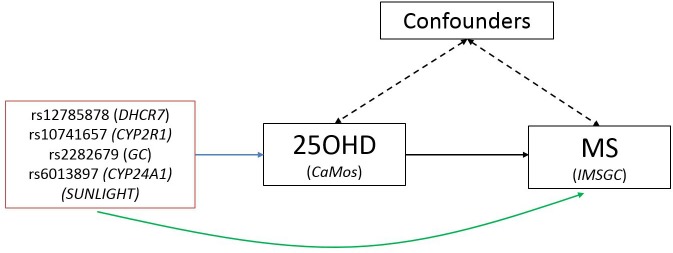
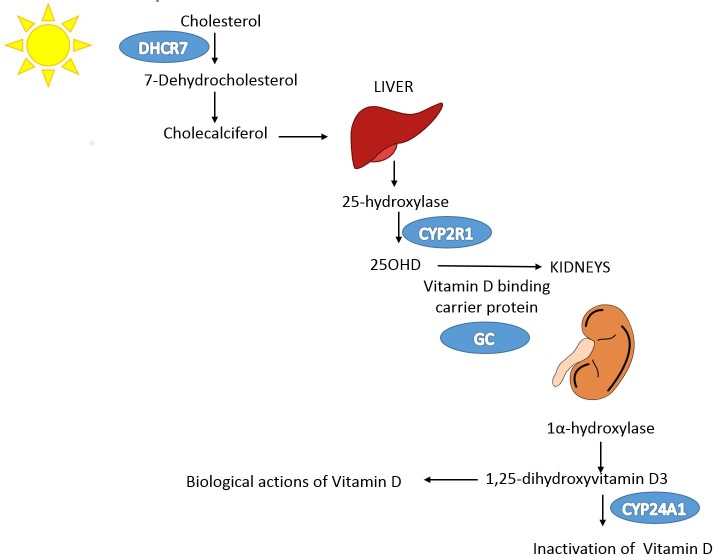
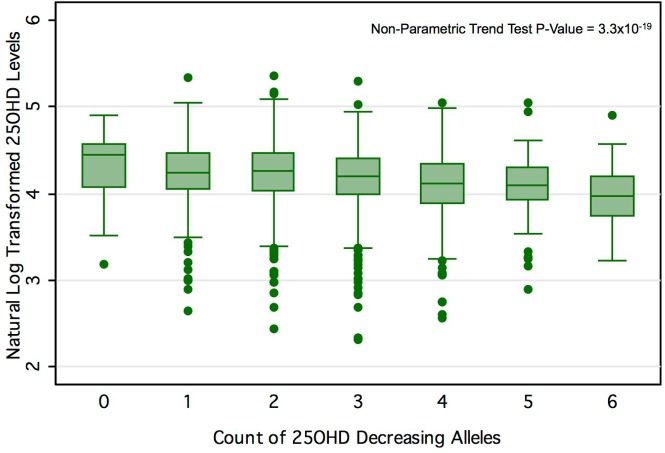
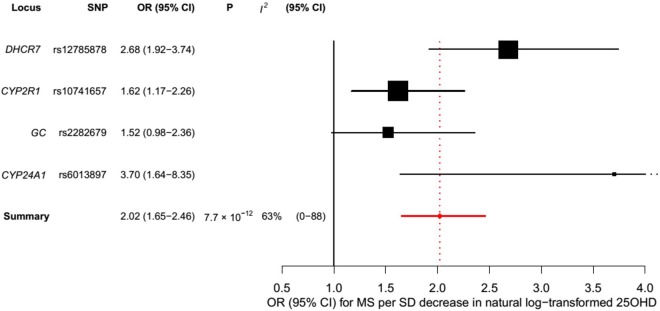
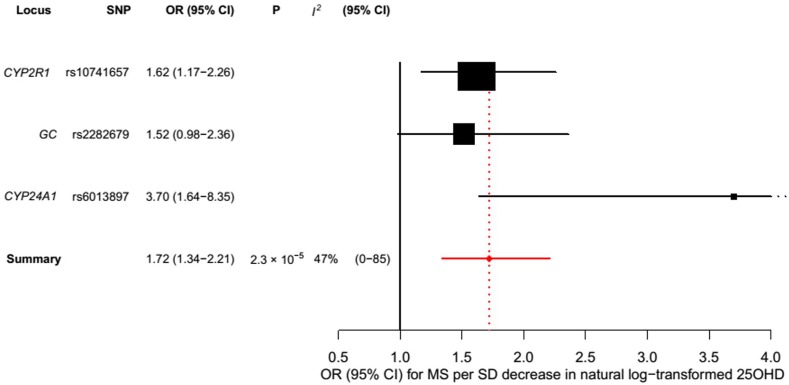
BACKGROUND: Observational studies have demonstrated an association between decreased vitamin D level and risk of multiple sclerosis (MS); however, it remains unclear whether this relationship is causal. We undertook a Mendelian randomization (MR) study to evaluate whether genetically lowered vitamin D level influences the risk of MS. METHODS AND FINDINGS: We identified single nucleotide polymorphisms (SNPs) associated with 25-hydroxyvitamin D (25OHD) level from SUNLIGHT, the largest (n = 33,996) genome-wide association study to date for vitamin D. Four SNPs were genome-wide significant for 25OHD level (p-values ranging from 6 × 10⁻¹⁰ to 2 × 10-109), and all four SNPs lay in, or near, genes strongly implicated in separate mechanisms influencing 25OHD. We then ascertained their effect on 25OHD level in 2,347 participants from a population-based cohort, the Canadian Multicentre Osteoporosis Study, and tested the extent to which the 25OHD-decreasing alleles explained variation in 25OHD level. We found that the count of 25OHD-decreasing alleles across these four SNPs was strongly associated with lower 25OHD level (n = 2,347, F-test statistic = 49.7, p = 2.4 × 10⁻¹²). Next, we conducted an MR study to describe the effect of genetically lowered 25OHD on the odds of MS in the International Multiple Sclerosis Genetics Consortium study, the largest genetic association study to date for MS (including up to 14,498 cases and 24,091 healthy controls). Alleles were weighted by their relative effect on 25OHD level, and sensitivity analyses were performed to test MR assumptions. MR analyses found that each genetically determined one-standard-deviation decrease in log-transformed 25OHD level conferred a 2.0-fold increase in the odds of MS (95% CI: 1.7-2.5; p = 7.7 × 10⁻¹²; I2 = 63%, 95% CI: 0%-88%). This result persisted in sensitivity analyses excluding SNPs possibly influenced by population stratification or pleiotropy (odds ratio [OR] = 1.7, 95% CI: 1.3-2.2; p = 2.3 × 10⁻⁵; I2 = 47%, 95% CI: 0%-85%) and including only SNPs involved in 25OHD synthesis or metabolism (ORsynthesis = 2.1, 95% CI: 1.6-2.6, p = 1 × 10⁻⁹; ORmetabolism = 1.9, 95% CI: 1.3-2.7, p = 0.002). While these sensitivity analyses decreased the possibility that pleiotropy may have biased the results, residual pleiotropy is difficult to exclude entirely. CONCLUSIONS: A genetically lowered 25OHD level is strongly associated with increased susceptibility to MS. Whether vitamin D sufficiency can delay, or prevent, MS onset merits further investigation in long-term randomized controlled trials.
Overview
The claims and statistics of this paper haven’t been checked yet.
Run the check — free, no account needed. It reads the open-access text and checks the sources it cites.
Integrity signals
Registry
Cites
Statistics
Figures
Verification
Claims the paper makes
The claims and statistics of this paper haven’t been checked yet.
Run the check — free, no account needed. It reads the open-access text and checks the sources it cites.
Claims other papers make about this one
Each is checked against this paper’s own text: does it say what the citing paper says it does?
In the citing paper
“These findings suggest an important role of vitamin D in autoantibody production and ASD pathogenesis, perhaps similar to other autoimmune diseases, such as MS and systemic lupus erythematosus [172,174].”
From Vitamin D and Autism Spectrum Disorder: A Literature Review (2016) · cites this paper as [174]
In the citing paper
“For the special case of a one-sample analysis with a binary disease outcome, if the genetic associations with the exposure are estimated in the controls only, then genetic associations with the exposure and outcome will not be correlated, and bias will follow the pattern of the two-sample setting 42 .”
From Guidelines for performing Mendelian randomization investigations (2020) · cites this paper as [42]
In the citing paper
“In this case, the direction and size of the bias varies linearly depending on the degree of overlap (formally, depending on the degree of correlation between the genetic association estimates).”
From Guidelines for performing Mendelian randomization investigations (2020) · cites this paper as [42]
In the citing paper
“However, as several large consortia have overlapping studies, participants may overlap between the datasets used to estimate the genetic associations with the exposure and outcome 42 .”
From Guidelines for performing Mendelian randomization investigations (2020) · cites this paper as [42]
Self-check
Percentages, sums and reported differences re-computed from the paper’s own numbers.
The self-check needs the paper’s full text.
Citations
Cites
Measuring inconsistency in meta-analyses
Higgins, J. P. T., Thompson, S. G., Deeks, J. J., & Altman, D. G. (2003) · BMJ · doi:10.1136/bmj.327.7414.557 · Cited by 63,139
Quantifying heterogeneity in a meta‐analysis
Higgins, J. P. T., & Thompson, S. G. (2002) · Statistics in Medicine · doi:10.1002/sim.1186 · Cited by 36,763
Diagnostic criteria for multiple sclerosis: 2010 revisions to the McDonald criteria
Polman, C. H., Reingold, S. C., Banwell, B., Clanet, M., Cohen, J. A., Filippi, M., Fujihara, K., Havrdova, E., Hutchinson, M., Kappos, L., et al. (2011) · Annals of Neurology · doi:10.1002/ana.22366 · Cited by 9,802
An integrated map of genetic variation from 1,092 human genomes
The 1000 Genomes Project Consortium (2012) · Nature · doi:10.1038/nature11632 · Cited by 7,711
New diagnostic criteria for multiple sclerosis: Guidelines for research protocols
Poser, C. M., Paty, D. W., Scheinberg, L., McDonald, W. I., Davis, F. A., Ebers, G. C., Johnson, K. P., Sibley, W. A., Silberberg, D. H., & Tourtellotte, W. W. (1983) · Annals of Neurology · doi:10.1002/ana.410130302 · Cited by 7,384
McDonald, W. I., Compston, A., Edan, G., Goodkin, D., Hartung, H., Lublin, F. D., McFarland, H. F., Paty, D. W., Polman, C. H., Reingold, S. C., et al. (2001) · Annals of Neurology · doi:10.1002/ana.1032 · Cited by 6,969
Mendelian Randomization Analysis With Multiple Genetic Variants Using Summarized Data
Burgess, S., Butterworth, A., & Thompson, S. G. (2013) · Genetic Epidemiology · doi:10.1002/gepi.21758 · Cited by 6,050
Davey Smith, G., & Ebrahim, S. (2003) · International Journal of Epidemiology · doi:10.1093/ije/dyg070 · Cited by 5,882
Diagnostic criteria for multiple sclerosis: 2005 revisions to the “McDonald Criteria”
Polman, C. H., Reingold, S. C., Edan, G., Filippi, M., Hartung, H., Kappos, L., Lublin, F. D., Metz, L. M., McFarland, H. F., O'Connor, P. W., et al. (2005) · Annals of Neurology · doi:10.1002/ana.20703 · Cited by 5,017
Mendelian randomization: genetic anchors for causal inference in epidemiological studies
Davey Smith, G., & Hemani, G. (2014) · Human Molecular Genetics · doi:10.1093/hmg/ddu328 · Cited by 4,677
Self-citation
Cited by
Sorted by citations
Items 401–445 of 445
Treatment of multiple sclerosis from the pharmacist´s perspective
Turjap, M., & Nedopílková, O. (2021) · Praktické lékárenství · doi:10.36290/lek.2021.040
Sejarah kebudayaan India Kuno / Anwar Sari
Sari, A. (1994)
Neural efficiency of a specific cognitive training in working memory in multiple sclerosis patients
Vidal, N. A. (2021) · Tesis Doctorals en Xarxa (Consorci de Serveis Universitaris de Catalunya) · doi:10.6035/14109.2021.447259
Mendelian Randomization Study on the Effect of Tumour Necrosis Factor on SchizophreniaPreprint
Wei, Z., & Wang, R. (2021) · SSRN Electronic Journal · doi:10.2139/ssrn.3989863
The Role of Host Genetics (and Genomics) in Tuberculosis
Naranbhai, V. (2017) · ASM Press eBooks · doi:10.1128/9781555819569.ch19
Ullrich, S. E. (2016) · Elsevier eBooks · doi:10.1016/b978-0-12-801238-3.64116-8
(2017) · CRC Press eBooks · doi:10.1201/9781315268828-6
Su, J., Xu, K., Wu, C., Li, Z., Hu, Z., Zheng, X., Song, S., Tang, W., Tang, Z., & Li, L. (2020) · doi:10.21203/rs.3.rs-28492/v1
Ning, P., Guo, X., Qu, Q., & Li, R. (2023) · SSRN Electronic Journal · doi:10.2139/ssrn.4349724
Are Vitamin D Supplements an Adequate Substitute for Sun Exposure?
Hoel, D. G., & Miller, A. (2023) · Medical Research Archives · doi:10.18103/mra.v11i3.3635
Salcedo-Hurtado, J. G., Alvarez-Osorio, S. M., Nossa-Martínez, D. P., & Vergara-Jiménez, C. C. (2023) · Revista de Nutrición Clínica y Metabolismo · doi:10.35454/rncm.v6n3.522
Methods of evaluating population studies of vitamin D: strengths and weaknesses
Giovannucci, E. L. (2023) · Elsevier eBooks · doi:10.1016/b978-0-323-91338-6.00003-3
Vitamin D metabolism and disorders in companion animals
Mellanby, R. J. (2023) · Elsevier eBooks · doi:10.1016/b978-0-323-91338-6.00033-1
Vitamin D mechanisms of protection in multiple sclerosis
Hayes, C. E., Astier, A., & Lincoln, M. R. (2023) · Elsevier eBooks · doi:10.1016/b978-0-323-91338-6.00051-3
Genetic determinants of 25-hydroxyvitamin D concentrations
Hyppönen, E., Zhou, A., & Vimaleswaran, K. S. (2023) · Elsevier eBooks · doi:10.1016/b978-0-323-91338-6.00010-0
Understanding vitamin D from mouse knockout models
Goltzman, D., Karapalis, A. C., Kremer, R. B., & Miao, D. (2023) · Elsevier eBooks · doi:10.1016/b978-0-323-91386-7.00010-6
Vitamin D as a modifier of genomic function and phenotypic expression during pregnancy
Wagner, C. L., & Hollis, B. W. (2023) · Elsevier eBooks · doi:10.1016/b978-0-323-91386-7.00045-3
Seasonality and clinical characteristics of MS in an equatorial country
Cárdenas‐Robledo, S., Arenas-Vargas, L. E., Carvajal-Parra, M. S., Guío‐Sánchez, C., & López-Reyes, L. (2023) · Multiple Sclerosis and Related Disorders · doi:10.1016/j.msard.2023.105352
Ma, J., Zong, K., Wang, Y., Wu, C., Liu, H., Lin, R., Li, R., Zou, C., Zuo, Q., Xu, Y., et al. (2024) · Research Square · doi:10.21203/rs.3.rs-3965535/v1
Vitamin D and Immune Function: Unraveling the Connections
Louis, L. R. P., Kannan, S., Shanmugham, D., Balakrishnan, J., & Nagarajan, P. (2024) · Advances in biochemistry in health and disease · doi:10.1007/978-3-031-55489-6_16
25 Hydroxyvitamin D and Cytokine Profile in Patients With Relapsing-Remitting Multiple Sclerosis
Slavov, G. S., Manova, M. G., & Kostadinova, I. I. (2024) · Cureus · doi:10.7759/cureus.61534
Observation of vitamin D levels in newly diagnosed multiple sclerosis patients: A case series
Huynh, T. N. Y., Nguyen, X. D., Nguyen, N. L., & Hoàng, T. T. N. (2024) · Tạp chí thần kinh học Việt Nam · doi:10.62511/vjn.42.2024.031
Abudusalamu, R., Maimaiti, A., Tuersun, M., fang, S., Hao, C., Han, D., & Ma, J. (2024) · Research Square · doi:10.21203/rs.3.rs-4850074/v1
Vitamin D Levels and Clinical Outcomes in Saudi Multiple Sclerosis Patients: A Cross-Sectional Study
Babukur, R., Sayer, N. A. A., Alrudaini, S. H., Badi, A. A., Alotaibi, W., Azmi, N. S. A., Alkathem, J. A., Alawad, F. H., & Alhodibi, M. (2024) · Journal of Advanced Trends in Medical Research · doi:10.4103/atmr.atmr_101_24
Islam, A., Bhat, K. A., Ahmad, F., Islam, Z., Syed, J., John, A., Allie, K. A., Shah, A. A., Ayaz, A., & Kaur, A. (2025) · Elsevier eBooks · doi:10.1016/b978-0-443-18776-6.00005-0
Allele-specific vitamin D receptor binding is associated with pediatric-onset multiple sclerosis
Yilmaz, D., Adams, C., Horton, M. K., Graves, J. S., Francisco, C., Rutatangwa, A., Quach, H., Quach, D. L., Aaen, G. S., Lotze, T. E., et al. (2025) · Multiple Sclerosis Journal - Experimental Translational and Clinical · doi:10.1177/20552173251335625
Moon craters in the brain: the striking lesions of Baló’s concentric sclerosis in a young adult
Halfi, I. M., Touarsa, F., Fikri, M., & Jiddane, M. (2025) · The Egyptian Journal of Radiology and Nuclear Medicine · doi:10.1186/s43055-025-01546-6
Bandi, J., Prakash, D. V. S., Nelapati, A. K., Dulla, J. B., & Venkateswarulu, T. C. (2025) · Springer eBooks · doi:10.1007/978-981-95-0520-3_4
Deng, A., Womack, J., & Espiridion, E. D. (2025) · The Open Rheumatology Journal · doi:10.2174/0118743129413429250925105156
Vitamin D and the immune system
Zulkipli, I. N., & Ahmad, L. (2025) · Elsevier eBooks · doi:10.1016/b978-0-443-34037-6.00033-9
From Skin to Lungs: The Causal Pathways Linking Skin Microbiota and Asthma
Chen, J. S., Zhang, Z., Jiang, N., Yu, Q., Li, F., & Zhou, D. (2025) · Dermatologic Therapy · doi:10.1155/dth/7880209
Facteurs génétiques et post-génétiques associés au développement de la sclérose en plaques
Axisa, P. (2017) · theses.fr (ABES) · doi:10.70675/bd87267ez6461z4759z8173z6f34bba4e52f
Integrating Genetics and Environment to Find Causal Mechanisms for Multiple Sclerosis
Leon, A. M., & Lincoln, M. R. (2026) · European Journal of Immunology · doi:10.1002/eji.70206
Decreased Serum Vitamin D Is Not Associated With Sjögren Disease in European and Asian Subjects
Yilmaz, D. S., Taylor, K. E., Criswell, L. A., Shiboski, C. H., & Barcellos, L. F. (2026) · ACR Open Rheumatology · doi:10.1002/acr2.90055
Caminero, A. B., Ginés, M. L. M., Gómez-Gutiérrez, M., & García-Castañón, I. (2026) · Frontiers in Neurology · doi:10.3389/fneur.2026.1812340
Epigenetic and genetic insights for tailored therapeutic strategies in multiple sclerosis
Mariki, A., Mousavi, S. M., Kohlmeier, K. A., Kamali, H., & Shabani, M. (2026) · Personalized Medicine · doi:10.1080/17410541.2026.2678216
Neonatal vitamin D levels and autoimmune disorders: a Danish population-based cohort study
Horsdal, H. T., Heitmann, B. L., Boelt, S. G., Agerbo, E., Werge, T. M., Borbye‐Lorenzen, N., Pedersen, C. B., McGrath, J. J., & Liu, X. (2026) · European Journal of Epidemiology · doi:10.1007/s10654-026-01436-9
Decoding anxiety: Plasma lipids and proteins as causal agents
He, J., Zhang, Z., Wang, Y., Chen, S., Liu, Q., Ru, K., Lv, X., Song, Y., & Li, F. (2026) · Behavioural Brain Research · doi:10.1016/j.bbr.2026.116402
Yatawara¹, T. P. B., & Wickramarachchi¹, D. S. (2026) · Research Square · doi:10.21203/rs.3.rs-10662661/v1
Falk, S., Schulte‐Mecklenbeck, A., Ostkamp, P., Wirth, T., Schneider‐Hohendorf, T., Deffner, M., Krämer, J., Korsukewitz, C., Klotz, L., Groß, C. C., et al. (2026) · Neurology Neuroimmunology & Neuroinflammation · doi:10.1212/nxi.0000000000200636
Żabicka, J., Lichtarska, K., Gutowski, M., Orzechowski, C., Filitaryna, S., Kałwak, M., Marciniak, M., Foryś, A., Wiatr, M., Wojas, W., et al. (2026) · International Journal of Innovative Technologies in Social Science · doi:10.31435/ijitss.3(51).2026.6487
Vitamin D signaling in thymic development and longevity
Artusa, P., & White, J. H. (2026) · Frontiers in Nutrition · doi:10.3389/fnut.2026.1961627
Shosha, E., & Qadi, N. (2026) · Frontiers in Immunology · doi:10.3389/fimmu.2026.1941832
Metadata
- Authors
- Mokry, L. E., Ross, S., Ahmad, O. S., Forgetta, V., Smith, G. D., Leong, A., Greenwood, C. M. T., Thanassoulis, G., & Richards, J. B.
- Affiliations
- Jewish General Hospital (CA)
- University of Bristol (GB)
- Harvard University (US)
- McGill University Health Centre (CA)
- King's College London (GB)
- Corresponding author
- Richards, J. Brent
- ORCID
- Venue
- PLOS Medicine
- Publisher
- Public Library of Science (PLoS)
- Published
- 2015-08-25
- Volume
- 12
- Issue
- 8
- Pages
- e1001866
- ISSN
- 1549-1277 (ISSN-L)
- 1549-1676
- PMC
- PMC4549308
- OpenAlex
- W2152795085
- Cited by
- 445
- References
- 61
- Citations by year
- 2026: 15 · 2025: 21 · 2024: 29 · 2023: 48 · 2022: 54 · 2021: 35 · 2020: 45 · 2019: 43 · 2018: 57 · 2017: 49 · 2016: 42 · 2015: 5
- FWCI
- 40.47
- Type
- journal article
- Language
- en
- Update notices
- correction (2016-03-02)
- Open access
- gold
- doi.org
- Licence
- Locations
- PLoS Medicine (publishedVersion, cc-by)
- Europe PMC (PubMed Central) (publishedVersion, cc-by)
- PubMed Central (publishedVersion, cc-by)
- PubMed (publishedVersion)
- Explore Bristol Research (publishedVersion, cc-by)
- Digital Access to Scholarship at Harvard (DASH) (Harvard University) (submittedVersion, cc-by)
- RePEc: Research Papers in Economics (submittedVersion)
- eScholarship@McGill (McGill) (submittedVersion)
- DOAJ (DOAJ: Directory of Open Access Journals) (submittedVersion, cc-by-sa)
- Figshare (submittedVersion, cc-by)
- Bristol Research (University of Bristol) (submittedVersion, cc-by)
- Spiral (Imperial College London) (submittedVersion, cc-by)
- Funders
- Heart and Stroke Foundation of Canada
- Canadian Diabetes Association
- Jewish General Hospital
- Servier
- Canadian Institutes of Health Research (119462_1)
- Topics
- Health Sciences › Medicine › Clinical Neurology › Multiple Sclerosis Research Studies
- Health Sciences › Medicine › Endocrinology, Diabetes and Metabolism › Vitamin D Research Studies
- Life Sciences › Biochemistry, Genetics and Molecular Biology › Genetics › Genetic Associations and Epidemiology
- Keywords
- multiple sclerosis, vitamin D, 25-hydroxyvitamin D, causal relationship, sun exposure, single nucleotide polymorphisms, pleiotropy, population stratification, vitamin D supplementation, disease risk factors
- MeSH terms
- Europe, Humans, Multiple Sclerosis, Risk Factors, Vitamin D Deficiency, Linkage Disequilibrium, Risk Assessment, Polymorphism, Single Nucleotide, Genome-Wide Association Study, Mendelian Randomization Analysis
About these checks
Registry, retraction, Cites and statistics results are computed, not judged, with one exception: a printed reference that no index lists is read once by a model before it counts as a citation error. Claims are extracted by a model and kept only when their quote appears verbatim in the text; each cited source is then checked, with a model’s help, for whether it says what the claim relies on. Those verdicts can be wrong — read the claim’s quote and the cited source before relying on one.
Statistics and arithmetic are recomputed, not judged.
Confidence bands are shown only for fields calibrated on our annotated test set. None is calibrated yet, so no band is shown.
What counts as a claim ›How we measure confidence ›How we check this ›
Are you an author, or do you see a problem with this page? Request a review
