

Daytime Naps, Motor Memory Consolidation and Regionally Specific Sleep Spindles
Open accessThe DOI matches its Crossref record; 34 of the 34 references it cites were found in a registry or an index.
Abstract
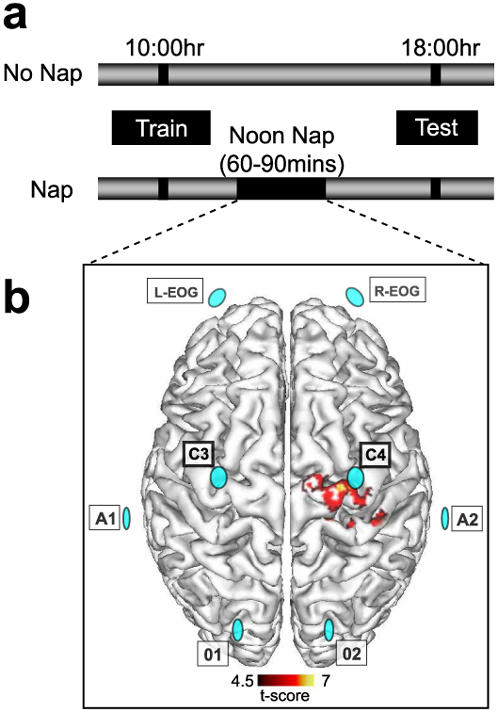
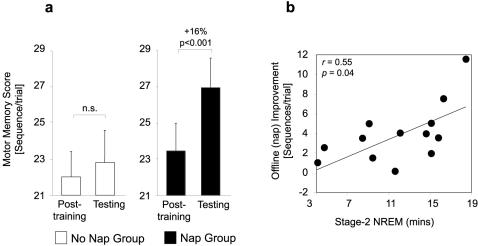
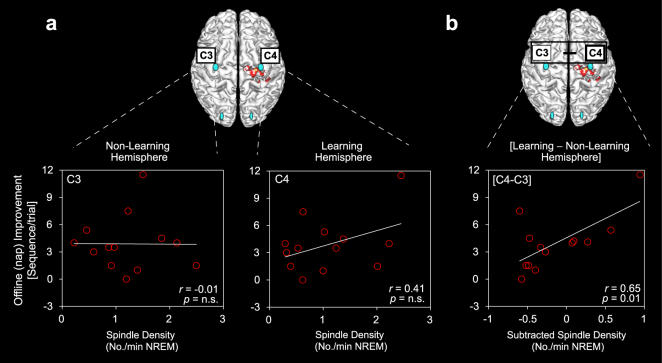
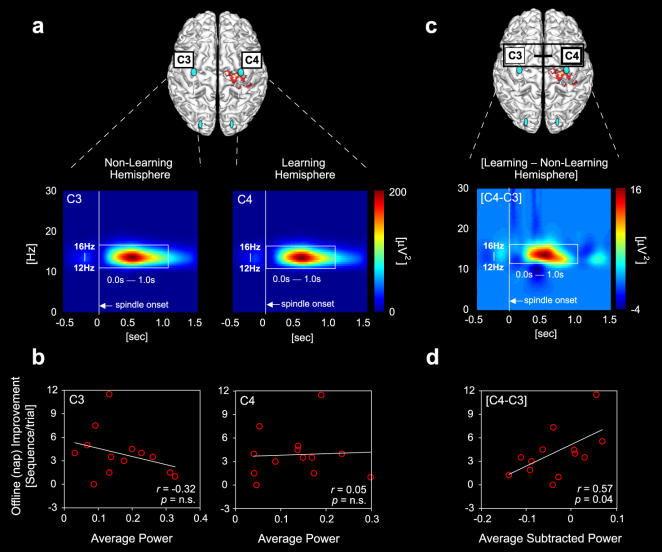
BACKGROUND: Increasing evidence demonstrates that motor-skill memories improve across a night of sleep, and that non-rapid eye movement (NREM) sleep commonly plays a role in orchestrating these consolidation enhancements. Here we show the benefit of a daytime nap on motor memory consolidation and its relationship not simply with global sleep-stage measures, but unique characteristics of sleep spindles at regionally specific locations; mapping to the corresponding memory representation. METHODOLOGY/PRINCIPAL FINDINGS: Two groups of subjects trained on a motor-skill task using their left hand - a paradigm known to result in overnight plastic changes in the contralateral, right motor cortex. Both groups trained in the morning and were tested 8 hr later, with one group obtaining a 60-90 minute intervening midday nap, while the other group remained awake. At testing, subjects that did not nap showed no significant performance improvement, yet those that did nap expressed a highly significant consolidation enhancement. Within the nap group, the amount of offline improvement showed a significant correlation with the global measure of stage-2 NREM sleep. However, topographical sleep spindle analysis revealed more precise correlations. Specifically, when spindle activity at the central electrode of the non-learning hemisphere (left) was subtracted from that in the learning hemisphere (right), representing the homeostatic difference following learning, strong positive relationships with offline memory improvement emerged-correlations that were not evident for either hemisphere alone. CONCLUSIONS/SIGNIFICANCE: These results demonstrate that motor memories are dynamically facilitated across daytime naps, enhancements that are uniquely associated with electrophysiological events expressed at local, anatomically discrete locations of the brain.
Overview
The claims and statistics of this paper haven’t been checked yet.
Free: it reads the open-access text and checks the first 5 claims that cite a source we can check. Create a free account to check every claim.
Integrity signals
Registry
Cites
Statistics
Figures
Verification
Claims the paper makes
The claims and statistics of this paper haven’t been checked yet.
Free: it reads the open-access text and checks the first 5 claims that cite a source we can check. Create a free account to check every claim.
Claims other papers make about this one
Each is checked against this paper’s own text: does it say what the citing paper says it does?
The source backs part of the claim, not all of it — or backs it for a different population, condition or comparison.
In the citing paper
“Spindle activity is increased over cortical regions involved in prior learning and, moreover, positively correlates with post sleep retrieval performance 180,181 and appears to accompany memory reactivations during sleep.108,114”
From Sleep—A brain-state serving systems memory consolidation (2023) · cites this paper as [181]
Experimental — accuracy not yet measuredIn the citing paper
“Sleep-dependent processing of procedural memories has frequently been linked to spindle activity.12,37,38,39”
From Random auditory stimulation during sleep disturbs traveling slow waves and declarative memory (2026) · cites this paper as [38]
Self-check
Percentages, sums and reported differences re-computed from the paper’s own numbers.
The self-check needs the paper’s full text.
Citations
Cites
Rechtschaffen, A. (1968) · Medical Entomology and Zoology · Cited by 12,675
Sleep function and synaptic homeostasis
Tononi, G., & Cirelli, C. (2006) · Sleep Medicine Reviews · doi:10.1016/j.smrv.2005.05.002 · Cited by 2,151 · cited 1×
“Pioneering work by Tononi and colleagues has demonstrated that overnight memory enhancements are regulated by homeostatic, regionally specific changes in sleep physiology [23].”
BackgroundHuber, R., Felice Ghilardi, M., Massimini, M., & Tononi, G. (2004) · Nature · doi:10.1038/nature02663 · Cited by 1,854 · cited 1×
“For example, following training on a motor reaching task, a corresponding increase in subsequent NREM slow-wave activity (SWA) was observed in parietal regions known to represent such memories, with the amount of SWA increase being proportional both to the extent of initial daytime learning and the degree of next-day…”
BackgroundPractice with Sleep Makes Perfect
Walker, M. P., Brakefield, T., Morgan, A., Hobson, J. A., & Stickgold, R. (2002) · Neuron · doi:10.1016/s0896-6273(02)00746-8 · Cited by 1,307 · cited 6×
“For example, it has been shown that offline motor-memory enhancements specifically develop across a night of sleep, with the extent of improvement demonstrating a positive relationship with the amount of stage-2 NREM sleep, especially in the last quarter of the night [4].”
BackgroundMethodResultSelf-citationWalker, M. P., & Stickgold, R. (2006) · Annual Review of Psychology · doi:10.1146/annurev.psych.56.091103.070307 · Cited by 1,075 · cited 1×
“Evidence of sleep-dependent consolidation now exists across numerous memory domains, including procedural as well as declarative memory [3].”
BackgroundSelf-citationDissociable stages of human memory consolidation and reconsolidation
Walker, M. P., Brakefield, T., Allan Hobson, J., & Stickgold, R. (2003) · Nature · doi:10.1038/nature01930 · Cited by 1,025 · cited 1×
“Moreover, the magnitude of enhancement we observed across the nap period was similar to the amount of improvement normally expressed following an entire night of sleep [4,14,17,18,28].”
ResultSelf-citationSLEEP COMPUTING COMMITTEE OF THE JAPANESE SOCIETY OF SLEEP RESEARCH SOCIETY (JSSR):, Hori, T., Sugita, Y., Koga, E., Shirakawa, S., Inoue, K., Uchida, S., Kuwahara, H., Kousaka, M., Kobayashi, T., et al. (2001) · Psychiatry and Clinical Neurosciences · doi:10.1046/j.1440-1819.2001.00810.x · Cited by 807
Wolpert, E. A. (1969) · Archives of General Psychiatry · doi:10.1001/archpsyc.1969.01740140118016 · Cited by 797
Sleep forms memory for finger skills
Fischer, S., Hallschmid, M., Elsner, A. L., & Born, J. (2002) · Proceedings of the National Academy of Sciences · doi:10.1073/pnas.182178199 · Cited by 589 · cited 1×
“Regarding procedural motor memory, several studies have demonstrated that the extent of initial learning, and the subsequent offline enhancement, commonly correlate with non-rapid eye movement (NREM) sleep, and neurophysiological characteristics of NREM [4–8], although see [9].”
BackgroundArm immobilization causes cortical plastic changes and locally decreases sleep slow wave activity
Huber, R., Ghilardi, M. F., Massimini, M., Ferrarelli, F., Riedner, B. A., Peterson, M. J., & Tononi, G. (2006) · Nature Neuroscience · doi:10.1038/nn1758 · Cited by 579 · cited 2×
“Conversely, motor limb inactivation through arm immobilization results in a corresponding decrease of SWA in localized sensori-motor regions [24].”
Background
Cited by
Diekelmann, S., & Born, J. (2010) · Nature Reviews Neuroscience · doi:10.1038/nrn2762 · Cited by 3,760
“Significant sleep benefits on memory are observed after an 8-hour night of sleep, but also after shorter naps of 1–2 hour”
BackgroundRasch, B., & Born, J. (2013) · Physiological Reviews · doi:10.1152/physrev.00032.2012 · Cited by 2,783
The Role of Sleep in Cognition and Emotion
Walker, M. P. (2009) · Annals of the New York Academy of Sciences · doi:10.1111/j.1749-6632.2009.04416.x · Cited by 993
“This increase in spindle activity may represent a local, endogenous trigger of intrinsic synaptic plasticity, again corresponding topographically to the underlying memory representation (Nishida & Walker 2007).”
BackgroundSelf-citationRegional Slow Waves and Spindles in Human Sleep
Nir, Y., Staba, R. J., Andrillon, T., Vyazovskiy, V. V., Cirelli, C., Fried, I., & Tononi, G. (2011) · Neuron · doi:10.1016/j.neuron.2011.02.043 · Cited by 924
“…choice was guided by the fact that projections to the amygdala in primates aremostly ipsilateral and arrive from diverse sources, with a notable contribution from other limbic structures such as entorhinal cortex, cingulate cortex, and hippocampus, as well as medial prefrontal and orbitofrontal…”
Sleep spindles: mechanisms and functions
Fernandez, L. M. J., & Lüthi, A. (2020) · Physiological Reviews · doi:10.1152/physrev.00042.2018 · Cited by 716
Metadata
- Authors
- Nishida, M., & Walker, M. P.
- Affiliations
- Beth Israel Deaconess Medical Center (US)
- Corresponding author
- Walker, Matthew P.
- Venue
- PLoS ONE
- Publisher
- Public Library of Science (PLoS)
- Published
- 2007-04-04
- Volume
- 2
- Issue
- 4
- Pages
- e341
- ISSN
- 1932-6203 (ISSN-L)
- PMC
- PMC1828623
- OpenAlex
- W2170139952
- Semantic Scholar
- 909cef44360ea7ed730d42f30f1cb5ab66b9cf02
- Cited by
- 531
- References
- 34
- Citations by year
- 2026: 13 · 2025: 17 · 2024: 35 · 2023: 20 · 2022: 26 · 2021: 23 · 2020: 29 · 2019: 34 · 2018: 19 · 2017: 37 · 2016: 37 · 2015: 29 · 2014: 39 · 2013: 45 · 2012: 33
- FWCI
- 10.85
- Type
- journal article
- Language
- en
- Open access
- gold
- doi.org
- Locations
- PLoS ONE (publishedVersion, cc-by)
- Europe PMC (PubMed Central) (publishedVersion, other-oa)
- PubMed Central (publishedVersion, cc-by)
- PubMed (publishedVersion)
- DOAJ (DOAJ: Directory of Open Access Journals) (submittedVersion, cc-by-sa)
- Funders
- National Institutes of Health (MH48,832, MH06,9935)
- National Institute of Mental Health (R21MH067754, R01MH065292, MH-48832, R03MH069935, MH069935, R01MH048832, MH 65292, MH67754)
- Topics
- Life Sciences › Neuroscience › Cognitive Neuroscience › Sleep and Wakefulness Research
- Life Sciences › Neuroscience › Cognitive Neuroscience › Memory and Neural Mechanisms
- Life Sciences › Neuroscience › Cognitive Neuroscience › Motor Control and Adaptation
- Keywords
- daytime napping, motor memory consolidation, sleep spindles, NREM sleep, motor skill learning, hemispheric lateralization, motor cortex plasticity
- MeSH terms
- Behavior, Humans, Learning, Memory, Motor Activity, Neuronal Plasticity, Sleep
About these checks
Registry, retraction, Cites and statistics results are computed, not judged, with one exception: a printed reference that no index lists is read once by a model before it counts as a citation error. Claims are extracted by a model and kept only when their quote appears verbatim in the text; each cited source is then checked, with a model’s help, for whether it says what the claim relies on. Those verdicts can be wrong — read the claim’s quote and the cited source before relying on one.
Statistics and arithmetic are recomputed, not judged.
Confidence bands are shown only for fields calibrated on our annotated test set. None is calibrated yet, so no band is shown.
What counts as a claim ›How we measure confidence ›How we check this ›
Are you an author, or do you see a problem with this page? Request a review
Data sources
Bibliographic data: Semantic Scholar, OpenAlex, Crossref.
Contains information from the Semantic Scholar Academic Graph Datasets, made available under the ODC Attribution License (ODC-BY 1.0).
Semantic Scholar’s data is described in: Kinney, R., et al. (2023). The Semantic Scholar Open Data Platform. arXiv:2301.10140.
