

The DOI matches its Crossref record; 51 of the 52 references it cites were found in a registry or an index.
A Post-Synaptic Scaffold at the Origin of the Animal Kingdom
Open accessAbstract
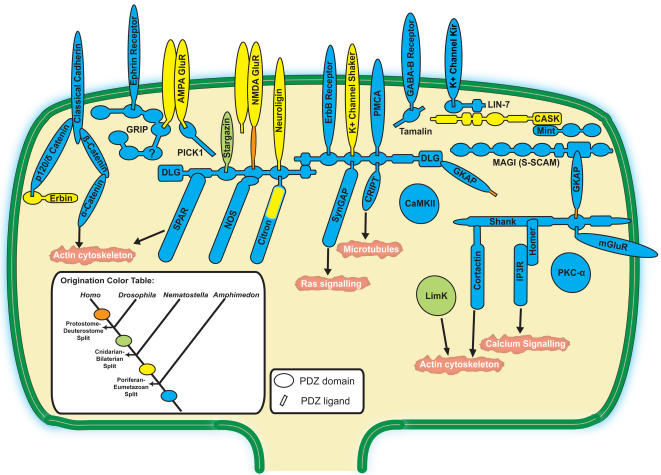
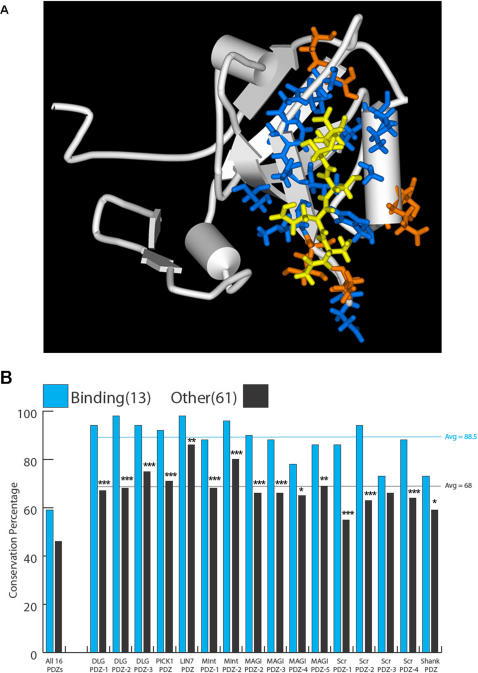
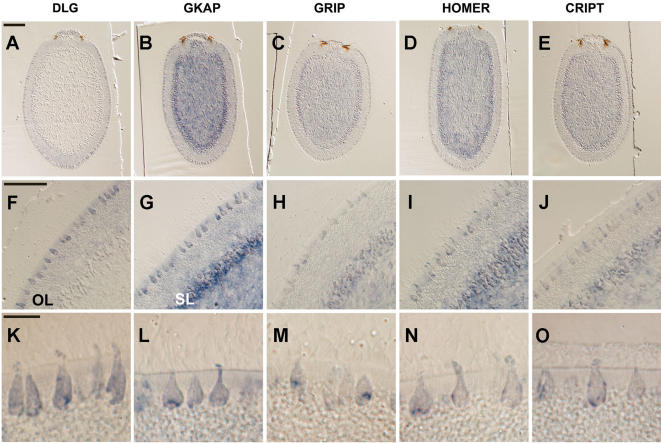
BACKGROUND: The evolution of complex sub-cellular structures such as the synapse requires the assembly of multiple proteins, each conferring added functionality to the integrated structure. Tracking the early evolution of synapses has not been possible without genomic information from the earliest branching animals. As the closest extant relatives to the Eumetazoa, Porifera (sponges) represent a pivotal group for understanding the evolution of nervous systems, because sponges lack neurons with clearly recognizable synapses, in contrast to eumetazoan animals. METHODOLOGY/PRINCIPAL FINDINGS: We show that the genome of the demosponge Amphimedon queenslandica possesses a nearly complete set of post-synaptic protein homologs whose conserved interaction motifs suggest assembly into a complex structure. In the critical synaptic scaffold gene, dlg, residues that make hydrogen bonds and van der Waals interactions with the PDZ ligand are 100% conserved between sponge and human, as is the motif organization of the scaffolds. Expression in Amphimedon of multiple post-synaptic gene homologs in larval flask cells further supports the existence of an assembled structure. Among the few post-synaptic genes absent from Amphimedon, but present in Eumetazoa, are receptor genes including the entire ionotropic glutamate receptor family. CONCLUSIONS/SIGNIFICANCE: Highly conserved protein interaction motifs and co-expression in sponges of multiple proteins whose homologs interact in eumetazoan synapses indicate that a complex protein scaffold was present at the origin of animals, perhaps predating nervous systems. A relatively small number of crucial innovations to this pre-existing structure may represent the founding changes that led to a post-synaptic element.
Overview
The claims and statistics of this paper haven’t been checked yet.
Run the check — free, no account needed. It reads the open-access text and checks the sources it cites.
Integrity signals
Registry
Cites
Statistics
Figures
Verification
Claims the paper makes
The claims and statistics of this paper haven’t been checked yet.
Run the check — free, no account needed. It reads the open-access text and checks the sources it cites.
Claims other papers make about this one
Each is checked against this paper’s own text: does it say what the citing paper says it does?
In the citing paper
“An “ancestral complexity” of cnidarians in terms of synaptic proteins is therefore apparent [28,32].”
From Back to the Basics: Cnidarians Start to Fire (2017) · cites this paper as [28]
In the citing paper
“most of the structural components of the post-synaptic density (PSD) are present in the sponge Amphimedon [22,28], and some have clear homologs in choanoflagellates and other unicellular holozoans [29,30]”
From Back to the Basics: Cnidarians Start to Fire (2017) · cites this paper as [28]
Self-check
Percentages, sums and reported differences re-computed from the paper’s own numbers.
The self-check needs the paper’s full text.
Citations
Cites
Gapped BLAST and PSI-BLAST: a new generation of protein database search programs
Altschul, S. (1997) · Nucleic Acids Research · doi:10.1093/nar/25.17.3389 · Cited by 73,302
Thompson, J. D., Higgins, D. G., & Gibson, T. J. (1994) · Nucleic Acids Research · doi:10.1093/nar/22.22.4673 · Cited by 64,617
Berman, H. M. (2000) · Nucleic Acids Research · doi:10.1093/nar/28.1.235 · Cited by 40,196
MrBayes 3: Bayesian phylogenetic inference under mixed models
Ronquist, F., & Huelsenbeck, J. P. (2003) · Bioinformatics · doi:10.1093/bioinformatics/btg180 · Cited by 29,194
PROCHECK: a program to check the stereochemical quality of protein structures
Laskowski, R. A., MacArthur, M. W., Moss, D. S., & Thornton, J. M. (1993) · Journal of Applied Crystallography · doi:10.1107/s0021889892009944 · Cited by 24,581
MAFFT: a novel method for rapid multiple sequence alignment based on fast Fourier transform
Katoh, K. (2002) · Nucleic Acids Research · doi:10.1093/nar/gkf436 · Cited by 17,027
A Simple, Fast, and Accurate Algorithm to Estimate Large Phylogenies by Maximum Likelihood
Guindon, S., & Gascuel, O. (2003) · Systematic Biology · doi:10.1080/10635150390235520 · Cited by 16,923
All-Atom Empirical Potential for Molecular Modeling and Dynamics Studies of Proteins
MacKerell, A. D., Bashford, D., Bellott, M., Dunbrack, R. L., Evanseck, J. D., Field, M. J., Fischer, S., Gao, J., Guo, H., Ha, S., et al. (1998) · The Journal of Physical Chemistry B · doi:10.1021/jp973084f · Cited by 14,429
The Pfam Protein Families Database
Bateman, A. G. (2002) · Nucleic Acids Research · doi:10.1093/nar/30.1.276 · Cited by 14,075
CHARMM: A program for macromolecular energy, minimization, and dynamics calculations
Brooks, B., Bruccoleri, R., Olafson, B. D., States, D., Swaminathan, S., & Karplus, M. (1983) · Journal of Computational Chemistry · doi:10.1002/jcc.540040211 · Cited by 13,736
Cited by
Sorted by citations
Dennis, E. A., Cao, J., Hsu, Y., Magrioti, V., & Kokotos, G. (2011) · Chemical Reviews · doi:10.1021/cr200085w · Cited by 1,241
The Amphimedon queenslandica genome and the evolution of animal complexity
Srivastava, M., Simakov, O., Chapman, J., Fahey, B., Gauthier, M. E. A., Mitros, T., Richards, G. S., Conaco, C., Dacre, M., Hellsten, U., et al. (2010) · Nature · doi:10.1038/nature09201 · Cited by 1,049
Self-citationThe Trichoplax genome and the nature of placozoans
Srivastava, M., Begovic, E., Chapman, J., Putnam, N. H., Hellsten, U., Kawashima, T., Kuo, A., Mitros, T., Salamov, A., Carpenter, M. L., et al. (2008) · Nature · doi:10.1038/nature07191 · Cited by 889
The origin and evolution of cell types
Arendt, D., Musser, J. M., Baker, C. V. H., Bergman, A., Cepko, C., Erwin, D. H., Pavlicev, M., Schlosser, G., Widder, S., Laubichler, M. D., et al. (2016) · Nature Reviews Genetics · doi:10.1038/nrg.2016.127 · Cited by 764
Croset, V., Rytz, R., Cummins, S. F., Budd, A., Brawand, D., Kaessmann, H., Gibson, T. J., & Benton, R. (2010) · PLoS Genetics · doi:10.1371/journal.pgen.1001064 · Cited by 772
Metadata
- Authors
- Sakarya, O., Armstrong, K. A., Adamska, M., Adamski, M., Wang, I.-F., Tidor, B., Degnan, B. M., Oakley, T. H., & Kosik, K. S.
- Affiliations
- University of California, Santa Barbara (US)
- MIT Computer Science and Artificial Intelligence Laboratory (US)
- The University of Queensland (AU)
- Corresponding author
- Kosik, Kenneth S.
- ORCID
- Venue
- PLoS ONE
- Publisher
- Public Library of Science (PLoS)
- Published
- 2007-06-06
- Volume
- 2
- Issue
- 6
- Pages
- e506
- ISSN
- 1932-6203 (ISSN-L)
- PMC
- PMC1876816
- OpenAlex
- W2079236594
- Cited by
- 291
- References
- 52
- Citations by year
- 2026: 2 · 2025: 5 · 2024: 6 · 2023: 2 · 2022: 3 · 2021: 8 · 2020: 13 · 2019: 15 · 2018: 8 · 2017: 16 · 2016: 21 · 2015: 28 · 2014: 20 · 2013: 12 · 2012: 18
- FWCI
- 24.18
- Type
- journal article
- Language
- en
- Open access
- gold
- doi.org
- Locations
- PLoS ONE (publishedVersion, cc-by)
- PubMed Central (publishedVersion, cc-by)
- PubMed (publishedVersion)
- DOAJ (DOAJ: Directory of Open Access Journals) (submittedVersion, cc-by-sa)
- Figshare (submittedVersion, cc-by)
- OSTI OAI (U.S. Department of Energy Office of Scientific and Technical Information) (submittedVersion)
- Funders
- U.S. Department of Energy
- Joint Genome Institute
- Topics
- Life Sciences › Agricultural and Biological Sciences › Animal Science and Zoology › Marine Invertebrate Physiology and Ecology
- Life Sciences › Neuroscience › Cellular and Molecular Neuroscience › Neuroscience and Neuropharmacology Research
- Life Sciences › Biochemistry, Genetics and Molecular Biology › Molecular Biology › Developmental Biology and Gene Regulation
- Keywords
- sponge genome, Amphimedon queenslandica, PDZ domain, protein interaction motifs, ionotropic glutamate receptors, Eumetazoa, protein complex formation
- MeSH terms
- Animals, Humans, Nerve Tissue Proteins, Porifera, Synapses, Genome, Evolution, Molecular
About these checks
Registry, retraction, Cites and statistics results are computed, not judged, with one exception: a printed reference that no index lists is read once by a model before it counts as a citation error. Claims are extracted by a model and kept only when their quote appears verbatim in the text; each cited source is then checked, with a model’s help, for whether it says what the claim relies on. Those verdicts can be wrong — read the claim’s quote and the cited source before relying on one.
Statistics and arithmetic are recomputed, not judged.
Confidence bands are shown only for fields calibrated on our annotated test set. None is calibrated yet, so no band is shown.
What counts as a claim ›How we measure confidence ›How we check this ›
Are you an author, or do you see a problem with this page? Request a review
