

The DOI matches its Crossref record; 18 of the 18 references it cites were found in a registry or an index.
Insulin Resistance and Body Fat Distribution in South Asian Men Compared to Caucasian Men
Open accessAbstract
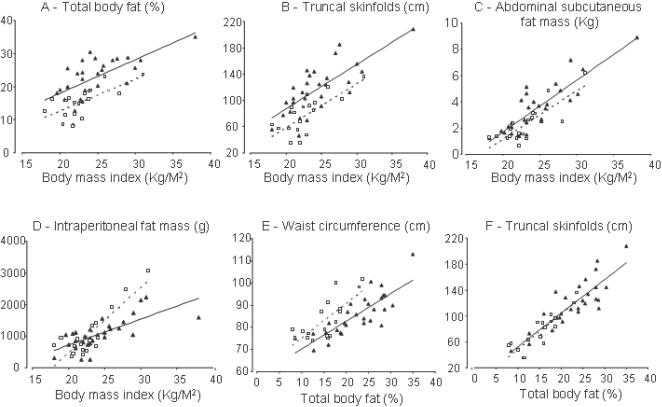
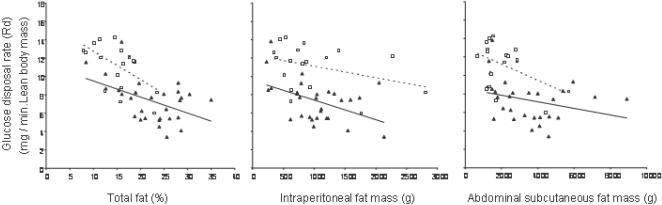
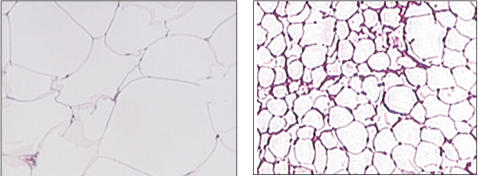
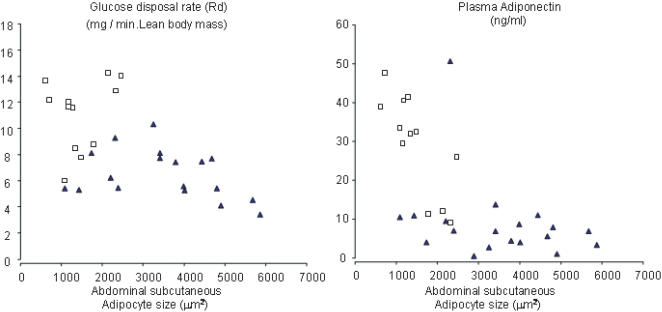
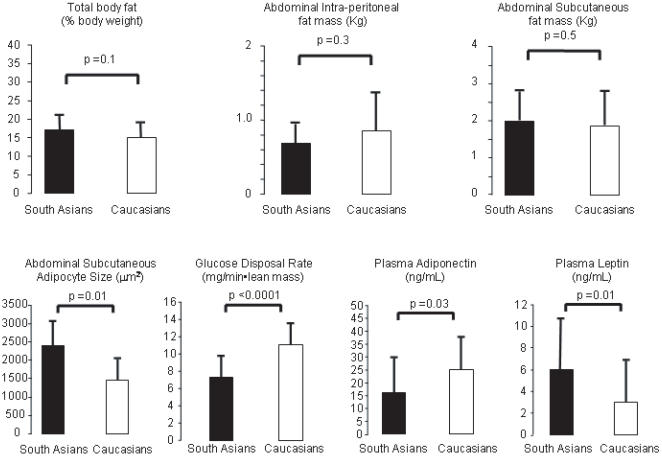
OBJECTIVE: South Asians are susceptible to insulin resistance even without obesity. We examined the characteristics of body fat content, distribution and function in South Asian men and their relationships to insulin resistance compared to Caucasians. RESEARCH DESIGN AND METHODS: Twenty-nine South Asian and 18 Caucasian non-diabetic men (age 27+/-3 and 27+/-3 years, respectively) underwent euglycemic-hyperinsulinemic clamp for insulin sensitivity, underwater weighing for total body fat, MRI of entire abdomen for intraperitoneal (IP) and subcutaneous abdominal (SA) fat and biopsy of SA fat for adipocyte size. RESULTS: Compared to Caucasians, in spite of similar BMI, South Asians had higher total body fat (22+/-6 and 15+/-4% of body weight; p-value<0.0001), higher SA fat (3.5+/-1.9 and 2.2+/-1.3 kg, respectively; p-value = 0.004), but no differences in IP fat (1.0+/-0.5 and 1.0+/-0.7 kg, respectively; p-value = 0.4). SA adipocyte cell size was significantly higher in South Asians (3491+/-1393 and 1648+/-864 microm2; p-value = 0.0001) and was inversely correlated with both glucose disposal rate (r-value = -0.57; p-value = 0.0008) and plasma adiponectin concentrations (r-value = -0.71; p-value<0.0001). Adipocyte size differences persisted even when SA was matched between South Asians and Caucasians. CONCLUSIONS: Insulin resistance in young South Asian men can be observed even without increase in IP fat mass and is related to large SA adipocytes size. Hence ethnic excess in insulin resistance in South Asians appears to be related more to excess truncal fat and dysfunctional adipose tissue than to excess visceral fat.
Overview
The claims and statistics of this paper haven’t been checked yet.
Run the check — free, no account needed. It reads the open-access text and checks the sources it cites.
Integrity signals
Registry
Cites
Statistics
Figures
Verification
Claims the paper makes
The claims and statistics of this paper haven’t been checked yet.
Run the check — free, no account needed. It reads the open-access text and checks the sources it cites.
Claims other papers make about this one
Each is checked against this paper’s own text: does it say what the citing paper says it does?
In the citing paper
“For example, South Asians have higher body fat content, waist to hip ratio, visceral fat to subcutaneous fat ratio, and adipocyte area than Caucasians matched for age, sex, and body mass index (BMI) (15,16).”
From The CardioMetabolic Health Alliance (2015) · cites this paper as [16]
Self-check
Percentages, sums and reported differences re-computed from the paper’s own numbers.
The self-check needs the paper’s full text.
Citations
Cites
McKeigue, P. M., Shah, B., & Marmot, M. G. (1991) · The Lancet · doi:10.1016/0140-6736(91)91164-p · Cited by 1,618
Weyer, C., Foley, J. E., Bogardus, C., Tataranni, P. A., & Pratley, R. E. (2000) · Diabetologia · doi:10.1007/s001250051560 · Cited by 799
Relationships of generalized and regional adiposity to insulin sensitivity in men.
Abate, N., Garg, A., Peshock, R. M., Stray-Gundersen, J., & Grundy, S. M. (1995) · Journal of Clinical Investigation · doi:10.1172/jci118083 · Cited by 759
Self-citationBody Fat Distribution and Insulin Resistance in Healthy Asian Indians and Caucasians
Raji, A., Seely, E. W., Arky, R. A., & Simonson, D. C. (2001) · The Journal of Clinical Endocrinology & Metabolism · doi:10.1210/jcem.86.11.7992 · Cited by 541 · cited 1×
“In particular, it has been reported that visceral obesity may be an important contributing factor [4,7,8].”
BackgroundRelationship between Generalized and Upper Body Obesity to Insulin Resistance in Asian Indian Men
Chandalia, M., Abate, N., Garg, A., Stray‐Gundersen, J., & Grundy, S. M. (1999) · The Journal of Clinical Endocrinology & Metabolism · doi:10.1210/jcem.84.7.5817 · Cited by 402
Self-citationAbate, N., Burns, D., Peshock, R. M., Garg, A., & Grundy, S. M. (1994) · Journal of Lipid Research · doi:10.1016/s0022-2275(20)40090-2 · Cited by 335
Self-citationInfluence of body fat content and distribution on variation in metabolic risk
Vega, G. L., Adams-Huet, B., Peshock, R., Willett, D., Shah, B., & Grundy, S. M. (2006) · The Journal of Clinical Endocrinology & Metabolism · doi:10.1210/jc.2006-0814 · Cited by 312
Self-citationFat cell enlargement is an independent marker of insulin resistance and ‘hyperleptinaemia’
Lundgren, M., Svensson, M. K. E., Lindmark, S., Renström, F., Ruge, T., & Eriksson, J. W. (2007) · Diabetologia · doi:10.1007/s00125-006-0572-1 · Cited by 283
The impact of ethnicity on type 2 diabetes
Abate, N. I., & Chandalia, M. (2002) · Journal of Diabetes and its Complications · doi:10.1016/s1056-8727(02)00190-3 · Cited by 282
Self-citationMcKeigue, P., Pierpoint, T., Ferrie, J. E., & Marmot, M. G. (1992) · Diabetologia · doi:10.1007/bf00429101 · Cited by 281
Relationship between Generalized and Upper Body Obesity to Insulin Resistance in Asian Indian Men
Chandalia, M. (1999) · The Journal of Clinical Endocrinology & Metabolism · doi:10.1210/jc.84.7.2329 · Cited by 269
Self-citationTHE CHEMICAL COMPOSITION OF ADIPOSE TISSUE OF MAN AND MICE
Thomas, L. W. (1962) · Quarterly Journal of Experimental Physiology and Cognate Medical Sciences · doi:10.1113/expphysiol.1962.sp001589 · Cited by 212
Adipose Tissue Metabolites and Insulin Resistance in Nondiabetic Asian Indian Men
Abate, N., Chandalia, M., Snell, P. G., & Grundy, S. M. (2004) · The Journal of Clinical Endocrinology & Metabolism · doi:10.1210/jc.2003-031843 · Cited by 201
Self-citationRush, E. C., Plank, L. D., Chandu, V., Laulu, M. S., Simmons, D. S., Swinburn, B. A., & Yajnik, C. S. (2004) · PubMed · Cited by 172
Genetic Polymorphism PC-1 K121Q and Ethnic Susceptibility to Insulin Resistance
Abate, N. I., Carulli, L., Cabo-Chan, A. V., Chandalia, M., Snell, P. G., & Grundy, S. M. (2003) · The Journal of Clinical Endocrinology & Metabolism · doi:10.1210/jc.2003-030453 · Cited by 126
Self-citationCounterpoint: Visceral Adiposity Is Not Causally Related to Insulin Resistance
Miles, J. M., & Jensen, M. D. (2005) · Diabetes Care · doi:10.2337/diacare.28.9.2326 · Cited by 102
Type 2 diabetes in South Asians: A pathophysiologic focus on the Asian-Indian epidemic
Bajaj, M., & Banerji, M. A. (2004) · Current Diabetes Reports · doi:10.1007/s11892-004-0026-4 · Cited by 84
Vague, J. (1999) · Nutrition · doi:10.1016/s0899-9007(98)00131-2 · Cited by 41
Research works printed but not linked: 1
- J Vague, 1999, The degree of masculine differentiation of obesities: a factor determining predisposition to diabetes, atherosclerosis, gout, and uric calculus disease., Nutrition., 15(1), 89
Cited by
Sorted by citations
MAFLD: a consensus-driven proposed nomenclature for metabolic associated fatty liver disease
Eslam, M., Sanyal, A. J., George, J., Sanyal, A., Neuschwander-Tetri, B., Tiribelli, C., Kleiner, D. E., Brunt, E., Bugianesi, E., Yki-Järvinen, H., et al. (2020) · Gastroenterology · doi:10.1053/j.gastro.2019.11.312 · Cited by 3,286
Obesity and the Metabolic Syndrome in Developing Countries
Misra, A., & Khurana, L. (2008) · The Journal of Clinical Endocrinology & Metabolism · doi:10.1210/jc.2008-1595 · Cited by 1,257
Metabolic Dysregulation and Adipose Tissue Fibrosis: Role of Collagen VI
Khan, T., Muise, E. S., Iyengar, P., Wang, Z. V., Chandalia, M., Abate, N., Zhang, B. B., Bonaldo, P., Chua, S., & Scherer, P. E. (2009) · Molecular and Cellular Biology · doi:10.1128/mcb.01300-08 · Cited by 1,053
Self-citationThe double burden of malnutrition: aetiological pathways and consequences for health
Wells, J. C., Sawaya, A. L., Wibaek, R., Mwangome, M., Poullas, M. S., Yajnik, C. S., & Demaio, A. (2020) · The Lancet · doi:10.1016/s0140-6736(19)32472-9 · Cited by 993
Eslam, M., Sarin, S. K., Wong, V. W., Fan, J.-G., Kawaguchi, T., Ahn, S. H., Zheng, M., Shiha, G. E.-S., Yilmaz, Y. N., Gani, R. A., et al. (2020) · Hepatology International · doi:10.1007/s12072-020-10094-2 · Cited by 860
Metadata
- Authors
- Chandalia, M., Lin, P., Seenivasan, T., Livingston, E. H., Snell, P. G., Grundy, S. M., & Abate, N.
- Affiliations
- The University of Texas Southwestern Medical Center (US)
- Corresponding author
- Chandalia, Manisha
- Abate, Nicola
- Venue
- PLoS ONE
- Publisher
- Public Library of Science (PLoS)
- Published
- 2007-08-29
- Volume
- 2
- Issue
- 8
- Pages
- e812
- ISSN
- 1932-6203 (ISSN-L)
- PMC
- PMC1950568
- OpenAlex
- W2032530751
- Cited by
- 253
- References
- 18
- Citations by year
- 2026: 7 · 2025: 13 · 2024: 10 · 2023: 10 · 2022: 14 · 2021: 10 · 2020: 10 · 2019: 15 · 2018: 15 · 2017: 16 · 2016: 7 · 2015: 17 · 2014: 20 · 2013: 31 · 2012: 17
- FWCI
- 5.50
- Type
- journal article
- Language
- en
- Open access
- gold
- doi.org
- Locations
- PLoS ONE (publishedVersion, cc-by)
- Europe PMC (PubMed Central) (publishedVersion, cc-by)
- PubMed Central (publishedVersion, cc-by)
- PubMed (publishedVersion)
- DOAJ (DOAJ: Directory of Open Access Journals) (submittedVersion, cc-by-sa)
- Funders
- National Institute of Diabetes and Digestive and Kidney Diseases (NIDDK RO1, R01DK072158, DK072158)
- Topics
- Health Sciences › Medicine › Endocrinology, Diabetes and Metabolism › Adipokines, Inflammation, and Metabolic Diseases
- Health Sciences › Medicine › Endocrinology, Diabetes and Metabolism › Diabetes, Cardiovascular Risks, and Lipoproteins
- Health Sciences › Medicine › Physiology (medical) › Adipose Tissue and Metabolism
- Keywords
- insulin resistance, South Asian men, body fat distribution, subcutaneous abdominal fat, intraperitoneal fat, adipocyte size, adiponectin, ethnic differences, abdominal obesity, insulin sensitivity, adipose tissue dysfunction
- MeSH terms
- Adipose Tissue, Adult, Glucose, Humans, Insulin Resistance, Male, Glucose Clamp Technique, White People, Asian People, Intra-Abdominal Fat, Body Fat Distribution
About these checks
Registry, retraction, Cites and statistics results are computed, not judged, with one exception: a printed reference that no index lists is read once by a model before it counts as a citation error. Claims are extracted by a model and kept only when their quote appears verbatim in the text; each cited source is then checked, with a model’s help, for whether it says what the claim relies on. Those verdicts can be wrong — read the claim’s quote and the cited source before relying on one.
Statistics and arithmetic are recomputed, not judged.
Confidence bands are shown only for fields calibrated on our annotated test set. None is calibrated yet, so no band is shown.
What counts as a claim ›How we measure confidence ›How we check this ›
Are you an author, or do you see a problem with this page? Request a review
