

Binding to the Minor Groove of the Double-Strand, Tau Protein Prevents DNA from Damage by Peroxidation
Open accessThe DOI matches its Crossref record; 52 of the 52 references it cites were found in a registry or an index.
Abstract
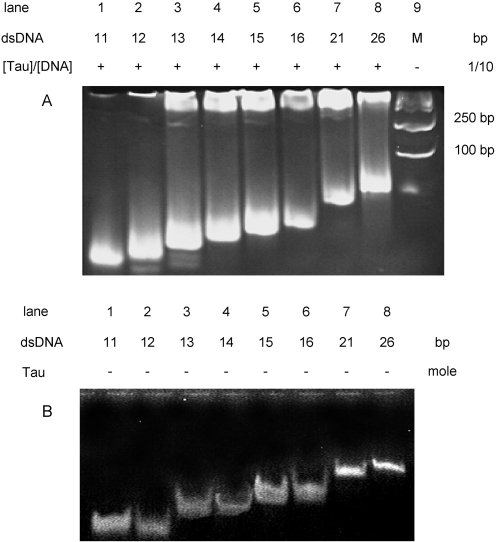
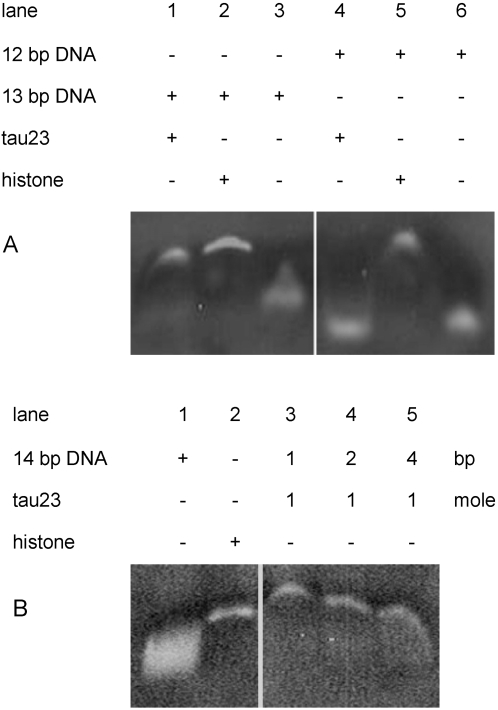
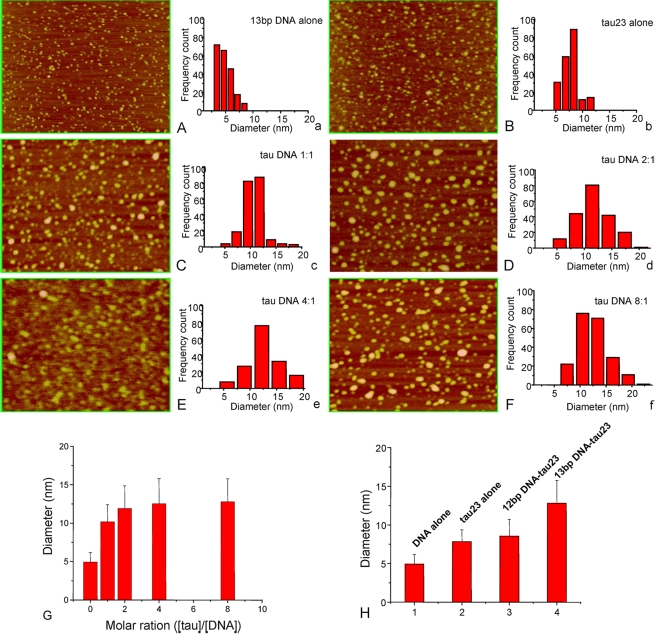
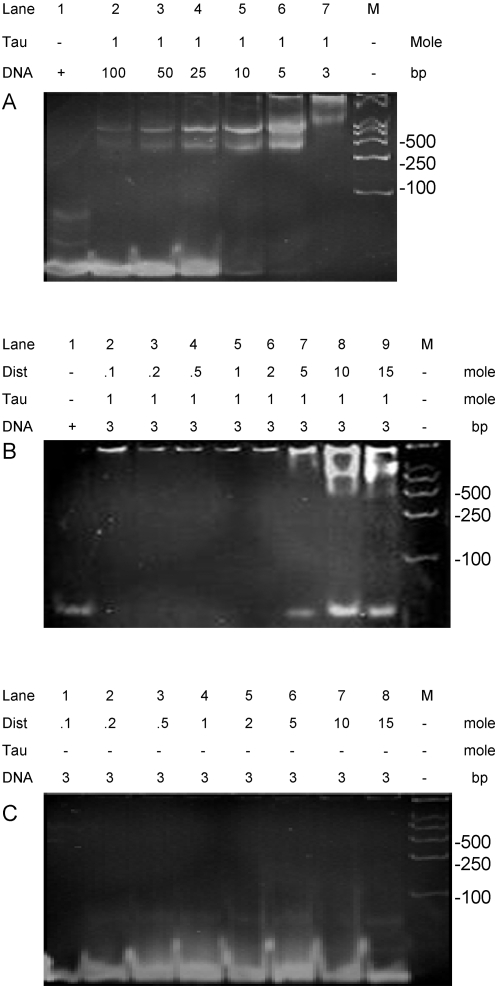
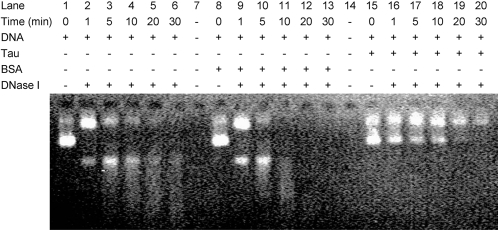
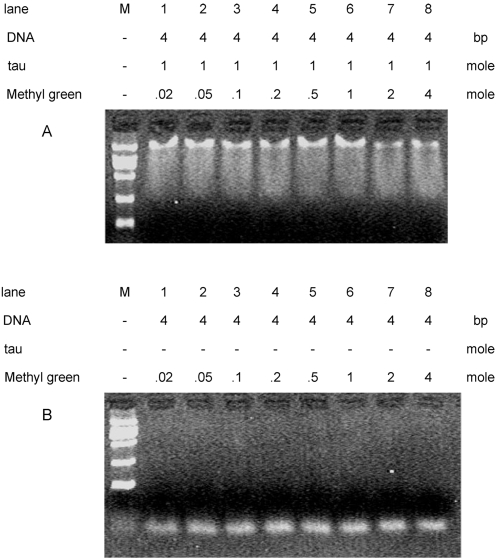
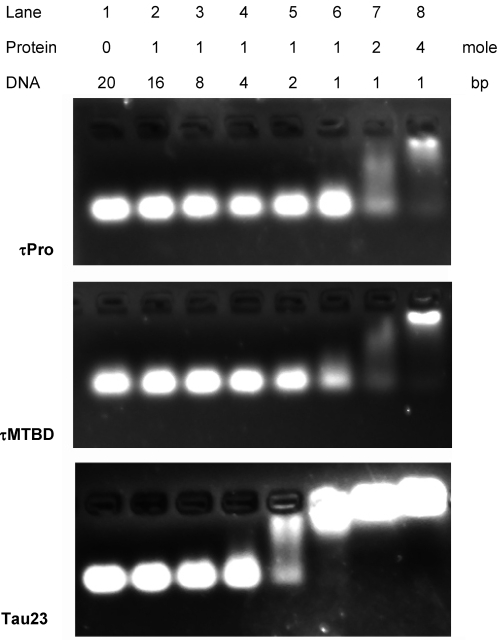
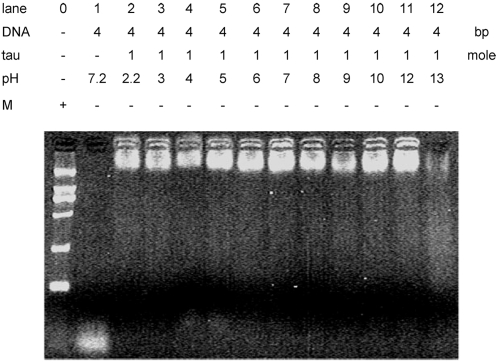
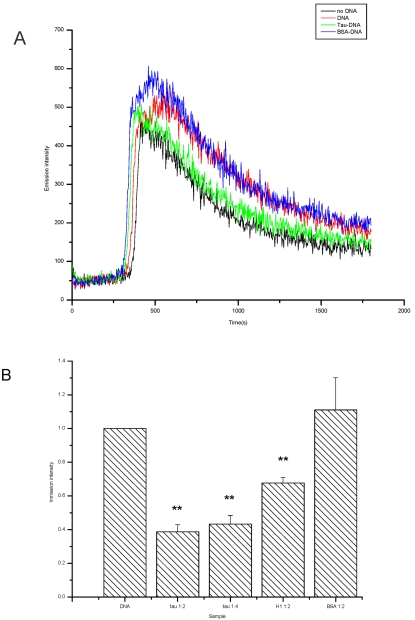
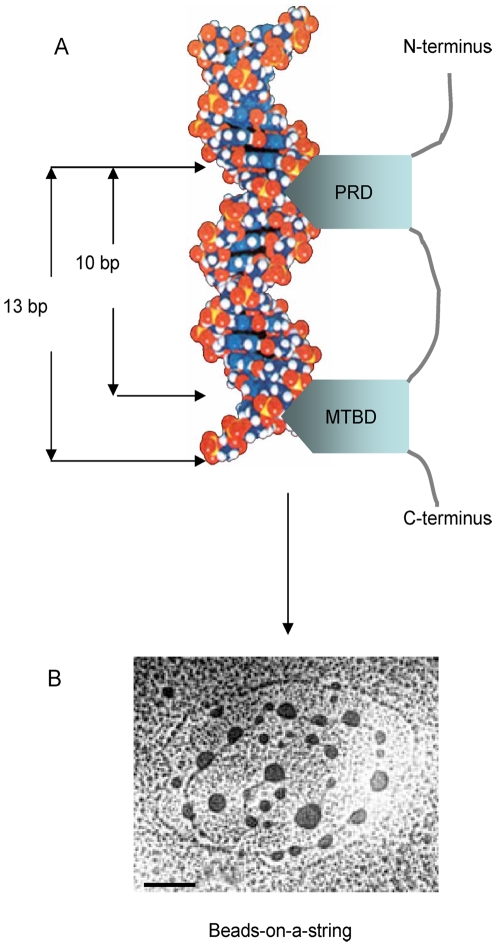
Tau, an important microtubule associated protein, has been found to bind to DNA, and to be localized in the nuclei of both neurons and some non-neuronal cells. Here, using electrophoretic mobility shifting assay (EMSA) in the presence of DNA with different chain-lengths, we observed that tau protein favored binding to a 13 bp or a longer polynucleotide. The results from atomic force microscopy also showed that tau protein preferred a 13 bp polynucleotide to a 12 bp or shorter polynucleotide. In a competitive assay, a minor groove binder distamycin A was able to replace the bound tau from the DNA double helix, indicating that tau protein binds to the minor groove. Tau protein was able to protect the double-strand from digestion in the presence of DNase I that was bound to the minor groove. On the other hand, a major groove binder methyl green as a negative competitor exhibited little effect on the retardation of tau-DNA complex in EMSA. This further indicates the DNA minor groove as the binding site for tau protein. EMSA with truncated tau proteins showed that both the proline-rich domain (PRD) and the microtubule-binding domain (MTBD) contributed to the interaction with DNA; that is to say, both PRD and MTBD bound to the minor groove of DNA and bent the double-strand, as observed by electron microscopy. To investigate whether tau protein is able to prevent DNA from the impairment by hydroxyl free radical, the chemiluminescence emitted by the phen-Cu/H(2)O(2)/ascorbate was measured. The emission intensity of the luminescence was markedly decreased when tau protein was present, suggesting a significant protection of DNA from the damage in the presence of hydroxyl free radical.
Overview
The claims and statistics of this paper haven’t been checked yet.
Free: it reads the open-access text and checks the first 5 claims that cite a source we can check. Create a free account to check every claim.
Integrity signals
Registry
Cites
Statistics
Figures
Verification
Claims the paper makes
The claims and statistics of this paper haven’t been checked yet.
Free: it reads the open-access text and checks the first 5 claims that cite a source we can check. Create a free account to check every claim.
Claims other papers make about this one
Each is checked against this paper’s own text: does it say what the citing paper says it does?
The source backs part of the claim, not all of it — or backs it for a different population, condition or comparison.
In the citing paper
“In vitro and in cultured cells, tau binds the minor groove of the DNA double helix”
From Tau promotes neurodegeneration through global chromatin relaxation (2014) · cites this paper as [48]
Experimental — accuracy not yet measuredThe cited source says what the claim attributes to it.
In the citing paper
“Tau has the capacity to bind DNA (281,304) and may protect it from oxidative damage (305).”
From Functional genomic screen and network analysis reveal novel modifiers of tauopathy dissociated from tau phosphorylation (2011) · cites this paper as [305]
The cited source says what the claim attributes to it.
In the citing paper
“and is thought to protect DNA from oxidative damage46-48”
From Tau promotes neurodegeneration through global chromatin relaxation (2014) · cites this paper as [48]
In the citing paper
“prevents DNA damage by oxidative stress 94, 106”
From Altered Machinery of Protein Synthesis in Alzheimer's: From the Nucleolus to the Ribosome (2016) · cites this paper as [106]
Self-check
Percentages, sums and reported differences re-computed from the paper’s own numbers.
The self-check needs the paper’s full text.
Citations
Cites
Goedert, M., Spillantini, M. G., Jakes, R., Rutherford, D., & Crowther, R. A. (1989) · Neuron · doi:10.1016/0896-6273(89)90210-9 · Cited by 2,492 · cited 1×
“Goedert [12–14].”
Buée, L., Bussière, T., Buée-Scherrer, V., Delacourte, A., & Hof, P. R. (2000) · Brain Research Reviews · doi:10.1016/s0165-0173(00)00019-9 · Cited by 2,015
Goedert, M., Wischik, C. M., Crowther, R. A., Walker, J. E., & Klug, A. (1988) · Proceedings of the National Academy of Sciences · doi:10.1073/pnas.85.11.4051 · Cited by 1,134 · cited 1×
“In the adult human brain, there are six isoforms of tau, produced from a single gene by alternative mRNA splicing”
BackgroundGoedert, M., Spillantini, M. G., Potier, M. C., Ulrich, J., & Crowther, R. A. (1989) · The EMBO Journal · doi:10.1002/j.1460-2075.1989.tb03390.x · Cited by 1,037 · cited 1×
“Goedert [12–14].”
Modulation of the dynamic instability of tubulin assembly by the microtubule-associated protein tau.
Drechsel, D. N., Hyman, A. A., Cobb, M. H., & Kirschner, M. W. (1992) · Molecular Biology of the Cell · doi:10.1091/mbc.3.10.1141 · Cited by 970 · cited 1×
“Tau is a major microtubule-binding protein that is important for the assembly and stabilization of microtubules [1].”
BackgroundCleveland, D. W., Hwo, S.-Y., & Kirschner, M. W. (1977) · Journal of Molecular Biology · doi:10.1016/0022-2836(77)90213-3 · Cited by 915
Structure and novel exons of the human .tau. gene
Andreadis, A., Brown, W. M., & Kosik, K. S. (1992) · Biochemistry · doi:10.1021/bi00158a027 · Cited by 624 · cited 1×
“In the adult human brain, there are six isoforms of tau, produced from a single gene by alternative mRNA splicing [12– 15].”
BackgroundKlemm, J. D., Rould, M. A., Aurora, R., Herr, W., & Pabo, C. O. (1994) · Cell · doi:10.1016/0092-8674(94)90231-3 · Cited by 506
The microtubule binding domain of tau protein
Lee, G., Neve, R. L., & Kosik, K. S. (1989) · Neuron · doi:10.1016/0896-6273(89)90050-0 · Cited by 500 · cited 1×
“The MTBD functions as a regulator of the rate of microtubule polymerization [17] and actin assembly [18,19].”
BackgroundBILLINGSLEY, M. L., & KINCAID, R. L. (1997) · Biochemical Journal · doi:10.1042/bj3230577 · Cited by 453 · cited 1×
“reported [33–35].”
Research works printed but not linked: 1
- Li FX Lu J Xu YJ Tong ZQ Nie CL 2008 Formaldehyde-mediated chronic damage may be related to sporadic neurodegeneration. Prog in Bioc and Biop 35 393 400
Cited by
Arendt, T., Stieler, J. T., & Holzer, M. (2016) · Brain Research Bulletin · doi:10.1016/j.brainresbull.2016.08.018 · Cited by 609
Tau promotes neurodegeneration through global chromatin relaxation
Frost, B., Hemberg, M., Lewis, J., & Feany, M. B. (2014) · Nature Neuroscience · doi:10.1038/nn.3639 · Cited by 495
“In vitro and in cultured cells, tau binds the minor groove of the DNA double helix and is thought to protect DNA from oxidative damage 46-48 .”
Kent, S. A., Spires-Jones, T. L., & Durrant, C. S. (2020) · Acta Neuropathologica · doi:10.1007/s00401-020-02196-w · Cited by 446
Nuclear Tau, a Key Player in Neuronal DNA Protection
Sultan, A., Nesslany, F., Violet, M., Bégard, S., Loyens, A., Talahari, S., Mansuroglu, Z., Marzin, D., Sergeant, N., Humez, S., et al. (2011) · Journal of Biological Chemistry · doi:10.1074/jbc.m110.199976 · Cited by 421
A walk through tau therapeutic strategies
Jadhav, S., Avila, J., Schöll, M., Kovacs, G. G., Kövari, E., Skrabana, R., Evans, L. D., Kontsekova, E., Malawska, B., de Silva, R., et al. (2019) · Acta Neuropathologica Communications · doi:10.1186/s40478-019-0664-z · Cited by 290
Metadata
- Authors
- Wei, Y., Qu, M.-H., Wang, X.-S., Chen, L., Wang, D.-L., Liu, Y., Hua, Q., & He, R.-Q.
- Affiliations
- Chinese Academy of Sciences (CN)
- Beijing University of Chinese Medicine (CN)
- Venue
- PLoS ONE
- Publisher
- Public Library of Science (PLoS)
- Published
- 2008-07-02
- Volume
- 3
- Issue
- 7
- Pages
- e2600
- ISSN
- 1932-6203 (ISSN-L)
- PMC
- PMC2432501
- OpenAlex
- W2077905824
- Cited by
- 129
- References
- 52
- Citations by year
- 2026: 9 · 2025: 4 · 2024: 4 · 2023: 7 · 2022: 10 · 2021: 11 · 2020: 11 · 2019: 7 · 2018: 12 · 2017: 7 · 2016: 4 · 2015: 9 · 2014: 10 · 2013: 7 · 2012: 4
- FWCI
- 2.94
- Type
- journal article
- Language
- en
- Open access
- gold
- doi.org
- Locations
- PLoS ONE (publishedVersion, cc-by)
- PubMed Central (publishedVersion, cc-by)
- PubMed (publishedVersion)
- DOAJ (DOAJ: Directory of Open Access Journals) (submittedVersion, cc-by-sa)
- Funders
- National Natural Science Foundation of China (90206041)
- Chinese Academy of Sciences (KSCX2-YW-R, KSCX2-YW-R-119)
- Topics
- Life Sciences › Neuroscience › Cellular and Molecular Neuroscience › Alzheimer's disease research and treatments
- Life Sciences › Biochemistry, Genetics and Molecular Biology › Molecular Biology › DNA and Nucleic Acid Chemistry
- Life Sciences › Biochemistry, Genetics and Molecular Biology › Molecular Biology › Protein Interaction Studies and Fluorescence Analysis
- Keywords
- tau protein, DNA minor groove binding, protein-DNA interactions, peroxidation, DNase I resistance, proline-rich region, microtubule-binding domain, DNA bending, minor groove binders, demyelination
- MeSH terms
- Binding Sites, DNA, DNA Damage, Humans, Microscopy, Electron, Models, Molecular, Nucleic Acid Conformation, Proline, tau Proteins, Hydroxyl Radical, Microscopy, Atomic Force, Electrophoretic Mobility Shift Assay
About these checks
Registry, retraction, Cites and statistics results are computed, not judged, with one exception: a printed reference that no index lists is read once by a model before it counts as a citation error. Claims are extracted by a model and kept only when their quote appears verbatim in the text; each cited source is then checked, with a model’s help, for whether it says what the claim relies on. Those verdicts can be wrong — read the claim’s quote and the cited source before relying on one.
Statistics and arithmetic are recomputed, not judged.
Confidence bands are shown only for fields calibrated on our annotated test set. None is calibrated yet, so no band is shown.
What counts as a claim ›How we measure confidence ›How we check this ›
Are you an author, or do you see a problem with this page? Request a review
Data sources
Bibliographic data: Semantic Scholar, OpenAlex, Crossref.
Contains information from the Semantic Scholar Academic Graph Datasets, made available under the ODC Attribution License (ODC-BY 1.0).
Semantic Scholar’s data is described in: Kinney, R., et al. (2023). The Semantic Scholar Open Data Platform. arXiv:2301.10140.
