

The DOI matches its Crossref record; 66 of the 66 references it cites were found in a registry or an index.
Neural Basis of Self and Other Representation in Autism: An fMRI Study of Self-Face Recognition
Open accessAbstract
BACKGROUND: Autism is a developmental disorder characterized by decreased interest and engagement in social interactions and by enhanced self-focus. While previous theoretical approaches to understanding autism have emphasized social impairments and altered interpersonal interactions, there is a recent shift towards understanding the nature of the representation of the self in individuals with autism spectrum disorders (ASD). Still, the neural mechanisms subserving self-representations in ASD are relatively unexplored. METHODOLOGY/PRINCIPAL FINDINGS: We used event-related fMRI to investigate brain responsiveness to images of the subjects' own face and to faces of others. Children with ASD and typically developing (TD) children viewed randomly presented digital morphs between their own face and a gender-matched other face, and made "self/other" judgments. Both groups of children activated a right premotor/prefrontal system when identifying images containing a greater percentage of the self face. However, while TD children showed activation of this system during both self- and other-processing, children with ASD only recruited this system while viewing images containing mostly their own face. CONCLUSIONS/SIGNIFICANCE: This functional dissociation between the representation of self versus others points to a potential neural substrate for the characteristic self-focus and decreased social understanding exhibited by these individuals, and suggests that individuals with ASD lack the shared neural representations for self and others that TD children and adults possess and may use to understand others.
Overview
The claims and statistics of this paper haven’t been checked yet.
Run the check — free, no account needed. It reads the open-access text and checks the sources it cites.
Integrity signals
Registry
Cites
Statistics
Figures
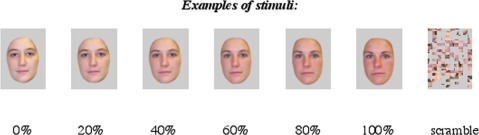
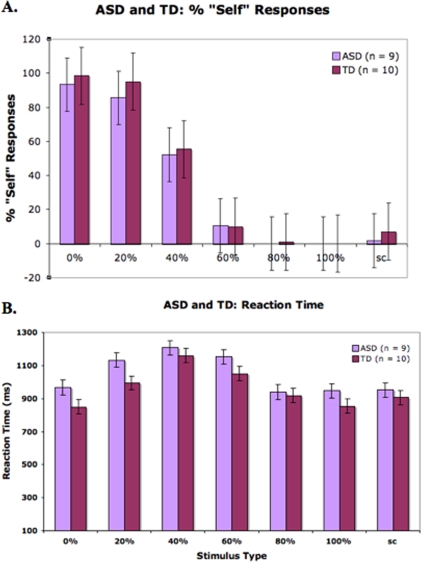
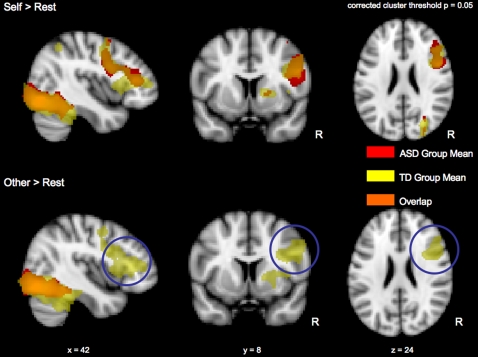
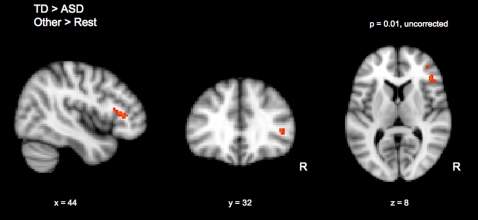
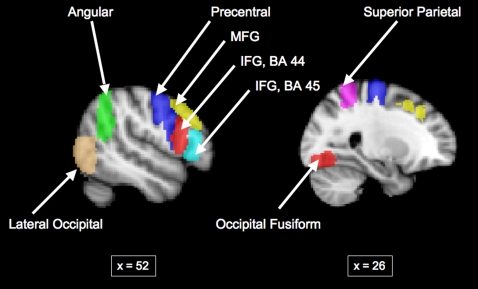
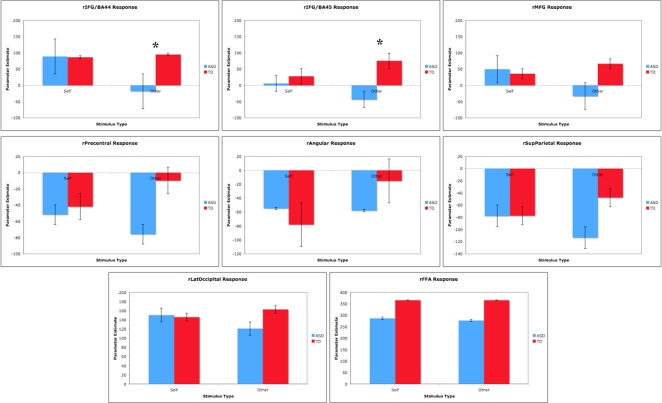
Verification
Claims the paper makes
The claims and statistics of this paper haven’t been checked yet.
Run the check — free, no account needed. It reads the open-access text and checks the sources it cites.
Claims other papers make about this one
Each is checked against this paper’s own text: does it say what the citing paper says it does?
In the citing paper
“Individuals with ASD often show difficulty in evaluating social cues and in appropriately interpreting another person’s experiences or emotions, and may display a preoccupation with self or limited interest in others 14–19.”
From Reduced sociability and social agency encoding in adult Shank3-mutant mice are restored through gene re-expression in real time (2021) · cites this paper as [18]
In the citing paper
“Individuals with ASD are often described as having inability to organize social information or appropriately interpret the state and experience of others 14–19.”
From Reduced sociability and social agency encoding in adult Shank3-mutant mice are restored through gene re-expression in real time (2021) · cites this paper as [18]
Self-check
Percentages, sums and reported differences re-computed from the paper’s own numbers.
The self-check needs the paper’s full text.
Citations
Cites
Lord, C., Rutter, M., & Le Couteur, A. (1994) · Journal of Autism and Developmental Disorders · doi:10.1007/bf02172145 · Cited by 9,065
(1943) · The Nervous child · Cited by 8,870
The fusiform face area: a module in human extrastriate cortex specialized for face perception
Kanwisher, N., McDermott, J., & Chun, M. M. (1997) · The Journal of Neuroscience · doi:10.1523/jneurosci.17-11-04302.1997 · Cited by 7,738
Lord, C., Risi, S., Lambrecht, L., Cook, E. H., Leventhal, B. L., DiLavore, P. C., Pickles, A., & Rutter, M. (2000) · Journal of Autism and Developmental Disorders · doi:10.1023/a:1005592401947 · Cited by 7,520
Empathy for Pain Involves the Affective but not Sensory Components of Pain
Singer, T., Seymour, B., O'Doherty, J., Kaube, H., Dolan, R. J., & Frith, C. D. (2004) · Science · doi:10.1126/science.1093535 · Cited by 3,929
Forman, S. D., Cohen, J. D., Fitzgerald, M., Eddy, W. F., Mintun, M. A., & Noll, D. C. (1995) · Magnetic Resonance in Medicine · doi:10.1002/mrm.1910330508 · Cited by 3,202
Autistic disturbances of affective contact.
Kanner, L. (1968) · PubMed · Cited by 2,282
A unifying view of the basis of social cognition
GALLESE, V, KEYSERS, C., & RIZZOLATTI, G. (2004) · Trends in Cognitive Sciences · doi:10.1016/j.tics.2004.07.002 · Cited by 2,236
Both of Us Disgusted in My Insula
Wicker, B., Keysers, C., Plailly, J., Royet, J.-P., Gallese, V., & Rizzolatti, G. (2003) · Neuron · doi:10.1016/s0896-6273(03)00679-2 · Cited by 2,185
A three-dimensional statistical analysis for CBF activation studies in human brain
Worsley, K. J., Evans, A. C., Marrett, S., & Neelin, P. (1992) · Journal of Cerebral Blood Flow & Metabolism · doi:10.1038/jcbfm.1992.127 · Cited by 2,036
Research works printed but not linked: 1
- T Behrens, 2003, Multi-subject null hypothesis testing using a fully bayesian framework: theory., Hum Brain Mapp
Cited by
Sorted by citations
A systematic review and meta-analysis of the fMRI investigation of autism spectrum disorders
Philip, R. C. M., Dauvermann, M. R., Whalley, H. C., Baynham, K., Lawrie, S. M., & Stanfield, A. C. (2011) · Neuroscience & Biobehavioral Reviews · doi:10.1016/j.neubiorev.2011.10.008 · Cited by 422
Sugranyes, G., Kyriakopoulos, M., Corrigall, R. J., Taylor, E., & Frangou, S. (2011) · PLoS ONE · doi:10.1371/journal.pone.0025322 · Cited by 289
Scott-Van Zeeland, A. A., Abrahams, B. S., Alvarez-Retuerto, A. I., Sonnenblick, L. I., Rudie, J. D., Ghahremani, D., Mumford, J. A., Poldrack, R. A., Dapretto, M., Geschwind, D. H., et al. (2010) · Science Translational Medicine · doi:10.1126/scitranslmed.3001344 · Cited by 252
Self-citationvan Veluw, S. J., & Chance, S. A. (2013) · Brain Imaging and Behavior · doi:10.1007/s11682-013-9266-8 · Cited by 240
Functional magnetic resonance imaging of autism spectrum disorders
Dichter, G. S. (2012) · Dialogues in Clinical Neuroscience · doi:10.31887/dcns.2012.14.3/gdichter · Cited by 215
Lateralization of affective processing in the insula
Duerden, E. G., Arsalidou, M., Lee, M., & Taylor, M. J. (2013) · NeuroImage · doi:10.1016/j.neuroimage.2013.04.014 · Cited by 212
Rudie, J. D., Shehzad, Z. E., Hernandez, L. M., Colich, N. L., Bookheimer, S. Y., Iacoboni, M., & Dapretto, M. (2011) · Cerebral Cortex · doi:10.1093/cercor/bhr171 · Cited by 206
Self-citationBrain-to-brain synchronization across two persons predicts mutual prosociality
Hu, Y., Hu, Y., Li, X., Pan, Y., & Cheng, X. (2017) · Social Cognitive and Affective Neuroscience · doi:10.1093/scan/nsx118 · Cited by 188
Gallese, V., Gernsbacher, M. A., Heyes, C. M., Hickok, G. S., & Iacoboni, M. (2011) · Perspectives on Psychological Science · doi:10.1177/1745691611413392 · Cited by 188
Self-citationSchulte‐Rüther, M., Greimel, E., Markowitsch, H. J., Kamp‐Becker, I., Remschmidt, H., Fink, G. R., & Piefke, M. (2010) · Social Neuroscience · doi:10.1080/17470911003708032 · Cited by 190
Neuroanatomical and neurofunctional markers of social cognition in autism spectrum disorder
Patriquin, M. A., DeRamus, T. P., Libero, L. E., Laird, A. R., & Kana, R. K. (2016) · Human Brain Mapping · doi:10.1002/hbm.23288 · Cited by 179
Yerys, B. E., Gordon, E. M., Abrams, D. N., Satterthwaite, T. D., Weinblatt, R., Jankowski, K. F., Strang, J. F., Kenworthy, L. E., Gaillard, W. D., & Vaidya, C. J. (2015) · NeuroImage Clinical · doi:10.1016/j.nicl.2015.07.018 · Cited by 154
An insular view of the social decision-making network
Rogers-Carter, M. M., & Christianson, J. P. (2019) · Neuroscience & Biobehavioral Reviews · doi:10.1016/j.neubiorev.2019.06.005 · Cited by 121
The self in autism: An emerging view from neuroimaging
Uddin, L. Q. (2011) · Neurocase · doi:10.1080/13554794.2010.509320 · Cited by 135
Self-citationMurdaugh, D. L., Shinkareva, S. V., Deshpande, H. R., Wang, J., Pennick, M. R., & Kana, R. K. (2012) · PLoS ONE · doi:10.1371/journal.pone.0050064 · Cited by 114
Bastiaansen, J. A., Thioux, M., Nanetti, L., van der Gaag, C., Ketelaars, C. E. J., Minderaa, R. B., & Keysers, C. (2011) · Biological Psychiatry · doi:10.1016/j.biopsych.2010.11.007 · Cited by 112
Cooperation and Heterogeneity of the Autistic Mind
Yoshida, W., Dziobek, I., Kliemann, D., Heekeren, H. R., Friston, K. J., & Dolan, R. J. (2010) · Journal of Neuroscience · doi:10.1523/jneurosci.0400-10.2010 · Cited by 104
Unraveling the paradox of the autistic self
Lombardo, M. V., & Baron‐Cohen, S. (2010) · Wiley Interdisciplinary Reviews Cognitive Science · doi:10.1002/wcs.45 · Cited by 104
Self-face recognition in children with autism spectrum disorders: A near-infrared spectroscopy study
Kita, Y., Gunji, A., Inoue, Y., Goto, T., Sakihara, K., Kaga, M., Inagaki, M., & Hosokawa, T. (2010) · Brain and Development · doi:10.1016/j.braindev.2010.11.007 · Cited by 88
Morin, A., & Hamper, B. (2012) · The Open Neuroimaging Journal · doi:10.2174/1874440001206010078 · Cited by 80
Neural correlates of own and close-other’s name recognition: ERP evidence
Tacikowski, P., Cygan, H. B., & Nowicka, A. (2014) · Frontiers in Human Neuroscience · doi:10.3389/fnhum.2014.00194 · Cited by 79
Apps, M. A. J., Tajadura‐Jiménez, A., Sereno, M. I., Blanke, O., & Manos Tsakiris, A. (2013) · Cerebral Cortex · doi:10.1093/cercor/bht199 · Cited by 79
Differential neural responses to faces physically similar to the self as a function of their valence
Verosky, S. C., & Todorov, A. T. (2009) · NeuroImage · doi:10.1016/j.neuroimage.2009.10.017 · Cited by 64
Update on autism: A review of 1300 reports published in 2008
Hughes, J. R. (2009) · Epilepsy & Behavior · doi:10.1016/j.yebeh.2009.09.023 · Cited by 72
Pina‐Camacho, L., Villero, S., Fraguas, D., Boada, L., Janssen, J., Navas-Sánchez, F. J., Mayoral, M., Llorente, C., Arango, C., & Parellada, M. (2011) · Journal of Autism and Developmental Disorders · doi:10.1007/s10803-011-1360-4 · Cited by 61
Morita, T., Kosaka, H., Saito, D. N., Ishitobi, M., Munesue, T., Itakura, S., Omori, M., Okazawa, H., Wada, Y., & Sadato, N. (2012) · Social Neuroscience · doi:10.1080/17470919.2011.598945 · Cited by 52
Apps, M. A. J., Tajadura‐Jiménez, A., Turley, G., & Manos Tsakiris, A. (2012) · NeuroImage · doi:10.1016/j.neuroimage.2012.08.053 · Cited by 47
Christian, B. M., Parkinson, C. M., Macrae, C. N., Miles, L. K., & Wheatley, T. P. (2014) · Journal of Cognitive Neuroscience · doi:10.1162/jocn_a_00754 · Cited by 46
Optimal Learning and Self-Awareness Versus PDI
Smeresky, B., Rizzo, A., & Sands, T. A. (2020) · Algorithms · doi:10.3390/a13010023 · Cited by 42
The I in autism: Severity and social functioning in autism are related to self‐processing
Gillespie‐Smith, K., Ballantyne, C. J., Branigan, H. P., Turk, D. J., & Cunningham, S. J. (2017) · British Journal of Developmental Psychology · doi:10.1111/bjdp.12219 · Cited by 45
Face processing in depersonalization: An fMRI study of the unfamiliar self
Ketay, S., Hamilton, H., Haas, B. W., & Simeon, D. (2014) · Psychiatry Research Neuroimaging · doi:10.1016/j.pscychresns.2014.02.003 · Cited by 37
Modelling Me, Modelling You: the Autistic Self
Perrykkad, K., & Hohwy, J. (2019) · Review Journal of Autism and Developmental Disorders · doi:10.1007/s40489-019-00173-y · Cited by 39
Damiano, C. R., Cockrell, D. C., Dunlap, K., Hanna, E. K., Miller, S., Bizzell, J., Kovac, M., Turner‐Brown, L., Sideris, J. H., Kinard, J. L., et al. (2015) · Journal of Neurodevelopmental Disorders · doi:10.1186/s11689-015-9107-8 · Cited by 37
Modeling self on others: An import theory of subjectivity and selfhood
Prinz, W. (2017) · Consciousness and Cognition · doi:10.1016/j.concog.2017.01.020 · Cited by 38
Lee, D. K., Li, S. W., Bounni, F., Friedman, G., Jamali, M., Strahs, L., Zeliger, O., Gabrieli, P., Stankovich, M. A., Demaree, J., et al. (2021) · Nature Neuroscience · doi:10.1038/s41593-021-00888-4 · Cited by 33
Three faces of self-face recognition: Potential for a multi-dimensional diagnostic tool
Sugiura, M. (2014) · Neuroscience Research · doi:10.1016/j.neures.2014.10.002 · Cited by 34
Self-Face Recognition in Schizophrenia: An Eye-Tracking Study
Bortolon, C., Capdevielle, D., Salesse, R. N., & Raffard, S. (2016) · Frontiers in Human Neuroscience · doi:10.3389/fnhum.2016.00003 · Cited by 30
Bioelectrical brain effects of one's own voice identification in pitch of voice auditory feedback
Korzyukov, O. A., Bronder, A., Lee, Y., Patel, S. A., & Larson, C. R. (2017) · Neuropsychologia · doi:10.1016/j.neuropsychologia.2017.04.035 · Cited by 31
Lavenne-Collot, N., Tersiguel, M., Dissaux, N., Degrez, C., Bronsard, G., Botbol, M., & Berthoz, A. (2023) · PLoS ONE · doi:10.1371/journal.pone.0275018 · Cited by 31
Stoit, A. M. B., van Schie, H. T., Riem, M. M. E., Meulenbroek, R. G. J., Newman‐Norlund, R., Slaats-Willemse, D. I. E., Harold Bekkering, A., & Buitelaar, J. K. (2011) · Research in Autism · doi:10.1016/j.rasd.2011.02.016 · Cited by 30
Morita, T., Saito, D. N., Ban, M., Shimada, K., Okamoto, Y., Kosaka, H., Okazawa, H., Asada, M., & Naito, E. (2018) · Cerebral Cortex · doi:10.1093/cercor/bhy027 · Cited by 23
Social Signals: A Psychological Perspective
Poggi, I., & D’Errico, F. (2011) · Springer eBooks · doi:10.1007/978-0-85729-994-9_8 · Cited by 28
Rahko, J. S., Paakki, J., Starck, T., Nikkinen, J., Pauls, D. L., Kätsyri, J., Jansson-Verkasalo, E. M., Carter, A. S., Hurtig, T. M., Mattila, M., et al. (2011) · Journal of Autism and Developmental Disorders · doi:10.1007/s10803-011-1332-8 · Cited by 24
Normativité sociale et normativité neuronale
Ogien, A. (2011) · Revue Française de Sociologie · doi:10.3917/rfs.514.0667 · Cited by 23
Sui, J., Chechlacz, M., Rotshtein, P., & Humphreys, G. W. (2013) · Cerebral Cortex · doi:10.1093/cercor/bht233 · Cited by 23
Empathy: shared circuits and their dysfunctions
Thioux, M., & Keysers, C. (2010) · Dialogues in Clinical Neuroscience · doi:10.31887/dcns.2010.12.4/mthioux · Cited by 21
Is it me? Self-recognition bias across sensory modalities and its relationship to autistic traits
Chakraborty, A., & Chakrabarti, B. (2015) · Molecular Autism · doi:10.1186/s13229-015-0016-1 · Cited by 20
Happier People Show Greater Neural Connectivity during Negative Self-Referential Processing
Kim, E. J., Kyeong, S.-H., Cho, S. W., Chun, J., Park, H., Kim, J., Kim, J., Dolan, R. J., & Kim, J.-J. (2016) · PLoS ONE · doi:10.1371/journal.pone.0149554 · Cited by 19
Typical and Atypical Neurodevelopment for Face Specialization: An fMRI Study
Joseph, J. E., Zhu, X., Gundran, A., Davies, F., Clark, J. D., Ruble, L. A., Glaser, P. E. A., & Bhatt, R. S. (2014) · Journal of Autism and Developmental Disorders · doi:10.1007/s10803-014-2330-4 · Cited by 20
Autism and Williams syndrome: truly mirror conditions in the socio-cognitive domain?
Niego, A., & Benítez‐Burraco, A. (2020) · International Journal of Developmental Disabilities · doi:10.1080/20473869.2020.1817717 · Cited by 18
Neuroimaging studies on recognition of personally familiar people
Sugiura, M. (2014) · Frontiers in bioscience · doi:10.2741/4235 · Cited by 19
Looking at My Own Face: Visual Processing Strategies in Self–Other Face Recognition
Chakraborty, A., & Chakrabarti, B. (2018) · Frontiers in Psychology · doi:10.3389/fpsyg.2018.00121 · Cited by 19
An update on the neurobiology of repetitive behaviors in autism
Yerys, B. E. (2015) · International review of research in developmental disabilities · doi:10.1016/bs.irrdd.2015.06.006 · Cited by 16
Gillespie‐Smith, K., Doherty‐Sneddon, G., Hancock, P., & Riby, D. M. (2014) · Cognitive Neuropsychiatry · doi:10.1080/13546805.2014.943365 · Cited by 16
Laterality and hemispheric specialization of self-face recognition
Molnar-Szakacs, I., & Uddin, L. Q. (2023) · Neuropsychologia · doi:10.1016/j.neuropsychologia.2023.108586 · Cited by 17
Self-citationButler, D. L., & Suddendorf, T. (2014) · Psychonomic Bulletin & Review · doi:10.3758/s13423-013-0559-0 · Cited by 14
Impaired attentional bias toward one's own face in autism spectrum disorder: ERP evidence
Cygan, H. B., Nowicka, M. M., & Nowicka, A. (2021) · Autism Research · doi:10.1002/aur.2647 · Cited by 14
KRAMER, R. A., Duran, K. A., Soder, H. E., Applegate, L., Youssef, A. M., Criscione, M. J., & Keenan, J. P. (2020) · The American Journal of Psychology · doi:10.5406/amerjpsyc.133.4.0487 · Cited by 14
Self-face and self-body recognition in autism
Gessaroli, E., Andreini, V., Pellegri, E., & Frassinetti, F. (2013) · Research in Autism · doi:10.1016/j.rasd.2013.02.014 · Cited by 13
Hashimoto, R., Itahashi, T., Ohta, H., Yamada, T., Kanai, C., Nakamura, M., Watanabe, H., & Kato, N. (2016) · Social Neuroscience · doi:10.1080/17470919.2016.1224202 · Cited by 13
Ammons, C. J., Winslett, M., & Kana, R. K. (2020) · Neuropsychologia · doi:10.1016/j.neuropsychologia.2020.107694 · Cited by 12
Core-Symptom-Defined Cortical Gyrification Differences in Autism Spectrum Disorder
Ning, M., Li, C., Gao, L., & Fan, J. (2021) · Frontiers in Psychiatry · doi:10.3389/fpsyt.2021.619367 · Cited by 11
Social signals: from theory to applications
Poggi, I., D’Errico, F., & Vinciarelli, A. (2012) · Cognitive Processing · doi:10.1007/s10339-012-0514-4 · Cited by 11
McClelland, R. T. (2010) · The Journal of mind and behavior · Cited by 10
Miller, J. G., Shrestha, S. B., Reiss, A. L., & Vrtička, P. (2020) · Cognitive Affective & Behavioral Neuroscience · doi:10.3758/s13415-020-00781-w · Cited by 13
Deltort, N., Swendsen, J. D., Bouvard, M. P., Cazalets, J., & Amestoy, A. (2022) · Frontiers in Psychiatry · doi:10.3389/fpsyt.2022.946066 · Cited by 9
Virtual mirror by fusing multiple RGB-D cameras
Shen, J., Cheung, S.-C. S., & Zhao, J. (2012) · Cited by 9
It wasn’t me: The role of perspective in self-perceptions of responsibility
Tausen, B. M., Miles, L. K., Lawrie, L., & Macrae, C. N. (2018) · Consciousness and Cognition · doi:10.1016/j.concog.2018.06.013 · Cited by 9
Simantov, T., Lombardo, M. V., Baron‐Cohen, S., & Uzefovsky, F. (2021) · Springer eBooks · doi:10.1007/978-3-030-51890-5_5 · Cited by 11
Integrating Multimedia into Autism Intervention
Cheung, S.-C. S. (2015) · IEEE Multimedia · doi:10.1109/mmul.2015.86 · Cited by 8
Conceptual and methodological challenges for neuroimaging studies of autistic spectrum disorders
Mazzone, L., & Curatolo, P. (2010) · Behavioral and Brain Functions · doi:10.1186/1744-9081-6-17 · Cited by 8
Translational Magnetic Resonance Imaging in Autism Spectrum Disorder From the Mouse Model to Human
Tsurugizawa, T. (2022) · Frontiers in Neuroscience · doi:10.3389/fnins.2022.872036 · Cited by 8
Molnar-Szakacs, I., & Uddin, L. Q. (2016) · Cambridge University Press eBooks · doi:10.1017/cbo9781139941297.016 · Cited by 7
Self-citationA CAD system for early diagnosis of autism using different imaging modalities.
Ismail, M. (2016) · doi:10.18297/etd/2599 · Cited by 7
Subjectively salient faces differ from emotional faces: ERP evidence
Żochowska, A., & Nowicka, A. (2024) · Scientific Reports · doi:10.1038/s41598-024-54215-5 · Cited by 9
Individual differences and motor planning influence self-recognition of actions
Kadambi, A., Xie, Q., & Lu, H. (2024) · PLoS ONE · doi:10.1371/journal.pone.0303820 · Cited by 5
Xuan, B., Li, S., Li, P., & Yang, L. (2022) · BMC Psychiatry · doi:10.1186/s12888-022-03995-z · Cited by 4
Anderson, J. S., Ferguson, M. A., & Nielsen, J. A. (2013) · Springer eBooks · doi:10.1007/978-1-4614-6843-1_10 · Cited by 4
The infected self: Revisiting the metaphor of the mind virus
Robertson, L. H. (2017) · Theory & Psychology · doi:10.1177/0959354317696601 · Cited by 4
Glossolalia influences on stress response among Apostolic Pentecostals
Lynn, C. D. (2009) · Scholars Archive - University at Albany (University at Albany, State University of New York) · doi:10.54014/c04d-06tt · Cited by 4
Wang, Y., Shao, Z., Zhang, L., & Feng, T. (2022) · Research in Autism · doi:10.1016/j.rasd.2022.101931 · Cited by 3
Sex differences in the effects of threats on self-face recognition in social and natural scenes
Yuan, Y., Xu, Y., Zhang, W., & Guan, L. (2022) · Current Psychology · doi:10.1007/s12144-022-03066-2 · Cited by 3
Hickson, R., Hebron, L., Müller‐Oehring, E. M., Cheu, A., Hernández, A., Kiss, O., Gombert, M., Baker, F. C., & Schulte, T. (2024) · Frontiers in Child and Adolescent Psychiatry · doi:10.3389/frcha.2024.1481957 · Cited by 4
A Model to Explain the Emergence of Imitation Development Based on Predictability Preference
Minato, T., Thomas, D., Yoshikawa, Y., & Ishiguro, H. (2011) · IEEE Transactions on Autonomous Mental Development · doi:10.1109/tamd.2011.2158098 · Cited by 2
Thinking About the Self While Talking to Someone Else: Investigating Self-Focus in Conversation
DiMatteo, C. (2017) · CUNY Academic Works (City University of New York) · Cited by 1
Nagai, Y. (2022) · The MIT Press eBooks · doi:10.7551/mitpress/13780.003.0024 · Cited by 1
Neural mechanisms of self-processing in autism: An ALE-based meta-analysis
Yuan, Y., Tao, M., Zhou, A., Guan, X., & Zhang, J. (2025) · Acta Psychologica · doi:10.1016/j.actpsy.2025.104787 · Cited by 1
Li, X., Xu, G., Geng, G., Wang, W., Hu, J., Li, Z., & Li, S. (2025) · CNS Neuroscience & Therapeutics · doi:10.1002/cns.70675 · Cited by 1
The Monstrous Brain: A Neuropsychoanalytic Aesthetics of Horror
Dodds, J. (2011) · PSYART · Cited by 1
Neural Correlates of Social Cognition Deficits in Autism Spectrum Disorders
Hernandez, L. M., Wang, A. T., & Dapretto, M. (2015) · Elsevier eBooks · doi:10.1016/b978-0-12-397025-1.00175-5 · Cited by 1
Self-citationThe art of film: Perspective on neural clues to repeated attraction to movie watching
Zaidel, D. W. (2023) · Neuropsychologia · doi:10.1016/j.neuropsychologia.2023.108485 · Cited by 5
Neural Substrates of Emotional Face Processing Across Development in Autism Spectrum Disorder
Leung, R. C. (2018) · TSpace (University of Toronto) · Cited by 1
Noninvasive detection of face perception characteristics in children with autism spectrum disorders
Gunji, A., & Inagaki, M. (2013) · Japanese Psychological Research · doi:10.1111/jpr.12038
Applications of fMRI to Psychiatry
Lopez-Larson, M. P., & Yurgelun-Todd, D. A. (2011) · Springer eBooks · doi:10.1007/978-1-4419-0345-7_31
Functional Neuroradiology of Psychiatric Diseases
Nucifora, P. G. P. (2011) · Springer eBooks · doi:10.1007/978-1-4419-0345-7_14
EVALUATION OF INTELLIGIBILITY AND SPEAKER SIMILARITY OF VOICE TRAN SFORMATION
Raghunathan, A. (2011) · UKnowledge (University of Kentucky)
Genetic Basis and Neural Mechanism of Autism Spectrum Disorder*
Li, J., Zhu-Mei, L. I. N., & Zhu, L. (2012) · PROGRESS IN BIOCHEMISTRY AND BIOPHYSICS · doi:10.3724/sp.j.1206.2011.00519
Effects of perspective taking on memory for self and other
Cox, C. L. (2009) · UA Campus Repository (The University of Arizona)
Metadata
- Authors
- Uddin, L. Q., Davies, M. S., Scott, A. A., Zaidel, E., Bookheimer, S. Y., Iacoboni, M., & Dapretto, M.
- Affiliations
- University of California, Los Angeles (US)
- Corresponding author
- Uddin, Lucina Q.
- Venue
- PLoS ONE
- Publisher
- Public Library of Science (PLoS)
- Published
- 2008-10-29
- Volume
- 3
- Issue
- 10
- Pages
- e3526
- ISSN
- 1932-6203 (ISSN-L)
- PMC
- PMC2568959
- OpenAlex
- W2005551003
- Cited by
- 118
- References
- 66
- Citations by year
- 2026: 4 · 2025: 2 · 2024: 3 · 2023: 6 · 2022: 6 · 2021: 6 · 2020: 5 · 2019: 4 · 2018: 5 · 2017: 7 · 2016: 6 · 2015: 7 · 2014: 10 · 2013: 7 · 2012: 7
- FWCI
- 5.69
- Type
- journal article
- Language
- en
- Open access
- gold
- doi.org
- Locations
- PLoS ONE (publishedVersion, cc-by)
- PubMed Central (publishedVersion, cc-by)
- PubMed (publishedVersion)
- DOAJ (DOAJ: Directory of Open Access Journals) (submittedVersion)
- eScholarship (California Digital Library) (submittedVersion)
- eScholarship (California Digital Library) (submittedVersion, cc-by)
- Funders
- National Science Foundation
- Brain Mapping Support Foundation
- National Institutes of Health (RR13642)
- National Center for Research Resources (P41RR013642, RR12169, RR 13642, RR00865, M01RR000865, C06RR012169)
- Eunice Kennedy Shriver National Institute of Child Health and Human Development (P01HD035470)
- Topics
- Life Sciences › Neuroscience › Cognitive Neuroscience › Autism Spectrum Disorder Research
- Life Sciences › Neuroscience › Cognitive Neuroscience › Face Recognition and Perception
- Social Sciences › Psychology › Developmental and Educational Psychology › Child and Animal Learning Development
- Keywords
- autism spectrum disorder, self-face recognition, self and other representations, face perception, self-focus, social cognition, children with autism
- MeSH terms
- Adolescent, Autistic Disorder, Behavior, Brain Mapping, Child, Face, Facial Expression, Humans, Magnetic Resonance Imaging, Male, Mental Processes, Pattern Recognition, Visual, Photic Stimulation, Self Concept, Social Perception
About these checks
Registry, retraction, Cites and statistics results are computed, not judged, with one exception: a printed reference that no index lists is read once by a model before it counts as a citation error. Claims are extracted by a model and kept only when their quote appears verbatim in the text; each cited source is then checked, with a model’s help, for whether it says what the claim relies on. Those verdicts can be wrong — read the claim’s quote and the cited source before relying on one.
Statistics and arithmetic are recomputed, not judged.
Confidence bands are shown only for fields calibrated on our annotated test set. None is calibrated yet, so no band is shown.
What counts as a claim ›How we measure confidence ›How we check this ›
Are you an author, or do you see a problem with this page? Request a review
