

The DOI matches its Crossref record; 40 of the 40 references it cites were found in a registry or an index.
Metabolic and Behavioral Compensations in Response to Caloric Restriction: Implications for the Maintenance of Weight Loss
Open accessAbstract
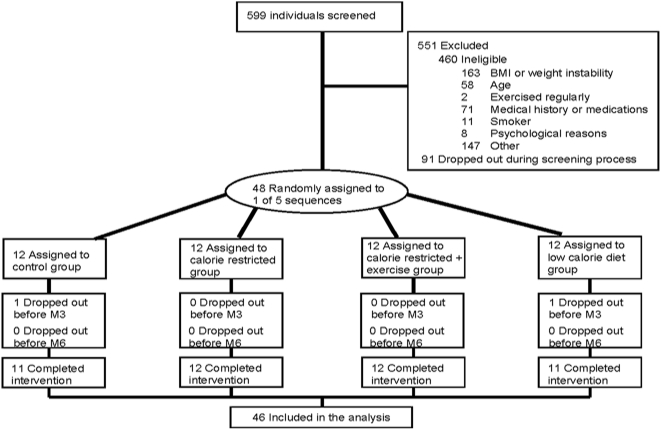
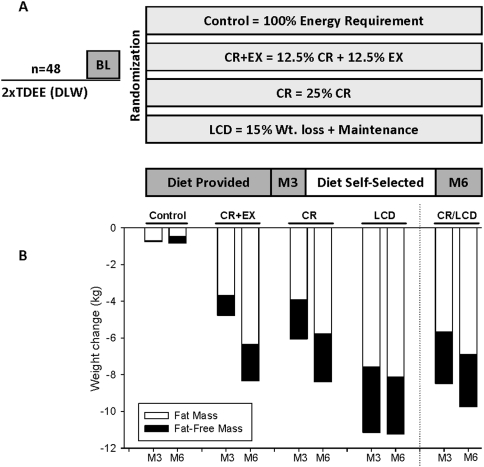
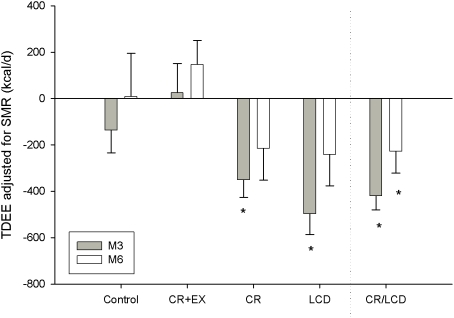
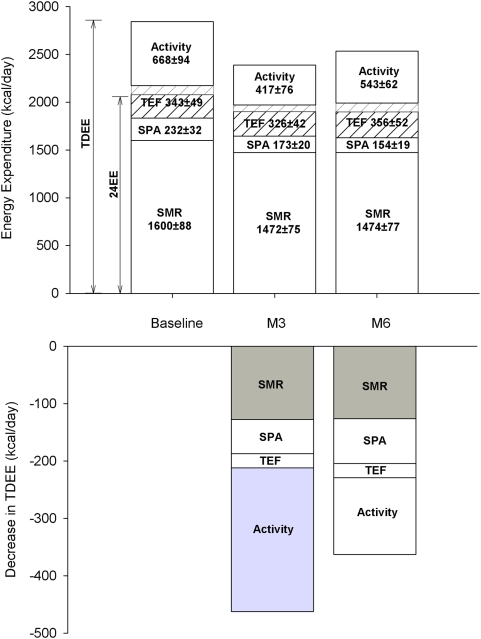
BACKGROUND: Metabolic and behavioral adaptations to caloric restriction (CR) in free-living conditions have not yet been objectively measured. METHODOLOGY AND PRINCIPAL FINDINGS: Forty-eight (36.8+/-1.0 y), overweight (BMI 27.8+/-0.7 kg/m(2)) participants were randomized to four groups for 6-months; CONTROL: energy intake at 100% of energy requirements; CR: 25% calorie restriction; CR+EX: 12.5% CR plus 12.5% increase in energy expenditure by structured exercise; LCD: low calorie diet (890 kcal/d) until 15% weight reduction followed by weight maintenance. Body composition (DXA) and total daily energy expenditure (TDEE) over 14-days by doubly labeled water (DLW) and activity related energy activity (AREE) were measured after 3 (M3) and 6 (M6) months of intervention. Weight changes at M6 were -1.0+/-1.1% (CONTROL), -10.4+/-0.9% (CR), -10.0+/-0.8% (CR+EX) and -13.9+/-0.8% (LCD). At M3, absolute TDEE was significantly reduced in CR (-454+/-76 kcal/d) and LCD (-633+/-66 kcal/d) but not in CR+EX or controls. At M6 the reduction in TDEE remained lower than baseline in CR (-316+/-118 kcal/d) and LCD (-389+/-124 kcal/d) but reached significance only when CR and LCD were combined (-351+/-83 kcal/d). In response to caloric restriction (CR/LCD combined), TDEE adjusted for body composition, was significantly lower by -431+/-51 and -240+/-83 kcal/d at M3 and M6, respectively, indicating a metabolic adaptation. Likewise, physical activity (TDEE adjusted for sleeping metabolic rate) was significantly reduced from baseline at both time points. For control and CR+EX, adjusted TDEE (body composition or sleeping metabolic rate) was not changed at either M3 or M6. CONCLUSIONS: For the first time we show that in free-living conditions, CR results in a metabolic adaptation and a behavioral adaptation with decreased physical activity levels. These data also suggest potential mechanisms by which CR causes large inter-individual variability in the rates of weight loss and how exercise may influence weight loss and weight loss maintenance. TRIAL REGISTRATION: ClinicalTrials.gov NCT00099151.
Overview
The claims and statistics of this paper haven’t been checked yet.
Run the check — free, no account needed. It reads the open-access text and checks the sources it cites.
Integrity signals
Registry
Cites
Statistics
Figures
Verification
Claims the paper makes
The claims and statistics of this paper haven’t been checked yet.
Run the check — free, no account needed. It reads the open-access text and checks the sources it cites.
Claims other papers make about this one
Each is checked against this paper’s own text: does it say what the citing paper says it does?
In the citing paper
“Even weight loss via caloric restriction faces difficulties, including an evolution-engendered guard against low fat mass [7, 31] and the propensity of the body to increase caloric efficiency during dieting [32, 33].”
From Regulation of obesity and insulin resistance by nitric oxide (2014) · cites this paper as [32]
In the citing paper
“Third, and probably most important, the body has homeostatic mechanisms such that weight loss produces an increase in caloric efficiency, i.e. a reduction in BMR, making further weight loss even more difficult 11,12.”
From Cellular bioenergetics as a target for obesity therapy (2010) · cites this paper as [11]
Self-check
Percentages, sums and reported differences re-computed from the paper’s own numbers.
The self-check needs the paper’s full text.
Citations
Cites
(1992) · PubMed · Cited by 33,716
The MOS 36-ltem Short-Form Health Survey (SF-36): I. Conceptual Framework and Item Selection
Ware, J. E., & Sherbourne, C. D. (1992) · Medical Care · doi:10.1097/00005650-199206000-00002 · Cited by 30,033
SF-36 health survey: Manual and interpretation guide
Ware, J. (2003) · Medical Entomology and Zoology · Cited by 11,424
Oxidative Stress, Caloric Restriction, and Aging
Sohal, R. S., & Weindruch, R. H. (1996) · Science · doi:10.1126/science.273.5271.59 · Cited by 3,133
THE BIOLOGY OF HUMAN STARVATION
Keys, A., BROŽEK, J., & Henschel, A. (1951) · The Medical Journal of Australia · doi:10.5694/j.1326-5377.1951.tb56499.x · Cited by 2,135
The Biology of Human Starvation: Volume I
KEYS, A., BROŽEK, J., HENSCHEL, A., MICKELSEN, O., & TAYLOR, H. L. (1950) · doi:10.5749/j.ctv9b2tqv · Cited by 2,039
Changes in Energy Expenditure Resulting from Altered Body Weight
Leibel, R. L., Rosenbaum, M., & Hirsch, J. (1995) · New England Journal of Medicine · doi:10.1056/nejm199503093321001 · Cited by 2,012
Handbook of the Biology of Aging
Finch, C. E., & Schneider, E. L. (1990) · DigitalGeorgetown (Georgetown University Library) · Cited by 1,210
Determinants of 24-hour energy expenditure in man. Methods and results using a respiratory chamber.
Ravussin, E., Lillioja, S., Anderson, T. E., Christin, L., & Bogardus, C. (1986) · Journal of Clinical Investigation · doi:10.1172/jci112749 · Cited by 1,166
Role of Nonexercise Activity Thermogenesis in Resistance to Fat Gain in Humans
Levine, J. A., Eberhardt, N. L., & Jensen, M. D. (1999) · Science · doi:10.1126/science.283.5399.212 · Cited by 997
Research works printed but not linked: 1
- MI Frisard, 2007, Physical activity level and physical functionality in nonagenarians compared to individuals aged 60–74 years., J Gerontol A Biol Sci Med Sci, 62, 783, 10.1093/gerona/62.7.783 · DOI
Cited by
Sorted by citations
Garvey, W. T., Mechanick, J. I., Brett, E. M., Garber, A. J., Hurley, D. L., Jastreboff, A. M., Nadolsky, K., Pessah-Pollack, R., & Plodkowski, R. (2016) · Endocrine Practice · doi:10.4158/ep161365.gl · Cited by 1,914
Sutton, E. F., Beyl, R., Early, K. S., Cefalu, W. T., Ravussin, E., & Peterson, C. M. (2018) · Cell Metabolism · doi:10.1016/j.cmet.2018.04.010 · Cited by 1,531
Speakman, J. R., & Mitchell, S. E. (2011) · Molecular Aspects of Medicine · doi:10.1016/j.mam.2011.07.001 · Cited by 797
Cellular bioenergetics as a target for obesity therapy
Tseng, Y.-H., Cypess, A. M., & Kahn, C. R. (2010) · Nature Reviews Drug Discovery · doi:10.1038/nrd3138 · Cited by 591
Calorie restriction in humans: An update
Most, J., Tosti, V., Redman, L. M., & Fontana, L. (2017) · Ageing Research Reviews · doi:10.1016/j.arr.2016.08.005 · Cited by 530
Metadata
- Authors
- Redman, L. M., Heilbronn, L. K., Martin, C. K., de Jonge, L., Williamson, D. A., Delany, J. P., Ravussin, E., & for the Pennington CALERIE team
- Affiliations
- Pennington Biomedical Research Center (US)
- Venue
- PLoS ONE
- Publisher
- Public Library of Science (PLoS)
- Published
- 2009-02-09
- Volume
- 4
- Issue
- 2
- Pages
- e4377
- ISSN
- 1932-6203 (ISSN-L)
- PMC
- PMC2634841
- OpenAlex
- W2037703570
- Cited by
- 355
- References
- 39
- Citations by year
- 2026: 8 · 2025: 8 · 2024: 10 · 2023: 15 · 2022: 18 · 2021: 18 · 2020: 12 · 2019: 9 · 2018: 22 · 2017: 20 · 2016: 22 · 2015: 52 · 2014: 37 · 2013: 20 · 2012: 23
- FWCI
- 18.62
- Type
- journal article
- Language
- en
- Open access
- gold
- doi.org
- Locations
- PLoS ONE (publishedVersion, cc-by)
- PubMed Central (publishedVersion, cc-by)
- PubMed (publishedVersion)
- Adelaide Research & Scholarship (AR&S) (University of Adelaide) (submittedVersion, other-oa)
- DOAJ (DOAJ: Directory of Open Access Journals) (submittedVersion, cc-by-sa)
- Figshare (submittedVersion, cc-by)
- Funders
- National Institutes of Health (5k23dk068052-04)
- Medical Research Council
- National Health and Medical Research Council
- National Institute on Aging (U01AG020478, U01-AG20478)
- National Institute of Diabetes and Digestive and Kidney Diseases (K23-DK-068052, K23 DK068052-01A2, P30DK072476)
- Topics
- Health Sciences › Medicine › Physiology (medical) › Dietary Effects on Health
- Life Sciences › Neuroscience › Endocrine and Autonomic Systems › Regulation of Appetite and Obesity
- Health Sciences › Medicine › Public Health, Environmental and Occupational Health › Obesity, Physical Activity, Diet
- Keywords
- caloric restriction, weight loss maintenance, metabolic adaptation, total energy expenditure, physical activity, hypocaloric diet, body composition, energy expenditure, overweight adults, free-living conditions, behavioral adaptation, doubly labeled water, sleeping metabolic rate, obesity treatment, compensatory behavior
- MeSH terms
- Adult, Body Composition, Energy Intake, Energy Metabolism, Female, Humans, Male, Middle Aged, Weight Loss, Body Mass Index, Caloric Restriction, Behavior Control
About these checks
Registry, retraction, Cites and statistics results are computed, not judged, with one exception: a printed reference that no index lists is read once by a model before it counts as a citation error. Claims are extracted by a model and kept only when their quote appears verbatim in the text; each cited source is then checked, with a model’s help, for whether it says what the claim relies on. Those verdicts can be wrong — read the claim’s quote and the cited source before relying on one.
Statistics and arithmetic are recomputed, not judged.
Confidence bands are shown only for fields calibrated on our annotated test set. None is calibrated yet, so no band is shown.
What counts as a claim ›How we measure confidence ›How we check this ›
Are you an author, or do you see a problem with this page? Request a review
