

INK4/ARF Transcript Expression Is Associated with Chromosome 9p21 Variants Linked to Atherosclerosis
Open accessThe DOI matches its Crossref record; 44 of the 44 references it cites were found in a registry or an index.
Abstract
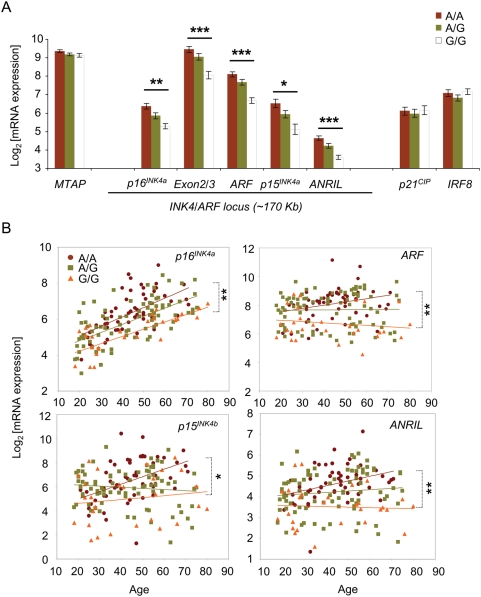
BACKGROUND: Genome-wide association studies (GWAS) have linked common single nucleotide polymorphisms (SNPs) on chromosome 9p21 near the INK4/ARF (CDKN2A/B) tumor suppressor locus with risk of atherosclerotic diseases and type 2 diabetes mellitus. To explore the mechanism of this association, we investigated whether expression of proximate transcripts (p16(INK4a), p15(INK4b), ARF, ANRIL and MTAP) correlate with genotype of representative 9p21 SNPs. METHODOLOGY/PRINCIPAL FINDINGS: We analyzed expression of 9p21 transcripts in purified peripheral blood T-cells (PBTL) from 170 healthy donors. Samples were genotyped for six selected disease-related SNPs spanning the INK4/ARF locus. Correlations among these variables were determined by univariate and multivariate analysis. Significantly reduced expression of all INK4/ARF transcripts (p15(INK4b), p16(INK4a), ARF and ANRIL) was found in PBTL of individuals harboring a common SNP (rs10757278) associated with increased risk of coronary artery disease, stroke and aortic aneurysm. Expression of MTAP was not influenced by rs10757278 genotype. No association of any these transcripts was noted with five other tested 9p21 SNPs. CONCLUSIONS/SIGNIFICANCE: Genotypes of rs10757278 linked to increased risk of atherosclerotic diseases are also associated with decreased expression in PBTL of the INK4/ARF locus, which encodes three related anti-proliferative transcripts of known importance in tumor suppression and aging.
Overview
The claims and statistics of this paper haven’t been checked yet.
Free: it reads the open-access text and checks the first 5 claims that cite a source we can check. Create a free account to check every claim.
Integrity signals
Registry
Cites
Statistics
Figures
Verification
Claims the paper makes
The claims and statistics of this paper haven’t been checked yet.
Free: it reads the open-access text and checks the first 5 claims that cite a source we can check. Create a free account to check every claim.
Claims other papers make about this one
Each is checked against this paper’s own text: does it say what the citing paper says it does?
The source backs part of the claim, not all of it — or backs it for a different population, condition or comparison.
In the citing paper
“Knock-out of p16 INK4a, p19 ARF, p21, and p53 had a pro-atherosclerotic effect in mice.203–205”
From Senescence-induced inflammation: an important player and key therapeutic target in atherosclerosis (2020) · cites this paper as [204]
Experimental — accuracy not yet measured
Self-check
Percentages, sums and reported differences re-computed from the paper’s own numbers.
The self-check needs the paper’s full text.
Citations
Cites
Analysis of Relative Gene Expression Data Using Real-Time Quantitative PCR and the 2−ΔΔCT Method
Livak, K. J., & Schmittgen, T. D. (2001) · Methods · doi:10.1006/meth.2001.1262 · Cited by 180,860
Genome-wide association study of 14,000 cases of seven common diseases and 3,000 shared controls
The Wellcome Trust Case Control Consortium, Management Committee, Burton, P. R., Clayton, D. G., Cardon, L. R., Craddock, N., Deloukas, P., Duncanson, A., Kwiatkowski, D. P., McCarthy, M. I., et al. (2007) · Nature · doi:10.1038/nature05911 · Cited by 9,442
A haplotype map of the human genome
The International HapMap Consortium (2005) · Nature · doi:10.1038/nature04226 · Cited by 5,858
Functional Demarcation of Active and Silent Chromatin Domains in Human HOX Loci by Noncoding RNAs
Rinn, J. L., Kertesz, M., Wang, J. K., Squazzo, S. L., Xu, X., Brugmann, S. A., Goodnough, L. H., Helms, J. A., Farnham, P. J., Segal, E., et al. (2007) · Cell · doi:10.1016/j.cell.2007.05.022 · Cited by 4,244 · cited 1×
“On the other hand, ANRIL could also influence the expression of other genes in trans- as has been recently reported for HOTAIR at Hox loci [39].”
BackgroundMutation of the mouse klotho gene leads to a syndrome resembling ageing
Kuro-o, M., Matsumura, Y., Aizawa, H., Kawaguchi, H., Suga, T., Utsugi, T., Ohyama, Y., Kurabayashi, M., Kaname, T., Kume, E., et al. (1997) · Nature · doi:10.1038/36285 · Cited by 3,837
Genome-wide association analysis identifies loci for type 2 diabetes and triglyceride levels
Saxena, R., Voight, B. F., Lyssenko, V., Burtt, N. P., de Bakker, P. I. W., Chen, H., Roix, J. J., Kathiresan, S., Hirschhorn, J. N., Daly, M. J., et al. (2007) · Science · doi:10.1126/science.1142358 · Cited by 2,843
A genome-wide association study of type 2 diabetes in Finns detects multiple susceptibility variants
Scott, L. J., Mohlke, K. L., Bonnycastle, L. L., Willer, C. J., Li, Y., Duren, W. L., Erdos, M. R., Stringham, H. M., Chines, P. S., Jackson, A. U., et al. (2007) · Science · doi:10.1126/science.1142382 · Cited by 2,753
Self-citationThe Wellcome Trust Case Control Consortium, U.K.
Mossman, K. (2008) · Scientific American · doi:10.1038/scientificamerican0108-42a · Cited by 2,684
Replication of Genome-Wide Association Signals in UK Samples Reveals Risk Loci for Type 2 Diabetes
Zeggini, E., Weedon, M. N., Lindgren, C. M., Frayling, T. M., Elliott, K. S., Lango, H., Timpson, N. J., Perry, J. R. B., Rayner, N. W., Freathy, R. M., et al. (2007) · Science · doi:10.1126/science.1142364 · Cited by 2,194 · cited 6×
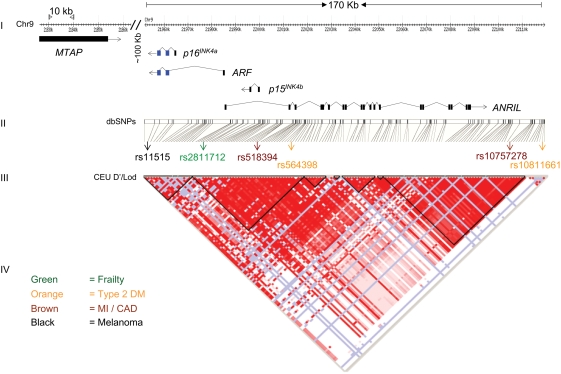
“We selected six SNPs for genotyping based on strength of association in previous studies: two associated with atherosclerosis (rs10757278 and rs518394) [1,2,3,4], two with T2DM (rs10811661 and rs564398) [8,9,10], one with frailty (rs2811712) [16], and one with melanoma (rs11515, in the 39 UTR of p16INK4a and ARF)[17]…”
BackgroundMethodInfluentialGenomewide Association Analysis of Coronary Artery Disease
Samani, N. J., Erdmann, J., Hall, A. S., Hengstenberg, C., Mangino, M., Mayer, B., Dixon, R. J., Meitinger, T., Braund, P., Wichmann, H.-E., et al. (2007) · New England Journal of Medicine · doi:10.1056/nejmoa072366 · Cited by 2,044 · cited 5×
“1), could mediate disease associations [3,4].”
BackgroundMethodInfluential
Research works printed but not linked: 1
- Helgadottir A Thorleifsson G Manolescu A Gretarsdottir S Blondal T 2007 A common variant on chromosome 9p21 affects the risk of myocardial infarction. Science 316 1491 1493 17478679 · DOI · Paper page
Cited by
Items 201–248 of 248
Omrani, M. D., Mohammad‐Rahimi, H., Basiri, A., Fallahian, M., Noroozi, R., Taheri, M. N., & Ghafouri‐Fard, S. (2021) · Urology journal./Urology jornal. · doi:10.22037/uj.v18i.6337 · Cited by 4
Aging-related epigenetic instability in lncRNAs and miRNAs mediates the development of hypertension
Chandhru, M., Ramamurthy, K., Sudhakaran, G., Choi, K. C., Arasu, M. V., & Arockiaraj, J. (2025) · European Journal of Pharmacology · doi:10.1016/j.ejphar.2025.178150 · Cited by 4
Niemiec, P., Balcerzyk, A., Iwanicki, T., Emich‐Widera, E., Kopyta, I. A., Nowak, T., Pilarska, E., Pienczk-Ręcławowicz, K., Kaciński, M., Wendorff, J., et al. (2017) · Journal of Stroke and Cerebrovascular Diseases · doi:10.1016/j.jstrokecerebrovasdis.2017.06.053 · Cited by 3
An increase in a long noncoding RNA ANRIL in peripheral plasma is an indicator of stable angina
Jiao, Y., Meng, F., Ma, G., Lei, H., & Liu, J. (2023) · Clinics · doi:10.1016/j.clinsp.2023.100289 · Cited by 3
“22 Ahmed W ’ s study also demonstrated a strong association between ANRIL single nucleotide polymorphisms and myocardial infarction as well as familial hypercho-lesterolemia patients in a population from northern Pakistan.”
BackgroundAnalysis on the Polymorphism of Chromosome Region 9p21 and the Susceptibility of Carotid Plaque
Sun, J., Sun, F., Yang, K., Fu, N., & Li, L. (2016) · European Neurology · doi:10.1159/000452970 · Cited by 3
Long Noncoding RNAs in Cardiovascular Disease
Holdt, L. M., Kohlmaier, A., & Teupser, D. (2019) · Cardiac and vascular biology · doi:10.1007/978-3-030-27371-2_7 · Cited by 3
Long non-coding RNA — perspectives?
Beylerli, O., & Фанилевич, Г. И. (2020) · Russian Journal of Preventive Medicine · doi:10.17116/profmed202023021124 · Cited by 3
Genetic Risk Factors for Type 2 Diabetes and Related Traits
Hertel, J. K. (2012) · NVA (Nasjonalt vitenarkiv) · Cited by 3
Assessment of Cytotoxic and Genotoxic Potential of Heavy Metals in Plants: A Review
Mishra, K. (2020) · International Journal of Plant and Environment · doi:10.18811/ijpen.v6i02.09 · Cited by 2
Shi, P., Tang, B., Xie, W., Li, K., Guo, D., Li, Y., Yao, Y., Cheng, X., Xu, C., & Wang, Q. K. (2025) · Journal of Biological Chemistry · doi:10.1016/j.jbc.2025.110246 · Cited by 3
“However, a separate study showed that the atherosclerosis risk allele was associated with the reduced transcription of all four INK4/ARF-related transcripts, including ANRIL (17).”
Nuclear Reprogramming and Its Role in Vascular Smooth Muscle Cells
Zaina, S., Valencia-Morales, M. D. P., Tristán-Flores, F. E., & Lund, G. (2013) · Current Atherosclerosis Reports · doi:10.1007/s11883-013-0352-6 · Cited by 2
“The latter gene maps to 9p21 in humans, a locus robustly linked to cardiovascular risk [46–48].”
BackgroundGenetic basis of myocardial infarction: Novel insights from genome-wide association studies
Erdmann, J., Linsel‐Nitschke, P., & Schunkert, H. (2009) · Current Cardiovascular Risk Reports · doi:10.1007/s12170-009-0063-2 · Cited by 3
“Liu et al. [ 25 ] analyzed the expression of 9p21 transcripts in purifi ed peripheral blood T cells from healthy probands.”
BackgroundhCINAP alleviates senescence by regulating MDM2 via p14ARF and the HDAC1/CoREST complex
Huang, X., Zhao, Y. T., Wei, M., Zhuge, R., & Zheng, X. (2023) · Journal of Molecular Cell Biology · doi:10.1093/jmcb/mjad015 · Cited by 2
Genetics of Aneurysmal Disease: The Dogs That Did Not Bark
Breimer, L. H. (2010) · Angiology · doi:10.1177/0003319709360031 · Cited by 2
“In a study in 170 healthy donors looking at expression in peripheral blood T cells, a group at the University of North Carolina found significantly reduced expression of INK4/ARF transcripts (p15, p16, ARF, and ANRIL) in 1 chromosome 9p21 variant associated with increased MI, AAA, and stroke.(35) Expression of MTAP wa…”
BackgroundAkan, G., Nyawawa, E., Nyangasa, B., Türkcan, M. K., Mbugi, E. V., Janabi, M., & Atalar, F. (2022) · Research Square · doi:10.21203/rs.3.rs-1300387/v1 · Cited by 2
Does the 9p21 Genetic Variant Have a Role in Cardiovascular Risk Prediction?
Paynter, N. P. (2010) · Current Cardiovascular Risk Reports · doi:10.1007/s12170-010-0150-4 · Cited by 1
“Improvement in risk prediction is assessed using a combination of methods as outlined in recent guidelines [32].”
MethodBorghini, A., Mercuri, A., Campolo, J., Parolini, M., Ndreu, R., Turchi, S., & Andreassi, M. G. (2023) · Journal of Cardiovascular Development and Disease · doi:10.3390/jcdd10090387 · Cited by 2
“…that the Chr9p21 risk variants influence the expression of the non-coding RNA ANRIL and INK4/ARF-associated transcripts (CDKN2A, CDKN2B) [25–29], supporting a crucial role for cell cycle inhibition and key physiological processes, such as vascular senescence and apoptosis in atherosclerosis [24–28].”
BackgroundGenomic Biomarkers in Human Population Studies
Danik, J. S., Paynter, N. P., & Ridker, P. M. (2012) · Elsevier eBooks · doi:10.1016/b978-0-12-382227-7.00021-5 · Cited by 2
Genetic Variations of Long Noncoding RNAs in Cancer
Dimitrova, N. (2017) · Elsevier eBooks · doi:10.1016/b978-0-12-811022-5.00016-4 · Cited by 1
Beyond genome wide discovery: an exploration of novel genetic variants for coronary heart disease
Patel, R. S. (2012) · ORCA Online Research @Cardiff (Cardiff University) · Cited by 1
Scutt, G., & Overall, A. D. J. (2021) · Journal of Infection · doi:10.1016/j.jinf.2021.02.006 · Cited by 1
Environmental Contributors to Epigenetics and Cardiovascular Disease Risk
Park, L. C., Turgeon, P. J., & Marsden, P. A. (2015) · Molecular and integrative toxicology · doi:10.1007/978-1-4471-6678-8_9
A Tale of Two ARFs: Tumor Suppressor and Anti-viral Functions of p14ARF: A Dissertation
Straza, M. W. (2010) · eScholarship@UMassChan · doi:10.13028/e1vv-ka50
“36 INK4/ARF SNP’s and decreased expression levels of all members of the locus (165).”
BackgroundFolkersen, L. (2011) · Figshare
Worrall, B. B., Southerland, A. M., & Keene, K. L. (2012) · Springer eBooks · doi:10.1007/978-0-85729-209-4_12
“Furthermore, data are emerging that suggest that there may be two or more clusters of phenotypes within the region relating to different pathways [ 63 ] .”
BackgroundCORONARY ARTERY DISEASE SUSCEPTIBILITY LOCUS ON CHROMOSOME 9P21
Beeton, L. D., Burch, B., Russell, K., Salvage, S. C., Chivers, P., & Webb, K. E. (2009) · Atherosclerosis · doi:10.1016/j.atherosclerosis.2009.09.048
Characterization of 𝘈𝘵𝘩𝘴𝘲1, an Atherosclerosis Modifier Locus on Mouse Chromosome 4:
Kuo, C.-L. (2011) · doi:10.7916/d8cv4qxc
“Individuals carrying the risk allele have been shown to exhibit decreased expression of p16, p19, and p15 -inhibitors of cellular proliferation encoded by the nearby CDKN2A/B locus – as well as proximal transcripts of a non-coding mRNA ANRIL, in some studies (104-106) but not others (107, 108).”
BackgroundResultInfluentialVessel wall integrity influence of genetics and flow
Björck, H. M. (2012) · KTH Publication Database DiVA (KTH Royal Institute of Technology)
Genetics of Coronary Artery Disease
Fuster, V., & Kovacic, J. C. (2014)
Functional Regulation at the 9p21.3 Genetic Risk Locus in Coronary Artery Disease (CAD)
Antoine, D. (2015) · uO Research (University of Ottawa) · doi:10.20381/ruor-4083
Investigating Genetic Risk Factors of Coronary Artery Disease Using Genome Editing
McVey, D. G. (2016) · Figshare
Mahdavi, S. S. (2018) · TSpace (University of Toronto)
An Investigation of Circular RNAs on a Genome-Wide Scale
Jeck, W. R. (2013) · Carolina Digital Repository (University of North Carolina at Chapel Hill) · doi:10.17615/ysjn-jn69
Global Dysregulation of miRNAs via Dicer Deficiency in Atherosclerosis
Park, C. (2014) · TSpace (University of Toronto)
Genetics of (Premature) Coronary Artery Disease
Schunkert, H., & Erdmann, J. (2010) · Springer eBooks · doi:10.1007/978-1-84996-471-5_23
Genetics of (Premature) Coronary Artery Disease
Erdmann, J., & Schunkert, H. (2016) · Springer eBooks · doi:10.1007/978-3-319-44203-7_22
Worrall, B. B., Chiota-McCollum, N. A., & Southerland, A. M. (2017) · Springer eBooks · doi:10.1007/978-3-319-56210-0_12
Genetics of (Premature) Coronary Artery Disease
Erdmann, J., & Schunkert, H. (2020) · Springer eBooks · doi:10.1007/978-3-030-45457-9_24
Schäfer, A. S. (2015) · Springer eBooks · doi:10.1007/978-3-319-17942-1_7
Genetics of Carotid Atherosclerosis
Worrall, B. B., Southerland, A. M., & Gusler, M. T. (2024) · Springer eBooks · doi:10.1007/978-3-031-41777-1_14
The genetic contribution to stroke in northern Sweden
Janunger, T. (2010)
Suryavanshi, S., Yang, H., Salido, E., & Sardo, V. L. (2026) · bioRxiv (Cold Spring Harbor Laboratory) · doi:10.64898/2026.01.14.699552
Liu, I. S., Ren, H., & Park, C. (2026) · Journal of Cardio-oncology · doi:10.1097/co9.0000000000000010
Cudejko, C. (2010) · theses.fr (ABES) · doi:10.70675/3be56540zf3b1z4ee1z99ffz2dbbe7a0dc17
Rôle de l’immunosurveillance des cellules sénescentes dans le cancer et le vieillissement
Iltis, C. (2020) · theses.fr (ABES) · doi:10.70675/9a339b58z5fecz427dz8de4z8ce0bd748478 · Cited by 1
From bench to bedside : in silico and ex vivo approaches for managing radiotherapy late toxicities
Hettal, L. (2021) · theses.fr (ABES) · doi:10.70675/4aa11fcdzbc44z446fzb168z1ac8d22ba9cd
Oxidants and antioxidants in cardiovascular disease
Ekblom, K. (2010) · DiVA at Umeå University (Umeå University)
Metadata
- Authors
- Liu, Y., Sanoff, H. K., Cho, H., Burd, C. E., Torrice, C., Mohlke, K. L., Ibrahim, J. G., Thomas, N. E., & Sharpless, N. E.
- Affiliations
- University of North Carolina at Chapel Hill (US)
- Corresponding author
- Sharpless, Norman E.
- ORCID
- Venue
- PLoS ONE
- Publisher
- Public Library of Science (PLoS)
- Published
- 2009-04-03
- Volume
- 4
- Issue
- 4
- Pages
- e5027
- ISSN
- 1932-6203 (ISSN-L)
- PMC
- PMC2660422
- OpenAlex
- W2171205956
- Cited by
- 248
- References
- 44
- Citations by year
- 2026: 2 · 2025: 3 · 2024: 2 · 2023: 6 · 2022: 2 · 2021: 4 · 2020: 15 · 2019: 13 · 2018: 16 · 2017: 15 · 2016: 18 · 2015: 14 · 2014: 22 · 2013: 17 · 2012: 26
- FWCI
- 19.18
- Type
- journal article
- Language
- en
- Open access
- gold
- doi.org
- Locations
- PLoS ONE (publishedVersion, cc-by)
- PubMed Central (publishedVersion, cc-by)
- PubMed (publishedVersion)
- Carolina Digital Repository (University of North Carolina at Chapel Hill) (submittedVersion)
- DOAJ (DOAJ: Directory of Open Access Journals) (submittedVersion, cc-by-sa)
- Figshare (submittedVersion, cc-by)
- UNC Libraries
- Funders
- Burroughs Wellcome Fund
- Ellison Medical Foundation
- National Institutes of Health (5r01ag024379-15, AG024379)
- National Institute on Aging (AG024379, R01-AG024379)
- National Cancer Institute (T32CA009156, R01CA112243, CA009156-34)
- National Institute of Diabetes and Digestive and Kidney Diseases (DK-072193, R01DK072193)
- National Institute of Environmental Health Sciences (T32ES007126)
- National Center for Research Resources (RR023248, K12RR023248)
- Topics
- Life Sciences › Biochemistry, Genetics and Molecular Biology › Genetics › Genetic Associations and Epidemiology
- Life Sciences › Immunology and Microbiology › Immunology › Atherosclerosis and Cardiovascular Diseases
- Life Sciences › Biochemistry, Genetics and Molecular Biology › Clinical Biochemistry › Paraoxonase enzyme and polymorphisms
- Keywords
- INK4/ARF locus, chromosome 9p21, CDKN2A, CDKN2B, p16INK4a, ARF, ANRIL, MTAP, rs10757278, single nucleotide polymorphisms, gene expression, peripheral blood T cells, atherosclerosis, coronary artery disease, stroke, aortic aneurysm, type 2 diabetes, tumor suppressor, genetic association
- MeSH terms
- Chromosomes, Human, Pair 9, Genotype, Humans, RNA, Messenger, Polymorphism, Single Nucleotide, Atherosclerosis, Cyclin-Dependent Kinase Inhibitor Proteins, Genome-Wide Association Study
About these checks
Registry, retraction, Cites and statistics results are computed, not judged, with one exception: a printed reference that no index lists is read once by a model before it counts as a citation error. Claims are extracted by a model and kept only when their quote appears verbatim in the text; each cited source is then checked, with a model’s help, for whether it says what the claim relies on. Those verdicts can be wrong — read the claim’s quote and the cited source before relying on one.
Statistics and arithmetic are recomputed, not judged.
Confidence bands are shown only for fields calibrated on our annotated test set. None is calibrated yet, so no band is shown.
What counts as a claim ›How we measure confidence ›How we check this ›
Are you an author, or do you see a problem with this page? Request a review
Data sources
Bibliographic data: Semantic Scholar, OpenAlex, Crossref.
Contains information from the Semantic Scholar Academic Graph Datasets, made available under the ODC Attribution License (ODC-BY 1.0).
Semantic Scholar’s data is described in: Kinney, R., et al. (2023). The Semantic Scholar Open Data Platform. arXiv:2301.10140.
