

Normative Data for the 12 Item WHO Disability Assessment Schedule 2.0
Open accessThe DOI matches its Crossref record; 10 of the 10 references it cites were found in a registry or an index.
Abstract
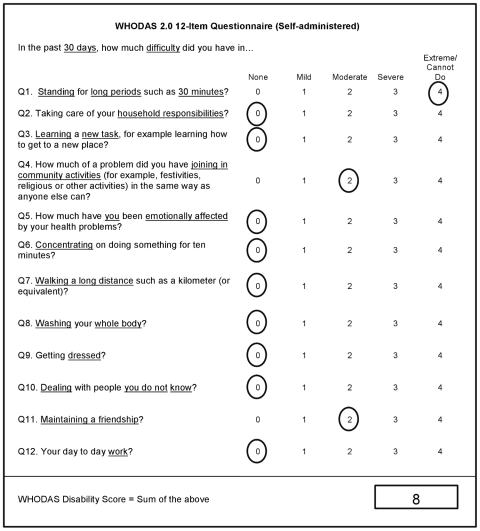
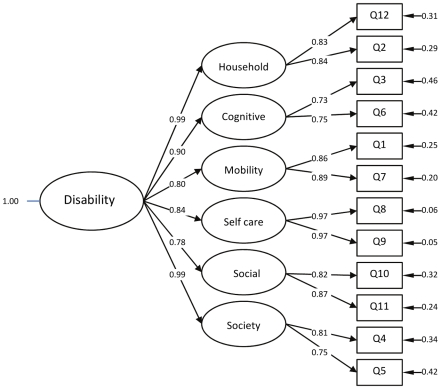
BACKGROUND: The World Health Organization Disability Assessment Schedule (WHODAS 2.0) measures disability due to health conditions including diseases, illnesses, injuries, mental or emotional problems, and problems with alcohol or drugs. METHOD: The 12 Item WHODAS 2.0 was used in the second Australian Survey of Mental Health and Well-being. We report the overall factor structure and the distribution of scores and normative data (means and SDs) for people with any physical disorder, any mental disorder and for people with neither. FINDINGS: A single second order factor justifies the use of the scale as a measure of global disability. People with mental disorders had high scores (mean 6.3, SD 7.1), people with physical disorders had lower scores (mean 4.3, SD 6.1). People with no disorder covered by the survey had low scores (mean 1.4, SD 3.6). INTERPRETATION: The provision of normative data from a population sample of adults will facilitate use of the WHODAS 2.0 12 item scale in clinical and epidemiological research.
Overview
The claims and statistics of this paper haven’t been checked yet.
Free: it reads the open-access text and checks the first 5 claims that cite a source we can check. Create a free account to check every claim.
Integrity signals
Registry
Cites
Statistics
Figures
Verification
Claims the paper makes
The claims and statistics of this paper haven’t been checked yet.
Free: it reads the open-access text and checks the first 5 claims that cite a source we can check. Create a free account to check every claim.
Claims other papers make about this one
Each is checked against this paper’s own text: does it say what the citing paper says it does?
The cited source says what the claim attributes to it.
In the citing paper
“Functional impairment was assessed with the 12-item WHO Disability Assessment Schedule (WHODAS) 2.0 [42].”
From Intolerance-of-uncertainty therapy versus metacognitive therapy for generalized anxiety disorder in primary health care: A randomized controlled pilot trial (2023) · cites this paper as [42]
The cited source says what the claim attributes to it.
In the citing paper
“The questionnaire yields a global disability score and has good psychometric properties (Rehm et al., 1999; Andrews et al., 2009).”
From Online mindfulness-enhanced cognitive behavioural therapy for anxiety and depression: Outcomes of a pilot trial (2018) · cites this paper as Andrews et al., 2009
The check wasn’t confident either way, so it gives no verdict — never disputed.
In the citing paper
“Research suggests that systematic assessment and feedback to clinicians can improve treatment outcomes.41”
From Acceptance-based Behavior Therapy for Depression With Psychosis (2015) · cites this paper as [41]
Experimental — accuracy not yet measured
Self-check
Percentages, sums and reported differences re-computed from the paper’s own numbers.
The self-check needs the paper’s full text.
Citations
Cites
Tabachnick, B. G., & Fidell, L. S. (1983) · Cited by 80,042
STATISTICAL METHODS FOR ASSESSING AGREEMENT BETWEEN TWO METHODS OF CLINICAL MEASUREMENT
Martin Bland, J., & Altman, D. (1986) · The Lancet · doi:10.1016/s0140-6736(86)90837-8 · Cited by 47,965
Statistical methods for assessing agreement between two methods of clinical measurement
Bland, J. M., & Altman, D. G. (2010) · International Journal of Nursing Studies · doi:10.1016/j.ijnurstu.2009.10.001 · Cited by 5,220 · cited 1×
“The data was scored using both scoring methods and compared to each other using Pearson’s correlation and the Bland-Altman method for assessing agreement between two measures [7].”
MethodThe Importance of the Normality Assumption in Large Public Health Data Sets
Lumley, T., Diehr, P., Emerson, S., & Chen, L. (2002) · Annual Review of Public Health · doi:10.1146/annurev.publhealth.23.100901.140546 · Cited by 1,803
2007 National Survey of Mental Health and Wellbeing: Methods and Key Findings
Slade, T., Johnston, A., Oakley Browne, M. A., Andrews, G., & Whiteford, H. (2009) · Australian & New Zealand Journal of Psychiatry · doi:10.1080/00048670902970882 · Cited by 832
Self-citationDisability and treatment of specific mental and physical disorders across the world
Ormel, J., Petukhova, M., Chatterji, S., Aguilar-Gaxiola, S., Alonso, J., Angermeyer, M. C., Bromet, E. J., Burger, H., Demyttenaere, K., de Girolamo, G., et al. (2008) · British Journal of Psychiatry · doi:10.1192/bjp.bp.107.039107 · Cited by 389
Rehm, J., Üstün, T. B., Saxena, S., Nelson, C. B., Chatterji, S., Ivis, F., & Adlaf, E. (1999) · International Journal of Methods in Psychiatric Research · doi:10.1002/mpr.61 · Cited by 287 · cited 2×
“0 [1] with a simple sum scoring method.”
BackgroundMethodFerrie, J. E., Kivimäki, M., Head, J., Shipley, M. J., Vahtera, J., & Marmot, M. G. (2005) · Occupational and Environmental Medicine · doi:10.1136/oem.2004.013896 · Cited by 226
The Accuracy of Self-Reported Disability Days
REVICKI, D. A., IRWIN, D., REBLANDO, J., & SIMON, G. E. (1994) · Medical Care · doi:10.1097/00005650-199404000-00008 · Cited by 137 · cited 1×
“. Furthermore, a growing body of research has evaluated the agreement of self-report measures of disability with objective measures of disability, finding good agreement”
BackgroundValidity of an illness severity measure for headache in a population sample of migraine sufferers
Stewart, W. F., Lipton, R. B., Simon, D., Liberman, J., & Von Korff, M. (1999) · Pain · doi:10.1016/s0304-3959(98)00181-x · Cited by 117
Research works printed but not linked: 1
- [3]3. Von Korff M, Andrews G, Delves M. Progress in assessing activity limitations and global disability among adults. 2009. Proceedings of the 2009 American Psychopathological Association meetings Mar 5–7; New York City, U.S (in press)
Cited by
Items 401–453 of 453
Ferreira, F. D. A. D. C. (2022) · Digital Library of Theses and Dissertations (Universidade de São Paulo) · doi:10.11606/d.5.2022.tde-26042022-164308
Psychopathology among Emerging Adults with Learning Disabilities in Canada
Chown, S. L., Browne, D. T., Leatherdale, S. T., & Ferro, M. A. (2022) · Disabilities · doi:10.3390/disabilities2040043 · Cited by 1
“, clinically relevant impairment) [37].”
Schizophrenia Spectrum and Other Psychotic Disorders: Third Wave Case Conceptualization
Ellenberg, S., & Gaudiano, B. A. (2022) · Springer eBooks · doi:10.1007/978-3-031-11677-3_22
Mental Health Classifications in Primary Care
Dowrick, C. F. (2023) · Cambridge University Press eBooks · doi:10.1017/9781009182232.013
Ahmed, K., & Mung’ayi, V. (2023) · International journal of anesthesia and clinical medicine. · doi:10.11648/j.ijacm.20231102.18
Assessing Health-related Quality of Life of Children
(2024) · Frontiers research topics · doi:10.3389/978-2-8325-4487-7
Évaluation de la récupération après chirurgie : intérêt des scores
Léger, M., Rineau, E., Campfort, M., & Lasocki, S. (2024) · Elsevier eBooks · doi:10.1016/b978-2-294-78187-2.00037-6
Vasiliadis, H., Roberge, P., Spagnolo, J., Lamoureux‐Lamarche, C., Chapdelaine, A., Brodeur, M., Grenier, J., Mahoney, A., Koszycki, D., Chomienne, M., et al. (2024) · BMC Psychiatry · doi:10.1186/s12888-024-06082-7
“The 12-item schedule measures activity limitations in the past 30 days in 6 domains (possible score range 0 to 60), will also be used to assess disability [69].”
MethodHawks, L. C., Iregbu, S., Walker, R. J., & Egede, L. E. (2024) · Journal of Affective Disorders · doi:10.1016/j.jad.2024.10.111
Mahoney, A., Chu, A., Shiner, C. T., Millard, M., & Brakoulias, V. (2025) · Journal of Obsessive-Compulsive and Related Disorders · doi:10.1016/j.jocrd.2025.100937
Katar, K. S., Işık, Ş., İspir, G. Z., & Gündoğmuş, A. G. (2025) · İnönü Üniversitesi Sağlık Hizmetleri Meslek Yüksek Okulu Dergisi · doi:10.33715/inonusaglik.1567475
Feasibility, utility, and acceptability of an online ACT-based rehabilitation for clinical burnout
van de Leur, J. C., Lundbäck, K., Forslund, S., Virtanen, N., & Buhrman, M. (2025) · Cognitive Behaviour Therapy · doi:10.1080/16506073.2025.2530420 · Cited by 3
“WHODAS-12 is a shorter version of the original 36-item scale that is useful for measuring functional impairment in psychiatric disorders and has been shown to be a reliable and valid instrument when administered via interview (Andrews et al., 2009; Weeks et al., 2016).”
Nguyen, J. M. V., Vicus, D., Hogen, L., Zigras, T., Paré, G., Chong, M., Roldán, Y., Devereaux, P. J., Ofori, S., Borges, F. K., et al. (2025) · PLoS ONE · doi:10.1371/journal.pone.0325651 · Cited by 1
“We will measure disability in several domains (including cognition, mobility, self-care, participation) using the 12-item World Health Organization Disability Assessment Schedule (WHODAS 2.0) [68], a patient-reported outcome tool widely validated in surgical older populations [69].”
InfluentialBrown, D. A., Tariq, S., Boffito, M., Asboe, D., Milinkovic, A., Nwokolo, N. C., Flavell, C. A., Strachan, S., Avery, L. M., O’Brien, K. K., et al. (2026) · PLoS ONE · doi:10.1371/journal.pone.0336679
“For WHODAS simple and complex sum scores, we calculated mean (standard deviation (SD)) and median (IQR as 25 th -75 th percentile) to align with normative data and existing literature [3,54,55].”
Lynham, A. J., Kendall, K. M., Walters, J., & Jones, I. R. (2026) · BJPsych Open · doi:10.1101/2025.11.17.25340399
Capin, J. J., Wilson, M. P., Hare, K., Vempati, S., Little, C. E., McGregor, D. V., Castillo‐Mancilla, J., Stevens‐Lapsley, J. E., Jolley, S. E., & Erlandson, K. M. (2022) · Figshare · doi:10.6084/m9.figshare.19424868
Eze, C. C., Ekeke, N., Alphonsus, C., Lehman, L. F., Chukwu, J. N., Nwafor, C. C., Stillwaggon, E. M., Meka, A., Sawers, L., Ikebudu, J., et al. (2021) · Figshare · doi:10.6084/m9.figshare.16681663
Boran, P., Dönmez, M., Barış, E., Us, M. C., Altaş, Z. M., Nisar, A., Atif, N., Sikander, S., Hıdıroğlu, S., Save, D., et al. (2023) · Figshare · doi:10.6084/m9.figshare.22607983
Eze, C. C., Ekeke, N., Alphonsus, C., Lehman, L. F., Chukwu, J. N., Nwafor, C. C., Stillwaggon, E. M., Meka, A., Sawers, L., Ikebudu, J., et al. (2021) · Figshare · doi:10.6084/m9.figshare.16681672
Capin, J. J., Wilson, M. P., Hare, K., Vempati, S., Little, C. E., McGregor, D. V., Castillo‐Mancilla, J., Stevens‐Lapsley, J. E., Jolley, S. E., & Erlandson, K. M. (2022) · Figshare · doi:10.6084/m9.figshare.19424865
Sasso, E. M., Muraki, K., Eaton-Fitch, N., Smith, P., Lesslar, O. L., Deed, G., & Marshall-Gradisnik, S. (2022) · Figshare · doi:10.6084/m9.figshare.20521400
Eze, C. C., Ekeke, N., Alphonsus, C., Lehman, L. F., Chukwu, J. N., Nwafor, C. C., Stillwaggon, E. M., Meka, A., Sawers, L., Ikebudu, J., et al. (2021) · Figshare · doi:10.6084/m9.figshare.16681681
Eze, C. C., Ekeke, N., Alphonsus, C., Lehman, L. F., Chukwu, J. N., Nwafor, C. C., Stillwaggon, E. M., Meka, A., Sawers, L., Ikebudu, J., et al. (2021) · Figshare · doi:10.6084/m9.figshare.16681675
Eze, C. C., Ekeke, N., Alphonsus, C., Lehman, L. F., Chukwu, J. N., Nwafor, C. C., Stillwaggon, E. M., Meka, A., Sawers, L., Ikebudu, J., et al. (2021) · Figshare · doi:10.6084/m9.figshare.16681678
Eze, C. C., Ekeke, N., Alphonsus, C., Lehman, L. F., Chukwu, J. N., Nwafor, C. C., Stillwaggon, E. M., Meka, A., Sawers, L., Ikebudu, J., et al. (2021) · Figshare · doi:10.6084/m9.figshare.16681687
Eze, C. C., Ekeke, N., Alphonsus, C., Lehman, L. F., Chukwu, J. N., Nwafor, C. C., Stillwaggon, E. M., Meka, A., Sawers, L., Ikebudu, J., et al. (2021) · Figshare · doi:10.6084/m9.figshare.16681684
Eze, C. C., Ekeke, N., Alphonsus, C., Lehman, L. F., Chukwu, J. N., Nwafor, C. C., Stillwaggon, E. M., Meka, A., Sawers, L., Ikebudu, J., et al. (2021) · Figshare · doi:10.6084/m9.figshare.16681693
Eze, C. C., Ekeke, N., Alphonsus, C., Lehman, L. F., Chukwu, J. N., Nwafor, C. C., Stillwaggon, E. M., Meka, A., Sawers, L., Ikebudu, J., et al. (2021) · Figshare · doi:10.6084/m9.figshare.16681690
Eze, C. C., Ekeke, N., Alphonsus, C., Lehman, L. F., Chukwu, J. N., Nwafor, C. C., Stillwaggon, E. M., Meka, A., Sawers, L., Ikebudu, J., et al. (2021) · Figshare · doi:10.6084/m9.figshare.16681666
Eze, C. C., Ekeke, N., Alphonsus, C., Lehman, L. F., Chukwu, J. N., Nwafor, C. C., Stillwaggon, E. M., Meka, A., Sawers, L., Ikebudu, J., et al. (2021) · Figshare · doi:10.6084/m9.figshare.16681696
Kröönström, L. A., Krause, J., Larsson, S. B., Sigström, R., & Sunnerhagen, K. S. (2024) · Figshare · doi:10.6084/m9.figshare.26556464
Non-communicable diseases in Ghana: risk factors, prevalence and social support systems
Banchani, E. (2021) · Memorial University Research Repository (Memorial University) · doi:10.48336/111n-0230 · Cited by 1
Eze, C. C., Ekeke, N., Alphonsus, C., Lehman, L. F., Chukwu, J. N., Nwafor, C. C., Stillwaggon, E. M., Meka, A. O., Sawers, L., Ikebudu, J., et al. (2021) · Figshare · doi:10.6084/m9.figshare.16681669
van de Leur, J. C. (2024) · Uppsala University Publications (Uppsala University) · Cited by 4
Spritzer, D. T. (2022) · LA Referencia (Red Federada de Repositorios Institucionales de Publicaciones Científicas)
Behavioural activation for depressed older adults in primary care
Janssen, N. P. (2024) · Radboud Repository (Radboud University)
Plamondon, J. (2021) · Corpus Université Laval (Université Laval)
Therrien, F., Ward, C., Zhang, Z., Chokka, P. R., Habert, J., Ismail, Z., McIntyre, R. S., & Marrache, A. M. (2025) · Journal of Clinical Psychopharmacology · doi:10.1097/jcp.0000000000002118
“23 Using anchor-based and distri-bution-based methods, a clinically relevant improvement in IDS-SR 10 Life Engagement subscale score was estimated as a 3-point (small/moderate improvement) to 5-point (large improvement) reduction from baseline in outpatients with MDD. 23 On the IDS-SR total score, an 11-to 15-point de…”
InfluentialGetie, A. A., Abebe, S. M., Ayelee, T. A., Azale, T., & Worku, N. (2026) · International Journal of Rehabilitation Research · doi:10.1097/mrr.0000000000000694
Germain, A., Wolfson, M. D., Espejo, E. P., Byrd, A. M., Jurick, S. M., Hungerford, L. D., Sitzer, T., Healy, K., Chinoy, E. D., Sessoms, P. H., et al. (2026) · Trials · doi:10.1186/s13063-026-09483-z
“The WHODAS 2.0 [38, 39] will be administered at baseline, post-intervention, and the 3-month follow-up.”
InfluentialComparison of health outcomes between traumatic spinal cord and cauda equina injuries
Beaumont, X., Liew, S. M., Reeder, S. C., Dipnall, J. F., & Gabbe, B. J. (2026) · Spinal Cord · doi:10.1038/s41393-026-01191-4
“The VSTR also administers the 12-item WHODAS 2.0 survey, which re fl ects a patient ’ s overall level of disability, re fl ecting the level of disability in the following categories: cognition, mobility, self-care, social interaction, general life activities and social participation [26].”
InfluentialMoral injury events, pain intensity, and functional mobility in post-9/11 U.S. combat veterans
Wild, M. G., Coppin, J. D., Greer, D., Mendoza, C., Herbert, M. S., Creech, S. K., & Frankfurt, S. B. (2026) · Journal of Pain · doi:10.1016/j.jpain.2026.106287
Jaisoorya, T. S., Sudhir, P. M., Thennarassu, K., & Reddy, Y. C. J. (2026) · The Canadian Journal of Psychiatry · doi:10.1177/07067437261442377
Sharma, P., Bhandari, A. R., Singh, S., Gurung, G., Joshi, C., Shakya, R., Amatya, A., & Shakya, R. (2026) · Nepal Journal of Dermatology Venereology & Leprology · doi:10.3126/njdvl.v24i1.81138
Gette, J. A., Hien, D. A., Kehle-Forbes, S. M., Curto, S., Hodgkins, C. C., Nelson, D. B., & Norman, S. B. (2026) · Contemporary Clinical Trials Communications · doi:10.1016/j.conctc.2026.101668
“The WHO Disability Schedule 2.0 (WHODAS) [51] is used to assess functional impairment.”
InfluentialKosilek, R. P., Schröder, N., Sanftenberg, L., Jung‐Sievers, C., Lindemann, D., Beutel, A., Schmidt, K., Brettschneider, C., König, H., & Gensichen, J. S. (2026) · Journal of Psychosomatic Research · doi:10.1016/j.jpsychores.2026.112932
Magawa, C. T., Eaton-Fitch, N., Muraki, K., & Marshall‐Gradisnik, S. (2026) · European Journal of Immunology · doi:10.1002/eji.70240
Miller, R., Dunn, J. A., O’Beirne, G. A., Whitney, S. L., & Snell, D. L. (2026) · Brain Impairment · doi:10.1071/ib25095
de Oliveira, M. V. S., de Menezes, G. M. B., & Fontenelle, L. F. (2026) · Comprehensive Psychiatry · doi:10.1016/j.comppsych.2026.152743
Engheepi, F. B. P., Rai, A. D., Visi, V., Thapa, A., & Sonowal, N. J. (2026) · Research Square · doi:10.21203/rs.3.rs-10515437/v1
Metadata
- Authors
- Andrews, G., Kemp, A., Sunderland, M., Von Korff, M., & Ustun, T. B.
- Affiliations
- UNSW Sydney (AU)
- Corresponding author
- Andrews, Gavin
- Venue
- PLoS ONE
- Publisher
- Public Library of Science (PLoS)
- Published
- 2009-12-17
- Volume
- 4
- Issue
- 12
- Pages
- e8343
- ISSN
- 1932-6203 (ISSN-L)
- PMC
- PMC2791224
- OpenAlex
- W1993518198
- Semantic Scholar
- e42043e91955e5ff5e03e7372b91bc528696467a
- Cited by
- 437
- References
- 10
- Citations by year
- 2026: 20 · 2025: 26 · 2024: 29 · 2023: 32 · 2022: 45 · 2021: 45 · 2020: 36 · 2019: 31 · 2018: 36 · 2017: 33 · 2016: 38 · 2015: 15 · 2014: 19 · 2013: 14 · 2012: 9
- FWCI
- 13.34
- Type
- journal article
- Language
- en
- Open access
- gold
- doi.org
- Locations
- PLoS ONE (publishedVersion, cc-by)
- PubMed Central (publishedVersion, cc-by)
- PubMed (publishedVersion)
- UNSWorks (University of New South Wales, Sydney, Australia) (submittedVersion, cc-by-nc-nd)
- RePEc: Research Papers in Economics (submittedVersion)
- DOAJ (DOAJ: Directory of Open Access Journals) (submittedVersion, cc-by-sa)
- Funders
- Medical Research Council
- National Health and Medical Research Council (510137)
- Topics
- Social Sciences › Economics, Econometrics and Finance › Economics and Econometrics › Health Systems, Economic Evaluations, Quality of Life
- Health Sciences › Medicine › Public Health, Environmental and Occupational Health › Aging, Health, and Disability
- Social Sciences › Decision Sciences › Management Science and Operations Research › Psychometric Methodologies and Testing
- Keywords
- WHODAS 2.0, disability assessment, reference values, global disability, factor structure, mental illness, physical disorders, adults
- MeSH terms
- Adolescent, Adult, Aged, Aged, 80 and over, Mental Disorders, Disability Evaluation, Persons with Disabilities, Health Surveys, Humans, Middle Aged, Surveys and Questionnaires, World Health Organization, Models, Statistical, Young Adult
About these checks
Registry, retraction, Cites and statistics results are computed, not judged, with one exception: a printed reference that no index lists is read once by a model before it counts as a citation error. Claims are extracted by a model and kept only when their quote appears verbatim in the text; each cited source is then checked, with a model’s help, for whether it says what the claim relies on. Those verdicts can be wrong — read the claim’s quote and the cited source before relying on one.
Statistics and arithmetic are recomputed, not judged.
Confidence bands are shown only for fields calibrated on our annotated test set. None is calibrated yet, so no band is shown.
What counts as a claim ›How we measure confidence ›How we check this ›
Are you an author, or do you see a problem with this page? Request a review
Data sources
Bibliographic data: Semantic Scholar, OpenAlex, Crossref.
Contains information from the Semantic Scholar Academic Graph Datasets, made available under the ODC Attribution License (ODC-BY 1.0).
Semantic Scholar’s data is described in: Kinney, R., et al. (2023). The Semantic Scholar Open Data Platform. arXiv:2301.10140.
