

The DOI matches its Crossref record; 51 of the 52 references it cites were found in a registry or an index.
Inhibition of mTOR by Rapamycin Abolishes Cognitive Deficits and Reduces Amyloid-β Levels in a Mouse Model of Alzheimer's Disease
Open accessAbstract
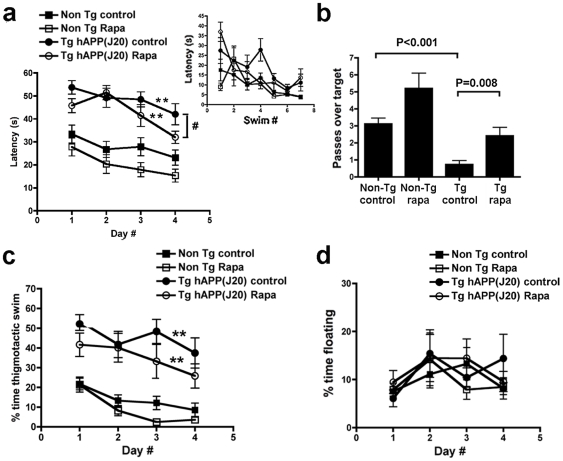
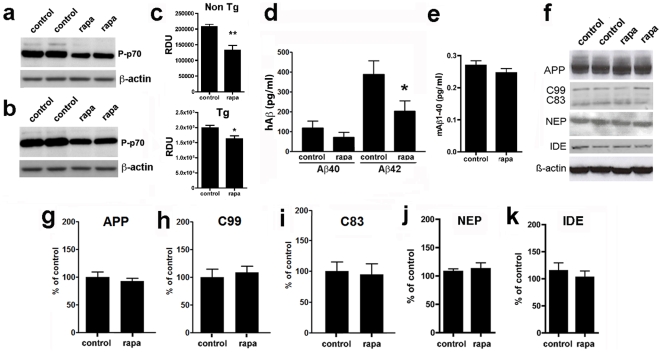
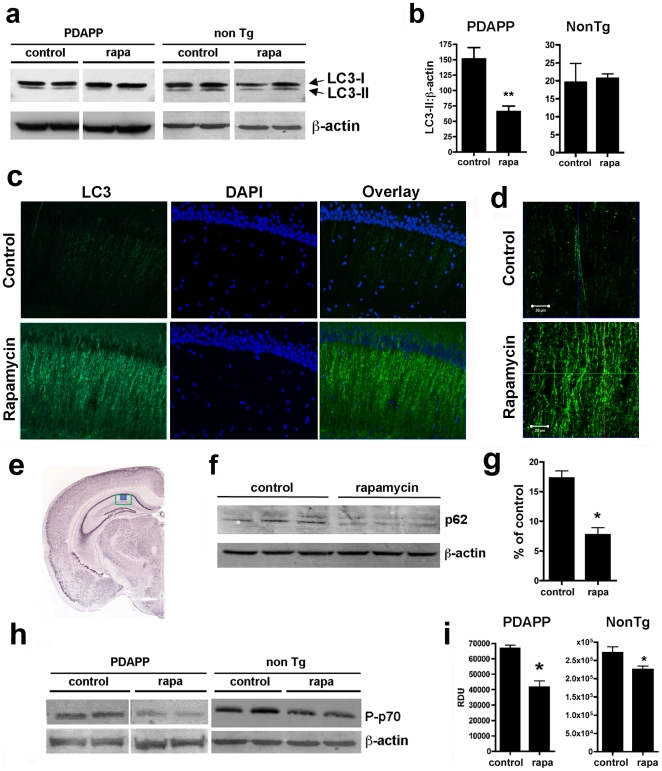
BACKGROUND: Reduced TOR signaling has been shown to significantly increase lifespan in a variety of organisms [1], [2], [3], [4]. It was recently demonstrated that long-term treatment with rapamycin, an inhibitor of the mTOR pathway[5], or ablation of the mTOR target p70S6K[6] extends lifespan in mice, possibly by delaying aging. Whether inhibition of the mTOR pathway would delay or prevent age-associated disease such as AD remained to be determined. METHODOLOGY/PRINCIPAL FINDINGS: We used rapamycin administration and behavioral tools in a mouse model of AD as well as standard biochemical and immunohistochemical measures in brain tissue to provide answers for this question. Here we show that long-term inhibition of mTOR by rapamycin prevented AD-like cognitive deficits and lowered levels of Abeta(42), a major toxic species in AD[7], in the PDAPP transgenic mouse model. These data indicate that inhibition of the mTOR pathway can reduce Abeta(42) levels in vivo and block or delay AD in mice. As expected from the inhibition of mTOR, autophagy was increased in neurons of rapamycin-treated transgenic, but not in non-transgenic, PDAPP mice, suggesting that the reduction in Abeta and the improvement in cognitive function are due in part to increased autophagy, possibly as a response to high levels of Abeta. CONCLUSIONS/SIGNIFICANCE: Our data suggest that inhibition of mTOR by rapamycin, an intervention that extends lifespan in mice, can slow or block AD progression in a transgenic mouse model of the disease. Rapamycin, already used in clinical settings, may be a potentially effective therapeutic agent for the treatment of AD.
Overview
The claims and statistics of this paper haven’t been checked yet.
Run the check — free, no account needed. It reads the open-access text and checks the sources it cites.
Integrity signals
Registry
Cites
Statistics
Figures
Verification
Claims the paper makes
The claims and statistics of this paper haven’t been checked yet.
Run the check — free, no account needed. It reads the open-access text and checks the sources it cites.
Claims other papers make about this one
Each is checked against this paper’s own text: does it say what the citing paper says it does?
The cited source says what the claim attributes to it.
In the citing paper
“Some studies have suggested that inhibition of mTOR activity may lead to cognitive improvement in mouse models of AD [54].”
From Tuberous Sclerosis Protein 2 (TSC2) Modulates CCN4 Cytoprotection During Apoptotic Amyloid Toxicity in Microglia (2013) · cites this paper as [54]
The cited source says what the claim attributes to it.
In the citing paper
“While rapamycin itself is not a strong inducer of autophagy compared to mTOR kinase inhibitors 53, the effects of rapamycin on the pathology of mouse models of Alzheimer’s disease has been attributed in part to increased autophagy 79,80.”
From Targeting the biology of aging with mTOR inhibitors (2023) · cites this paper as [80]
Self-check
Percentages, sums and reported differences re-computed from the paper’s own numbers.
The self-check needs the paper’s full text.
Citations
Cites
Developments of a water-maze procedure for studying spatial learning in the rat
Morris, R. (1984) · Journal of Neuroscience Methods · doi:10.1016/0165-0270(84)90007-4 · Cited by 7,180
LC3, a mammalian homologue of yeast Apg8p, is localized in autophagosome membranes after processing.
Kabeya, Y., Mizushima, N., Ueno, T., Yamamoto, A., Kirisako, T., Noda, T., Kominami, E., Ohsumi, Y., & Yoshimori, T. (2000) · The EMBO Journal · doi:10.1093/emboj/19.21.5720 · Cited by 6,605
Alzheimer's Disease Is a Synaptic Failure
Selkoe, D. J. (2002) · Science · doi:10.1126/science.1074069 · Cited by 4,420
Rapamycin fed late in life extends lifespan in genetically heterogeneous mice
Harrison, D. E., Strong, R., Sharp, Z. D., Nelson, J. F., Astle, C. M., Flurkey, K., Nadon, N. L., Wilkinson, J. E., Frenkel, K., Carter, C. S., et al. (2009) · Nature · doi:10.1038/nature08221 · Cited by 3,766
Self-citationBjørkøy, G., Lamark, T., Brech, A., Outzen, H., Perander, M., Øvervatn, A., Stenmark, H., & Johansen, T. (2005) · The Journal of Cell Biology · doi:10.1083/jcb.200507002 · Cited by 3,276
Prolonged Rapamycin Treatment Inhibits mTORC2 Assembly and Akt/PKB
Sarbassov, D. D., Ali, S. M., Sengupta, S., Sheen, J.-H., Hsu, P. P., Bagley, A. F., Markhard, A. L., & Sabatini, D. M. (2006) · Molecular Cell · doi:10.1016/j.molcel.2006.03.029 · Cited by 2,365
Ravikumar, B., Vacher, C., Berger, Z., Davies, J. E., Luo, S., Oroz, L. G., Scaravilli, F., Easton, D. F., Duden, R., O'Kane, C. J., et al. (2004) · Nature Genetics · doi:10.1038/ng1362 · Cited by 2,347
A mammalian protein targeted by G1-arresting rapamycin–receptor complex
Brown, E. J., Albers, M. W., Bum Shin, T., ichikawa, K., Keith, C. T., Lane, W. S., & Schreiber, S. L. (1994) · Nature · doi:10.1038/369756a0 · Cited by 2,053
FoxO3 Controls Autophagy in Skeletal Muscle In Vivo
Mammucari, C., Milan, G., Romanello, V., Masiero, E., Rudolf, R., Del Piccolo, P., Burden, S. J., Di Lisi, R., Sandri, C., Zhao, J., et al. (2007) · Cell Metabolism · doi:10.1016/j.cmet.2007.11.001 · Cited by 1,953
Reducing Endogenous Tau Ameliorates Amyloid ß-Induced Deficits in an Alzheimer's Disease Mouse Model
Roberson, E. D., Scearce-Levie, K., Palop, J. J., Yan, F., Cheng, I. H., Wu, T., Gerstein, H., Yu, G.-Q., & Mucke, L. (2007) · Science · doi:10.1126/science.1141736 · Cited by 1,892
Cited by
Sorted by citations
mTOR Signaling in Growth, Metabolism, and Disease
Saxton, R. A., & Sabatini, D. M. (2017) · Cell · doi:10.1016/j.cell.2017.02.004 · Cited by 7,555
The role of autophagy in neurodegenerative disease
Nixon, R. A. (2013) · Nature Medicine · doi:10.1038/nm.3232 · Cited by 2,059
Ageing as a Risk Factor for Disease
Niccoli, T., & Partridge, L. (2012) · Current Biology · doi:10.1016/j.cub.2012.07.024 · Cited by 1,831
mTOR is a key modulator of ageing and age-related disease
Johnson, S. C., Rabinovitch, P. S., & Kaeberlein, M. (2013) · Nature · doi:10.1038/nature11861 · Cited by 1,676
Hallmarks of Brain Aging: Adaptive and Pathological Modification by Metabolic States
Mattson, M. P., & Arumugam, T. V. (2018) · Cell Metabolism · doi:10.1016/j.cmet.2018.05.011 · Cited by 1,242
Metadata
- Authors
- Spilman, P., Podlutskaya, N., Hart, M. J., Debnath, J., Gorostiza, O., Bredesen, D., Richardson, A., Strong, R., & Galvan, V.
- Affiliations
- Buck Institute for Research on Aging (US)
- The University of Texas at San Antonio Health Science Center (US)
- University of California, San Francisco (US)
- Venue
- PLoS ONE
- Publisher
- Public Library of Science (PLoS)
- Published
- 2010-04-01
- Volume
- 5
- Issue
- 4
- Pages
- e9979
- ISSN
- 1932-6203 (ISSN-L)
- PMC
- PMC2848616
- OpenAlex
- W2037653131
- Cited by
- 1,033
- References
- 52
- Citations by year
- 2026: 46 · 2025: 50 · 2024: 41 · 2023: 63 · 2022: 61 · 2021: 75 · 2020: 91 · 2019: 82 · 2018: 72 · 2017: 57 · 2016: 68 · 2015: 75 · 2014: 72 · 2013: 62 · 2012: 58
- FWCI
- 39.00
- Type
- journal article
- Language
- en
- Update notices
- Open access
- gold
- doi.org
- Locations
- PLoS ONE (publishedVersion, cc-by)
- PubMed Central (publishedVersion, cc-by)
- PubMed (publishedVersion)
- DOAJ (DOAJ: Directory of Open Access Journals) (submittedVersion, cc-by-sa)
- eScholarship (California Digital Library) (submittedVersion)
- eScholarship (California Digital Library) (submittedVersion, cc-by)
- Funders
- U.S. Department of Veterans Affairs
- Alzheimer's Association (NIRG-DDC-120433)
- Buck Institute for Research on Aging
- University of Texas Health Science Center at San Antonio
- National Institute on Aging (P30AG13319, P30AG013319, U01AG022307)
- National Cancer Institute (R01CA126792)
- Topics
- Life Sciences › Neuroscience › Cellular and Molecular Neuroscience › Alzheimer's disease research and treatments
- Life Sciences › Biochemistry, Genetics and Molecular Biology › Cell Biology › Autophagy in Disease and Therapy
- Health Sciences › Medicine › Psychiatry and Mental health › Dementia and Cognitive Impairment Research
- Keywords
- rapamycin, mTOR inhibition, Alzheimer's disease, amyloid-beta 42, cognitive impairment, autophagy, lifespan extension, neuroprotection, therapeutic target
- MeSH terms
- Aging, Alzheimer Disease, Animals, Autophagy, Cognition Disorders, Disease Models, Animal, Immunosuppressive Agents, Signal Transduction, Amyloid beta-Peptides, Sirolimus, Mice, TOR Serine-Threonine Kinases
About these checks
Registry, retraction, Cites and statistics results are computed, not judged, with one exception: a printed reference that no index lists is read once by a model before it counts as a citation error. Claims are extracted by a model and kept only when their quote appears verbatim in the text; each cited source is then checked, with a model’s help, for whether it says what the claim relies on. Those verdicts can be wrong — read the claim’s quote and the cited source before relying on one.
Statistics and arithmetic are recomputed, not judged.
Confidence bands are shown only for fields calibrated on our annotated test set. None is calibrated yet, so no band is shown.
What counts as a claim ›How we measure confidence ›How we check this ›
Are you an author, or do you see a problem with this page? Request a review
