

The Human Nasal Microbiota and Staphylococcus aureus Carriage
Open accessThe DOI matches its Crossref record; 69 of the 70 references it cites were found in a registry or an index.
Abstract
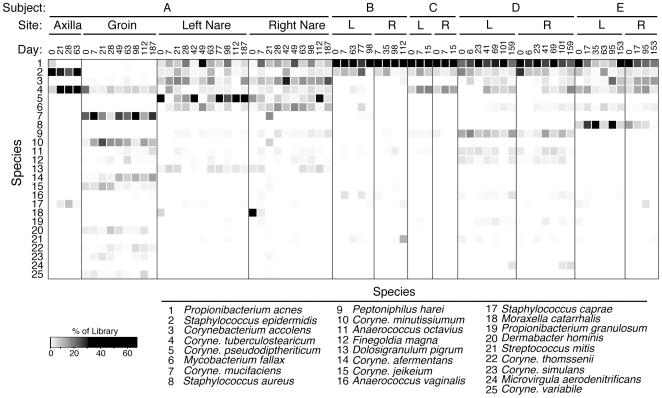
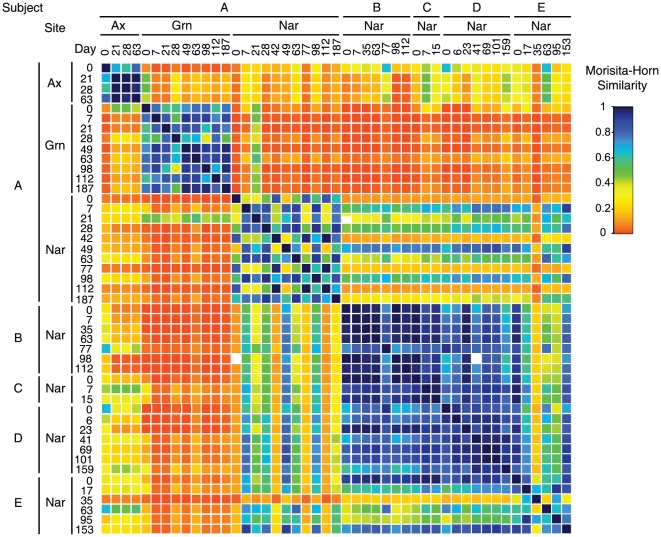
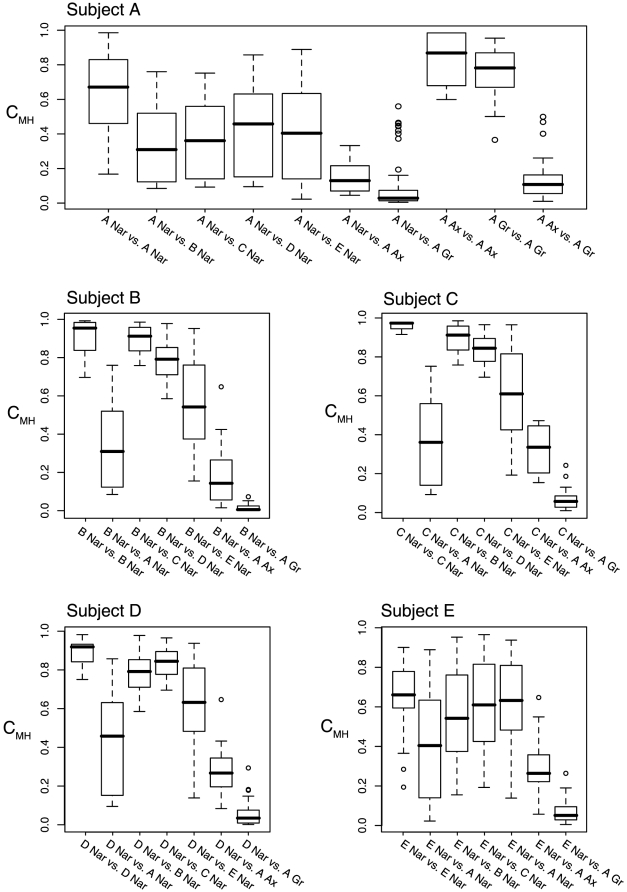
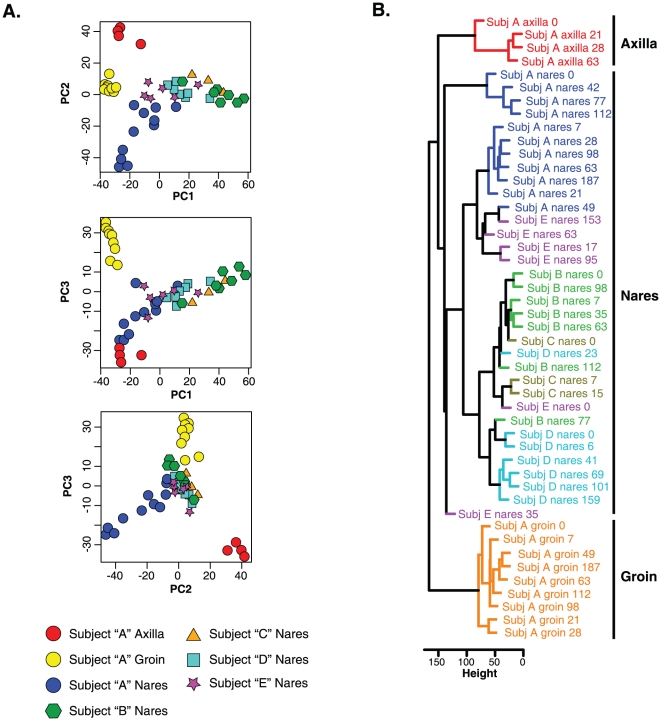
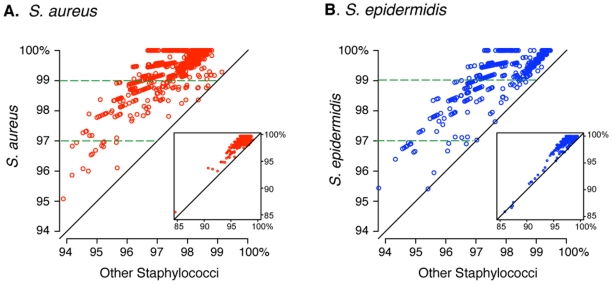
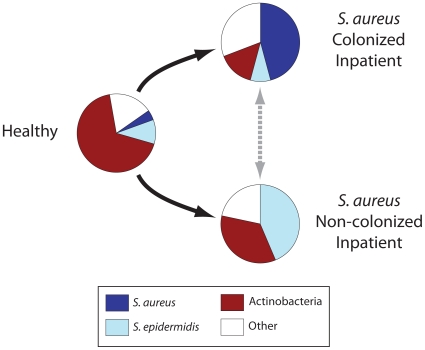
BACKGROUND: Colonization of humans with Staphylococcus aureus is a critical prerequisite of subsequent clinical infection of the skin, blood, lung, heart and other deep tissues. S. aureus persistently or intermittently colonizes the nares of approximately 50% of healthy adults, whereas approximately 50% of the general population is rarely or never colonized by this pathogen. Because microbial consortia within the nasal cavity may be an important determinant of S. aureus colonization we determined the composition and dynamics of the nasal microbiota and correlated specific microorganisms with S. aureus colonization. METHODOLOGY/PRINCIPAL FINDINGS: Nasal specimens were collected longitudinally from five healthy adults and a cross-section of hospitalized patients (26 S. aureus carriers and 16 non-carriers). Culture-independent analysis of 16S rRNA sequences revealed that the nasal microbiota of healthy subjects consists primarily of members of the phylum Actinobacteria (e.g., Propionibacterium spp. and Corynebacterium spp.), with proportionally less representation of other phyla, including Firmicutes (e.g., Staphylococcus spp.) and Proteobacteria (e.g. Enterobacter spp). In contrast, inpatient nasal microbiotas were enriched in S. aureus or Staphylococcus epidermidis and diminished in several actinobacterial groups, most notably Propionibacterium acnes. Moreover, within the inpatient population S. aureus colonization was negatively correlated with the abundances of several microbial groups, including S. epidermidis (p = 0.004). CONCLUSIONS/SIGNIFICANCE: The nares environment is colonized by a temporally stable microbiota that is distinct from other regions of the integument. Negative association between S. aureus, S. epidermidis, and other groups suggests microbial competition during colonization of the nares, a finding that could be exploited to limit S. aureus colonization.
Overview
The claims and statistics of this paper haven’t been checked yet.
Free: it reads the open-access text and checks the first 5 claims that cite a source we can check. Create a free account to check every claim.
Integrity signals
Registry
Cites
Statistics
Figures
Verification
Claims the paper makes
The claims and statistics of this paper haven’t been checked yet.
Free: it reads the open-access text and checks the first 5 claims that cite a source we can check. Create a free account to check every claim.
Claims other papers make about this one
Each is checked against this paper’s own text: does it say what the citing paper says it does?
The source backs part of the claim, not all of it — or backs it for a different population, condition or comparison.
In the citing paper
“The anterior nares are closest to the external environment and are lined with a skin-like keratinized squamous epithelium, including serous and sebaceous glands, the latter of which produces sebum, which leads to the enrichment of lipophilic skin colonizers, including Staphylococcus spp., Propionibacterium spp. and Corynebacterium spp.46,47,48.”
From The microbiota of the respiratory tract: gatekeeper to respiratory health (2017) · cites this paper as [46]
Experimental — accuracy not yet measuredThe cited source says what the claim attributes to it.
In the citing paper
“In healthy adults, bacteria present in the nasal cavity are typically those associated with skin, predominantly members of the Actinobacteria (e.g., Corynebacterium spp., Propionibacterium spp.), followed by Firmicutes (e.g., Staphylococcus spp.), and Proteobacteria”
From Respiratory viral infection-induced microbiome alterations and secondary bacterial pneumonia. (2018) · cites this paper as [67]
In the citing paper
“Competition between S. aureus and S. epidermidis has been implicated as a source of the differences reported between S. aureus carrier and non-carrier communities (Frank et al., 2010).”
From Nasal Microenvironments and Interspecific Interactions Influence Nasal Microbiota Complexity and S. aureus Carriage (2013) · cites this paper as Frank et al., 2010
In the citing paper
“A common feature of microbial ecological studies of the anterior naris has been the dominance of Corynebacterium, Staphylococcus, and Propionibacterium species (Costello et al., 2009; Frank et al., 2010; Grice et al., 2009; TheHumanMicrobiomeProjectConsortium, 2012; Zhou et al., 2013).”
From Nasal Microenvironments and Interspecific Interactions Influence Nasal Microbiota Complexity and S. aureus Carriage (2013) · cites this paper as Frank et al., 2010
In the citing paper
“A negative correlation between S. aureus abundance and Corynebacterium abundance have been previously observed, although no specific mechanisms have been proposed (Frank et al., 2010; Lina et al., 2003; Uehara et al., 2000).”
From Nasal Microenvironments and Interspecific Interactions Influence Nasal Microbiota Complexity and S. aureus Carriage (2013) · cites this paper as Frank et al., 2010
1 more claim about this paper
Create a free account to see every claim other papers make about this one.
Self-check
Percentages, sums and reported differences re-computed from the paper’s own numbers.
The self-check needs the paper’s full text.
Citations
Cites
R: A Language and Environment for Statistical Computing
R Core Team (2025) · doi:10.32614/r.manuals · Cited by 352,181
Naïve Bayesian Classifier for Rapid Assignment of rRNA Sequences into the New Bacterial Taxonomy
Wang, Q., Garrity, G. M., Tiedje, J. M., & Cole, J. R. (2007) · Applied and Environmental Microbiology · doi:10.1128/aem.00062-07 · Cited by 19,885 · cited 2×
“rRNA sequences were provisionally identified by BLAST query of 16S rRNA sequences extracted from the All-Species Living Tree Project database (version LTP_S95; [33]) and results corroborated through the RDP Classifier tool [34,35], parsimony insertion into the SILVA SSURef_98 tree [36], and pairwise distance compariso…”
MethodLane, D. (1991) · Medical Entomology and Zoology · Cited by 12,669
Finding groups in data: an introduction to cluster analysis
(1991) · Choice Reviews Online · doi:10.5860/choice.28-4558 · Cited by 10,474
Nucleic acid techniques in bacterial systematics
Stackebrandt, E. S., & Goodfellow, M. (1991) · Wiley eBooks · Cited by 9,460
Diversity of the Human Intestinal Microbial Flora
Eckburg, P. B., Bik, E. M., Bernstein, C. N., Purdom, E., Dethlefsen, L., Sargent, M., Gill, S. R., Nelson, K. E., & Relman, D. A. (2005) · Science · doi:10.1126/science.1110591 · Cited by 7,913 · cited 1×
“Collectively these microorganisms define a pan-microbiota of the human anterior nares as has been reported for other anatomical sites, including the genitourinary tract [45], gut [38,46,47,48], lung [49], and skin [37,40,41,50,51,52].”
BackgroundBase-Calling of Automated Sequencer Traces Using Phred. I. Accuracy Assessment
Ewing, B., Hillier, L., Wendl, M. C., & Green, P. (1998) · Genome Research · doi:10.1101/gr.8.3.175 · Cited by 6,967 · cited 1×
“Sequence base calling and contig assembly were performed with the applications phred and phrap [56,57], as implemented by XplorSeq [58].”
MethodARB: a software environment for sequence data
Ludwig, W. (2004) · Nucleic Acids Research · doi:10.1093/nar/gkh293 · Cited by 6,702 · cited 2×
“Ambiguities between GenBank and RDP classifications (,0.1% of sequences) were resolved by reference to the results of parsimony insertion into the SILVA guide tree in ARB.”
MethodInfluentialPruesse, E., Quast, C., Knittel, K., Fuchs, B. M., Ludwig, W., Peplies, J., & Glockner, F. O. (2007) · Nucleic Acids Research · doi:10.1093/nar/gkm864 · Cited by 6,668 · cited 2×
“All sequences were aligned to the SILVA SSURef version 98 database using the SINA automated aligner provided by the SILVA web service [36].”
MethodNonparametric estimation of the number of classes in a population
Chao, A. (1984) · Scandinavian Journal of Statistics · Cited by 5,880
Cited by
Items 401–449 of 449
Barsotti, N. S., do Carmo, B. N. C., Antunes, A. A., & Lisboa, G. P. (2020) · Revista Brasileira de Ciências Biomédicas · doi:10.46675/rbcbm.v1i2.15
“Revista da Escola de Enfermagem da USP, 2012; 46(1):132-137.”
BackgroundInfluentialIbrahim, L. F. (2019) · Minerva Access (University of Melbourne)
Infecciones por estafilococos en el niño: aspectos fisiopatológicos, bacteriológicos y clínicos
Tran, T.-A., & Filleron, A. (2020) · EMC - Pediatría · doi:10.1016/s1245-1789(20)44340-9 · Cited by 1
Ghattas, M. Z., ElRakaiby, M. T., Aziz, R. K., & Hafez-Zedan, H. (2019) · Research Square · doi:10.21203/rs.2.13709/v1
“epidermidis from other CoNS, and this differentiation is database dependent (Frank et al. 2010).”
BackgroundInfluentialQekwana, D. N., Odoi, A., & Oguttu, J. W. (2021) · Animals · doi:10.3390/ani11113232
Os mecanismos inflamatórios na rinossinusite crónica
Vieira, P. M. F. L. D. O. (2014) · Portuguese National Funding Agency for Science, Research and Technology (RCAAP Project by FCT) · doi:10.34626/bkxb-1t14 · Cited by 1
Unlocking the Mysteries of the Human Microbiome to Combat COVID-19
Muthuirulan, P., Bandyopadhyay, M., Mamillapalli, S., & Sharma, P. (2022) · Springer eBooks · doi:10.1007/978-981-16-7672-7_11
Spinler, J. K. (2014) · Springer eBooks · doi:10.1007/978-1-4614-6418-1_444-2
Microbiology and Antibiotic Resistance in Chronic Rhinosinusitis
Feazel, L. M., Ramakrishnan, V. R., & Kingdom, T. T. (2013) · Springer eBooks · doi:10.1007/978-3-642-23499-6_799
Self-citationGhattas, M. Z., ElRakaiby, M. T., Aziz, R. K., & Hafez-Zedan, H. (2019) · Research Square · doi:10.21203/rs.2.13709/v2
Gouveia, A. M. (2023) · Digital Library of Theses and Dissertations (Universidade de São Paulo) · doi:10.11606/d.82.2023.tde-05102023-153925
Awais, M., Fahad, S., Rehman, M. U., Ayub, U., Ahmad, K., Awan, W. A., Khan, D., & Waseem, M. (2023) · Research Square · doi:10.21203/rs.3.rs-3619740/v1 · Cited by 1
Portadores nasales en pacientes con infección por Staphylococcus aureus: riesgo de recurrencia
Colomina-Rodríguez, J., Carretero, D., Camacho-Marín, J., Michelena-García, P., Clari, M. Á., & Navarro-Ortega, D. (2023) · Revista de Medicina de Laboratorio · doi:10.20960/revmedlab.00196
Winarti, T. M., Mohamed, N. A., Aziz, N. A. A., & Lotfi, N. A. A. (2024) · Journal of Health and Dental Sciences · doi:10.54052/jhds.v3n3.p333-344
Invasion muqueuse au cours de la colonisation nasale à Staphylococcus aureus
Rigaill, J. (2022) · theses.fr (ABES) · doi:10.70675/c7eb76b0z0712z4e85z838bz018afa6ace89
Anyiam, I. V., & Zige, D. V. (2024) · Current Applied Science and Technology · doi:10.55003/cast.2024.258357
The Impact of the Microbiome in Chronic Rhinosinusitis with Nasal Polyps
Jimenez, J. E., Ramaswamy, U., Patel, V. A., & Lee, S. E. (2024) · Springer eBooks · doi:10.1007/978-3-031-33199-2_13
И.А., В., Редько, Д. Д., & А.А., В. (2024) · Оториноларингология Восточная Европа · doi:10.34883/pi.2024.14.4.028
Современные представления об атипичных мастоидитах: обзор литературы
Mukhmadov, I. D., Shpotin, V. P., Saidulaev, V., Aliev, S., & Nuralieva, A. K. (2024) · Оториноларингология Восточная Европа · doi:10.34883/pi.2024.14.4.035
Anand, S., Panda, P. S., Thomas, B. J., Vats, K., Haider, M., & Rynga, D. (2025) · International Journal of Community Medicine and Public Health · doi:10.18203/2394-6040.ijcmph20252841
Staphylococcus aureus Acquisition, Persistence, and Infection Dynamics in the Household
Mork, R. L. (2019) · Knowledge@UChicago (University of Chicago) · doi:10.6082/uchicago.1715
Konovalovas, A., Armalytė, J., Klimkaitė, L., Liveikis, T., Jonaitytė, B., Danila, E., Bironaitė, D., Mieliauskaitė, D., Bagdonas, E., & Aldonytė, R. (2024) · Figshare · doi:10.6084/m9.figshare.25708957
Konovalovas, A., Armalytė, J., Klimkaitė, L., Liveikis, T., Jonaitytė, B., Danila, E., Bironaitė, D., Mieliauskaitė, D., Bagdonas, E., & Aldonytė, R. (2024) · Figshare · doi:10.6084/m9.figshare.26713541
(2017) · Arizona State University Library Digital Repository (Arizona State University)
Allano, M. (2024) · Papyrus : Institutional Repository (Université de Montréal) · doi:10.71781/3536
Ramaekers, K. (2021) · Lirias (KU Leuven)
Mikrobielle Besiedlung der Nasenschleimhaut von Patienten mit postviraler Riechstörung
Hollemann, E. (2025) · Qucosa (Saxon State and University Library Dresden)
Jablonska, S., Kula, A., & Putonti, C. (2026) · Frontiers in Microbiomes · doi:10.3389/frmbi.2026.1691965
“Streptococcus is a recognized core member of the buccal microbiome (Mark Welch et al., 2019), and Corynebacterium , Staphylococcus , and Streptococcus constitute core taxa of the nasal microbiome (Frank et al., 2010; Blum et al., 2022).”
Caractérisation de la diversité microbienne de l’air des espaces clos.
Gaüzère, C. (2012) · theses.fr (ABES) · doi:10.70675/25ce1375z5f11z4051zbe76zf10bca4695fe · Cited by 2
Colonisation muqueuse par Staphilococcus aureus et persistance du portage nasal
Verhoeven, P. O. (2015) · theses.fr (ABES) · doi:10.70675/7d2c8679z29e3z4fc7zae81z4a482bc25601 · Cited by 1
Couderc, C. (2015) · theses.fr (ABES) · doi:10.70675/68df2dfbz38eez4fc1zb3d9ze4bc7aaca555 · Cited by 3
Morgene, M. F. (2018) · theses.fr (ABES) · doi:10.70675/b0196800za02fz441eza108z5f55bfa12952 · Cited by 2
Impact du métabolisme des molécules odorantes sur la perception olfactive chez l'Homme
Robert‐Hazotte, A. (2018) · theses.fr (ABES) · doi:10.70675/b59a8807z6e65z4c9dz84deze02c2c0fdd83
Cely, P. A. G., & Rosero, J. G. G. (2026) · Repositorio Institucional Universidad El Bosque
Seriki, A. T., Adewumi, G. A., sikanmi, T. A., Alao, F. O., Adekunle, A. A., & Obi, C. C. (2026) · Nigerian Journal of Pure and Applied Sciences · doi:10.48198/njpas/25.b45
Laureti, C., Benelli, D., Zoccali, F., Riccardi, G., Michele, M. U. D., Venarubea, S., Barbato, C., Minni, A., & Petrella, C. (2026) · Diseases · doi:10.3390/diseases14070264
Yang, Y., Cui, J., Dong, X., Huang, Y., An, J., Cui, T., Ou, X., Liu, T., Gao, X., Zhang, H., et al. (2026) · Pathogens · doi:10.3390/pathogens15090883
Ferreira, M. C. D. S., Stephens, T. G., & Brinsmade, S. R. (2026) · Journal of Bacteriology · doi:10.1128/jb.00185-26
Selective statin therapy and nasal staphylococcal colonisation: a retrospective case-control study
Abbas, Z. M., Hughes, J., Sunderland, B., Parsons, R. W., Rawlins, M., Robinson, J. O., & Czarniak, P. (2026) · European Journal of Clinical Microbiology & Infectious Diseases · doi:10.1007/s10096-026-05646-7
A multicolor silver nanoparticle platform for multiplex detection of Influenza A and B
Ipek, E., Ozufuklar, O., Erdogan, T., Ghorbanizamani, F., Cicek, C., İşbilir, A., Göksel, T., Tımur, S., & Guler, E. (2026) · Microchemical Journal · doi:10.1016/j.microc.2026.119826
Siempis, T., Yeap, Z. H., Ali, S., & Philpott, C. M. (2026) · Clinical Otolaryngology · doi:10.1111/coa.70172
Babolhavaeji, K., Kazemi, S., Etesamifard, T., & Solgi, R. (2026) · International Journal of Microbiology · doi:10.1155/ijm/8281541
“One significant route of contamination involves human carriers; S. aureus is commonly found as part of the nasal and skin microbiota of food handlers, including street food vendors, making direct contact a likely source of transmission [20, 21].”
Camus, L., Franz, J., Gerlach, D., Lange, A., Power, J. J., Navarro-Díaz, M., Stahl, J., Krismer, B., Rapp, J., Bilici, K., et al. (2026) · Microbiome · doi:10.1186/s40168-026-02563-x · Cited by 1
“For instance, S. aureus carriage has been negatively associated with the presence of Dolosigranu-lum pigrum [9, 10, 13, 14], S. epidermidis [15–21], and S. lugdunensis [22, 23].”
Huang, S., Hon, K., Bennett, C., Hu, H., Menberu, M., Wormald, P.-J., Zhao, Y., Vreugde, S., & Liu, S. (2022) · doi:10.3389/fmicb.2022.984741.s003
Metadata
- Authors
- Frank, D. N., Feazel, L. M., Bessesen, M. T., Price, C. S., Janoff, E. N., & Pace, N. R.
- Affiliations
- University of Colorado Boulder (US)
- Veterans Health Administration (US)
- Denver Health Medical Center (US)
- Corresponding author
- Pace, Norman R.
- Venue
- PLoS ONE
- Publisher
- Public Library of Science (PLoS)
- Published
- 2010-05-17
- Volume
- 5
- Issue
- 5
- Pages
- e10598
- ISSN
- 1932-6203 (ISSN-L)
- PMC
- PMC2871794
- OpenAlex
- W2169891354
- Cited by
- 422
- References
- 70
- Citations by year
- 2026: 13 · 2025: 21 · 2024: 20 · 2023: 14 · 2022: 25 · 2021: 20 · 2020: 35 · 2019: 27 · 2018: 30 · 2017: 21 · 2016: 40 · 2015: 42 · 2014: 30 · 2013: 32 · 2012: 30
- FWCI
- 17.42
- Type
- journal article
- Language
- en
- Open access
- gold
- doi.org
- Locations
- PLoS ONE (publishedVersion, cc-by)
- Europe PMC (PubMed Central) (publishedVersion, cc-by)
- PubMed Central (publishedVersion, cc-by)
- PubMed (publishedVersion)
- DOAJ (DOAJ: Directory of Open Access Journals) (submittedVersion, cc-by-sa)
- Figshare (submittedVersion, cc-by)
- Funders
- U.S. Department of Veterans Affairs
- Topics
- Health Sciences › Medicine › Infectious Diseases › Antimicrobial Resistance in Staphylococcus
- Health Sciences › Medicine › Dermatology › Dermatology and Skin Diseases
- Life Sciences › Biochemistry, Genetics and Molecular Biology › Molecular Biology › Bacterial biofilms and quorum sensing
- Keywords
- nasal microbiota, Staphylococcus aureus colonization, Staphylococcus epidermidis, Propionibacterium acnes, actinobacteria, microbial competition, nasal carriage, hospitalized patients, 16S rRNA gene sequencing, skin microbiome
- MeSH terms
- Adult, DNA, Ribosomal, Health, Hospitalization, Humans, Inpatients, Longitudinal Studies, Molecular Sequence Data, Nasal Cavity, Nose, Residence Characteristics, Staphylococcus aureus, Staphylococcus epidermidis, Time Factors, Colony Count, Microbial, Bacterial Typing Techniques, Sequence Analysis, DNA, Biodiversity, Metagenome
About these checks
Registry, retraction, Cites and statistics results are computed, not judged, with one exception: a printed reference that no index lists is read once by a model before it counts as a citation error. Claims are extracted by a model and kept only when their quote appears verbatim in the text; each cited source is then checked, with a model’s help, for whether it says what the claim relies on. Those verdicts can be wrong — read the claim’s quote and the cited source before relying on one.
Statistics and arithmetic are recomputed, not judged.
Confidence bands are shown only for fields calibrated on our annotated test set. None is calibrated yet, so no band is shown.
What counts as a claim ›How we measure confidence ›How we check this ›
Are you an author, or do you see a problem with this page? Request a review
Data sources
Bibliographic data: Semantic Scholar, OpenAlex, Crossref.
Contains information from the Semantic Scholar Academic Graph Datasets, made available under the ODC Attribution License (ODC-BY 1.0).
Semantic Scholar’s data is described in: Kinney, R., et al. (2023). The Semantic Scholar Open Data Platform. arXiv:2301.10140.
