

The DOI matches its Crossref record; 64 of the 65 references it cites were found in a registry or an index.
Low-Density Lipoprotein Receptor-Related Protein 1 (LRP1) Mediates Neuronal Aβ42 Uptake and Lysosomal Trafficking
Open accessAbstract
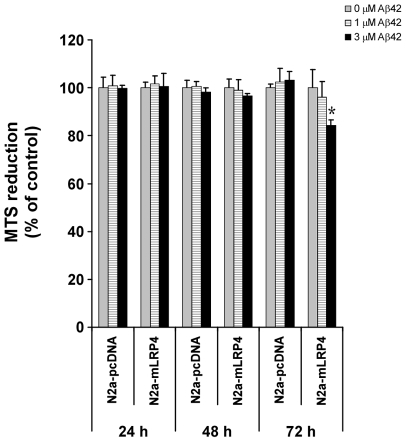
BACKGROUND: Alzheimer's disease (AD) is characterized by the presence of early intraneuronal deposits of amyloid-beta 42 (Abeta42) that precede extracellular amyloid deposition in vulnerable brain regions. It has been hypothesized that endosomal/lysosomal dysfunction might be associated with the pathological accumulation of intracellular Abeta42 in the brain. Our previous findings suggest that the LDL receptor-related protein 1 (LRP1), a major receptor for apolipoprotein E, facilitates intraneuronal Abeta42 accumulation in mouse brain. However, direct evidence of neuronal endocytosis of Abeta42 through LRP1 is lacking. METHODOLOGY/PRINCIPAL FINDINGS: Here we show that LRP1 endocytic function is required for neuronal Abeta42 uptake. Overexpression of a functional LRP1 minireceptor, mLRP4, increases Abeta42 uptake and accumulation in neuronal lysosomes. Conversely, knockdown of LRP1 expression significantly decreases neuronal Abeta42 uptake. Disruptions of LRP1 endocytic function by either clathrin knockdown or by removal of its cytoplasmic tail decreased both uptake and accumulation of Abeta42 in neurons. Finally, we show that LRP1-mediated neuronal accumulation of Abeta42 is associated with increased cellular toxicity. CONCLUSIONS/SIGNIFICANCE: These results demonstrate that LRP1 endocytic function plays an important role in the uptake and accumulation of Abeta42 in neuronal lysosomes. These findings emphasize the central function of LRP1 in neuronal Abeta metabolism.
Overview
The claims and statistics of this paper haven’t been checked yet.
Run the check — free, no account needed. It reads the open-access text and checks the sources it cites.
Integrity signals
Registry
Cites
Statistics
Figures
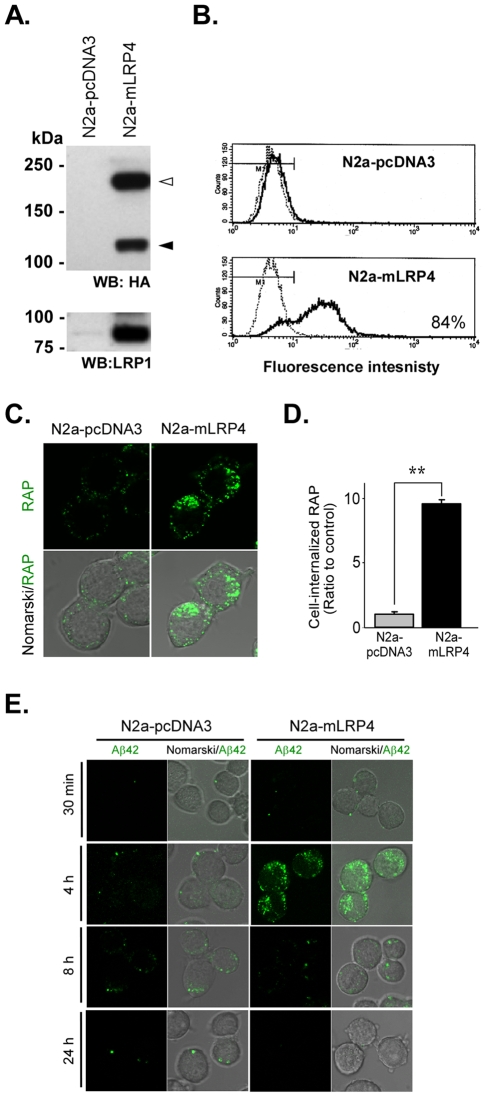
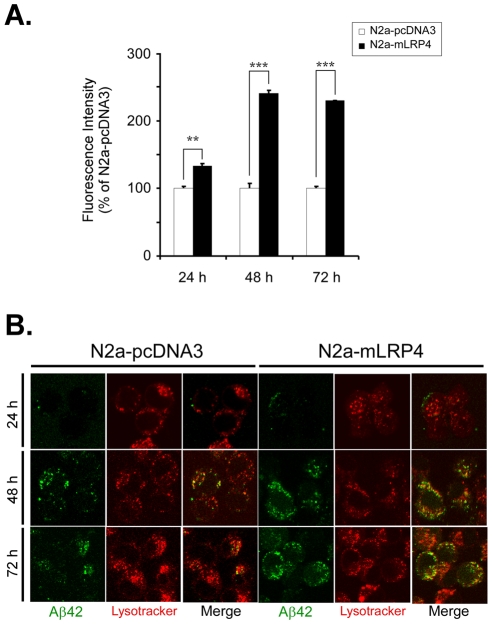
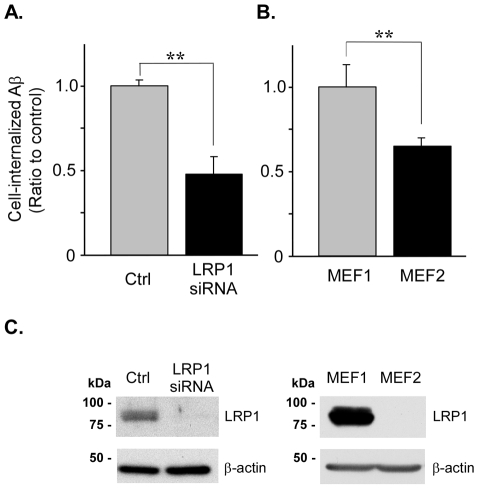
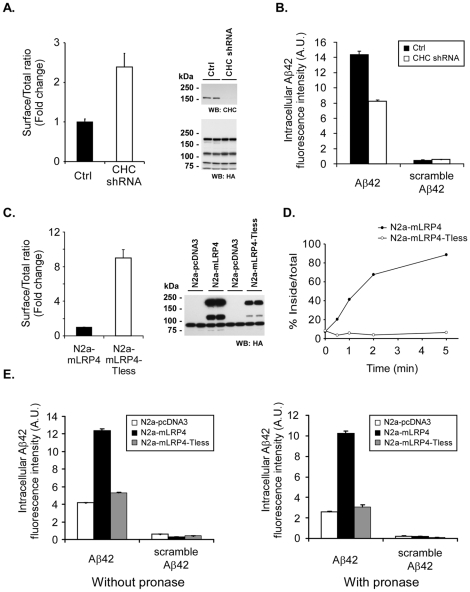
Verification
Claims the paper makes
The claims and statistics of this paper haven’t been checked yet.
Run the check — free, no account needed. It reads the open-access text and checks the sources it cites.
Claims other papers make about this one
Each is checked against this paper’s own text: does it say what the citing paper says it does?
The source backs part of the claim, not all of it — or backs it for a different population, condition or comparison.
In the citing paper
“Overexpression of low-density lipoprotein receptor-related protein (LRP) in several neuronal cell lines resulted in increased intraneuronal Ab accumulation.15,40”
From Blocking the Interaction between Apolipoprotein E and Aβ Reduces Intraneuronal Accumulation of Aβ and Inhibits Synaptic Degeneration (2013) · cites this paper as [40]
Experimental — accuracy not yet measuredThe source backs part of the claim, not all of it — or backs it for a different population, condition or comparison.
In the citing paper
“Studies indicate that APOE binding is integral to some of these processes [16–20] with differences in APOE isoform-specific receptor binding affinity and lipid interactions affecting neuroinflammation, tau pathology, and amyloid plaque dynamics [21–24].”
From APOE Christchurch enhances a disease-associated microglial response to plaque but suppresses response to tau pathology (2025) · cites this paper as [16]
Experimental — accuracy not yet measuredThe source backs part of the claim, not all of it — or backs it for a different population, condition or comparison.
In the citing paper
“Collectively, these recent findings underscore the influence of APOE and APOE3Ch on both Aβ and tau pathology, either directly or through downstream effects such as neuroinflammation.”
From APOE Christchurch enhances a disease-associated microglial response to plaque but suppresses response to tau pathology (2025) · cites this paper as [16]
Experimental — accuracy not yet measuredThe cited source says what the claim attributes to it.
In the citing paper
“In addition, uptake of Aβ through apolipoprotein receptors may be another Aβ clearance pathway (Bu, 2009; Fuentealba et al., 2010; Kanekiyo et al., 2011).”
From miR-106b impairs cholesterol efflux and increases Aβ levels by repressing ABCA1 expression (2012) · cites this paper as Fuentealba et al., 2010
The cited source says what the claim attributes to it.
In the citing paper
“We have shown that inhibition of LRP1 endocytosis decreases cellular Aβ uptake in N2a cells (Fuentealba et al., 2010).”
From Heparan Sulphate Proteoglycan and the Low-Density Lipoprotein Receptor-Related Protein 1 Constitute Major Pathways for Neuronal Amyloid-β Uptake (2011) · cites this paper as Fuentealba et al., 2010
The cited source says what the claim attributes to it.
In the citing paper
“We recently showed that enhancement of Aβ uptake through LRP1 leads to eventual lysosomal accumulation and slightly decreased cell viability when cells were exposed to high Aβ concentrations and long periods of incubation (Fuentealba et al., 2010).”
From Heparan Sulphate Proteoglycan and the Low-Density Lipoprotein Receptor-Related Protein 1 Constitute Major Pathways for Neuronal Amyloid-β Uptake (2011) · cites this paper as Fuentealba et al., 2010
In the citing paper
“As LRP1 has been previously shown to mediate neuronal Aβ42 uptake”
From The Sigma-2 Receptor/TMEM97, PGRMC1, and LDL Receptor Complex Are Responsible for the Cellular Uptake of Aβ42 and Its Protein Aggregates (2020) · cites this paper as [49]
Self-check
Percentages, sums and reported differences re-computed from the paper’s own numbers.
The self-check needs the paper’s full text.
Citations
Cites
The Amyloid Hypothesis of Alzheimer’s Disease: Progress and Problems on the Road to Therapeutics
Hardy, J., & Selkoe, D. J. (2002) · Science · doi:10.1126/science.1072994 · Cited by 13,864
Corder, E. H., Saunders, A. M., Strittmatter, W. J., Schmechel, D. E., Gaskell, P. C., Small, G. W., Roses, A. D., Haines, J. L., & Pericak-Vance, M. A. (1993) · Science · doi:10.1126/science.8346443 · Cited by 9,429
Triple-Transgenic Model of Alzheimer’s Disease with Plaques and Tangles
Oddo, S., Caccamo, A., Shepherd, J. D., Murphy, M. P., Golde, T. E., Kayed, R., Metherate, R., Mattson, M. P., Akbari, Y., & LaFerla, F. M. (2003) · Neuron · doi:10.1016/s0896-6273(03)00434-3 · Cited by 4,126
Association of apolipoprotein E allele ϵ4 with late‐onset familial and sporadic Alzheimer's disease
Saunders, A. M., Strittmatter, W. J., Schmechel, D., St. George-Hyslop, P. H., Pericak-Vance, M. A., Joo, S. H., Rosi, B. L., Gusella, J. F., Crapper-MacLachlan, D. R., Alberts, M. J., et al. (1993) · Neurology · doi:10.1212/wnl.43.8.1467 · Cited by 3,786
Intracellular amyloid-β in Alzheimer's disease
LaFerla, F. M., Green, K. N., & Oddo, S. (2007) · Nature Reviews Neuroscience · doi:10.1038/nrn2168 · Cited by 1,942
Lentivirus-delivered stable gene silencing by RNAi in primary cells.
Stewart, S. A., Dykxhoorn, D. M., Palliser, D., Mizuno, H., Yu, E. Y., An, D., Sabatini, D., Chen, I. S. Y., Hahn, W., Sharp, P., et al. (2003) · RNA: A publication of the RNA Society · doi:10.1261/rna.2192803 · Cited by 1,619
Billings, L. M., Oddo, S., Green, K. N., McGaugh, J. L., & LaFerla, F. M. (2005) · Neuron · doi:10.1016/j.neuron.2005.01.040 · Cited by 1,294
Apolipoprotein E and its receptors in Alzheimer's disease: pathways, pathogenesis and therapy
Bu, G. (2009) · Nature Reviews Neuroscience · doi:10.1038/nrn2620 · Cited by 1,168
Self-citationIn vitro characterization of conditions for amyloid-β peptide oligomerization and fibrillogenesis
Stine, W. B., Dahlgren, K. N., Krafft, G. A., & LaDu, M. J. (2003) · Journal of Biological Chemistry · doi:10.1074/jbc.m210207200 · Cited by 1,015
Self-citationIntraneuronal Aβ42 Accumulation in Human Brain
Gouras, G. K., Tsai, J., Naslund, J., Vincent, B., Edgar, M., Checler, F., Greenfield, J. P., Haroutunian, V., Buxbaum, J. D., Xu, H., et al. (2000) · The American Journal of Pathology · doi:10.1016/s0002-9440(10)64700-1 · Cited by 991
Cited by
Sorted by citations
ApoE in Alzheimer’s disease: pathophysiology and therapeutic strategies
Raulin, A.-C., Doss, S. V., Trottier, Z. A., Ikezu, T. C., Bu, G., & Liu, C.-C. (2022) · Molecular Neurodegeneration · doi:10.1186/s13024-022-00574-4 · Cited by 756
Self-citationInsulin in the brain: There and back again
Banks, W. A., Owen, J. B., & Erickson, M. A. (2012) · Pharmacology & Therapeutics · doi:10.1016/j.pharmthera.2012.07.006 · Cited by 593
Apolipoprotein E, Receptors, and Modulation of Alzheimer’s Disease
Zhao, N., Liu, C.-C., Qiao, W., & Bu, G. (2018) · Biological Psychiatry · doi:10.1016/j.biopsych.2017.03.003 · Cited by 370
Self-citationPropagation of Protein Aggregation in Neurodegenerative Diseases
Vaquer‐Alicea, J., & Diamond, M. I. (2019) · Annual Review of Biochemistry · doi:10.1146/annurev-biochem-061516-045049 · Cited by 316
Kanekiyo, T., & Bu, G. (2014) · Frontiers in Aging Neuroscience · doi:10.3389/fnagi.2014.00093 · Cited by 281
Self-citation
Metadata
- Authors
- Fuentealba, R. A., Liu, Q., Zhang, J., Kanekiyo, T., Hu, X., Lee, J.-M., LaDu, M. J., & Bu, G.
- Affiliations
- Washington University in St. Louis (US)
- University of Illinois Chicago (US)
- Corresponding author
- Bu, Guojun
- ORCID
- Venue
- PLoS ONE
- Publisher
- Public Library of Science (PLoS)
- Published
- 2010-07-29
- Volume
- 5
- Issue
- 7
- Pages
- e11884
- ISSN
- 1932-6203 (ISSN-L)
- PMC
- PMC2912373
- OpenAlex
- W2158409776
- Cited by
- 116
- References
- 65
- Citations by year
- 2026: 5 · 2025: 9 · 2024: 8 · 2023: 4 · 2022: 5 · 2021: 4 · 2020: 5 · 2019: 3 · 2018: 7 · 2017: 7 · 2016: 4 · 2015: 9 · 2014: 14 · 2013: 9 · 2012: 10
- FWCI
- 6.93
- Type
- journal article
- Language
- en
- Open access
- gold
- doi.org
- Locations
- PLoS ONE (publishedVersion, cc-by)
- PubMed Central (publishedVersion, cc-by)
- PubMed (publishedVersion)
- Digital Commons@Becker (Washington University School of Medicine) (submittedVersion)
- DOAJ (DOAJ: Directory of Open Access Journals) (submittedVersion, cc-by-sa)
- Rare & Special e-Zone (The Hong Kong University of Science and Technology) (submittedVersion)
- Funders
- Alzheimer's Association
- Hope Center for Neurological Disorders
- National Institutes of Health
- National Institute on Aging (P01AG030128, R01AG027924, R01AG019121, R01 AG19121, P01AG021184, R01AG035355)
- National Institute of Neurological Disorders and Stroke (P30NS057105)
- Topics
- Life Sciences › Neuroscience › Cellular and Molecular Neuroscience › Alzheimer's disease research and treatments
- Life Sciences › Biochemistry, Genetics and Molecular Biology › Cell Biology › Cellular transport and secretion
- Life Sciences › Neuroscience › Neurology › Neuroinflammation and Neurodegeneration Mechanisms
- Keywords
- LRP1, LDL receptor-related protein 1, amyloid-beta 42, lysosomal trafficking, Alzheimer's disease, clathrin, cytoplasmic tail, apolipoprotein E receptor, neurotoxicity, amyloid-beta metabolism
- MeSH terms
- Animals, Biological Transport, Cell Survival, Clathrin, Endocytosis, Flow Cytometry, Kinetics, Lysosomes, Neurons, Peptide Fragments, Receptors, LDL, Immunoblotting, Amyloid beta-Peptides, Microscopy, Confocal, Tumor Suppressor Proteins, Low Density Lipoprotein Receptor-Related Protein-1, Cell Line, Tumor, Mice
About these checks
Registry, retraction, Cites and statistics results are computed, not judged, with one exception: a printed reference that no index lists is read once by a model before it counts as a citation error. Claims are extracted by a model and kept only when their quote appears verbatim in the text; each cited source is then checked, with a model’s help, for whether it says what the claim relies on. Those verdicts can be wrong — read the claim’s quote and the cited source before relying on one.
Statistics and arithmetic are recomputed, not judged.
Confidence bands are shown only for fields calibrated on our annotated test set. None is calibrated yet, so no band is shown.
What counts as a claim ›How we measure confidence ›How we check this ›
Are you an author, or do you see a problem with this page? Request a review
