

The DOI matches its Crossref record; 47 of the 48 references it cites were found in a registry or an index.
Associations between Dopamine D4 Receptor Gene Variation with Both Infidelity and Sexual Promiscuity
Open accessAbstract
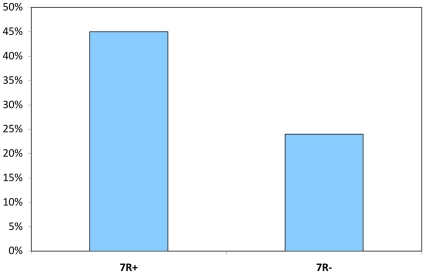
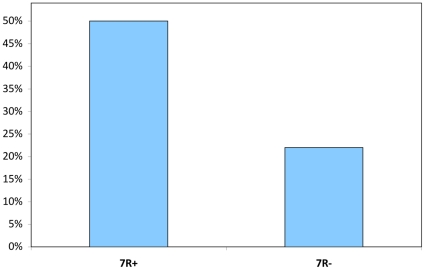
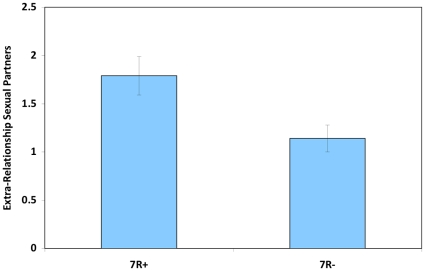
BACKGROUND: Human sexual behavior is highly variable both within and between populations. While sex-related characteristics and sexual behavior are central to evolutionary theory (sexual selection), little is known about the genetic bases of individual variation in sexual behavior. The variable number tandem repeats (VNTR) polymorphism in exon III of the human dopamine D4 receptor gene (DRD4) has been correlated with an array of behavioral phenotypes and may be predicatively responsible for variation in motivating some sexual behaviors, particularly promiscuity and infidelity. METHODOLOGY/PRINCIPAL FINDINGS: We administered an anonymous survey on personal history of sexual behavior and intimate relationships to 181 young adults. We also collected buccal wash samples and genotyped the DRD4 VNTR. Here we show that individuals with at least one 7-repeat allele (7R+) report a greater categorical rate of promiscuous sexual behavior (i.e., having ever had a "one-night stand") and report a more than 50% increase in instances of sexual infidelity. CONCLUSIONS/SIGNIFICANCE: DRD4 VNTR genotype varies considerably within and among populations and has been subject to relatively recent, local selective pressures. Individual differences in sexual behavior are likely partially mediated by individual genetic variation in genes coding for motivation and reward in the brain. Conceptualizing these findings in terms of r/K selection theory suggests a mechanism for selective pressure for and against the 7R+ genotype that may explain the considerable global allelic variation for this polymorphism.
Overview
The claims and statistics of this paper haven’t been checked yet.
Run the check — free, no account needed. It reads the open-access text and checks the sources it cites.
Integrity signals
Registry
Cites
Statistics
Figures
Verification
Claims the paper makes
The claims and statistics of this paper haven’t been checked yet.
Run the check — free, no account needed. It reads the open-access text and checks the sources it cites.
Claims other papers make about this one
Each is checked against this paper’s own text: does it say what the citing paper says it does?
The cited source says what the claim attributes to it.
In the citing paper
“Variations in a dopamine receptor gene have been found to correlate in humans with infidelity and sexual promiscuity (Garcia et al. 2010).”
From Natural Selection, Childrearing, and the Ethics of Marriage (and Divorce): Building a Case for the Neuroenhancement of Human Relationships (2012) · cites this paper as Garcia et al. 2010
Self-check
Percentages, sums and reported differences re-computed from the paper’s own numbers.
The self-check needs the paper’s full text.
Citations
Cites
The Theory of Island Biogeography
MacArthur, R. H., & Wilson, E. O. (2001) · Princeton University Press eBooks · doi:10.1515/9781400881376 · Cited by 13,298
The Theory of Island Biogeography
Kirkby, M. J., MacArthur, R. H., & Wilson, E. O. (1968) · Geographical Journal · doi:10.2307/1796430 · Cited by 11,589
The Fagerstrom Test for Nicotine Dependence: a revision of the Fagerstrom Tolerance Questionnaire
HEATHERTON, T. F., KOZLOWSKI, L. T., FRECKER, R. C., & FAGERSTROM, K. (1991) · British Journal of Addiction · doi:10.1111/j.1360-0443.1991.tb01879.x · Cited by 10,738
Sexual strategies theory: an evolutionary perspective on human mating
Buss, D. M., & Schmitt, D. P. (1993) · Psychological Review · doi:10.1037/0033-295x.100.2.204 · Cited by 4,253
Heroin addicts have higher discount rates for delayed rewards than non-drug-using controls.
Kirby, K. N., Petry, N. M., & Bickel, W. K. (1999) · Journal of Experimental Psychology: General · doi:10.1037/0096-3445.128.1.78 · Cited by 2,171
Extra pair paternity in birds: a review of interspecific variation and adaptive function
Griffith, S. C., Owens, I. P. F., & Thuman, K. A. (2002) · Molecular Ecology · doi:10.1046/j.1365-294x.2002.01613.x · Cited by 1,426
Neuroendocrine perspectives on social attachment and love
Sue Carter, C. (1998) · Psychoneuroendocrinology · doi:10.1016/s0306-4530(98)00055-9 · Cited by 1,425
The neurobiology of attachment
Insel, T. R., & Young, L. J. (2001) · Nature Reviews Neuroscience · doi:10.1038/35053579 · Cited by 1,173
depue, R. A., & morrone-strupinsky, J. V. (2005) · Behavioral and Brain Sciences · doi:10.1017/s0140525x05000063 · Cited by 958
Extra-Pair Paternity in Birds: Causes, Correlates, and Conflict
Westneat, D. F., & Stewart, I. R. K. (2003) · Annual Review of Ecology Evolution and Systematics · doi:10.1146/annurev.ecolsys.34.011802.132439 · Cited by 690
Research works printed but not linked: 1
- [22]Neuman MG 2008 The Truth about Cheating: Why Men Stray and What You Can Do to Prevent It. New Jersey John Wiley & Sons, Inc
Cited by
Sorted by citations
Sexual Hookup Culture: A Review
Garcia, J. R., Reiber, C., Massey, S. G., & Merriwether, A. M. (2012) · Review of General Psychology · doi:10.1037/a0027911 · Cited by 572
Self-citationFemale extrapair mating behavior can evolve via indirect selection on males
Forstmeier, W., Martin, K., Bolund, E., Schielzeth, H., & Kempenaers, B. (2011) · Proceedings of the National Academy of Sciences · doi:10.1073/pnas.1103195108 · Cited by 223
Stark, R. M., Klucken, T., Potenza, M. N., Brand, M., & Strahler, J. (2018) · Current Behavioral Neuroscience Reports · doi:10.1007/s40473-018-0162-9 · Cited by 193
Perceived threat of infectious disease and its implications for sexual attitudes
Murray, D. R., Jones, D. N., & Schaller, M. (2012) · Personality and Individual Differences · doi:10.1016/j.paid.2012.08.021 · Cited by 124
MacKillop, J. (2012) · Journal of the Experimental Analysis of Behavior · doi:10.1002/jeab.4 · Cited by 120
Self-citationFundamentals of Human Mating Strategies
Schmitt, D. P. (2015) · Wiley eBooks · doi:10.1002/9781119125563.evpsych111 · Cited by 116
Evaluation and treatment of sex addiction
Rosenberg, K. P., Carnes, P., & O'Connor, S. (2014) · Journal of Sex & Marital Therapy · doi:10.1080/0092623x.2012.701268 · Cited by 112
Neurogenetics of depression: A focus on reward processing and stress sensitivity
Bogdan, R., Nikolova, Y. S., & Pizzagalli, D. A. (2012) · Neurobiology of Disease · doi:10.1016/j.nbd.2012.05.007 · Cited by 114
Lehmiller, J. J. (2015) · The Journal of Sexual Medicine · doi:10.1111/jsm.12987 · Cited by 100
Infidelity and Its Associated Factors: A Systematic Review
Haseli, A., Shariati, M., Nazari, A., Keramat, A., & Emamian, M. H. (2019) · The Journal of Sexual Medicine · doi:10.1016/j.jsxm.2019.04.011 · Cited by 107
Harden, K. P. (2013) · Psychological Bulletin · doi:10.1037/a0033564 · Cited by 88
Social Monogamy in Nonhuman Primates: Phylogeny, Phenotype, and Physiology
French, J. A., Cavanaugh, J., Mustoe, A. C., Carp, S. B., & Womack, S. L. (2017) · The Journal of Sex Research · doi:10.1080/00224499.2017.1339774 · Cited by 76
Karaca, S., Saleh, A., Canan, F., & Potenza, M. N. (2016) · International Journal of Mental Health and Addiction · doi:10.1007/s11469-016-9660-8 · Cited by 75
Gray, P. B. (2013) · American Journal of Physical Anthropology · doi:10.1002/ajpa.22394 · Cited by 70
Prenatal Whole Genome Sequencing
Donley, G., Hull, S. C., & Berkman, B. E. (2012) · The Hastings Center Report · doi:10.1002/hast.50 · Cited by 64
DRD4 Polymorphism Moderates the Effect of Alcohol Consumption on Social Bonding
Creswell, K. G., Sayette, M. A., Manuck, S. B., Ferrell, R. E., Hill, S. Y., & Dimoff, J. D. (2012) · PLoS ONE · doi:10.1371/journal.pone.0028914 · Cited by 62
Motivations for Extradyadic Infidelity Revisited
Selterman, D. F., Garcia, J. R., & Tsapelas, I. (2017) · The Journal of Sex Research · doi:10.1080/00224499.2017.1393494 · Cited by 77
Self-citationNeurobiological basis of hypersexuality
Kühn, S., & Gallinat, J. (2016) · International Review of Neurobiology · doi:10.1016/bs.irn.2016.04.002 · Cited by 55
Trading Later Rewards for Current Pleasure: Pornography Consumption and Delay Discounting
Negash, S., Sheppard, N. V. N., Lambert, N. M., & Fincham, F. D. (2015) · The Journal of Sex Research · doi:10.1080/00224499.2015.1025123 · Cited by 66
Dopamine and Risk Choices in Different Domains: Findings Among Serious Tournament Bridge PlayersPreprint
Zeckhauser, R., Dreber, A., Rand, D. G., Wernerfelt, N., Garcia, J. R., & Lum, J. K. (2010) · RePEc: Research Papers in Economics · Cited by 57
Self-citationEarp, B. D., Sandberg, A., & Savulescu, J. (2012) · Philosophy & Technology · doi:10.1007/s13347-012-0081-8 · Cited by 58
Meltzer, D. J. (2021) · Cambridge University Press eBooks · doi:10.1017/9781108632867 · Cited by 64
Gray, J. C., & MacKillop, J. M. (2015) · Frontiers in Psychology · doi:10.3389/fpsyg.2015.01104 · Cited by 57
Self-citationSchmitt, D. P. (2014) · Evolutionary psychology · doi:10.1007/978-1-4939-0314-6_1 · Cited by 47
After the Honeymoon: Neural and Genetic Correlates of Romantic Love in Newlywed Marriages
Acevedo, B. P., Poulin, M. J., Collins, N. L., & Brown, L. L. (2020) · Frontiers in Psychology · doi:10.3389/fpsyg.2020.00634 · Cited by 46
Silveira, P. P., Portella, A. K., Kennedy, J. L., Gaudreau, H., Davis, C. A., Steiner, M. S., Soares, C. N., Matthews, S. G., Sokolowski, M. B., Dubé, L., et al. (2013) · Appetite · doi:10.1016/j.appet.2013.10.004 · Cited by 40
Fairbanks, L. A., Way, B. M., Breidenthal, S. E., Bailey, J. N., & Jorgensen, M. J. (2012) · Psychological Science · doi:10.1177/0956797612444905 · Cited by 38
Genetic polymorphisms predict national differences in life history strategy and time orientation
Minkov, M., & Bond, M. H. (2015) · Personality and Individual Differences · doi:10.1016/j.paid.2014.12.014 · Cited by 39
Trait Sexual Motivation Questionnaire: Concept and Validation
Stark, R. M., Kagerer, S., Walter, B., Vaitl, D., Klucken, T., & Wehrum‐Osinsky, S. (2015) · The Journal of Sexual Medicine · doi:10.1111/jsm.12843 · Cited by 36
Male bisexual arousal: A matter of curiosity?
Rieger, G., Rosenthal, A. M., Cash, B. M., Linsenmeier, J. A. W., Bailey, J. M., & Savin‐Williams, R. C. (2013) · Biological Psychology · doi:10.1016/j.biopsycho.2013.09.007 · Cited by 35
“Drunk in Love”: The Portrayal of Risk Behavior in Music Lyrics
Holody, K. J., Anderson, C. N., Craig, C., & Flynn, M. A. (2016) · Journal of Health Communication · doi:10.1080/10810730.2016.1222032 · Cited by 33
Gray, J. C., & MacKillop, J. (2014) · Brain and Behavior · doi:10.1002/brb3.284 · Cited by 31
Self-citationRen, D., Chin, K. R., & French, J. A. (2014) · PLoS ONE · doi:10.1371/journal.pone.0111638 · Cited by 28
Predictive or preposterous? The marketing of DTC genetic testing
Caulfield, T. (2011) · Journal of Science Communication · doi:10.22323/2.10030302 · Cited by 27
Sales, J. M., Smearman, E., Brody, G. H., Milhausen, R. R., Philibert, R. A., & DiClemente, R. J. (2013) · Sexual Health · doi:10.1071/sh13005 · Cited by 27
Exploring intergenerational patterns of infidelity
Weiser, D. A., & Weigel, D. J. (2017) · Personal Relationships · doi:10.1111/pere.12222 · Cited by 28
van Esch, P., & Cui, Y. G. (2021) · Journal of the Association for Consumer Research · doi:10.1086/714503 · Cited by 24
Zahavi, A. Y., Sabbagh, M. A., Washburn, D., Mazurka, R., Bagby, R. M., Strauss, J., Kennedy, J. L., Ravindran, A. V., & Harkness, K. L. (2016) · PLoS ONE · doi:10.1371/journal.pone.0150872 · Cited by 23
VanderDrift, L. E., Antshel, K. M., & Olszewski, A. K. (2017) · Journal of Attention Disorders · doi:10.1177/1087054717707043 · Cited by 27
Increased brain activity to unpleasant stimuli in individuals with the 7R allele of the DRD4 gene
Gehricke, J., Swanson, J. M., Duong, S., Nguyen, J., Wigal, T. L., Fallon, J., Caburian, C., Muftuler, L. T., & Moyzis, R. K. (2014) · Psychiatry Research Neuroimaging · doi:10.1016/j.pscychresns.2014.10.021 · Cited by 23
Parasites and promiscuity: Acute disease salience leads to more restricted sexual attitudes
Moran, J. B., Kerry, N., Goh, J. X., & Murray, D. R. (2021) · Journal of Social and Personal Relationships · doi:10.1177/02654075211030999 · Cited by 20
Hypersexuality Addiction and Withdrawal: Phenomenology, Neurogenetics and Epigenetics
Blum, K., Badgaiyan, R. D., & Gold, M. S. (2015) · Cureus · doi:10.7759/cureus.348 · Cited by 25
Biehl, S. C., Dresler, T., Reif, A., Scheuerpflug, P., Deckert, J., & Herrmann, M. J. (2011) · PLoS ONE · doi:10.1371/journal.pone.0028396 · Cited by 21
Hidden Depths: The Origins of Human Connection
Spikins, P. (2022) · White Rose University Press eBooks · doi:10.22599/hiddendepths · Cited by 19
Self-transcendence is related to higher female sexual desire
Costa, R. M., Oliveira, T., Pestana, J. O. M., & Costa, D. (2016) · Personality and Individual Differences · doi:10.1016/j.paid.2016.02.078 · Cited by 20
Monogamy and Nonmonogamy: Evolutionary Considerations and Treatment Challenges
Brandon, M. (2016) · Sexual Medicine Reviews · doi:10.1016/j.sxmr.2016.05.005 · Cited by 18
Fisher, H. E. (2014) · Elsevier eBooks · doi:10.1016/b978-0-12-407724-9.00010-0 · Cited by 19
Rosenberg, K. P., O’Connor, S., & Carnes, P. J. (2014) · Elsevier eBooks · doi:10.1016/b978-0-12-407724-9.00009-4 · Cited by 20
Casual Sex: Integrating Social, Behavioral, and Sexual Health Research
Garcia, J. R., Seibold–Simpson, S. M., Massey, S. G., & Merriwether, A. M. (2015) · Handbooks of sociology and social research · doi:10.1007/978-3-319-17341-2_12 · Cited by 17
Self-citationDopamine and risk choices in different domains: Findings among serious tournament bridge players
Dreber, A., Rand, D. G., Wernerfelt, N., Garcia, J. R., Vilar, M. G., Lum, J. K., & Zeckhauser, R. (2011) · Journal of Risk and Uncertainty · doi:10.1007/s11166-011-9119-z · Cited by 18
Self-citationSelterman, D. F., Garcia, J. R., & Tsapelas, I. (2020) · Journal of Sex & Marital Therapy · doi:10.1080/0092623x.2020.1856987 · Cited by 14
Self-citationZapien, N. (2016) · Journal of Phenomenological Psychology · doi:10.1163/15691624-12341311 · Cited by 13
Taub, D. R., & Page, J. (2016) · Frontiers in Psychology · doi:10.3389/fpsyg.2016.00857 · Cited by 12
The sexual selection of creativity: A nomological approach
Novaes, F. C., & Natividade, J. C. (2023) · Frontiers in Psychology · doi:10.3389/fpsyg.2022.874261 · Cited by 12
The pupils are the windows to sexuality: pupil dilation as a visual cue to others’ sexual interest
Lick, D. J., Cortland, C. I., & Johnson, K. L. (2015) · Evolution and Human Behavior · doi:10.1016/j.evolhumbehav.2015.09.004 · Cited by 12
First Peoples in a New World: Populating Ice Age America
Meltzer, D. J. (2021) · Cited by 12
Lee, S. S., & Humphreys, K. L. (2014) · Experimental and Clinical Psychopharmacology · doi:10.1037/a0035338 · Cited by 13
Ketidaksetiaan : Eksplorasi Ilmiah tentang Perselingkuhan
Shaleha, R. R. A., & Kurniasih, I. (2021) · Buletin Psikologi · doi:10.22146/buletinpsikologi.55278 · Cited by 35
The Genetics of Risk Aversion: A Systematic Review
Molins, F., Sahin, F., & Serrano, M. Á. (2022) · International Journal of Environmental Research and Public Health · doi:10.3390/ijerph192114307 · Cited by 14
The relationship between sexual and emotional promiscuity and infidelity
Pinto, R., & Arantes, J. (2017) · Athens Journal of Social Sciences · doi:10.30958/ajss.4-4-3 · Cited by 13
Integrity, Creativity, and Corporate CulturePreprint
Grieser, W., Li, R., & Simonov, A. (2016) · SSRN Electronic Journal · doi:10.2139/ssrn.2741049 · Cited by 11
A sense of shame among the virtues
Nichols, R. (2016) · Journal of Moral Education · doi:10.1080/03057240.2016.1174677 · Cited by 9
MHC Homozygosity Is Associated with Fast Sexual Strategies in Women
Murray, D. R., Gildersleeve, K. A., Fales, M. R., & Haselton, M. G. (2016) · Adaptive Human Behavior and Physiology · doi:10.1007/s40750-016-0057-5 · Cited by 9
Cao, H., Zhou, N., Leerkes, E. M., & Su, J. (2020) · Journal of Family Psychology · doi:10.1037/fam0000722 · Cited by 9
Halley, A. C., Boretsky, M., Puts, D. A., & Shriver, M. D. (2015) · Archives of Sexual Behavior · doi:10.1007/s10508-015-0646-6 · Cited by 9
The Search for Ice Age Americans
Meltzer, D. J. (2021) · Cambridge University Press eBooks · doi:10.1017/9781108632867.005 · Cited by 9
Hypersexuality Addiction and Withdrawal: Phenomenology, Neurogenetics and Epigenetics
Blum, K., Badgaiyan, R. D., & Gold, M. S. (2015) · Cureus · doi:10.7759/cureus.290 · Cited by 11
RetractedAffective Infrastructures: Toward a Cultural Neuropsychology of Sport
Heywood, L. L. (2011) · Frontiers in Evolutionary Neuroscience · doi:10.3389/fnevo.2011.00004 · Cited by 8
The German Competence Network HIV/AIDS, Horn, A., Scheller, C., du Plessis, S., Burger, R., Arendt, G., Joska, J. A., Sopper, S., Maschke, C. M., Obermann, M., et al. (2016) · Journal of Neural Transmission · doi:10.1007/s00702-016-1659-6 · Cited by 8
Trejo-Sánchez, I., Pérez‐Monter, C., Huerta-Pacheco, N. S., & Gutiérrez‐Ospina, G. (2020) · Frontiers in Behavioral Neuroscience · doi:10.3389/fnbeh.2020.00090 · Cited by 8
How origin stories shape children’s social reasoning
Foster‐Hanson, E., & Rhodes, M. (2020) · Cognitive Development · doi:10.1016/j.cogdev.2020.100962 · Cited by 7
Kogan, S. M., Lei, M., Beach, S. R. H., Brody, G. H., Windle, M. T., Lee, S., MacKillop, J. M., & Chen, Y. (2014) · Journal of Adolescent Health · doi:10.1016/j.jadohealth.2014.02.019 · Cited by 6
Self-citationGarcia, J. R., Escasa-Dorne, M. J., Gray, P. B., & Gesselman, A. N. (2015) · International Journal of Sexual Health · doi:10.1080/19317611.2015.1030529 · Cited by 6
Self-citationFuerst, J. G. R. (2015) · Open Behavioral Genetics · doi:10.26775/obg.2015.06.18 · Cited by 6
Dopamine Modulation of Reunion Behavior in Short and Long Term Marmoset Pairs
Carp, S. B., Taylor, J. H., Womack, S. L., & French, J. A. (2018) · Frontiers in Ecology and Evolution · doi:10.3389/fevo.2018.00046 · Cited by 5
Soriano-Hernandez, D. A., Romero-Michel, J. C., Velasco-Rodríguez, R., Mendoza-Hernandez, M. A., Briseño-Gomez, X. G., Martinez-Escamilla, N., Mojarro-Iglesias, J. E., Rodriguez-Sanchez, I. P., Guzmán-Esquivel, J., Martínez‐Fierro, M. L., et al. (2019) · Sexuality Research and Social Policy · doi:10.1007/s13178-019-00403-2 · Cited by 5
Is Toxoplasma gondii Infection Associated with Sexual Promiscuity? A Cross-Sectional Study
Alvarado‐Esquivel, C., Estrada-Martínez, S., Ramos-Nevárez, A., Pérez-Álamos, A. R., Beristáin-García, I., Alvarado-Félix, Á. O., Cerrillo-Soto, S. M., Alvarado-Félix, G. A., Guido-Arreola, C. A., Sáenz-Soto, L., et al. (2021) · Pathogens · doi:10.3390/pathogens10111393 · Cited by 5
To Thine Own Self Be True? Incentive Problems in Personalized LawPreprint
Barry, J. M., Hatfield, J. W., & Kominers, S. D. (2020) · SSRN Electronic Journal · doi:10.2139/ssrn.3536174 · Cited by 5
Should We Biochemically Enhance Sexual Fidelity?
Arrell, R. (2018) · Royal Institute of Philosophy Supplement · doi:10.1017/s1358246118000462 · Cited by 4
Sales, J. M., Smearman, E., Brown, J. L., Brody, G. H., Philibert, R. A., Rose, E., & DiClemente, R. J. (2015) · Journal of HIV/AIDS & Social Services · doi:10.1080/15381501.2014.920759 · Cited by 5
Costa, E. T., Pate, M., & Gibson, C. L. (2017) · Criminal Justice and Behavior · doi:10.1177/0093854817715882 · Cited by 4
Possible effects of pair bonds on general cognition: Evidence from shared roles of dopamine
Savidge, L. E., & Bales, K. L. (2023) · Neuroscience & Biobehavioral Reviews · doi:10.1016/j.neubiorev.2023.105317 · Cited by 4
Is Infidelity Biologically Determined?
Balon, R. (2016) · Current Sexual Health Reports · doi:10.1007/s11930-016-0084-z · Cited by 4
Sexting: Emotional promiscuity and sexual sensation seeking in Pakistani young adults
Bilal, A. (2021) · Liberal Arts and Social Sciences International Journal (LASSIJ) · doi:10.47264/idea.lassij/5.1.6 · Cited by 3
The Dopamine Receptor D4 Gene (DRD4) and Self-Reported Risk Taking in the Economic Domain
Dreber, A., Rand, D. G., Wernerfelt, N., Garcia, J. R., Lum, J. K., & Zeckhauser, R. (2011) · Digital Access to Scholarship at Harvard (DASH) (Harvard University) · Cited by 3
Self-citationSerfilippi, T., Piccirillo, S., Preziuso, A., Terenzi, V., Romagnoli, F., Tarini, M., Lariccia, V., Secondo, A., & Magi, S. (2026) · Clinics and Practice · doi:10.3390/clinpract16010019 · Cited by 2
A metabolic framework for reward: Redefining dopamine and opioids as physiological agents
Cohen, M. T., & Atzil, S. (2026) · Neuroscience & Biobehavioral Reviews · doi:10.1016/j.neubiorev.2026.106608 · Cited by 3
Jóźków, P., Słowińska-Lisowska, M. R., Łaczmański, Ł., & Medraś, M. (2013) · Neuroendocrinology · doi:10.1159/000350324 · Cited by 2
Zakai, S. (2018) · Routledge eBooks · doi:10.4324/9781315110646-7 · Cited by 2
Gottlieb, L. Y., & Schmitt, D. P. (2022) · Oxford University Press eBooks · doi:10.1093/oxfordhb/9780197502891.013.12 · Cited by 2
The Neural and Genetic Basis of Romantic Love
Acevedo, B. P., Bartels, A., Sainz‐Ballesteros, A., & Grassi, P. R. (2025) · Springer eBooks · doi:10.1007/978-3-031-76665-7_63-1 · Cited by 1
Litif, C. G., Flom, L. T., Sandum, K. L., Hodgins, S. L., Vaccaro, L., Stitzel, J. A., Ungerleider, N., Mannino, M. C., Gigley, J. P., Schoborg, T. A., et al. (2025) · Addiction Neuroscience · doi:10.1016/j.addicn.2025.100242 · Cited by 1
Medicalisation and Client-Practitioner Relations
Amzat, J., & Razum, O. (2014) · Springer eBooks · doi:10.1007/978-3-319-03986-2_9 · Cited by 1
Murray, D. R. (2017) · Social Cognition · doi:10.1521/soco.2017.35.4.475 · Cited by 1
Sex for health? How sexual activity improves physical and mental health and beyond
Kim, K. H. (2025) · Sexual & Relationship Therapy · doi:10.1080/14681994.2025.2491050 · Cited by 1
Is Infidelity Biologically Determined?
Balon, R. (2015) · European Psychiatry · doi:10.1016/s0924-9338(15)30061-4 · Cited by 1
Pair bonding: what mediates its formation and maintenance?
Dios, A. M. (2015) · doi:10.7282/t35b04d4 · Cited by 2
Vargas-Nieto, J. C., Granados, C., & Zambrano, D. (2018) · Enfoques · doi:10.24267/23898798.247 · Cited by 1
DRD4 Allele Frequency as a Lab Exercise in Neuroscience and Genetics Courses.
Koob, A. O., Ballantyne, S. M., Levesque, A. A., Qureshi, A. A., & Congdon, S. T. (2021) · PubMed · Cited by 1
The Behavioral Genetics of Human Pair Bonding
Walum, H., & Westberg, L. (2011) · Wiley eBooks · doi:10.1002/9781118101803.ch2 · Cited by 1
Metadata
- Authors
- Garcia, J. R., MacKillop, J., Aller, E. L., Merriwether, A. M., Wilson, D. S., & Lum, J. K.
- Affiliations
- Binghamton University (US)
- University of Georgia (US)
- Corresponding author
- Garcia, Justin R.
- Venue
- PLoS ONE
- Publisher
- Public Library of Science (PLoS)
- Published
- 2010-11-30
- Volume
- 5
- Issue
- 11
- Pages
- e14162
- ISSN
- 1932-6203 (ISSN-L)
- PMC
- PMC2994774
- OpenAlex
- W1997660607
- Cited by
- 134
- References
- 48
- Citations by year
- 2026: 8 · 2025: 5 · 2023: 3 · 2022: 4 · 2021: 24 · 2020: 6 · 2019: 3 · 2018: 8 · 2017: 8 · 2016: 13 · 2015: 16 · 2014: 10 · 2013: 8 · 2012: 10
- FWCI
- 3.36
- Type
- journal article
- Language
- en
- Open access
- gold
- doi.org
- Locations
- PLoS ONE (publishedVersion, cc-by)
- PubMed Central (publishedVersion, cc-by)
- PubMed (publishedVersion)
- DOAJ (DOAJ: Directory of Open Access Journals) (submittedVersion)
- The Open Repository - Binghamton (Binghamton University) (submittedVersion, cc-by)
- Funders
- National Institutes of Health (DA027827)
- Binghamton University
- National Institute on Alcohol Abuse and Alcoholism (K23AA016936)
- National Institute on Drug Abuse (P30DA027827)
- Topics
- Life Sciences › Neuroscience › Cellular and Molecular Neuroscience › Neurotransmitter Receptor Influence on Behavior
- Social Sciences › Psychology › Experimental and Cognitive Psychology › Evolutionary Psychology and Human Behavior
- Life Sciences › Agricultural and Biological Sciences › Ecology, Evolution, Behavior and Systematics › Animal Behavior and Reproduction
- Keywords
- dopamine D4 receptor, 7-repeat allele, sexual infidelity, promiscuity, one-night stands, sexual selection, young adults
- MeSH terms
- Female, Genotype, Humans, Male, Motivation, Polymorphism, Genetic, Surveys and Questionnaires, Reward, Sexual Behavior, Sex Factors, Smoking, Linear Models, Minisatellite Repeats, Statistics, Nonparametric, Receptors, Dopamine D4, Young Adult
About these checks
Registry, retraction, Cites and statistics results are computed, not judged, with one exception: a printed reference that no index lists is read once by a model before it counts as a citation error. Claims are extracted by a model and kept only when their quote appears verbatim in the text; each cited source is then checked, with a model’s help, for whether it says what the claim relies on. Those verdicts can be wrong — read the claim’s quote and the cited source before relying on one.
Statistics and arithmetic are recomputed, not judged.
Confidence bands are shown only for fields calibrated on our annotated test set. None is calibrated yet, so no band is shown.
What counts as a claim ›How we measure confidence ›How we check this ›
Are you an author, or do you see a problem with this page? Request a review
