

The DOI matches its Crossref record; 41 of the 42 references it cites were found in a registry or an index.
Role of Bcr1-Activated Genes Hwp1 and Hyr1 in Candida Albicans Oral Mucosal Biofilms and Neutrophil Evasion
Open accessAbstract
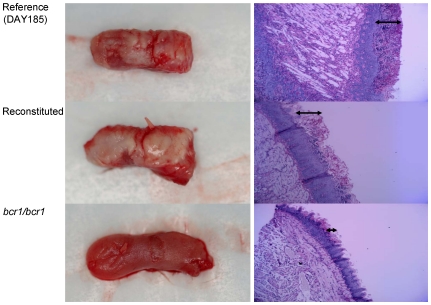
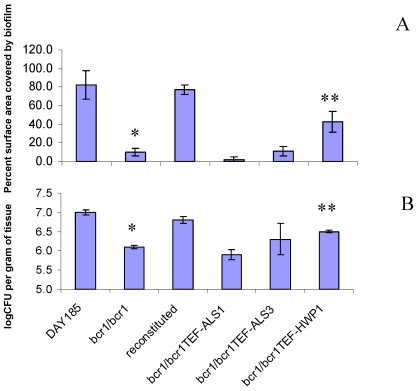
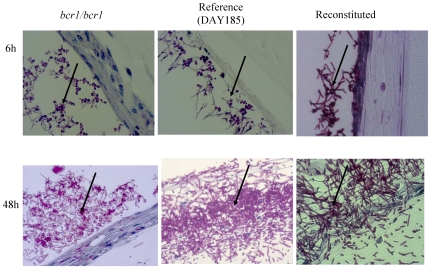
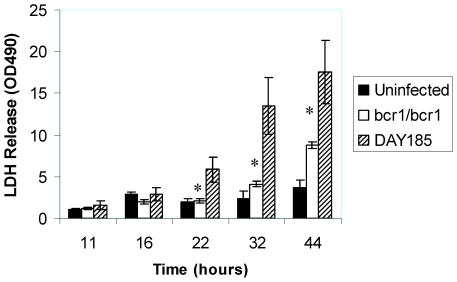
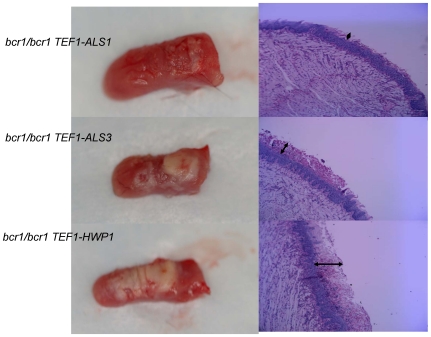
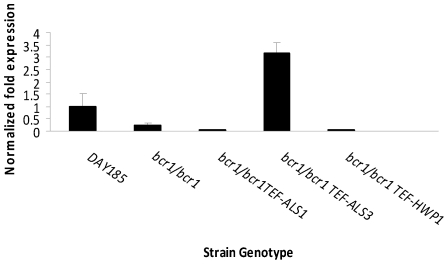
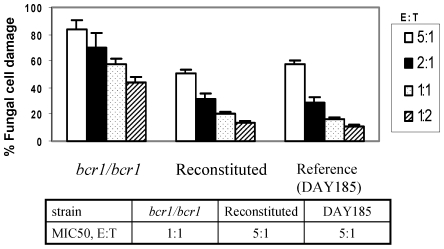
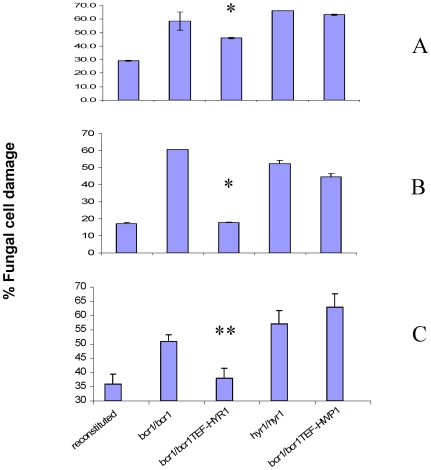
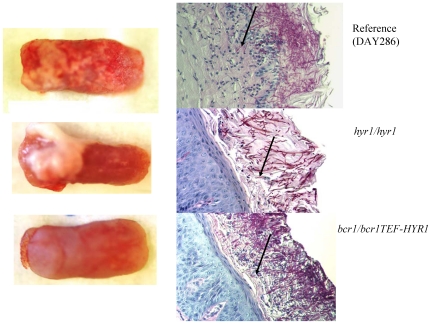
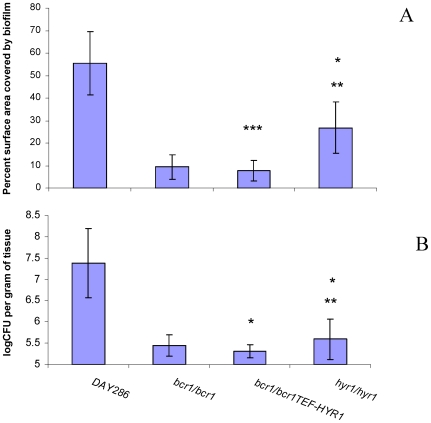
Candida albicans triggers recurrent infections of the oropharyngeal mucosa that result from biofilm growth. Prior studies have indicated that the transcription factor Bcr1 regulates biofilm formation in a catheter model, both in vitro and in vivo. We thus hypothesized that Bcr1 plays similar roles in the formation of oral mucosal biofilms and tested this hypothesis in a mouse model of oral infection. We found that a bcr1/bcr1 mutant did not form significant biofilm on the tongues of immunocompromised mice, in contrast to reference and reconstituted strains that formed pseudomembranes covering most of the tongue dorsal surface. Overexpression of HWP1, which specifies an epithelial adhesin that is under the transcriptional control of Bcr1, partly but significantly rescued the bcr1/bcr1 biofilm phenotype in vivo. Since HWP1 overexpression only partly reversed the biofilm phenotype, we investigated whether additional mechanisms, besides adhesin down-regulation, were responsible for the reduced virulence of this mutant. We discovered that the bcr1/bcr1 mutant was more susceptible to damage by human leukocytes when grown on plastic or on the surface of a human oral mucosa tissue analogue. Overexpression of HYR1, but not HWP1, significantly rescued this phenotype. Furthermore a hyr1/hyr1 mutant had significantly attenuated virulence in the mouse oral biofilm model of infection. These discoveries show that Bcr1 is critical for mucosal biofilm infection via regulation of epithelial cell adhesin and neutrophil function.
Overview
The claims and statistics of this paper haven’t been checked yet.
Run the check — free, no account needed. It reads the open-access text and checks the sources it cites.
Integrity signals
Registry
Cites
Statistics
Figures
Verification
Claims the paper makes
The claims and statistics of this paper haven’t been checked yet.
Run the check — free, no account needed. It reads the open-access text and checks the sources it cites.
Claims other papers make about this one
Each is checked against this paper’s own text: does it say what the citing paper says it does?
The source backs part of the claim, not all of it — or backs it for a different population, condition or comparison.
In the citing paper
“This hyphal-specific protein has previously been found to inhibit C. albicans killing by neutrophils and contribute to virulence in mouse models of both disseminated candidiasis and OPC, but its host cell receptor was unknown [24,25].”
From Candida albicans stimulates formation of a multi-receptor complex that mediates epithelial cell invasion during oropharyngeal infection (2023) · cites this paper as [25]
Experimental — accuracy not yet measuredThe cited source says what the claim attributes to it.
In the citing paper
“It has previously been found that Hyr1 also required for maximal virulence in an immunosuppressed mouse model of OPC [25].”
From Candida albicans stimulates formation of a multi-receptor complex that mediates epithelial cell invasion during oropharyngeal infection (2023) · cites this paper as [25]
Self-check
Percentages, sums and reported differences re-computed from the paper’s own numbers.
The self-check needs the paper’s full text.
Citations
Cites
Single-Step Method of RNA Isolation by Acid Guanidinium Thiocyanate–Phenol–Chloroform Extraction
Chomczynski, P., & Sacchi, N. (1987) · Analytical Biochemistry · doi:10.1006/abio.1987.9999 · Cited by 65,515
Adhesive and mammalian transglutaminase substrate properties of Candida albicans Hwp1.
Staab, J., Bradway, S. D., Fidel, P., & Sundstrom, P. (1999) · Science · doi:10.1126/science.283.5407.1535 · Cited by 683
Als3 Is a Candida albicans Invasin That Binds to Cadherins and Induces Endocytosis by Host Cells
Phan, Q. T., Myers, C. L., Fu, Y., Sheppard, D. C., Yeaman, M. R., Welch, W. H., Ibrahim, A. S., Edwards, J. E., & Filler, S. G. (2007) · PLoS Biology · doi:10.1371/journal.pbio.0050064 · Cited by 641
Critical Role of Bcr1-Dependent Adhesins in C. albicans Biofilm Formation In Vitro and In Vivo
Nobile, C. J., Andes, D. R., Nett, J. E., Smith, F. J., Yue, F., Phan, Q.-T., Edwards, J. E., Filler, S. G., & Mitchell, A. P. (2006) · PLoS Pathogens · doi:10.1371/journal.ppat.0020063 · Cited by 507
Self-citationRegulation of Cell-Surface Genes and Biofilm Formation by the C. albicans Transcription Factor Bcr1p
Nobile, C. J., & Mitchell, A. P. (2005) · Current Biology · doi:10.1016/j.cub.2005.05.047 · Cited by 464
Self-citationFradin, C., De Groot, P., MacCallum, D., Schaller, M., Klis, F., Odds, F. C., & Hube, B. (2005) · Molecular Microbiology · doi:10.1111/j.1365-2958.2005.04557.x · Cited by 455
Function of Candida albicans Adhesin Hwp1 in Biofilm Formation
Nobile, C. J., Nett, J. E., Andes, D. R., & Mitchell, A. P. (2006) · Eukaryotic Cell · doi:10.1128/ec.00194-06 · Cited by 395
Self-citationJesaitis, A. J., Franklin, M. J., Berglund, D. L., Sasaki, M., Lord, C. I., Bleazard, J. B., Duffy, J. E., Beyenal, H., & Lewandowski, Z. (2003) · The Journal of Immunology · doi:10.4049/jimmunol.171.8.4329 · Cited by 373
Ramage, G., VandeWalle, K., López-Ribot, J. L., & Wickes, B. L. (2002) · FEMS Microbiology Letters · doi:10.1016/s0378-1097(02)00853-4 · Cited by 334
Candida albicans forms biofilms on the vaginal mucosa
Harriott, M. M., Lilly, E. A., Rodriguez, T. E., Fidel, P. L., & Noverr, M. C. (2010) · Microbiology · doi:10.1099/mic.0.039354-0 · Cited by 301 · cited 3×
“with results in the mouse vaginal mucosa model [16], we found that the bcr1/bcr1 strain was deficient in forming a clinically visible mucosal biofilm on the tongues of immunocompromised mice in vivo (Fig.”
BackgroundResultRIM101-Dependent and -Independent Pathways Govern pH Responses in Candida albicans
Davis, D. A., Wilson, R. B., & Mitchell, A. P. (2000) · Molecular and Cellular Biology · doi:10.1128/mcb.20.3.971-978.2000 · Cited by 296
Self-citationBailey, D., Feldmann, P. J. F., Bovey, M., Gow, N. A., & Brown, A. J. (1996) · Journal of Bacteriology · doi:10.1128/jb.178.18.5353-5360.1996 · Cited by 259
Zhao, X., Oh, S.-H., Cheng, G., Green, C. B., Nuessen, J. A., Yeater, K., Leng, R. P., Brown, A. J. P., & Hoyer, L. L. (2004) · Microbiology · doi:10.1099/mic.0.26943-0 · Cited by 254
Jin, Y., Yip, H. K., Samaranayake, Y. H., Yau, J. Y. Y., & Samaranayake, L. P. (2003) · Journal of Clinical Microbiology · doi:10.1128/jcm.41.7.2961-2967.2003 · Cited by 252
Characterization of Mucosal Candida albicans Biofilms
Dongari‐Bagtzoglou, A. I., Kashleva, H., Dwivedi, P., Diaz, P. I., & Vasilakos, J. P. (2009) · PLoS ONE · doi:10.1371/journal.pone.0007967 · Cited by 214
Self-citationA contact-activated kinase signals Candida albicans invasive growth and biofilm development
Kumamoto, C. A. (2005) · Proceedings of the National Academy of Sciences · doi:10.1073/pnas.0407097102 · Cited by 210
An Extensive Circuitry for Cell Wall Regulation in Candida albicans
Blankenship, J. R., Fanning, S., Hamaker, J. J., & Mitchell, A. P. (2010) · PLoS Pathogens · doi:10.1371/journal.ppat.1000752 · Cited by 201
Self-citationDavis, D. A., Bruno, V. M., Loza, L., Filler, S. G., & Mitchell, A. P. (2002) · Genetics · doi:10.1093/genetics/162.4.1573 · Cited by 184
Self-citationCandida albicans Als3p is required for wild-type biofilm formation on silicone elastomer surfaces
Zhao, X., Daniels, K. J., Oh, S.-H., Green, C. B., Yeater, K. M., Soll, D. R., & Hoyer, L. L. (2006) · Microbiology · doi:10.1099/mic.0.28959-0 · Cited by 179
Development of a highly reproducible three-dimensional organotypic model of the oral mucosa
Dongari‐Bagtzoglou, A. I., & Kashleva, H. (2006) · Nature Protocols · doi:10.1038/nprot.2006.323 · Cited by 162
Self-citationCandida albicans Biofilm-Defective Mutants
Richard, M. L., Nobile, C. J., Bruno, V. M., & Mitchell, A. P. (2005) · Eukaryotic Cell · doi:10.1128/ec.4.8.1493-1502.2005 · Cited by 161
Self-citationDevelopment and Validation of an In Vivo Candida albicans Biofilm Denture Model
Nett, J. E., Marchillo, K., Spiegel, C. A., & Andes, D. R. (2010) · Infection and Immunity · doi:10.1128/iai.00480-10 · Cited by 161
Green, C. B., Cheng, G., Chandra, J., Mukherjee, P. K., Ghannoum, M. A., & Hoyer, L. L. (2004) · Microbiology · doi:10.1099/mic.0.26699-0 · Cited by 159
Tsuchimori, N., Sharkey, L. L., Fonzi, W., French, S., Edwards, J., & Filler, S. (2000) · Infection and Immunity · doi:10.1128/iai.68.4.1997-2002.2000 · Cited by 138
Sundstrom, P., Balish, E., & Allen, C. M. (2002) · The Journal of Infectious Diseases · doi:10.1086/338836 · Cited by 134
Candida albicans Hyr1p Confers Resistance to Neutrophil Killing and Is a Potential Vaccine Target
Luo, G., Ibrahim, A. S., Spellberg, B., Nobile, C. J., Mitchell, A. P., & Fu, Y. (2010) · The Journal of Infectious Diseases · doi:10.1086/652407 · Cited by 125
Self-citationClassification and clinical manifestations of oral yeast infections
Holmstrup, P., & Axéll, T. (1990) · Acta Odontologica Scandinavica · doi:10.3109/00016359009012734 · Cited by 118
Proteomics for the analysis of the Candida albicans biofilm lifestyle
Thomas, D. P., Bachmann, S. P., & Lopez‐Ribot, J. L. (2006) · PROTEOMICS · doi:10.1002/pmic.200600332 · Cited by 117
Schaller, M., Boeld, U., Oberbauer, S., Hamm, G., Hube, B., & Körting, H. C. (2004) · Microbiology · doi:10.1099/mic.0.27169-0 · Cited by 112
Candida albicans biofilm formation in a new in vivo rat model
Řičicová, M., Kucharíková, S., Tournu, H., Hendrix, J., Bujdáková, H., Eldere, J. V., Lagrou, K., & Dijck, P. V. (2009) · Microbiology · doi:10.1099/mic.0.033530-0 · Cited by 110
Inhaled and nasal corticosteroids: safety aspects*
Passalacqua, G., Albano, M., Canonica, G. W., Bachert, C., Cauwenberge, P. V., Davies, R. J., Durham, S. R., Kontou-Fili, K., Horak, F., & Malling, H. ‐. (2000) · Allergy · doi:10.1034/j.1398-9995.2000.00370.x · Cited by 108
Nicolatou‐Galitis, O., Dardoufas, K., Markoulatos, P., Sotiropoulou‐Lontou, A., Kyprianou, K., Kolitsi, G., Pissakas, G. J., Skarleas, C., Kouloulias, V., Papanicolaou, V. S., et al. (2001) · Journal of Oral Pathology and Medicine · doi:10.1034/j.1600-0714.2001.030008471.x · Cited by 73
Identification of Candida albicans genes induced during thrush offers insight into pathogenesis
Cheng, S., Clancy, C. J., Checkley, M. A., Handfield, M., Hillman, J. D., Progulske‐Fox, A., Lewin, A. S., Fidel, P. L., & Nguyen, M. H. (2003) · Molecular Microbiology · doi:10.1046/j.1365-2958.2003.03521.x · Cited by 64
Role of Candida albicans polymorphism in interactions with oral epithelial cells
Villar, C. C., Kashleva, H., & Dongari‐Bagtzoglou, A. I. (2004) · Oral Microbiology and Immunology · doi:10.1111/j.1399-302x.2004.00150.x · Cited by 60
Self-citationThrush in the Breastfeeding Dyad: Results of a Survey on Diagnosis and Treatment
Brent, N. B. (2001) · Clinical Pediatrics · doi:10.1177/000992280104000905 · Cited by 56
Humanized In Vivo Model for Streptococcal Impetigo
Scaramuzzino, D. A., McNiff, J. M., & Bessen, D. E. (2000) · Infection and Immunity · doi:10.1128/iai.68.5.2880-2887.2000 · Cited by 54
Frequency of oral manifestations in children infected with human immunodeficiency virus.
Fonseca, R., Cardoso, A. S., & Pomarico, I. (2000) · PubMed · Cited by 39
Dongari‐Bagtzoglou, A. I., Villar, C. C., & Kashleva, H. (2005) · Medical Mycology · doi:10.1080/13693780500064557 · Cited by 34
Self-citation(B1) Candida and Mycotic Infections
Coogan, M. M., Fidel, P. L., Komesu, M. C., Maeda, N., & Samaranayake, L. P. (2006) · Advances in Dental Research · doi:10.1177/154407370601900124 · Cited by 30
PROTEOMICS – Continued growth and comprehensive coverage
Dunn, M. J. (2006) · PROTEOMICS · doi:10.1002/pmic.200690000 · Cited by 18
Incidence and management of oral conditions in general practice.
Deconinck, S., Boeke, A. J. P., van der Waal, I., & van der Windt, D. (2003) · Europe PMC (PubMed Central) · Cited by 6
Cited by
Sorted by citations
Candida albicans Biofilms and Human Disease
Nobile, C. J., & Johnson, A. D. (2015) · Annual Review of Microbiology · doi:10.1146/annurev-micro-091014-104330 · Cited by 1,057
Candida albicans biofilms: development, regulation, and molecular mechanisms
Gulati, M., & Nobile, C. J. (2016) · Microbes and Infection · doi:10.1016/j.micinf.2016.01.002 · Cited by 738
Fanning, S., & Mitchell, A. P. (2012) · PLoS Pathogens · doi:10.1371/journal.ppat.1002585 · Cited by 465
Self-citationSchlecht, L. M., Peters, B. M., Krom, B. P., Freiberg, J. A., Hänsch, G. M., Filler, S. G., Jabra‐Rizk, M. A., & Shirtliff, M. E. (2014) · Microbiology · doi:10.1099/mic.0.083485-0 · Cited by 286
Candida albicans interactions with epithelial cells and mucosal immunity
Naglik, J. R., Moyes, D. L., Wächtler, B., & Hube, B. (2011) · Microbes and Infection · doi:10.1016/j.micinf.2011.06.009 · Cited by 277
Metadata
- Authors
- Dwivedi, P., Thompson, A., Xie, Z., Kashleva, H., Ganguly, S., Mitchell, A. P., & Dongari-Bagtzoglou, A.
- Affiliations
- University of Connecticut (US)
- Carnegie Mellon University (US)
- Venue
- PLoS ONE
- Publisher
- Public Library of Science (PLoS)
- Published
- 2011-01-25
- Volume
- 6
- Issue
- 1
- Pages
- e16218
- ISSN
- 1932-6203 (ISSN-L)
- PMC
- PMC3026825
- OpenAlex
- W2091452473
- Cited by
- 110
- References
- 42
- Citations by year
- 2026: 3 · 2025: 4 · 2024: 10 · 2023: 11 · 2022: 5 · 2021: 6 · 2020: 2 · 2019: 6 · 2018: 8 · 2017: 12 · 2016: 7 · 2015: 4 · 2014: 6 · 2013: 9 · 2012: 12
- FWCI
- 6.94
- Type
- journal article
- Language
- en
- Open access
- gold
- doi.org
- Locations
- PLoS ONE (publishedVersion, cc-by)
- PubMed Central (publishedVersion, cc-by)
- PubMed (publishedVersion)
- DOAJ (DOAJ: Directory of Open Access Journals) (submittedVersion, cc-by-sa)
- Funders
- National Institutes of Health
- National Institute of Allergy and Infectious Diseases (R01AI067703)
- National Institute of Dental and Craniofacial Research (R01DE013986)
- Topics
- Health Sciences › Medicine › Infectious Diseases › Antifungal resistance and susceptibility
- Life Sciences › Biochemistry, Genetics and Molecular Biology › Molecular Biology › Fungal and yeast genetics research
- Life Sciences › Biochemistry, Genetics and Molecular Biology › Molecular Biology › Bacterial biofilms and quorum sensing
- Keywords
- Candida albicans, HWP1, fungal virulence, oropharyngeal infection, immunodeficient mice, pseudomembranous candidiasis
- MeSH terms
- Animals, Candida albicans, Fungal Proteins, Membrane Glycoproteins, Mouth Mucosa, Neutrophils, Transcription Factors, Biofilms, Adhesins, Bacterial, Mice, Immune Evasion
About these checks
Registry, retraction, Cites and statistics results are computed, not judged, with one exception: a printed reference that no index lists is read once by a model before it counts as a citation error. Claims are extracted by a model and kept only when their quote appears verbatim in the text; each cited source is then checked, with a model’s help, for whether it says what the claim relies on. Those verdicts can be wrong — read the claim’s quote and the cited source before relying on one.
Statistics and arithmetic are recomputed, not judged.
Confidence bands are shown only for fields calibrated on our annotated test set. None is calibrated yet, so no band is shown.
What counts as a claim ›How we measure confidence ›How we check this ›
Are you an author, or do you see a problem with this page? Request a review
