

The DOI matches its Crossref record; 29 of the 29 references it cites were found in a registry or an index.
NIH Disease Funding Levels and Burden of Disease
Open accessAbstract
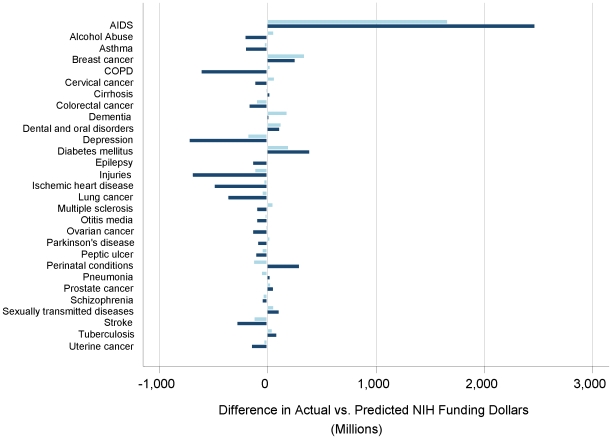
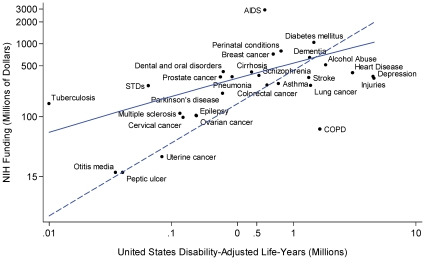
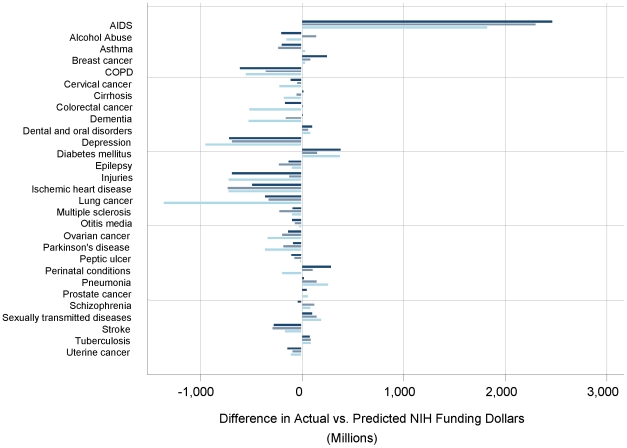
BACKGROUND: An analysis of NIH funding in 1996 found that the strongest predictor of funding, disability-adjusted life-years (DALYs), explained only 39% of the variance in funding. In 1998, Congress requested that the Institute of Medicine (IOM) evaluate priority-setting criteria for NIH funding; the IOM recommended greater consideration of disease burden. We examined whether the association between current burden and funding has changed since that time. METHODS: We analyzed public data on 2006 NIH funding for 29 common conditions. Measures of US disease burden in 2004 were obtained from the World Health Organization's Global Burden of Disease study and national databases. We assessed the relationship between disease burden and NIH funding dollars in univariate and multivariable log-linear models that evaluated all measures of disease burden. Sensitivity analyses examined associations with future US burden, current and future measures of world disease burden, and a newly standardized NIH accounting method. RESULTS: In univariate and multivariable analyses, disease-specific NIH funding levels increased with burden of disease measured in DALYs (p = 0.001), which accounted for 33% of funding level variation. No other factor predicted funding in multivariable models. Conditions receiving the most funding greater than expected based on disease burden were AIDS ($2474 M), diabetes mellitus ($390 M), and perinatal conditions ($297 M). Depression ($719 M), injuries ($691 M), and chronic obstructive pulmonary disease ($613 M) were the most underfunded. Results were similar using estimates of future US burden, current and future world disease burden, and alternate NIH accounting methods. CONCLUSIONS: Current levels of NIH disease-specific research funding correlate modestly with US disease burden, and correlation has not improved in the last decade.
Overview
The claims and statistics of this paper haven’t been checked yet.
Run the check — free, no account needed. It reads the open-access text and checks the sources it cites.
Integrity signals
Registry
Cites
Statistics
Figures
Verification
Claims the paper makes
The claims and statistics of this paper haven’t been checked yet.
Run the check — free, no account needed. It reads the open-access text and checks the sources it cites.
Claims other papers make about this one
Each is checked against this paper’s own text: does it say what the citing paper says it does?
In the citing paper
“historically, psychiatric research has ben underfunded in comparison to public health impact (with the possible exception of AD). 141–144”
From Genetic architectures of psychiatric disorders: the emerging picture and its implications (2012) · cites this paper as [144]
Self-check
Percentages, sums and reported differences re-computed from the paper’s own numbers.
The self-check needs the paper’s full text.
Citations
Cites
Zhang, Q., Wang, C., Zheng, M., Li, Y., Li, J., Zhang, L., Shang, X., & Yan, C. (2014) · Cerebrovascular Diseases · doi:10.1159/000369778 · Cited by 11,609
Projections of Global Mortality and Burden of Disease from 2002 to 2030
Mathers, C. D., & Loncar, D. (2006) · PLoS Medicine · doi:10.1371/journal.pmed.0030442 · Cited by 11,386
Self-citation(1996) · Cited by 6,884
Higgins, S. M. F., Macken, A. P., Cullen, W., Saunders, J., Dunne, C. P., & O’Gorman, C. S. (2013) · PubMed · doi:10.34961/9953 · Cited by 4,807
Global mortality, disability, and the contribution of risk factors: Global Burden of Disease Study
Murray, C. J., & Lopez, A. D. (1997) · The Lancet · doi:10.1016/s0140-6736(96)07495-8 · Cited by 4,492 · cited 1×
“The GBD systematically collects timely disease-specific epidemiologic information and models missing data to estimate a variety of measures of burden [15,16].”
BackgroundGlobal Burden of Disease and Risk Factors
López, A. D., Mathers, C. D., Ezzati, M., Jamison, D. T. T., & Murray, C. J. L. (2006) · World Bank, Washington, DC eBooks · doi:10.1596/978-0-8213-6262-4 · Cited by 2,714
Self-citationNational Center for Biotechnology Information
Gressner, A. M., & Arndt, T. (2019) · Springer Reference Medizin · doi:10.1007/978-3-662-48986-4_301184 · Cited by 1,412
Imaging Studies for Low Back Pain
Clearingh, N. Q. M., & Agency for Healthcare Research and (2008) · Journal of Pain & Palliative Care Pharmacotherapy · doi:10.1080/15360280802537332 · Cited by 653
Impact factor: a valid measure of journal quality?
(2003) · Europe PMC (PubMed Central) · Cited by 584
The Relation between Funding by the National Institutes of Health and the Burden of Disease
Gross, C. P., Anderson, G. F., & Powe, N. R. (1999) · New England Journal of Medicine · doi:10.1056/nejm199906173402406 · Cited by 509
Cited by
Sorted by citations
Items 101–200 of 249
How to Improve Research Funding in Academia? Lessons From the COVID-19 Crisis
Sikimić, V. (2022) · Frontiers in Research Metrics and Analytics · doi:10.3389/frma.2022.777781 · Cited by 12
Health research in the Western Cape province, South Africa: Lessons and challenges
London, L., Naledi, T., & Petros, S. G. (2014) · African Journal of Primary Health Care & Family Medicine · doi:10.4102/phcfm.v6i1.698 · Cited by 12
Karimkhani, C., Trikha, R., Aksut, B., Jones, T. M., Boyers, L. N., Schlichte, M. J., Pederson, H., Okland, T. S., DiGuiseppi, C. G., Nasser, M., et al. (2016) · Injury · doi:10.1016/j.injury.2015.12.019 · Cited by 13
“Cost is one of the major driving forces behind research, while other prioritisation criteria include lack of economical interventions, opportunity for pioneering therapies, prevention of highly transmissible diseases, public interest, and burden of disease [1–3].”
BackgroundZhang, L., Zhao, W., Liu, J., Sivertsen, G., & Huang, Y. (2020) · Scientometrics · doi:10.1007/s11192-020-03572-9 · Cited by 12
"Diabetes Associated Genes from the Dark Matter of the Human Proteome"
Narayanan, R. (2014) · MOJ Proteomics & Bioinformatics · doi:10.15406/mojpb.2014.01.00020 · Cited by 10
“Diabetes affects a large number of people in the world and is a major healthcare challenge [13,14].”
BackgroundClinical investigations for SUS, the Brazilian public health system
de Paula, A. P., Giozza, S. P., Pereira, M. Z., Boaventura, P. S., Santos, L. M. P., Sachetti, C. G., Carranza-Tamayo, C. O., Kowalski, C. C. G., Elias, F. T. S., Serruya, S. J., et al. (2012) · Sao Paulo Medical Journal · doi:10.1590/s1516-31802012000300008 · Cited by 11
Wang, A. S., & Xiang, H. (2022) · Journal of Surgical Research · doi:10.1016/j.jss.2022.06.071 · Cited by 11
Ward, D. J., Martino, O. I., Packer, C., Simpson, S., & Stevens, A. J. (2013) · Journal of Health Services Research & Policy · doi:10.1177/1355819613476015 · Cited by 11
“HIV/AIDS received the most funding in relation to its burden, and depression received the least.(11) Innovative outputs from research generally follow a similar trend; a disproportionately high number of health technologies (including drugs, devices, diagnostic products, procedures, programmes and settings) are develo…”
BackgroundIdentifying Otolaryngology Systematic Review Research Gaps
Pederson, H., Okland, T. S., Boyers, L. N., Karimkhani, C., Rosenfeld, R. M., Nasser, M., Yoong, S. L., Wolfenden, L., Kyu, H. H., Serina, P. T., et al. (2014) · JAMA Otolaryngology–Head & Neck Surgery · doi:10.1001/jamaoto.2014.2700 · Cited by 11
The implication of telehealthcare in COPD management of China
Lao, X., Zhang, J., & Bai, C. (2013) · Expert Review of Respiratory Medicine · doi:10.1586/17476348.2013.838019 · Cited by 11
Attributing medical spending to conditions: A comparison of methods
Ghosh, K., Bondarenko, I., Messer, K. L., Stewart, S. T., Raghunathan, T., Rosen, A., & Cutler, D. M. (2018) · PLoS ONE · doi:10.1371/journal.pone.0237082
“For example, researchers and policy makers often ask questions such as: Does spending align with the burden of disease, or are the two independent [1]? How much of medical spending growth is associated with the rising prevalence of chronic disease [2–4]? Each of these questions requires a condition-based look at spend…”
Optimal Allocation of Research Funds under a Budget Constraint
Fairley, M., Cipriano, L. E., & Goldhaber‐Fiebert, J. D. (2020) · Medical Decision Making · doi:10.1177/0272989x20944875 · Cited by 10
How does academia respond to the burden of infectious and parasitic disease?
Zhao, W., Wang, L., & Zhang, L. (2022) · Health Research Policy and Systems · doi:10.1186/s12961-022-00889-0 · Cited by 10
“As metrics that reflect research effort, prior studies have considered academic research output [29, 30], funding [17, 21, 31] and clinical trials [32, 33].”
BackgroundResultWhere does public funding for cancer research go
Trasta, A. (2018) · EMBO Reports · doi:10.15252/embr.201845859 · Cited by 9
“In fact, various studies show that governmental funding is not directly associated with disease burden: Some types of cancer appear to be relatively over- or underfunded [1,2].”
BackgroundJung, Y. L., Yoo, H. S., & Kim, E. S. (2019) · Health Research Policy and Systems · doi:10.1186/s12961-019-0510-6 · Cited by 9
The role of depression and social support on readmission rates within one year of traumatic injury.
Agtarap, S., Shelley, J. K., Bennett, M., Roden-Foreman, J. W., McShan, E., Dome, M. R., Powers, M. B., Petrey, L. B., & Warren, A. M. (2018) · Health Psychology · doi:10.1037/hea0000590 · Cited by 9
“With such high readmission rates following traumatic injury, there exists a disproportionate lack of representation for surgical funding and research that could very well address readmissions rates and burden (Gillum et al., 2011; Rangel, Efron, & Moss, 2002).”
BackgroundBarnett, B. S. (2025) · Psychoactives · doi:10.3390/psychoactives4010004 · Cited by 8
“Finally, since depression was the most common focus of the analyzed grants, it is worth noting that depression research is considered underfunded by the NIH relative to the condition’s significant burden of disease in the population [26].”
Telehealthcare management for patients with chronic obstructive pulmonary disease
Yohannes, A. M. (2012) · Expert Review of Respiratory Medicine · doi:10.1586/ers.12.28 · Cited by 8
Vu, A., Duber, H. C., Sasser, S. M., Hansoti, B., Lynch, C. A., Khan, A., Johnson, T. L., Modi, P., Clattenburg, E. J., & Hargarten, S. W. (2013) · Academic Emergency Medicine · doi:10.1111/acem.12267 · Cited by 8
Anything to Stay Alive: The Challenges of a Campaign for an Experimental Drug
Geffen, N. (2015) · Developing World Bioethics · doi:10.1111/dewb.12084 · Cited by 8
Dual-Use and Infectious Disease Research
Evans, N. G. (2020) · International library of ethics, law, and the new medicine/The international library of ethics, law, and the new medicine · doi:10.1007/978-3-030-39819-4_9 · Cited by 8
Toward Priorities for Aging Research
Needham, S. (2013) · Rejuvenation Research · doi:10.1089/rej.2013.1508 · Cited by 8
“in 1996, found that only 39% of National Institutes of Health (NIH) funding variance was explained by DALYs in the United States.(9) Even after demands from the US Congress in 1998 for this disparity were corrected, a decade later the rate had further dropped to just 33%.”
BackgroundEngineering behaviour change in an epidemic: the epistemology of NIH‐funded HIV prevention science
Green, A., & Kolar, K. (2015) · Sociology of Health & Illness · doi:10.1111/1467-9566.12210 · Cited by 8
Yegros, A., van de Klippe, W., García, M. F. A., & Ràfols, I. (2019) · SSRN Electronic Journal · doi:10.2139/ssrn.3459230 · Cited by 9
Health Research Priority Setting: Do Grant Review Processes Reflect Ethical Principles?
Pierson, L., & Millum, J. (2021) · Global Public Health · doi:10.1080/17441692.2021.1922731 · Cited by 7
“In addition, analyses of funding allocations at specific organisations suggest that they correlate only moderately with disease burden, and funding does not fluctuate with changes in disease burden (Gillum et al., 2011; Xu et al., 2014).”
BackgroundExisting Funding Sources in Degenerative Cervical Myelopathy Research: Scoping Review
Bestwick, H., Teh, J. Q., Mowforth, O. D., Grodzinski, B., Kotter, M., & Davies, B. M. (2022) · Interactive Journal of Medical Research · doi:10.2196/36194 · Cited by 7
“In an analysis of research funding by the US NIH, disease burden correlated poorly with research investment [30].”
Nimgaonkar, A., Mughal, A. Y., Heimer, H., Nimgaonkar, V. L., Greenstein, D. K., & Wright, A. (2022) · Health Research Policy and Systems · doi:10.1186/s12961-022-00837-y · Cited by 7
“earlier studies of NIH funding outlays, as well as those of different health systems [3, 4].”
BackgroundMethodInfluentialKeeping the “Public” in Schools of Public Health
Freudenberg, N., Klitzman, S., Diamond, C., & El-Mohandes, A. A. E. (2015) · American Journal of Public Health · doi:10.2105/ajph.2014.302534 · Cited by 7
Artificial liver research output and citations from 2004 to 2017: a bibliometric analysis
Li, Y., He, M., Zou, Z., Bian, X., Huang, X., Yang, C., Wei, S., & Dai, S. (2019) · PeerJ · doi:10.7717/peerj.6178 · Cited by 7
“In addition, USA, Japan, and Germany were developed countries and had a huge disease burden of liver failure, promoting more research interest and more research funding as well in artificial liver researches (Gillum et al., 2011).”
BackgroundNIH funding of COVID-19 research in 2020: a cross-sectional study
Balaguru, L., Dun, C., Meyer, A., Hennayake, S., Walsh, C. M., Kung, C., Cary, B., Migliarese, F., Dai, T., Bai, G., et al. (2022) · BMJ Open · doi:10.1136/bmjopen-2021-059041 · Cited by 7
Yaqub, O., Luna, J. A., Moore, D. A. Q., & Yegros, A. (2022) · Science and Public Policy · doi:10.1093/scipol/scac040 · Cited by 7
“The exact distribution of these funding allocations has attracted considerable scrutiny, not only in terms of which disease areas are afforded most funds but also in terms of the extent to which they are aligned with social priorities (as reflected by disease burden), local priorities (as reflected by geographical inc…”
BackgroundShah, P., Vaughan, G., & Ledley, F. D. (2023) · PLoS ONE · doi:10.1371/journal.pone.0283887 · Cited by 7
“It should be emphasized that the primary objective of federal funding for academic biomedical research is not to generate economic activity but rather to “enhance health, lengthen life, and reduce illness and disability” [90,91].”
BackgroundStockmann, C. R., Hersh, A. L., Sherwin, C. M. T., & Spigarelli, M. G. (2014) · International Journal of Cardiology · doi:10.1016/j.ijcard.2013.12.095 · Cited by 6
van de Laar, L., de Kruif, T., Waltman, L., Meijer, I., Gupta, A., & Hagenaars, N. (2018) · BMJ Open · doi:10.1136/bmjopen-2017-020818 · Cited by 6
Is there underfunding in brain research? The UK research expenditure
Winter, Y., Oertel, W. H., & Dodel, R. C. (2011) · European Journal of Neurology · doi:10.1111/j.1468-1331.2011.03499.x · Cited by 6
“In conclusion, the disease burden is still not adequately reflected in research funding, either in the UK as the authors pointed out in their study or in other European countries and the USA.”
BackgroundInfluentialThe clinical relevance and newsworthiness of NIHR HTA-funded research: a cohort study
Wright, D. N. M., Young, A. J., Iserman, E. C., Maeso, R., Turner, S., Haynes, R. B., & Milne, R. (2014) · BMJ Open · doi:10.1136/bmjopen-2013-004556 · Cited by 5
“exist between publicly funded research and burden of disease.(2) Similarly, research conducted on patient or clinician research priorities has revealed potential mismatches between clinical priorities and funded research.”
Gómez‐García, T., Moreno‐Casbas, T., González‐María, E., & Fuentelsaz‐Gallego, C. (2014) · Enfermería Clínica · doi:10.1016/j.enfcli.2014.04.001 · Cited by 5
The Feasibility of COPD Surveillance in Ontario: A Population Study
Victor, J. C., To, T. M., Wilton, A. S., Guan, J., Ho, M. M., & Gershon, A. S. (2011) · Healthcare Quarterly · doi:10.12927/hcq.2011.22647 · Cited by 5
“Similar findings have been demonstrated for COPD funding in the United States (Gillum et al. 2011).”
ResultHossain, I., & Milne, C. (2018) · Clinical Therapeutics · doi:10.1016/j.clinthera.2018.06.007 · Cited by 5
An Update in Health Disparities in COPD in the USA
Kuhn, B., Wick, K. D., & Schivo, M. (2021) · Current Pulmonology Reports · doi:10.1007/s13665-021-00268-0 · Cited by 5
“Despite a large impact on the US population both in terms of prevalence and morbidity/mortality, research for COPD has traditionally received appreciably less funding when compared to cancer, heart disease, and other diseases [66].”
BackgroundZaveri, A. J., Vissoci, J. R. N., Daraio, C. C., & Pietrobon, R. S. (2013) · Lecture notes in computer science · doi:10.1007/978-3-642-41338-4_16 · Cited by 5
“Additionally, there are studies that have analyzed the relation between funding by the NIH (National Institutes of Health) and burden of disease [11].”
BackgroundNational Institutes of Health Funding for Tobacco Versus Harm From Tobacco
Hughes, J. R. (2015) · Nicotine & Tobacco Research · doi:10.1093/ntr/ntv137 · Cited by 5
Editorial: Prevalence of Arthritis Revisited
Katz, J. N. (2017) · Arthritis & Rheumatology · doi:10.1002/art.40357 · Cited by 5
“Indeed, Gillum and colleagues showed that disability-adjusted life years lost explained 33% of the variance in NIH disease-specific funding in 2006; prevalence explained 6% (9).”
BackgroundSilvestre, J., Martinez, R., Thompson, T. L., Wilson, R. H., & Nelson, C. L. (2022) · Journal of Bone and Joint Surgery · doi:10.2106/jbjs.22.00025 · Cited by 4
Funding priorities and health outcomes in Danish medical research
Madsen, E. B., & Andersen, J. P. (2024) · Social Science & Medicine · doi:10.1016/j.socscimed.2024.117347 · Cited by 6
Katz, L., Fink, R. V., Bozeman, S. R., & McNeil, B. J. (2014) · PLoS ONE · doi:10.1371/journal.pone.0114873 · Cited by 4
“The VA medical research program consists of a network of intramural investigators based at 109 medical centers across the United States.”
BackgroundInfluentialDisease burden and the advancement of biomedical knowledge
Hsiehchen, D., Espinoza, M., & Hsieh, A. (2016) · Scientometrics · doi:10.1007/s11192-016-2169-x · Cited by 4
“Remarkably, DALYs only explained 21% of NIH funding variance in 2012, which is decreased from 33% in 2006 and 39% in 1996 based on historic data (Gillum et al. 2011).”
BackgroundMethodResultInfluentialAssessing the academic achievement of United States orthopaedic departments
Trikha, R., Olson, T. E., Chaudry, A. E., Ishmael, C. R., Villalpando, C., Chen, C. J., Hori, K. R., & Bernthal, N. M. (2022) · World Journal of Orthopedics · doi:10.5312/wjo.v13.i2.201 · Cited by 4
Omari, A., Reeves, S. L., Prosser, L. A., Creary, M., Ahmad, A., & Chua, K. (2022) · International Journal of Neonatal Screening · doi:10.3390/ijns8030042 · Cited by 4
“Such questions have been investigated with respect to cystic fibrosis and sickle cell anemia [10,11], but racial and ethnic disparities in research investment have not been evaluated across all RUSP disorders.”
BackgroundNational Institutes of Health Funding for Hearing Loss Research
Blustein, J. (2019) · JAMA Otolaryngology–Head & Neck Surgery · doi:10.1001/jamaoto.2019.0649 · Cited by 4
Defining research priorities without biases: what is the optimal process?
Doğan, S., Pistilli, B., & André, F. (2016) · Annals of Oncology · doi:10.1093/annonc/mdw629 · Cited by 4
Gao, T., Han, O., Li, G., & Zeng, W. (2025) · npj Health Systems · doi:10.1038/s44401-025-00048-x · Cited by 3
“A subsequent study in 2011, which analyzed data in 2006 for 29 disease categories, reported a modest relationship between NIH funding and BoD 9 .”
Seidel, F., Oebel, B., Stein, L., Stoll‐Kleemann, S., & Gaugler, T. (2026) · Nutrients · doi:10.3390/nu18030426 · Cited by 3
“The latter problem of information gaps is especially likely to arise with this marginal proportion, as less funding and therefore fewer studies are to be expected due to the lower burden involved [26].”
Dietary Restriction in C. elegans
Zhang, Y., & Mair, W. B. (2016) · Healthy ageing and longevity · doi:10.1007/978-3-319-44703-2_16 · Cited by 4
The persistence of very low correlations between NIH research funding and disease burdens
Carter, A. J. R., & Gevorkian, M. (2024) · Public Health in Practice · doi:10.1016/j.puhip.2024.100580 · Cited by 3
“In 2006, the National Institutes of Health Reform Act reiterated the importance of battling hardships related to health by recommending prioritization of funding allocations based on disease specific burdens to society [4,6].”
InfluentialThe Case for Increased Funding for Research in Pulmonary and Critical Care
Peters-Golden, M. L., Klinger, J. R., & Carson, S. S. (2012) · American Journal of Respiratory and Critical Care Medicine · doi:10.1164/rccm.201203-0371pp · Cited by 3
“A follow-up analysis of 2006 allocations (4) revealed little improvement in the alignment between NIH funding and lung disease burdens over that decade.”
BackgroundWang, W., Robertson, J. C., & Basu, A. (2016) · Journal of Comparative Effectiveness Research · doi:10.2217/cer-2016-0021 · Cited by 3
Ma, J., Zhang, L., Li, X., Shen, J., Sun, Y., & Huang, Y. (2023) · Global Health Research and Policy · doi:10.1186/s41256-023-00288-0 · Cited by 3
“Previous R&D-related ND studies concentrate on identifying the association between disease burden and health expenditure [14, 15].”
BackgroundObserved consensus on research priorities for the hypertriglyceridemia patient registry
Freedman, S., de‐Madaria, E., Bruckert, É., Löhr, M. J., Rebours, V., & Jandhyala, R. (2023) · Current Medical Research and Opinion · doi:10.1080/03007995.2023.2235153 · Cited by 3
“The correlation between investment in research and medical needs is weak 14 – 16 .”
BackgroundPublic Health Innovation: Biopharmaceuticals Lost in Translation?
Halim, N. D., & Doyle, J. (2013) · Therapeutic Innovation & Regulatory Science · doi:10.1177/2168479013482315 · Cited by 3
“A seminal study examining NIH funding and disease burden was published in 1998(11) and a follow-up study was published in 2011.(9) These studies demonstrate a correlation between NIH funding and burden of disease, as measured in disability-adjusted life years (DALYs), but the authors also identify disease states for w…”
BackgroundMethodInfluentialOkhovati, M., Zare, M., & Bazrafshan, A. (2015) · Journal of Cardiovascular and Thoracic Research · doi:10.15171/jcvtr.2015.35 · Cited by 3
Krone, M., Dufner, V., Wagner, M., Gelbrich, G., Ertl, G., & Heuschmann, P. U. (2018) · Clinical Research in Cardiology · doi:10.1007/s00392-018-1240-4 · Cited by 3
Economic Burden of Polycystic Ovary Syndrome
Riestenberg, C. K., Jagasia, A., & Azziz, R. (2022) · Springer eBooks · doi:10.1007/978-3-030-92589-5_22 · Cited by 2
Tian, Y., DeWitt, L., Almeida, R. S., Clark, M., Obregon, D., Adame, S., Davis, T. M., Mendez-Maio, N. E., & Hamer, G. L. (2025) · Journal of Medical Entomology · doi:10.1093/jme/tjaf100 · Cited by 2
5 Years of bipolar disorder conversations on Reddit: Methods, key topics and future directions
Poh, C., Head, C., Nunez, J.-J., Lapadat, L., Morton, E., & Michalak, E. (2026) · PLoS ONE · doi:10.1371/journal.pone.0338622 · Cited by 2
“Despite the serious impacts of mental health conditions like BD, allocation of research funding towards the condition from both public and non-profit sources is disproportionate to the level of need, especially when compared with the amount of funding provided for physical health conditions [4,5].”
Long COVID disability burden in US adults
Bonuck, K. A., Gao, Q., Congdon, S., & Kim, R. (2026) · Communications Medicine · doi:10.1038/s43856-026-01516-7 · Cited by 2
Rumalla, K., Reddy, A. Y., & Petralia, A. (2019) · Kansas Journal of Medicine · doi:10.17161/kjm.v9i1.8597 · Cited by 2
Limited alignment of publicly competitive disease funding with disease burden in Japan
Nomura, S., Yoneoka, D., Tanaka, S., Makuuchi, R., Sakamoto, H., Ishizuka, A., Nakamura, H., Kubota, A., & Shibuya, K. (2020) · PLoS ONE · doi:10.1371/journal.pone.0228542 · Cited by 2
Nonpharmacological therapies for neurodegenerative disorders
Siddiq, A., Shrestha, S., Das, M., Chodnekar, S. Y., Wadan, A. S., Ayad, Y. W., & Ashraf, G. M. (2024) · Elsevier eBooks · doi:10.1016/b978-0-443-28822-7.00021-0 · Cited by 3
Anderson, A. B., Grazal, C. F., Tintle, S. M., Potter, B. K., Forsberg, J. A., & Dickens, J. F. (2021) · Journal of the American Academy of Orthopaedic Surgeons · doi:10.5435/jaaos-d-20-00259 · Cited by 2
Khurana, M. P., & Madsen, E. B. (2022) · Science and Public Policy · doi:10.1093/scipol/scac074 · Cited by 2
Silvestre, J., Clemmons, J. A., Wu, H., Caldwell, K., & Kang, J. D. (2023) · Journal of Neurosurgery Spine · doi:10.3171/2023.7.spine23101 · Cited by 2
What Makes Diseases and Drug Research and Development Attractive for the Pharmaceutical Industry
Hanekom, N., Bam, L., & Kock, I. D. (2019) · IEEE International Conference on Engineering, Technology and Innovation (ICE/ITMC) · doi:10.1109/ice.2019.8792645 · Cited by 2
“It can be measured by means of incidence, prevalence, mortality, years-of-life-lost (YLL), or disability-adjusted-life-years (DALYs) [4].”
BackgroundLinked Data Quality Assessment and its Application to Societal Progress Measurement
Zaveri, A. J. (2014) · Qucosa (Saxon State and University Library Dresden) · Cited by 2
Subjective Well-Being, Health and Healthcare Utilization: A Study of Rural Elderly in Odisha
Banjare, P. (2016) · Cited by 2
Stigma as a Barrier to Treatment and Adoption of InnovationPreprint
Grigolon, L. V., & Lasio, L. (2021) · RePEc: Research Papers in Economics · Cited by 2
Berglas, E., Musheyev, D., Lavi, A. B., Berglas, R. S., Berglas, R., & Kabarriti, A. E. (2025) · The Lancet Regional Health - Americas · doi:10.1016/j.lana.2025.101081 · Cited by 1
“4,5 However, this fi nding is inconsistent and is likely related to year-to-year changes.”
de Oliveira, J. H. P., Arruda, I. E. S., Sena, M. R., de Oliveira, F. H. C., Soares, M. F. D. L. R., Gadelha, C. A. G., & Soares‐Sobrinho, J. L. (2025) · BMC Public Health · doi:10.1186/s12889-025-25539-2 · Cited by 1
“DALYs are widely applied in health research prioritisation and resource allocation [59–61], including the development of national agendas [52].”
Spinal cord injury research and national institutes of health funding: a call to action
Silvestre, J., Martin, J. C., Roth, W., Ferdon, R. J., Reitman, C. A., Lawrence, J. P., Fehlings, M. G., & Ravinsky, R. A. (2025) · Spinal Cord · doi:10.1038/s41393-025-01156-z · Cited by 1
Quantifying multi-ethnic representation in genetic studies of high mortality diseases.
Chen, R., Dudley, J. T., Ruau, D., & Butte, A. J. (2012) · Europe PMC (PubMed Central) · Cited by 1
Health Disparities in Chronic Obstructive Pulmonary Disease
Siegel, M. R., Krishnan, J. A., Sullivan, J. L., Cerreta, S., & Mannino, D. M. (2015) · Respiratory medicine · doi:10.1007/978-3-319-23675-9_10 · Cited by 1
Funding research to achieve the Spine “10 × 25” goal
Hanna, M. (2016) · The Spine Journal · doi:10.1016/j.spinee.2016.03.045 · Cited by 1
The Impact of Comorbidities in Patients with Chronic Respiratory Diseases
Yohannes, A. M. (2017) · Springer eBooks · doi:10.1007/978-1-4939-7009-4_9 · Cited by 1
Counts, N. Z., Gionfriddo, P., & Chapman, R. H. (2020) · Applied Health Economics and Health Policy · doi:10.1007/s40258-020-00568-7 · Cited by 1
Sorensen, C. J., Dresser, C. J., Balakumar, A., Wheat, S., Yates, E. F., Healy, J. P., Brown, C., Butala, N., Lehmann, E. Y., Malina, G. E. K., et al. (2023) · Health Affairs · doi:10.1377/hlthaff.2022.01407 · Cited by 1
Kiarashi, J. (2024) · Handbook of clinical neurology · doi:10.1016/b978-0-12-823357-3.00016-1 · Cited by 1
Association between research topics and disease burden in health technology assessment
Kim, H.-S., Lee, J., & Yoo, B. (2016) · Journal of Korean Medical Association · doi:10.5124/jkma.2016.59.7.536 · Cited by 1
“Other studies have also explored the correlation between research fund and disease burden in the health and medical research and development [10-13] or analyzed research trends among published health technology assessment articles [14].”
BackgroundNeuromodulation Intervention in Resistant Depression
Prasetya, E. C., & Basoeki, L. (2020) · Jurnal Psikiatri Surabaya · doi:10.20473/jps.v8i2.17136 · Cited by 1
“[25] Gillum LA, Gouveia C, Dorsey ER, Pletcher M,”
BackgroundCarga de la enfermedad por VIH/sida en la Orinoquia colombiana 2010-2018
Lesmes, Ó. A. G., Vinasco-Ramos, D. S., & Plata‐Casas, L. I. (2023) · Boletín Semillero de Investigación en Familia · doi:10.22579/27448592.828 · Cited by 1
HUGHES, V. A. (2013) · Nature Medicine · doi:10.1038/nm0313-257 · Cited by 1
Diabetes Research and the Public Good: Federal Support for Research on Type 1 DiabetesPreprint
Shapiro, R. J., & Pham, N. D. (2014) · SSRN Electronic Journal · doi:10.2139/ssrn.2542171 · Cited by 1
“17 43 National Institutes of Health (2012); World Trade Organization (2008); Gillum et al. (2011). 44 National Institutes of Health (2010).”
BackgroundInfluentialSadatsafavi, M., & Sin, D. D. (2015) · CHEST Journal · doi:10.1378/chest.14-2979 · Cited by 1
Akiba, C. F., Powell, B. J., Pence, B. W., Muessig, K. E., Golin, C. E., & Go, V. F.-L. (2022) · Research Square · doi:10.21203/rs.3.rs-1626073/v1 · Cited by 1
(How) Do Health Shocks Reallocate Research Direction?Preprint
Zhou, H., Garg, P., & Fetzer, T. (2025) · medRxiv · doi:10.1101/2025.09.29.25336909 · Cited by 1
WITHDRAWN: Matching Taxpayer Funding to Taxpayer Health Needs
Hanna, M. S. (2014) · The American Journal of Medicine · doi:10.1016/j.amjmed.2014.02.035
RetractedEvaluating New Health Technologies and Disease Burden in Developed Countries
Catalá-López, F., Gènova-Maleras, R., & García‐Altés, A. (2012) · Value in Health · doi:10.1016/j.jval.2012.04.009
“[4] Gillum LA, Gouveia C, Dorsey ER, et al.”
BackgroundAhmed, S. (2014) · White Rose eTheses Online (University of Leeds, The University of Sheffield, University of York)
Innovation and the Burden of Disease—Reply to Letter to the Editor by Catalá-López et al
Martino, O. I., Ward, D. J., Packer, C., Simpson, S., & Stevens, A. J. (2012) · Value in Health · doi:10.1016/j.jval.2012.05.001
From the ATS Research Advocacy Committee
Peters-Golden, M. L., Klinger, J. R., Carson, S. S., & Msrb (2012)
Metadata
- Authors
- Gillum, L. A., Gouveia, C., Dorsey, E. R., Pletcher, M., Mathers, C. D., McCulloch, C. E., & Johnston, S. C.
- Affiliations
- University of California, San Francisco (US)
- Johns Hopkins University (US)
- World Health Organization (CH)
- Corresponding author
- Johnston, S. Claiborne
- ORCID
- Venue
- PLoS ONE
- Publisher
- Public Library of Science (PLoS)
- Published
- 2011-02-24
- Volume
- 6
- Issue
- 2
- Pages
- e16837
- ISSN
- 1932-6203 (ISSN-L)
- PMC
- PMC3044706
- OpenAlex
- W1986799651
- Cited by
- 248
- References
- 29
- Citations by year
- 2026: 9 · 2025: 13 · 2024: 11 · 2023: 13 · 2022: 16 · 2021: 12 · 2020: 16 · 2019: 32 · 2018: 16 · 2017: 8 · 2016: 16 · 2015: 27 · 2014: 22 · 2013: 13 · 2012: 19
- FWCI
- 18.56
- Type
- journal article
- Language
- en
- Open access
- gold
- doi.org
- Locations
- PLoS ONE (publishedVersion, cc-by)
- PubMed Central (publishedVersion, cc-by)
- PubMed (publishedVersion)
- RePEc: Research Papers in Economics (submittedVersion)
- DOAJ (DOAJ: Directory of Open Access Journals) (submittedVersion, cc-by-sa)
- eScholarship (California Digital Library) (submittedVersion)
- eScholarship (California Digital Library) (submittedVersion, cc-by)
- Figshare (submittedVersion, cc-by)
- Funders
- National Institutes of Health
- University of California, San Francisco
- National Center for Research Resources (KL2RR024130, KL2RR024136)
- Topics
- Health Sciences › Medicine › Public Health, Environmental and Occupational Health › Health and Medical Research Impacts
- Social Sciences › Economics, Econometrics and Finance › Economics and Econometrics › Health Systems, Economic Evaluations, Quality of Life
- Social Sciences › Economics, Econometrics and Finance › Economics and Econometrics › Global Health Care Issues
- Keywords
- NIH funding, disease burden, disability-adjusted life years, research prioritization, global burden of disease, depression, chronic obstructive pulmonary disease, injuries
- MeSH terms
- Cross-Sectional Studies, Disease, Epidemiology, Female, Humans, Male, National Institutes of Health (U.S.), Research, Research Support as Topic, United States, Cost of Illness, Quality-Adjusted Life Years, International Classification of Diseases
About these checks
Registry, retraction, Cites and statistics results are computed, not judged, with one exception: a printed reference that no index lists is read once by a model before it counts as a citation error. Claims are extracted by a model and kept only when their quote appears verbatim in the text; each cited source is then checked, with a model’s help, for whether it says what the claim relies on. Those verdicts can be wrong — read the claim’s quote and the cited source before relying on one.
Statistics and arithmetic are recomputed, not judged.
Confidence bands are shown only for fields calibrated on our annotated test set. None is calibrated yet, so no band is shown.
What counts as a claim ›How we measure confidence ›How we check this ›
Are you an author, or do you see a problem with this page? Request a review
