

The Candida albicans-Specific Gene EED1 Encodes a Key Regulator of Hyphal Extension
Open accessThe DOI matches its Crossref record; 59 of the 59 references it cites were found in a registry or an index.
Abstract
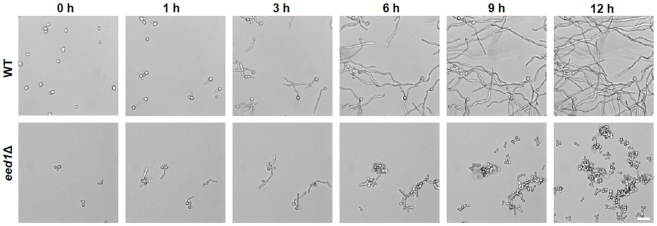
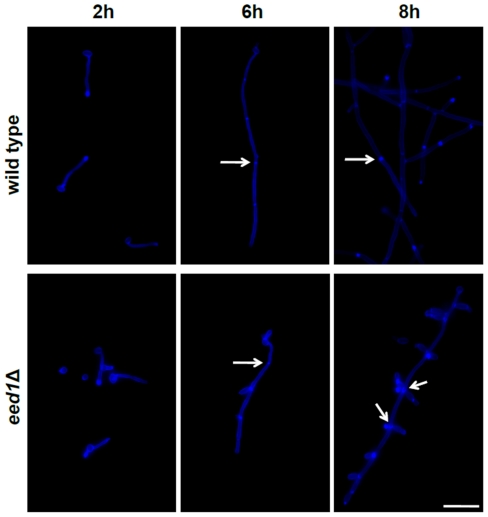
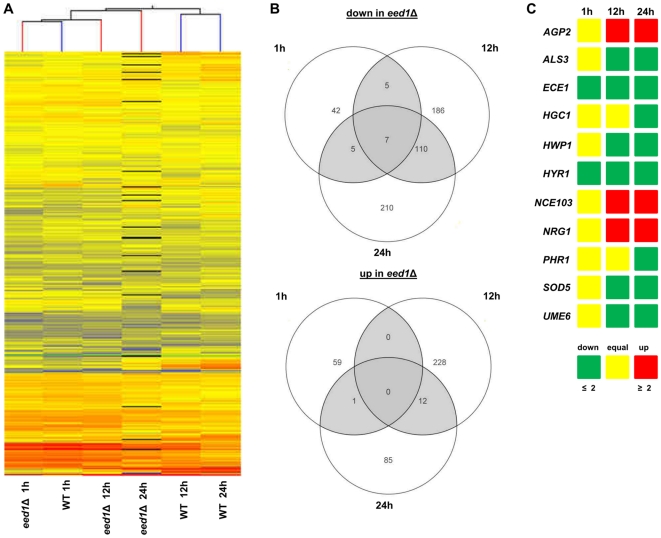
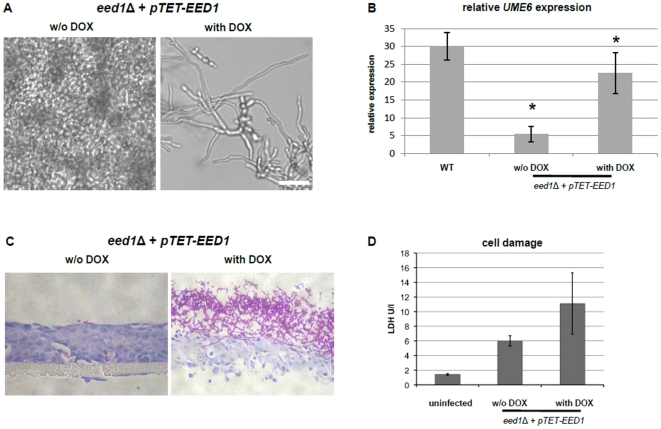
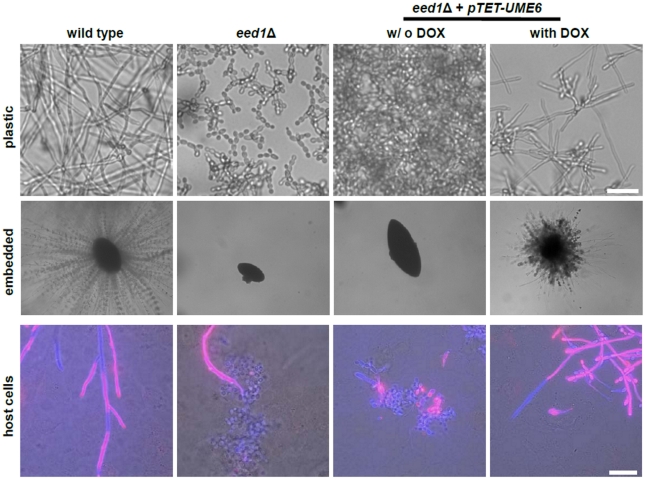
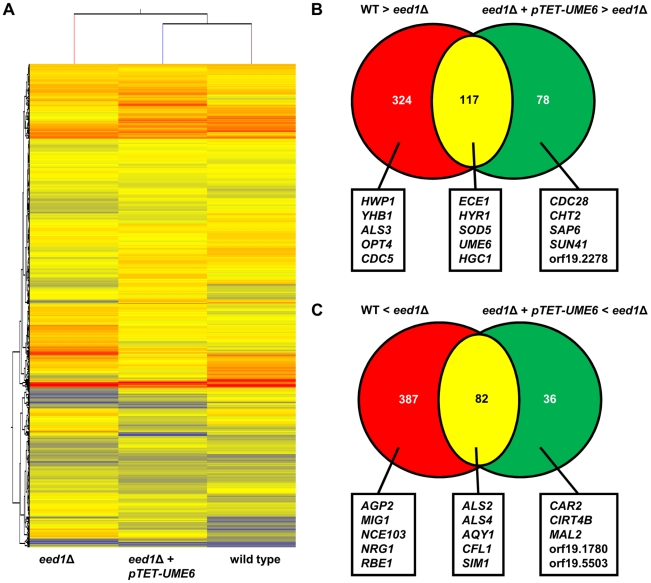
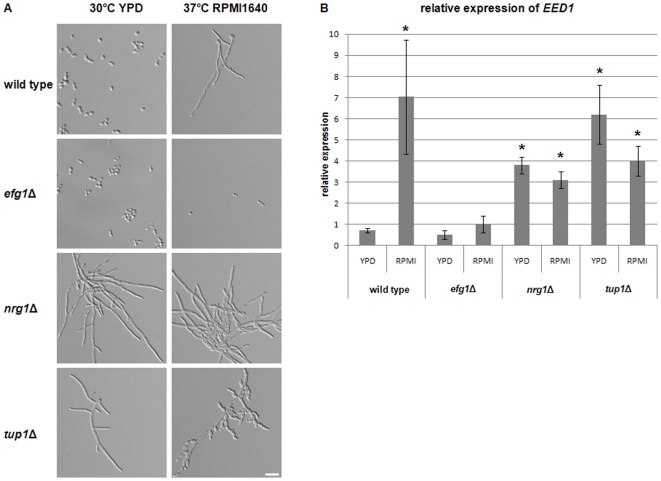
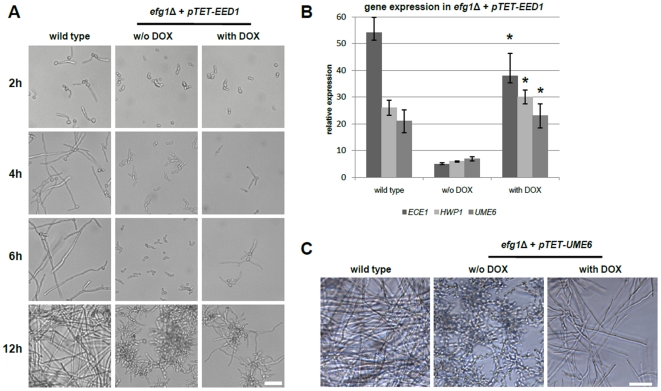
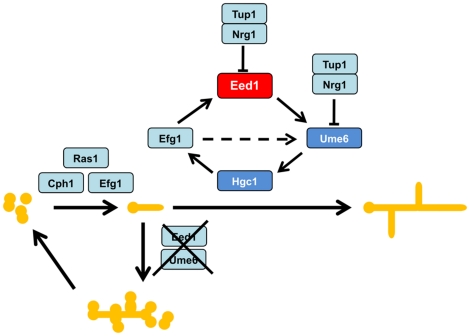
The extension of germ tubes into elongated hyphae by Candida albicans is essential for damage of host cells. The C. albicans-specific gene EED1 plays a crucial role in this extension and maintenance of filamentous growth. eed1Δ cells failed to extend germ tubes into long filaments and switched back to yeast growth after 3 h of incubation during growth on plastic surfaces. Expression of EED1 is regulated by the transcription factor Efg1 and ectopic overexpression of EED1 restored filamentation in efg1Δ. Transcriptional profiling of eed1Δ during infection of oral tissue revealed down-regulation of hyphal associated genes including UME6, encoding another key transcriptional factor. Ectopic overexpression of EED1 or UME6 rescued filamentation and damage potential in eed1Δ. Transcriptional profiling during overexpression of UME6 identified subsets of genes regulated by Eed1 or Ume6. These data suggest that Eed1 and Ume6 act in a pathway regulating maintenance of hyphal growth thereby repressing hyphal-to-yeast transition and permitting dissemination of C. albicans within epithelial tissues.
Overview
The claims and statistics of this paper haven’t been checked yet.
Free: it reads the open-access text and checks the first 5 claims that cite a source we can check. Create a free account to check every claim.
Integrity signals
Registry
Cites
Statistics
Figures
Verification
Claims the paper makes
The claims and statistics of this paper haven’t been checked yet.
Free: it reads the open-access text and checks the first 5 claims that cite a source we can check. Create a free account to check every claim.
Claims other papers make about this one
Each is checked against this paper’s own text: does it say what the citing paper says it does?
The cited source says what the claim attributes to it.
In the citing paper
“Intracellular hyphal extension is dependent on expression of EED1 (Epithelial Escape and Dissemination 1) [206], and continued growth of hyphae results in the piercing of epithelial cells and subsequent dissemination.”
From Mechanisms of fungal dissemination (2021) · cites this paper as [206]
Self-check
Percentages, sums and reported differences re-computed from the paper’s own numbers.
The self-check needs the paper’s full text.
Citations
Cites
A new mathematical model for relative quantification in real-time RT-PCR
Pfaffl, M. W. (2001) · Nucleic Acids Research · doi:10.1093/nar/29.9.e45 · Cited by 34,610
Nonfilamentous C. albicans Mutants Are Avirulent
Lo, H.-J., Köhler, J. R., DiDomenico, B., Loebenberg, D., Cacciapuoti, A., & Fink, G. R. (1997) · Cell · doi:10.1016/s0092-8674(00)80358-x · Cited by 1,809 · cited 3×
“HLC52(efg1D) efg1::hisG/efg1::hisG-URA3-hisG in CAI-4 [16]”
BackgroundGillum, A. M., Tsay, E. Y. H., & Kirsch, D. R. (1984) · Molecular and General Genetics MGG · doi:10.1007/bf00328721 · Cited by 1,251
Evolution of pathogenicity and sexual reproduction in eight Candida genomes
Butler, G., Rasmussen, M. D., Lin, M. F., Santos, M. A. S., Sakthikumar, S., Munro, C. A., Rheinbay, E., Grabherr, M., Forche, A., Reedy, J. L., et al. (2009) · Nature · doi:10.1038/nature08064 · Cited by 1,065
Self-citationAn integrated model of the recognition of Candida albicans by the innate immune system
Netea, M. G., Brown, G. D., Kullberg, B. J., & Gow, N. A. R. (2008) · Nature Reviews Microbiology · doi:10.1038/nrmicro1815 · Cited by 946 · cited 1×
“In addition, the transition between yeast and hyphal growth forms has a significant effect on the host immune response and possibly on the outcome of an infection [18,19].”
BackgroundThe SAT1 flipper, an optimized tool for gene disruption in Candida albicans
Reuß, O., Vik, Å., Kolter, R., & Morschhäuser, J. (2004) · Gene · doi:10.1016/j.gene.2004.06.021 · Cited by 742
Transcriptional Response of Candida albicans upon Internalization by Macrophages
Lorenz, M. C., Bender, J. A., & Fink, G. R. (2004) · Eukaryotic Cell · doi:10.1128/ec.3.5.1076-1087.2004 · Cited by 712 · cited 1×
“albicans as part of an escape mechanism: phagocytosed yeast cells can produce hyphae, which pierce the host membrane and kill the macrophage [16,17].”
BackgroundAls3 Is a Candida albicans Invasin That Binds to Cadherins and Induces Endocytosis by Host Cells
Phan, Q. T., Myers, C. L., Fu, Y., Sheppard, D. C., Yeaman, M. R., Welch, W. H., Ibrahim, A. S., Edwards, J. E., & Filler, S. G. (2007) · PLoS Biology · doi:10.1371/journal.pbio.0050064 · Cited by 641 · cited 1×
“albicans _nvasion triggering fungal up-take via interactions with receptors on epithelial or endothelial cells [9].”
BackgroundGenetic control of Candida albicans biofilm development
Finkel, J. S., & Mitchell, A. P. (2011) · Nature Reviews Microbiology · doi:10.1038/nrmicro2475 · Cited by 612 · cited 1×
“dispersion of yeast cells from biofilms [43,44].”
Adhesive and Mammalian Transglutaminase Substrate Properties of Candida albicans Hwp1
Staab, J. F., Bradway, S. D., Fidel, P. L., & Sundstrom, P. (1999) · Science · doi:10.1126/science.283.5407.1535 · Cited by 607 · cited 1×
“hyphae to epithelial surfaces is mediated by hyphal-associated ynvasiony, namely the glycosylphosphatidylinositol (GPI)-anchored protein Hwp1”
Background
Cited by
Growth of Candida albicans hyphae
Sudbery, P. E. (2011) · Nature Reviews Microbiology · doi:10.1038/nrmicro2636 · Cited by 1,110
“The null mutants eed1 −/− and um e 6 −/− each initiate germ tube formation in liquid culture on hyphal induction, but hyphal growth cannot be maintaine”
BackgroundZhou, N., Jiang, Y., Bergquist, T. R., Lee, A. J., Kacsoh, B. Z., Crocker, A. W., Lewis, K. A., Georghiou, G., Nguyen, H. N., Hamid, M. N., et al. (2019) · Genome Biology · doi:10.1186/s13059-019-1835-8 · Cited by 452
Candida albicans dimorphism as a therapeutic target
Jacobsen, I. D., Wilson, D., Wächtler, B., Brunke, S., Naglik, J. R., & Hube, B. (2012) · Expert Review of Anti-infective Therapy · doi:10.1586/eri.11.152 · Cited by 363
Self-citationCandida albicans interactions with epithelial cells and mucosal immunity
Naglik, J. R., Moyes, D. L., Wächtler, B., & Hube, B. (2011) · Microbes and Infection · doi:10.1016/j.micinf.2011.06.009 · Cited by 277
“Finally, EED1 is known to be essential for maintenance of hyphal elongation [9;62].”
BackgroundSelf-citationThe regulation of hyphae growth in Candida albicans
Chen, H., Zhou, X., Ren, B., & Cheng, L. (2020) · Virulence · doi:10.1080/21505594.2020.1748930 · Cited by 277
“is located between Efg1 and Ume6 in the pathway [90].”
Background
Metadata
- Authors
- Martin, R., Moran, G. P., Jacobsen, I. D., Heyken, A., Domey, J., Sullivan, D. J., Kurzai, O., & Hube, B.
- Affiliations
- Leibniz-Institut für Naturstoff-Forschung und Infektionsbiologie e. V. - Hans-Knöll-Institut (HKI) (DE)
- Trinity College Dublin (IE)
- Corresponding author
- Hube, Bernhard
- Venue
- PLoS ONE
- Publisher
- Public Library of Science (PLoS)
- Published
- 2011-04-07
- Volume
- 6
- Issue
- 4
- Pages
- e18394
- ISSN
- 1932-6203 (ISSN-L)
- PMC
- PMC3075580
- OpenAlex
- W2003833125
- Cited by
- 85
- References
- 59
- Citations by year
- 2026: 3 · 2025: 4 · 2024: 7 · 2023: 3 · 2022: 3 · 2021: 5 · 2020: 8 · 2019: 6 · 2018: 5 · 2017: 5 · 2016: 3 · 2015: 4 · 2014: 8 · 2013: 8 · 2012: 7
- FWCI
- 3.74
- Type
- journal article
- Language
- en
- Open access
- gold
- doi.org
- Locations
- PLoS ONE (publishedVersion, cc-by)
- Europe PMC (PubMed Central) (publishedVersion, cc-by)
- PubMed Central (publishedVersion, cc-by)
- PubMed (publishedVersion)
- Arrow@dit (Dublin Institute of Technology) (submittedVersion, cc-by-nc-sa)
- DOAJ (DOAJ: Directory of Open Access Journals) (submittedVersion)
- Figshare (submittedVersion, cc-by)
- Trinity's Access to Research Output (TARA) (Trinity College Dublin) (submittedVersion)
- Lenus, The Irish Health Repository (Dr Steevens Hospital Library) (submittedVersion)
- Funders
- University of Aberdeen
- Deutsche Forschungsgemeinschaft (Hu528/10)
- Universität Salzburg
- University of California, San Francisco
- Topics
- Life Sciences › Biochemistry, Genetics and Molecular Biology › Molecular Biology › Fungal and yeast genetics research
- Health Sciences › Medicine › Infectious Diseases › Antifungal resistance and susceptibility
- Health Sciences › Medicine › Infectious Diseases › Fungal Infections and Studies
- Keywords
- Candida albicans, EFG1, Ume6, hyphal extension, filamentous growth, germ tube formation, transcriptional regulation, oral infection, fungal virulence, gene regulatory pathways
- MeSH terms
- Candida albicans, Fungal Proteins, Gene Expression Regulation, Fungal, Hyphae
About these checks
Registry, retraction, Cites and statistics results are computed, not judged, with one exception: a printed reference that no index lists is read once by a model before it counts as a citation error. Claims are extracted by a model and kept only when their quote appears verbatim in the text; each cited source is then checked, with a model’s help, for whether it says what the claim relies on. Those verdicts can be wrong — read the claim’s quote and the cited source before relying on one.
Statistics and arithmetic are recomputed, not judged.
Confidence bands are shown only for fields calibrated on our annotated test set. None is calibrated yet, so no band is shown.
What counts as a claim ›How we measure confidence ›How we check this ›
Are you an author, or do you see a problem with this page? Request a review
How to cite
Cite CoChat for the checks on this page, and the paper for its own findings.
- This page
- CoChat. (2026). Citation check: The Candida albicans-Specific Gene EED1 Encodes a Key Regulator of Hyphal Extension. https://app.cochat.ai/papers/10.1371/journal.pone.0018394
- The paper
- Martin, R., Moran, G. P., Jacobsen, I. D., Heyken, A., Domey, J., Sullivan, D. J., Kurzai, O., & Hube, B. (2011). The Candida albicans-Specific Gene EED1 Encodes a Key Regulator of Hyphal Extension. PLoS ONE. https://doi.org/10.1371/journal.pone.0018394
Data sources
Bibliographic data: Semantic Scholar, OpenAlex, Crossref.
Contains information from the Semantic Scholar Academic Graph Datasets, made available under the ODC Attribution License (ODC-BY 1.0).
Semantic Scholar’s data is described in: Kinney, R., et al. (2023). The Semantic Scholar Open Data Platform. arXiv:2301.10140.
