

Nocturnal Hypoxia and Loss of Kidney Function
Open accessThe DOI matches its Crossref record; 45 of the 45 references it cites were found in a registry or an index.
Abstract
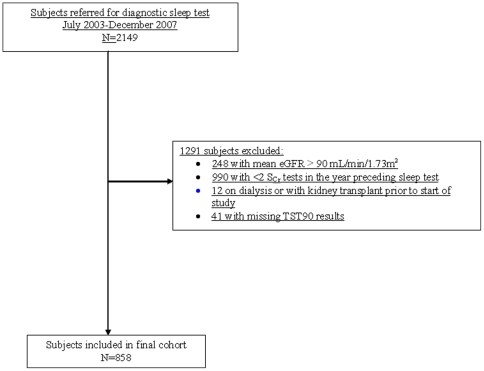
BACKGROUND: Although obstructive sleep apnea (OSA) is more common in patients with kidney disease, whether nocturnal hypoxia affects kidney function is unknown. METHODS: We studied all adult subjects referred for diagnostic testing of sleep apnea between July 2005 and December 31 2007 who had serial measurement of their kidney function. Nocturnal hypoxia was defined as oxygen saturation (SaO2) below 90% for ≥12% of the nocturnal monitoring time. The primary outcome, accelerated loss of kidney function, was defined as a decline in estimated glomerular filtration rate (eGFR) ≥4 ml/min/1.73 m(2) per year. RESULTS: 858 participants were included and followed for a mean study period of 2.1 years. Overall 374 (44%) had nocturnal hypoxia, and 49 (5.7%) had accelerated loss of kidney function. Compared to controls without hypoxia, patients with nocturnal hypoxia had a significant increase in the adjusted risk of accelerated kidney function loss (odds ratio (OR) 2.89, 95% confidence interval [CI] 1.25, 6.67). CONCLUSION: Nocturnal hypoxia was independently associated with an increased risk of accelerated kidney function loss. Further studies are required to determine whether treatment and correction of nocturnal hypoxia reduces loss of kidney function.
Overview
The claims and statistics of this paper haven’t been checked yet.
Free: it reads the open-access text and checks the first 5 claims that cite a source we can check. Create a free account to check every claim.
Integrity signals
Registry
Cites
Statistics
Figures
Verification
Claims the paper makes
The claims and statistics of this paper haven’t been checked yet.
Free: it reads the open-access text and checks the first 5 claims that cite a source we can check. Create a free account to check every claim.
Claims other papers make about this one
Each is checked against this paper’s own text: does it say what the citing paper says it does?
The cited source says what the claim attributes to it.
In the citing paper
“Obstructive sleep apnea can also contribute to CKD (Ahmed et al., 2011)”
From Obstructive sleep apnea: transition from pathophysiology to an integrative disease model (2022) · cites this paper as Ahmed et al., 2011
Self-check
Percentages, sums and reported differences re-computed from the paper’s own numbers.
The self-check needs the paper’s full text.
Citations
Cites
Epidemiology of Obstructive Sleep Apnea: A Population Health Perspective
Young, T., Peppard, P. E., & Gottlieb, D. J. (2002) · American Journal of Respiratory and Critical Care Medicine · doi:10.1164/rccm.2109080 · Cited by 4,244 · cited 2×
“However, we were able to control for important clinical data that have been shown to impact loss of kidney function, including hypertension [27], use of ACE-I or ARBs [14] and use of non-steroidal antiinflammatory drugs [28].”
BackgroundNieto, F. J. (2000) · JAMA · doi:10.1001/jama.283.14.1829 · Cited by 3,369
Adult Obstructive Sleep Apnea Task Force of the American Academy of Sleep Medicine, Epstein, L. J., Kristo, D., Strollo, P. J., Friedman, N., Malhotra, A., Patil, S. P., Ramar, K., Rogers, R., Schwab, R. J., et al. (2009) · Journal of Clinical Sleep Medicine · doi:10.5664/jcsm.27497 · Cited by 3,360 · cited 3×
“Hypopnea was defined as an abnormal respiratory event lasting 10 s or more, with at least a 30% reduction in thoraco-abdominal movement or airflow compared with baseline and associated with at least a 4% oxygen desaturation [25].”
BackgroundMethodInfluentialHux, J. E., Ivis, F., Flintoft, V., & Bica, A. (2002) · Diabetes Care · doi:10.2337/diacare.25.3.512 · Cited by 1,290 · cited 2×
“However, we were able to control for important clinical data that have been shown to impact loss of kidney function, including hypertension [27], use of ACE-I or ARBs [14] and use of non-steroidal antiinflammatory drugs [28].”
MethodChronic Hypoxia and Tubulointerstitial Injury: A Final Common Pathway to End-Stage Renal Failure
Nangaku, M. (2006) · Journal of the American Society of Nephrology · doi:10.1681/asn.2005070757 · Cited by 1,135 · cited 3×
“The increasingly high prevalence of sleep-disordered breathing in the general community [14] coupled with the potential for nocturnal hypoxia to cause deterioration in kidney function [1,2,3] prompted our investigation of the relationship between nocturnal hypoxia and loss of kidney function in a cohort referred for e…”
BackgroundKokotailo, R. A., & Hill, M. D. (2005) · Stroke · doi:10.1161/01.str.0000174293.17959.a1 · Cited by 709 · cited 1×
“Validated algorithms using administrative data were employed to define diabetes [27], asthma [28], stroke [29], myocardial infarction [30], heart failure [31], and hypertension [32].”
MethodImprovement of Sleep Apnea in Patients with Chronic Renal Failure Who Undergo Nocturnal Hemodialysis
Hanly, P. J., & Pierratos, A. (2001) · New England Journal of Medicine · doi:10.1056/nejm200101113440204 · Cited by 575
Self-citationAccuracy of administrative databases in identifying patients with hypertension.
Tu, K., Campbell, N. R. C., Chen, Z., Cauch‐Dudek, K., & McAlister, F. A. (2007) · PubMed Central · Cited by 553
Austin, P. C., Daly, P. A., & Tu, J. V. (2002) · American Heart Journal · doi:10.1067/mhj.2002.123839 · Cited by 525 · cited 1×
“Validated algorithms using administrative data were employed to define diabetes [27], asthma [28], stroke [29], myocardial infarction [30], heart failure [31], and hypertension [32].”
MethodFine, L. G., & Norman, J. T. (2008) · Kidney International · doi:10.1038/ki.2008.350 · Cited by 515 · cited 3×
“The increasingly high prevalence of sleep-disordered breathing in the general community [14] coupled with the potential for nocturnal hypoxia to cause deterioration in kidney function [1,2,3] prompted our investigation of the relationship between nocturnal hypoxia and loss of kidney function in a cohort referred for e…”
Background
Research works printed but not linked: 1
- Levey AS Greene T Kusek JW Beck GL 2000 MDRD Study Group. A simplified equation to predict glomerular filtration rate from serum creatinine (abstract) J Am Soc Nephrol 11 155A
Cited by
Obstructive sleep apnea and comorbidities: a dangerous liaison
Bonsignore, M. R., Baiamonte, P., Mazzuca, E., Castrogiovanni, A., & Marrone, O. (2019) · Multidisciplinary Respiratory Medicine · doi:10.1186/s40248-019-0172-9 · Cited by 258
“Another longitudinal study on patients recruited in a sleep laboratory found that an accelerated decline in eGFR was more common among subjects who spent >12% of sleep time with oxygen saturation <90% than in less hypoxic subjects [97].”
BackgroundLiu, H., Liu, S., Li, Y., Wang, X., Xue, W., Ge, G., & Luo, X. (2012) · PLoS ONE · doi:10.1371/journal.pone.0034608 · Cited by 262
“syndrome [7].”
Declining Kidney Function Increases the Prevalence of Sleep Apnea and Nocturnal Hypoxia
Nicholl, D. D. M., Ahmed, S. B., Loewen, A. H. S., Hemmelgarn, B. R., Sola, D. Y., Beecroft, J. M., Turin, T. C., & Hanly, P. J. (2012) · Chest · doi:10.1378/chest.11-1809 · Cited by 205
Self-citationBidirectional relationships of comorbidity with obstructive sleep apnoea
Gleeson, M., & McNicholas, W. T. (2022) · European Respiratory Review · doi:10.1183/16000617.0256-2021 · Cited by 203
Obstructive Sleep Apnea and Kidney Disease: A Potential Bidirectional Relationship?
Abuyassin, B., Sharma, K., Ayas, N. T., & Laher, I. (2015) · Journal of Clinical Sleep Medicine · doi:10.5664/jcsm.4946 · Cited by 165
Metadata
- Authors
- Ahmed, S. B., Ronksley, P. E., Hemmelgarn, B. R., Tsai, W. H., Manns, B. J., Tonelli, M., Klarenbach, S. W., Chin, R., Clement, F. M., & Hanly, P. J.
- Affiliations
- University of Calgary (CA)
- University of Alberta (CA)
- Corresponding author
- Ahmed, Sofia B.
- ORCID
- Venue
- PLoS ONE
- Publisher
- Public Library of Science (PLoS)
- Published
- 2011-04-29
- Volume
- 6
- Issue
- 4
- Pages
- e19029
- ISSN
- 1932-6203 (ISSN-L)
- PMC
- PMC3084745
- OpenAlex
- W2086132389
- Semantic Scholar
- e9679ca17686c3258c4586d3e4b267354d7e5e79
- Cited by
- 132
- References
- 45
- Citations by year
- 2026: 3 · 2025: 4 · 2024: 8 · 2023: 9 · 2022: 4 · 2021: 4 · 2020: 16 · 2019: 13 · 2018: 8 · 2017: 8 · 2016: 15 · 2015: 12 · 2014: 11 · 2013: 6 · 2012: 8
- FWCI
- 6.11
- Type
- journal article
- Language
- en
- Open access
- gold
- doi.org
- Locations
- PLoS ONE (publishedVersion, cc-by)
- Europe PMC (PubMed Central) (publishedVersion, cc-by)
- PubMed Central (publishedVersion, cc-by)
- PubMed (publishedVersion)
- DOAJ (DOAJ: Directory of Open Access Journals) (submittedVersion, cc-by-sa)
- Funders
- Canadian Health Services Research Foundation
- Fondation pour la Recherche Médicale
- Canadian Institutes of Health Research
- Topics
- Health Sciences › Medicine › Physiology (medical) › Obstructive Sleep Apnea Research
- Health Sciences › Medicine › Nephrology › Chronic Kidney Disease and Diabetes
- Health Sciences › Medicine › Pulmonary and Respiratory Medicine › Chronic Obstructive Pulmonary Disease (COPD) Research
- Keywords
- nocturnal hypoxia, obstructive sleep apnea, renal function decline, estimated glomerular filtration rate, chronic kidney disease, oxygen saturation, sleep-disordered breathing
- MeSH terms
- Adult, Aged, Hypoxia, Female, Glomerular Filtration Rate, Humans, Kidney, Kidney Diseases, Male, Middle Aged, Oxygen, Respiration, Risk, Cohort Studies, Comorbidity, Sleep Apnea, Obstructive
About these checks
Registry, retraction, Cites and statistics results are computed, not judged, with one exception: a printed reference that no index lists is read once by a model before it counts as a citation error. Claims are extracted by a model and kept only when their quote appears verbatim in the text; each cited source is then checked, with a model’s help, for whether it says what the claim relies on. Those verdicts can be wrong — read the claim’s quote and the cited source before relying on one.
Statistics and arithmetic are recomputed, not judged.
Confidence bands are shown only for fields calibrated on our annotated test set. None is calibrated yet, so no band is shown.
What counts as a claim ›How we measure confidence ›How we check this ›
Are you an author, or do you see a problem with this page? Request a review
Data sources
Bibliographic data: Semantic Scholar, OpenAlex, Crossref.
Contains information from the Semantic Scholar Academic Graph Datasets, made available under the ODC Attribution License (ODC-BY 1.0).
Semantic Scholar’s data is described in: Kinney, R., et al. (2023). The Semantic Scholar Open Data Platform. arXiv:2301.10140.
