

The DOI matches its Crossref record; 35 of the 35 references it cites were found in a registry or an index.
Cholinergic Interneurons Mediate Fast VGluT3-Dependent Glutamatergic Transmission in the Striatum
Open accessAbstract
The neurotransmitter glutamate is released by excitatory projection neurons throughout the brain. However, non-glutamatergic cells, including cholinergic and monoaminergic neurons, express markers that suggest that they are also capable of vesicular glutamate release. Striatal cholinergic interneurons (CINs) express the Type-3 vesicular glutamate transporter (VGluT3), although whether they form functional glutamatergic synapses is unclear. To examine this possibility, we utilized mice expressing Cre-recombinase under control of the endogenous choline acetyltransferase locus and conditionally expressed light-activated Channelrhodopsin2 in CINs. Optical stimulation evoked action potentials in CINs and produced postsynaptic responses in medium spiny neurons that were blocked by glutamate receptor antagonists. CIN-mediated glutamatergic responses exhibited a large contribution of NMDA-type glutamate receptors, distinguishing them from corticostriatal inputs. CIN-mediated glutamatergic responses were insensitive to antagonists of acetylcholine receptors and were not seen in mice lacking VGluT3. Our results indicate that CINs are capable of mediating fast glutamatergic transmission, suggesting a new role for these cells in regulating striatal activity.
Overview
The claims and statistics of this paper haven’t been checked yet.
Run the check — free, no account needed. It reads the open-access text and checks the sources it cites.
Integrity signals
Registry
Cites
Statistics
Figures
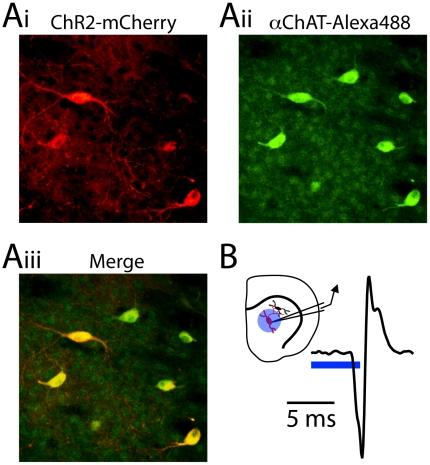
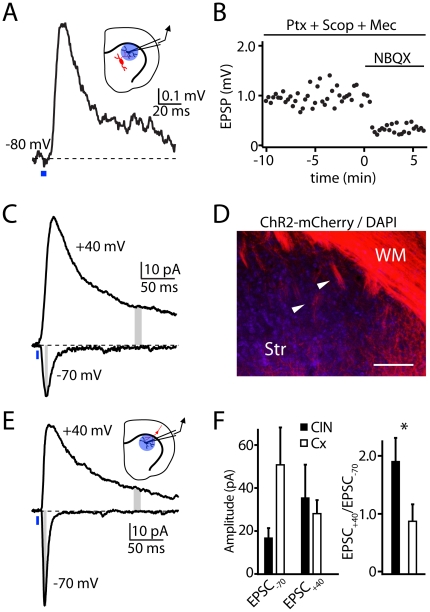
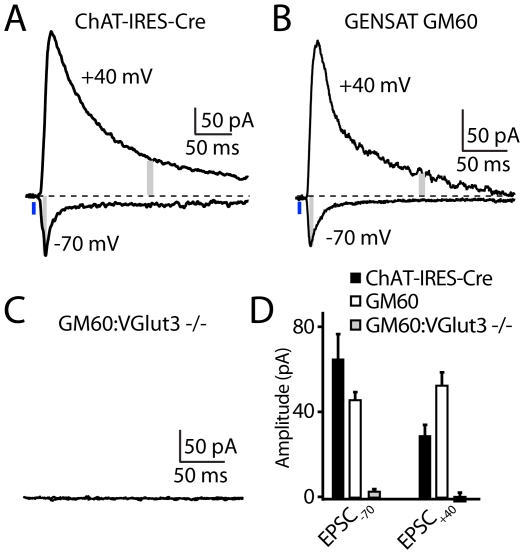
Verification
Claims the paper makes
The claims and statistics of this paper haven’t been checked yet.
Run the check — free, no account needed. It reads the open-access text and checks the sources it cites.
Claims other papers make about this one
Each is checked against this paper’s own text: does it say what the citing paper says it does?
In the citing paper
“Glutamate release onto SPNs activates postsynaptic ionotropic glutamate receptors with distinct AMPA/NMDA ratios compared with cortico-striatal synapses, suggesting distinct plasticity rules from these disparate inputs.60”
From Synaptic and circuit functions of multitransmitter neurons in the mammalian brain (2023) · cites this paper as [60]
In the citing paper
“Striatal cholinergic interneurons (CINs) cotransmit Ach and glutamate locally onto spiny projection neurons (SPNs) 60 and dopaminergic axonal terminals.[61][62][63]”
From Synaptic and circuit functions of multitransmitter neurons in the mammalian brain (2023) · cites this paper as [60]
Self-check
Percentages, sums and reported differences re-computed from the paper’s own numbers.
The self-check needs the paper’s full text.
Citations
Cites
Phasic Firing in Dopaminergic Neurons Is Sufficient for Behavioral Conditioning
Tsai, H.-C., Zhang, F., Adamantidis, A., Stuber, G. D., Bonci, A., de Lecea, L., & Deisseroth, K. (2009) · Science · doi:10.1126/science.1168878 · Cited by 1,266 · cited 1×
“Intracranial injection of adeno-associated virus encoding a Credependent (double floxed inverted) Channelrhodopsin2-mCherry fusion protein (DFI-ChR2-mCherry) [25,26] into the striatum of these mice enabled the CIN-specific expression of the lightactivated excitatory ChR2, which was clearly observed 7–14 days after inj…”
BackgroundStriatal Plasticity and Basal Ganglia Circuit Function
Kreitzer, A. C., & Malenka, R. C. (2008) · Neuron · doi:10.1016/j.neuron.2008.11.005 · Cited by 1,071 · cited 1×
“Synaptic plasticity in the striatum is thought to be critical for normal motor learning, and many forms are dependent on activation of both NMDARs and metabotropic glutamate receptors [33].”
BackgroundGong, S., Doughty, M., Harbaugh, C. R., Cummins, A., Hatten, M. E., Heintz, N., & Gerfen, C. R. (2007) · The Journal of Neuroscience · doi:10.1523/jneurosci.2707-07.2007 · Cited by 977 · cited 10×
“To examine this possibility, we utilized mice expressing Cre-recombinase under control of the endogenous choline acetyltransferase locus and conditionally expressed light-activated Channelrhodopsin2 in CINs.”
MethodInfluentialOttersen, O. P., & Storm‐Mathisen, J. (1984) · The Journal of Comparative Neurology · doi:10.1002/cne.902290308 · Cited by 848 · cited 1×
“brainstem and mesencephalon [1] and revealed the presence of”
BackgroundOptogenetic interrogation of neural circuits: technology for probing mammalian brain structures
Zhang, F., Gradinaru, V., Adamantidis, A. R., Durand, R., Airan, R. D., de Lecea, L., & Deisseroth, K. (2010) · Nature Protocols · doi:10.1038/nprot.2009.226 · Cited by 692 · cited 1×
“The virus carried either a double-floxed-inverted Channelrhodopsin2-mCherry construct under control of the Ef1a promoter (CINs) or non-conditional construct coding for Channelrhodopsin2-mCherry under the synapsin promoter (corticostriatal) [34].”
Rossi, J., Balthasar, N., Olson, D., Scott, M., Berglund, E., Lee, C. E., Choi, M. J., Lauzon, D., Lowell, B. B., & Elmquist, J. K. (2011) · Cell Metabolism · doi:10.1016/j.cmet.2011.01.010 · Cited by 672
Self-citationPatneau, D. K., & Mayer, M. (1990) · Journal of Neuroscience · doi:10.1523/jneurosci.10-07-02385.1990 · Cited by 653 · cited 2×
“2C), estimating the contribution of AMPARs.”
BackgroundA third vesicular glutamate transporter expressed by cholinergic and serotoninergic neurons
Gras, C., Herzog, E., Bellenchi, G. C., Bernard, V., Ravassard, P., Pohl, M., Gasnier, B., Giros, B., & El Mestikawy, S. (2002) · The Journal of Neuroscience · doi:10.1523/jneurosci.22-13-05442.2002 · Cited by 639 · cited 4×
“the vesicular glutamate transporter VGluT3, which co-localizes with the vesicular ACh transporter in the same presynaptic terminals [6,7,9].”
BackgroundInfluentialAtasoy, D., Aponte, Y., Su, H. H., & Sternson, S. M. (2008) · Journal of Neuroscience · doi:10.1523/jneurosci.1954-08.2008 · Cited by 635 · cited 1×
“Intracranial injection of adeno-associated virus encoding a Credependent (double floxed inverted) Channelrhodopsin2-mCherry fusion protein (DFI-ChR2-mCherry) [25,26] into the striatum of these mice enabled the CIN-specific expression of the lightactivated excitatory ChR2, which was clearly observed 7–14 days after inj…”
BackgroundCoincident but Distinct Messages of Midbrain Dopamine and Striatal Tonically Active Neurons
Morris, G., Arkadir, D., Nevet, A., Vaadia, E., & Bergman, H. (2004) · Neuron · doi:10.1016/j.neuron.2004.06.012 · Cited by 574
Fremeau, R. T., Burman, J. L., Qureshi, T., Tran, C. H., Proctor, J. M., Johnson, J., Zhang, H., Sulzer, D. L., Copenhagen, D. R., Storm‐Mathisen, J., et al. (2002) · Proceedings of the National Academy of Sciences · doi:10.1073/pnas.222546799 · Cited by 568 · cited 3×
“the vesicular glutamate transporter VGluT3, which co-localizes with the vesicular ACh transporter in the same presynaptic terminals [6,7,9].”
BackgroundDopaminergic terminals in the nucleus accumbens but not the dorsal striatum corelease glutamate
Stuber, G. D., Hnasko, T. S., Britt, J. P., Edwards, R. H., & Bonci, A. (2010) · Journal of Neuroscience · doi:10.1523/jneurosci.1754-10.2010 · Cited by 529 · cited 2×
“However, recent work has demonstrated that both electrical and Channelrhodospin2 (ChR2)-mediated optical stimulation of midbrain dopaminergic cells can evoke monosynaptic glutamatergic responses in the ventral striatum [12,13,14].”
BackgroundWang, Z., Li, K., Day, M., Ronesi, J. A., Yin, H. H., Ding, J., Tkatch, T., Lovinger, D. M., & Surmeier, D. J. (2006) · Neuron · doi:10.1016/j.neuron.2006.04.010 · Cited by 513
Re-emergence of striatal cholinergic interneurons in movement disorders
Pisani, A., Bernardi, G., Ding, J., & Surmeier, D. J. (2007) · Trends in Neurosciences · doi:10.1016/j.tins.2007.07.008 · Cited by 474 · cited 2×
“Recordings were made at room temperature to reduce spontaneous firing of CINs [17].”
BackgroundCholinergic Interneurons Control Local Circuit Activity and Cocaine Conditioning
Witten, I. B., Lin, S.-C., Brodsky, M., Prakash, R., Diester, I., Anikeeva, P., Gradinaru, V., Ramakrishnan, C., & Deisseroth, K. (2010) · Science · doi:10.1126/science.1193771 · Cited by 467
Acetylcholine-mediated modulation of striatal function
Calabresi, P., Centonze, D., Gubellini, P., Pisani, A., & Bernardi, G. (2000) · Trends in Neurosciences · doi:10.1016/s0166-2236(99)01501-5 · Cited by 452 · cited 1×
“Striatal cholinergic interneurons (CINs) provide the sole source of ACh in the striatum and are thought to correspond to ‘‘tonically active neurons (TANs)’’ recorded in vivo [16,17].”
BackgroundSensorineural Deafness and Seizures in Mice Lacking Vesicular Glutamate Transporter 3
Seal, R. P., Akil, O., Yi, E., Weber, C. M., Grant, L. M., Yoo, J. W., Clause, A. R., Kandler, K., Noebels, J. L., Glowatzki, E., et al. (2008) · Neuron · doi:10.1016/j.neuron.2007.11.032 · Cited by 414 · cited 1×
“GM60 mice were bred with VGluT3 mice [29] to generate GM60;VGluT3 animals.”
Dopamine neurons make glutamatergic synapses in vitro
Sulzer, D. L., Joyce, M. P., Lin, L., Geldwert, D., Haber, S. N., Hattori, T., & Rayport, S. (1998) · PubMed Central · doi:10.7916/d8-snm4-r132 · Cited by 316
Glutamatergic signaling by mesolimbic dopamine neurons in the nucleus accumbens
Tecuapetla, F., Patel, J. C., Xenias, H., English, D., Tadros, I., Shah, F., Berlin, J., Deisseroth, K., Rice, M. E., Tepper, J. M., et al. (2010) · The Journal of Neuroscience · doi:10.1523/jneurosci.0265-10.2010 · Cited by 310 · cited 2×
“However, recent work has demonstrated that both electrical and Channelrhodospin2 (ChR2)-mediated optical stimulation of midbrain dopaminergic cells can evoke monosynaptic glutamatergic responses in the ventral striatum [12,13,14].”
BackgroundDopamine Neurons Make Glutamatergic SynapsesIn Vitro
Sulzer, D. L., Joyce, M. P., Lin, L., Geldwert, D., Haber, S. N., Hattori, T., & Rayport, S. (1998) · Journal of Neuroscience · doi:10.1523/jneurosci.18-12-04588.1998 · Cited by 304 · cited 1×
“Physiological evidence for synaptic glutamate release from traditionally non-glutamatergic cells was initially limited to cell culture systems in which serotonergic and dopaminergic neurons were shown to make functional glutamatergic autapses [10,11].”
BackgroundBoulland, J., Qureshi, T., Seal, R. P., Rafiki, A., Gundersen, V., Bergersen, L. H., Fremeau, R. T., Edwards, R. H., Storm‐Mathisen, J., & Chaudhry, F. A. (2004) · Journal of Comparative Neurology · doi:10.1002/cne.20354 · Cited by 280 · cited 1×
“GABAergic interneurons of the hippocampus [5,6,7,8].”
Self-citationCompetitive regulation of synaptic Ca2+ influx by D2 dopamine and A2A adenosine receptors
Higley, M. J., & Sabatini, B. L. (2010) · Nature Neuroscience · doi:10.1038/nn.2592 · Cited by 271 · cited 1×
“To directly compare optically-evoked glutamatergic inputs from CINs with similarly evoked inputs from cortical afferents, we expressed a Cre recombinase-independent version of the ChR2mCherry fusion protein in motor cortex neurons projecting to the striatum [27].”
BackgroundFast synaptic subcortical control of hippocampal circuits
Varga, V., Losonczy, A., Zemelman, B. V., Borhegyi, Z., Nyiri, G., Domonkos, A., Hangya, B., Holderith, N., Magee, J. C., & Freund, T. F. (2009) · Science · doi:10.1126/science.1178307 · Cited by 248 · cited 2×
“Additionally, optical stimulation of serotonergic neurons in the raphe nuclei evokes glutamatergic potentials in hippocampal interneurons capable of triggering action potentials [15].”
BackgroundStornetta, R. L., Sevigny, C. P., & Guyenet, P. G. (2002) · The Journal of Comparative Neurology · doi:10.1002/cne.10141 · Cited by 240 · cited 1×
“with tyrosine hydroxylase in brainstem catecholaminergic neurons [4].”
BackgroundDopamine Neurons Mediate a Fast Excitatory Signal via Their Glutamatergic Synapses
Chuhma, N., Zhang, H., Masson, J., Zhuang, X., Sulzer, D. L., Hen, R., & Rayport, S. (2004) · Journal of Neuroscience · doi:10.1523/jneurosci.4317-03.2004 · Cited by 228 · cited 2×
“However, recent work has demonstrated that both electrical and Channelrhodospin2 (ChR2)-mediated optical stimulation of midbrain dopaminergic cells can evoke monosynaptic glutamatergic responses in the ventral striatum [12,13,14].”
BackgroundCholinergic synaptic input to different parts of spiny striatonigral neurons in the rat
Izzo, P. N., & Bolam, J. P. (1988) · The Journal of Comparative Neurology · doi:10.1002/cne.902690207 · Cited by 213 · cited 1×
“Ultrastructural analyses indicate that cholinergic terminals are typically apposed to dendritic shafts and the necks of dendritic spines, in contrast to the spine heads targeted by cortical synapses [30].”
BackgroundThe vesicular glutamate transporter VGLUT3 synergizes striatal acetylcholine tone
Gras, C., Amilhon, B., Lepicard, È. M., Poirel, O., Vinatier, J., Herbin, M., Dumas, S., Tzavara, E. T., Wade, M. R., Nomikos, G. G., et al. (2008) · Nature Neuroscience · doi:10.1038/nn2052 · Cited by 211 · cited 6×
“the vesicular glutamate transporter VGluT3, which co-localizes with the vesicular ACh transporter in the same presynaptic terminals [6,7,9].”
BackgroundInfluentialYamasaki, M., Matsui, M., & Watanabe, M. (2010) · The Journal of Neuroscience · doi:10.1523/jneurosci.5719-09.2010 · Cited by 203 · cited 1×
“This model is consistent with the hypothesis that ACh acts primarily via volume transmission [32].”
ResultManns, I. D., Mainville, L., & Jones, B. E. (2001) · Neuroscience · doi:10.1016/s0306-4522(01)00302-5 · Cited by 186 · cited 1×
“enzyme, in cholinergic and dopaminergic neurons [2,3].”
Leading tonically active neurons of the striatum from reward detection to context recognition
Apicella, P. (2007) · Trends in Neurosciences · doi:10.1016/j.tins.2007.03.011 · Cited by 186 · cited 3×
“Conversely, in vivo TANs, which are thought to correspond to cholinergic neurons, transiently reduce their firing in response to behaviorally relevant sensory cues [19], suggesting that appropriately timed pauses in glutamate release may contribute to learning stimulus-reward associations.”
BackgroundInfluentialRecurrent Inhibitory Network among Striatal Cholinergic Interneurons
Sullivan, M. A., Chen, H., & Morikawa, H. (2008) · Journal of Neuroscience · doi:10.1523/jneurosci.2411-08.2008 · Cited by 142 · cited 1×
“striatal cells, CINs are hypothesized to regulate striatal synaptic transmission and long-term plasticity via nicotinic and muscarinic ACh receptors [20,21,22].”
BackgroundSynaptic glutamate release by postnatal rat serotonergic neurons in microculture
Johnson, M. D. (1994) · Neuron · doi:10.1016/0896-6273(94)90283-6 · Cited by 137
Kaneko, T., Akiyama, H., Nagatsu, I., & Mizuno, N. (1990) · Brain Research · doi:10.1016/0006-8993(90)90535-j · Cited by 126 · cited 1×
“enzyme, in cholinergic and dopaminergic neurons [2,3].”
Cholinergic modulation of multivesicular release regulates striatal synaptic potency and integration
Higley, M. J., Soler-Llavina, G. J., & Sabatini, B. L. (2009) · Nature Neuroscience · doi:10.1038/nn.2368 · Cited by 110 · cited 1×
“striatal cells, CINs are hypothesized to regulate striatal synaptic transmission and long-term plasticity via nicotinic and muscarinic ACh receptors [20,21,22].”
BackgroundPoulin, A. N., Guerci, A., Mestikawy, S. E., & Semba, K. (2006) · The Journal of Comparative Neurology · doi:10.1002/cne.21081 · Cited by 87 · cited 1×
“GABAergic interneurons of the hippocampus [5,6,7,8].”
Cited by
Sorted by citations
Cachope, R., Mateo, Y., Mathur, B. N., Irving, J. M., Wang, H., Morales, M., Lovinger, D. M., & Cheer, J. F. (2012) · Cell Reports · doi:10.1016/j.celrep.2012.05.011 · Cited by 529
“This establishes even broader implications, given that glutamate released from cholinergic interneurons mediates not only excitation of medium spiny neurons, as previously described (Higley et al., 2011), but also shapes accumbal dopamine release.”
InfluentialNeurotransmitter Corelease: Mechanism and Physiological Role
Hnasko, T. S., & Edwards, R. H. (2012) · Annual Review of Physiology · doi:10.1146/annurev-physiol-020911-153315 · Cited by 284
“Consistent with VGLUT3 expression by these cells, the response was abolished in VGLUT3 KO mice (110).”
Stouffer, M. A., Woods, C. A., Patel, J. C., Lee, C. R., Witkovsky, P., Bao, L., Machold, R. P., Jones, K. T., de Vaca, S. C., Reith, M. E. A., et al. (2015) · Nature Communications · doi:10.1038/ncomms9543 · Cited by 288
“However, the effect of insulin on evoked [DA] o was absent throughout the striatal complex in forebrain ChAT KO mice, demonstrating that insulin-mediated enhancement of DA release requires striatal ACh, but not co-released transmitters from ChIs, such as glutamate 36 .”
Striatal Local Circuitry: A New Framework for Lateral Inhibition
Burke, D. A., Rotstein, H. G., & Alvarez, V. A. (2017) · Neuron · doi:10.1016/j.neuron.2017.09.019 · Cited by 287
Striatal cholinergic interneuron regulation and circuit effects
Lim, S. A. O., Kang, U. J., & McGehee, D. S. (2014) · Frontiers in Synaptic Neuroscience · doi:10.3389/fnsyn.2014.00022 · Cited by 244
“Striatal ChIs also co-release glutamate with ACh (Higley et al., 2011).”
Background
Metadata
- Authors
- Higley, M. J., Gittis, A. H., Oldenburg, I. A., Balthasar, N., Seal, R. P., Edwards, R. H., Lowell, B. B., Kreitzer, A. C., & Sabatini, B. L.
- Affiliations
- Howard Hughes Medical Institute (US)
- University of California, San Francisco (US)
- Beth Israel Deaconess Medical Center (US)
- Corresponding author
- Sabatini, Bernardo L.
- ORCID
- Venue
- PLoS ONE
- Publisher
- Public Library of Science (PLoS)
- Published
- 2011-04-22
- Volume
- 6
- Issue
- 4
- Pages
- e19155
- ISSN
- 1932-6203 (ISSN-L)
- PMC
- PMC3081336
- OpenAlex
- W2137833675
- Cited by
- 175
- References
- 35
- Citations by year
- 2026: 4 · 2025: 6 · 2024: 8 · 2023: 10 · 2022: 14 · 2021: 11 · 2020: 14 · 2019: 10 · 2018: 12 · 2017: 16 · 2016: 14 · 2015: 16 · 2014: 12 · 2013: 10 · 2012: 13
- FWCI
- 5.30
- Type
- journal article
- Language
- en
- Open access
- gold
- doi.org
- Locations
- PLoS ONE (publishedVersion, cc-by)
- Europe PMC (PubMed Central) (publishedVersion, cc-by)
- PubMed Central (publishedVersion, cc-by)
- PubMed (publishedVersion)
- Explore Bristol Research (publishedVersion)
- Figshare (submittedVersion, cc-by)
- Digital Access to Scholarship at Harvard (DASH) (Harvard University) (submittedVersion, cc-by)
- KiltHub Repository (submittedVersion, other-oa)
- DOAJ (DOAJ: Directory of Open Access Journals) (submittedVersion)
- eScholarship (California Digital Library) (submittedVersion)
- eScholarship (California Digital Library) (submittedVersion, cc-by)
- Bristol Research (University of Bristol) (submittedVersion)
- KiltHub Repository (cc-by)
- Funders
- Howard Hughes Medical Institute
- W. M. Keck Foundation
- Parkinson's Disease Foundation
- National Alliance for Research on Schizophrenia and Depression
- National Institutes of Health (DK057521, DK046200, DA10154, NS046579)
- National Institute of Mental Health (F32MH068085, MH50712, R01MH050712, R37MH050712, F31MH093026)
- National Institute on Drug Abuse (P01DA010154, DA-10154)
- National Institute of Diabetes and Digestive and Kidney Diseases (P30DK057521, R01DK075632, P30DK046200, DK075632)
- National Institute of Neurological Disorders and Stroke (NS064984, R01NS046579, F32NS063663, R01NS064984, R37NS046579, NS063663, NS046579)
- Topics
- Life Sciences › Neuroscience › Cellular and Molecular Neuroscience › Neuroscience and Neuropharmacology Research
- Life Sciences › Neuroscience › Cellular and Molecular Neuroscience › Neurotransmitter Receptor Influence on Behavior
- Health Sciences › Medicine › Clinical Neurology › Deep Brain Stimulation and Movement Disorders
- Keywords
- cholinergic interneurons, striatum, VGLUT3, glutamatergic neurotransmission, medium spiny neurons, NMDA receptor, choline acetyltransferase, channelrhodopsin-2, optogenetic stimulation
- MeSH terms
- Channelrhodopsins, Central Nervous System Stimulants, Animals, Corpus Striatum, Evoked Potentials, Female, Interneurons, Male, Mecamylamine, Picrotoxin, Receptors, Cholinergic, Scopolamine, Receptors, N-Methyl-D-Aspartate, Amino Acid Transport Systems, Acidic, Mice
About these checks
Registry, retraction, Cites and statistics results are computed, not judged, with one exception: a printed reference that no index lists is read once by a model before it counts as a citation error. Claims are extracted by a model and kept only when their quote appears verbatim in the text; each cited source is then checked, with a model’s help, for whether it says what the claim relies on. Those verdicts can be wrong — read the claim’s quote and the cited source before relying on one.
Statistics and arithmetic are recomputed, not judged.
Confidence bands are shown only for fields calibrated on our annotated test set. None is calibrated yet, so no band is shown.
What counts as a claim ›How we measure confidence ›How we check this ›
Are you an author, or do you see a problem with this page? Request a review
