

The DOI matches its Crossref record; 31 of the 32 references it cites were found in a registry or an index.
Television Viewing and Incident Cardiovascular Disease: Prospective Associations and Mediation Analysis in the EPIC Norfolk Study
Open accessAbstract
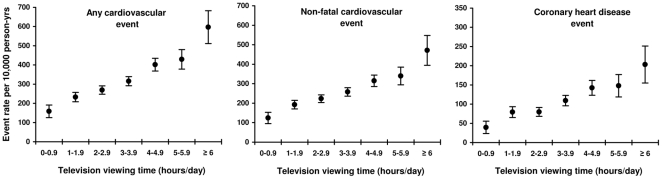
BACKGROUND: Although television viewing time is detrimentally associated with intermediate cardiovascular risk factors, the relationship with incident total (i.e. combined fatal and non-fatal) cardiovascular disease (CVD), non-fatal CVD and coronary heart disease is largely unknown. This study examined whether television viewing time is associated with these three outcomes, independently of physical activity energy expenditure and other confounding variables. METHODOLOGY/PRINCIPAL FINDINGS: A population-based cohort of 12,608 men and women (aged 61.4±9.0), free from stroke, myocardial infarction and cancer at baseline in 1998-2000 were followed up until 2007 (6.9±1.9 years). Participants self-reported education, smoking, alcohol use, antihypertensive, lipid lowering and antidepressant medication, disease history, total energy intake, sleep duration, physical activity and television viewing. BMI, waist circumference, blood pressure, triglycerides, HDL cholesterol and glycated haemoglobin (HbA(1c)) were measured by standardized procedures; a clustered metabolic risk score was constructed. Every one hour/day increase in television viewing was associated with an increased hazard for total (HR = 1.06, 95%CI = 1.03-1.08; 2,620 cases), non-fatal CVD (HR = 1.06, 95%CI = 1.03-1.09; 2,134 cases), and coronary heart disease (HR = 1.08, 95%CI = 1.03-1.13; 940 cases), independent of gender, age, education, smoking, alcohol, medication, diabetes status, CVD family history, sleep duration and physical activity energy expenditure. Energy intake, BMI, waist circumference, blood pressure, triglycerides, HDL cholesterol, HbA(1c) and the clustered metabolic risk score only partially mediated these associations. CONCLUSIONS: These results indicate that the most prevalent leisure time (sedentary) behaviour, television viewing, independently contributes to increased CVD risk. Recommendations on reducing television viewing time should be considered.
Overview
The claims and statistics of this paper haven’t been checked yet.
Run the check — free, no account needed. It reads the open-access text and checks the sources it cites.
Integrity signals
Registry
Cites
Statistics
Figures
Verification
Claims the paper makes
The claims and statistics of this paper haven’t been checked yet.
Run the check — free, no account needed. It reads the open-access text and checks the sources it cites.
Claims other papers make about this one
Each is checked against this paper’s own text: does it say what the citing paper says it does?
The cited source says what the claim attributes to it.
In the citing paper
“The largest gender difference reported by Wijndaele, et al. [16] where 3.7% more females reported levels of >3.6 h TV viewing daily.”
From Prevalence of Sedentary Behavior in Older Adults: A Systematic Review (2013) · cites this paper as [16]
In the citing paper
“Report of TV viewing by gender was less common, the average difference between gender report was 1.8 ± 1.4% [16,17,21,23].”
From Prevalence of Sedentary Behavior in Older Adults: A Systematic Review (2013) · cites this paper as [16]
In the citing paper
“The EPIC survey reported by tertiles and found that 32.5% reported TV viewing over 3.6 h per day [16].”
From Prevalence of Sedentary Behavior in Older Adults: A Systematic Review (2013) · cites this paper as [16]
In the citing paper
“TV viewing has also been well correlated with negative health outcomes, such as cardiovascular disease, mortality and being overweight or obese [16,19,22,30].”
From Prevalence of Sedentary Behavior in Older Adults: A Systematic Review (2013) · cites this paper as [16]
Self-check
Percentages, sums and reported differences re-computed from the paper’s own numbers.
The self-check needs the paper’s full text.
Citations
Cites
Compendium of physical activities: an update of activity codes and MET intensities
AINSWORTH, B. E., HASKELL, W. L., WHITT, M. C., IRWIN, M. L., SWARTZ, A. M., STRATH, S. J., O???BRIEN, W. L., BASSETT, D. R., SCHMITZ, K. H., EMPLAINCOURT, P. O., et al. (2000) · Medicine & Science in Sports & Exercise · doi:10.1097/00005768-200009001-00009 · Cited by 8,497
Amount of Time Spent in Sedentary Behaviors in the United States, 2003-2004
Matthews, C. E., Chen, K. Y., Freedson, P. S., Buchowski, M. S., Beech, B. M., Pate, R. R., & Troiano, R. P. (2008) · American Journal of Epidemiology · doi:10.1093/aje/kwm390 · Cited by 2,631
Hu, F. B., Li, T. Y., Colditz, G. A., Willett, W. C., & Manson, J. E. (2003) · JAMA · doi:10.1001/jama.289.14.1785 · Cited by 1,892
The Effects of Climate Change on Cardiac Health
De Blois, J., Kjellstrom, T., Agewall, S., Ezekowitz, J. A., Armstrong, P. W., & Atar, D. (2015) · Cardiology · doi:10.1159/000398787 · Cited by 1,697
Sitting time and mortality from all causes, cardiovascular disease, and cancer
KATZMARZYK, P. T., CHURCH, T. S., CRAIG, C. L., & BOUCHARD, C. (2009) · Medicine & Science in Sports & Exercise · doi:10.1249/mss.0b013e3181930355 · Cited by 1,611
Walking Compared with Vigorous Exercise for the Prevention of Cardiovascular Events in Women
Manson, J. E., Greenland, P., LaCroix, A. Z., Stefanick, M. L., Mouton, C. P., Oberman, A., Perri, M. G., Sheps, D. S., Pettinger, M. B., & Siscovick, D. S. (2002) · New England Journal of Medicine · doi:10.1056/nejmoa021067 · Cited by 1,349
Priming effects of television food advertising on eating behavior.
Harris, J. L., Bargh, J. A., & Brownell, K. D. (2009) · Health Psychology · doi:10.1037/a0014399 · Cited by 945
Hamilton, M. T., Healy, G. N., Dunstan, D. W., Zderic, T. W., & Owen, N. G. (2008) · Current Cardiovascular Risk Reports · doi:10.1007/s12170-008-0054-8 · Cited by 915
Physical Activity and Television Watching in Relation to Risk for Type 2 Diabetes Mellitus in Men
Hu, F. B., Leitzmann, M. F., Stampfer, M. J., Colditz, G. A., Willett, W. C., & Rimm, E. B. (2001) · Archives of Internal Medicine · doi:10.1001/archinte.161.12.1542 · Cited by 828
Dunstan, D. W., Barr, E. L. M., Healy, G. N., Salmon, J., Shaw, J. E., Balkau, B., Magliano, D. J., Cameron, A. J., Zimmet, P. Z., & Owen, N. (2010) · Circulation · doi:10.1161/circulationaha.109.894824 · Cited by 825
Cited by
Sorted by citations
Biswas, A., Oh, P. I., Faulkner, G. E., Bajaj, R. R., Silver, M. A., Mitchell, M. S., & Alter, D. A. (2015) · Annals of Internal Medicine · doi:10.7326/m14-1651 · Cited by 2,726
Wilmot, E. G., Edwardson, C. L., Achana, F. A., Davies, M. J., Gorely, T., Gray, L. J., Khunti, K., Yates, T., & Biddle, S. J. H. (2012) · Diabetologia · doi:10.1007/s00125-012-2677-z · Cited by 1,789
Patterson, R., McNamara, E., Tainio, M., de Sá, T. H., Smith, A. D., Sharp, S. J., Edwards, P., Woodcock, J., Brage, S., & Wijndaele, K. (2018) · European Journal of Epidemiology · doi:10.1007/s10654-018-0380-1 · Cited by 1,423
Owen, N. G., Sugiyama, T., Eakin, E., Gardiner, P. A., Tremblay, M. S., & Sallis, J. F. (2011) · American Journal of Preventive Medicine · doi:10.1016/j.amepre.2011.05.013 · Cited by 944
Young, D. R., Hivert, M.-F., Alhassan, S., Camhi, S. M., Ferguson, J. F., Katzmarzyk, P. T., Lewis, C. E., Owen, N., Perry, C. K., Siddique, J., et al. (2016) · Circulation · doi:10.1161/cir.0000000000000440 · Cited by 791
Metadata
- Authors
- Wijndaele, K., Brage, S., Besson, H., Khaw, K.-T., Sharp, S. J., Luben, R., Bhaniani, A., Wareham, N. J., & Ekelund, U.
- Affiliations
- Research Foundation - Flanders (BE)
- MRC Epidemiology Unit (GB)
- University of Cambridge (GB)
- Corresponding author
- Ekelund, Ulf
- ORCID
- Venue
- PLoS ONE
- Publisher
- Public Library of Science (PLoS)
- Published
- 2011-05-25
- Volume
- 6
- Issue
- 5
- Pages
- e20058
- ISSN
- 1932-6203 (ISSN-L)
- PMC
- PMC3102066
- OpenAlex
- W2037124155
- Cited by
- 117
- References
- 32
- Citations by year
- 2025: 4 · 2024: 5 · 2023: 10 · 2022: 5 · 2021: 6 · 2020: 4 · 2019: 5 · 2018: 4 · 2017: 4 · 2016: 13 · 2015: 16 · 2014: 10 · 2013: 19 · 2012: 10
- FWCI
- 8.95
- Type
- journal article
- Language
- en
- Open access
- gold
- doi.org
- Locations
- PLoS ONE (publishedVersion, cc-by)
- PubMed Central (publishedVersion, cc-by)
- PubMed (publishedVersion)
- Ghent University Academic Bibliography (Ghent University) (submittedVersion, other-oa)
- DOAJ (DOAJ: Directory of Open Access Journals) (submittedVersion, cc-by-sa)
- Funders
- National Institute for Health and Care Research
- British Heart Foundation
- European Commission
- Medical Research Council
- Topics
- Health Sciences › Medicine › Public Health, Environmental and Occupational Health › Physical Activity and Health
- Health Sciences › Medicine › Cardiology and Cardiovascular Medicine › Cardiovascular Health and Risk Factors
- Health Sciences › Medicine › Public Health, Environmental and Occupational Health › Nutritional Studies and Diet
- Keywords
- television viewing, sedentary behavior, cardiovascular disease, coronary artery disease, incident cardiovascular disease, mediation analysis, metabolic risk score, physical activity, EPIC-Norfolk cohort
- MeSH terms
- Activities of Daily Living, Aged, Cardiovascular Diseases, Coronary Disease, Energy Metabolism, Europe, Female, Humans, Male, Middle Aged, Prospective Studies, Risk Factors, Television, Time Factors, Cohort Studies, Proportional Hazards Models
About these checks
Registry, retraction, Cites and statistics results are computed, not judged, with one exception: a printed reference that no index lists is read once by a model before it counts as a citation error. Claims are extracted by a model and kept only when their quote appears verbatim in the text; each cited source is then checked, with a model’s help, for whether it says what the claim relies on. Those verdicts can be wrong — read the claim’s quote and the cited source before relying on one.
Statistics and arithmetic are recomputed, not judged.
Confidence bands are shown only for fields calibrated on our annotated test set. None is calibrated yet, so no band is shown.
What counts as a claim ›How we measure confidence ›How we check this ›
Are you an author, or do you see a problem with this page? Request a review
