

Caffeine Consumption Prevents Diabetes-Induced Memory Impairment and Synaptotoxicity in the Hippocampus of NONcZNO10/LTJ Mice
Open accessThe DOI matches its Crossref record; 58 of the 58 references it cites were found in a registry or an index.
Abstract
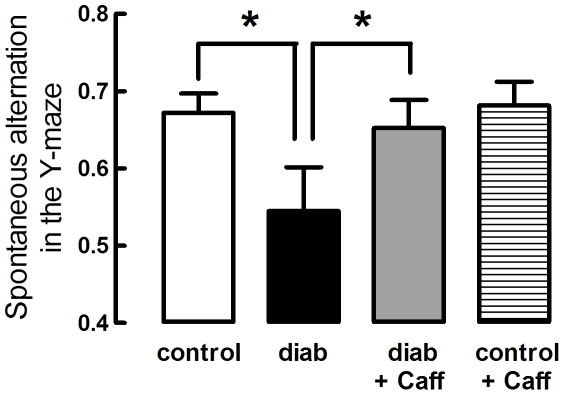
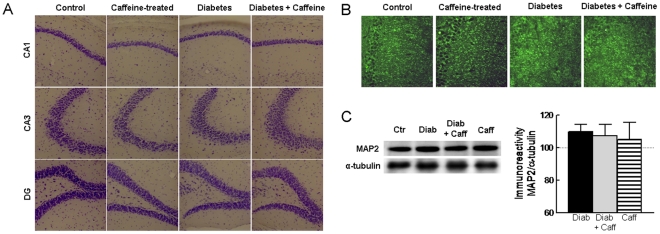
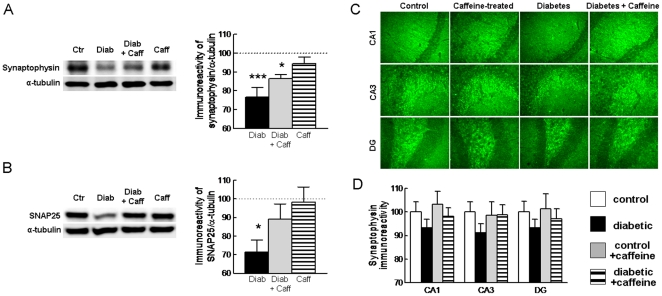
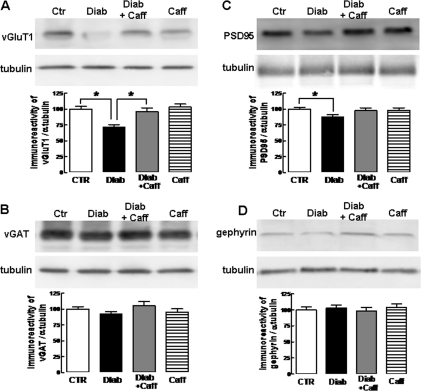
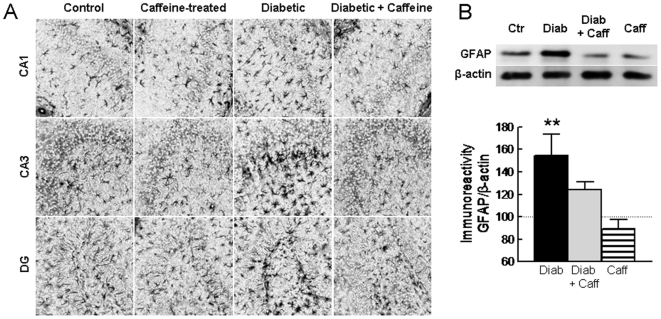
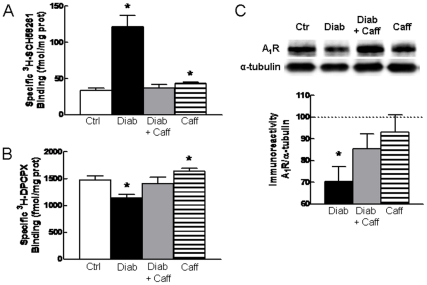
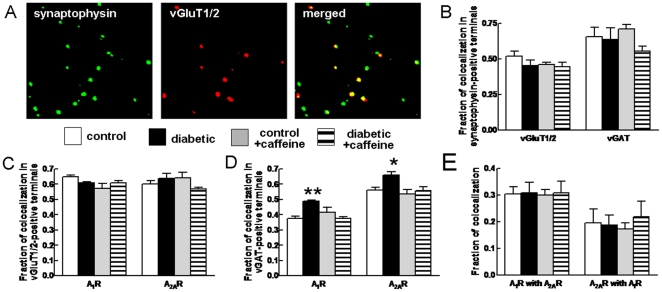
Diabetic conditions are associated with modified brain function, namely with cognitive deficits, through largely undetermined processes. More than understanding the underlying mechanism, it is important to devise novel strategies to alleviate diabetes-induced cognitive deficits. Caffeine (a mixed antagonist of adenosine A(1) and A(2A) receptors) emerges as a promising candidate since caffeine consumption reduces the risk of diabetes and effectively prevents memory deficits caused by different noxious stimuli. Thus, we took advantage of a novel animal model of type 2 diabetes to investigate the behavioural, neurochemical and morphological modifications present in the hippocampus and tested if caffeine consumption might prevent these changes. We used a model closely mimicking the human type 2 diabetes condition, NONcNZO10/LtJ mice, which become diabetic at 7-11 months when kept under an 11% fat diet. Caffeine (1 g/l) was applied in the drinking water from 7 months onwards. Diabetic mice displayed a decreased spontaneous alternation in the Y-maze accompanied by a decreased density of nerve terminal markers (synaptophysin, SNAP25), mainly glutamatergic (vesicular glutamate transporters), and increased astrogliosis (GFAP immunoreactivity) compared to their wild type littermates kept under the same diet. Furthermore, diabetic mice displayed up-regulated A(2A) receptors and down-regulated A(1) receptors in the hippocampus. Caffeine consumption restored memory performance and abrogated the diabetes-induced loss of nerve terminals and astrogliosis. These results provide the first evidence that type 2 diabetic mice display a loss of nerve terminal markers and astrogliosis, which is associated with memory impairment; furthermore, caffeine consumption prevents synaptic dysfunction and astrogliosis as well as memory impairment in type 2 diabetes.
Overview
The claims and statistics of this paper haven’t been checked yet.
Free: it reads the open-access text and checks the first 5 claims that cite a source we can check. Create a free account to check every claim.
Integrity signals
Registry
Cites
Statistics
Figures
Verification
Claims the paper makes
The claims and statistics of this paper haven’t been checked yet.
Free: it reads the open-access text and checks the first 5 claims that cite a source we can check. Create a free account to check every claim.
Claims other papers make about this one
Each is checked against this paper’s own text: does it say what the citing paper says it does?
The cited source says what the claim attributes to it.
In the citing paper
“caffeine consumption could also reduce the loss of glutamatergic nerve terminals in the hippocampus, restoring diabetes-induced memory dysfunction in mice [209].”
From Effects of Coffee and Its Components on the Gastrointestinal Tract and the Brain–Gut Axis (2020) · cites this paper as [209]
Self-check
Percentages, sums and reported differences re-computed from the paper’s own numbers.
The self-check needs the paper’s full text.
Citations
Cites
Astrocyte-Neuron Lactate Transport Is Required for Long-Term Memory Formation
Suzuki, A., Stern, S. A., Bozdagi, O., Huntley, G. W., Walker, R. H., Magistretti, P. J., & Alberini, C. M. (2011) · Cell · doi:10.1016/j.cell.2011.02.018 · Cited by 1,711
Astrocyte activation and reactive gliosis
Pekny, M., & Nilsson, M. (2005) · Glia · doi:10.1002/glia.20207 · Cited by 1,611
Astrocyte Control of Synaptic Transmission and Neurovascular Coupling
Haydon, P. G., & Carmignoto, G. (2006) · Physiological Reviews · doi:10.1152/physrev.00049.2005 · Cited by 1,323
Synaptic alterations in CA1 in mild Alzheimer disease and mild cognitive impairment
Scheff, S. W., Price, D. A., Schmitt, F. A., DeKosky, S. T., & Mufson, E. J. (2007) · Neurology · doi:10.1212/01.wnl.0000260698.46517.8f · Cited by 824
Fredholm, B. B., Chen, J.-F., Cunha, R. A., Svenningsson, P., & Vaugeois, J.-M. (2005) · International Review of Neurobiology · doi:10.1016/s0074-7742(05)63007-3 · Cited by 692
Self-citationCoffee Consumption and Risk of Type 2 Diabetes: A Systematic Review
van Dam, R. M., & Hu, F. B. (2005) · JAMA · doi:10.1001/jama.294.1.97 · Cited by 662
Neuroprotection by adenosine in the brain: From A1 receptor activation to A2A receptor blockade
Cunha, R. A. (2005) · Purinergic Signalling · doi:10.1007/s11302-005-0649-1 · Cited by 537
Self-citationSelective induction of astrocytic gliosis generates deficits in neuronal inhibition
Ortinski, P. I., Dong, J., Mungenast, A., Yue, C., Takano, H., Watson, D. J., Haydon, P. G., & Coulter, D. A. (2010) · Nature Neuroscience · doi:10.1038/nn.2535 · Cited by 495 · cited 1×
“A recent study showed a direct causal relation between reactive astrocytosis and modifications of GABAergic transmission leading to over-excitability in hippocampal tissue, which was argued to have a metabolic basis [53].”
BackgroundHippocampal damage and memory impairments as possible early brain complications of type 2 diabetes
Gold, S. M., Dziobek, I., Sweat, V., Tirsi, A., Rogers, K., Bruehl, H., Tsui, W., Richardson, S., Javier, E., & Convit, A. (2007) · Diabetologia · doi:10.1007/s00125-007-0602-7 · Cited by 489
Arendash, G. W., Schleif, W., Rezai-Zadeh, K., Jackson, E. K., Zacharia, L. C., Cracchiolo, J. R., Shippy, D., & Tan, J. (2006) · Neuroscience · doi:10.1016/j.neuroscience.2006.07.021 · Cited by 457
Cited by
Items 101–130 of 130
Lukesch, H., & Schüller, H. (1989) · University of Regensburg Publication Server (University of Regensburg) · Cited by 15
Chen, Y., Cai, M., Deng, J., Li, T. X., Wang, S., Li, T., Dong, H., & Xiong, L. (2016) · Neurochemical Research · doi:10.1007/s11064-016-1932-y · Cited by 6
Esteca, M. V., Divino, I. A., da Silva, A. L. V., Severino, M. B., Braga, R. R., Ropelle, E. R., Simabuco, F. M., & Baptista, I. L. (2024) · Acta Physiologica · doi:10.1111/apha.14111 · Cited by 8
Bae, J. Y. (2020) · Medicina · doi:10.3390/medicina56070331 · Cited by 7
“To evaluate cognitive function, spontaneous alternation was tested in a Y-maze just before dissection [28].”
MethodGarcía-Serrano, A. M., Skoug, C., Axling, U., Korhonen, E. R., Teixeira, C., Ahrén, I. L., Mukhopadhya, I., Boteva, N., Martin, J. C., Scott, K. P., et al. (2017) · Beneficial Microbes · doi:10.1163/18762891-bja00040 · Cited by 9
Self-citationParaxanthine enhances memory and neuroplasticity more than caffeine in rats
Jäger, R., Sawan, S. A., Orrù, M., Tinsley, G. M., Purpura, M., Wells, S. D., Liao, K., & Godavarthi, A. (2024) · Experimental Brain Research · doi:10.1007/s00221-024-06954-0 · Cited by 8
Skoug, C., Erdogan, H., Vanherle, L., Vieira, J. P. P., Matthes, F., Eliasson, L., Meißner, A., & Duarte, J. M. N. (2023) · Neurochemical Research · doi:10.1007/s11064-023-04033-4 · Cited by 8
“For example, pharmacologically targeting the altered adenosinergic system components confers neuroprotection and improves memory performance in diabetes models [28, 29, 34].”
BackgroundSelf-citationCaffeine affects the neurobehavioral impact of sodium benzoate in adolescent rats
Sabry, F. M., Masoud, M. A., & Georgy, G. S. (2024) · Neuroscience Letters · doi:10.1016/j.neulet.2024.137801 · Cited by 5
Griffith, T. A., Russell, J. S., Naghipour, S., Helman, T. J., Peart, J. N., Stapelberg, N. J. C., Headrick, J. P., & Toit, E. F. D. (2022) · Life Sciences · doi:10.1016/j.lfs.2022.121137 · Cited by 5
Diler, A. S., Ziylan, Y. Z., & Üzüm, G. (2013) · Journal of Caffeine Research · doi:10.1089/jcr.2013.0022 · Cited by 5
“…in particular with regard to the chronic consumption of caffeine, which was reported not to enhance memory performance per se but instead to prevent the deterioration of memory by noxious stimuli such as sleep deprivation, 30 type I 31 or type 2 diabetes, 32 chronic stress, 33 or convulsions.”
Taha, M., Ibrahim, M. M., Eldesoqui, M. B., Iesa, M. A. M., Baokbah, T. A. S., & Sonpol, H. M. A. (2021) · Scientia Pharmaceutica · doi:10.3390/scipharm89030041 · Cited by 5
“Combined treatment of rats with both cinnamon and ginger oil decreases expression of GFAP, which is in agreement with previous studies conducted by [47,48], which proved that the treatment of diabetic rats with ginger improves oxidative stressinduced reactive gliosis.”
ResultCapucho, A. M., Ponce-de-Leão, J., Flôr, K. C., Melo, G. M., Fernandes, M., Sacramento, J. F., & Conde, S. V. (2026) · Pharmacological Research · doi:10.1016/j.phrs.2026.108140 · Cited by 6
de Assis, A. M., da Silva, J. S., Rech, A., Longoni, A., Nonose, Y., Repond, C., Pasquali, M. A. D. B., Moreira, J. C. F., Souza, D. O., & Pellerin, L. (2016) · Frontiers in Neuroscience · doi:10.3389/fnins.2016.00509 · Cited by 6
“Interestingly, recent studies have shown that hippocampal metabolism is affected when glycemia is increased (Mcnay and Recknagel, 2011; Duarte et al., 2012).”
BackgroundFrom Clinical to Basic Research: The Neuroprotective Effects and Mechanisms of Caffeine
Wang, L., & Wang, L. (2025) · Health and Metabolism · doi:10.53941/hm.2025.100008 · Cited by 6
“These findings suggest that caffeine intake can prevent synaptic dysfunction, astrocyte proliferation, and memory impairment in patients with type 2 diabetes [82].”
Lin, J., Liu, H., Yang, J., Gao, Y., Zhao, G., & Lv, C. (2025) · Food Chemistry · doi:10.1016/j.foodchem.2025.144587 · Cited by 2
Marshad, R. A., Khatib, R. A., Amer, H., Shammari, M. A., Otaibi, A. A., Otaibi, F. A., Behbehani, N., Sayed, A. A., Hoty, N. A., Hassan, Z., et al. (2018) · PubMed Central · Cited by 6
Gharib, M. A.-A. (2016) · Pakistan Journal of Nutrition · doi:10.3923/pjn.2016.194.202 · Cited by 2
İNSAN VE HAYVANLARDA DİABETES MELLİTUS
Özmen, Ö., & Topsakal, Ş. (2016) · Mehmet Akif Ersoy Üniversitesi Veteriner Fakültesi Dergisi · doi:10.24880/maeuvfd.260791 · Cited by 1
“Diyabet, açlık hiperglisemisi ile karakterizedir fakat hastalık klinik olarak belirgin olmayan devrelerde glikoz intoleransının olduğu dönemde de teşhis edilebilir (17-19).”
BackgroundFatke, B., & Förstl, H. (2013) · Springer eBooks · doi:10.1007/978-3-642-29908-7_19 · Cited by 1
Adenosine A2A Receptor-Mediated Control of Non-Motor Functions in Parkinson’s Disease
Prediger, R. D., MATHEUS, F. C., de Oliveira, P. A., Rial, D., Moretti, M., Souza, A. C. G., Aguiar, A. S., & Cunha, R. A. (2015) · Current topics in neurotoxicity · doi:10.1007/978-3-319-20273-0_10
Self-citationLeite, M. R. (2012) · LA Referencia (Red Federada de Repositorios Institucionales de Publicaciones Científicas)
Jamali-Raeufy, N., Zeinivand, M., Goudarzi, M., & Haghani, S. (2020) · فصلنامه علوم پزشکی دانشگاه آزاد اسلامی واحد پزشکی تهران · doi:10.29252/iau.30.2.107
Skoug, C., Holm, C., & Duarte, J. M. N. (2021) · bioRxiv (Cold Spring Harbor Laboratory) · doi:10.1101/2021.09.03.458841
Self-citationGarcía-Serrano, A. M., Skoug, C., Axling, U., Korhonen, E. R., Teixeira, C., Ahrén, I. L., Mukhopadhya, I., Boteva, N., Martin, J. C., Scott, K. P., et al. (2023) · bioRxiv (Cold Spring Harbor Laboratory) · doi:10.1101/2023.11.02.564919
Self-citationEffect of Taurine and Caffeine on Spatial Memory in Adult Male Wistar Rats
Owoyele, B. V., Alashi, Y., & Oyewole, A. L. (2017) · NIgerian Journal of Neuroscience · doi:10.47081/njn2017.8.2/002
Melatonin supplementation improves impairment in cognitive function in type 2 diabetes-induced rats
Nwaji, A. R., Oparaji, K. C., Igwe, C. C., Igwe, E. O., Okechukwu, M. P., Esinulo, J. I., Simon, T., & Ogbonna, K. G. (2025) · Pharmacological Research - Reports · doi:10.1016/j.prerep.2025.100055
Sevenoaks, T., & Yeomans, M. R. (2025) · Physiology & Behavior · doi:10.1016/j.appet.2025.108120 · Cited by 1
Caffeine Alleviates Oxidative Damage of Retinal Pigment Epithelium Cells
Liu, H., Zhang, W., Xiong, Y., Yang, M., Long, H., Gong, C., & Li, S. (2025) · Journal of Ophthalmology · doi:10.1155/joph/6121757
Kawaharada, R., Kimura, R., Miyata, E., Noguchi, R., Toriumi, A., & Nakamura, A. (2026) · Nutrients · doi:10.3390/nu18111748
“Furthermore, abnormalities in the insulin signaling pathways and alterations in synapse-related proteins have been reported, indicating that the fetal metabolic environment may influence neural function [15,16].”
Liy-Salmerón, G., & Azrad, S. (2014) · Elsevier eBooks · doi:10.1016/b978-0-12-408139-0.00010-9
Metadata
- Authors
- Duarte, J. M. N., Agostinho, P. M., Carvalho, R. A., & Cunha, R. A.
- Affiliations
- Centro de Neurociências e Biologia Celular (PT)
- Corresponding author
- Cunha, Rodrigo A.
- Venue
- PLoS ONE
- Publisher
- Public Library of Science (PLoS)
- Published
- 2012-04-13
- Volume
- 7
- Issue
- 4
- Pages
- e21899
- ISSN
- 1932-6203 (ISSN-L)
- PMC
- PMC3326010
- OpenAlex
- W2070016881
- Cited by
- 130
- References
- 58
- Citations by year
- 2026: 3 · 2025: 5 · 2024: 10 · 2023: 8 · 2022: 6 · 2021: 11 · 2020: 7 · 2019: 8 · 2018: 15 · 2017: 7 · 2016: 17 · 2015: 9 · 2014: 11 · 2013: 8 · 2012: 4
- FWCI
- 7.51
- Type
- journal article
- Language
- en
- Open access
- gold
- doi.org
- Locations
- PLoS ONE (publishedVersion, cc-by)
- Europe PMC (PubMed Central) (publishedVersion, cc-by)
- PubMed Central (publishedVersion, cc-by)
- PubMed (publishedVersion)
- DOAJ (DOAJ: Directory of Open Access Journals) (submittedVersion)
- Portuguese National Funding Agency for Science, Research and Technology (RCAAP Project by FCT) (submittedVersion, cc-by)
- Lund University Publications (Lund University) (submittedVersion)
- Topics
- Health Sciences › Medicine › Pharmacology (medical) › Coffee research and impacts
- Life Sciences › Neuroscience › Cellular and Molecular Neuroscience › Neuroscience and Neuropharmacology Research
- Life Sciences › Neuroscience › Cellular and Molecular Neuroscience › Alzheimer's disease research and treatments
- Keywords
- caffeine, type 2 diabetes, memory impairment, hippocampus, synaptotoxicity, adenosine A1 receptor, adenosine A2A receptor, astrocyte activation, synaptophysin, SNAP-25, vesicular glutamate transporter, spontaneous alternation, cognitive impairment
- MeSH terms
- Animals, Caffeine, Diabetes Mellitus, Experimental, Hippocampus, Immunohistochemistry, Insulin, Male, Memory Disorders, Blotting, Western, Mice
About these checks
Registry, retraction, Cites and statistics results are computed, not judged, with one exception: a printed reference that no index lists is read once by a model before it counts as a citation error. Claims are extracted by a model and kept only when their quote appears verbatim in the text; each cited source is then checked, with a model’s help, for whether it says what the claim relies on. Those verdicts can be wrong — read the claim’s quote and the cited source before relying on one.
Statistics and arithmetic are recomputed, not judged.
Confidence bands are shown only for fields calibrated on our annotated test set. None is calibrated yet, so no band is shown.
What counts as a claim ›How we measure confidence ›How we check this ›
Are you an author, or do you see a problem with this page? Request a review
Data sources
Bibliographic data: Semantic Scholar, OpenAlex, Crossref.
Contains information from the Semantic Scholar Academic Graph Datasets, made available under the ODC Attribution License (ODC-BY 1.0).
Semantic Scholar’s data is described in: Kinney, R., et al. (2023). The Semantic Scholar Open Data Platform. arXiv:2301.10140.
